
Kawa: Rediscovering Indigeneity in China via Reggae
DOI: https://doi.org/10.59350/ee2cd-52z32
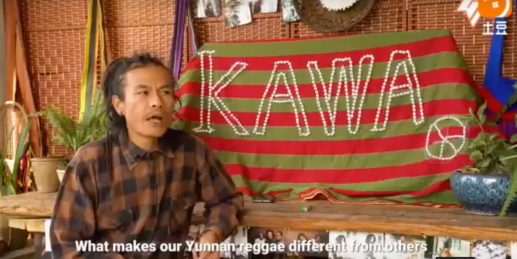
Kawa is a reggae group from Yunnan’s Ximeng, an autonomous county for the Wa people in the southwest of China, bordering Myanmar. When I learned about Kawa’s story in 2016, I was first intrigued by the geographical similarities between Yunnan and Jamaica: both regions are characterized by tropical climates, lush vegetations, and perhaps most prominently, proximities to marijuana plantations. Outsiders often associate the musical style of reggae with a stereotypical “laidback” lifestyle projected onto these locales. Known as “Yunnan Reggae,” Kawa’s music indeed exhibits some of the most characteristic elements of reggae music—slower tempos, remixed vocals, and repetitive chords falling on the offbeat.
“Yunnan Reggae”–Kawa
Recently I realized this climate connection was simplistic and reductive, and what I failed to grasp in Kawa’s music was far more important—a notion of indigeneity manifested through reggae’s generic elements. In Steven Feld’s “From Schizophonia to Schismogenesis: The Discourses and Practices of World Music and World Beat” in 1995, he noted the affinity of many indigenous cultures for reggae music. “Its [reggae] perception by indigenous peoples outside the Caribbean as an oppositional roots ethnopop form has led to its local adoption by migrants and indigenes in places as diverse as Europe, Hawaii, Native North America, Aboriginal Australia, Papua New Guinea, South Africa, and Southeast Asia” (110). In the 1970s, “roots” reggae translated the everyday lives of Jamaicans as well as their Rastafarian spirituality into a stark resistance to racial oppression, economic inequality, and colonial capitalism that they had experienced in history. The music was deeply embedded in the Jamaican culture. Around the same time, however, engineers and producers in Jamaica–many of them Chinese and Chinese-Jamaican–began to experiment with remixing reggae songs, contributing to an adaptive style of pop music as well as its international popularity. Therefore, against the global market force for “a world music,” reggae was quickly adopted to preserve indigenous cultures, remixing a wide range of ethnomusical elements.
But note that Feld’s list did not include East Asia. In fact, indigeneity as a discourse has been largely absent in this region. Taiwan is perhaps the only exception, where the Austronesian peoples have claimed their indigenous status and political rights. Japan and the Koreas are often considered as the most ethnically homogeneous countries in the world. And China, while officially acknowledging its ethnic diversity, never thought its internal migration of the Han majority as a potential threat to its ethnic minorities and indigenous cultures. I grew up in the southwest of China in the 1990s, when the internal migration of ethnic groups was already a norm. I could not remember if “indigeneity” meant anything even remotely political. I could not remember if the cultural traditions of ethnic minorities were meant to be tied up to the land on which they are/were practiced. What I do remember is that there are regions where the ethnic minorities concentrate and in which they integrate.
This post examines how the Chinese reggae group Kawa introduces an indigenous discourse through the sonic elements of reggae. In their performances, Lao Han often opens with a statement about being an indigenous ethnic minority. Most members of the group have non-Han Chinese backgrounds—Wa, Hani, Aini, and Hui. And even the name Kawa refers to the Wa people in their own language.
Kawa always find the most innovative ways to incorporate ethnic elements into their interpretations of the genre. In “Yunnan Reggae,” for example, sampled vocals from Wa people, lyrics written in Wa language, and traditional Wa instrumentation all work together to portray living cultural traditions closely associated with the Wa ethnic identity. However, it is the intimacy with the land Kawa expresses in their music that foregrounds their indigenous sentiments.
Although the entirety of the lyrics consists of two lines, the song “Red Hair Tree” reveals an indigenous life dwelling on the land—in its neighborhood, locality, and proximity.
Such a huge red hair tree
Hitting the wooden drum sounding dong dong
“Red Hair Tree” resembles a labor song narrating the mundane activities of logging and drum crafting. The first line describes the tree’s size, invoking a reverence for its sublimity. The glistening red color contributes to the plant’s vibrant animacies. As Ai Yong explains, “If you have chatted with the elders on the A Wa Mountains about this land, you will see an extraordinary beam of light glistening in their eyes, carrying endless assurance and reverence” (translated by Meng Ren). The second line translates that reverence into a more intimate whispering. Due to the Wa people’s animist beliefs, the red hair tree’s spirit is reincarnated in the wooden drum. The “dong dong” sound then embodies an invocation of the natural spirits. “The Wa ancestors believe, where there is the red hair tree, there is god’s blessing. In the past, the tall and robust red hair trees surrounded all Wa villages.” As Ai Yong continues to explain, the natural spirits are called for protection in exchange for the people’s worship.
“Red Hair Tree” is not the first time when reggae prompted the Han Chinese to confront questions about migration and indigeneity, however. It is often forgotten that the Chinese diaspora in Jamaica contributed to the development of reggae. Stephen Cheng’s “Always Together (A Chinese Love Song)” in 1967 is a rare yet symptomatic example of how the Chinese imagined indigeneity through remixing reggae.
Despite its obvious rocksteady overtone, the song combines a wide range of Chinese elements. It opens with a pronounced bass line coupled by the guitar and then the accented drum beat. Although this rhythmic beat is reminiscent of typical reggae songs, the music flow is somehow disrupted by the sudden appearance of the male vocal. Stephen Cheng sings in Mandarin. His chest voice meanders across a wide range, registering a sonority that is more often heard in Chinese opera than in reggae songs (or pop music in general). His delivery accentuates on the extended vowels, exaggerating the dramatic ups and downs of the tonal language—Mandarin Chinese. In fact, the music is adapted from a well-known Taiwanese folk song “Green is the Mountain (Gao Shan Qing).” On the surface, it is a romantic love story. It depicts the scenic landscape of the mountains and waters of Alishan, which the Taiwanese indigenous Tsou people traditionally inhabit. Through a metaphorical parallel, the romantic love between a young Tsou couple is embodied in the companionship between the mountain and the water, which resonates with its English title “Always Together.”
Indeed, “Green is the Mountain” was written by the Han Chinese who fled to Taiwan during the Chinese Civil War, and it is often criticized for romanticizing the experience of the indigenous peoples who were forced to move into the mountain. When the song is rendered into reggae by Cheng, however, it re-contextualizes this imagined indigeneity as a diasporic yearning to restore the lost connections between land and culture. “Always Together” was produced by Byron Lee, a Chinese-Jamaican who founded the renowned ska band Byron Lee and the Dragonaires. As record producers, sound system owners, or band managers, numerous Chinese-Jamaicans like Lee contributed “Chinese elements” to reggae during its formative years. In return, reggae carries on the tradition of cultural remix, always opening itself up to local adaptions.
Reggae has always been an eclectic music form. As we have seen, both examples combine a wide range of musical elements from different cultures—from ethnic minorities in China to Chinese and African diaspora in Jamaica. Despite almost a half century apart, the two reggae songs foreground a discourse on indigeneity that is shaped by the migration of people and the mixing of culture. Despite the most generic “pop” elements, the local adoption of reggae reveals an attempt to comprehend the relationship between ethnic identity, cultural practice, and the land. Understood in this way, Kawa’s reggae music becomes an important voice in understanding ethnic differences and indigeneity in today’s China.
—
Featured Image: Screen Shot from “Kawa: Chinese Yunnan Reggae Band”
—
Junting Huang is a Ph.D. Candidate in the Department of Comparative Literature at Cornell University. His research areas include literary studies, film/media studies, and sound studies. His dissertation project “The Noise Decade: Intermedial Impulse in Chinese Sound Recording” examines the figure of noise in contemporary Chinese literature and new media art. It analyzes how noise is conceptualized through the recorded sound as a materializing force that indexes the shifting social relations in the 1990s.
—

REWIND! . . .If you liked this post, you may also dig:
Decolonizing the Radio: Africa Abroad in the Age of Independence– Samantha Pinto
“Everyone I listen to, fake patois…”– Osvaldo Oyola
Radio de Acción: Violent Circuits, Contentious Voices: Caribbean Radio Histories–Alejandra Bronfman
—
Share this:

Femmes Fucking the Camera: Listening to the Sonics of Boudoir Photography

DOI: https://doi.org/10.59350/fwt1n-gav19
Pictured above are Raven Von Scrumptious (right) an Sepia Jewel (left), two burlesque dancers from San Diego, California. Raven and Sepia started “eye fucking” in burlesque classes with Coco L’Amour and later they transferred these gestures to the photo studio and the stage, gestures that as Juana Maria Rodriguez notes, “dance, flirt and fuck” (2014). “Eye fucking” is transmitting tease, a play with your audience that is coquettish. Eye fucking entails going beyond the gaze of the audience into a realm where you meet your inner erotic, your inner gaze. Eye fucking creates arousal, homosociality, agency, femme desire, confidence, and a queer space with a lot of glitter. As Smiley LaRose—the name I chose to take on as my student burlesque name—I have learned to “fuck the camera lens” from these two women and the burlesque community in San Diego, who encourage me to embrace what Celine Parreñas Shimizu calls “productive perversity.”
In this post, I reflect on the sonic intimacies between burlesque and boudoir photography. I am sharing part of a larger film project titled #GlitterBabes, where I tell a story of how burlesque as a recreational practice empowers women to engage their sensual selves. The film came about when I signed up for a Soloist Workshop and my burlesque stage persona Smiley LaRose was born. I tell this story through Glitter Tribe Studio, the first studio dedicated to the art of burlesque in San Diego.
In fact, both the dance and photography studios I write about here have an intimate relationship. The film starts with Smiley’s curiosity about how her classmates and teachers engaged the art of tease and navigated all the different aspects of it. As a fat performer, I was particularly interested in the way that my burlesque sisters and myself would navigate topics of body confidence, sensuality and stripping. As it turned out, these practices require a practice of listening to the details of our bodies and its engagement with musicality, the rhythm of our tease(s), and our awareness for how the camera can capture our corporeal erotic wavelengths both on and off stage.
In other words, I engage in ‘dirty listening’ to describe the sonics of boudoir photography and the erotic sounds that go into capturing sensuality in its most intimate ways. In their qualitative study of erotic photographers, Wentland and Muise found that in order to have a successful shoot it was crucial to create “relaxing and comfortable” spaces for femmes. A common practice among the photographers was to have “constant dialogue with their clients, both at the beginning and during the photo shoot, in order to help their clients relax.” They allowed femmes to have control over the shoot and explained every step along the way. In fact, as photo shoots progressed, several clients “requested shots that were more revealing than what they had initially discussed” (106). The findings by Wentland and Muise share many commonalities with the way photographers in San Diego also engage the practice of Boudoir, particularly the understanding that agency is experienced along a continuum and photographers support their clients by accommodating different techniques that can silence their negative self-talk.
At Bad Kitty Photography, where both Raven and Sepia had their shoots, a layer enabling femmes to get into an affective state of sensual comfort is music. To prepare for shoots, Bad Kitty asks their clients to think about their favorite music to set the mood. On their website, they list creating a music playlist as a recommendation to prepare for the shoot. This recommendation intrigued me and aroused an intellectual sonic orgasm. As a scholar of music, sound, and sexuality, their suggestion reminded me of a post by Robin James, where she argues that “we can understand the physical pleasures of listening to music, music making, and music performance as kinds of sexual pleasure.” In Modernity’s Ear: Listening to Race and Gender in World Music, Roshanak Khesti has described the erotic aspects of aurality, and has described the ear, as an ‘invaginated organ’ that penetrates the body with pleasure-in-listening. Here, music is consumed in a femme-centered space to get the model and its photographer to a state of intoxicating perversity.
Beyond the music recommendation, the photographer who worked with me also used sonic techniques to help me get relaxed and comfortable. Ashley Rae, aka “My Bomb Ass photographer,” no longer works at Bad Kitty, but her impact there particularly with other women of color clients is remembered. While we were choosing my outfits, I shared with Ashley, how nervous I was about not being able to make sexy faces. She looked at me and said, “It’s easy! All you have to do is pronounce ‘juice.’” She later asked me to look at the mirror while I practiced. The trick in the exercise was how slow I said “juice” the slowness and softness or my pronunciation created a shape in my lips that unconsciously also influenced the way my eyes moved. After juice she told me to pronounce “prune.” Ppppp-rrrr-uuuuuuu-nnnnnn—ee.
I look at my photos and I see the effect it created. “vocal utterances function as another kind of embodied gesture – opening the mouth and projecting sounds, words, and breath imprinted by the unique physical qualities of our inhabited bodily instruments,” as she points out in Sexual Futures, Queer Gestures, and other Latina Longings (124).


Rodriguez asks, “what happens when I talk dirty to you? How does the address of speech transform the performative gesture of its utterance?” (125). Dirty talk– how my photographer engaged me in dialogue – contributed to my afloje (looseness) as the shoot progressed. The address of her speech, along with her gestures, made me get lost in her camera. Witnessing the way she touched herself–and the way she wanted me to touch my body–formed a collective vision of sensuality, one where all femmes of color could feel like goddesses. It was her dirty talk, the tone of her voice, and the power of her Black Femme gaze that helped me get there. Following Audre Lorde’s vision for the power of the erotics, we imaged a different world with her camera, a world where femmes eye fuck each other, and for each other, constantly displacing the male gaze. Her foreplay allowed me to listen to how my Eyes Talked, My Eyes Teased, My Eyes Fucked.
Beyond the shoot, the boudoir photos that she took of me would capture forever the fat perversity that she inspired in me. The energy we created inside that studio lingers in my skin. I remember her dirty talk and when we pose, my friends who have also gone through her spell also say, “give me more bootyhole” Like that, my remix yells “si, metete con mi Cucu!”

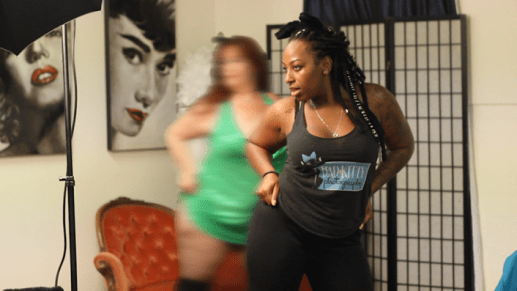

As a fat student of burlesque, my dirty talk, my dirty listening, is inspired by other women of color, fat performers, and porn stars. I gaze upon them for inspiration, guidance on eye fucking, and poses. On March 9, 2018, I participated in the second annual Plus Size Art Show at Meseeka Art studio in San Diego, California. I submitted 20 pieces of boudoir photography to the show that celebrated the bodies of five women of color plus-size burlesque performers from San Diego. They included Buttah Love, Raven VonScrumptious, Lucy May, Sepia Jewel and Smiley LaRose. The other art pieces in the show also centered fat perversity by presenting women in shibari, bikinis, nude, and boudoir.

The all-women DJ collective Chulita Vinyl Club de San Diego played at the show while people danced, drank, and viewed the live fat artwork in formation. Listening to the charlas in the room, you could hear fat women share the power they felt from seeing other fat women feeling sexy. One of the participants approached Sepia and Smiley to ask us if we were also exhibited in the artwork. We both pointed at our images, celebrating each other by complementing our sexy poses. She told us that it was her first time ever taking photos in lingerie, and that playing with the shoot was empowering. We both agreed, because as burlesque dancers and students, stripping to nakedness has had multiple effects on the way we viewed our bodies, and their sensuality. Can you listen to how we use boudoir, erotic art and burlesque to create a visual archive of fat-sex-positivity?
Although Raven was not able to attend the opening of the show, she saw it through Buttah’s Instagram story. When I texted Raven, she told me she almost cried from seeing her photos framed on the wall. Raven was art, a fat femme was art. But even though she was not there, her photos transmitted energy and a fat perversity: her fat eyes talked, her fat eyes teased, her fat eyes fucked us.

Prrruuuuuu-nnnnnnneeeeee
We moan.
—
All images courtesy of the author.
—
Yessica Garcia Hernandez is a doctoral candidate and filmmaker in the Department of Ethnic Studies at the University of California San Diego. Her scholarship bridges fan studies, sound studies, women of color feminisms, fat studies, girl studies, and sexuality/porn studies to think about intergenerational fans of Mexican regional music. Yessica earned her B.A. in Chicanx Studies from University of California, Riverside and an M.A. in Chicanx and Latinx Studies at California State University Los Angeles. She has published in the Journal of Popular Music, New American Notes Online, Imagining America, Journal of Ethnomusicology, and the Chicana/Latina Studies Journal. Her dissertation entitled, “Boobs and Booze: Jenni Rivera, the Erotics of Transnational Fandom, and Sonic Pedagogies” examines the ways in which Jenni Rivera fans reimagine age, gender, sexuality, motherhood, and class by listening to her music, engaging in fandom, and participating in web communities. She explores the social element of their gatherings, both inside and outside the concert space, and probe how these moments foreground transmissions of Latina power. Yessica’s broader research interests includes paisa party crews, Banda Sinaloense, Contestaciones, and Gordibuena/BBW erotics. She is a co-founder and member of the Rebel Quinceañera Collective, a project that utilizes art, music, photography, creative writing, filmmaking, and charlas to activate spaces for self-expression and radical education by and for youth of color in San Diego.
—
REWIND!…If you liked this post, check out:
Unapologetic Paisa Chingona-ness: Listening to Fans’ Sonic Identities–Yessica Garcia Hernandez
Freedom Back: Sounding Black Feminist History, Courtesy the Artists– Tavia Nyong’o
Mediated Sexuality in ASMR Videos–Emma Leigh Waldron
—
Share this:




Current Top Posts




April 2021

January 2020

November 2019

October 2019

August 2019

April 2014

November 2017
March 2015

December 2017

October 2015


Recent Comments