
Straight Outta Compton . . .Via New York

DOI: https://doi.org/10.59350/440bb-mrr46
Sounding Race in Rap Songs explores the production of musical identity in hip hop’s first two decades as a commercial genre. Although I don’t ignore lyrics or visual imagery, my main purpose is to analyze rap music as music, to understand how specific artistic decisions contribute to racial meaning in particular songs. My methods revolve around the study of how producers manipulate breakbeats, also commonly known as “breaks.” Initially understood as short, percussion-heavy passages that appear in many songs recorded in the 1960s and 1970s, breaks have been central to hip hop from the music’s earliest days in the South Bronx when DJs began isolating and looping them on their turntables to the delight of dancers. Since then, producers have tried out new approaches to working with breakbeats: hiring studio musicians to re-record them; programming drum machines to imitate them; and using sampling-sequencing technology to capture and rearrange them.
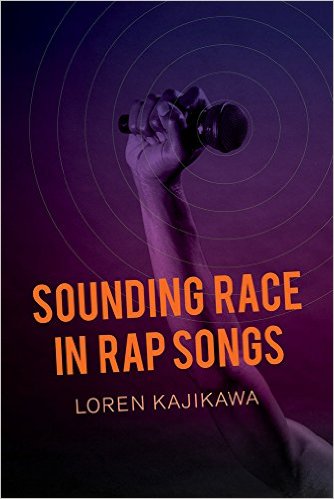
Throughout the book, I describe how producers use breaks and give rise to musical-racial codes that can be manipulated to project a variety of identities and attitudes. The following excerpt from the third chapter of Sounding Race, explains how the style of beat making popularized by the New York-based Bomb Squad (Public Enemy’s production team) provided a blueprint for pioneering west coast gangsta rap group N.W.A’s depiction of Compton, California. By layering multiple loops into a dense, cacophonous mix, N.W.A transposed Public Enemy’s “too black, too strong” sound onto the world of Los Angeles’s postindustrial streets.
N.W.A and its former members have been in the news recently thanks to the biopic Straight Outta Compton. Yet one aspect of the group’s development downplayed in the film is the way that its members formulated their identities in relation to east coast rap. In the mid-1980s, New York was the undisputed center of the industry, and its influence on L.A.-based acts is easy to see and hear. Ice Cube’s first group C.I.A. ( Cru’ In Action) used a nasal, hocket style approach to rapping cribbed directly from the Beastie Boys 1986 album License to Ill. And the cover of N.W.A’s first album N.W.A and the Posse, features numerous group members posing with the giant clock necklaces made famous by Public Enemy’s Flavor Flav. In similar fashion, the beat Dr. Dre produced for “Straight Outta Compton” (the title track to their breakout 1988 album) followed the Bomb Squad’s potent formula for signifying militant blackness. —Loren Kajikawa
—
The following is an excerpt from Chapter Three “‘Let Me Ride’: Gangsta Rap’s Drive Into The Popular Mainstream,” of Loren’s Kajikawa’s Sounding Race in Rap Songs, with thanks to The University of California Press. Any notes have been included in the text to conform to Sounding Out!‘s style sheet.
We [Public Enemy] were in Vegas and they [N.W.A.] were on tour with us, and I had just got the vinyl in. That’s what this is all about. Because Run-DMC and LL Cool J gave me energy. And if our energy happened to be transferred to N.W.A., then that’s what this whole thing is for.” Chuck D as quoted in Brian Coleman, Check The Technique: Liner Notes For Hip-Hop Junkies (New York: Villard Books, 2007), 354.
According to Chuck D, Public Enemy’s musical style directly influenced Dre, and he recalls giving the first two copies of It Takes a Nation of Millions To Hold Us Back to Dr. Dre and Eazy-E prior to the album’s official release. The recorded evidence supports Chuck D’s recollection. For many of the tracks on Straight Outta Compton, Dr. Dre seems to have borrowed from the “loops on top of loops” style of Public Enemy’s Bomb Squad.
In fact, when Ice Cube left N.W.A. in 1989, he hoped that Dre would continue to make beats for his solo project. When this proved impossible due to Dre’s contractual obligations to N.W.A., Ice Cube began collaborating with the Public Enemy’s Bomb Squad, which served as the production unit for his album Amerikkka’s Most Wanted (1990). N.W.A.’s breakthrough was finding a way to put a distinctive spin on these influences, and the artistic strategy that they arrived at for their first Ruthless Records release was designed to put themselves on the map—both literally and figuratively.
Rather than shout out the multiplicity of neighborhoods where their members were actually from (as they had done in “Panic Zone”), N.W.A. chose to center their identity around Dr. Dre and Eazy-E’s hometown of Compton, California. The sound of Compton as Dr. Dre imagined it, however, drew on musical practices and artistic decisions similar to those found in Public Enemy’s “Rebel Without a Pause.” To construct the rhythmic foundation of “Straight Outta Compton,” Dre looped the breakbeat from The Winstons’ “Amen Brother” (1969), one of the most sampled beats in hip hop, that also served as the foundation for dozens of songs in the UK’s “jungle” (aka “drum and bass”) genre.

Like other heavily sampled breaks from this era, the one-measure loop features a syncopated interlocking of snare and bass hits that is reminiscent of James Brown’s “Funky Drummer (featuring Clyde Stubblefield’s famous beat). As if he were following the Bomb Squad’s exact formula, Dr. Dre layered a drum machine (Roland TR-808) over this break.

The 808 was programmed to add its characteristic bass boom to the first two drum kicks of the “Amen” loop, and to tick off a 16-count hi-hat pulse with a closing hi-hat clasp on the downbeat of every other measure. The “Amen” break and the two hi-hat parts, provide the rhythmic foundation around which Dr. Dre places numerous other repeating sounds. Two other ingredients stand out in this beat: a guitar ostinato and a low drone on what sounds like a baritone sax or trombone (or perhaps a downwardly pitched sample of another instrument). The guitar ostinato, which plays straight eighth-notes on E-flat except for a one step descent to D-flat on the “and” of every fourth beat, churns out tight 1-measure units of sound.

The horn drone (also on E-flat) has a raw, muddled quality, and casts an ominous cloud over the track.
By combining these layers with the dense percussion track, Dre created a tightly packed funk groove with many sonic similarities to Public Enemy’s Bomb Squad. Like “Rebel Without a Pause,” the track to “Straight Outta Compton” features tight 1-measure loops stacked on top of one another to create a thick and intense groove.

Except for the drone, most of the elements in the track have a punchy feel, full of rhythmic stabs and staccato attacks, including the automatic gunfire that Dre samples to follow Ice Cube’s reference to an AK-47 assault rifle. Due to the “noisiness” of the beat, the way sonic space seems filled to maximum capacity, the members of N.W.A.—similar to Public Enemy’s Chuck D and Flavor Flav—practically yell their verses, as if they must raise their voices in order to be heard over the cacophony. Even before the actual words to “Straight Outta Compton” are digested, the sound of the track and the group’s vocals evoke the palpable tension of imminent conflict, which reinforces the theme of violent confrontation in the song’s lyrics. For the chorus of “Straight Outta Compton,” Dr. Dre strings together a series of samples with rapid-fire precision. The sound of screeching car tires from Davy DMX’s “One for the Treble” is followed by turntable scratching; the scratching leads directly to a choppy sample of the words “City of Compton” from Ronnie Hudson’s “Westcoast Poplock,” which is then followed by more scratching. The whole chain of musical events is deployed over the breakbeat from Funkadelic’s “You’ll Like It Too,” which Dr. Dre splices into the beat just for the chorus. The rapid cutting from one sample to the next exemplifies the “rupture” Tricia Rose identifies as fundamental to hip hop’s post-industrial aesthetic in Black Noise: Rap Music and Black Culture in Contemporary America (39).
Thus, the music and lyrics for “Straight Outta Compton” depict the city as a place of extremes, where things happen fast and change is sudden and complete. It is a place where one is either equipped to deal or left behind. In this way, Dr. Dre exploited the spatial characteristics encoded in Public Enemy’s music to depict Compton as place. The sonic characteristics that animated Public Enemy’s militant blackness were rerouted and effectively transposed onto N.W.A.’s depiction of Los Angeles gangstas.
—
Loren Kajikawa has served on the faculty at the University of Oregon’s School of Music and Dance since 2009. His main area of research and teaching is American music of the twentieth and twenty-first centuries, and he offers a variety of courses in music history, ethnomusicology, and musicology. Kajikawa’s writings have appeared in American Music, Black Music Research Journal, ECHO: a music-centered journal, Journal of the Society for American Music,and Popular Music and Society, among others. His recent book Sounding Race in Rap Songs (University of California, 2015) explores the relationship between rap music’s backing tracks and racial representation.
—

REWIND! . . .If you liked this post, you may also dig:
“‘I’m on my New York s**t’: Jean Grae’s Sonic Claims on the City”––Liana Silva
Love and Hip Hop: (Re)Gendering The Debate Over Hip Hop Studies–Travis Gosa
Caterpillars and Concrete Roses in a Mad City: Kendrick Lamar’s “Mortal Man” Interview with Tupac Shakur–Regina Bradley
—
Share this:

Caterpillars and Concrete Roses in a Mad City: Kendrick Lamar’s “Mortal Man” Interview with Tupac Shakur
DOI: https://doi.org/10.59350/z7nsx-2w210
I’ve been hesitant to write about Kendrick Lamar’s 2015 album To Pimp a Butterfly (TPAB) because there are layers to the shit. Sonic, cultural, and political layers that need time to breathe and manifest. Some of those layers are pedagogical. For example, Brian Mooney brilliantly paired the album with Toni Morrison’s The Bluest Eye to help students work through themes of Black consciousness and self-love. Mooney’s lesson plan garnered Lamar’s attention and a recent visit with Mooney students. Lamar’s open grappling with art and blackness throw him into heavy debates about his worth as a cultural and even literary icon. Yet Lamar’s formula of introspective angst – the use of battling his own demons to shed light on broader American society – pulls me to think about how Lamar and TPAB fit into a long standing trajectory of Black folks’ self-examination in art as a frame for larger critiques of racial politics in American society.
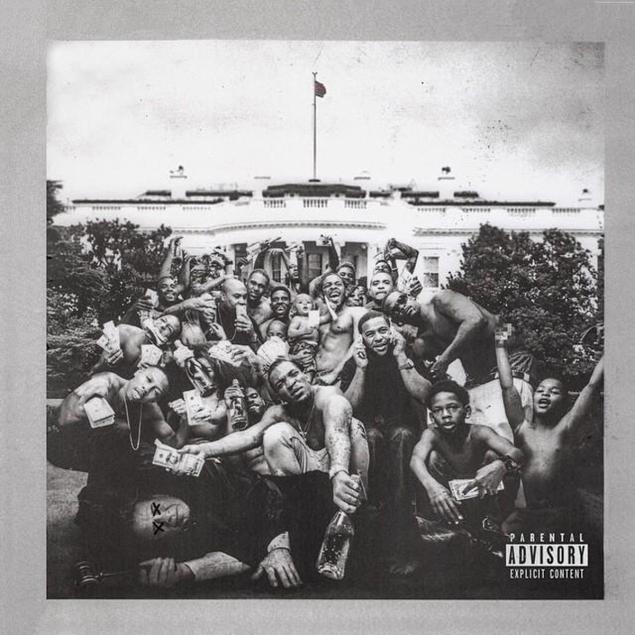
I’m drawn to TPAB’s outro of the final track of the album “Mortal Man.” “Mortal Man” sonically invokes Lamar’s struggle to assume a position as a gatekeeper of a branch of hip hop that focuses on Black community and self-actualization. The track includes a sample from a 1994 Tupac Shakur interview with Swedish music journalist Mats Nileskär. Lamar positions himself as the interviewer, asking a different set of questions that engages Shakur about walking the fault lines of fame, fortune, and Black consciousness in this current cycle of hip hop. The construction and execution of the interview revisits the lines between hip hop’s collective and generational responsibilities via Lamar and Shakur’s interaction. Their conversation moves from creative (and creating) political protest to larger philosophical questions within hip hop: self-consciousness, mortality, and death. Lamar parallels his angst with Tupac using his voice, with Tupac himself heralded as hip hop’s martyred t.h.u.g. with a conscience. In this contemporary moment where Black men’s mortality and worth is attached to being a thug and a problem, Lamar poses Shakur in “Mortal Man” as a keystone for connecting popular scripts with cultural expectations of Black masculinity and agency in the United States.
The song “Mortal Man” launches the interview. The track can be considered a double sample – it uses Houston Person’s cover of Fela Kuti’s song “I No Get Eye for Back.” Lamar’s voice is clear but the background track soft and subdued, forcing the listener to pay full attention to Lamar’s voice, which interrogates what it takes for one to be loyal or respected in mainstream America. Percussion (bass kicks, acoustic drums, soft piano chords) and bass guitar chords annotate Lamar’s solemn lyrical delivery. A horn and woodwind medley – lead by Houston’s tenor sax playing – punctuate Lamar’s chorus:
When the shit hit the fan, is you still a fan?
When the shit his the fan, is you still a fan?
Want you to look to your left and right, make sure you ask your friends
The instrumental accompaniment is soft and steady, suggesting Lamar’s question is a continuous negotiation or checklist for one’s proclamation of loyalty and respect. Lamar’s repetition of “when the shit hit the fan is you still a fan” addresses his fanbase and the followers of other notable Black cultural and creative leaders. They, like Lamar, are usefully flawed – whether by accusation or self-proclamation – and use their flaws to further their cause. Nelson Mandela, Martin Luther King, Moses, Malcolm X, and Michael Jackson all exhibited social-cultural and political agency for (Black) folks. Yet they also suffered scrutiny and disregard because of their personal lives or less-than-respectable experiences.

I am especially intrigued by Lamar’s reference to Malcolm X as “Detroit Red,” a nickname X had as a young hellraiser before his conversion to Islam. Lamar’s reference to X in his youth here speaks to larger questions of respectability, Black youth, and protest. Detroit Red is young, flawed but influential, similar to Lamar and other young Black folks leading protests in this contemporary moment. Lamar’s roll call suggests a struggle with the question of authority, both as a creator of Black culture and how his music implies a larger struggle of contemporary Black agency and angst. Interviewing Tupac brings Lamar’s struggle to a head, evoking Shakur’s voice as a culturally recognizable authority of hip hop’s commercial progress and cultural process. The trope of a flawed nature as a departure point for creative expression and agency is a theme that runs throughout TPAB and the rest of Lamar’s musical catalogue.
The musical accompaniment to the “Mortal Man” song fades out and against a backdrop of silence Lamar begins to recite what he states is an unfinished piece. He begins, “I remember when you was conflicted,” which implies he is talking to himself or talking to someone else. The background silence that leads to Lamar and Shakur’s conversation is as telling as the conversation itself, sonically alluding both to Lamar’s ‘quiet’ struggles of self-affirmation and the possibility that someone other than the audience is listening. The quiet is Lamar’s moment of clarity; the listeners are with him at his most vulnerable moment. He uses the silence to focus attention on himself and without the ‘outside noise’ of others’ beliefs and impressions of his music and purpose.
Tupac Amaru Shakur, CC BY-NC-ND 2.0
Although the interview takes place over 20 years earlier, Tupac’s answers are clear and ‘live.’ Shakur’s initial voice is pensive and calculating – he sounds like he is thinking through his responses as he speaks – but later sounds more relaxed, laughing and talking louder and faster. The decreasing formality of Shakur’s answers suggests his increasing comfort with the interviewer as well as confidence in his own answers (and ultimately in sharing his beliefs). Lamar’s use of Shakur’s voice serves as the ultimate form of crate digging, using an obscure (or rare) radio interview sample to create his own voice in hip hop. Lamar’s engagement with Shakur serves memory as a cultural archive and as a cultural production. He not only preserves Shakur’s legacy in his own words but uses Shakur as a departure point for how to blur acts of listening for hip hop fans in a digital age.
The act of listening takes center stage for the interview. The interview is presented as an informal sitdown, reminiscent of what takes place during studio sessions: artists share new material and garner advice from veteran artists. Both rookies and veteran artist listen for new perspectives and listening for suggestions to approach a topic or track. Listening here shows Lamar’s awe and respect of Shakur’s perspective and artistry but also hints at how his conversation with Shakur is ultimately a conversation with himself. Lamar starts the conversation with an unfinished piece about his angsts regarding commercial success and how it conflicts with his creative process. He then moves on to asking Shakur about how he grapples with his creative and political consciousness. The listening work taking place here is critical and archival: without Lamar’s (and Lamar’s audience) interest in Shakur’s creative process his voice loses authority and ultimately its power.
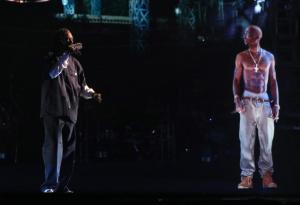
Tupac’s sonic ‘resurrection’ signifies his lasting effect in hip hop while serving as a springboard for Lamar’s own pondering about the purpose of his music and the burden of its success. Unlike the visual representation of Shakur via hologram at the 2012 Coachella Music Festival, Lamar’s use of Tupac’s sonic likeness offers an alternative entry point for engaging Tupac’s work outside of his rapping. For example, much of Shakur’s social-political work takes place in his poetry i.e. his collection of poetry The Rose that Grew from Concrete. Further, the ‘thingness’ of the hologram, a physical and technological manifestation of hip hop fans’ and artists’ revering of Tupac’s image and death, makes me think about the type of work the hologram was expected to perform as compared to the sonic ‘ghostliness’ of Tupac’s voice on Lamar’s track. If, as John Jennings suggests, the hologram manifested Tupac as a “ghost in the machine,” how does Tupac’s voice work as a ghost in the machine? On a visceral level hearing Tupac’s voice in conversation with Kendrick Lamar stirs feelings about whether or not he is dead or alive and his immortality as a hip hop icon.
Where the Coachella hologram visualized Tupac Shakur spirit, “Mortal Man” sonically evokes his spirit and the connection between his (im)mortality and storytelling. Lamar says: “Sometimes I be like. . .get behind a mic and I don’t what type of energy I’ma push out or where it comes from.” Shakur responds “because the spirits, we ain’t really even rappin’, we just letting our dead homies tell stories for us.” Listening to Shakur’s use of “we” out of historical context – the interview took place in 1994, 21 years before “Mortal Man” – suggests that Tupac himself is among the dead. He is a “dead homie” and telling a story that Lamar himself is trying to relay to his audience and himself. Yet the lingering possibility of Tupac’s mortality – most embodied in Tupac’s silence after Lamar’s discussion of the significance of a caterpillar to the album – is a powerful moment of protest. Shakur’s quiet and Lamar’s attempt to “call him back,” signifies a period in the conversation. Lamar is left to fend for himself, fighting a “fight he can’t win.” There is also the possibility that his exchange with Shakur is “just some shit he wrote,” an unfinished idea and story that he is still figuring out. Lamar’s rendering of Tupac’s voice makes me think about the DJ Spooky statement “the voice you speak with may not be your own.” Tupac’s ghostly voice and Lamar’s search for his own voice blend to present Tupac as a mouthpiece for not only himself but Lamar.
At surface level Lamar resurrects and interviews Tupac Shakur because of regional ties to West Coast hip hop and a nearly standard declaration in rap of Shakur’s influence and fandom. He is arguably the most celebrated and iconic figure in hip hop. Shakur’s untimely death and open struggles with seeking balance between fame and personal responsibility mold him as hip hop’s shining prince. Shakur’s family ties with the Black Panther Party – a member of the Panthers once called him an “eternal cub” – positioned him to use hip hop as a mouthpiece for contemporary Black protest. But Shakur’s branding of protest and hip hop was messy, in part because of a working understanding and maneuvering of his image as controversial and commercially successful.
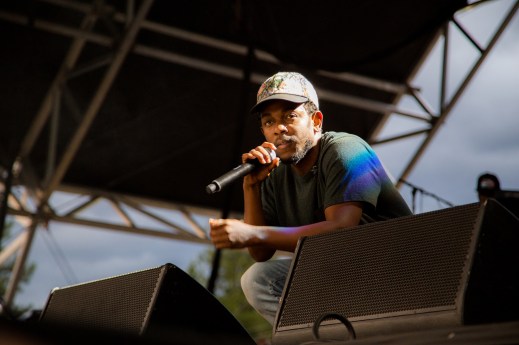
Pemberton Music Festival (Credit: Andy Holmes), CC BY-NC 2.0)
The “Mortal Man” interview signifies sound’s ability to usefully bridge past and present social, cultural, and political moments. Lamar’s sonic evoking of Tupac Shakur demonstrates hip hop as a space of Black youth political protest. Lamar uses sound to render hip hop temporality and re-emphasize Black popular culture as a departure point for recognizing contemporary Black angst. The shrinking mediums of spaces available to indicate why and how #BlackLivesMatter position the sonic as a work bench for engaging race relations in a deemed post-racial era. The “Mortal Man” interview serves as a blueprint for connecting hip hop to longstanding conversations about Black protest as a (messy) cultural product.
—
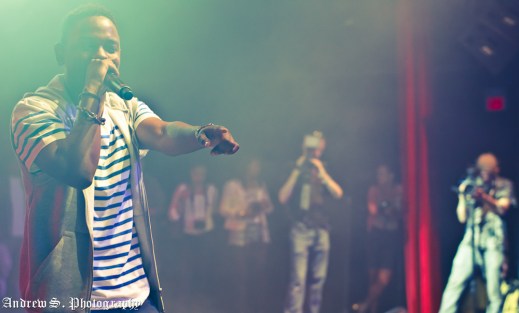
Featured image: “Shot by Drew: Kendrick Lamar” by Flickr user The Come Up Show, CC BY-NC-ND 2.0
—
Regina Bradley recently completed her PhD at Florida State University in African American Literature. Her dissertation is titled “Race to Post: White Hegemonic Capitalism and Black Empowerment in 21st Century Black Popular Culture and Literature.” She is a regular writer for Sounding Out!
—

REWIND!…If you liked this post, you may also dig:
I Been On: BaddieBey and Beyoncé’s Sonic Masculinity — Regina Bradley
Saving Sound, Sounding Black, Voicing America: John Lomax and the Creation of the “American Voice”— Toniesha Taylor
Como Now? Marketing “Authentic” Black Music— Jennifer Stoever
—
Share this:




Current Top Posts





April 2021

January 2020

November 2019

October 2019

August 2019

April 2014

November 2017

March 2015

December 2017

October 2015


Recent Comments