
A Tradition of Free and Odious Utterance: Free Speech & Sacred Noise in Steve Waters’s Temple
DOI: https://doi.org/10.59350/fd6n5-swb29
**This post is co-authored by Gabriel Solomon Mindel and Alexander J. Ullman
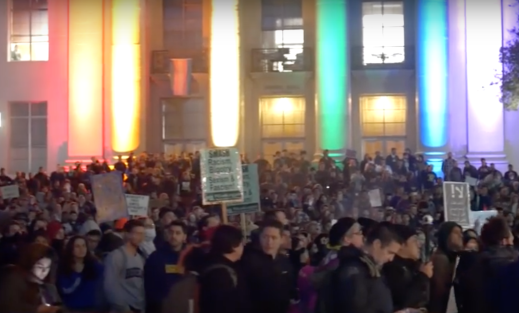
On February 2, 2017, thousands of protesters took to the University of California Berkeley’s Sproul Plaza to protest and ultimately shut down a planned talk by the right-wing provocateur Milo Yiannopoulos. Captured in real time, its dark and blurry image projected to screens across the world, this gathering dumped fuel on a fire that had been burning slowly for many years. Conservative and predominantly “white-male” resentment against the mainstreaming of “politically correct” speech had become the basis for an inchoate community via the internet and was now emerging as a socially acceptable sentiment in the era of Trump. For those protesting at Berkeley, the silencing of Yiannopoulos was not intended simply to condemn the content of his speech, but to intervene preemptively in the culture-wide “fascist creep” disguising itself as humour and taboo breaking. It called into question the actual meaning of both speech and freedom in a place that had become synonymous with the struggle for both.
Viewed by some as a riot, the militant protest tactics evoked scorn, distress, and confusion from a wide spectrum of respondents. Conservative audiences were horrified by the self-evident violence of the Left, even while enjoying a laugh with Milo at the various fails of “SJW’s” and “snowflakes”. Meanwhile Liberals couldn’t seem to fathom the expressions of anger and nihilism evinced by the black-clad mass celebrating in front of the shattered windows of the Martin Luther King Jr. Student Union, who set a fire at the very steps upon which the Free Speech Movement of 1964 had been birthed. The cancellation of Yiannopoulos’s talk has since set off a chain of rhetorical and physical confrontations resulting in the cancellation of Conservative speeches on campus and multiple “free speech” rallies which have devolved into street battles between a motley cohort of alt-right groups and various counter-protesters surrounding a park that was also named after MLK.

Coincident with the events that same spring, Berkeley’s Aurora Theatre staged Temple by British playwright Steve Waters, a revisiting of 2011’s Occupy London protests whose encampments surrounded the area of St. Paul’s Cathedral. First performed in London in 2015, the play speculates that the swirling circumstances of the ten-day period leading up to the dean’s resignation (including the cathedral’s closing on October 21; the Canon Chancellor’s abrupt resignation on the morning of October 28; and the reopening of the cathedral later that day, effectively evicting the protesters) had something to do with the church’s own struggle to reconcile its responsibility to serve both God and his people in the face of ethical contradictions.
Seeing Temple on Aurora Street, barely two weeks and two blocks from the “Patriot’s Day” melee on April 15, provoked us to consider what resonances seemed to be emerging between places and times evoked in the play and humming in the streets. Thinking comparatively between Berkeley in 2017 and Temple yields historical and political synchronicities, between protest movements and the institutions which arbitrate public space and public speech. Temple offers a critique of how the discourse of “free speech” is naturalized, even weaponized, by historical actors; yet it also imagines speech as sonic form never separate from its ethical content. The play exposes how “free speech” often serves as an empty signifier mobilized for political purposes, how it always risks being separated from its material and ethical consequences. Against this, the play pits the noise of protest as a powerful riposte to these abstractions.

Temple’s story centers around the personal conflict of the Dean, who vacillates between support for the protests surrounding the church and for the city eager to evict them, dramatizing how London’s Occupy movement, displaced from its original encampment outside the London Stock Exchange, took refuge in the courtyards surrounding St. Paul’s Cathedral, replacing one symbolic institution of power with another. As the Dean reminds us, this debating throng gathered on the church’s doorstep is an echo of the folkmoot at St. Paul’s Cross from nearly 800 years before: “In the Reformation era firebrands would preach against usury, against merchants in the very presence of the Mayor…doubtless a riotous affair…” Thus Temple situates Occupy as not an impediment to the functioning of the Church, but a revival of “a tradition of free, even odious utterance… of untrammelled public speech” (41-42).
Despite this sympathetic gesture, the Dean struggles against the unremitting noise of the current protestors outside his window. He frequently sits on the window ledge, holding his head as he peers out toward the loud chanting in what otherwise would be moments of silence: “This drumming, the music, the occasional shout…every night this fitful rhythm of noise, shouts, cries” (34). The polyphonic mass is yet another ethically demanding voice fighting for the dean’s attention. So too the other church leaders, the city lawyer arguing for the camp’s eviction, and the Canon Chancellor’s resort to Twitter where the realm of appearances seems to dictate political decisions because “like the whispering gallery …everything we do is broadcast …amplified …reverberating around the world” (42). Should the dean re-open the church and have the protest camp removed? Should he resign? What would Jesus do?

This interior struggle is formalized in the clash between the sound of protesters and the ritualized sounds of the church. The play compresses the drama of a three hour period into an hour and a half, and every quarter hour the bells at St. Paul’s ring, marking the ritualized time structure of the church and its domination over the city’s soundscape. R. Murray Schafer points out in The Soundscape that “time is always running out in the Christian system,” (i.e. its inevitable destiny in the apocalypse) “and the clock bell punctuates this fact” (56). The bells mark time, but they also mark power, for they are the “Sacred Noise” that Schafer claims societies “deliberately invoked as a break from the tedium of tranquility” – the silent world of the profane (51). The Church’s ability to determine time and disturb the peace is the (sound)mark of its power, yet the sound of the London protest encampment frequently disrupts its claim to sovereignty. The sonic agon of the play allegorized the one in the street: as Occupy’s cacophony challenged St. Paul’s exclusive right to make noise without censure, so too can the free speech protests be heard as a kind of sonic riposte to the institutionalized soundscape of the university, a sparse scholarly murmur punctuated by the bells of Berkeley’s Sather Tower.
Sonic ritual and sacred noise bookend Temple: the sound of a church choir opening it and the bells in closing. However, the play’s critique of such ritual occurs through constant sonic disruption and the unremitting attack on silence in the final stage direction (“the noise builds”). Therefore, as the Dean’s decision to reopen the cathedral suggests that the church’s rituals have won out, Temple insinuates that Occupy’s struggle was as much about the power to disrupt the peace with speech as it was to preserve its camp. This disruptive quality of ‘noise’ in the play calls attention to protest’s spatial capacities: the ability for sounding to extend beyond the limits of the body, to challenge the very architectures of power. We never see the protesters in the play, yet their acousmatic noise is manifest as if a distinct body were sharing space within the rectory. . Yet what are the limits of this ghostly aurality? Does the noise of the crowd simply become metaphor? We might ask the same thing of the protests at Berkeley, their proximity to the halls of power – university buildings, city hall, police stations – not compensating for their simultaneous containment in public space and exclusion from power’s internal deliberation. How does this risk metaphorizing the very material presence of these protests, the people who were using their actions and bodies to protest against the right’s usurpation of the term “free speech”?

The contest between the pew and the street in Temple exposed how the term “free speech” is metaphorically mobilized for political and ethical convenience. In a way, Temple is a critique of the Dean Graeme Knowles’s actual homily given on October 28th, 2011, just before the church reopened and just after the diegetic time of the play closes. In this homily, Knowles appropriates the language of testimony while at the same time appealing to a more abstract notion of “free speech”:
We are called out to be witnesses, to speak out, to testify…like Simon and Jude, many of us will be anonymous, but like them, our voices need to be heard. Because of their testimony, we are here today. Without their voice, the good news of the gospel would not have reached us.
While the church’s reopening (and the concomitant removal of Occupy) may actually appear like a restriction on free speech, the dean reassures congregants that the church is itself a testament to it. “World leaders have spoken under this throne,” he says, at once emphasizing the church’s personal importance to Christians who feel silenced by the church’s closing and the political importance of an otherwise “neutral” institution.

Waters’s play attempts to resolve the church/streets binary by filling hollow calls to testimony with multiple voices across a political spectrum, offering a polyvocality that helps to unpack this contradiction of the church standing up for free speech while simultaneously denying it. Through the clash of sounds and the characters voices, Temple exposes how Knowles’s homily is actually covering up a historical contradiction between numerous relations: between various iterations of what “free speech” means; between who controls the soundscape; between various iterations of free speech movements throughout history. It is here that the link to what is happening in Berkeley in 2017 is most poignant, in the resonance between the church’s past and its conflicted present on the one hand, and the dissonance between the historic memory of the UC Berkeley-based Free Speech Movement (FSM) of the fall of 1964 and how the “New Free Speech Movement” of the “alt-right” has effortlessly yet inaccurately usurped its language and moral ground.
If the Church and the University are spaces of exception, institutions that are both public and private, their responsibility to democratized speech is premised on ethical and legal principles that are not the same as the constitution-bound worlds around them. It is this being of the world and not that incites the agonism around who can speak and what they can say: according to Jesus in John 15:19 “… because you do not belong to the world…therefore the world hates you.”
The Free Speech Movement of 1964 advocated for the ability to offer persuasive speech with social consequences–rather than mere talk–carried forth by an uneasy alliance of liberal and conservative students brought together by the simultaneity of the Civil Rights Movement and Republican Party election campaigns. Campus administrators and the economic and political elite of the day claimed that students were being persuaded to perform illegal activities off campus, while it was the FSM leadership’s assertion that civil disobedience and direct action of the type being developed in civil rights and labor struggles was in fact defensible “free expression.” 50 years ago tactics such as sit-ins, occupations, blocking an arrest, and transforming a police car into a stage were seen by moderate and conservative commentators as coercive and violent forms of rebellion, but for activists they paled in comparison to the everyday racist violence affecting Black people in America, the imperial violence of the Vietnam War, or the total annihilation promised by a potential nuclear war. Similarly today, Antifa accept pre-emptive and coercive violence as necessitated by the potential violence summoned by the “alt-right,” whether in the form of lone individuals inspired by their white supremacist ideology or the spectre of a large scale fascist transformation of American society.
Though protest songs provided the background music to the FSM of the 60’s, the current debate and protests over “free speech” call attention to another constitutive relationship between sound and protest, between noise and power. Behind the liberal plea to “lower the voices” and heighten the reason in political discourse is a reminder that sound has an ability to interact with consciousness in non-rational, even hypnotic ways. We see a kind of hypnosis in the very language of “free speech” today, a term invoked by the alt-right and the university to protect certain political agendas similar to the way that the term “objectivity” was deployed mid-century. Stanley Fish made a similar argument in the 1990’s amidst that moment’s culture wars, arguing that because all speech is socially constructed and ideologically asserted “there’s no such thing as Free Speech.”
Free speech, for Fish, only exists as an ideal construct outside of history in which voices are pure “noise,” separated from consequences and assertions. But his notion of “noise” and “free speech” again are too metaphorical, separated from the uneven histories of protected speech and the materiality of noisy protests. As Jonathan Sterne writes, out of the perceived noise and meaninglessness of protests there emerge rhythms and grooves that can be heard farther than they can be seen, that invite participation and resistance. In the context of Temple and the UC Berkeley protests, the “noise” created within and against the term “free speech” should not simply be dialed down or declared a realm of meaningless utterance, but unpacked as an important opening in to how power is both employed and resisted by institutions like the university and the church.

The Chancellors of UC Berkeley have never been averse to using violence to correct and regulate speech on its campuses, whether it be Chancellor Strong’s eviction of the FSM’s occupation of Sproul Hall in 1964, or the brutalization of student protesters by campus police under the watchful eye of Chancellor Birgeneau in 2009. The Dean of St. Paul’s agony could give us insight into what went into Chancellor Christ’s ambivalent public letter that assures us that “free speech” and “safety” will come at a cost. In ‘64 the discourse of “free speech” became a platform for political dialogue and social transformation, not for usurping the language of testimony and personal experience while abstracting real societal power. What the “alt-right” frames as a common struggle for a moral and legal principle only disguises the balances of power that determine who can speak without the consequence of violence: white people or people of color; governments or protestors; bankers or the poor.
“Free Speech” is the domain of a particular sacred noise, one that has the power to disrupt what Martin Luther King Jr. himself described as the “appalling silence and indifference of good people who sit around saying ‘wait on time’.” In this recently discovered speech, given in London just after he spoke at St. Paul’s in December 1964, MLK goes on to say that “human progress never rolls in on the wheels of inevitability,” retroactively giving moral weight to Mario Savio’s demand that “you’ve got to put your bodies […] upon the wheels.” We can see this spirit of rebellion in the counter-rhythms of London’s anti-austerity occupations, rising up to meet the bells of St. Paul’s, and as well in the “rough music” of outraged students rising up to meet the Sather Tower Carillon as it insistently keeps time.
—
Featured Image: Still from video of Berkeley Protests, February 2017
—
Gabriel Salomon Mindel is an interdisciplinary artist and scholar whose research considers ways that people produce and struggle for space using sound to extend beyond the limits of their bodies, particularly in formal and informal modes of protest. He received an MFA in Visual Arts from Simon Fraser University where his work focused on the production of visual artworks from time-based phenomena such as sound composition, dance, social practices and protest. He has also spent nearly two decades exhibiting artwork, performing improvised music and composing for dance and film. Images, writings and recordings can be found at https://diademdiscos.com/gms/.
Alexander J. Ullman is a PhD student at UC Berkeley’s Department of English where he researches Nineteenth, Twentieth, and Twenty-first Century Literatures.
—

REWIND! . . .If you liked this post, you may also dig:
The Sound of Hippiesomething, or Drum Circles at #OccupyWallStreet–Gina Arnold
On Ventriloquism, Dummies, and Trump’s Voice–Sarah Kessler
G.L.O.S.S., Hardcore, and the Righteous White Voice–Chris Chien
—
Share this:

“Share your story” – but who will listen?

DOI: https://doi.org/10.59350/7dfwb-p4t46
Editor’s Note: Welcome to the second installment in the “DH and Listening” blog series for World Listening Month, our annual forum that prompts readers to reflect on what it means to listen. This year’s forum considers the role of “listening” in the digital humanities (DH, for short). We at Sounding Out! are stoked to hear about (and listen to) all the new projects out there that archive sound, but we wonder whether the digital humanities engage enough with the the notion of listening. After all, what’s a sound without someone to listen to it?
On our opening week, Jacqueline Wernimont from the Vibrant Lives team shared with us about the ethics of listening to 20th century sterilization victims’ records. Then, Emmanuelle Sonntag introduces us to a figure from a long time ago, “la soeur écoute,” a nun whose was responsible for sitting in and listening when another nun had a visitor. This week, Fabiola Hanna reflects upon what DH means when it talks about participatory practices. –Liana Silva, Managing Editor
—
Germanic and Holocaust historian and Digital Humanist Todd Presner has worked through more than 52,000 testimonies of the Shoah Foundation’s Visual History Archive, perhaps the largest archive of testimony, to investigate “the ethics of the algorithm.” The scale of this participatory archive has prompted Presner to ask: is it possible for a computer to listen to testimony?
Digital Humanities (DH) projects are, in varying degrees, led by the desire to engage with a wider public. Some often include actions such as inviting participants to share their stories, images, audio clips, drawings, and videos. In order to avoid lumping all DH works under a broad category that includes, among others, text analysis, mapping, visualization, 3D, and archiving. Below I examine DH projects that collect oral histories: memories, stories, and testimonies.
I argue that it is not enough to share stories; it is also important to recognize how these stories are shared. A majority of these living histories end up in an audio or video database displayed in full on a webpage, not unlike oral history transcripts ending up in a dusty closet. Listening as an active mode of participation can provide us with a framework that reveals the relationships, aesthetics and politics engendered by participation. Although seemingly about access (and some have started questioning whether users of such an archive should have access by default, or whether you need to be part of a community in order to access certain stories, see Mukurtu CMS), my focus is rather on the medium that these stories are circulated in, how they are displayed to the user and what the user’s participation does to these stories.
I take the space here, on the one hand, to think through participation from two fields, archives and interactive documentary (i-docs), and on the other hand to write about how sound studies, particularly an attention to listening and its aesthetics, its affordances, and its politics, can offer another approach to participation.

DH + participation: steps towards making place for popular
The work of requesting participation is in itself an accomplishment. It’s only been since the 1950s/60s, and perhaps more broadly since the 1990s, that ordinary peoples’ stories have been valued in the tradition that oral historians have established. It is possible to trace the field’s origins to Augusto Boal’s Theatre of the Oppressed (itself rooted in Paolo Friere’s work), to Howard Zinn’s A People’s History of the United States, or to postmodernism, the death of the author, and the end of grand narratives. With the arrival of Web 2.0, oral history seemed like the perfect medium for the ideals of participation on the Internet, precisely because it was about the everyday and involved “anyone” (with an internet connection). Video, audio and live streaming technologies made it possible for oral history to be recorded and displayed, and social media enabled unprecedented circulation through sharing. So the recent push to preserve everyday histories online, in DH projects, follows these ideals of stories from below.
Listening to stories as a mode of engagement is fitting with regards to oral history and testimony. Making space with openness and silence for someone’s testimony, especially when difficult, is a mode of participation that we aspire to. Media scholar Wendy Chun has argued that “a politics and practice of listening [is] a necessary complement to a politics of testifying.” In the case of Holocaust testimony, for instance, many scholars have argued that there is a responsibility to listen (Laub & Felman and Henry Greenspan).
I differentiate between two types of listening:
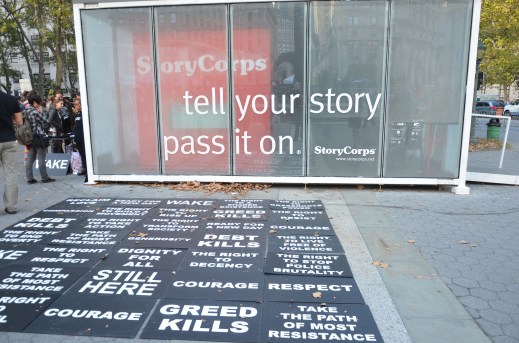
- Listening on the part of the users of these DH projects. Is it realistic to expect that users will listen to large archives of testimony? In Listening Publics, Kate Lacey writes that listening has been absent from theories of the public sphere, even where “the objective of political agency is often characterized as being to find a voice – which surely implies finding a public that will listen, and that has a will to listen” (viii). Because of their scale, these large archives of testimony pose a significant design challenge to the user, which could be resolved through curation. To build on one of the most successful digital storytelling projects, the Storycorps team knows very well that if they didn’t curate and edit together shorter versions, then no one would listen to the longer interviews in full.

- Listening on the part of the interface and its design. This involves questioning the medium and its effects on what it houses. Here I find Susan Bickford’s work very useful in her definition of listening and what it accomplishes: ‘the riskiness of listening comes partly from the possibility that what we hear will require change from us’ (1996, 149). If interfaces for stories pre-close any openness to what contributed stories could change, then listening is not being considered. This is more directly seen in the tagging of videos and their categorization without additional interpretational work. This will to not “add” to these stories seems to come from the premise that these testimonies should “speak for themselves” (I get to this point in a little bit); that no added interpretation is needed, even that any added interpretation distracts from the directness of the stories. But this often also means the medium and its effects on these stories are not carefully examined.
Contrary to Western cultural beliefs, listening can be seen as an active mode of participation in conversation. As Jodi Dean rightly argues, it is not enough to express one’s opinion, or for a message to be circulated: it is crucial to get a response to the message. Lisbeth Lipari writes that even in Dean’s formulation, however, the response as speech is still emphasized, thereby ignoring the work that happens beforehand: the listening. Apart from the major contribution of Susan Bickford, mentioned above, with the concept of political listening, little attention has been paid to listening in the field of political theory.

As arguably the most important philosopher on listening, Gemma Corradi Fiumara, writes: “listening involves the renunciation of a predominantly moulding and ordering activity; a giving up sustained by the expectation of a new and different quality of relationship” (as quoted by Lipari, 8). For Fiumara, listening is a mode of participation that is open and that does not pre-close potential possible contributions. Listening, therefore, as a mode of engagement can provide a useful method for thinking about participation in various contexts.
DH + Archives + i-docs
If a mission of a certain DH project is to engage with a wider public, then preservation of stories is not enough. More often than not, DH projects are already under difficult strain of resources, due to costs for developing technological projects and time for interviewing, collecting, indexing, tagging, uploading and making sense of these larger collections. DH have taken on a lot: preserving and archiving everyday stories with the mission to share with a wider public. It is useful to draw from experts who have been working through ideas of preservation and access: archivists. Archives generally have a mission of preservation, but when demands of sharing with a public arise, there are not many models from which to draw. Rick Prelinger writes that although the archive as a theoretical concept is overly theorized, its practice (in the plural form of the word) is under theorized.

Francis X Blouin and William G. Rosenberg trace the intersection of history and archives and found that Ranke, during the enlightenment, conceptualized history as a scientific endeavor in that truth could be extracted from archives through rigorous methodologies. This led to the idea that documents could “speak for themselves” (Blouin, 24). As if simply making documents available, without providing context of any sort, would reveal their inner truth. This is one of many cases where the reading of documents is taken for granted. It also ignores the effect that archivists have on the collecting, saving, and indexing of documents. Influential archivists such as Terry Cooke, Richard Brown and Brian Brothman have brought about new attitudes to repositories with an acknowledgment of the effect that archivists have on documents (as quoted by Richard J Cox, 33). This relatively recent push in archival theory, therefore, points to the flaws in the claim that documents on their own can represent themselves: that would be ignoring all the various power relationships at play, as well as the medium itself in which the stories are communicated.
In thinking about collaboration, with the unstated but implied goal of providing knowledge of a given subject, non-fiction film has experimented by inviting self-interested participants online and offline to contribute to projects. Sandra Gaudenzi makes clear that interactive documentaries, also called i-docs (documentaries designed for online or mobile viewing), are very distinct and that it is important to recognize the varying strategies employed by these digital projects: “uploading content is the most common way to collaborate in the case of online documentary, but it is definitely not the only one. […] contributions of content lead to co-creation but not to co-authorship, since the latter require a degree of intervention in the overall concept (i.e., form) of the product.” In her differentiation of co-creation and co-authorship, Gaudenzi points to the medium-limiting effect that users have in their participation. The “degree of intervention,” as a coming in between that leads to change, which Gaudenzi requires for co-authored documentaries, might be attained through listening, a listening through the work itself, such as The WorryBox Project.
Listening in The WorryBox Project
Irene Lusztig’s The WorryBox Project (2011) web-based documentary invites mothers to write their worries in an online form, which Lusztig then individually writes down on a piece of paper, rolls-up and stores in a physical box. The act of writing down in analog form what was input into a digital box goes an extra step beyond collection. It is emblematic of an extended care for these worries. The additional layer of documenting these actions, as part of the artwork itself, not only points to the embodiment of these worries but also to their representation.

Because listening has often been thought of as passive and feminine, it is also associated with a specific kind of caring, also in its passive and feminine forms. But I don’t equate that definition of care with listening, which surely the readers of this blog will question. In this case, care extends as a mode of listening because it pushes against the active/passive binary for speaking/listening. I use care in the sense it gave to curating (care is its early root), where curating points to the work of engagement and conversation. Curating as a form of listening.

This extended care would be an example of the listening I am thinking of. The work of translating the form’s digital input into the handwritten words and the documentation of that act stretch the layering of interpretation and with it the care given to these submissions. The change that occurs in this writing is definitely not an agreement or an endorsement of what is submitted but an open attitude of listening, of reception. This reinforces the notion that listening is not passive, but an active mode of participation.
This mode of listening does not imply an understanding, as the receipt of information in cybernetics theory suggested by Shannon and Weaver. Rather this mode of communication embraces the notion that listening does not necessarily mean an understanding. The audio action collaborative Ultra-Red conveys this idea perfectly: “Sound possesses a palpable promiscuity in relation to the body. One may say what one means, but somewhere between the mouth that speaks and the ear that hears, sound always exceeds its master. Politically, it may be useful to say that we hear the truth in the voice or that we listen with obedience, but sound always transgresses such duties.” So for DH storytelling projects to be participatory, it is beneficial to allow stories the space for listening, in a similar sense to Hannah Arendt’s “distancing” in order to understand. This brings me to media and communication’s scholar Lisbeth Lipari’s term for this: “listening otherwise.”

For Lipari, in engaging with difficult stories or perhaps stories that offer different perspectives: “It is […] a listening otherwise that suspends the willfulness of self- and foreknowledge in order to receive the singularities of the alterity of the other” (185, emphasis in original). For this “listening otherwise” to work online, I argue that it is important for the employed structures, systems and processes to reflect this specific kind of participation. In other words, in addition to placing “different voices” side-by-side, it is equally critical for these different perspectives to exist in a space where the medium, whether the recording, the software, the interface and its design, listens to what these differences are. An interface designed in order not to predetermine, not to predict or preclose what others might contribute would then be an example of this listening. Anthropomorphizing aside, for a computer to listen to testimony, as Presner asks, it must be designed to be open to changing itself.
—
Fabiola Hanna is a new media artist & software designer currently working towards a PhD in Film and Digital Media at UC Santa Cruz where she also holds an MFA in Digital Arts & New Media. Her doctoral work is on building an automatic editing machine that weaves together competing narratives about the history of Lebanon, which has led her to engage with software studies & digital humanities, archives & memory and new media art activism.
Her work has been exhibited widely in California at the Museum of Art and History in Santa Cruz, the New Children’s Museum in San Diego, the SubZero Festival in San Jose, the Digital Arts Research Center in Santa Cruz, and the Maker Faire in San Mateo. She is also a 2015 fellow of the Institute for Critical Social Inquiry at the New School, New York and has previously taught at University of California, San Diego and at various maker spaces including FabLab San Diego and MakerPlace.
Her website is fabiolahanna.com and she can be reached by email fhanna {@} ucsc {dot} edu.
—
Featured Image: “Story Corps” by Steve Rhodes, (CC BY-NC-ND 2.0)
—

REWIND!…If you liked this post, you may also dig:
What Mixtapes Can Teach Us About Noise: Reading Shannon and Weaver in 2010–Aaron Trammell
Machinic Ballads: Alan Lomax’s Global Jukebox and the Categorization of Sound Culture–Tanya Clement
“Digital Analogies: Techniques of Sonic Play“-Roger Moseley
—
Share this:




Current Top Posts





April 2021

January 2020

November 2019

October 2019

August 2019

April 2014

November 2017

March 2015

December 2017

October 2015


Recent Comments