
Tape Hiss, Compression, and the Stubborn Materiality of Sonic Diaspora

DOI: https://doi.org/10.59350/wq79t-x3184
In an article for Pitchfork, music critic Adam Ward reminisces about digital music files that sound as if they’re “being played through a payphone,” and calls the extreme compression of the low-quality MP3 “this generation’s vinyl crackle or skipping CD.” The crackles, hisses, and compression that characterize such sound files are what I term “encoded materiality.” Focusing on the encoded materiality of the digital helps us to reconfigure our approach to sonic media, understanding how the compression of early MP3s and tape hiss remind us not only of lost fidelity, but also of the richness of exchange. These warm and stubborn sonic impurities, having been encoded in our digital listening formats and thus achieving repeatability and variability, act as persistent reminders that we can think diaspora beyond melancholy and authenticity, sidestepping the questions of purity and loss that so often characterize dialogues in the field of diaspora studies.
In Mechanisms, his work on electronic textuality, Matthew Kirschenbaum proposes a “material matrix governing writing and inscription in all forms” composed of four elements: “erasure, variability, repeatability, and survivability” (xiii). The defects of sonic technology that become encoded in digital files are one such type of inscription. Tape hiss and other recording accidents–such as Casey Kasem ruining your attempt to tape record the first Western song you fell in love with after leaving Hong Kong by fading the outro and butting in with his banter–achieve repetition and survival during the digital encoding process, becoming a welcome reminder of time and place. Such materiality helps us to better understand the politics of diaspora. It clues us in to how the elements of textual encoding (erasure, variability, repeatability, and survivability) become embedded within diaspora’s complex logic.
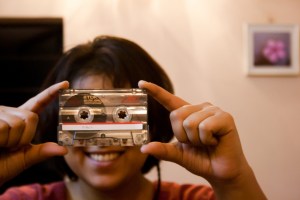
To think through these complex moments of exchange, let me offer a story about my experience with tape hiss. I grew up listening to music touched by this particular sonic grain: a ground level of noise upon which my sonic experiences were built. After I received my first iPod in 2005, I connected a tape player to the input of my computer, recorded a stack of tapes, and then manually split them into MP3s—pseudo-piracy committed in earnest. A few weeks ago, I dug up these same files and put them on my phone, once again returning the buried albums to their former glory on a constant rotation playlist. I keep returning to these particular files, rather than finding the now easily available digital versions, because I admire the survivability of their materiality. The materiality of these tracks allowed me to trace the complexity of my own history—the tape hiss is just as much a part of this history as the songs themselves.
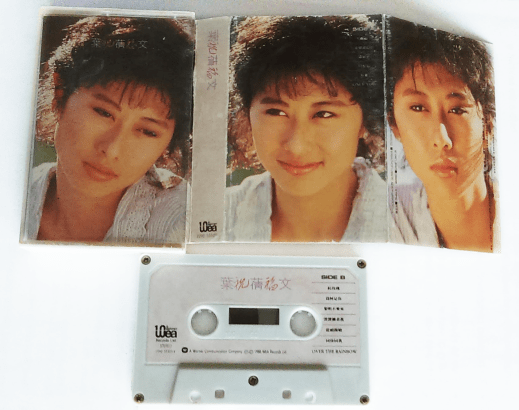
After first moving to Canada from Hong Kong, my family and I established ourselves by unswervingly performing the same routine each weekend. We would have late lunch at our favorite dim sum restaurant, drive around for a bit, and then relax at home; there wasn’t much to do in the ex-urbs of Toronto. On those drives, we listened to selections from a stack of cassette tapes in the glovebox of our old Pontiac Bonneville. Sally Yeh’s 1987 album Blessing was on constant rotation and received its fair share of wear. This was one of the tapes I recorded to my computer, destined for digitization.
Because I hit the record button a few seconds early, my MP3 of Sally Yeh’s Blessing begins with a few seconds of silence. It’s enough to trick me into thinking that the song isn’t playing. In a quiet enough spot, I can hear that it’s actually tape hiss. No matter where I am, on the road or in the shower, my mind fills in the blank with the thick ker-chunk of the cassette entering that Pontiac stereo right before that familiar tape hiss would fill the car, always giving us a few sometimes-needed, sometimes-awkward moments of silence before the music started. The sonic texture of that tape stems from its material nature as plastic and metal. The hiss itself is due to the size of the magnetized particles on the plastic. Because of these sounds, the song tells its own story. It recalls our shared sonic and material experience as I migrate it from device to device.
Before Blessing made its way into our car, it was one of the few cassette tapes that my parents carefully packed into a dozen cardboard boxes and shipped by sea to Canada in the late 1980s. This was in the midst of the countrywide protests in China that led to the events at Tiananmen Square. That insistent ker-chunk of plastic on metal that my brain inserts every time I play the MP3s keeps my experience of the music grounded in this earlier history, too. Strange that a fluffy pop song would remind me of the serious political strife taking place on the doorstep of a Hong Kong nervously awaiting its “handover.” This sonic anchor’s ability to recall to me these snippets of history, both personal, national, and transpacific has been crucial in the development of my own diasporic identity. Listening to this particular recording of Blessing helps me to keep track of my self and my history.
Ker-chunk.
The act of withdrawal that many of us perform in order to interface with our sonic technologies, as Alexander Weheliye shows in his reading of Ralph Ellison’s Invisible Man in Phonographies, can play a powerful role in understanding one’s own racial subjectivity. Weheliye focuses on the scene in which the titular narrator-protagonist retreats to a subterranean cave-like space to listen to Louis Armstong’s recorded, disembodied voice in complete solitude. He asserts that the narrator builds his own subjectivity through a recognition of the self by projecting that self onto Louis Armstrong’s “vocal apparatus,” that is, his voice coming through a phonograph (143). “The phonograph’s ability to disconnect the singing voice from its face, or rather to replace it with a technological visage, further heightens its materiality, which impels the protagonist to imbue Armstrong’s voice with a surplus of signification” (Weheliye 145).
More than a black and white photo or a stern historical lecture from the elders, the “heightened materiality” of the digital format, a type of “technological visage” cathects my own diasporic history most forcefully to the sonic anchor of tape hiss because it acts as a “voice without a face” in the same way as the phonographic Armstrong. But despite the privacy of the phonographic listening act in this scenario, Weheliye suggests that
the phonographic listening modality also bears the traces of sociality… since the listening subject is drawn out of him/herself by encountering the technologically mediated sounds of other subjects—we might even go so far as to suggest that the phonograph itself functions as a subject, especially in its interfacings with various humans. (165)
So it is with similar sonic technologies that can encourage the “eschewing [of] the social” such as iPhones, CDs, and, yes, cassette tapes. Like Ellison’s narrator interfacing with the mechanical apparatus that conveys Armstrong’s voice, the insistent “defects” kept on the digital file keep the mechanism of its delivery at the fore, allowing me first to understand that diasporic feeling of dis-ease—and to imagine beyond it.
What I gain from the digital yet still stubbornly material tape of Blessing is not any overt lyrical or thematic gesture to a diasporic subjectivity on the artist’s part, but rather an induction into what Giorgio Agamben calls, “the idea of an inessential commonality, a solidarity that in no way concerns an essence” (18), or perhaps a community based on “belonging itself” (84). Likewise, Weheliye’s “diasporic citizenship coarticulate[s] the national and transnational instead of playing a zero-sum game with political identification” (369). If diaspora is defined by the perpetual desire to seek an imagined originary point of true identity that inevitably leads to melancholy, as psychoanalysis maintains, tape hiss and other encoded materialities turn the gaze away from the mists of origin, validating instead the development of diasporic identity in the aftermath of emigration. Of course, loss and melancholy are legitimate psychic aspects of the diasporic experience, as persuasively demonstrated by scholars such as David Eng, Shinhee Han, Anne Anlin Cheng, but they neither define the whole experience nor are they mutually exclusive to it. It is in this way that we can think of diaspora as a community of belonging by becoming.
A consideration of the stubborn ways that materiality is encoded in the digital helps us to think of diaspora as more than psychic fait accompli—it is also a ‘coming community’ characterized by the process of belonging. Kirschenbaum’s matrix provides the right foundation for a study which considers how material inscriptions are related to our diasporic lives. The inscription that defined my diasporic becoming came from the cassette tape that travelled across the ocean in a boat for five weeks, escaped erasure, survived repeated playings, became digital, and lives on now as a hissing reminder of our history of emigration. What else may we find about our own becoming and belonging if we attune our ears to the encoded materialities of sonic diaspora?
–
Featured image “Decayed Cassette” by darkday @Flickr CC BY.
–
Chris Chien is a Ph.D. candidate in the Department of English at the University of Southern California working variously in the areas of sound, diaspora and transpacific studies, all with a distinctly queer bent. He completed his M.A. in English Literature at Loyola Marymount University and his Honors B.A. in English Literature and Latin at the University of Toronto. Chris has presented papers on angelic gender fluidity in John Milton’s Paradise Lost and post-colonial affect in the work of Herman Melville and Amitav Ghosh at the Rocky Mountain MLA and South Atlantic MLA conferences respectively. He is currently developing a paper that examines the performativity of diaspora, masculinity, and the capitalist ethos in Eddie Huang’s memoir Fresh Off the Boat and its adaptation as an ABC sitcom.
–

REWIND! . . .If you liked this post, you may also dig:
Pushing Play: What Makes the Portable Tape Recorder Interesting?—Gus Stadler
SANDRA BLAND: #SayHerName Loud or Not at All — Regina N. Bradley
Listening (Loudly) to Spanish-language Radio — Dolores Inés Casillas
Brasil Ao Vivo!: The Sonic Pleasures of Liveness in Brazilian Popular Culture — Kaleb Goldschmitt
—
Share this:

On Sound and Pleasure: Meditations on the Human Voice

After a rockin’ (and seriously informative) series of podcasts from Leonard J. Paul–a three part “Inside the Game Sound Designer’s Studio”– and a post on sound and black women’s sexual freedom from SO! Regular Regina Bradley, our summer Sound and Pleasure series keeps doin’ it and doin’ it and doin’ it well, this week with a beautiful set of meditations from scholar, artist, performer, and voice activist, Yvon Bonenfant. EVERYBODY SCREAM!!!–-JS, Editor-in-Chief
—
DOI: https://doi.org/10.59350/29wsv-zgd60
1
What I have to say about sound and pleasure can mostly be summed up this way: everyone deserves to take profound pleasure in their body’s sound.
Not only this, everyone deserves to both engage passionately with social sound and negotiate the exchange of social sound on pleasurable terms.
Like other expressive systems, however, these inalienable sonic human rights are mostly ignored, curtailed, or otherwise ‘disciplined and punished’ in the Foucauldian sense by our social systems. So, we are mostly neurotic, or otherwise hung up on, what kinds of sounds we make, where and when. We fetishise sound, particularly virtuosically framed sound, because it is part of a series of sublimated impulses, or we repress it because we think we aren’t supposed to emit it, or we ignore it.
2
In any given human relationship within which all parties can vocalize, the voice is an evident, key relational tool. It is full of gesture and meaning and text and sends rapid-fire, complex, layered, even self-contradictory or oxymoronic messages. It is a truly tangled web, and of course, for those who can use speech, transmits language.
However, I’d like to disentangle our sound from our language for a moment. Indeed, sound is not necessary in order to develop and transmit linguistically carried ideas, information and impulses. It has long been accepted that sign languages are fully developed languages, with intricate grammatical systems, vocabularies, and all of the other features of spoken languages. It is thus not necessary to use sound as a carrier of language. Yet if we have a voice, we almost always use sound to carry our language. And we force deaf people to try to fake having a voice and to fake listening to voices through lip reading and gesturing.
The last twenty years has seen a real boom in speculation and even scientific experiments that theorise why human bodily sound – the most evident aspect of which is our vocal sound – is so important to us. Musicology, biomusicology, evolutionary psychology, neuropsychology, and cultural studies of many kinds have tried to account for this. I have my own favorite reason, one I’ve tried to describe in a number of scholarly articles. This is that sound is much like touch. Like, yet unalike. It reaches and vibrates bodies, but at distance. It voyages through space in other ways, but it evokes haptic responses.
3
Sound isn’t solid, but it takes up space. This is expressed by Stephen Connor within his concept of the vocalic body. When we sound, there is a resonant field of vibration that moves through matter, which behaves according to the laws of physics – it vibrates molecules. This vibratory field leaves us, but is of us, and it voyages through space. Other people hear it. Other people feel it.

I’ve said that sound is like touch. However, one key way that it is not like touch is that it can do this thing. It can leave our bodies and travel away from us. We don’t need to grip it. We don’t need to hold on. And once emanated, it is out of our control.
More than one emanation can co-exist within matter. Their vibrations interact with one another, waves colliding and travelling in similar or different directions, and the vocalic bodies that they represent are morphed, hybridized: they intersect and invent composite bodies.
We hear the resulting harmonies. Historically policed into ‘consonances’ and ‘dissonances’, we have the power to let the negativizing connotations of either of these words go and simply hear the results of the collisions. Voices sounding simultaneously create choreographies of gesture that can be jubilant, depressing, assertive, aggressive, delightful, morose… or many of these simultaneously and in rapid alternation.
The fields of human sound in which we bathe are a continually self-knitting web of sensation. They are full of gestures pregnant with intention, filled with improvisatory spontaneity, success, failure and experimentation. They are filled with a desire to act upon matter, and to reach and engage one another.
4
My Ukrainian-origin mother was ‘loud’, I guess, at least by Anglo-Saxon standards, and her voice was timbrally very rich. And my father was a radio announcer (he disliked being called a DJ immensely, even though he worked in commercial radio and worked on shows that spun discs – he preferred being associated with talking). His voice was also very rich, as well as extremely crafted. It could be pointed and severe: a weapon. He had professional command of its qualities. We were not a quiet family; none of us were vocal wallflowers. But were our soundings pleasure-filled? Certainly, we were allowed to make lots of sound in some circumstances. However, just being allowed to be loud – though it might sometimes be a pleasure – does not necessarily lead to a pleasure-filled dynamic. Weightlifting makes us stronger, but it doesn’t necessarily feel good.
The amount of sound and whether ‘lots’ of it, or heightenings of its qualities – lots of amplitude, or lots of other kinds of distinctness, let’s say things like pitch or emotional timbre – are key variable features of family life in our cultures. Sound takes us directly into the meatiest of interpersonal dynamics – the dynamics of space and gesture, the dynamics of who takes up space with their sound and when. Families are, of course, microcosms of this sonic dynamic, but any group within which we generate relationships and encounters is subject to this dynamic, too. Our very own bodies end up developing what Thomas Csordas might call a ‘somatic mode’ that embodies our experience of these dynamics.

Whether we start from psychodynamic, neuropsychiatric, or even habitus-based models, it’s clear that repressing the expression of bodily sound regulates breathing impulses and other metabolic processes in ways that might become, well, habits.
Let’s put this in other ways.
The classic, Freudian, psychodynamic model of neurosis – as disputed as it is, and with all of its colonial, sexist, homophobic, racist and even abuse-denying overtones – did at least one thing for our understanding of what repressed emotion does. Repressed emotion affects the body.
Today, a popular understanding of this kind of emotional repression from a biophysical perspective might be: the use of the conscious mind to hold back emotional flow, and along with it, the emotional qualities of certain associations, memories, or even the content of the memories themselves.
Repressing this thing we might call emotional flow represses the voice. The literal, physical voice. Now, this kind of repression of the voice can become what Freudians would call unconscious. To allow it out isn’t any longer a choice that can be made, because we’re so used to holding back, that we don’t realize we’re doing it any more.
Somatics have taught us, through the contended practices of the body psychotherapies descended from Wilhelm Reich’s work, or Bonnie Bainbridge Cohen’s Body-Mind Centering, or any numerous other somatic practices – from certain styles of yoga through to Zen meditation and beyond – that emotional flow is at least partly dependent on how we breathe. And neuropsychology and physiology bear this out.

Whatever might ‘cause’ an emotion – and the roots of the causes of emotion are a source of debate – once it gets going, it isn’t just a thought process. Emotion is meaty and full of pumping hormones and breath pattern alterations and gestures and rushes of fluid. Chemicals get released. Chemicals get washed away. Heart rates speed up and slow down. Our breath rises and falls and its patterns change. Digestion patterns speed up or slow down or get interrupted. What happens in the body affects the body. What happens in the body affects the voice. Ever heard that kind of voice that seems hardened against the world? Or that media voice – the voice that is carefully shaped to invoke reason? Maybe these vocalisers can never let go of that sound: maybe it’s the only sound they can do, now. It’s just too habitual to let it change.
So, these habits can become so habitual that we don’t notice them anymore. We might change our breathing in some way to modify our expressive states. Because the exact nature of the sound our voices make is exquisitely dependent on how we breathe, and on everything else we do with our bodies, it then changes as well. Our choices to not let impulses flow – and the breath is only one bodily impulse among many – get caught up in this web. What were once choices can become embedded, difficult, and stubborn. To go far beyond the psychoanalytic and neurophysiological models, we can end up embodying a culture of these choices, and invent together a cultural body that regulates vocal sound based on groups of people making similar choices or playing by similar rules of sonic exchange.
This can end up perpetuating itself within our very tissues, and it can be an incredibly subtle dynamic to identify and shift. The way we embody the complexities of how we structure our physical and psychological engagement with the world – the ways we breathe, look, move, gesture… the ensemble of these is how Bourdieu defined the habitus. Where these complexities start and end is perhaps an infinite loop, a continual cycle of turning and exchange and influence flowing from ourselves to our culture and back again. Our bodies are cultural, counter-cultural, infra-cultural, extra-cultural bodies: we react to culture; we interact with it: we take positions.
Sound – who gets to do it, and when and how – is negotiated, with others, but also, within our own bodies. The traces that others leave there, the things we might call sonic and vocal inhibitions, tensions, these held-back-nesses, eventually become ours to carry, live with, and/or dissolve. They are gifted to us by our culture…. by our environment… by our experience … and by our bodies themselves.
We negotiate sounding.
Pleasure is negotiated, too.
5

We do this to our children: we shut them up. Oh, of course, we also facilitate their sound, and some do this more than others. But even if we give them sonic liberty at home, someone will shut them up, somewhere. We all know and we all remember being silenced as children by somebody, or at least, made to raise our hands in a classroom to ensure one speaker at a time, chosen by the authority in question. Later, teenagers, more often girls than boys, are called mouthy. The mouth: implicitly loud, and if too active, implicitly offensive. The term has been used against feminists, every identity we might include within LGBTI+, African-Americans, and the list goes on.
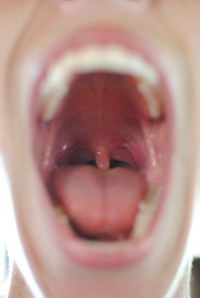
The wet, open, loud, loud mouth, just ready to mouth off, just ready to make trouble with its irritating, nasty, and above all, bothersome noise – bothersome because it makes us have to react – to have to consider the existence, the needs, the demands of those we might otherwise ignore – that moist orifice can be a source of great pleasure.
6
And on the score of that poor mouthy mouth, let’s consider some other colloquial terms, like ‘sucker’. Sucking is bad, apparently. It expresses need. Thumb out of the mouth! Stop wanting intimacy, reassurance, warmth, contact, and above all stop wanting to satisfy your hard-wired, biological need to suck for comfort and food (my little child). And you there, you sexually active adult! You fucking cocksucker. You ass-licker. That gaping mouth should shut itself up: its gooey pleasures are disgusting. These pleasures involve direct skin-to-skin contact.
Perhaps there is a revolution to be had, in the simple facilitation of gape-mouthed drool.
The vocal tract – that long tunnel surrounded by tongue and palates and teeth and various bits of throat, with at its bottom, the resonant buzz of elastic membranes, through which air is squeezed – also grips the world with direct contact. It’s not just a resonating and sound-shaping cave.
7

I’m making some artworks for children and families right now, and I group them together under the project moniker “Your Vivacious Voice” [See SO! Amplifies post from 6/19/14 to learn more about the free Voice Bubbles App aspect of YB’s project—ed]. I’m collaborating with some scientists and clinician-scientists on this project. They all work with the voice – in psycholinguistics, in understanding infant language acquisition, in voice medicine, and even in laryngeal surgery. We interview these scientists, and use inspiration from our conversations as sources of metaphors for art-making.
One of these is the head Speech and Language Therapist at the Royal National Ear, Nose and Throat Hospital in London, Dr Ruth Epstein. She sees and/or oversees some of the most difficult cases of vocal problems in the whole of the UK. When we asked her what concerns she’d most like us to address in artworks for children and families, she responded along the lines of: please, find a way to get through to them that voice is contact, human contact. She has begun using communication skills, such as eye contact and turn-taking exercises, in addition to vocal skills, in families with children who have injured voices – because she realized at some point that in many of these families, the near exclusive modality of contact was yelling: yelling without contact – without relationship.
The contactless yell is the thrashing arm that somehow remains alone in a void. It’s a yell that might strike if it lands on other flesh, but somehow doesn’t grip, and can’t convert to a caress. It can’t hold… it only punches.
This reminds me of a rockish tune by Carole Pope and Rough Trade from the Canadiana of my childhood – the refrain went:
It hit me like, it hit me like, it hit me like a slap, oh-oh-oh, all touch…
All touch and all touch and no contact…..
8
Back to our children, and to us.
Bodily sound can be a pointed weapon. It can be violent, in that it can frighten, dominate, attack, evoke deep fear, and engage other mechanisms of terror and control and subjugation, and that it can attempt to annihilate our ability to recognize the existence of others. We can drown out others’ sounds. We can drown out their gesture. We can drown their vocalic bodies in our own through amplitude and clashes of timbral spectra. We can shut them up.
Let us consider, here, the desire for amplification and how amplified sound represents an exaggeration of this power, a cybernetic enhancement of the ability to dominate with our emanating waves. We can drown out the social ability for whole groups to hear anyone but ourselves.
However, if, in our cultural environments, everyone is allowed to sound – if, indeed, we facilitate social environments in which everyone’s sound is welcome, then those who are subjected to vocal and sonic violence have an incredible counter-power to this power: they have the power to make sound too.
Although making sound back to violent sound, back to annihilating sound, is not always easy, possible or permitted, it is a power that can’t be easily erased. And we can almost always feel, if not cognitively hear, our own sound vibrate within our own skulls and through our own bones, no matter what is coming from the outside, no matter what waves of vocalic body are streaming toward us. Our sound waves continue to exist, even if transformed.

We can give voice to ourselves. We can change our habits. We can expand away from them.
It isn’t even necessary to fight back. It’s only necessary to vibrate.
And we can take it further.
We can actively encourage each other’s sound. We can actively encourage our children’s sound. We can actively encourage social sound. We can actively encourage a dance with others’ voices. We can facilitate, make space for, enjoy being touched by, the uniqueness of other voices. We can play with how our voices collide and create children with the vocalic bodies of others. After all, our composite vocal bodies are the products of our intensive exchange. We can jublilate in the massages we receive by making our own sound, by vibrating our own skulls, flesh, blood, lymph, interstitial fluid, and the air near us, and we can make it so that we can engage in passionate exchange with the vibrations of others.
This might be something like music. Or other kinds of art. Or it might be simple conversation. Or it might be cooing with a baby. Or it might be making comforting sounds while a toddler cries. Or it might be screaming with rage together.
What it always is, though, is focusing on, opening up to, enjoying the dynamics of the dance of individual, idiosyncratic, messy, fleshly, bodily, sonic emanations reacting with one another.
In the end, the policing of our sound is under our control. We can find ways to unpolice, and enjoy the unbridledness of our sound.
Our bodily sound is a means of engaging passionately with relationship and of glorying in its results.
—
Featured image: “Faces 529” by Flickr user Greg Peverill-Conti, CC BY-NC-ND 2.0
—
Yvon Bonenfant is Reader in Performing Arts at the University of Winchester. He likes voices that do what voices don’t usually do, and he likes bodies that don’t do what bodies usually do. He makes art starting from these sounds and movements. These unusual, intermedia works have been produced in 10 countries in the last 10 years, and his writing published in journals such as Performance Research, Choreographic Practices, and Studies in Theatre and Performance. He currently holds a Large Arts Award from the Wellcome Trust and funding from Arts Council England to collaborate with speech scientists on the development of a series of participatory, extra-normal voice artworks for children and families; see www.yourvivaciousvoice.com. Despite his air of Lenin, he does frighteningly accurate vocal imitations of both Axl Rose and Jon Bon Jovi. www.yvonbonenfant.com.
—

REWIND! . . .If you liked this post, you may also dig:
Experiments in Aural Resistance: Nordic Role-Playing, Community, and Sound— Aaron Trammell
This Is Your Body on the Velvet Underground— Jacob Smith
Sound Designing Motherhood: Irene Lusztig & Maile Colbert Open The Motherhood Archives— Maile Colbert
Share this:




Current Top Posts





April 2021

January 2020

November 2019

October 2019

August 2019

April 2014

November 2017

March 2015

December 2017

October 2015


Recent Comments