
Future Memory: Womb Sound As Shared Experience Crossing Time and Space
This Month will feature a two-part post by SO! regular writer Maile Colbert. Look for Part Two on Monday, January 19th.
—
I was a child obsessed with time travel. Beyond favorites such as A Wrinkle in Time and Time Bandits, I perpetually daydreamed of the ability to pause, reverse, and fast-forward my life. I had a book on the “olden days” and it amazed me that my great-grandparents, whom I had the fortune to know, had lived them. I wanted to fast forward and see myself their current age, telling stories to the next generations of a good life lived. I used to entertain the thought that if I let my breath go and let myself sink to the bottom of a body of water, I could pause time, or at least slow it down, as the sound of the fluid world around me seemed to suggest. Whenever my family moved, I made a time capsule, and I always scanned the ocean for long lost bottled messages. These were the beginnings of my future in time-based media–both image and sound–my love for found footage, and my recent research and writing on sound back in time.
Now as a new mother, I am beginning to think about the future in a way I hadn’t before. I see my mother in my daughter, and I see her mother, and my partner’s mother. I recognize my grandfather’s eyebrow when furrowed, and her grandfather’s nose. My mouth when smiling, my partner’s mouth when in concentration.
And our ears. . .our very sensitive hearing, almost like a punch line. Our daughter is truly the daughter of sound artists. In this first post of a two part series on humans’ earliest interactions with sound, I document our work sounding and listening together, which began in a future-oriented past I am still learning about.
Womb
There was a study in which doctors gave babies only a day old pacifiers connected to tape recorders. Depending on the pattern of the new babies suck, the tape recorder would either switch on the sound of the mother’s voice, or a stranger’s.
“Within 10 to 20 minutes, the babies learned to adjust their sucking rate on the pacifier to turn on their own mother’s voice,” says the study’s coauthor William Fifer, Ph.D., an associate professor of psychiatry and pediatrics at Columbia University’s College of Physicians and Surgeons. “This not only points out a newborn’s innate love for his mother’s voice but also a baby’s unique ability to learn quickly.”
– “What Babies Learn in the Womb,” 2014, Lara Flynn Maccarthy, Parenting
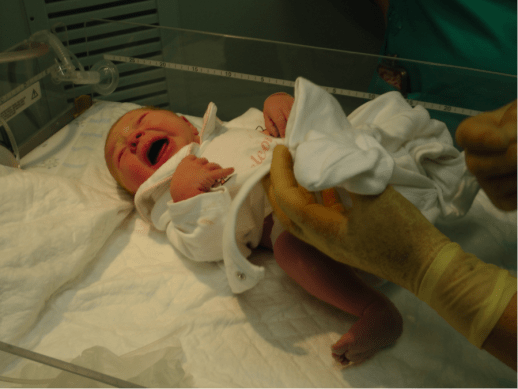
My daughter Odette knew my voice the moment she was born. In a strange, bright, cold new world, it seemed one constant she could rely upon. When she was first placed upon my chest, I started to sing to her, and she was calming, staring at me, as much as her newborn eyes would let her, with an expression of surprised recognition, as this familiar voice sang a familiar song, one I sang her often in the womb. One I knew by heart because my mother would sing it to me when I was a child.
Are you going to Scarborough Fair
Parsley, sage, rosemary and thyme
Remember me to the one who lives there
She once was a true love of mine. . .
The mother’s voice comes to the fetus not solely as ambient sound through the abdomen, as other external sounds and voices would, but also through the vocal cords’ internal vibration. There is a direct connection, a shared space. As early as the seventh month, a fetal heartbeat will slow and calm to the sound of the mother’s voice, and research has shown newborns even prefer a similar version of their mother’s voice to what they heard in the womb, muffled and low. When Odette suffered colic in her early months, one sure way to help comfort her was to sing to her while she was on my chest. Aside from the close contact of skin, the familiar smell, the warmth, it could be that hearing my voice also through the chest mimicked the womb filter.
In the tape recorder study, researchers also noted that newborns would suck more intensely to recordings of people speaking in the language of their mothers, most likely picking up on the melody and rhythm. We are beginning to understand that learning starts in the womb.
Fetal Soap Addiction
Carmen Bank found her 1985 pregnancy rather boring. So, to pass the time, she started doing something she would never have dreamed of: watching a soap opera.
Unexpectedly, she found herself hooked. And so she spent almost every morning in front of her television set, ready for the familiar theme of “Ryan’s Hope.” After Melissa was born that October, Bank bought a videocassette recorder so she could tape the show when she was too busy to watch.
Bank isn’t sure when she discovered the behavior, but, shortly after Melissa was born, Bank realized that the baby seemed to recognize the “Ryan’s Hope” theme and would stop fussing when the program began.
“She’d just sit there and watch the whole introduction and then she would start imitating what they do on the show,” Bank said. “This has been going on forever.”
-The Very Young and Restless, Do Soaps Hook the Unborn? June 28, 1988, Allan Parachini, The New York Times
My third trimester was a rough one. I was a walking swimming pool of about forty pounds of baby and amniotic fluid. My pelvis had gone completely out of line, making even that pregnancy waddle slow and difficult. Needless to say, I was less and less mobile. I was lucky that much of my remaining work was writing and studio based, but often found myself having to take mental breaks as well. My body/mind chemistry was working overtime. Something that happens with pregnancy when preparing mentally for your new, shared life is to think a lot about your own childhood. I was lucky to have a happy one, and so strong nostalgic feelings and memories would come up, particularly around the television show Dr. Who. I used to spend a happy hour with my father once a week watching reruns from the 70’s in the 80’s.
Dr. Who returned to broadcast in the 2000s, in a few new successful regenerations. The new iteration uses a lot of the classic themes, characters, and even remixes and re-masters the the original opening score written by Ron Grainer and realized by the great Delia Derbyshire for the BBC Radiophonic Workshop in 1963; the Dr. Who theme was one of the very first signature electronic music tunes, and performed well before commercial synthesizers were even available. Derbyshire used musique concrete techniques, cutting each note individually on analogue tape, speeding up and slowing down to create the notes from recordings of a single plucked string, white noise, and the simple harmonic waveforms of test-tone oscillators. (Grainer was famous for asking after hearing Derbyshire’s magic, “Did I write that?”. Derbyshire replied “Most of it.” The BBC, who kept members of the Radiophonic Workshop anonymous, prevented Grainer from giving Derbyshire a co-composer credit and a share of the royalties.)
It is a really, really catchy tune:
While Odette was in the womb, I watched all of those decades addictively, one after another. When I came across the soap opera study after she was born, I decided my obsessive Who-watching had set up a perfect laboratory to try it out myself. We started in 1963 and moved through time with the Doctor. Odette looked up in surprise and her brow furrowed in concentration. She looked around slowly at first, then faster and faster. She smiled; she cooed; she laughed. She started to flap her arms.
.
When I finally turned it off, she stopped everything and looked concerned. I turned it on again and we danced together in clear recognition of this already-shared future past sonic moment, one I had with my father and now with her. Now I understood that as I consumed Dr. Who, Odette was not only hearing, she was learning, and beginning the act of listening.
Sounds have a surprising impact upon the fetal heart rate: a five second stimulus can cause changes in heart rate and movement which last up to an hour. Some musical sounds can cause changes in metabolism. “Brahm’s Lullaby,” for example, played six times a day for five minutes in a premature baby nursery produced faster weight gain than voice sounds played on the same schedule (Chapman, 1975)
-The Fetal Sense, A Classical View, David B. Chamberlain, Birth Psychology
Wombscapes
Odette’s very first movements, her first “quickening”, was in response to David Bowie’s “Starman”. This was around 16 weeks, often the time for first movements in the fetus, and interestingly also the time when the hearing has developed. The fetus floats in a rich and complex soundscape; it is anything but quiet. The womb filter…amniotic fluid, embryonic membranes, uterus, the maternal abdomen-low frequencies, and blood in veins whooshing, then Mother’s voice and body noises such as hiccups and the gurgles of digestion and of course, the heartbeat. The Mother’s heartbeat can be as loud as a vacuum cleaner and ultra sounds as loud as a subway car arriving in a train station.We can try to mimic the womb-scape, imagining sounds being filtered through the body. We can use a hydrophone–a pressure microphone designed to be sensitive to soundwaves through fluid matter–on the abdomen to get an idea and sample for our womb-scape.
Perhaps it would sound something like this…
…reactive listening begins eight weeks before the ear is structurally complete at about 24 weeks. These findings indicate the complexity of hearing, lending support to the idea that receptive hearing begins with the skin and skeletal framework, skin being a multireceptor organ integrating input from vibrations, thermo receptors, and pain receptors. This primal listening system is then amplified with vestibular and cochlear information as it becomes available. With responsive listening proven at 16 weeks, hearing is clearly a major information channel operating for about 24 weeks before birth.
-The Fetal Sense, A classical view
Sound artist and Acoustic Ecologist Andrea Williams has been recently working on a composition for Bellybuds, for her yet born nephew. Bellybuds are “a specialized speaker system that gently adheres to your belly & safely plays memory-shaping sound directly to the womb.” Much of her work is composed with space in mind, using room sounds in a live performance situation. Williams told me it was interesting thinking about the womb as a new “venue,” with her little developing nephew as her audience. “What is he hearing?” she asked, “will he recognize me right away upon meeting him for the first time if he only hears the sound of my voice through the Bellybuds while he is a fetus?” I love the idea that she could send a “hello” from one place to her nephew in the womb in another.
The more we understand and realize about fetal hearing and processing sound, the more we understand how fetuses can detect subtle changes and process complex information. Memory starts to form around 30 weeks, and it’s possible early sound interventions at this time could help babies with detected abnormal development. Speaking and singing to the unborn fetus, allowing them to experience different soundscapes while still in the womb, helps shape their brains. This is probably why the urge to do so is there.
. . .Odette’s first dance. Odette’s first songs. . . transcending time and space.
—
dedicated to Odette Helen, and to the family, daughter, and memory of Steven Miller
—
Featured Image: Odette’s Birth Cry, photo credit Rui Costa
The album Future Memory, for Odette will be released in 2015 through Wild Silence. A dedication album to a newborn daughter…a mix of her parents’ recorded and shared sounds, memories, hopes, and dreams towards a future with her. Sounds of her womb-scape, birth, and first year…music in collaboration with friends and family across oceans and land…an album of lullabies for Odette.
—
Maile Colbert is a multi-media artist with a concentration on sound and video who relocated from Los Angeles, US to Lisbon, Portugal. She is a regular writer for Sounding Out!
—
 REWIND! . . .If you liked this post, you may also dig:
On Sound and Pleasure: Meditations on the Human Voice– Yvon Bonenfant
This Is Your Body on the Velvet Underground– Jacob Smith
Sound Designing Motherhood: Irene Lusztig & Maile Colbert Open The Motherhood Archives– Maile Colbert
Share this:

A Brief Review of Australian Radio Art

Welcome to the second part of Radio Art Reflections, a series on radio art that brings together the thoughts of three practitioners who have been researching the field from Canada, Australia and the UK.
In the first part Canadian sound and radio artist Anna Friz discussed how transmission art has shaped her practice and how it has become an important current within the expanded territory of radio art. Following this, musician and sound artist Colin Black reflects on the particularities of Australia’s radio art history, analyzing the effects of ongoing cutbacks at the Australian Broadcasting Corporation. Black fears a distinctive Australian soundscape-based radio art is in danger of being lost, while identifying a current renaissance in narrative based radio features which currently shape ABC radio output, and considers the potential of ABC’s new Creative Audio Unit.
– Guest Editor Magz Hall
—
As an artist growing up in rural Australia, I was hugely influenced by how state-owned radio engaged with sound-based practitioners. For decades, radio not only gave voice to some of the more exploratory artists and their works, it allowed artists and audiences from all over this vast continent to find a space in which experimental works could, with financial support, gestate, be realized and propelled onto a world stage, often receiving international acclaim for their distinctive perspective.
In recent years I have come back to those works as a PhD researcher, interviewing thirty five international practitioners, theorists and producers on Australian radio art thereby gaining a new appreciation of its particular aesthetic practices and approaches. This article draws on some of these interviews to highlight national and international perceptions about where Australian radio art has been, while also demonstrating its potential to influence a new generation of artists to explore beyond mainstream media formats.

Murray Higgins, ABC Adelaide Drama supervising engineer recording various armaments on the deck of a Royal Australian Navy ship. This actuality was used for a live broadcast of a radio play scheduled for broadcast on the same day of recording. (Photo taken April 8, 1945 by an unknown photographer)
THE LISTENING ROOM
While there are a few early examples of Australian radio art, consistant programming and commissioning of radio art effectively commenced in the 1980s with the formation of the ABC Arts Unit during 1984-85 and the acoustic arts programme The Listening Room, which aired from 1988 to 2003. Although long-decommissioned, The Listening Room was still one of a very few signposts that my interviewees cited when trying to understand the properties of Australian radio art. The Listening Room’s founding executive producer Andrew McLennan, who expanded the boundaries of ABC radio from 1976 onwards, had a clear take on the aesthetic framework of the show, stating in one internal ABC report (c1990) that the programme was a:
… venue for the exploration, the cross-pollination of radio forms. … you can hear new radio plays, audio essays, acoustic features, sound documentaries, new music, sound-scapes and sculptures, audio installations, acoustic art forms …
This approach was broader than that of other international radio art programs. Here is a quote from the formative executive producer of Deutschlandradio Kultur, Götz Naleppa, who took a much more “aesthetic” approach for his well-known Klangkunst programmes in Germany:
The difference to other radio-art-forms like radio-play is simple: sound-composition [a term Naleppa prefers to radio art] shares with them the same elements: sound, text (voice) and music. But in radio-play text (dialogue) is in the foreground and the other elements SERVE it (often in an illustrative way). And in (radio)sound-composition we have the same elements – but they are EQUAL, they are simply MATERIAL in the hands of the composer [Götz Naleppa, e-mail message to author July 28, 2005].
Of the two, The Listening Room clearly had a wider scope. Thus a number of ABC works, like On the Raft, All at Sea (by Robyn Ravlich and Russell Stapleton), placed the text in the foreground as the narrative is primarily driven by the use of spoken dialogue and the other elements are used to serve the text in a chiefly illustrative fashion. By definition Naleppa would call this a “radio-play” and not necessarily neues hörspiel or radio art, and definitely not a radio “sound-composition.”
.
Extract from On the Raft, All at Sea (2002) by Robyn Ravlich and Russell Stapleton (courtesy Robyn Ravlich and ABC Radio)

Figure Two: The Listening Room, program logo postcard designed by Antart (c 1990).
“AUSTRALIAN” RADIO ART
Alongside this inclusiveness of a wide scope of work, my research uncovered a range of other ideas about the identifiable properties of Australian radio art. Austrian Elisabeth Zimmerman claims that with Australian work there is “a certain tradition” that favours the “use of environmental sounds … but in a very composed way.” Andrew McLennan supports Zimmerman’s viewpoint and states: “it’s always hard to say and it is probably a bit of a cliché … [however he] often think[s] of it as quite environmentally driven.” Douglas Kahn, an American, is more skeptical, observing that “The Australian stuff was much broader range … I don’t think you can say that there was an Australian aesthetic because there were so many different artists that were brought in to do things.” Although later Kahn does state that a common thread heard in Australian work was its “really high quality production values … really nice complex mixes … people playing the mixing board like it was a piano in a really sophisticated way.” Kaye Mortley from her Australian French background describes Australian work as “radiophonic art, of various sorts, more experimental in nature, some produced by composers.” While not a composer, Australian Virginia Madsen supports Mortley’s viewpoint when she describes her own work as “experimental … it combines music, theatre performance, and documentary really.” The common theme that emerges from my research is the openness and commitment to experimentation that exists alongside a highly professional approach to the art form within Australian radio art culture.
My interviews also indicated that radio art plays a role in the perceived amorphous and multi-faceted notion of national identity, while confirming Kahn and Nicholas Zurbrugg’s earlier observations that radio art has critically contributed to the overall arts ecology in Australia. As a practitioner, I would also describe my own work as having an experimental approach that is influenced by the high quality production levels of programs like The Listening Room. While much of my work is environmentally driven, my artistic focus is to create multi-faceted, intimate aural geographies in which human imprint is present.
.
Extract from Alien In The Landscape (2007) by Colin Black (courtesy DeutschlandRadio Kultur). This extract features synchronous field recordings made by a Rodes NT4, X-Y configured stereo microphone and Fender Stratocaster with additional strings attached as pictured below.

Figure Three: The author conducting field recordings at the edge of the Great Sandy Desert in Australia, 2006.
THE CREATIVE AUDIO UNIT AND AUSTRALIAN RADIO TODAY
When The Listening Room was decommissioned in 2003, explorative radio was forced in two directions: ABC Radio National programmed some word-based works, while ABC Classic FM aired another set of works that Kate Dundas (Director of ABC Radio) has called “Shorter-form pieces, maybe perhaps down the sound-based acoustic end or radiophonic end of the spectrum.”Budgets were dramatically reduced and diverted, resulting in the effective abandonment of regular commissions and airtime for long-form sound-based works. In 2012 ABC management decommissioned book readings and Creative Instinct (a “feature program that reflects and explores the creative world”) and The Night Air (described as “aural equivalents of the avant-garde cut-up: a montage of interviews, location sound, music and found audio”). Moreover management oversaw the dismantling of the Airplay programme, which included “hour-long dramatic fictions [sic] experiment with form” effectively ending an 80-year tradition of Australian radio drama. In replacing these programmes, the Creative Audio Unit (CAU) was planned and American-style low budget radio production techniques for dramatic short stories (as championed at the 2012 ABC run Radio Beyond Radio conference) were put on the table as the future of radio.
In 2013 the ABC recruited a whole new team (who collectively had very little direct engagement with prior radio drama and The Listening Room production budgets and procedures), to setup, oversee and run the CAU. This transition was so atypical of past ABC changes that it raises questions as to whether this was an orchestrated act of cultural amnesia. It is perhaps not surprising that one of the major challenges this new team faces is the lack of resources, which impedes the magnitude of new works commissioned. This also raises questions as to how the previous budgets from Airplay, The Night Air and Creative Instinct have been reassigned. Another challenge is this unit’s extremely wide area of responsibility (that was previously spread across a number of ABC Units) ranging from radio drama and essays on the Radiotonic programme (effectively replacing the entire radio drama department) to what it claims to be a “portal into radio art, performance, soundscapes and composed audio features” on its Soundproof programme.
While Soundproof makes gestures to re-stimulate radio art activities in Australia, in sampling its first twenty episodes it becomes apparent that a very large percentage of airtime is heavily driven by the spoken dialogue narrative, more in line with radio drama or documentary. Furthermore, the episodes that contain the more interesting sound works seem to be frequently interrupted by extended contextual dialogue and therefore, for the most part, present only extracts or shorter form radio art works. Therefore, as a practitioner who runs the risk of being excluded from future CAU activities, I would nevertheless argue that for the most part, the CAU is doubling up on its focus on radio drama and documentary style productions and has not to date reached its goal of fully exploring and presenting sound rich radio art features, as it claims (please see Soundproof episode mp3 downloads dated between 11 May to 21 September 2014). Moreover, Soundproof is much more constrained, even backward-looking, when compared to its predecessors and is therefore aiming to attract a much less adventurous radio audience. More glaringly, the first twenty episodes lack a strong presence for new Australian works when compared to The Listening Room that broadcast sixty-four Australian works with a total duration of fifty hours in its first year of operation. As an inquisitive listener it seems that, to date, Soundproof has forgotten its own lineage without offering anything new or innovative and in doing so, has also forgotten audience members like myself in Australia and throughout the world.
I sometimes wonder what the conclusions from my research study would be if it were only focused on current practice. Would today’s Australian radio art still play a role in the perceived multi-faceted notion of Australian national identity? Would it still be perceived to have an experimental approach with high quality production levels that favour the use of environmental sounds? Is it still a critical contributor to the overall arts ecology in Australia? Audience members who have little prior knowledge of Australian radio art, may think so or may not conceive of its potential to do so. However, given sustained support, the space for experimentation and a clear inventive vision for the future, building on the legacy of past achievements, Australian radio art clearly has the potential to regain its status on a world stage.
—
Featured Image: Beastman mural on Brisbane Radio by Flickr User JAM Project
—
Dr Colin Black is an internationally acclaimed composer/sound artist having won the 2003 Prix Italia Award and achieving the final round selection in the 2010 and 2011 Prix Phonurgia Nova for his creative feature length works. As a result of this acclaim, Black has received multiple national and international commissions to create innovative long-form works for broadcast across major Australian and European networks. Black’s curator credits include, international festival/showcases of award winning Australian acoustic art and radio art at London’s Resonance104.4fm, Kunstradio (ÖRF, Austria) and Toronto’s New Adventures In Sound Art. In 2013 he also curated the Australian Broadcasting Corporation’s Sound Fix: Your Weekly Dose of Transmitted Audible Art series. He is a PhD graduate of the Sydney Conservatorium of Music where he was a recipient of the University of Sydney Postgraduate Awards Scholarship. More recently Black has been engaged as an academic lecturing at the University Technology, Sydney; moreover he has authored a number of conference papers and peer reviewed journal articles including “An Overview of Spatialised Broadcasting Experiments With a Focus on Radio Art Practices” in Organised Sound. Black is also the founding member of The International Radio Art (and Creative Audio for Trans-media) Research Group. For more information see: www.colinblack.com.au
—

REWIND! . . .If you liked this post, you may also dig:
Unsettled Listening — Randolph Jordan
Radio Ambulante: A Radio that Listens — Carolina Guerrero
Everything Sounds Podcast — Craig Shank
Share this:


Current Top Posts





April 2021

January 2020

November 2019

October 2019

August 2019

April 2014

November 2017

March 2015

December 2017

October 2015
 Sounding Out!
Recent Comments