
Sonic Brownface: Representations of Mexicanness in an Era of Discontent

Image by Flickr User Thomas Hawk
In the current anti-immigrant climate, the visual, sonic, and textual modes of representation are becoming battlegrounds we must consider. Arizona, Georgia, and Alabama’s takes on immigration policy and eliminations of ethnic study course offerings from college and high school curricula, are signs of a climate fraught with discontent. However, these fights are not limited solely to the political sphere; in fact, the arena of cultural production—music, literature, theater, and film—facilitates a generalized outlook on Latinidad in the United States by representing Dreamers (the generations of children who were raised in the U.S. from a young age but are not citizens), and/or the thousands of undocumented immigrants who sustain an infrastructure of cheap labor. Within these often stereotypical representations, it is frequently sound that produces the strongest sense of social, cultural, and political difference for Latino subjects.
In this post, I analyze the 2006 film Nacho Libre, a comedy starring Jack Black as a friar who becomes a Lucha Libre fighter, as symptomatic of what I term “sonic brownface,” an aural performativity of Mexicanness. My interest on Nacho Libre is to elucidate how sonic brownface manifests on the big screen, and what is at stake through these seemingly innocent (re)presentations of Mexicanness. I characterize “sonic brownface” as a “speedification” of a Mexican accent, named after Speedy Gonzalez’ infamous call “¡Ándale! ¡Ándale! ¡Arriba! ¡Arriba! ¡Epa! ¡Epa! ¡Epa!” Although comedian Jack Black intends to present a respectful portrayal of a Mexican, his speech enables my analysis of “sonic brownface” within popular culture, a sound that reproduces ideologies about an invisible majority that is also perceived as non-American: Latinos, undocumented immigrants, and dreamers.

The May 1, 2006 protest in Los Angeles, Image by Flickr user The Korean Resource Center 민족학교
Voicing the Other…

Popular silent-era leading man Ramon Novarro (née José Ramón Gil Samaniego) as photographed by Carl Van Vechten in 1935
The last scene of the Academy Award winning film The Artist (2011), presents why the silent film Artist was against the industry’s move toward the “talkie.” His voice collided with the visual representation of the suave debonair cosmopolitan man—and audience expectations of what such privilege sounds like. Though French actor Jean Dujardin plays the lead character in the film The Artist, it must be noted that several Mexican and Latin American actors did quite well in those early years of Hollywood cinema. Their exotic looks made them desirable and allowed audiences to fantasize about the man or woman on the screen because they could not hear them speak. Moreover, their physicality allowed some actors to “pass” as white. When talkies became the norm, Latino actors began performing now familiar stereotypical characters because in the U.S., their voices were indelibly associated with their “foreignness.”
In the realm of popular culture, both Disney and Warner Brothers created their own “Mexican” characters. In 1944, Disney introduced a Mexican and a Brazilian in the animated film Three Caballeros. Joaquin Garay was a Mexican voice actor featured in the voice of Panchito Pistoles in the Three Caballeros.
.
His accent and his singing sounded like someone who is Mexican speaking English, as oppose to an exaggerated Mexican accent heard later in the cartoon character of Speedy Gonzalez. Panchito Pistolas showcases a pride in being Mexican as heard in the singing of a ranchera and wearing his gun like the Mexican Revolutionaries of the 1910s. In the 1950s, Warner Brothers introduced Speedy Gonzales to their pantheon of animated characters, coinciding with the next wave of anti-Mexican sentiment during the campaign of Operation Wetback.
In his essay “Autopsy of a Rat,” William Nericcio posits that viewers come to recognize a series of stereotypes about Mexicans through the animated character of Speedy Gonzales. Nericcio incorporates historical references that influenced the design and creation of Gonzalez. He stipulates that this animation creates visual cues which American audiences connect as qualities of Mexicanness, “how this popular animated star comes to function in a way that reinforces politically charged, visions/versions of the ‘Mexican’ on ‘American’ soil” (212). Nericcio emphasizes the “visuo-ethnic clues” to deconstruct the Speedy Gonzales cartoon, and his definition of the stereotype helps corroborates my interest in how “sonic brownface” manifests as a “Speedification” of a Mexican accent. “Strapped for existential input as to the dynamic of Mexican subjects, we turn to stereotypes to provide us with visuo-ethnic ‘clues’ that fill in for empirical data and satisfy the lazy desire of our collective curiosity (219). Whereas Nericcio emphasizes the visual, however, I argue that sound has also held a strong purchase on the American racial imaginary in the case of Latinos. When audiences see and hear Jack Black as Nacho Libre, for example, they already recognize the accent.
Nacho Libre, sonic brownface personified
I propose the concept of “sonic brownface,” which pairs auditory with visual signs of Mexicanness as mediated in popular culture, to characterize the Mexican as a perpetual foreigner within the national imaginary. My interest in a film like Nacho Libre is to elucidate how audiences already recognize “Speedification,” a voicing of Mexicanness that manifests as a performance of “sonic brownface.” This conceptualization of “sonic brownface” is informed by Jennifer Stoever-Ackerman’s work on the “sonic color-line.” In “Splicing the Sonic Color-Line: Tony Schwartz Remixes Postwar Nueva York,” she posits that “sound is not merely a scientific phenomenon—vibrations passing through matter at particular frequencies—it is also a set of social relations … the “sonic color-line” begins to theorize the mutually constitutive relationship between sound, listening, and race.” She elaborates how “aural signifiers of race are thoroughly enmeshed with the visuality of race [because] they never really lose their ultimate referent to different types of bodies” (65). In the case of “sonic brownface,” Jack Black does not need to be a Mexican actor, he just needs to sound “Mexican” to conjure a physical referent.
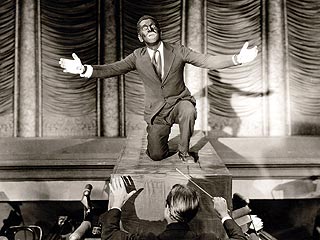
Still from The Jazz Singer
In utilizing the term “brownface,” I also reference minstrel entertainment in which blackness fetishized and simultaneously disavowed African American entertainers consequently framing racial codes onto a spectrum of racialized bodies. In his analysis of the first talkie The Jazz Singer (1927) “Blackface, White Noise,” Michael Rogin proposes that the “protagonist adopts a black mask and ventriloquiz[es]the black, sings through his mouth” (419). Through this masking, the Jazz Singer becomes Americanized through “appropriat[ing] an imaginary blackness” (421). Even as our contemporary sensibility would call out any form of contemporary blackface performance, we have yet to identify a similar masking when it occurs with Mexican or Latino characters. I contend that the models seen in blackface entertainment have already placed familiar scenarios of seeing White or Jewish actors performing an ethnic Other. When American audiences see Jack Black as “Nacho Libre,” they do not need to see him brown his skin; it is enough to hear a “speedification” of Spanish to have us entertain his believability. When “sonic brownface” occurs, it does not Americanize the performer, rather it perpetuates the Mexican and by extension Chicanos and Latinos as always already foreigners.
In order to recognize how “sonic brownface” is performed in the comedy Nacho Libre, it is also necessary to understand how its sound echoes a political climate that conflates “Mexican” with “Immigrant,” thereby representing Mexicans as undocumented people who have no right to be on this side of the U.S./Mexico border, and lumps all Latinos together as “Mexican.” The film was released a month after the nation’s largest immigrant rallies on May 1, 2006, occurring throughout many cities. The timing of the film also coincided with the first series of policy measures on immigration reform proposed by Congress. Whereas before the May Day marches, some members of congress discussed immigrants as criminals, after the big turnout Congress changed their tune, beginning to consider amnesty or easier paths to citizenship for undocumented immigrants, including generation Dreamers, already raised and finishing their schooling in the States. Cue Jack Black.

Image by Flickr User Thommy Browne
Speedification del Celluloid: “sonic brownface” in Nacho Libre
Nacho Libre, directed by Jared Hess (of Napoleon Dynamite fame) presents a comedic fictionalization of the story of Fray Tormenta, a career Lucha Libre fighter who was actually Reverend Sergio Gutiérrez Benitez. The film highlights Black’s strengths as a singer and presents him in a character that is the classic underdog trying to achieve his wrestling dream. As Nacho, the cook for the orphanage, he also wishes to provide the children a better meal, at least once in a while. I will highlight a few scenes in which Black’s sonic brownface performance stands in contrast to the other Mexican cinema actors who speak English. I will conclude with a proposition as to why sonic brownface is already so familiar to us.
From the opening sequence, we see the quaint orphanage located in a small Mexican pueblo. “Sonic brownface” is introduced in the film from Black’s first words “Be grateful Juan Pablo today is especially delicious.” In the next sequence, Hess films the Father saying mass in Spanish with no translation, or subtitles. I point this out because it sets up a type of authenticity with the Mexican orphanage, and that the film brings together both American actors speaking “Es-Pan-ish” and Mexican actors speaking in English. Ana de la Reguera, “Sister Encarnación,”–a nun who arrives to teach the children–also does not perform sonic brownface. She sounds like a Mexican actress speaking English, very much like other Mexican actors preceding her in Hollywood, adding a third later of sonic representation that actually works to heighten sonic brownface’s effects.
However, the sequence that most prominently presents the visual and auditory cues of sonic brownface appear in a twenty-minute segment when Nacho recruits his partner, Esquelito, and they transform into luchadores. In the midst of Nacho’s transformation, he must also contend with his carnal feelings for Sister Encarnación and to instruct the boys that wrestling is not good. Black goes from Italian in “taste of glory” (19:114-16); to Cuban “take it easy” (24:03); to urban Mexican American “my life is good, really good. It’s fantastic” (35:50). The sequence ends as Nacho cannot defend Sister Encarnación and blames Esqueleto for the mishap. Here sonic blackface culminates this performativity of Other with “get that corn outta my face. I looked like a fool last night. What took you so long?!” (39:54-40:29).
One could read this performativity of Otherness in the remix of accents as Black’s self-awareness that he is voicing something not of his experience. However, that he is Jewish and a comedian implies a privileged position already granted to him through blackface performances: the permission to co-opt ethnic and racial identities. When he inflects a Cubanesque accent, audiences can recall Al Pacino in Scarface, an earlier articulation of “sonic brownface.” Or the urban Chicano accent as seen in Born in East L.A. when Cheech Marin teaches the Mexicans waiting to cross the border how to blend in with Chicanos. By the time Black performs sonic blackface, as audiences we have been cued to these auditory references, thus we do not need him to alter his physicality to match the accent. It is enough to hear it to understand the referent. The sequence reaffirms Nacho as the luchador, since we also see his persona of the fighter come to life.
Rogin’s analysis can help us understand these slippages, as well as the role of “sonic brownface” in representations of Latinos by white actors. Rogin posits how Jolson’s performance in the first talkie simultaneously killed Vaudeville entertainment and reintroduced blackface into popular media (429). It is Rogin’s conclusion that it is with the appearance of “Jack Robin” in blackface, that the Jewish individual “Jakie Robinowitz” becomes white and thereby successful, mediating this success through visual codes of blackness. Similarly, in Nacho Libre, sonic brownface operates as both the visual and sonic cues of Mexicanness that enable Jack Black to become the luchador who doesn’t need to live behind a mask. As the film ends, Nacho is content, becoming a hero to the orphans who no longer bemoans his lot in life. This ending is contrary to the plight of immigrants from Latin America who must leave their home in search of better economic opportunities.
By identifying sonic brownface, we can see how American audiences fetishize the sounds of the Mexican/Latin Other yet simultaneously disavow their presence by placing non-Latino actors in these roles. Through the performativity of sonic brownface, popular media and film reify codes of Mexicanness as always foreign, silencing their accents because español is still an unwelcomed sound. Sonic brownface can also be a useful tool by which to investigate similar auditory articulations of Latino sounds. I’m thinking here of Rita Moreno in West Side Story (1961)—see Priscilla Peña Ovalle‘s Sounding Out! post “Aurally Other: Rita Moreno and the Articulation of ‘Latina-ness’” (January 2011)–George Lopez in Beverly Hills Chihuahua (2008), Wilmer Valderrama “Fez” in the television series That 70s Show, and the panoply of Latino actors in Machete (2010) by Richard Rodriguez. Given that media tends to recycle tropes and stereotypes, as audience members we have developed a keen awareness of these sonic markings of Otherness.
Most importantly, my intent in identifying sonic brownface concerns its re-appearance during another surge of anti-immigrant rhetoric. The rallies that occurred on May Day 2006 became synomous with immigrant rights. The release of Nacho Libre shortly after these rallies unknowingly silenced immigrant Spanish speaking voices in the popular imaginary until the film A Better Life (2011) staring Demián Bichir, connected undocumented immigrants with an empathetic experience. The strongest counteractions, however, have not been channeled through Hollywood. With the 2012 election, another surge of immigrant rallies happened at the Democratic National Convention with UndocuBus riders arriving in time to call attention to immigrant rights (start at 8:10-11:24).
As seen in this video clip, undocumented immigrants, Dreamers, Latina/s, and Chicana/os committed acts of civil disobedience because their voices will not be silenced.
—
reina alejandra prado saldivar is an art historian, curator, and an adjunct lecturer in the Social Science Division of Glendale Community College in Glendale, California.As a cultural activist, she focused her earlier research on Chicano cultural production and the visual arts. Prado is also a poet and performance artist known for her interactive durational work Take a Piece of my Heart as the character Santa Perversa (www.santaperversa.com) and is currently working on her first solo performance entitled Whipped!
—
 REWIND! . . .If you liked this post, you may also dig:
Sound and Curation; or, Cruisin’ through the galleries, posing as an audiophiliac-–reina alejandra prado saldivar
Chicana Radio Activists and the Sounds of Chicana Feminisms–Monica De La Torre
Listening to Modern Family’s Accent–Juan Sebastian Ferrada and Dolores Inés Casillas
Share this:

An Ear-splitting Cry: Gender, Performance, and Representations of Zaghareet in the U.S.

At the opening of a recent annual “Under a Desert Moon” concert presented by Sahara Dance, a belly dance studio located in Washington, DC, one of the teachers began by telling the audience that the dancers would appreciate vocal feedback during the show. Holding a microphone with one hand and the other in front of her mouth, she demonstrated the practice known in Arabic as zaghareet, asking audience members to imitate her sound. This pedagogical interaction with an ethnically and generationally diverse audience on the campus of American University illustrates some of the complexities of translating sonic practices across cultural and economic divides. Zaghareet carries very different weight in a Palestinian wedding in the West Bank, where it is one piece of a larger formation of celebratory experience, than it does in a belly dance performance in Washington, DC, where it is used in part to generate authenticity in a tradition both geographically and culturally removed from the Middle East.
Located somewhere between singing and yelling, ululation occupies a unique position in the spectrum of human vocality. The sound is created by touching the tongue either to the sides of the mouth or the teeth in rapid succession, and it is characterized by a piercing sound quality enacted in the upper vocal register.
Having taken belly dance classes in the U.S. and seen a number of performances, I thought I had a sense of what ululation was and what it represented. The more I ran across it in the course of my dissertation research, however, the more I wanted to know about its historical background and affective meanings across contexts. In other words, what are the cultural genealogies of zaghareet in the Middle East, and how has the sound been perceived and represented in the U.S.? Although ululation is performed in a range of locations in South Asia, the Middle East and North Africa (MENA), my research is on U.S.-Middle East sonic encounters, and thus I will focus primarily on that context in this post. In particular, I became interested in why female voices typically perform zaghareet, and how its circulation in U.S. media and pop culture fit into larger narratives about the Middle East before and after 9/11.
Zaghareet is auditorally conspicuous, and in U.S. during the postwar decades before 9/11, it was often framed as a sonic encapsulation of an Arab exotic. The sound itself came to invoke elements that constitute classic Western stereotypes about the region known as the Middle East: veiling, gender oppression, desert wandering, and pre-modern ritual. Its status as a primarily female practice made it appealing as a sign of difference, since the West has been notoriously preoccupied with the status of women in the Middle East (see Chandra T. Mohanty, “Under Western Eyes: Feminist Scholarship and Colonial Discourses;” Lila Abu-Lughod, ed., Remaking Women: Feminism and Modernity in the Middle East; Leila Ahmed, Women and Gender in Islam: Historical Roots of a Modern Debate, among others). Zaghareet poses a contradiction to this orientalizing logic, as it works against the image of the oppressed Arab woman “silenced” by her surroundings. Instead, her voice takes on an uncanny resonance, indicating the tantalizing alienness of Arab culture. In a post-9/11 U.S. context, zaghareet become directly correlated with premodern barbarity, taking on more menacing anti-American associations. By taking a critical approach to the practice of zaghareet and its representations I hope to deflate some of these prevalent views and help to develop a new framework for thinking about aural exoticism.

Celebration of Egyptian revolution in DC, 2011, Image by Flicker user Collin David Anderson
Zaghareet’s combination of high pitch, loud volume, vibrato, and tongue oscillation contributes to its prominent, distinctive sound. In Jennifer Jacobs’ dissertation on ululation in the Levantine context (the term Levant refers to a region made up of Syria, Lebanon, Jordan, Palestine/Israel, and other areas in the Eastern Mediterranean), “Ululation in Levantine Society: The cultural reproduction of an affective vocalization” she points out that zaghareet typically last approximately 3 1/3 seconds, which is longer than the articulation of most words in speech, but not beyond the length of a typical speech phrase (111). Thus, though it is not speech or singing, zaghareet is related to these vocalizations in the sense that it lasts approximately the length of one breath. The practice is most often performed by women, and its acoustic intensity is remarkable considering that in an indoor setting with the performer near the microphone it can reach 85 dB, a level that can cause hearing damage with prolonged exposure. These components highlight the significance of zaghareet as a primarily female performance, making the practitioners audible at a level that isimpossible to ignore.

Woman at pro-Palestinian rally in France, Image by Flickr user lookingforpetry
Zaghareet takes place within a unique set of circumstances with a range of other sounds occurring simultaneously, and therefore should be conceptualized as part of a web of social meanings and practices, not as a discrete element to be observed on its own. The history of zaghareet (and ululation more generally) reaches back to ancient Greece, where the practice was referred to as ololuge, an onomatopoetic reference to the sound. In the 21st century Levant, zaghareet is often part of social gatherings where live music and dancing are also present. While most often situated in celebratory social settings, zaghareet can also take place in a variety of everyday circumstances, but in almost all cases it connotes farah, or joy. Performers generally do zaghareet to express their excitement, delight, and/or encouragement to others present. The practice tends to be contagious in that after hearing it others tend to join in, but the exact origins of the sound can remain mysterious due to the fact that most practitioners cover their mouths with their hands or clothing. This produces an omnipresent effect that both dislocates the listener and develops shared experience, and the collectivity of the performance magnifies its affective power. Jacobs writes, “When one person begins performing zaghareet, another person might join in; then, a third person might also join just as the first vocalist is dropping off. This overlapping of performances creates a perceptual experience of zaghareet as something layered, continuous, and emanating from different spatial locations, a haunting bodily experience, especially for a first-time listener” (75). This is complicated by broader soundscapes in which it is performed, which may include music, clapping, firing of guns, traffic, and other sounds.
In addition to performance setting, gender is a key component of zaghareet. While it is performed more often by women than men, in certain contexts and communities, men do participate. Jacobs describes one case in which men had demonstrated that they could skillfully perform zaghareet, but only minutes later jokingly denied that they knew how to do it when she asked. This emphasis on modesty is also apparent in the way that most female practitioners cover their mouths while doing zaghareet to hide the movement of the tongue, which tends to be considered immodest or impolite. In this Youtube clip, for example, the zaghareet performer covers her mouth with her hijab:
.
And as is shown in the clip, zaghareet often takes place in homosocial environments where men are not immediately present, providing space for playful exchange between women in ways that heterosocial settings may not. The homosociality of the sonic practice is related to its affective reverberations, as the sound is used to convey bonds of attachment, conviviality and mutual appreciation between women. In this sense zaghareet embodies these interpersonal connections, and also reinforces them through its aural intensity.
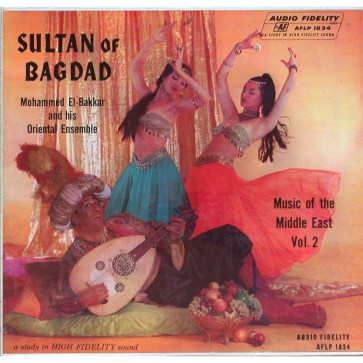
In American and European popular culture, zaghareet has played a notable role in framing depictions of the Middle East, particularly through the female body. In the years following World War II, zaghareet samples often marked the Middle East as wild and exciting. Lebanese-born singer Mohammed El Bakkar, for example, used the sound of zaghareet on his song “Yalla-Yalla” from the 1958 album The Sultan of Bagdad, one of several albums he recorded for the Audio Fidelity label in the late-1950s marketed to a mainstream American audience.
.
“Yalla-Yalla,” which translates loosely as “Come with me,” features finger cymbals, clapping, and female zaghareet, along with jovial calls from El Bakkar at the ends of phrases, conjuring a celebratory setting. All of these elements–along with the album cover photo that shows El Bakkar lounging on a cushion with two beautiful dancers standing over him–combine to create a quintessential exotic scene for many American listeners.
Although unintentionally kitschy at times, the 1962 British epic Lawrence of Arabia—a film which has the dubious distinction of having no spoken lines by a woman in its 3 1/2 hour running time—represents zaghareet quite seriously. The ululations first appear about half of the way through the film, where Lawrence and the Arab forces set off to fight the Turkish at Aqaba, and women provide blessings and encouragement.
.
Lawrence of Arabia is a classically orientalist film about the scope of British empire, and in this instance, zaghareet accentuates the majesty of the scene where Lawrence rides beside his Arab counterparts through the desert with veiled women calling from the cliffs above. Like the previous example, the women here constitute part of a foreign landscape, and their cries of encouragement serve along with the visuals to construct a multi-sensory experience of otherness.
Zaghareet has taken on more explicitly violent associations in a post-9/11 American context, where it is often coupled with Arab depravity and linked to terrorism. Zaghareet was demonstrated in a newsclip aired on CNN, Fox, and several other news networks displaying Palestinians in the West Bank “celebrating after 9/11.” One woman in the clip briefly ululates in front of the camera, connecting the sound to perceived Arab hatred for Americans.
.
The video went viral, and reactions to it exemplify the extent to which zaghareet has come to symbolize a new stereotype in the post-9/11 era: the depraved Middle Eastern Other. This formula collapses and combines the categories of “Arab” and “Muslim,” and, although it complicates the figure of the terrorist as male, since it is a woman who is shown celebrating after 9/11, it also reveals western anxieties about the power that Lawrence of Arabia represented as harnessed by colonial forces.
Screen shot by author
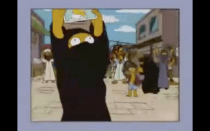
A parody of the viral news clip appeared on a 2004 The Simpsons episode entitled “Bart-Mangled Banner” in which Bart accidentally moons the American flag at a basketball game, and subsequently faces a public outcry from critics calling him anti-American. The nightly news shows the “overseas” response, in which a woman wearing niqab holds up a photo of Homer and says “Simpsons be praised! Praise be to Springfield!” and then performs zaghareet against a backdrop of celebratory gunfire. This satire hints at the absurdity of controversies over such displays, but it also reinscribes the idea of the Arab/Muslim female as a source of danger, a new element of anti-American hostility that became associated with the sound after 9/11.
Unlike previous impressions of zaghareet, which focused on the sound as part of an exotic terrain, post-9/11 visions tend to locate practitioners in a distinctly antagonistic matrix. The distinctive sonicity of zaghareet makes it particularly susceptible to portrayals that frame it as a sign of Arab barbarity. For certain performers, however, such as belly dance students in Washington, DC, zaghareet is not subject to this type of racialized logic, and is instead treated as an ethnic novelty. In American film, TV, music, and a range of other contexts, zaghareet is becoming increasingly audible, and it is a phenomenon that deserves thoughtful and critical attention.
—
Meghan Drury is a fifth-year Ph.D. candidate in the Department of American Studies at the George Washington University. She received an MA in ethnomusicology from UC Riverside in 2006. She is currently working on a dissertation tentatively titled “Aural Exotics: The Middle East in American Popular Music 1950-2011.” This project examines the interplay between popular music and American cultural representations of the Middle East from the mid-20th century to the present, illustrating how music and sound acted a means of consolidating and disseminating a range of ideas about Middle Eastern culture in the American mainstream. She is particularly interested in the way that sound increased the visibility of Arab Americans both before and after 9/11, offering a space for negotiations of identity. More broadly, Meghan’s interests include sound studies, U.S.-Middle East cultural relations, and Arab American cultural performance.
—
REWIND! . . .If you liked this post, you may also dig:
Rallying Cries as Suffering Sounds: “Allah-O-Akbar” and the Aurality of Feminized Iranian Suffering–Roshanak Kheshti
Aurally Other: Rita Moreno and the Articulation of “Latina-ness”–Priscilla Peña Ovalle
Beat-ification: British Muslim Hip Hop and Ethical Listening Practices–Jeanette Jouili
Share this:


Current Top Posts





April 2021

January 2020

November 2019

October 2019

August 2019

April 2014

November 2017

March 2015

December 2017

October 2015
 Sounding Out!
Recent Comments