
Voices at Work: Listening to and for Elsewhere at Public Gatherings in Toronto, Canada (at So-called 150)

“Decolonization,” Eve Tuck and K. Wayne Yang propose in “Decolonization is Not a Metaphor,” “is not an ‘and.’ It is an elsewhere.”
Elsewhere, not here, not now. Not here. Not now. Enough!
In the context of decolonization, elsewhere is a refusal to accept the conditions of life as is in the here and now.
Elsewhere is that place that already is, that place that used to be, that place that might just be.
Elsewhere, an endeavor to enact otherwise.
Elsewhere, a commitment to perform the work to create, memorialize, and sustain some place else because the here and now are not enough.
This essay listens to and for elsewhere in the voices performing decolonial efforts at some public gatherings—rallies, protests, marches, and memorials—in Toronto between March 2016 and June 2017. These gatherings took place in the lead-up to Canada (at so-called) 150, the federally funded, almost countrywide commemoration of Canadian Confederacy. At these public gatherings, the dissenting sounds of elsewhere reverberate to break the silence tantamount to Canada as a white settler colonial nation-state. It is by disrupting this silence that elsewhere takes form; “a break of something,” writes Sara Ahmed in her latest book, Living a Feminist Life, is also “the start of something” (200). This essay is about listening to the voice as a social prism of sound that disperses and reflects power. Thus by listening to and for elsewhere at public gatherings, we hear voices at work—in formation—producing an elsewhere by refusing to comply with the sonic demands of a Canadianness based on white settler colonialism, dependent on state-sanctioned multiculturalism, and rendered as silence.
Canadian Multiculturalism as Silent Visibility,
or the Visible Silence of White Settler Colonialism as Canada
Silence is often a condition of belonging that nation-states attach to citizenship. Indeed in Canada, visibility begets silence. Canadian Prime Minister Pierre Elliott Trudeau (1968–1979; 1980–1984) adopted Multiculturalism within a Bilingual Framework as official policy in 1971. This would subsequently catalyze the appearance of the figure of the visible minority, a demographic designation for anyone who is non-white and non-Indigenous but used as an umbrella term to denote “person of color.” The visible minority has been central to the discourse of diversity as multiculturalism; and diversity continues to be an enduring tenet of Canadian nationalism.
However, according to Eva Mackey’s The House of Difference: Cultural Politics and National Identity in Canada, the policy of multiculturalism is “primarily concerned with mobilising diversity for the project of nation-building, as well as limiting that diversity to symbolic rather than political forms” (80). To be understood as Canadian, one must ascribe to its multicultural terms, namely accepting white settler colonialism—and the sonic politics of whiteness—as norm; and typically, whiteness is thought to be unmarked and inaudible, silent.
It is in this way that in Canada silence is understood as harmony. Another way to put this: social harmony is believed to derive from silence. Any person or group or form of sound that breaks this social contract, what Audra Simpson refers to in “The State is a Man: Theresa Spence, Loretta Saunders and the Gender of Settler Sovereignty” as “Canadian silence,” is categorized as noise or noisy. Thus in the context of the US, and yet very much applicable to Canada, Jennifer Lynn Stoever writes in her book The Sonic Color Line, “As dominant listening practices discipline us to process white male ways of sounding as default, natural, normal, and desirable…they deem alternate ways of listening and sounding aberrant” (12).
Social censorship in Canada of what can and cannot be said in public is a distinguishing feature of everyday life. Silence is a sonic means by which white settler colonialism thrives. Stay quiet. Be quiet. Or, else; where the threat becomes a dare to live a life unrestrained by what Lesley Belleau describes as “the false safety of silence” in The Winter We Danced (181).
This else though. What are the possibilities of this else? Where might it lead?
Elsewhere.
Black Lives Matter Toronto Rally /// #BLMTOblackOUT
#BLMTOtentcity /// Toronto Police Service Headquarters
Saturday, March 26, 2016
It was a blustery, cold, spring day. Black Lives Matter Toronto (BLMTO) had organized a rally, #BLMTOblackOUT, to commemorate the then one-week anniversary of #BLMTOtentcity—their occupation of Toronto Police Service Headquarters’ outdoor plaza. On Sunday, March 20, 2016 outside Toronto City Hall in Nathan Phillips Square, BLMTO held a rally against anti-black racism—police brutality (in particular the killing of Andrew Loku and Jermaine Carby by the police), carding, and the defunding of black cultural programs, Afrofest namely. By evening’s end, the rally had moved to Toronto Police Service Headquarters where it became an occupation that lasted two weeks.
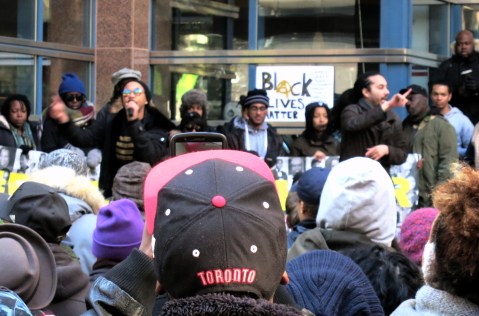
#BLMTOblackOUT, Toronto Police Service Headquarters, Toronto, Saturday, March 26, 2016, image by author
BLACK LIVES THEY MATTER HERE,” a BLMTO member shouted into a microphone; a call and declaration of a black elsewhere affirmed by the audience’s response: “BLACK LIVES THEY MATTER HERE.”
#BLMTOblackOUT, Toronto Police Service Headquarters, Toronto, Saturday, March 26, 2016, recording by author
She reiterated, “BLACK LIVES THEY MATTER HERE,” as Rhythms of Resistance Toronto, a band that performs at social justice events across the city, began to accompany her with a samba groove; this was elsewhere as a black diasporic space. “BLACK LIVES THEY MATTER HERE,” confirmed the audience in response who were now clapping along to the beat. A back-and-forth ensued where repetition and the obstinacy of the leader’s voice marked what Daphne Brooks has identified in “All That You Can’t Leave behind”: Black Female Soul Singing and the Politics of Surrogation in the Age of Catastrophe” as “urgency and excess.” This urgency and excess were further compounded by the start of another chant, which interlocked with the one she was leading. Another member of BLMTO then exclaimed into a microphone, “NO JUSTICE, NO PEACE. NO RACIST POLICE.” Some of the audience members began to heed her call. “BLACK LIVES THEY MATTER HERE / NO JUSTICE, NO PEACE. NO RACIST POLICE.” Together, the two chants, loud and overpowering, created a tension that paralleled the social pressures wrought by a Canadian silence that takes the form of anti-black racism.
After a few rounds of the layered chant were exhausted, the second leader stopped to catch her breath. By bringing the chant to a halt, she demonstrated not only the toll that shouting takes on a person but also the labor, power, and duress needed, according to Kelley Tatro, “to express personal and collective rage.” “I can’t breathe,” said Eric Garner eleven times while the police officers holding him down against the pavement disavowed him of his personhood. In the US and Canada, breathing and shouting are presumed antithetical to life within the realms of white settler colonialism.
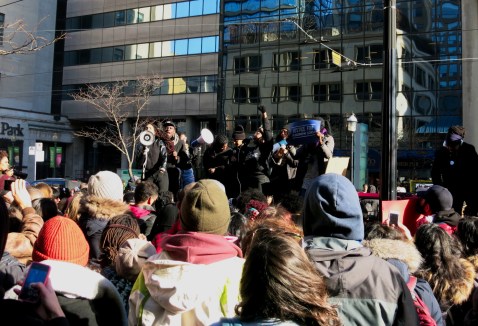
#BLMTOblackOUT, Toronto Police Service Headquarters, Toronto, Saturday, March 26, 2016, image by author
Shouting, performing anger and defiance via sound in public, is considered noise under the logics of whiteness. Thus, as Jack Halberstam writes in the introduction to Stefano Harney and Fred Moten’s The Undercommons, “In order to bring colonialism to an end then, one does not speak truth to power, one has to inhabit the crazy nonsensical, ranting language of the other, the other who has been rendered a nonentity by colonialism” (8). What both BLMTO members leading chants indicated at #BLMTOblackOUT is that shouting, in this case in the form of chanting, is another way of breathing elsewhere into existence.
#NoDAPL Solidarity March with Standing Rock
Queens Park to Nathan Phillips Square
Saturday, November 5, 2016
It began where many politically motivated public gatherings in Toronto do: outside Queen’s Park, which houses the Government of Ontario offices. Participants made speeches, chanted, cheered, jeered, and sang songs. The crowd then headed south on University Avenue sounding their discontent in front of the US Consulate building, which coincidentally is on the way to Nathan Phillips Square.
The march had been organized by and alongside Indigenous groups to show support for protesters at Standing Rock. In solidarity with the Water Protectors holding camp at Sacred Stone Camp, marchers in Toronto were expressing their disapproval of the US government’s efforts to construct an oil pipeline through Indigenous territory, a project that endangers clean water resources and violates treaties.
Once at Nathan Phillips Square, Indigenous people led participants in a pan-tribal round dance. Most strongly since Idle No More, or #IdleNoMore, in the winter of 2012/2013, round dances became emblems of Indigenous self-determination across what is typically referred to as Canada. Taking place in public venues, notably malls, as part of Idle No More actions, round dances served as communal claims not to Canada and Canadianness but rather to Turtle Island and Indigeneity.
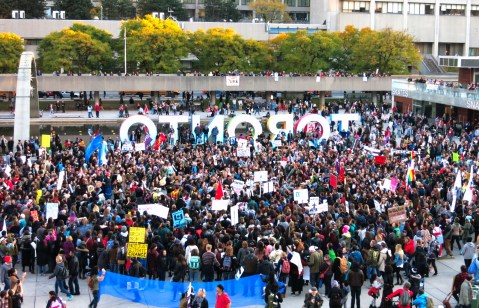
Round Dance, Nathan Phillips Square, Toronto, Saturday, November 5, 2016, image by author
Along with drumming, singing makes up the sonic elements of a round dance all the while those participants not playing a drum in the middle of the circle hold hands and move in a clockwise direction to the music. The high-pitched singing voice invites and welcomes those who have passed to join. In this way, the singing voice is an understanding that life and kinship do not cease at death. As such, the high-pitched singing voice is also a reach towards something else, a nameless elsewhere describable, graspable, through vocables. These vocables, these sonic registers of possibility, cannot be contained by the limitations of any official language. As part of round dances, then, vocables announce that while this elsewhere has yet to be legitimized through language, it exists in sound. And elsewhere’s existence is celebrated by what Anna Hoefnagels writes in “Northern Style Powwow Music: Musical Features and Meanings” are the improvised “whoops, shouts, yelps or ululations by singers” (14).
Through round dances, Indigenous people recognize that according to treaties signed by Indigenous groups and European settlers the land and its resources are to be shared. Round dances are a means to assert that Turtle Island is not another name for North America but rather a place that exists alongside North America.
Women’s March on Washington: Toronto
Queen’s Park to Nathan Phillips Square
Saturday, January 21, 2017
The labor, the creativity, of women of color is largely to thank for the organizing and mobilizing efforts that led to the Women’s March on Washington. Toronto’s “sister march” made evident the ways in which the work that women of color, particularly black women, perform in producing elsewhere has and continues to go unrecognized. The use of songs with black female vocals to lead Toronto’s Women’s March is an example of how audibility accompanies invisibility in Canada.
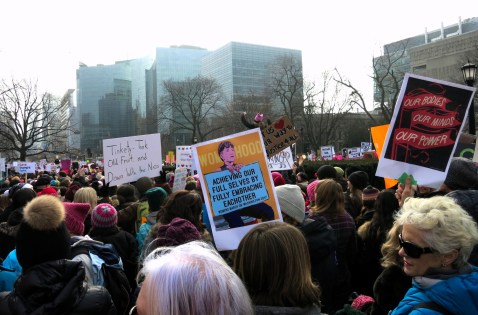
Women’s March on Washington: Toronto, Queen’s Park, Toronto, Saturday, January 21, 2017, image by author
he joyous tenor of the march was introduced partially through disco and disco-inflected songs like Sister Sledge’s “We Are Family” (1979) and the Eurythmics’ and Aretha Franklin’s duet “Sisters Are Doin’ It for Themselves” (1985). March organizers wanted participants to feel that this march was a celebration of sisterhood, of women, like Aretha Franklin and Annie Lennox, coming together harmoniously as kin. Intersectionality need not apply—maybe as a catchword but definitely not in practice.
Women’s March on Washington: Toronto, Queen’s Park, Toronto, Saturday, January 21, 2017, recording by author
.
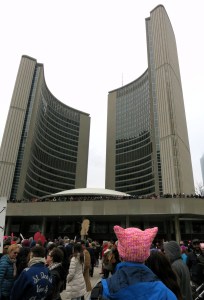
Women’s March on Washington: Toronto, Nathan Phillips Square, Toronto, Saturday, January 21, 2017, image by author
The emotional labor that Debbie, Joni, Kim, and Kathy Sledge of Sister Sledge and Aretha Franklin perform in these songs was not meant to be heard as women belaboring a black feminist, or womanist or queer, elsewhere; instead, marchers—like much of white feminism historically—enjoyed the benefits, without the risks, of an elsewhere made possible by the emotional labor that black female singers perform in dance music. In the voices of Sister Sledge and Aretha Franklin, some marchers did not recognize the invisible labor required to flourish in white settler heteropatriarchal nation-states; at the march, the power of black female voices was misappropriated to signal thriving because of white settler colonialism, paternalism, and blanket sisterhood.
Women’s March on Washington: Toronto, Queen’s Park, Toronto, Saturday, January 21, 2017, recording by author
.
Pulse Memorial
Barbara Hall Park
Monday, June 12, 2017
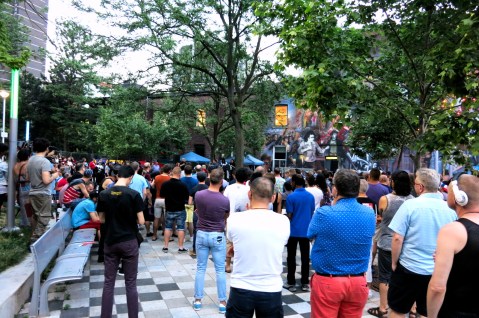
Pulse Memorial Event, Barbara Hall Park, Toronto, Monday, June 12, 2017, image by author
Adjacent to Toronto’s AIDS Memorial in Barbara Hall Park, attendees gathered to remember the forty-nine victims of the shooting at Pulse Nightclub in Orlando, Florida. The event commemorated the one-year anniversary of the shooting with a short film screening, a DJ set, musical performances, poems, short speeches, and food. Surrounded and sustained by the light of candles, the names of the forty-nine primarily Latinx victims were read by the event’s three MCs against the flickering screen of the lit wicks.
Pulse Memorial Event, Barbara Hall Park, Toronto, Monday, June 12, 2017, image by author
| Stanley Almodovar III, age 23
Amanda Alvear, 25 Oscar A. Aracena-Montero, 26 Rodolfo Ayala-Ayala, 33 Alejandro Barrios Martinez, 21 Martin Benitez Torres, 33 Antonio D. Brown, 30 Darryl R. Burt II, 29 Jonathan A. Camuy Vega, 24 Angel L. Candelario-Padro, 28 Simon A. Carrillo Fernandez, 31 Juan Chevez-Martinez, 25 Luis D. Conde, 39 Cory J. Connell, 21 Tevin E. Crosby, 25 Franky J. Dejesus Velazquez, 50 |
Deonka D. Drayton, 32
Mercedez M. Flores, 26 Peter O. Gonzalez-Cruz, 22 Juan R. Guerrero, 22 Paul T. Henry, 41 Frank Hernandez, 27 Miguel A. Honorato, 30 Javier Jorge-Reyes, 40 Jason B. Josaphat, 19 Eddie J. Justice, 30 Anthony L. Laureano Disla, 25 Christopher A. Leinonen, 32 Brenda L. Marquez McCool, 49 Jean C. Mendez Perez, 35 Akyra Monet Murray, 18 Kimberly Morris, 37 Jean C. Nieves Rodriguez, 27 |
Luis O. Ocasio-Capo, 20
Geraldo A. Ortiz-Jimenez, 25 Eric I. Ortiz-Rivera, 36 Joel Rayon Paniagua, 32 Enrique L. Rios Jr., 25 Juan P. Rivera Velazquez, 37 Yilmary Rodriguez Solivan, 24 Christopher J. Sanfeliz, 24 Xavier E. Serrano Rosado, 35 Gilberto R. Silva Menendez, 25 Edward Sotomayor Jr., 34 Shane E. Tomlinson, 33 Leroy Valentin Fernandez, 25 Luis S. Vielma, 22 Luis D. Wilson-Leon, 37 Jerald A. Wright, 31 |
The reading of their names was an incantation of forty-nine lives lost and an invocation of an elsewhere maintained through remembrance. The vocalization of their names was thus a commitment to an understanding of intimacy that refuses the state’s limited definitions of what and whom constitutes a (grievable) life; and concurrently, their names were sonic acknowledgments of the violence that is basic to life for many under white settler colonialism, what Christina Sharpe calls “being in the wake.” Their names, too, were evocations of the queer of color dancefloor. It us under and around the disco ball, after all, that many queers of color enact an elsewhere, love light in flight. Therefore, the reading of the forty-nine names was an assertion that life and intimacy are sonic demands and collective endeavors.
Night March
George Hislop Park to Old City Hall
Wednesday, June 21, 2017
Annually, some queer Canadians take it upon themselves to organize a Night March, an unofficial (by choice) Pride event that insists that Pride has been and will continue to remain political. Night March is a refusal to abide by the respectability politics attached to the visibility and corporatism that Pride garners across Toronto. “LET’S GET CRITICAL, OUR PRIDE IS POLITICAL,” one of the chants goes. Participants meet at a predetermined location, announced through posters and social media, somewhere near or in the Church and Wellesley Neighborhood—Toronto’s “gayborhood.” Before setting out to march, participants listen to a small set of speakers who share information on some of the issues that are not being discussed at Toronto’s official Pride events: the defunding of organizations working on HIV/AIDS and the housing discrimination faced by trans women and sex workers, for example.
The gathering at George Hislop Park this year also made evident a particular rift among LGBTQ+ people, groups, and institutions surrounding this year’s Pride festivities: whether to support BLMTO’s actions and demands at last year’s Pride Parade, namely the removal of uniform police from partaking in future parades. On Sunday, June 26, 2016 and in their role as honored guests of the parade, members of BLMTO halted Toronto’s Pride Parade at the intersection of Yonge and College Streets for thirty minutes—to the dismay of some and the approval of others. It was then that BLMTO served Pride Toronto, the organization that runs Pride in the city, with a list of demands. Pride Toronto’s Executive Director at time Mathieu Chantelois hastily signed BLMTO’s list of demands only to retract his approval shortly thereafter. Following months of heated debate and backlash against BLMTO, the Pride Toronto membership formally agreed to adopt all of BLMTO’s demands at its Annual General Meeting (AGM) on January 27, 2017—uniformed police would not march at this year’s Pride parade.
At George Hislop Park, Night March participants were unequivocal in their support of BLMTO. The mostly millennial and predominantly white gathering’s chants, which they shouted as they made their way down Church Street, included “BLACK LIVES MATTER” and “NO JUSTICE, NO PEACE. NO RACIST POLICE.”
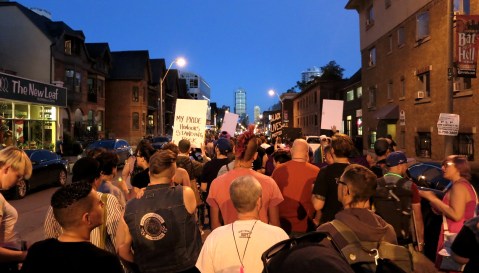
Night March, Church Street, Toronto, Wednesday, June 21, 2017, image by author
Night March participants even halted traffic on College Street as they briefly occupied the traffic lanes in front of Toronto Police Service Headquarters. Accompanied by Rhythms of Resistance Toronto, a few participants called out “BLACK LIVES THEY MATTER HERE.” The rest of the gathering responded, “BLACK LIVES THEY MATTER HERE.”
Night March, Toronto Police Service Headquarters, Toronto, June 21, 2017, image by author
.

Night March, Toronto Police Service Headquarters, Toronto, June 21, 2017, image by author
Police officers who were following the marchers on bicycles sounded out a short siren, a sound of disapproval and a warning to disperse. The marchers continued chanting. They then switched chants and began shouting in unison, “NO JUSTICE, NO PEACE. NO RACIST POLICE.” After a few rounds of this chant, one participant led the gathering into another chant:
WHEN BLACK LIVES ARE UNDER ATTACK, WE REVOLT, UNITE, FIGHT BACK. x9
WHEN TRANS LIVES ARE UNDER ATTACK, WE REVOLT, UNITE, FIGHT BACK. x3
WHEN INDIGENOUS LIVES ARE UNDER ATTACK, WE REVOLT, UNITE, FIGHT BACK. x3
WHEN WOMEN’S LIVES ARE UNDER ATTACK, WE REVOLT, UNITE, FIGHT BACK. x3
WHEN QUEER LIVES ARE UNDER ATTACK, WE REVOLT, UNITE, FIGHT BACK. x3
The chants at Night March were sonic testaments of an elsewhere impossible to imagine and enact without the collective labor of BLMTO’s membership since its formation in 2014, which has included but has not been limited to #BLMTOtentcity and their protests at Toronto’s 2016 Pride Parade. The chants were also a compilation and validation of noisy political activity—a loud elsewhere—in a city and in a nation-state that prefers, promotes, and is predicated on the silence, the violence, that is white settler colonialism.
Conclusion
“Only together,” argues Gloria Anzaldúa in Borderlands/La Frontera, “can we be a force” (209).
Together, these voices at public gatherings say NO to Toronto, Canada at so-called 150; NO is a refusal to be complicit, to stay silent, to death. These are voices that do not consent to white settler colonialism. A NO to police brutality, the disappearance and murders of Indigenous women and girls, the conditions that drive Indigenous youth to suicide, lack of clean drinking water, carding, anti-semitic and Islamophobic hate crimes, the different forms of violence LGBTQ+ people, particularly trans women, face, the municipal, provincial, and federal governments defunding and unfunding of public housing and healthcare programs. It is by amplifying and listening to these NOs that we actually hear the workings of a YES, to an affirmation of elsewhere in the here and now that is always already attuned to the past and future, to lives—black, trans, Indigenous, feminine, queer—that matter, to life otherwise.
—
Featured Image: Round Dance, Nathan Phillips Square, Toronto, Saturday, November 5, 2016, photo by author
—
Gabriela Jimenez defended her PhD dissertation in ethnomusicology at the University of Toronto this spring. Her dissertation is on the ways in which nonnormatively gendered and sexually oriented persons in Mexico City use musical performances to alter their surroundings. Her writing has been featured in Black Music Research Journal and The Fader.
—
 REWIND!…If you liked this post, you may also dig:
“Quebec’s #casseroles: on participation, percussion and protest”-Jonathan Sterne
“Deejaying her Listening: Learning through Life Stories of Human Rights Violations”-Emmanuelle Sonntag and Bronwen Low
“Listening to the Border: ‘”2487″: Giving Voice in Diaspora’ and the Sound Art of Luz María Sánchez”-D. Ines Casillas
Share this:

Deep Listening as Philogynoir: Playlists, Black Girl Idiom, and Love


Here at Sounding Out! we like to celebrate World Listening Day (July 18) with a blog series. This year, we bring your attention to the role of listening when it comes to the sounds of the K-12 classroom, and by extension, the school.
Any day in a K-12 school involves movement and sounds day in and day out: the shuffling of desks, the conversations among classmates, the fire drill alarm, the pencils on paper, the picking up of trays of food. However, in many conversations about schools, teaching, and learning, sound is absent.
This month’s series will have readers thinking about the sounds in classrooms in different ways. They will consider race, class, and gender, and how those aspects intersect how we listen to the classrooms of our past and our present. More importantly, the posts will all include assignments that educators at all stages can use in their classrooms.
Time’s up, pencils down, and let’s listen to Shakira Holt‘s playlists, compiled by three of her high school graduates. –Liana Silva, Managing Editor
—
This past school year, in my roles as a high school teacher who likes what music can do for the classroom environment and as a Link Crew Coordinator who oversees student leaders as they host a mixture of freshman-only and schoolwide events, I frequently found myself sternly censoring black female student contributions to musical playlists. Although I emphasized the criterion of “clean” with increasing exasperation, my students just did not seem to get it. Strangely overlooking “ni**a,” “f***,” and “s**t,” they brought me songs, which, if played, would have gotten me called into the principal’s office, literally. When they triumphantly approached me with “clean” versions, they typically cast not a moment’s thought towards the lyrical content of drugging, drinking, fighting, and sexing, topics no less hazardous for campus play. Clearly, my students and I were working from battling notions of “clean.”

Parental Advisory label, By RIAA (RIAA) [Public domain], via Wikimedia Commons
Feeling every bit the forty-year old school marm that I am, I remain abundantly clear on my objections to these songs for general classroom and campus use. However, I confess that my effectual silencing of these young women never sat quite right with me. It nagged me with worries over what I was really refusing to hear, to make space for by shutting off the voices of these young black women in this way.
However outré, daring, or trouble-making I may fancy myself as a scholar and thinker, when placed within the K-12 context, I am, it turns out, your average, workaday campus censor. I hypocritically feign alarm at cussing. I fake-clear my throat with loud ahems whenever that blue talk ventures into the X-rated. While I fully respect the creativity and naughtiness of student-to-student speech and spend a good bit of time pretending not to hear what is meant to be conversation among peers, there is a limit I feel compelled to enforce. Whenever the volume grows too loud for me to pretend not to have heard or when the word choice becomes spectacularly adventurous, the expectations of the classroom/campus setting demand my intervention. Dutifully, I step in as judge and censor.
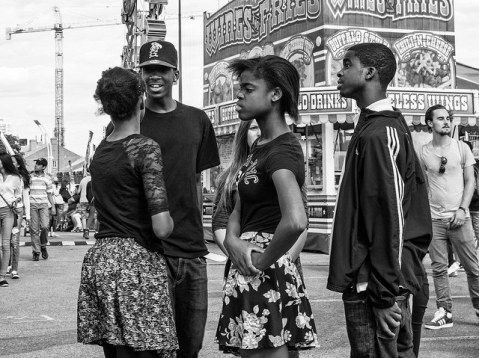
“DSC02583_ep_gs” by Flickr user Erik Parker, CC BY-NC 2.0
Nor is this a singular feature of schools. Places and spaces of all kinds depend heavily upon the extent to which both occupants and itinerants adhere to place-based expected modes of behavior and speech. It is important to note that even when enforced and observed by people of color, these behavior and speech norms remain overwhelmingly middle-class and white in origin and character, which can lead to interesting, sometimes alarming, and even deadly implications for people of color who enter “allegedly public” spaces without observing these norms, as Jennifer Lynn Stoever points out. In the Introduction to The Sonic Color Line: Race & the Cultural Politics of Listening, Stoever argues that in failing to act or speak in ways that reflect the place-based expected modes of behavior and speech governing such spaces, people of color frequently run the risk of falling prey to what she calls “white Americans’…implicit, sometimes violent, control over…an ostensibly ‘free,’ ‘open,’ and ‘public’ space” (2). This risk, as Stoever illustrates, often exposes non-compliant people of color to condemnation, confrontation, and even bodily harm.
 The collision of place/space, race, and gender is a natural element of life in the U.S. and has become a regular and needful facet of contemporary national discourse. In a brilliant analysis of this collision as it took place in the 2013 George Zimmerman trial, Regina Bradley explores how the presence of Rachel Jeantel laid bare the way in which enforcement of place-based norms is often racialized and gendered. Rachel Jeantel is the young black woman whose body, comportment, and speech set off waves of derision and controversy as she testified in court regarding the last living moments of her close friend, Trayvon Martin. Bradley recalls how critics ignored Jeantel’s anguish, her grief, and her trauma in order to train excessive focus on her “refusal and inability to conform to expected cultural and aural scripts of black womanhood within the confines of the courtroom.” The courtroom’s “cultural and aural scripts of black womanhood” demand overt demonstrations of respect, if not outright intimidation, passivity, and general humility in tone and demeanor which would typically compensate for any deviations from Standard American English speech norms. Jeantel’s speech played only by the rules of what Brittney Cooper has called “her own particular, idiosyncratic black girl idiom” as created by her “Haitian and Dominican working-class background, her U.S. Southern upbringing, and the three languages—Haitian Kreyol…Spanish, and English—that she speaks,” and not by the rules of SAE. Thus lacking both the gentle mien expected of black women in court and an acceptable mainstream speech pattern, Jeantel suffered a broad range of brutal racist, classist, and sizeist critiques centering not only on her attitude and her speech, but also on her weight, her skin tone, her hair, and her general unfitness for public consumption.
Like the courtroom, the K-12 classroom and campus are place-based contexts that possess their own “expected cultural and aural scripts.” These scripts prescribe and police such speech elements as volume, tone, syntax, diction, and content. Like courtrooms and other spaces, the K-12 classroom and campus can easily become oppositional, and sometimes downright antagonistic, towards the young black female people who occupy these spaces while speaking their “own particular, idiosyncratic black girl idiom[s].” The idiosyncrasies of their idioms can so completely transgress the K-12 cultural and aural script that these young black female people often lose the right of being heard altogether, of achieving any attention at all beyond opprobrium for their transgressiveness. Bradley writes pointedly of Jeantel, “Her emotionally charged question ‘are you listening?’ jolted not only [George Zimmerman’s attorney, Don] West but those watching the trial. Were we listening? What were we listening for?” I find overwhelming resonance here because when I reframe my students’ playlists and song choices as alternative types of “idiosyncratic black girl idiom,” I must also reframe myself as an agent of what Bradley calls “hyper-respectability,” a source of censure and scorn. I must then answer Jeantel and Bradley’s questions honestly: For most of the year, I was not listening to my black female students. Too preoccupied with listening for speech that matched the cultural and aural scripts of the K-12 classroom and campus, I repeatedly silenced idiosyncratic black girl idiom, enacting an all too-frequent response to black female voices.

“son of roots” by Flickr user Brittany Randolph, CC BY-NC-ND 2.0
This sin against my students becomes even clearer when I consider it in the context of terms set forth by Robin James in “How not to listen to Lemonade: music criticism and epistemic violence.” James discusses at length how music criticism can inflict great violence upon “black women’s cultural and creative work” by “recentering [white] men as authorities and experts.” When white men are recentered as omniscient, innately generic, and consummately universal arbiters of culture and artistry, cultural and creative work emerging from outside of their personal and cultural frames of reference become subjected to filters, demands, and expectations often inapplicable or inappropriate to the work but especially to the black female experiences and vantage points from which that work arises. Hence the “epistemic violence” of which James’ title speaks. Without difficulty, I can replace James’ “black women’s cultural and creative work” with Cooper’s “idiosyncratic black girl idiom,” or even have my own go at it with “black female vision and voice.” I can then also substitute James’ “recenter[ed white] men with “recentered elder/teacher/agent of hyper-respectability.” Having done so, I arrive once again at the epistemic and ontological violence I enacted upon my students—for good reason, of course, but to the same unfortunate end.
My intention is not to intimate that I should have green lighted their every choice and let their music go blaring from the loud speaker at lunch while high school kids enjoyed our classic recess days, during which big kids actually had fun at lunch, dancing and tossing the football (girls, too!) and jumping double-dutch. In retrospect, I see now that there was a way to keep that aural space PG-13 AND to listen deeply to the songs that mattered most to these young women, to hear not only what the songs were saying to them but more importantly to hear what they were saying through the songs. I am saddened that I could have been generating ways throughout the year to center and amplify the very black female student voices I stifled and silenced far too often, for far too long.

“Afro Punk Fest 2013” by Flickr user J-No, CC BY-NC-ND 2.0
This post is an attempt at redemption for all my huffy exasperation and my quickness to relieve them of the aux cord this school year. Enlisting the help of the three seniors (now graduates) who bore the brunt of all my aux cord snatching, I have set about putting things right. I asked them to compile playlists of their top five songs, along with the lyrics. I then asked these young women either to come in and speak with me about their songs or to submit written commentary about the music they chose. I took off all restrictions and encouraged them to select whatever songs their hearts desired.
When I first imagined the critical value of engaging in this project, I figured that I might be able to mine their playlists and commentaries for some Patricia Hill Collins-esque crystallization of black female thought as it exists at this moment, late in the second decade of the new millennium, among high school seniors on the cusp of black womanhood in a country which remains steadfastly anti-woman, anti-black, and anti-black woman. That is indeed a worthy project and one which deserves completion. For this post, however, I simply want to listen to my students at long last. I want to listen closely, and I want to listen deeply. I want others to listen to them, too.
Attending fully to the thoughts and words and feelings of black female people, is but one means of expressing a form of love I call philogynoir. Clearly, this term plays with and off of Moya Bailey’s misogynoir, which she defined upon its 2010 inception as a “the particular brand of hatred directed at black women in American visual & popular culture.” Philogynoir is my attempt to rise to the challenge of naming, which Bailey identified as essential to addressing social ills. She told Mic.com last year, “I think we have to refine language in a lot of different ways so we can actually come up with solutions that help the communities we want to address,” she said. “When you use language that’s generic or unspecific you can get at some of the problem, but not all of it.”
If misogynoir calls out racist-sexist hatred aimed squarely at black women so that that hatred can be challenged and ultimately eliminated, then the concept of philogynoir provides a name for conscious gestures of love towards those same people—words, acts, and artifacts of acknowledgement, admiration, and adoration which have the potential to neutralize and ultimately undo the effects of the hatred. Deep listening, as I imagine it, in its potential to affirm, to humanize, to dignify, and to amplify, can be activated as a powerful form of philogynoir.
Other than the chance to redress my teacherly wrongs, the greatest honor I experienced in this philogynoir project was the opportunity to attend to the hurts of my students by listening to their distress, their agony. To be sure, their playlists and commentaries demonstrate that the idiosyncratic black girl idiom is highly equipped to express a full range of feelings, thoughts, experiences, and yearnings, so I hesitate to make any move which might define and confine the black female experience or its idiosyncratic idiom only in terms of pain and trauma, especially when there is such little space for black girl pain beyond its most fetishized pop culture iterations. The pain and the trauma are there, however, and deserve witness and respect.

“Listen to the music” by Flickr user Ludo Rouchy, CC BY 2.0
I call attention to the pain and the trauma in my students’ idiosyncratic black girl idiom because it is precious. These are sacred hurts, holy injuries—not because they were inflicted by a deity, but because where they touched the lives of these young women, they became creative forces, shaping the signs and symbols by which these young women will know and be known, by which they will call and be called. There is tragedy here, yes, and terrible misery—but there is also mystery and great, thrilling, healing power, as well. My fervent wish for these young women is that with time, they will come to embrace the mystery and to know healing in every hurting place. My prayer is that they will each, in time, wield that creative force of their own accord to make something beautiful and lasting in the genius of their own idiosyncratic black girl idiom.
What follows are the playlists, with commentary, of these three young black women (whose names I have changed), both bespeaking and spoken in the “idiosyncratic black girl idiom” of each individual young woman, articulating each unique voice and vision and innately honoring the experiences that have shaped them. I have included no critiques of the songs or even of their commentaries. For the time being, these playlists represent a sacred line in the sand across which I will not venture with critique.
I am simply listening now. I’m listening to them, and I’m listening for them…in solidarity and in love.

“Afro Punk Fest 2013” by Flickr user J-No, CC BY-NC-ND 2.0
Amani’s List
- Long Song Away by Kevin Ross
This whole song is jazzy, especially the intro. It’s about a girl in the rush of it all. I connected to it because I had so many responsibilities at home. I never had time for fun. My life was joyless. I was like a robot. I finally had to have a conversation with my mom and let her know that she would have to let me live a little and be young. There had to be some kind of fun in my life. This song is about slowing down and just letting the record play.
- Confidently Lost by Sabrina Claudio
This song speaks to me. I’ve been lost before and I got to a place where I was comfortable with my lostness. I love the part about “I don’t need you to find me cuz I’m not hiding anything.” This is a good soul/R&B song about how hard it is to figure out what will bring you fulfillment but that’s not a bad place to be. Being lost is not necessarily anything negative. It means you’re going somewhere.
- Redbone by Childish Gambino
This song makes me want to put on some skates and roll-bounce to it. A lot of people like the groove on this song, but they miss the deeper meaning. It’s telling people to wake up and be known for who you are. It has a lot of references to the Black Lives Matter Movement and the dangers involved in being black. When he says “scandalous” and “creep up on you,” he’s talking about police brutality and racism, especially with the president we have now, and when he says “greenlight,” that’s a code for “wake up” as in “be woke.”
- Location by Khalid
This one is about early teenage love and it’s talking about how we are all too attached to our electronics, so when he says “send me your location,” he’s talking about using the electronics as a way to get to face-to-face communication.
- Put It On Me by Jah Rule feat. Lil Mo & Vita
I like this song maybe because I was born in them days. It’s about a thug and his ride-or-die chick. I like the part when he says, “Every thug needs a lady.” But this song actually means more to me than just the song. In my family, I have many family members who have ties to gangs. I’m looking out for my little brother and doing everything I can to keep him from that life. One of the things we do is perform in the house. We always do this song, like we act it out and everything. So I always think of my brother when I hear this song, especially the part where he says, “Where would I be without you?” I’m that person for my brother. If I wasn’t there for him, he’d be in a gang. I also have a close friend who used to be affiliated, but she’s not anymore. I think about her on the part where it says, “A tear for a tear,” because when she cries, I cry.
Rikki’s List
- Coming Out Strong by Future & The Weekend
I chose this song because it reminds me that no matter what, I can never give up on myself even if I’m in a bad position in life.
- Do For Love by TuPac
I like this song because it tells a story and the way TuPac loves the girl and never gave up on her….I wish someone could do the same for me.
- Confidently Lost & Much Too Late by Sabrina Claudio
I chose these two songs by this particular singer because she talks about love in a different aspect compared to everyone else these days. Her take on love is different, like it’s more thoughtful and more mature. It’s not just sex and drama.
- Candy by Cameo
I chose this song because I just have to have some funk in my life. LOL
- Ride of Your Life by Tinashe
I like the beat of this song and it’s kind of catchy in a way.
- Habits (Stay High) by Tove Lo
I chose this song because after my first love broke my heart, I developed bad habits because my heart was traumatized.
- Kiss It Better by Rihanna
I wish someone could kiss my heart better, but it seems like everyone is the same.
- Party Monster by The Weekend
After my bad habits formed like having sex with no love interest hoping it would make me feel better some type of way….This song talks about sex, drugs, and waking up next to someone and not really knowing them.
Zora’s List
- The Letter by Kehlani
“‘The Letter’ by Kehlani is featured on her album You Should Be Here. It was released in April of 2015. The song speaks on a loved one who abandoned Kehlani at a young age. She references her mother, and it goes through the motions of abandonment and feeling unwanted. In the song, she says,
And if you weren’t gonna guide me
Why bring me into the light?
Must have done something
To make you want to run and hide
Why oh why didn’t you just live your life?
And every girl needs a mother, and dammit, I needed you.
I chose this song because it was the first time I felt like I could personally and truly relate to art. My mother left my life when I was 15. Similar to Kehlani in the song, I had so many things going on in my head for years. But then I heard the song…and it said everything I didn’t know how to say at the time. I blamed myself like she did for a while, and I questioned her motives every day. My mother left during a crucial stage of my childhood, and it’s something I still don’t know how to recover from. The experience in this song plays a role in my story because it showed me that I’m not the only one, and that I had a choice to let the loss make me or break me. I chose for it to make me stronger.”
- Keep Ya Head Up by Tupac
“Keep Ya Head Up” by Tupac was featured on his album Strictly for My N.I.G.G.A.Z. which debuted in February of 1993. This song talks about a lot of issues in today’s society but particularly women’s roles. He speaks on rape culture and women’s rights.
I wonder why we take from our women
Why we rape our women — do we hate our women?
I think it’s time to kill for our women
Time to heal our women, be real to our womenAnd since a man can’t make one
He has no right to tell a woman when and where to create one
So will the real men get up?
I know you’re fed up, ladies, but keep ya head up
I chose this song because it relates to my womanhood. Tupac speaks on our lesser value in today’s society and our mistreatment. Women are allowed to be raped without any repercussions and we are constantly STILL fighting for our own rights, even today.
- 1st of Tha Month by Bone Thugs-n-Harmony
“1st of Tha Month” by Bone Thugs-N-Harmony is featured on their 1999 Eternal album. The song centers around receiving welfare checks in lower income areas and how the community rejoices.
Wake up, wake up, wake up
It’s the 1st of the month
So get up, get up, get up
So cash your checks and come up
I chose this song because I know that feeling, of not having much to eat all month. Sometimes you could feel that emptiness and you resort to doing things you wouldn’t normally do if you weren’t put in that situation. Getting those checks brought solace to my household. That economic struggle made me who I am, and made me appreciate so much. But the 1st of the month… The whole hood would feel that deposit.
- Weary Blues by Louis Armstrong
“Weary Blues” by Louis Armstrong was released in the year of 1925 and is featured on his Jazz Collected album, collaborating with Hot Five and Hot Seven. The song feels like soul. With the rhythm, all the way to the emotion, you can feel celebration. I chose this song because it reminds me of Louisiana itself. It reminds me of Mardi Gras, the crawfish, the Southern lingo. It reminds me of my Southern culture which plays a huge role in my life.
- Wishing by Edo G feat. Masta Ace
“Wishing” by Edo G and Masta Ace is featured on Edo G’s album, My Own Worst Enemy, which released in 2004. The song speaks about problems reflected in the system, that need to be addressed. Being lied to by presidents, lack of healthcare, blacks being murdered, drugs, and many other issues. In the first verse Masta Ace says,
I wish the president would stop lying
Black babies would stop crying
And young brothers would stop dying
I wish the police would stop killing
Politicians stop stealing and acting like they not dealing
When they know they got bricks in the street
I’ve chosen this song, because it speaks about problems that often are ignored that go on within my community. It also speaks about political corruption, which is something I care about. These issues affect me as an American because they are American issues. Being black and low income, you are subjected to a lot of different deprivations. This song highlights them and throws up a red flag. For change.
—
Featured image: “Afro Punk Fest 2013” by Flickr user J-No, CC BY-NC-ND 2.0
—
Shakira Holt is a lifelong Los Angeles resident and teaches literature on the secondary level. She earned a doctorate degree in English from the University of Southern California and works primarily in the area of black women’s literature and culture. o
—
REWIND! . . .If you liked this post, you may also dig:
What Feels Good to Me: Extra-Verbal Vocal Sounds and Sonic Pleasure in Black Femme Pop Music-Robin James
This is What It Sounds Like . . . . . . . . On Prince (1958-2016) and Interpretive Freedom-Ben Tausig
A Listening Mind: Sound Learning in a Literature Classroom–Nicole Furlonge
Share this:


Current Top Posts





April 2021

January 2020

November 2019

October 2019

August 2019

April 2014

November 2017

March 2015

December 2017

October 2015
 Sounding Out!
Recent Comments