
Sounding Out! Occupies the Internet, or Why I Blog

Ticker Tape Parade, New York City Financial District, by Kitty Wallace
Welcome to our 100th post! It’s me, Jennifer Stoever Editor-in-Chief, Guest Posts Editor, and Co-Founder of Sounding Out! : The Sound Studies Blog, which has been faithfully “pushing sound studies into the red since 2009.” Together with Liana Silva, Co-Founder and Managing Editor, and Aaron Trammell, Co-Founder and Multimedia Editor, we thank you for your faithful readership, your enthusiasm, and of course, your likes, shares, retweets, and good, old-fashioned word-of-mouth!! We are going to keep serving up sound studies’ latest and greatest for a long time to come, for anyone who wants to listen. Keep a look out for our site redesign coming in January 2012: same good stuff, just that much easier on the eyes.
In honor of this momentous occasion, I am going to get all “meta-“ on you and take you behind the scenes of Sounding Out!, sharing some of the reasons why we decided to start a public conversation about sound studies on the Internet. A manifesto of sorts, this post is adapted from a talk I gave a few weeks back at the American Studies Association annual meeting in Baltimore as part of an excellent panel called “Digital Displays: Women Imagining The Blogosphere as Alternative Public Spheres,” sponsored by the American Studies Women’s Committee, organized by Nicole Hodges Persley (University of Kansas) and featuring the excellent work of Tanya Golash-Bolaza, Judy Lubin, and Jamie Schmidt Wagman.
With all that has happened in the short time that has passed since mid-October—especially at #Occupy sites across the country and around the world—I am only more convinced of the need to empower ourselves by building our own microphones, platforms, and audiences, rather than wait for “official” channels to open up; more often than not, they are cut off, nonresponsive, non-existent or just plain hijacked. Without stretching the metaphor too far or confusing what we do with front-line activism—no one is pepper spraying SO!, let’s be real—I’d like to think that the story of Sounding Out! is also a tale of occupation in its own way. In that spirit of solidarity and D.I.Y. information exchange, here’s a bit about why I blog. I hope to inspire you to join in the conversation.
(P.S. Check our November 2011 coverage of the acoustics of the #Occupy movement thanks to guest writers Gina Arnold and Ted Sammons)
***
In their introduction to the hot-off-the presses special issue of American Quarterly on sound studies—which actually mentions Sounding Out!, on page 451! Yes!—editors Kara Keeling and Josh Kun report receiving an unusual number of submissions from junior faculty members and graduate students, which they describe as “a sign not only of sound’s quantitative currency but the promise of its future as a field of ongoing inquiry, and its importance and relevance to the future of American Studies itself” (452). Keeling and Kun’s editorial openness to newer work is a wonderful exception in traditional academic publishing, where issues of access can loom large for emerging scholars struggling to publish and build a national reputation, particularly for women, scholars of color and/or first-generation scholars, whose expertise in their particular fields is rarely taken for granted. I use the term access here to refer to breaking into the centers of power on our campuses and/or in our respective fields. When you are a “nontraditional” scholar frequently isolated at and from your institution, marginalized in your field, and excluded from formal and informal networks of power, all key characteristics cited by Rosabeth Kanter’s influential study of “Tokenism,” gaining a foothold in the increasingly bleak academic landscape can seem insurmountable.

The Logo of the Women’s Audio Mission: Changing the Face of Sound
Because Sound Studies is not yet fully institutionalized—there are beginning to be sound studies masters’ concentrations at a few schools like NYU and the New School, but there are still no “sound studies” departments in the United States—I believe the kind of intervention that I am helping to stage with Sounding Out! is even more important. Scholars working in audio cultures are spread across, and often isolated in, many fields that are themselves identified as white and male dominated, both in terms of demographics and research agenda: media studies, the history of science and technology, popular music, sound art and design, and film studies, to name a few. When considered alongside the abysmal numbers of many professional fields for sound practitioners, like video game design, radio announcing, and audio recording—the Women’s Audio Mission reports that 95% of the professional recording industry is currently male—the need is even more clear for two-way channels that increase the access of women and people of color to the central conversations of their industries and academic fields while improving the access of other scholars and wider reading publics to our work.

Blast from the Pre-Sounding Out! Past: BU Sound Studies Collective Logo Circa 2008
Rather than wait for a platform for our sound studies scholarship to arise, I helped to build a public conversation in a medium that could not only be more responsive to the lightning-paced nature of sound studies’ breakthrough moment, but also one that could be more responded to: open, collaborative, and in conversation with a wide range of interested parties. Way back in 2009, there were few traditional publication venues for research on sound; sound studies scholars had to rely on rare special issues or occasional essays on the margins of various disciplines’ journals. The first print journal primarily devoted to sound launched in Summer 2008, Music, Sound, and the Moving Image, but it still left large gaps for those not working in film. Not only did we lack the considerable resources necessary to start a print journal, but the medium wasn’t quite up to our tasks. A blog seemed much more flexible, able to build a continuously updated, networked, public archive of sound studies scholars, while sustaining what Kathleen Fitzpatrick describes as “an open, post-publication review process [that] is a non-anonymous discussion by a community of scholars working together on collective issues” in her September 30th, 2011 interview with Inside Higher Ed.
Paul Krugman called such interventions “breaking in from anywhere” in his October 18th, 2011 blog for the New York Times, “Our Blogs, Ourselves,” arguing that the blogosphere makes academia’s “magic circles” seem “less formal and less defined by where you sit or where you went to school.” Krugman argues blogging has “showed what things are really like. If some famous economists seem to be showing themselves intellectually naked, it’s not really a change in their wardrobe, it’s the fact that it’s easier than it used to be for little boys to get a word in.” We at Sounding Out! like to think we’re also helping women (little, big, or otherwise) to join this conversation, and more importantly, to change it.
 While voices like those on Team Sounding Out! are often central to the “ground floor” conversations that shape a new field at conferences, online, and/or at our home institutions, they are often left behind when a field crystallizes in print journal publishing, which, given its limited space and slower-pace, favors the seasoned scholar. Publishing a blog can both complement peer-reviewed research and intervene in its recalcitrant institutional practices. As Claire Potter, author of the blog Tenured Radical, writes, the blogosphere “works against the stultifying tendency of the academy to keep untenured people in as subservient a state as possible for the longest possible time.” Sounding Out! enables our untenured but knowledgeable editorial crew to approach the field with agency and gusto, actively seeking out the “ground floor” intellectual labor and innovation happening in sound studies, making it audible and visible in a public forum that is far from ghettoized. We deliberately curate an integrated, and dynamic collaboration between junior scholars, senior scholars, graduate students, and sound professionals. Thanks to you, we’ll be topping 50,000 hits this week.
Before this all sounds too rosy, I should also be clear that running Sounding Out! is plenty of work, even with a brilliant editorial team. I am constantly surprised at how much time I spend just wrestling with WordPress, let alone the cooler parts of the gig. Not to mention, its role in my tenure case remains to be seen. However, even when the hours get long (squeezed in on nights and weekends after already impossibly long days and weeks), I will also say that it is work that is deeply satisfying and creative, work that feels both truly my own and yet deeply connected to a worthy collective goal.
I am also thrilled to report that several members of my non-academic family have told me that, thanks to the blog, they “finally understand what the hell it is I do,” which is one of the highest compliments I have received in a long while. As Editor-in-Chief, one of my main missions for Sounding Out! has always been for the blog to become—and remain—a smart, well-written, and informative-yet-irresistible venue for the work of emerging sound studies scholars for academics and non-academics alike. That is ultimately why we work so hard over here at SO!: to share the most vital and important findings of our field in a way that impacts lives as well as careers.
—
Jennifer Stoever is co-founder, Editor-in-Chief and Guest Posts Editor for Sounding Out! She is also Assistant Professor of English at Binghamton University and a Fellow at the Society for the Humanities at Cornell University.
Share this:

The Sound of Hippiesomething, or Drum Circles at #OccupyWallStreet
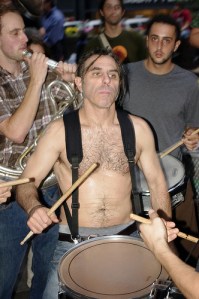
Photo from Zuccotti Park, September 28 2011 by Flickr user David Shankbone
Last week’s news was been full of alarming stories of real and threatened violence at various #Occupy sites around America. But also disturbing were the reports that complaints about the continuous drumming at the Occupy Wall Street site in Lower Manhattan were threatening to shut the entire operation down. According to stories in N + 1, slate.com, Mother Jones, and New York, the ten hour marathon drum circles at Zuccotti Park have been a focal point of mounting tensions, both between the occupiers and the drummers, and between the occupiers and the community at large. Last week, community members asked that the drummers limit their drumming to 2 hours a day, a request backed by actual OWS protesters. The drummers, loosely organized in a group called PULSE, initially resisted the restriction, claiming that such requests mimicked those of the government they were protesting against. Since then, a compromise has been worked out, but the situation gives rise to a host of questions about race, sound, drums, and protest.
Community organizers both inside and outside OWS said they were distressed by the continuous noise that these protesters are making, and certainly they had reason: as Jon Stewart put it in his episode of talking points, “it’s a public space, it’s for everyone, including people who don’t consider drum circles to be sleepy time music.”
Writer and singer Henry Rollins agrees, telling LA Weekly that he dreams of an #Occupy Music festival, because “So far [he has] heard people playing drums and other percussion instruments” but still wonders “if there will be a band or bands who will be a musical voice to this rapidly growing gathering of citizens.” Rage Against the Machine guitarist and frequent #Occupier Tom Morello also seems to concur, telling Rolling Stone, “Normally protests of this nature are furtive things, It’ll be 12 people with a small drum circle and a couple of red flags. But this has become something that people feel part of.” Stewart, Rollins, and Morello all have a point: not everyone likes drum circles, in fact some people feel quite strongly about them, which has the potential to be divisive for a movement famously representing “the 99%.”
But over and above the questions of musical taste, the very audible presence of snare drums, cymbals, and entire drum sets at OWS—more often found in marching bands or suburban garage band practice spaces than the usual drum circle staple, the conga—raises a different set of questions, both sonic and social, around the interrelated issues of “noise,” public space, and privilege.
That a drum circle populated by a large number of bad, mostly white drummers is being touted as “the sound” of occupation isn’t that surprising, at least not for alumni of UC Berkeley.
In my day, a more conga-oriented drum circle sprouted up on Sproul Plaza every Sunday; today, a similar one occupies a green space in Golden Gate Park right across from Hippie Hill, pretty much 24/7. (I walk by it every Thursday on my way to the gourmet food trucks: happily, the delicious smell of garlic noodles and duck taco obliviates all other senses.)
These kinds of regular, yet impromptu, circles abound in California and elsewhere: indeed, the sound of drum circles à la OWS has characterized certain types of social spaces for the last forty years. But what exactly does the sound of drum circles characterize? What meaning is being made by them, and why?

Drumming and Dancing the Bamboula in Place Congo, circa 1880
In the Americas, drum circles go back hundreds of years– many indigenous peoples have drumming traditions, for example, and, in Congo Square in New Orleans, slaves of African ancestry gathered weekly to dance to the rhythms they played on the bamboula, a bamboo drum with African origins, beginning in the early 1700s. The notion of the “circle” was a fundamental part of the dancing and music making at Congo Square—according to Gary Donaldson, the circles represented the memories of African nationalities and various reunited tribes people—and was echoed in various types of “ring shouts” across the West Indies and the Southern U.S. The contemporary drum circle stand-by, the conga, also came to the Americas via the forced migration of slaves; it is of Cuban origin but with antecedents in Africa, like the bamboula. The black power movements of the 1960s drew on this history—and sound—to good effect, reigniting semi-permanent drum circles in many U.S. neighborhoods– like the formal gathering that meets in Marcus Garvey Park in Harlem on Saturdays that is currently also under fire from a nearby condo association –audibly announcing their presence and enacting new community formations.
Given this history–and without erasing the presence of drummers of color at OWS--it can seem puzzling how the drum circle has come to occupy such a curiously whitened position in America’s cultural zeitgeist. Furthermore, one of the more problematic aspects of the OWS drum circle debate is the racialized implications of the instrumentation there—implications borne out by videos of OWS that show an overabundance of snares, some of the loudest drums available. According to percussionist Joe Taglieri, “no conga is louder than a fiberglass drum with a synthetic head.” If snares are louder than congas, then noise – actual decibel level — is probably not the sole issue when community groups attempt to control or oust drummers like those in Marcus Garvey Park. It does seem to be a key point of contention at OWS, however.
While there is also a history of African American marching bands, especially in the South, snare drums speak to a different set of American cultural traditions. Drum kits themselves evolved from Vaudeville, when theater space restrictions (and tight pay rolls) precluded inviting a large marching band inside. Mainstream associations with snares include but are not limited to army parades, high school marching bands, and of course hard rock music. Sometimes, like in the case of Tommy Lee, it is an unholy alliance of several of these contexts.

Tommy Lee, formerly with Motley Crue, drumming for the University of Nebraska
In other words, outside of OWS, snares are hardly the sound of social upheaval.
How the drum circle became associated with political protest in the first place is interesting. Although people sometimes associate drum circles with beatniks rather than hippies, a case could be made that they actually connect more strongly to an electrified Woodstock rather than an acoustic Bleecker Street, thanks in part to Michael Shrieve’s widely mediated turn during Santana’s performance of “Soul Sacrifice” at the 1969 festival.
It is important to note that Shrieve is playing the traps in this sequence, not the conga, which is one reason I’d like to suggest that something about that scene – the hands on the congas, the grins of the other guys, the ecstatic face of a 20-year-old as he slams his kit, and the fetishistic gaze of the camera on the sticks, the skins and the cymbals – caught the imagination of a particular segment of American society. Santana’s band – two Mexican Americans (Carlos Santana and Mike Carabello), a Nicaraguan (Chepito Areas), two whites (Shrieve and Gregg Rolie, who later plagued the world in Journey) and an African American (bassist David Brown)—was truly multi-racial, creating a “small world” visual that furthered Woodstock’s utopian rhetoric in ways that were surely not borne out by the demographics of its audience. More importantly perhaps, the Woodstock movie showed a white suburban hippie guy as an equal participant in a multi-ethnic rhythmic stew, a powerful image in the 1960s. Indeed, the Santana performance may be precisely the moment when the idea of the drum circle was lifted from the context of “black power” and moved into the hippie mainstream.
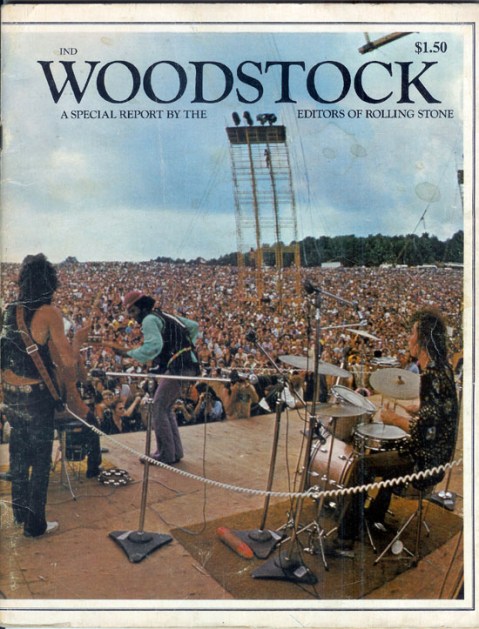
When's the last time you've seen a drummer on a magazine cover?: Santana on Rolling Stone's Woodstock special issue
Woodstock made congas hip to the mass of America—not just in Santana’s set but also in the performances of Richie Havens and Jimi Hendrix—and Woodstock helped define what the drum circle meant, in part by encapsulating certain discursive tropes that were very particular to those times. For example, drum circles epitomize the ’60s idea that political action is simultaneously self-expressive and collective. If a crowd of people sing “We Shall Overcome” or chant “Ho Ho Ho Chi Minh/The NLF is going to win,” it is a a collective act. It’s collective even if the crowd is singing “Yellow Submarine” and it’s not overtly political. By contrast, drum circles are about improvisation, so each drummer can “do his own thing” while participating in the groupthink. (The “his” is implied: video of drum circles show few women participants. Apparently Janet Weiss, Meg White, and Sheila E.’s “own thing” can actually be done on their own.)
In terms of sound, drum circles also project well beyond their immediate location, compared to singing and chanting (in fact, OWS has had problems with the drum circles drowning out its “human microphone”). Plus, since the drummers can take breaks and change out, the actual drumming never stops, unlike a performing musician. Thus, drum circles are celebrations of self expression that are actively imposed on an audience that is well beyond eyesight. This summarizes a modern view of personality rooted in the 1960s: that it’s not enough to participate, you’ve also got to “be yourself.” I think these two notions account for the enduring idea of the drum circle as a supposedly political sound, even when it’s not. Drumming in a drum circle allows for a public display of self-expression that simultaneously allows the participant to belong to a group. The appeal of that is obvious, especially in our contemporary iCulture. However, the politicization of the sound of drum circles only makes sense when you add in the lingering sonic traces of black protest, modulated through a hippie lens. You can see this clearly in New York magazine’s “Bangin’: A Drum Circle Primer” (10.30.11), whose visual imagery prominently features a West African djembe drum and describes only the “hippie-era use of traditional African instruments” rather than their actual, snare-heavy configuration at OWS. Despite the snares and in spite of the oft-commented on lack of black faces at OWS—see Greg Tate’s piece in the Village Voice—drum circles still carry enough connotations of militant blackness to annoy the bourgeoisie.
One key thing differentiates OWS’s drummers from the demonstrations of yore, however: in the 60s and early 70s, there was a notion that drum circles were for drummers. Santana’s band, though young, was made up of world class musicians from the San Francisco scene. But to a certain type of viewer – young, white and male—the drum circle must have seemed so doable. Compared to the singular virtuosity of Jimi Hendrix or sheer talent of Pete Townshend, Santana’s music was the sonic equivalent of socialism. No wonder the drum circle scene has had more of a half-life in the hearts and minds of would-be Woodstockians than just about any other: it is a visceral depiction of music as communal, ecstatic, and accessible. Today, thanks to the far-reaching waves of the movie Woodstock: 3 Days of Peace & Music (1970), the percussive noise such a circle makes creates a particular sonic backdrop that clearly—and nostalgically—says hippiesomething.
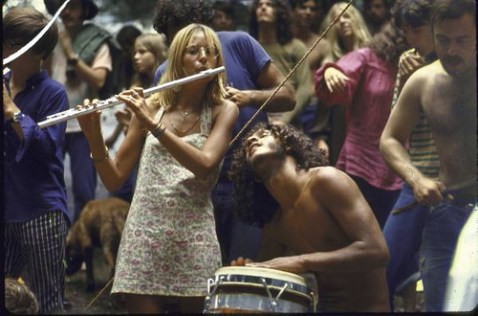
Photo by Flickr user Paul Townsend
And yet, politically speaking, nostalgia is, as theorists like Antonio Gramsci, Guy Debord, Jacques Attali and Theodor Adorno have frequently reminded us, invariably associated with Fascism. From Mussolini to Hitler to Reagan to Glenn Beck, it’s a tactic that has been explicitly invoked to thwart social progress. The nostalgia conundrum seems to have escaped both mainstream news media—which uses the drum circle to signify to viewers that OWS is a radical leftist plot—as well as the drummers themselves. For the drummers are hippies, and hippies young and old really believe in drum circles. Hippies take part in them, hippies enjoy them. It’s fair to say, however, that few others do, just as no one ever really enjoyed the 45- minute drum solos on live records by Cream, Led Zeppelin, and Iron Butterfly. (I’m thinking about Ginger Baker’s “Toad,” John Bonham’s “Moby Dick,” and “In-a-Gadda-Da-Vida,” respectively. Also about the time I went to the bathroom and bought popcorn at the LA Forum during a drum solo by some band I know forget, and still had to sit through ten more minutes.) .

Corporate Teambuilding in Boston, by Exclusive Events
However, that fact does not seem to bother those involved in drum circles, and herein lies the great problem with the whole equation drum + hippie = activism. To any members of the mainstream media who hears and records them, a drum circle instantly conjures up a chaotic, possibly even violent, scene: Chicago ‘68, Seattle 2000, Oakland 2011. But the truth is that, outside Fox News, the noun “hippie” no longer means “liberal,” or possibly even politically engaged. The curious thing about drum circles, then, is that while they sound progressive, they can actually mean conservative. A 2006 piece from NPR, for example, describes how drum circles have been adapted as teambuilding exercises for corporations like Apple, Microsoft, and McDonald’s.
The OWS situation illustrates such conservatism in different ways. In another recent article in New York Magazine, a 19 year old drummer from New Jersey is quoted as saying, “Drumming is the heartbeat of this movement. Look around: This is dead, you need a pulse to keep something alive.” This is said in the face of opposition from the movement’s own management, who fear a shutdown due to severe problems with neighborhood groups and restrictions on the General Assembly’s call-and-response “mic checks” that have been so galvanizing. His words are instructive as well as ominous, illustrating that young hippies like him believe that the sound of drums is a suitable replacement for protest or action itself.
The idea that sound alone can energize a movement is not just wrong, it also showcases a willful misunderstanding within the ranks of OWS. In Oakland last week, a small band of anarchists threw bottles at the police, whose wrath rained down in the form of tear gas canisters and a fusillade of dowels: one protester, an Iraq veteran, has been seriously injured.
The incident highlights a kind of cognitive dissonance that is hindering the ability of OWS to achieve political progress. The drumming problems at Zuccotti Park highlight the way that history can repeat itself as farce, as the distance between nostalgia and action — and between sound and meaning — disturbs the peace in more ways than one. Just as drummers in Sproul Plaza refuse to acknowledge that UC Berkeley is now mainly host to computer science and business majors, and drummers in Golden Gate Park refuse to deal with a Haight Ashbury that is gentrifying in front of their eyes, so too do the drummers at OWS refuse to acknowledge that their sound is no longer the sound of social activism. Indeed, the sound of a drum circle is reminiscent of the ring of a telephone, the scratch of a needle dropped on a record, or the clip clop of horse hoofs on hay-covered streets. No wonder it sounds out of place at OWS.
—
Gina Arnold recently received her Ph.D. in the program of Modern Thought & Literature at Stanford University, where she is currently a post doctoral scholar. Prior to beginning graduate work, she was a rock critic. Her dissertation, which draws on historical archives, literature, and films about counter cultural rock festivals of the 1960s and 1970 as well as on her own experience covering the less counter cultural rock festivals of the 1990s, is called Rock Crowds & Power. It is about rock crowds and power.
Share this:


Current Top Posts





April 2021

January 2020

November 2019

October 2019

August 2019

April 2014

November 2017

March 2015

December 2017

October 2015
 Sounding Out!

Recent Comments