
Evoking the Object: Physicality in the Digital Age of Music

In our current relationship with technology, we bring our bodies, but our minds rule–Linda Stone, “Conscious Computing”
I begin with an epigraph from Linda Stone, who coined the phrase ‘continuous partial attention’ to describe our mental state in the digital age. The passive cousin of multi-tasking, continuous partial attention is a reaction to our constantly connected lifestyles in which everything is happening right now and where value is increasingly equated with our ability to digest it all. Almost everything we do has the potential to be interrupted, be it by an email, a text or a tweet; often we will give only partial attention to any one thing in anticipation of the next thing that will require our attention. In this internal fight for mental attention, listening to music has been seriously impacted.
The digital era has seen more music releases than ever before. Unfortunately, the massive influx of quantity is by no means a measure of how we are engaging with said music. iPhones and similar devices, for which music players have become mere features, enable listening to become a thing of partial attention. From allowing the shuffle or random modes to choose music selections for you, or even streaming music algorithms to calculate things you might like, to listening while playing Angry Birds or reading your Twitter stream, less commitment is made to the act of listening, and as such only a portion of our working memory is committed to the experience. Without working memory actively processing musical information, it is less likely to be stored for the long term, particularly if other information is continuously vying for space and attention.
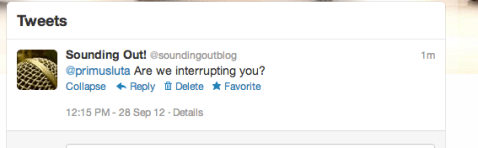
These days video games sell better than music. Despite being a digital product, games are able to instill memories (even of the music) into one’s consciousness, because the game interface allows our sensory memories to work together in an active manner with the medium. Iconic memory stores visual cues from the game, echoic memory takes the audible cues from the game and the haptic memory is engaged in controlling game play. There is only so much more which can be done while playing a video game. If something were to interrupt game play, the game would be paused to address the new information rather than giving it partial attention. This is quite different from music which plays a background role in so much of our lives even when we are actively putting music on we tend to only engage it with partial attention.
When I began thinking about turning Concrète Sound System into a record label, one of my main goals was to create works that could engage the audience in active musical experiences that could create long term memories. I felt that as important as the music would be, it would take something material to create these memories, a physical product more evocative of earlier moments in recording history than the CD, its most recent gasp. I wondered if, by creatively evoking the physical object, the listener could be engaged in an active manner that would enable the memory of music and its power to persist through the everyday waves of digital noise.
The first mass duplicated audio medium was the Gold Moulded Edison Cylinder at the turn of the twentieth century. Imagine two cylinder copies of one of these recording today, as musical objects. Each of them would have over a hundred years of physical history. From the wear of the cases to the condition of the wax based on the temperature in which they were stored, each of these cylinders would be unique musical objects, with completely different histories, despite having the same origin. It is reasonable to assume that if the cylinders were played today on the same playback device, despite the fact that the compositions and performances are exactly the same, the differences between the recordings would be audible.

Wax Cylinders in the Library of Congress preservation Lab, Image by Flickr User Photo Phiend
Even without a century of history, there would likely be audible differences between the cylinders. If one cylinder was the first copy made, and another the 150th –master cylinders of Gold Moulded Edison Cylinders could only produce 150 copies reliably–the physical wear in the process of reproduction would leave its own imprint, making each of those copies distinct musical objects. In the analog world, as the technology improved the differences between copies decreased substantially. Cassettes were manufactured in batches of ten to hundreds of thousands without audible differences. But even in circulations so high, over time each of those analog copies took on their own identity and collected their own memories.
The listener as an active agent contributed to the development of these unique musical objects. After a purchase, any number of variables played into the ritual of the first experience of the music. Was there a way to listen upon walking out of the store? Were there liner notes or lyric sheets inside? Would you read those prior to listening or as you listen? Where would you listen? Through headphones? The listening chair in front of the hi-fi stereo? Or on the boombox with some friends? All of these possibilities shaped memories as musical objects that defined the music consumption culture of the past.
 For example, I bought the debut 2Pac album 2Pacalypse Now on cassette the day it was released. I loved the album so much I kept it in regular rotation in my Walkman for months until finally the tape popped. Rather than go out and buy a new copy I decided to perform a surgery. It was in a screwless reel case which meant I couldn’t just open it up to retrieve the ends of the tape trapped inside, but rather had to crack the reel case open and transplant the reels into a new body. So, my copy of the 2Pacalypse Now cassette is now inside of a clear reel holder with no visual markings. It also has a piece of tape that was used to splice it back together, which makes an audible warp when played back. I can pretty much be sure that there is no other copy of 2Pacalypse which sounds exactly like mine. While this probably detracts from the resale value of the cassette (not that I’d sell it), it is imbued with a personal history that is priceless.
Cassettes, in particular, played a significant role in the attachment of physical memories to music beyond the recordings they held. They gave birth to the mixtape. The taper community was born from personal tape recorders that allowed concert-goers to record performances they attended, and, prior to the rise of peer to peer sharing online, these communities were trading tapes internationally via regular postal mail. European jazz and rock concerts were finding their way back to the states and South Bronx hip-hop performances were traveling with the military in Asia. All of these instances required a physical commitment with which came memories that inherently became their own musical objects.
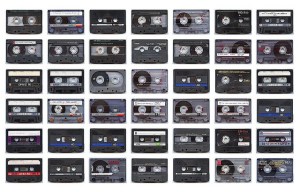
Needless to say the nature of musical exchange has changed with the rise of the digital age of music. This is not to say that memories as musical objects have gone away, but they are being taken for granted as the objects lose their physicality. I remember going to The Wiz on 96th Street with $10 to spend on music. I spent at least ten minutes trying to decide between Sid and B-Tonn and Arabian Prince. I ended up with Arabian Prince and have regretted it since I got home and listened that day, as I never found Sid and B-Tonn for sale again. Today I could download both in the time it took me to walk to the train station. After skimming through the first few songs of Arabian Prince I could decide it was not for me and drag drop it in the trash where the memory of it would disappear with the files. No matter how I felt about the music then, the memory of it is a permanent fixture in my mind because of the physical actions it took to listen.
The first release for Concrète Sound System, Schrödinger’s Cassette, tackled this issue head on by presenting the audience with its own paradox, an update of physicist Erwin Schrödinger’s famous Thought Experiment, where the ultimate fate of the cassette inside is left up to the individual. Schrödinger’s Cassette sought to take listeners out of digital modes of consumption by using an analog medium to evoke the physical. The cassette release trend has been growing over the last few years, almost in parallel to the rise of the digital music and speaking to the need to separate music from our digital lives and to a desire to work harder for it. At the minimum, listening to a cassette requires having a cassette player, and acquiring one these days takes commitment. Unlike digital media, listeners cannot instantly skip a song on a cassette or put a favorite on repeat. It takes physical manipulation of the medium to move through its songs and doing so is a time investment. All these limitations make the cassette a medium that is best for linear listening, from beginning to end (unless you physically cut, rearrange, and splice it yourself).

Schrödinger’s Cassette, Image Courtesy of The Wire
Schrödinger’s Cassette took the required commitment a step further by encasing the cassette itself in industrial grade concrete. This required the user to actively crack the concrete (or the french concrète meaning ‘real’, from which the label derives its name) in order to listen to the music. The paradox is that, depending on the listener’s method for cracking, harm could be done to the cassette that might render it ‘unlistenable’. Upon receiving one of these pieces, the listener holds in their hands a musical object which they must physically act upon in order to create an unrepeatable musical event. Schrödinger’s Cassette has a look, a sound (if shaken you can hear the cassette reels), a feel, a smell, and a taste as well (though I wouldn’t advise it). All of the senses can be actively focused on the object and, as such, the whole of one’s working memory is engaged in the discernment of the object’s musical contents.

The Wire breaks open Schrödinger’s Cassette courtesy of their Twitterstream
For many, Schrödinger’s Cassette was taken as a work of art and left uncracked. The Wire magazine successfully cracked one edition open, revealing a portion of the musical contents on their regular radio program. For those that decided not to crack it, digital versions were made available so that they could listen, though this option was only made available after the listener spent some time with their physical object. In this way, the music from the project, a compilation called Between the Cracks, was directly connected to physical memories spurred by a material presence.
Triggering active memory during the consumption of music through physical objects need not be this complex. Old medium such as vinyl and cassette releases inherently have the physical properties required without the concrete or much else. Perhaps for this reason they show new signs of life despite the rise of digital. No matter how much our reality is augmented by our digital lives, we still inhabit those bodies that we bring with us, and, as far as the memories those bodies carry with them go, physicality rules.
—
Featured Image: Wax Cylinders in the Library of Congress, Image by Flickr User Photo Phiend
—
Primus Luta is a husband and father of three. He is a writer and an artist exploring the intersection of technology and art, and their philosophical implications. He is a regular guest contributor to theCreate Digital Music website, and maintains his own AvantUrb site. Luta is a regular presenter for the Rhythm Incursions Podcast series with his monthly showRIPL. As an artist, he is a founding member of the live electronic music collectiveConcrète Sound System, which spun off into a record label for the exploratory realms of sound in 2012.
Share this:

Music Meant to Make You Move: Considering the Aural Kinesthetic

“Dance!” by Flickr user Clearly Ambiguous, under Creative Commons License 2.0
In the two weeks prior to my drafting this piece, the world lost Adam “MCA” Yauch, Robin Gibb, Donna Summer, and Chuck Brown. In their wake they leave a profound legacy of music, yes, but of dance music particularly. MCA declared your right to party while demonstrating that white MCs aren’t always gimmicks. The BeeGees gave you a new strut courtesy of the bounce-funky soundtrack to Saturday Night Fever. The goddess Donna Summer seduced your ears with her orgasmic whispers, then pumped up the pulsating synthetic beats that brought the discotech from its urban centers directly to you. And go-go’s blaze, though not as far-reaching as disco’s, grew out of Chuck Brown’s musical sensibility, and burned deep in the hearts of Chocolate City natives. For all of these artists, moving to the music isn’t merely a possibility or inclination, but a deeply irresistible impulse. Altogether, these artists brought music that not only called out to people to dance, but if you didn’t dance you missed something essential: the inextricable ties between music and movement. One acts as a key that opens up a dimension to understanding the other.
Seeing people dance to a live go-go band taught me how to appreciate their music. When I finally heard go-go for the first time at a club in 1995, it challenged my musical sensibilities, which were more attuned to smooth R&B and jazzy Hip Hop. By then, go-go music seemed so fast, and coupled with the multiplicity of drums that I didn’t know how to get inside of the groove. In the midst of the bubbling fervor I stood noticeably still as the young woman next to me ripped the shirt off her sweaty body and whipped it above her head (like a flag at carnival), never once missing a beat in her frantic jumping and pumping to the live drums while wearing only her bra and a pair of jeans. The dancing bodies of the whole club fueled my understanding, and by extension appreciation, of what go-go does. Without them, I would have missed out on something deeper.
I am drawing your attention both to music meant to make you dance and dancing that is necessarily done to music—i.e the arena of social dance. Julie Malnig, in Ballroom, Boogie, Shimmy Sham, Shake: A Social & Popular Dance Reader, defines “social dancing” by “a sense of community often derive[d] less from preexisting groups brought together by shared social and cultural interests than from a community created as a result of the dancing” (4, emphasis in original). That might include social dances that correspond to particular songs, or called and standardized steps, like the twist or the electric slide. My focus is more broadly on a visceral, embodied, kinesthetic response to dance music in a particular social space, which is not explicitly directed by the lyrics or a set of moves but by the feel of a song as a whole. In the Hip Hop social dances I write about, rather than a finite set of moves there are infinite possibilities for improvisational play within a particular style (like b-boying or popping) that the music draws out of the dancer. As David F. García states in his piece on mambo titled “Embodying Music/Disciplining Dance: The Mambo Body in Havana and New York City,” “the embodied experience of sound and movement [are] merged through the body” (172).
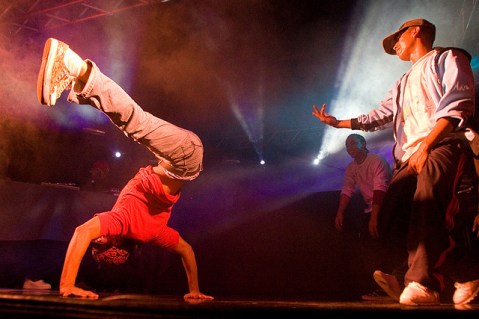
Break Dancing en Costa Rica, 2009 by Flickr User Néstor Baltodano, under Creative Commons License 2.0
I have come to name the frame for analyzing the simultaneity of social dance and music (and sound broadly) as aural-kinesthetics. While these words capture sound and movement separately, together I am looking to engage more than just the sensory response of moving to what one hears. The term develops out of works by music scholars like Kyra Gaunt (The Games Black Girls Play: Learning the Ropes From Double Dutch to Hip Hop), Kodwo Eshun (More Brilliant Than the Sun: Adventures in Sonic Fiction), and Kai Fikentscher (“You Better Work!”: Underground Dance Music in New York City), who shift our orientation to music and rhythm by drawing on our kinesthetic responses to it. Aural kinesthetics recognize that social dance practices are kinesthetic forms within the all-encompassing aurality of an environment. I use spatial terms to acknowledge sound’s omni-directionalality, coming at you from all sides and helping to actually produce the social dance place. In other words, the aural kinesthetic is also a kind of spatial practice (along the lines of Henri Lefebvre’s The Production of Space). For example, consider how a bomba dancer orchestrates the primary bomba drummer’s rhythms within the rhythmic arena created by the second and tertiary drummers; or how loud music in street dance performances fills the immediate surroundings and bleeds out into other areas, attesting to their capacity to claim public spaces (the volume has volume). Music in particular plays a fundamental role in establishing the conceptual performance arena that ultimately makes the physical space functional for certain dance practices.
Despite the fact that social dances necessarily have a musical component, dance is typically overdetermined by the visual, which in Western cultures we are better equipped to address. The sound and feel of dance experiences are often overridden by the spectacle of dancing, which the following clip demonstrates. In this clip showcasing the final battle from the 2007 Freestyle Sessions in Los Angeles, the spectacle of these amazing dancers distracts you from the actual social dynamics of their battle, of which music is central.
.
The exchange between dancers is truncated, spliced together for dramatic effect. You focus on the center of the cypher, lost in the visual thrill of it all. The song they were actually dancing to is replaced by another that, though danceable, prevents us from appreciating a particular song’s nuances as well as the crowd and emcee’s involvement in the event. Overdubbing songs that you do not have clearance for is in compliance with copyright laws that force the video’s producers to instead play songs to which they have legal access, in sacrifice of aural-kinesthetic experiences the videos attempt to capture. Yet even in cases of the below clip where we hear the original song, the recording cannot capture the quality of the force of the music that is loud enough to feel throughout your entire body, thereby promoting a shared sensorial experience in the room. Whether one is recording with a camera or in writing, capturing the aural-kinesthetic can be tricky.
2009 Dutch B-Boy Championships Semi-Finals between Hustle Kids and Rugged Solutions
For me, the aural-kinesthetic is useful insofar as it opens up creative space for me in writing the simultaneity of sound and movement. Scholars like Mary Fogarty (Dance to the Drummer’s Beat: Competing Tastes in International B-Boy/B-Girl Culture) have approached the topic by distinguishing between notions of musical taste and musical competency in clarifying the contours of b-boying’s dance-music relationship. In my own writing, I’ve tended toward storytelling and descriptive analyses. In contrast, considerations such as those of Roland Barthes’ “The Grain of the Voice” (in Image, Music, Text) propose to expand the language on (vocal) music in general by shifting the object of analysis to create new ways of writing music, which we can extend to writing social dance.
So what is a productive approach for writing the aural-kinesthetic? I’m not prescribing a method, but I do want to consider the possibilities of shifting the focus of analysis in such a way that it allows for the simultaneity of music and movement. For example, there may be value in examining a gesture repeatedly made to a particular part of a song to understand what that song is doing; or examining the physical layout of a room and how that space gets used through the song that fills it. Perhaps coming at social dance indirectly and on multiple fronts makes for a richer depiction.
For now, let’s take advantage of this digital space and collectively consider our options. Here’s a task I hope you might take up: post a link to a song or a video clip that makes you move. Describe some quality of your visceral response to the song and place your thoughts in the comments section below. Include the multiple fronts that help you to articulate your experience. While music and dance have the capacity to “speak” in ways that verbal language cannot always reach, my hope is that a range of possibilities might get us there. or at least much closer.
—
Dr. Imani Kai Johnson is a Ford Dissertation Fellow, who has just completed a three year postdoctoral fellowship at NYU’s Performance Studies Department. She received her PhD in American Studies & Ethnicity at the University of Southern California in 2009, where she wrote a dissertation titled,”Dark Matter in B-Boying Cyphers: Race and Global Connection in Hip Hop,” which considers the cultural and performative dimensions of Hip Hop dance as a global phenomenon through cyphers (dance circles), and the invisible forces of the collaborative ritual. Dr. Johnson is currently completing a manuscript based on her dissertation.
Share this:


Current Top Posts





April 2021

January 2020

November 2019

October 2019

August 2019

April 2014

November 2017

March 2015

December 2017

October 2015
 Sounding Out!
Recent Comments