
Making His Story Their Story: Teaching Hamilton at a Minority-serving Institution
In the summer of 2016, optimistic about a full-time teaching position at a minority-serving institution, yet unsure about what the U.S. election would mean for immigrants’ rights, I played the Hamilton soundtrack daily. Lin Manuel Miranda wrote the Pulitzer-prize winning musical inspired by Ron Chernow’s biography on the United States’ founding father because, he believed, Alexander Hamilton’s life embodied hip hop. My repeated listenings urged me to assign the musical as homework in my courses.
Colleagues with whom I engage on Twitter provided resources with which to begin. A public historian, Lyra Monteiro, wrote an important review for Public History,“Race-Conscious Casting and the Erasure of the Black Past in Lin-Manuel Miranda’s Hamilton,” which provide one key angle of critique. Latinx Theater scholar and SO! writer Trevor Boffone created an online syllabus, #Syllabus4Ham, that provided important critiques of the musical, news coverage of its growing popularity, and initial scholarly analyses of the cultural historical significance of the musical’s popularity. Pedagogically, Miranda’s archival research in addition to his belief that Hamilton’s life embodied hip hop sparked an interest to bring the production to my gender and interdisciplinary studies classrooms. While colleagues works’ inspired ways to discuss the musical in class, post-election coverage and the release of the Hamilton Mixtape provided more material to discuss. Teaching children of hip hop whose lives embody the struggle that Miranda made the central force behind his re-writing of Hamilton’s contribution to United States’ history, I wanted to develop lessons drawing on those relations.
By the spring 2017, I had done preliminary reading on the syllabus Boffone provided and replaced the musical with the Mixtape as my car ride soundtrack. When organizing my syllabus, I assigned tracks from the mixtape against the musical’s soundtrack with the intent of assigning students excerpts in both both my introductory Gender Studies course and Interdisciplinary Research Methods courses, but with a unique twist for each class. Gender Studies engaged with the content contextualized by discussions of immigration and citizenship. I assigned my Research Methods course Monteiro’s critique of race-consciousness of the musical against the mixtape and the musical. While students were in solidarity with Montiero’s argument, I invited them to consider Miranda’s original intent, the mixtape, which may have informed the themes Miranda prioritized.
Few of them had heard of the musical before my class and less had heard of the mixtape. Their limited exposure necessitated historicizing both Miranda’s career and the evolution Hamilton’s, which begins with 2009 Miranda’s White House performance. Miranda, invited by President Obama to perform a song from his previous hit In the Heights, instead decided to introduce his new project, a mixtape based on Alexander Hamilton.
Through discussion, I proposed that the students consider that the production, in 2009 envisioned as an album, served as a strategic catalyst to bring attention to his forthcoming mixtape. That attention evolved into encouraging Miranda to produce the musical; it would take a few more years till the intended mixtape was produced. Even though produced later, I speculated that the mixtape thematically benefited from the popularity of the musical because the musical’s focus on Alexander Hamilton rewrites the context of the mixtape.
Teaching Hamilton the musical and the mixtape felt politically necessary at a minority serving institution in this historical moment of anti-immigrant, and anti-black sentiment. Having, in the past, worked with other youth to mobilize youth empowerment through hip hop, Hamilton provided an avenue in which I could discuss its political potential because of its popularity not only in spite of it. In breaking down Miranda’s cultural and political significance, I summarized the evolution of awards he and the musical’s cast had won as well as the preliminary cast’s reflections on participating in Hamilton, along with what it means to have the success of the musical produce a wider audience for the mixtape.
After more than a semester working with students who grow frustrated with the traditional research paper and because of my own work producing research-based fiction and poetry, teaching the musical and mixtape provided an important example of research-based art. Because some students approach interdisciplinary research methods not understanding the possibilities of the relationship between art and research and some students are unsure of how to connect learning outcomes to their aspiring performance careers, I find teaching Miranda’s work remains necessary. Further, Miranda provides an avenue through which I could relate to students because of our shared interest in music as well as our conflicted relationship with consuming hip hop.
Teaching a student population that is 25% Latinx and who are either directly or indirectly affected by immigration policies, my students related, often quite deeply and intimately, to the message of the song. I watched their faces as they listened, particularly to “Immigrants (We Get the Job Done),” and their kinesthetic responses showcased what many of us ache for our students to experience: wonder, appreciation, and the illumination of insight.
I then guided them to hone in specifically on Puerto Rican rapper Residente rapping about the Mexican immigrant struggle in Spanish, emphasizing how he sonically and rhetorically urges a Latin pan-ethnicity while using his U.S. citizenship privilege to historicize border crossing Mexicans. Residente’s lyrics create an opportunity to discuss Puerto Ricans’ cultural reality of being perceived as immigrants while being legally defined as citizens, all the while calling back to the lyrical connection to the “Battle of Yorktown” from the musical.
I highlighted Miranda’s rhetorical strategy in building a song around one line that contexts changes across either song. The “Battle of Yorktown” centers on the contributions of immigrants to gaining freedom. During the lecture, I drew connections between the lyric that would become a song and the lyric subtly referencing the lack of freedoms for black people who were enslaved in the U.S. I asked about the parallels before explaining them, using the intentionality behind creating and compelling a racially diverse cast to script a narrative about who could and who had built the United States. What does it mean to hear these voices emanating from this cast, telling this story?
Pedagogically, teaching music in either course served the intent of reimagining the purpose and potential of sound, whether from a musical or a mixtape, as a site of critical thinking. Popular musicians’ cultural authority slowly decenters the white fragility I have come to expect from difficult conversations such as the ones Hamilton and The Hamilton Mixtape allow me to have. Furthermore, the call-and-response between the mixtape and the musical work address the silence of the unrecognized, exploited, and/or enslaved labor that continues to build this country. For my students, hearing musicians they like or who perform in their favorite genre, speaking truth to power about poverty, struggle, and not being thought of as good enough shifted not only our classroom energy, but many students’ perspectives.
Teaching the Hamiltons helped my student population make sense of their “invisible” status in the U.S. and want more than what’s expected. They gained something in being able to hear their stories in the classroom—not just read them on the page—but hear them from people who look and sound like them. Hungry for more material that speaks to their disenfranchisement, my students wondered why more songs that sound the complex beauty of our resilience and struggle are not on the radio. They wanted to know how they can ask for more.
—
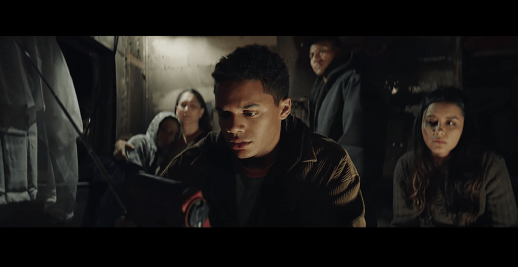
Featured Image: Screen capture from “Immigrants (We Get the Job Done)” remix video
—
Erika Gisela Abad, Ph.D, is a Queer Latina poet, born and raised in Chicago. She received her PhD in American Studies in 2012. Since completing her degree, she has worked as: a customer service associate and a scheduler at a phone interpreter call center, head counselor for a caddy program affiliated with a high school scholarship fund, field director for an education policy campaign, an oral historian and ethnographer. Since August 2016, she has been a full time assistant professor teaching gender studies. Twitter: @lionwanderer531; @prof_eabad
—
 REWIND!…If you liked this post, you may also dig:
“Don’t Be Self-Conchas”: Listening to Mexican Styled Phonetics in Popular Culture*–Sara V. Hinojos and Dolores Inés Casillas
“Ich kann nicht”: Hearing Racialized Language in Josh Inocéncio’s Purple Eyes (Ojos Violetas)–Trevor Boffone
Moonlight’s Orchestral Manoeuvers: A duet by Shakira Holt and Christopher Chien
The Sounds of Anti-Anti-Essentialism: Listening to Black Consciousness in the Classroom- Carter Mathes
Share this:

“Happy Homes Have Gramophones” –Gender, Technology, and the Sonic Restaging of Community Before and After the Partition of Bengal


co-edited by Praseeda Gopinath and Monika Mehta
Our listening practices are discursively constructed. In the sonic landscape of India, in particular, the way in which we listen and what we hear are often normative, produced within hegemonic discourses of gender, class, caste, region, and sexuality. . . This forum, Gendered Soundscapes of India, offers snapshots of sound at sites of trans/national production, marketing, filmic and musical texts. Complementing these posts, the accompanying photographs offer glimpses of gendered community formation, homosociality, the pervasiveness of sound technology in India, and the discordant stratified soundscapes of the city. This series opens up for us the question of other contexts in India where sound, gender, and technology might intersect, but, more broadly, it demands that we consider how sound exists differently in Pakistan, Sri Lanka, the Maldives, Bangladesh, Bhutan, Nepal, and Afghanistan. How might we imagine a sonic framework and South Asia from these locations? —Guest Editors Praseeda Gopinath and Monika Mehta
For the full introduction to the forum, click here.
To read all of the posts in the forum, click here.
—
“She compelled respect at once by refusing on any account to be phonographed: perhaps she thought, amongst other things, that if she committed her soul to a broken piece of wax it might get broken…my subsequent experiences showed that it was only too likely,” wrote the British musicologist A.H. Fox-Strangways in 1910 about Indian female singer Chandra Prabha, while remarking on the harsh reactions to the gramophone in India (90). Such deep-rooted discomfort with the gramophone speaks to the cognitive, perceptual and experiential challenges faced by a listener/performer when a new auditory technology substitutes familiar terrains of musical production.
In this post, I revisit the decades prior to and following the 1947 Partition of Bengal, a phase singularly volatile not only in India’s political but also its musical and technological histories. I examine how the introduction of European harmony/polyphony in the aural imaginary of Bengal negotiates ideologies espoused by the nationalists in the (re)constitution of gendered space post-Partition by transforming relations of consumption. The production of gendered domesticity was vitally related to rigid conceptions of physical space and its allocation in colonial Bengal which, further, influenced music reception in ways worth probing.
The auditory regimes prior to the emergence of recording/radio-broadcast typified public modes of listening based on live performances engendering affective flows and presupposed human proximity. This culture of aurality is inextricably tied to communal modes of consumption and performance, be it the high-end salon-tradition of the Bengali modern song, the hard-hitting agitprop strains of the Bengal wing of the IPTA (Indian People’s Theatre Association) or even the stylized elite classical genres. The collective nature of musical practice conjures up traditional connotations of masculine spaces, especially in the case of the elite Bengali household where the gendered ideology of spatial orientation relegated the respectable Bengali woman (bhadramahila) to the interiors of the house (antahpur/andarmahal). The delights of salon-music were to be relished by the man of the house (babu).

‘Gramophone – a home entertainer’
Thus, the communitarian character of musical practice often made it elusive to respectable women. However, the emergence and subsequent sophistication of auditory technologies ushered a radical transformation to such a dynamic by dissociating music from the human performer. Besides leading to the obvious technological alienation in the listener, the privatization of the listening experience was accompanied by a condition of a penetrating solitude and interiority, a state speaking to the voices and /sounds emanating from the phonograph. At the sociological level, the entry of recording technology redefined long-held divisions of domestic space and the gendered dynamics thereof by not only democratizing musical consumption but also forging provisional collectivities of listeners often cutting across gender, class and caste. Besides, traditional associations of musical genres with specific loci- classical music with the salon/concert space for instance- gave way to a more fluid conception of domestic space assuming multiple sonic/musical identities depending on what the gramophone played. The phonographic interface, thus, radically reconfigures listening practices and produces a different paradigm of self, sound, community, and gender.
What is at stake here is not some covert form of linear technological determinism, but a more nuanced detour around auditory-technologies, spaces of consumption, and the affordances thereof that calibrate auditory experience along new registers. What merits contemplation is how (if at all) these technological innovations in the commercial arena complement and usher formal nuances and sonic innovations in the musical works they mediate. The gramophone renders problematic the uncritical conflation of the sonic and visual registers typical of live musical performance and, in the process, sets in motion a unique dynamic of interacting with musical sound. Severed from its visual footholds in live performance, phonographic sounds often provoke the listener to imagine the singing/performing body which, in turn, informs the way the sounds are processed mentally.

Vintage Gramophone spotted in Little India, Serangoon, Singapore, Image by Flickr User Linkway88, (CC BY-NC-ND 2.0)
Indian music has traditionally been based on a single melody which, in its skeletal grammar, is an individual mode of expression, even when performed by a group. The intrinsic form of Indian and traditional East Asian music in general exhibits a non-harmonic character. The concept of musical harmony proper is considered a European import. European harmony, polyphony, and counterpoint are in their very essences a set of disparate tonal registers forging a gestalt which impresses on the mind of the listener an overarching unity. At an experiential level, the polyphonic form embodies a distinct sonic ontology and a novel dimension, as it were, and thus cannot be reduced to merely a stylistic import. It induces a new auditory condition, a new register of being-in-listening (the lecture snippet from 57:08-.1:02:07 effectively demonstrates the morphing of the basic melody of a song into its polyphonic equivalent). The new auditory condition conjoins the familiarity of the melody with the markedly different yet complementing registers of the polyphony, creating a novel sensation for the uninitiated Bengali listener.
Among the very early records to employ musical polyphony in India were two iconic musical works of the mid-20th century, one devotional in intent– Aham Rudre from Mahishasurmardini (1931) composed by the legendary music director Pankaj Mullick–and the other, a professed experiment in introducing polyphony in Bengali music, Shurer Ei Jharna (1958), by the noted composer Salil Chowdhury.
In the current context, it is important to note how the sonic dimension of musical polyphony in Aham Rudre and Shurer Ei Jharna embodies and substitutes notions of aural communities and restages a communitarian character. Notably, the creation and circulation of these works paralleled the establishment of commercial state-radio in India (1930) and the first microgroove record in Kolkata in 1958 by the Gramophone Company.
The Gramophone Company in Calcutta marketed its records with the Bengali tagline “Shukhi Grihokon Shobhe Gramophone/Happy Homes Have Gramophones,” projecting the phonograph as the symbolic ideal of the domestic idyll and in the process confronting gendered spatial demarcations head-on by invading the auditory horizons of the secluded Bengali women. The striking presence of the gramophone in the iconic Gramophone Scene (1:35:17-1:35:28) in Satyajit Ray’s movie Ghare Baire–set in the backdrop of the 1905 Partition of Bengal–beautifully illustrates the sorority forged by the gramophone which, notably, draws even the marginalized widow Bouthan within its field of influence.
However, the gramophone superseded its commodity-character to serve not only in crass exhibitionism but also as an index of a masculine, elite consumerist culture where “serious music” and musical connoisseurship often became synonymous with the gramophone and recorded sound. A new breed of “record-collectors” came into existence, mainly belonging to the upwardly-mobile/elite classes whose passion for records was their most prominent identity-marker in the domestic realm, occasionally outweighing even their professional concerns.
But even as the radio and phonograph transcended the hitherto gendered character of musical reception by entering the women’s quarters and dissolving time-honored segregations of auditory spaces within the household, it had to contend with a deep-seated psychological discomfort in the listener, a fundamental unease with befriending technology that substituted the human. I argue that the newly insulated character of the radiophonic auditory experience was counteracted by significant efforts, conscious or otherwise, at sonically restaging and reclaiming the community lost in technological mediation.

Indian farmers gathered to listen the Farm Forum programme broadcast by All India Radio in the 1950s, Image Courtesy of Flickr User Public Resources.Org, (CC BY 2.0)
Given pet notions of musical anthropology and the chronological coincidence between the early uses of harmony and the entry and sophistication of technologically mediated music in Bengal one could, at the risk of slight oversimplification, posit that the import of the harmonic form at this significant juncture sonically compensates the auditory solitude induced by radio/phonograph by recreating a modified and idealized Platonic (Platonic here is used as an allusion to ‘music of the spheres’ to point towards how musical harmony since medieval times has been associated with ideal public) community and restaging it within the confines of the constitutive plurality of the polyphonic mode. As an aside, the initial introduction of polyphony in Shurer Ei Jharna (1958) garnered flak from a large section of the audience who cognized it as a group of amateur performers ‘singing out of key’ (Salil Chowdhury’s lecture from 30:31-31:15). Over the next few decades, however, this form was trans-culturated and seamlessly assimilated within the sonic vocabulary of the Bengali/Indian masses, so much so that without the regular vocal/instrumental counterpoint, commercial songs nowadays are often felt to be lacking hue.
The sonic changes that I have been investigating preceded or followed the Partition of Bengal, which informed the gendered patterns of popular musical consumption. It is well-known that the exigencies of the Partition proved emancipatory for women in that they were exposed to the vagaries of the workplace, leaving the confines of their quarters. It is with an often uncritical celebratory fervor that the Partition is credited with fashioning the independent, self-reliant and educated middle-class Bengali working woman, on occasion emerging as the sole bread-earner of the family. Jasodhara Bagchi says that the “partition accelerated the earlier trends of the twentieth century of abolishing the ‘purdah that had confined the Bengali bhadramahila to her antahpur (private quarters)…The same stroke that brought this flood of uprooted marginalised women to Calcutta also opened the door to many new opportunities for Bengali middle-class Hindu women. They came out of the private domain of domesticity and child rearing to take up public duties.’”(8) Uditi Sen, however, in her revisionist reading of the celebratory impulse argues that “situational aberrations” notwithstanding, the Partition did not lead to “a transformation of social norms or any substantive change of women’s ideal role within the bounds of the family.”(16)
In the aftermath of the Second World War, which had also witnessed the entry of women into the professional/public sphere, the USA launched a propaganda war to restore women to their hearth, revivifying the “cult of the housewife,” deploying films and popular music to promote the trope of the ideal housewife. Redefining domestic spaces as woman’s space had also been in the cards for the Indian state post-Partition, which had to a large extent been governed by patterns of popular media consumption. Arguably, the coincidental emergence of musical harmony and sophistication of private auditory technologies in the years following the Partition contributed to efforts to restore women to their private quarters, by compensating the lost professional community of the self-reliant working woman with the poetic/sonic community embodied by the polyphonic form, in the process enlivening her insipid lived quarters. Popular media technologies often employ innovation in content to revivify clichéd formats; musical harmony coupled with sophisticated audio-reproduction provides a classic instance of inaugurating a new sonic dimension in popular music which provides a powerful and enthralling form of domestic leisure.
Thus, in the context of early 20th century Bengal, the gramophone was a significant import which not only reconfigured perceptual registers and musical cultures but also listening practices by entering the interiors of elite Bengali households. Besides democratizing the listening experience, which till then had largely been restricted to male constituencies, the gramophone privatized musical consumption. It was through the introduction of musical polyphony, which is intrinsically ‘public/ communal’ as regards its sonic character, that this impulse was counteracted. As mentioned earlier, these technical/musical innovations widened the scope and impact of musical performance and arguably contributed to the reconstitution of gendered domestic space post-Partition which points to subtle and complex relations among technology, (musical) genre and gender.
—
Featured Image: Screen Capture from by SO! Ed. Satyajit Ray’s Ghare Baire
—
Ronit Ghosh is a postgraduate student at the Department of Art and Technology, Aalborg University, Denmark. His research interests include aesthetic philosophy, critical sound studies and the sociology of Indian popular music. He has published articles on sound studies in the International Journal on Stereo and Immersive Media and The Rupkatha Journal and has an article forthcoming in the Journal of Sonic Studies. He is a classical violinist and an aspiring music composer.
—
REWIND! . . .If you liked this post, you may also dig:
Tape Hiss, Compression, and the Stubborn Materiality of Sonic Diaspora–Chris Chien
Pushing Play: What Makes the Portable Cassette Recorder Interesting?—Gustavus Stadler
Hearing “Media-Capitalism” in Egypt–Ziad Fahmy
Share this:


Current Top Posts





April 2021

January 2020

November 2019

October 2019

August 2019

April 2014

November 2017

March 2015

December 2017

October 2015
 Sounding Out!
Recent Comments