
Listening to MAGA Politics within US/Mexico’s Lucha Libre


This series listens to the political, gendered, queer(ed), racial engagements and class entanglements involved in proclaiming out loud: La-TIN-x. ChI-ca-NA. La-TI-ne. ChI-ca-n-@. Xi-can-x. Funded by an Andrew W. Mellon Foundation as part of the Crossing Latinidades Humanities Research Initiative, the Latinx Sound Cultures Studies Working Group critically considers the role of sound and listening in our formation as political subjects. Through both a comparative and cross-regional lens, we invite Latinx Sound Scholars to join us as we dialogue about our place within the larger fields of Chicanx/Latinx Studies and Sound Studies. We are delighted to publish our initial musings with Sounding Out!, a forum that has long prioritized sound from a queered, racial, working-class and “always-from-below” epistemological standpoint. —Ed. Dolores Inés Casillas
—
This post is co -authored by Esther Díaz Martín and Rebeca Rivas
DOI: https://doi.org/10.59350/9w0h7-6cy40
—
“Lucharaaaaaán a dos a tres caídas sin limite de tiempoooo!“
[“They will fight two out of three falls, with no time limit!”]
Announcer at Lucha Libre, El Paso, Texas
“This ain’t no sideshow.”
George Lipsitz on the role of popular culture
The announcer’s piercing “lucharaaaaaán” cries from the middle of the ring proclaims the constitutional two-out-of-three-falls rule of lucha libre. But before the famous cry rings out to set the stage for the spectacularized acrobatic combat between costumed warriors, their theatrical entrances set the all-important emotional stakes of the battle. The entrances are loud, campy, interactive exchanges between luchadores and spectators. An entrance song itself cues the luchador’s persona: a cumbia could signal a técnico (a good guy); a heavy metal song more than likely indicates a rudo (a bad guy) typically donning black, death-themed getups. Luchadores saunter into the arena, stopping to pose, high five their fans, and verbally heckle their opponents. The storylines of good versus evil, betrayal and revenge, or humility versus arrogance are some of the more standard plots that motivate spectators to adamantly cheer for the favorite and jeer for the foe.
The sonic exchanges between luchadores’ and spectators before, during, and after the fight positions lucha libre as much more than a sport. And while the term spectators, suggests the privileged act of watching or viewing; here, we expand spectators within lucha libre arena to mean “a call to witness” (á la Chela Sandoval). Put simply, lucha libre is a cultural phenomenon where contemporary cultural, social, and political anxieties are often tapped as fodder for theatrical plots. In the U.S./Mexico’s sister cities of El Paso, Texas and Ciudad Juarez, Chihuahua, the political realities of border enforcement, immigration politics, and racial tensions are loudly heard and placed on display. As part of Rebeca Riva’s ongoing research about the history of lucha libre at the border—which too often gets skipped over for Mexico City as the epicenter of the sport—we listen for the exchanges between luchadores and spectators as resonant participants in the ritual of this sport. Specifically, we tune into lucha libre and its accompanying mega-spectacle to analyze how fans scoff at lucha libre’s MAGA-spectacles. In Time Passages, George Lipsitz (2001) reminded scholars of popular culture decades ago that “this ain’t no sideshow.” In a similar vein, lucha libre directly engages in the larger social and political arena that contextualizes the sport.
In lucha libre, spectators are resonant participants in the construction of an essential “hi-fi” sonic ambiente. Like in football, as Kaj Ahisved notes, the “noise of the crowd” (building on Les Back’s concept) are essential to a “hi-fi” sound where a high degree of information exchange occurs between listeners and the sound environment.Or, as David Hendy describes Olympic arenas, “cauldrons of concentrated sound, [where] the roar of the spectators took on a collective force of its own – a volatile quality rich with cultural and political repercussions.” The crowd’s response, experienced by athletes as ambient noise, bolsters athlete’s spirits and develops an emotional plot for the contest. In certain cases, for instance in Algeria as Stephen Wilford documents, it is a venue for social critique; football stadiums served as “safe zones” where fans could dissent the Abdelaziz Bouteflika dictatorship through chanting political slogans and songs as an anonymous crowd (139).
By listening to lucha libre, we gain a deeper understanding of the embodied components of fan activism, collective identity, and political action. Visual spectacle, bodily gestures, and musical choices, coupled with verbal taunts and visceral grunts serve as interactive storytelling tools. Yet, the crowd’s noise and, importantly, the sonic memories evoked by visual parafenalia amplify a shared political consciousness and prompts the expression of their allegiance with and opposition to the symbolic representations staged.

* * *
The following audio was captured in November 2023 at a parking lot across from El Paso City Hall during a children’s fundraiser. We hear Chris Watson, a previous college wrestler from Oklahoma, make his debut appearance in lucha libre as a white supremacist character. Wearing a clichéd U.S. flag-themed bandana and waving a Trump 2024 campaign flag, he points towards the crowd and makes swimming motions with his arms to communicate the pejorative “wetback.”
Aligning these symbols of MAGA ideologies with Watson’s role as a rudo in the match positions him as a willing vessel for the scorn of the mostly Mexican American spectators. His red-white-and-blue echoes Trump’s xenophobic statements burned into Latinx consciousness: “they’re all rapists,” “bad hombres,” from “shithole countries” as well as renewed promises to “build a great wall… and Mexico will pay” and enact the largest deportation effort in U.S. history since Eisenhower’s “Operation Wetback.”
The reactions from spectators are visceral and cathartic, eliciting camaraderie, anger, or empowerment. They retaliate strongly: “Fuck you! Fuck Donald Trump!”‘ and “Fuera!”, a seemingly hateful exchange interjected with cheering and laughter. Spectators are amused by the insults and retaliations. Watson’s staged “gimmick” prompts spectators to playfully rage against the violence he embodies. Their taunting in Spanish represents both resistance as cultural pride and insider knowledge. The joke is on Watson, who (presumably) does not understand the double entendres hurled at him.
A MAGA luchador evokes the memory of violence carried out against Mexicans and African Americans in Texas since at least the mid 1800s by white enslavers, colonial settlers, Texas Rangers, border patrol, and the modern police force. White supremacist violence is not mere political rhetoric but an ongoing contemporary reality. On August 3rd, 2019 a white man motivated by the “Great Replacement” theory popular in MAGA circles, drove 9 hours from his home in Allen, Texas to a Walmart in El Paso, a majority Latino city, to carry out a mass shooting with the intent of discouraging immigration. He killed 23 people and left 22 injured. Listening and yelling at Watson and his MAGA symbols at the US/Mexico border vocalizes the cultural, political and humanitarian crisis propelled by neoliberalism, the militarized police, and the exploitation of White supremacist sentiments by a wannabe fascist dictator.

Watson comes from a line of “gringo” white supremacist luchadores such as Sam Adonis (Sam Polinsky) who sprays himself orange and waves a US flag stamped with a Trump portrait. El Migra (Gonzalo Garcia), a U.S.-born Mexican American border enforcer performed during the Bush/Clinton era, who threw tortillas while taunting “traguense estas tortillas frijoleros nopaleros” (“choke on these you cactus-eating beaners”) and growled the U.S. national anthem into the mic. Spectators jeered and threw their drink cups at him; an opportunity to retort white supremacist rhetoric.
In another instance from the 1990s, a major showdown between Love Machine (a gringo wrestler turned técnico) and Blue Panther (a tejana wearing feline-themed rudo) the crowd favor turned against the yankee when his neck-breaking illegal move prompted fans to reconsider their alliances in the context of massive Mexican emigration prompted by the devastating yoke of the country’s debt to the IMF and subsequent neoliberal economic reforms. Love Machine’s fake benevolence would seem to embody U.S. gleeful exploitation of Mexico’s expatriated campesinos while simultaneously introducing legislation to further marginalize them.

Unlike Karen Yamashita‘s staging of SUPERNAFTA vs. El Gran Mojado in her 1997 novel Tropic of Orange, or the masked Chicano poetry of the Rudo Revolutionary Front, MAGA-spectacles within lucha libre are not intentionally staged to politicize the public but tap into the raw political nerve of the moment. They allow fans to emotionally resolve social and political anxieties when excoriating the “bad guy,” be it an anti-social character or the symbols of the oppressor, even if only for dos de tres caidas.
—
Featured image by Flickr User C-Monster, taken in Ontario, CA (2017) CC BY-NC 2.0
—
Esther Díaz Martín is an assistant professor of Latin American and Latino Studies and Gender and Women’s Studies at the University of Illinois Chicago. Her book, Latina Radiophonic Feminisms: Sounding Gender Politics into the Digital Age, (forthcoming UT Press, Spring 2025) theorizes Chicana feminist listening attending to the political work of Latina voices in contemporary sound media.
Rebeca Rivas is a graphic artist and doctoral student in History at the University of Texas at El Paso. Her research examines the lucha libre and community building in El Paso, Texas and Ciudad Juárez, Chihuahua. She is currently conducting an extensive oral history and archival project documenting this spectacular sport at the border.
—

REWIND!…If you liked this post, you may also dig:
Xicanacimiento, Life-giving Sonics of Critical Consciousness—Esther Díaz Martín and Kristian E. Vasquez
Ronca Realness: Voices that Sound the Sucia Body—Cloe Gentile Reyes
Echoes in Transit: Loudly Waiting at the Paso del Norte Border Region—José Manuel Flores & Dolores Inés Casillas
Share this:

“In My Life”: Loving Queerly and Singing Across Generations
DOI: https://doi.org/10.59350/xbkqp-f5b45
December 1975.
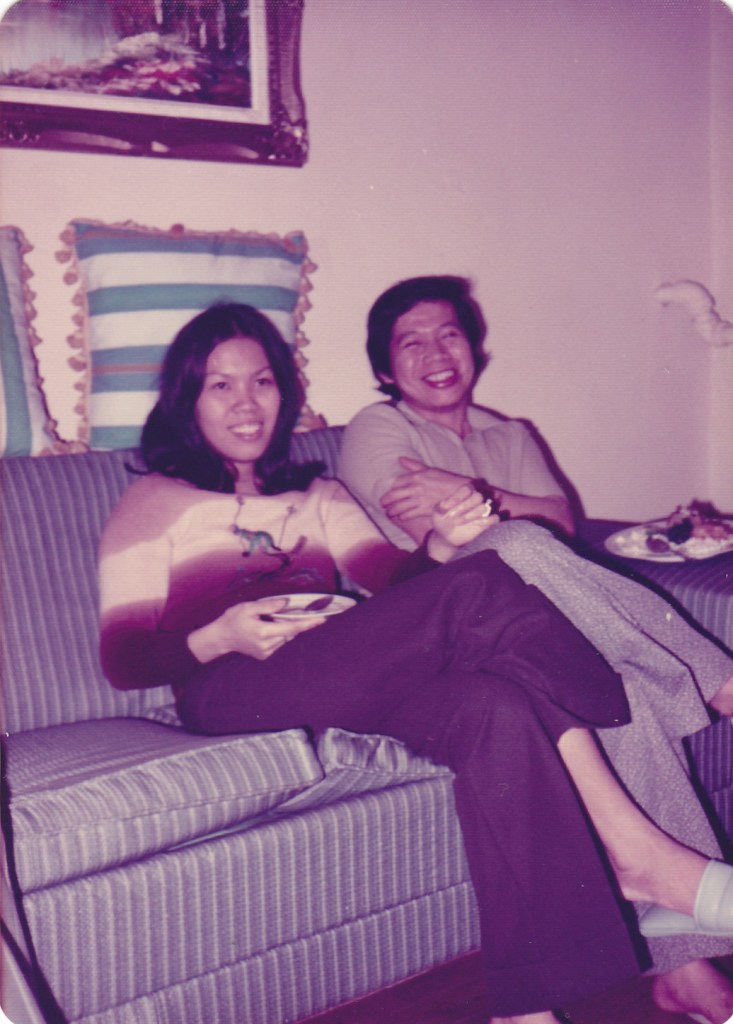
The cold winds staked their claim over Toronto, where my parents had recently arrived from the Philippines. They were underdressed and making their way down Parliament Street. Despite being warned of a shift in temperature, they were not expecting the brutal intensities of Canadian winter. I’m not sure how anyone anticipates the sharp sting of negative temperatures when they are arrivants used to tropical climates. Undeterred, my mother and father headed to a small Filipino grocer, hoping to encounter a semblance of domestic familiarity. Pressed against the biting winds, my mother abruptly stopped, looked at my father and said, “Tumutolo ang sipon” – you have a runny nose. To which my father replied, “Ikaw din” – you do too! They both started laughing and laughed again when they retold me this story 48 years later. When faced with the challenges of migrating to a new and very cold country, they managed to mine humour from a deep well of difficult circumstances. We had been listening to the song “In My Life” by the Beatles (Lennon & McCartney 1965). Something in its expression, melody, and feeling caused my parents to be transported to this small but important moment.
In her conversation with Christine Bacareza Balance, “‘Revolutions in Sound’: Keynote Duet” (2022) Alexandra T. Vazquez writes: “The popular…leaves so much room for engagement with sound artists (musicians without the gallery). None of them need theorists to argue for them, to argue for their mattering because to so many, they already do. How do they instead invite theorists to take part in something alongside them?” (12). I was never a big fan of the Beatles, but regardless of my opinions, they were popular. As a relentlessly oppositional teenager, I was put off by their mass popularity. As Vazquez suggests, despite one’s musical taste, songs are invitations, not scholarly conquests. The memory re-opened by my parents’ connection to “In My Life” was an invitation for me to take stock of the song’s affective and, for them, diasporic trajectories. As Balance (2022) suggests songs request us to “listen long so we hear where another is coming from” (15). For her, “long” describes temporality and commitment. To “listen long” implies that duration and attention are the pretext for empathic relations.
“In My Life” was released in 1965. My mother was fifteen years old when she first heard the song on the radio in a boarding house in Marbel, Philippines. One year later, on July 16, 1966 the Philippine Free Press would announce, “The Beatles Are Coming” (de Manila as cited by Robert Nery in “The Hero Takes a Walk” 2018). At that time, Ferdinand Marcos was the newly elected president of the Philippines, and Imelda Marcos was his First Lady. The Marcoses would later unleash an era of violent dictatorial power and impose Martial Law in 1972, escalating political suppression (Burns 2013). My mother recalls that the band’s first and only appearance in the Philippines was remembered by many less for their two scheduled concerts and more for their “snub” of Imelda. The Beatles were noticeably absent at a lunch reception they were expected to attend with the First Lady at the Presidential Palace. Their absence, attributed to a communication error between the concert promoter and the band’s manager, incited public disapproval and resulted in the sudden disappearance of their security escort and hotel and porter service. Unlike in other cities, the band was refused room service and was forced to carry their own luggage (Nery 2018).
What is striking about this moment is that it breaks from preoccupations with Filipinx desires for assimilation and mimicry of Western imperial projects. In Video Night in Kathmandu and Other Reports from the Not-So-Far East, British travel writer Pico Iyer (1988) famously stated that Filipinx people are the “[m]aster of every American gesture, conversant with every western song…the Filipino plays minstrel to the entire continent (153)” Turning against imperial scripts and the band’s documented disdain of “Mosquito City” and even worse, John Lennon’s comment that a return to the Philippines would require “an H-bomb,” the soured residues of their visit marks a queer rupture in Beatlemania. The public decried that Filipinx people deserved better from the band, capturing what Balance describes in Tropical Renditions: Making Musical Scenes in Filipino America (2016), as “disobedience” in that “disavows a belief in the promises of assimilation” (5). For me, Filipinx non-compliance textures the sonic substance of “In My Life.” While the shadow of the Marcoses cronyism and corruption is an inescapable footnote, it is the defiant voices of hotel employees, dismayed fans, and airport workers that insisted on the “ordinariness” (Wofner & Smeaton, 2003) of the Beatles that holds the song’s queer decibels.

There are places I’ll remember all my life, though some have changed. Some forever, not for better. Some have gone, and some remain.
“In My Life” (Lennon & McCartney 1965).
January 2018.
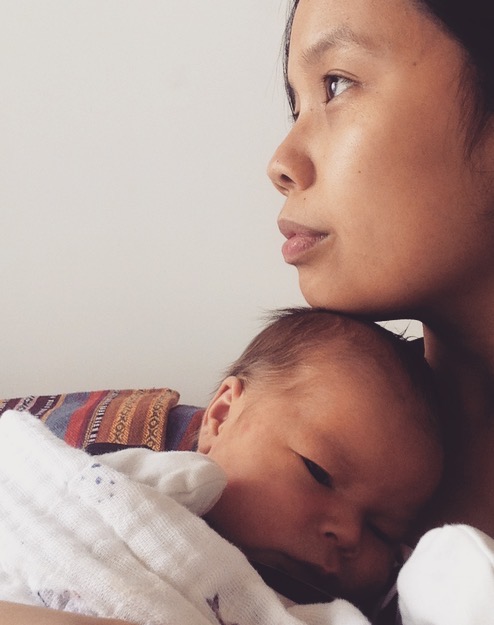
I am sitting on my couch watching a Toronto Raptors game. The television emits light that flickers through a large window that frames a bright winter moon. I am 41 weeks pregnant at this point (feeling similarly shaped and sized as the moon outside). My stubborn queer resistance to the Beatles somehow dissipated during my pregnancy, and the song “In My Life” made its way to me. I would quietly sing the song to my pregnant belly. Then, that January night, I felt a snap inside my body and a rush of water down my legs. I won’t go into much gratuitous detail other than to say that at 12:49 pm the next day, Asa Cy Dyer-Mecija was born at home.
And these memories lose their meaning when I think of love as something new.
“In My Life” (Lennon & McCartney 1965)
Sometimes, I needed to couch the queerness of pregnancy in words that were not mine. The distance between these words and the ones I had yet to find would help to structure my unfolding love for Asa. Here, queerness presented a modality of encounter with uncensored desires. Queerness is often theorized as a utopian impulse; the queerness of my pregnancy jostled both the hopes and fears brought up by the unknown terrain of parenting amidst heteronormativity. For me, “In My Life” is riven by sentimentality and nostalgia, but it also gave melody to a tender relationship with myself and my new role in the world. This was the sonic throughline to my parents, a queer inheritance of tension made from the hopes for kinder contexts amidst the limitations of harsh realities.
December 2022.
I was invited to perform as part of the Queer Songbook Orchestra’s holiday fundraiser. The Queer Songbook Orchestra is a chamber pop ensemble that hosts an annual concert focused on songs and stories about “chosen family and queer joy” (Queer Songbook n.d.). At that time, Asa was four years old. He is a child of the pandemic. He’s a kid with two moms, a present and kind donor, and is dearly loved by his Lolo and Lola, his grandparents, aunts, titas, uncles, cousins, kuya, ate, and his beautiful chosen family. My partner, Hannah, and I sometimes worry about how his world will be affected by reactions to the makeup of our family, but mostly, we know he’ll be sure he’s loved by many.
To me, the song “In My Life” offers a useful sonic response to homophobia. As a baby, after Asa’s baths, I would often wrap him in a towel, and while rocking him back and forth, I would sing these lyrics from the song: “Though I know I’ll never lose affection for people and things that went before, I know I’ll often stop and think about them. In my life, I love you more” (Lennon & McCartney 1965). To me, this statement is a queer ethos. We know that 2SLGBTQ+ people have necessarily and creatively reworked and reimagined the organization and expression of kinship. When family is so often bounded by what Julianne Pidduck calls “constraints of relationality” in “Queer Kinship and Ambivalence”(2008: 441), the lyrics “In my life, I love you more” are a call to action. More is a word used comparatively to insist that there is something greater, something more exists, something more is possible. I embrace the challenge to love more. My queerness urges me to love more, and parenting Asa does, too. On the evening of the performance, indexed by my parents’ struggles and our shared disdain for the chill of winter, Asa and I performed “In My Life” together. The video of our performance will remain a treasured sonic archive that I will return to often, and as Asa gets older, I hope it reminds him of how beautiful he’s always been.
—
Casey Mecija is an Assistant Professor in the Department of Communication & Media Studies at York University. Her current research examines sound as a mode of affective, psychic, and social representation, specifically in relation to diasporic experience. Drawing on sound studies, queer diaspora studies and Filipinx Studies, her research considers how sensorial encounters are enmeshed and disciplined by social and psychic conditions. In this work, she theorizes sounds made in and beyond Filipinx diaspora to make an argument about a “queer sound” that permeates diasporic sensibilities. She is also a musician and filmmaker whose work has received several accolades and has been presented internationally.
—
REWIND!…If you liked this post, you may also dig:
Blank Space and “Asymmetries of Childhood Innocence” –Casey Mecija
The Sound of What Becomes Possible: Language Politics and Jesse Chun’s 술래 SULLAE (2020) –Casey Mecija
The Cyborg’s Prosody, or Speech AI and the Displacement of Feeling–Dorothy Santos
Tape Hiss, Compression, and the Stubborn Materiality of Sonic Diaspora–Chris Chien
Xicanacimiento, Life-giving Sonics of Critical Consciousness—Esther Díaz Martín and Kristian E. Vasquez
Moonlight’s Orchestral Manoeuvers: A duet by Shakira Holt and Christopher Chien
Enacting Queer Listening, or When Anzaldúa Laughs–Maria Chaves Daza
Echoes in Transit: Loudly Waiting at the Paso del Norte Border Region—José Manuel Flores & Dolores Inés Casillas
The Queerness of Wham’s “Last Christmas”–Justin Burton
Could I Be Chicana Without Carlos Santana?–Wanda Alarcón
Share this:




Current Top Posts





April 2021

January 2020

November 2019

October 2019

August 2019

April 2014

November 2017

March 2015

December 2017

October 2015
 Sounding Out!
Recent Comments