
The “Tribal Drum” of Radio: Gathering Together the Archive of American Indian Radio
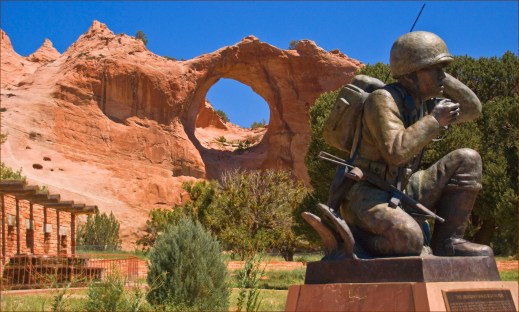

Over the next few weeks, Sounding Out! is proud to offer a new Thursday series spotlighting endangered radio archives across the United States, the kind of resources whose recognition and preservation could not only change media history, but also how we conceive of media history – and the voices that belong in it.
Our writers are part of an effort that is historic in its own right, the Radio Preservation Task Force (RPTF), part of the National Recording Reservation Plan at the Library of Congress. Over the past six months, under the guidance of Christopher Sterling (George Washington University) and Josh Shepperd (Catholic University), the RPTF has drawn together more than 120 faculty researchers and advisors from across the country who in turn have spread the word to create a network of more than 270 archives that hold recordings of broadcast radio, with the goal of creating a national inventory of finding aids and encouraging preservation and modernization through digital access.
If you’ve got archival broadcast radio that can’t be got online and maybe nobody even knows about — in any format or genre, national or local, high-powered or low, commercial or college, in a display or a shoebox – then we want you.
The coming months will see a second campaign of archive recruitment – I’ve taken on a role as Network Director to help coordinate that – as the RPTF rolls out a new working association with the American Archives of Public Broadcasting and gears up for a conference at the Library of Congress in early 2016, for which radio historian Michele Hilmes will be the Program Director.
Drawing on this vast effort, SO! will be bringing you stories of gaps in the record, voices we’ve long missed and need to recover, and some we are in danger of losing for good. We begin with a post by Josh Garrett-Davis, a PhD Candidate at Princeton University pursuing unique research into the long-unrecognized and uncatalogued history of Native American broadcasting.
Pursuing that history requires hard work and persistence; it also requires reimagining what counts as an archive in the first place.
— Special Editor Neil Verma
—
Despite dire poverty across most of the archipelago of semi-sovereign Native American land often called “Indian Country,” radio receivers had become a normal part of life there by the Great Depression. For example, as contemporary publications and later memoirs and oral histories reveal, after work hours in the camps of the Indian Emergency Conservation Work program (the Indian CCC) from northern Minnesota to the Southwest and the West Coast, many men and women listened to the wider world—even following Admiral Richard Byrd’s broadcasts from as far away as Little America, Antarctica.
Listeners, yes. But when did Native people take up the means of production, so to speak, and generate broadcasts themselves? In his history of Native radio, Signals in the Air, Michael C. Keith quotes several sources suggesting little sustaining programming existed until the first Native-owned and -oriented station appeared in New Mexico in 1972. As a sort of internal colony of the United States, Indian Country heard only imperial broadcasts for half a century. The “right to establish their own media in their own languages” in addition to “access to all forms of non-indigenous media without discrimination”—as described in the U.N.’s 2007 Declaration on the Rights of Indigenous Peoples—arrived remarkably late, and are still not fully granted to Native people. Quite recent are the 53 stations catering to Indian communities, and vital national programs like Native America Calling.
But Native people did speak and sing over the airwaves in earlier decades. In some cases a direct or indirect archive even exists, and undoubtedly more will emerge as radio archives more generally are preserved and cataloged through efforts such as the Radio Preservation Task Force of the National Recording Preservation Plan. The trouble is that the cumulative archive of early Indian radio has not been identified as a valuable record or really as a coherent archive at all, perhaps due to compounded misconceptions of radio as an inconsequential documentary record, and of American Indians as technological naïfs. In this post I call attention to the scattered fragments of this archive, which should be recognized as an important heritage for the recent progress in Indigenous media, echoing the various ways Native people seized limited opportunities once broadcast technology appeared.
Here is an initial attempt to quilt a few of those pieces into a pattern:
Widespread broadcasting started at about the same moment—the 1920s—as the first agitation toward tribal political sovereignty in the (constrained) twentieth-century sense. In March 1925, the Cayuga statesman Levi General, who held the ceremonial title Deskaheh, delivered an address from a Rochester, New York, studio. As transcribed in the Haudenosaunee (Iroquois Confederacy)–produced book A Basic Call to Consciousness, he began, “Nearly everyone who is listening to me is a pale face, I suppose,” and went on to appeal to those palefaces for Iroquois sovereignty on land that, like his radio signal, straddled the Canada–U.S. border (18). He urged his listeners to write to representatives in both governments and “ask them to tell you when and how they got the right to govern people who have no part in your government and do not live in your country but live in their own” (22). General certainly grasped the democratic and transnational possibilities of the new medium as he spoke directly to the citizens of two newcomer nations and plainly described to them a Haudenosaunee sovereignty that must have seemed radical.
Around the same time, the Yakama/Cherokee singer Kiutus Tecumseh (aka Herman Roberts) used his celebrity to perform on radio stations across the country, adding political commentary on Indian policy between songs. Often the songs he performed were Indianist compositions by non-Indian composers; Tecumseh was, in historian John Troutman’s words, “‘playing Indian’ with a pointed, political message” (250). Ojibwe bass singer Chief Roaring Thunder (aka George LaMotte), meanwhile, performed on KVOO from Tulsa in the 1920s, as mentioned in the contemporary press.
So far no audio transcriptions of any of these pioneering broadcasts have turned up, though in the 1970s the publication Akwesasne Notes produced a reenactment of General’s address and sold it on reel-to-reel, cassette, and cartridge.
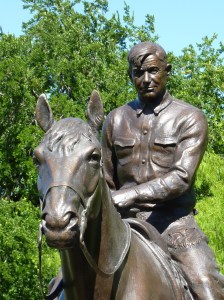
“Soapsuds and Will Rogers” by Flickr user Granger Meador, CC BY-NC 2.0
One Native radio voice of whom an audio archive remains is the humorist Will Rogers (Cherokee). Historians Lary May and Amy M. Ware have convincingly argued that Rogers espoused Cherokee values—which informed his communitarian politics—and sometimes advocated directly on Native issues. Part of the task of creating and preserving an Indigenous media archive is to recognize Rogers’s place in a genealogy: He united oratory like Levi General’s with the vaudeville sensibility of Kiutus Tecumseh and Chief Roaring Thunder. (Rogers could also stand in for a number of mainstream performers whose Indian heritage was not widely recognized, from Lee Wiley to Hank Williams to Jimi Hendrix.)
World War II brought about vast changes in Indian Country, including increased exposure on the air. Great numbers of Native people served in the war effort—notably, in terms of radio, the Navajo and Comanche “code talkers.” But back home, the first sustained radio program, aptly named the Indians for Indians hour, began in 1941 on WNAD in Norman, Oklahoma. Don Whistler (aka Kesh-Ke-Kosh), the first Sac and Fox chief elected under the reforms of the “Indian New Deal,” created the show as a model of participatory programming and (fortunately for later generations) recorded more than a hundred programs on acetate discs before he died in 1951. Indians for Indians, which served and drew performers from perhaps twenty tribal communities and several Indian boarding schools in Oklahoma, persisted in various forms until the 1980s. The only show available online is one from 1976.
I have listened to most of the extant shows from the first decade—which are not endangered except insofar as they have been ignored—and it is a remarkable institution that adopted Will Rogers’s humor and brio while also foreshadowing the vibrant Native radio networks of today.
Archives are more scarce from elsewhere in Indian Country, but traces endure in archives and history books: The renowned Chiricahua Apache artist Allan Houser performed on the air in New Mexico as “the Apache Kid.” In the 1930s and ’40s, students from Santa Fe Indian School and Flandreau Indian School performed on radio shows in Santa Fe and Omaha, respectively. I have not found any recordings of any of these instances, but a few audio archives suggest transcriptions yet to surface: A Tuscarora farm family can be heard singing “By the Waters of the Minnetonka” on Major Bowes and His Amateur Hour on NBC in 1935. NBC also covered an American Indian Exposition and the Flagstaff All-Indian Powwow in the ’30s, which gave Native singers and speakers a national hearing. A non-Indian couple recorded Hopi and Zuni singers on an unidentified station in 1955 and 1956 from Parks, Arizona, a tape which was dubbed by an anthropologist and deposited in the Archives of Traditional Music at Indiana University.
There must be many other fragments, and we can hope that broad efforts like the Radio Preservation Task Force—as well as archival efforts originating among Indigenous organizations like Native Public Media, Koahnic Broadcast Corporation, Native Media Resource Center, and Vision Maker Media—could turn up records of them.
Marshall McLuhan once wrote ominously of the “tribal drum of radio” leading the masses to totalitarianism. But that message, like the medium itself, could be interpreted in a much more constructive sense. When we gather together the early history of Native radio and assemble the intertribal quilt proposed above, the product seems to squarely refute the racial logic McLuhan implied. We may find instead that Indian people themselves recognized right away the importance this “drum” could and would have for maintaining vibrant language, musical, and oral traditions in the face of colonialism.
The Red Power movement is generally thought to begin with the occupation of Alcatraz Island in 1969–71. Part of that action was the Santee Dakota poet and activist John Trudell’s creation, “Radio Free Alcatraz” on KPFA in Berkeley, California. We might hear these programs (preserved in the Pacifica Network’s archives) as heralding a new era of reservation stations and media advocacy by Native people. We could also hear them as descending from efforts—still unrecognized and uncatalogued—by Native innovators over the previous half century.
—
Josh Garrett-Davis is a PhD candidate in history at Princeton University. His dissertation, “Resounding Voices: American Indians and Audio Technology, 1890–1969,” examines Native American use of phonograph and radio technology from the earliest ethnographic and commercial phonograph records to the founding of Indian-run labels and radio shows in the mid-twentieth century. He is the author of Ghost Dances: Proving Up on the Great Plains (Little, Brown, 2012), and a member of the collective M12, which promotes and creates art in rural places.
—
 REWIND! . . .If you liked this post, you may also dig:
A Tribe Called Red Remixes Sonic Stereotypes— Christina Giacona
Chicana Radio Activists and the Sounds of Chicana Feminisms — Monica De La Torre
Radio de Acción: Violent Circuits, Contentious Voices: Caribbean Radio Histories— Alejandra Bronfman
__
__
Special thanks to Daniel Murphy for the RPTF Logo.
Share this:

Sound at ASA 2014
The 2014 American Studies Association meeting will be held in Los Angeles, an appropriate setting for this year’s theme, “Fun and the Fury: Dialectics of Pleasure and Pain in the Post-American Century.” The conference, which will take place from November 6-9, will offer panels of interest to Sound Studies scholars. The City of Angels has long served as a muse for artists and thinkers interested in creating innovative worlds. Los Angeles is a place of experimentation and futuristic transformation, or as Norman Mailer called it, a constellation of plastic. Part of Mexico until 1848, Los Angeles is a global metropolis that embodies the keen contradictions of national and capital in the 21st century, often exposing the nuts and bolts that hold together these structures. Fun, fury, and the “dialectics of pleasure and pain” are useful for conceptualizing the sharp contrasts that characterize the city of LA itself. A panel on Sunday, Central Avenue Breakdown: Gender, Race, and Coming of Age in a Los Angeles Jazz Community, will discuss the historical complexities of the city of Los Angeles by way of the African American entertainment district of Central Avenue (Sunday 2:00-3:45).
This year’s ASA program features an increase in sound and music-related papers in comparison to last year’s conference in Washington, D.C., which was concerned with the logic of debt. The upswing is partially due to the 2014 theme, which emphasizes the production of alternative spaces that counter repressive forces. As the program committee, comprised of co-chairs J. Jack Halberstam, Fred Moten, and Sandra Soto, writes, “The critical power of ‘fun’ in this unconventional convention theme seeks nothing less than the reimagining of possibility, impossibility, probability and freedom.” Sound Studies is already geared toward thinking about how careful listening can offer new ways of being-in-the-world, so the increase in music-themed panels this year is not surprising. As music scholars and listeners have long insisted, music is foundational to embodied experiences of pleasure and fun. Music’s ability to transport listeners and to cultivate collectivity makes it uniquely relevant to discussions of pleasure.
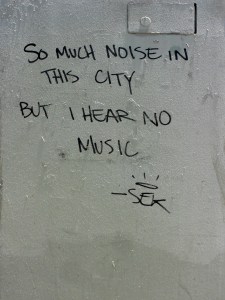
“So Much Noise” by Flickr user Doran, CC BY-NC-ND 2.0
One notable exception to the musical focus is the second of the two ASA Sound Studies Caucus panels, “The Racial Politics of Listening: ‘Accents,’ Hate Speech, and Language in the U.S. Media,” which will take place on Saturday from 2:00-3:45. Featuring Dolores Inés Casillas, Sara Hinojos, Marci McMahon, and SO! Editor-in-Chief, Jennifer Stoever, The panel will examine the role of speech and auditory cues in constructing racial representations. An individual paper by Craig Eley in the Environment and Culture Caucus panel Ecologies of Pleasure and Pain: Deviance, Destruction and Desire in Environmental History, entitled Psychologically Ultimate Seashores: Natural Sound, Personal Pleasure, and Recording Technologies is also worth mentioning (Sunday 10:00-11:45).
This year’s call for papers asked for participants to formulate creative modes for presenting their work, and Sound Studies scholars are stepping up. The first panel hosted by the ASA Sound Studies Caucus (Saturday 10:00-11:45) is an exciting listening dialogue entitled “Power Ballads and Blurred Lines: Songs from the Boundaries of Fun.” The commentators, Jeff Chang, Alice Echols, Evelyn McDonnell, Oliver Wang, and Rubén Martinez, will each play a song and discuss how pop music that is treated as harmless fun may nevertheless speak to social dynamics in real and important ways. A roundtable on Music, Fashion and the Power of (Queer) Nightlife (Friday 12:00-1:45) will include scholars of nightlife as well as party promoters and DJs, discussing the possibility for belonging in subcultural “nightworlds.”

“Hotel Bonaventure” by Flickr user S. N. Johnson-Roehr, CC BY-NC 2.0
This year there are a number of notable African American Studies panels, including After the Rain: Vanguardist Jazz in the Seventies (Thursday 10:00-11:45) organized in memory of Amiri Baraka, Stomp, Swerve, Rattle, and Roll: Fun and Pleasure as Political Resistance in American Blues Music (Thursday 4:00-5:45), What Words Can’t Do: Instrumentals, Identity, and Interpretation (Sunday 10:00-11:45), and Pleasure, Pain, Politics, and Performance: Black Women Artists and Their Fans (Sunday 12:00-1:45). The category of pleasure provides a framework for panels on The Aesthetics of Pleasure in California Funk (Sunday 10:00-11:45) and Performative Pleasures of Blackness: The Creation, Consumption, and Conflict of Pleasurable Blacknesses. Sound scholars also continue to investigate transnational modes of listening, in panels such as The Transnational Movements of Hip-Hop (Thursday 12:00-1:45), Fugitive Preludes: Chicana/o Popular Music and the Neoliberal City (Friday 10:00-11:45), and Performing Decolonial Aesthetics and the Politics of Pain and Pleasure in Music Across the Americas (Friday 12:00-1:45).
Two years ago, Jennifer Stoever mentioned that work in the field of Sound Studies was entering a period of reflection and becoming more nuanced and robust with sub-fields starting to develop. It is clear from this year’s program that the field is both broadening and deepening its focus. After two years of official recognition under the ASA Sound Studies Caucus and three years after the publication of Sound Clash, the special issue of American Quarterly, scholarship on sound in American Studies is developing in a myriad of ways and is coming into its own as a field.
Jump to THURSDAY, November 6
Jump to FRIDAY, November 7
Jump to SATURDAY, November 8
Jump to SUNDAY, November 9
—
Featured image: “Carmaheaven” by Flickr user waltarrrrr, CC BY-NC-ND 2.0
—
Please comment to let SO! know what you think–both before and after ASA 2013. If we somehow missed you or your panel in this round up, please let our Managing Editor know!: lms@soundingoutblog.com
—
Meghan Drury is a fifth-year Ph.D. candidate in the Department of American Studies at the George Washington University. She received an MA in ethnomusicology from UC Riverside in 2006. She is currently working on a dissertation tentatively titled “Aural Exotics: The Middle East in American Popular Music 1950-2011.” This project examines the interplay between popular music and American cultural representations of the Middle East from the mid-20th century to the present, illustrating how music and sound acted a means of consolidating and disseminating a range of ideas about Middle Eastern culture in the American mainstream. She is particularly interested in the way that sound increased the visibility of Arab Americans both before and after 9/11, offering a space for negotiations of identity. More broadly, Meghan’s interests include sound studies, U.S.-Middle East cultural relations, and Arab American cultural performance.
—
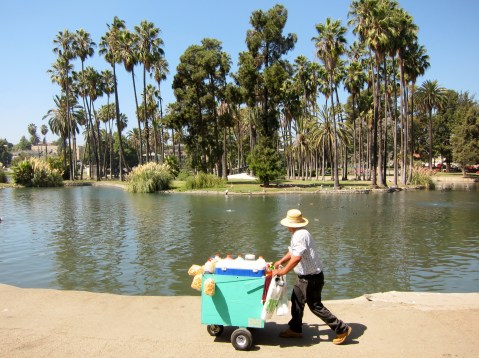
“Echo Park September 2010” by Flickr user Calvin Fleming
THURSDAY, November 6th, 2014
8:00 am – 9:45 am
Religiosity and Altered States
Westin Bonaventure, Los Feliz (L1)
—Richard Cullen Rath, University of Hawai’i, Manoa (HI)
Dangerous Fun in Puritan New England: Mary Ross and the Singing Quakers
Riots, Radios, and the Historical Record: Mass Media and Crisis in Twentieth American Literature and Art
Westin Bonaventure, San Bernardino (L1)
—Hadji Bakara, University of Chicago (IL)
Guernica on the Radio: Anti-Fascism, Mass Media, and the Emergence of Human Rights Activism
.
10:00 am – 11:45 am
Playing with Rules: Having Fun and Keeping Order in Mid-Century Racial Liberalism
Westin Bonaventure, San Fernando (L1)
—Yusuke Torii, Setsunan University (Japan)
S. I. Hayakawa’s Jazz Credentials and Racial Liberalism in Mid-Century America
—Masayoshi Yamada, Doshisha University (Japan)
Jazz, Fans, and the Pleasure of Listening during Turbulent Times
.
After the Rain: Vanguardist Jazz in the Seventies (in memory of Amiri Baraka)
Westin Bonaventure, San Gabriel C (L1)
CHAIR:
Ronald Radano, University of Wisconsin, Madison (WI)
PAPERS:
Paul A. Anderson, University of Michigan, Ann Arbor (MI)
“Thunder Blossoms Gorgeously”: Abstracting the Pastoral in Marion Brown’s Georgia Trilogy
Robert Maclean, The College of Wooster (OH)
Ensemble After Eventuality: Neoliberalism and the Duo Form
Brent Hayes Edwards, Columbia University (NY)
Notes Toward a “Loft” History of Jazz
COMMENT:
Ronald Radano, University of Wisconsin, Madison (WI)
.
12:00 pm – 1:45 pm
Fun in Public: The Cultures of Amateur Labor
Westin Bonaventure, Palos Verdes (L1)
—Alexander W. Corey, University of Colorado, Boulder (CO)
Impulsive Triads: Frédéric Chopin, Amateur Pianists, and The Autobiography of an Ex-Colored Man
.
The Transnational Movements of Hip-Hop
Westin Bonaventure, Santa Monica D (L3)
CHAIR:
Alexander Weheliye, Northwestern University (IL)
PAPERS:
Lenna Tayseer Odeh, University of California, San Diego (CA)
Acts of Sumud: Exploits of Resistance Through the Palestinian Hip-Hop Youth and Political Prisoner Movements
Najwa Mayer, Yale University (CT)
Muhammad was a punk rocker: Seeking Faith, Fun, and Form in Taqwacore
Elliott H. Powell, University of Minnesota, Twin Cities (MN)
The Sounds of Afro-South Asian Pleasure: Hip Hop, 9/11, and South-South Connections
Halifu Osumare, University of California, Davis (CA)
Play and Pain in Black Atlantic Hip-Hop: Hiplife in Ghana as Case Study
COMMENT:
Alexander Weheliye, Northwestern University (IL)
.
2:00 pm – 3:45 pm
alt. Black Musical History
Westin Bonaventure, San Gabriel C (L1)
CHAIR:
Courtney Michael Brown, California State University, Fullerton (CA)
PAPERS:
Matthew Hayden Anthony, Pennsylvania State University, Harrisburg (PA)
I Got Country Roots: Race, Identity and Black Country Singers in the 1970s
Kreg Abshire, Johnson & Wales University (CO)
On Sonic Nostalgia: Making Sense of alt.country’s Hip Traditionalism
Keith D. Leonard, American University (DC)
Who Stole the Soul: An Avant-Garde History of the Dark Room Collective
Christa Holm Vogelius, University of Alabama, Tuscaloosa (AL)
The Jennie C. Lee Archive and the Silent Musical History of the Tuskegee Institute
COMMENT:
Courtney Michael Brown, California State University, Fullerton (CA)
.
The Choreography of Protest
Westin Bonaventure, Santa Barbara B (L1)
—Sarah Ehlers, University of Houston (TX)
The Joys of the Picket Line: Reading the Rhythms of the Left
—Robert Michael Zecker, Saint Francis Xavier University (Canada)
A Mandolin Orchestra Could Attract a Lot of Attention: Interracial Fun with Radical Immigrants, 1930–1954
.
Empire of Funk: Hip Hop and Representation in Filipina/o America—A Roundtable
Westin Bonaventure, Santa Barbara C (L1)
CHAIR:
Dawn Bohulano Mabalon, San Francisco State University (CA)
PANELISTS:
Roderick Labrador, University of Hawai’i, Manoa (HI)
Mark Villegas, University of California, Irvine (CA)
Mario “Nomi” De Mira, Artist
Stephen Bischoff, Washington State University, Pullman (WA)
COMMENT:
Dawn Bohulano Mabalon, San Francisco State University (CA)
.
On Athletes and Outlaws: Asian Americans in Popular Culture and the Pleasures of Recognition
Westin Bonaventure, Santa Monica C (L3)
—Douglas S. Ishii, University of Maryland, College Park (MD)
Not about race, per se: Dave Boyle’s Asian American Music Film
.
4:00 pm – 5:45 pm
Love and Rage: Cultural Strategies in Postwar U.S. Anarchism
Westin Bonaventure, San Bernardino (L1)
—Shon MeckFessel, University of Washington, Seattle (WA)
From a Disavowal of Commitment to a Commitment of Disavowal: (Non)Left Positionalities in 1980s Post-Punk and Anarchy-Punk
.
Alternative Economies of Pleasure in Contemporary Southern Working-Class Cultures
Westin Bonaventure, San Pedro (L1)
—Nicholas Neil Gorrell, University of Mississippi (MS)
Economies of Scarcity and Abundance in Contemporary Southern Blues
—Anne Gessler, University of Texas, Austin (TX)
Second Lines, Creative Economies, and Gentrification: Music Cooperatives in Post-Katrina New Orleans
.
Stomp, Swerve, Rattle, and Roll: Fun and Pleasure as Political Resistance in American Blues Music
Westin Bonaventure, Santa Monica A (L3)
CHAIR:
Daphne Brooks, Yale University (CT)
PAPERS:
Mark Anthony Neal, Duke University (NC)
“Let Me Bang Your Box”: The “Erotic Life” of the Blues
Sonnet Retman, University of Washington, Seattle (WA)
Memphis Minnie’s Jukebox Blues
Kimberly Mack, University of California, Los Angeles (CA)
“That Natural Blues Man Look”: Black Elvis and the Demythologization of the Black Blues Figure
R. J. Smith, Independent Scholar
Calling All Freaks!: The Licentious Blues Spirit of the Rent Party and the Buffet Flat
COMMENT:
Adam Gussow, University of Mississippi (MS)
.
**Wildness: The Fun and the Fury of Anarchy**
Westin Bonaventure, San Gabriel C (L1)
CHAIR:
Mel Y. Chen, University of California, Berkeley (CA)
PAPERS:
Peter Coviello, Bowdoin College (ME)
The Wild Less Than the Good: Erotics and Biopolitics in Thoreau
Jack Halberstam, University of Southern California (CA)
‘Wildness at the End of the World’
Tavia Nyong’o, New York University (NY)
William Blake’s Wild America
COMMENT:
Mel Y. Chen, University of California, Berkeley (CA)
.

“Busker (street musician) #2” by Flickr user Sunny Lapin, CC BY-NC-SA 2.0
FRIDAY, November 7th
8:00 am – 9:45 am
Feeling Queer
Westin Bonaventure, San Gabriel B (L1)
—Elias Krell, Northwestern University (IL)
Mixing Sound: Technologies of Fem(me)ninity and Mixed Race in Kelly Moe
.
Life-Writing, Musical Lives
Westin Bonaventure, San Gabriel C (L1)
CHAIR:
Ulrich Adelt, University of Wyoming (WY)
PAPERS:
Nassim Winnie Balestrini, Karl-Franzens-University (Austria)
Fun, Fury, Fans: Affective Strategies in Intermedial Hip-Hop Life Writing
Mercy Romero, Sonoma State University (CA)
Two Lives in Music
Petra Rivera-Rideau, Virginia Polytechnic Institute and State University (VA)
The Pleasures and Pains of Love: Listening to La Lupe and Ivy Queen
Jessica Elaine Teague, University of Nevada–Las Vegas (NV)
Charles Mingus and the Serious Fun of Jazz Autobiography
COMMENT:
Ulrich Adelt, University of Wyoming (WY)
.
**Caucus: War and Peace Studies: Reconsidering the ‘R and R’: Dialectics of Violence and Pleasure in Militarism**
Westin Bonaventure, Santa Anita B (L1)
—Patricia Stuelke, University of Massachusetts, Boston (MA)
You’re a Criminal as Long as You’re Mind: The U.S. Invasion of Panama and the Sounds of Bad Romance
.
**ASA Program Committee: Uncontrolled Substances/Altered States**
Westin Bonaventure, Level 1, San Bernadino
—Josh Kun, University of Southern California (CA)
The Musical Más Allá: Narco/Necro/Anarco
.
10:00 am – 11:45 am
Fugitive Preludes: Chicana/o Popular Music and the Neoliberal City
Westin Bonaventure, San Gabriel C (L1)
CHAIR:
Christina Zanfagna, Santa Clara University (CA)
PAPERS:
Wanda Alarcón, University of California, Berkeley (CA)
Variations on a Theme: Performing América on the National Stage
Jonathan Gomez, University of California, Santa Barbara (CA)
Teen Post to Rainbow Alley: Facing Unexpectancy with Unexpectant Punk Rock Social Spaces
Kurt Newman, University of California, Santa Barbara (CA)
Undoing the Math: Chingo Bling, the “Not-All,” and the Politics of Parody
COMMENT:
Christina Zanfagna, Santa Clara University (CA)
.
Willful Subjects: Action, Agency, and Politics
Westin Bonaventure, San Anita B (L1)
—Neil Roberts, Williams College (MA)
It’s Bigger than Hip Hop: Decoding the Trayvon Martin Event
.
12:00 pm – 1:45 pm
Music, Fashion and the Power of (Queer) Nightlife
Westin Bonaventure, Los Cerritos (L1)
CHAIR:
Madison Moore, King’s College London (England)
PANELISTS:
Ananya Jahanara Kabir, King’s College London (England)
Matthew D. Morrison, Columbia University (NY)
Victor P. Corona, Fashion Institute of Technology (NY)
Gregory Alexander, Artist
Loren Granic, Artist
Amy Cakes Danky Dank, Artist
.
High on Crack: Surveillance, Loss and Addiction in Black Communities
Westin Bonaventure, San Fernando (L1)
—Andreana Clay, San Francisco State University (CA)
“Kick in the Bass”: Sonic Navigation of Pleasure and Pain in Crack Lyrics
.
Performing Decolonial Aesthetics and the Politics of Pain and Pleasure in Music Across the Americas
Westin Bonaventure, San Pedro (L1)
CHAIR:
Jaime Cardenas, Seattle Central Community College (WA)
PAPERS:
Marie “Keta” Miranda, University of Texas, San Antonio (TX)
Polka Dawgs: Tejana/o Dance as Pleasure in Response to Racial and Class Subordination
Marco Cervantes, University of Texas, San Antonio (TX)
Third Root Poetics Through Hip Hop Aesthetics: Performative Autoethnographies and Musical Empowerment
COMMENT:
Jaime Cardenas, Seattle Central Community College (WA)
.
2:00 pm – 3:45 pm
Twelve Years a Slave: Sounds and Spectacles of Slavery
Westin Bonaventure, Santa Anita A (L1)
—Paul Fess, City University of New York, Graduate Center (NY)
“The most excruciating noise”: Power Structures of Music in Solomon Northup’s Twelve Years a Slave
.
4:00 pm – 5:45 pm
Bittersweet: Remaking the Exhibit “American Sabor: Latinos in U.S. Popular Music” for the Smithsonian Institution
Westin Bonaventure, San Gabriel A (L1)
CHAIR:
Juan Flores, New York University (NY)
PANELISTS:
Marisol Berrios Miranda, Independent Scholar
Shannon Dudley, University of Washington, Seattle (WA)
Njoroge Njoroge, University of Hawai’i, Manoa (HI)
Victor Hugo Viesca, California State University, Los Angeles (CA)
.
We’re Listening: Surveillance Technologies and Non-Private Publics
Westin Bonaventure, Santa Monica B (L3)
CHAIR:
Gus Stadler, Haverford College (PA)
PAPERS:
Andrew Hamsher, University of Texas, Austin (TX)
Controlling Fantasyland: Surveillance and Freedom in Transmedia Storyworlds
Jason Farman, University of Maryland, College Park (MD)
Creative Misuse as Resistance: Surveillance, Mobile Technologies, and Locative Games
Brian Hochman, Georgetown University (DC)
Eavesdrop Nation: The Rise of ‘Private Ear’ Wiretap, 1959-1974
Stephen Knadler, Spelman College (GA)
Kerry’s OMG Washington: Re-Scandalizing Racial Surveillance in the Obama Era
.

“2nd Street Tunnel, Los Angeles — Dec 30, 2010” by Flickr user Ray_from-LA, CC BY 2.0
SATURDAY, November 8th
8:00 am – 9:45 am
Indigeneity and Difference
Westin Bonaventure, Santa Barbara B (L1)
Elizabeth Sine, University of California, San Diego (CA)
Native Jazz: Radical Multiraciality and the Politics of Desire in an Age of Global Crisis
.
10:00 am – 11:45 am
Caucus: Sound Studies: Power Ballads and Blurred Lines: Songs from the Boundaries of Fun
Westin Bonaventure, Santa Barbara C (L1)
CHAIR:
Eric Weisbard, University of Alabama, Tuscaloosa (AL)
PANELISTS:
Jeff Chang, Stanford University (CA)
Alice Echols, University of Southern California (CA)
Evelyn McDonnell, Loyola Marymount University (CA)
Oliver Wang, California State University, Long Beach (CA)
Rubén Martínez, Loyola Marymount University (CA)
.
2:00 pm – 3:45 pm
Caucus: Sound Studies: The Racial Politics of Listening: “Accents,” Hate Speech, and Language in the U.S. Media
Westin Bonaventure, San Fernando (L1)
CHAIR:
Isabel Molina-Guzman, University of Illinois, Urbana-Champaign (IL)
PAPERS:
Sara Veronica Hinojos, University of California, Santa Barbara (CA)
Reading Lupe Vélez, Mexicanness, and Her Fiery “Accent”
Dolores Inés Casillas, University of California, Santa Barbara (CA)
Inglés Sin Barreras, Rosetta Stone, and the Politics of Language Learning
Marci McMahon, University of Texas, Pan American (TX)
Staging the Sound of Citizenship in Josefina Lopez’s Detained in the Desert
Jennifer Stoever-Ackerman, State University of New York, Binghamton (NY)
“You. Got. To. Un. Der. Stand”: Rachel Jeantel, “Reasonable” Listening, and the Sonic Color-line
COMMENT:
Isabel Molina-Guzman, University of Illinois, Urbana-Champaign (IL)
.
To Be Young, Global, and Black: The Global Circulations of Blackness and Americanness
Westin Bonaventure, San Pedro (L1)
CHAIR:
Jeff K. Chang, Stanford University (CA)
PAPERS:
—Samir Meghelli, University of Illinois, Urbana-Champaign (IL)
Rapping and Race-ing Across the Atlantic: Hip Hop and Racial Politics in Postcolonial France
—H. Samy Alim, Stanford University (CA), Shaheen Ariefdien, Independent Scholar (South Africa)
Whaddup, San?: Hip Hop, “Colouredness,” and the Construction of Khoisan Identity in Post-Apartheid South Africa
.
4:00 pm – 5:45 pm
Racial Meanings and Musical Performance in Film: Uses of Folk, Calypso, and Jazz in Films, 1944–1965
Westin Bonaventure, Beaudry B (L1)
CHAIR:
Kevin Gaines, University of Michigan, Ann Arbor (MI)
PAPERS:
Geoffrey Jacques, Independent Scholar
Jazz, Film, and the Black Hipster
Shane Vogel, Indiana University–Bloomington (IN)
Trinidad Goes Hollywood: The Ersatz Epistemology of the Calypso Craze
Judith E. Smith, University of Massachusetts, Boston (MA)
Using, and Being Used by Hollywood: Harry Belafonte on Film, 1953–1959
Jacqueline Stewart, University of Chicago (IL)
The Cry of Jazz and The Corner: Filming Music of Everyday Black Life in Chicago
COMMENT:
Kevin Gaines, University of Michigan, Ann Arbor (MI)
.
Liberating Encounters: Cultural Consumption as Agent of Pleasure and Social Change in Contemporary Asian, Latin-American, and U.S. Popular Culture
Westin Bonaventure, San Fernando (L1)
—Patty Ahn, University of Southern California (CA)
Detours of Indebtedness: South Korean Pop Music and Neoliberal Logics of Race
.
Arab Worlds: Then and Now
Westin Bonaventure, Santa Monica C (L3)
—Meghan E. Drury, George Washington University (DC)
The Belly of the Wail: Feminism and Arab Hybridity in 1990s World Music
.
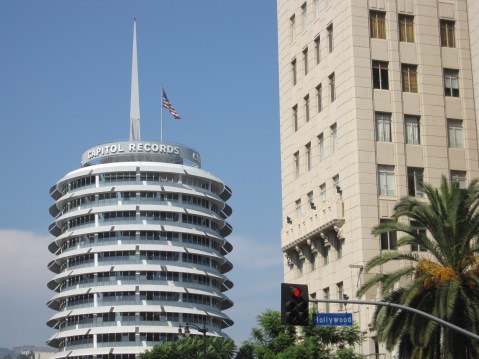
“Capitol Records Building” by Flickr user Wieland Van Dijk, CC BY-ND-SA 2.0
SUNDAY, November 9th
8:00 am – 9:45 am
Sports, Sex, and Music across the Pacific during the Cold War
Westin Bonaventure, Beaudry B (L1)
—Mari Yoshihara, University of Hawai’i, Manoa (HI)
Lenny Blows Up the World: Classical Musicians Play the Cold War
.
Sonics of Black Excess, 1940s to 1980s
Westin Bonaventure, Los Cerritos (L1)
CHAIR:
Imani D. Owens, Princeton University (NJ)
PAPERS:
Brian Lefresne, University of Guelph Canada
A Fool in Space: Sun Ra the Jester at the Carnival
Charles McGovern, College of William and Mary (VA)
I Want a Lavender Cadillac: Fun, Excess and Labor in Black Popular Music, 1940–1970
Terrion L. Williamson, Michigan State University (MI)
I‘m Not Your Superwoman: Black Female Embodiment and the Sites of Social Intimacy
Brian Edward Jones, College of William and Mary (VA)
Big Fun with the Prince of Darkness: Miles Davis and the Death of the American Dream
COMMENT:
Imani D. Owens, Princeton University (NJ)
.
10:00 am – 11:45 am
What Words Can’t Do: Instrumentals, Identity, and Interpretation
Westin Bonaventure, Los Cerritos (L1)
CHAIR:
Shana L. Redmond, University of Southern California (CA)
PANELISTS:
Shana L. Redmond, University of Southern California (CA)
Tsitsi Jaji, University of Pennsylvania (PA)
Guthrie Ramsey, Jr., University of Pennsylvania (PA)
Tamara Roberts, University of California, Berkeley (CA)
.
The Pleasures and Pains of Hip Hop Listening: New Aesthetic Approaches
Westin Bonaventure, San Bernardino (L1)
CHAIRS:
Jill Toliver Richardson, City University of New York, Borough of Manhattan Community College (NY)
James Ford, Occidental College (CA)
PAPER:
Karen Jaime, University of Illinois, Urbana-Champaign (IL), Jonathan Gray, City University of New York, John Jay College of Criminal Justice (NY), Candice Jenkins, City University of New York, Hunter College (NY), James Ford, Occidental College (CA)
The Pleasures and Pains of Hip Hop Listening: New Aesthetic Approaches
COMMENT:
Michael Jeffries, Wellesley College (MA)
.
“All the Way Live”: The Aesthetics of Pleasure in California Funk
Westin Bonaventure, Santa Barbara C (L1)
CHAIR:
Laura Harris, Pitzer College (CA)
PAPERS:
Scot Brown, University of California, Los Angeles (CA)
“All the Way Live”: The Live Funk Aesthetic of Lakeside
Cheryl L. Keyes, University of California, Los Angeles (CA)
From Mademoiselle Mabry to Betty Davis: The Reigning Funk Diva from the Underground
Tony Bolden, University of Kansas (KS)
Are You Funkified?: The Choreopoetics of Pleasure in the Music of Sly and the Family Stone
COMMENT:
Laura Harris, Pitzer College (CA)
.
**Caucus: Environment and Culture: Ecologies of Pleasure and Pain: Deviance, Destruction, and Desire in Environmental History**
Westin Bonaventure, Santa Barbara A (L1)
—Craig Eley, University of Wisconsin, Madison
Psychologically Ultimate Seashores: Natural Sound, Personal Pleasure, and Recording Technologies
.
12:00 pm – 1:45 pm
Pleasure, Pain, Politics, and Performance: Black Women Artists and Their Fans
Westin Bonaventure, Palos Verdes (L1)
CHAIR:
Gayle Wald, George Washington University (DC)
PANELISTS:
Ruth Feldstein, Rutgers University, Newark (NJ)
Emily Lordi, University of Massachusetts, Amherst (MA)
Cherise Smith, University of Texas, Austin (TX)
Gayle Wald, George Washington University (DC)
.
Performative Pleasures of Blackness: The Creation, Consumption, and Conflict of Pleasureable Blacknesses
Westin Bonaventure, San Fernando (L1)
—Danielle C. Heard, University of California, Davis (CA)
Feeling Good: Nina Simone and the Pleasures of Live Performance, Montreux 1976
—Scott Poulson-Bryant, Harvard University (MA)
The ‘Unruly Delights’ of the Great Black Way: Contradiction, Pleasure and Black Musicals of the 1970s
.
Can Black Women Have Fun?: Beyond Mammies and Martyrs
Westin Bonaventure, San Gabriel A (L1)
—Margo Crawford, Cornell University (NY)
Erykah Badu’s Black Fantastic Re-invigoration of Black Cultural Nationalism
.
2:00 pm – 3:45 pm
Central Avenue Breakdown: Gender, Race, and Coming of Age in a Los Angeles Jazz Community
Westin Bonaventure, Beaudry B (L1)
CHAIR:
Farah Jasmine Griffin, Columbia University (NY)
PAPERS:
Maxine Gordon, Fordham University (NY)
Dexter Gordon and Melba Liston: The ‘Mischievous Lady Session’, June 5, 1947, Dial Records
Monica Hairston-O’Connell, Columbia College (IL), Sherrie Tucker, University of Kansas (KS)
Revisiting Central Avenue through Melba Liston’s Oral Histories
Nichole T. Rustin, Independent Scholar
Playing with Dynamics: Racialized Masculinity, Jazz, and Coming of Age on 1940s Central Avenue
COMMENT:
Farah Jasmine Griffin, Columbia University (NY)
.
What Beyoncé (and Her Stans) Can Teach Us About The Pleasures of Intersectional Identity
Westin Bonaventure, Santa Barbara A (L1)
CHAIR:
Deborah Paredez, University of Texas, Austin (TX)
PANELISTS:
Clare Croft, University of Michigan, Ann Arbor (MI)
Micah Salkind, Brown University (RI)
Kristen Warner, University of Alabama, Tuscaloosa (AL)
Chelsea Bullock, University of Oregon (OR)
Deborah Paredez, University of Texas, Austin (TX)
.

“DSCN9630” by Flickr user Carsten Titibach, CC BY 2.0
Share this:




Current Top Posts





April 2021

January 2020

November 2019

October 2019

August 2019

April 2014

November 2017

March 2015

December 2017

October 2015
 Sounding Out!
Recent Comments