
SO! Amplifies: Allison Smartt, Sound Designer of MOM BABY GOD and Mixed-Race Mixtape
 SO! Amplifies. . .a highly-curated, rolling mini-post series by which we editors hip you to cultural makers and organizations doing work we really really dig. You’re welcome!
—
Currently on the faculty and the associate technical director of California Institute of the Arts Sharon Lund Disney School of Dance, Allison Smartt worked for several years in Hampshire’s dance program as intern-turned-program assistant. A sound engineer, designer, producer, and educator for theater and dance, she has created designs seen and heard at La MaMa, The Yard, Arts In Odd Places Festival, Barrington Stage Company, the Five College Consortium, and other venues.

Allison Smartt
She is also the owner of Smartt Productions, a production company that develops and tours innovative performances about social justice. Its repertory includes the nationally acclaimed solo-show about reproductive rights, MOM BABY GOD, and the empowering, new hip-hop theatre performance, Mixed-Race Mixtape. Her productions have toured 17 U.S. cities and counting.
Ariel Taub is currently interning at Sounding Out! responsible for assisting with layout, scoping out talent and in the process uncovering articles that may relate to or reflect work being done in the field of Sound Studies. She is a Junior pursuing a degree in English and Sociology from Binghamton University.
__
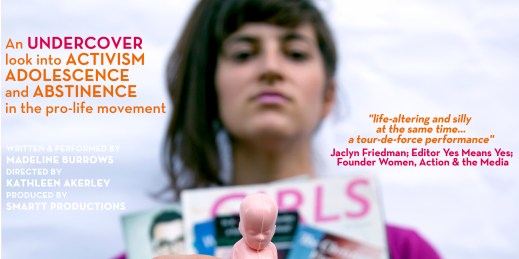
Recently turned on to several of the projects Allison Smartt has been involved in, I became especially fascinated with MOM BABY GOD 3.0, of which Smartt was sound designer and producer. The crew of MOM BABY GOD 3.o sets the stage for what to expect in a performance with the following introduction:
Take a cupcake, put on a name tag, and prepare to be thrown into the world of the Christian Right, where sexual purity workshops and anti-abortion rallies are sandwiched between karaoke sing-alongs, Christian EDM raves and pro-life slumber parties. An immersive dark comedy about American girl culture in the right-wing, written and performed by Madeline Burrows. One is thrown into the world of the Christian Right, where sexual purity workshops and anti-abortion rallies are sandwiched between karaoke sing-alongs, Christian EDM raves and pro-life slumber parties.
It’s 2018 and the anti-abortion movement has a new sense of urgency. Teens 4 Life is video-blogging live from the Students for Life of America Conference, and right-wing teenagers are vying for popularity while preparing for political battle. Our tour guide is fourteen-year-old Destinee Grace Ramsey, ascending to prominence as the new It-Girl of the Christian Right while struggling to contain her crush on John Paul, a flirtatious Christian boy with blossoming Youtube stardom and a purity ring.
MOM BABY GOD toured nationally to sold-out houses from 2013-2015 and was the subject of a national right-wing smear campaign. In a newly expanded and updated version premiering at Forum Theatre and Single Carrot Theatre in March 2017, MOM BABY GOD takes us inside the right-wing’s youth training ground at a more urgent time than ever.
I reached out to Smartt about these endeavors with some sound-specific questions. What follows is our April 2017 email exchange [edited for length].
Ariel Taub (AT): What do you think of the voices Madeline Burrows [the writer and solo actor of MOM BABY GOD] uses in the piece? How important is the role of sound in creating the characters?
Allison Smartt (AS): I want to accurately represent Burrows’s use of voice in the show. For those who haven’t seen it, she’s not an impersonator or impressionist conjuring up voices for solely comedy’s sake. Since she is a woman portraying a wide range of ages and genders on stage and voice is a tool in a toolbox she uses to indicate a character shift. Madeline has a great sense of people’s natural speaking rhythms and an ability to incorporate bits of others’ unique vocal elements into the characters she portrays. Physicality is another tool. Sound cues are yet another…lighting, costume, staging, and so on.
I do think there’s something subversive about a queer woman voicing ideology and portraying people that inherently aim to repress her existence/identity/reproductive rights.
Many times, when actors are learning accents they have a cue line that helps them jump into that accent. Something that they can’t help but say in a southern, or Irish, or Canadian accent. In MOM BABY GOD, I think of my sound design in a similar way. The “I’m a Pro-Life Teen” theme is the most obvious example. It’s short and sweet, with a homemade flair and most importantly: it’s catchy. The audience learns to immediately associate that riff with Destinee (the host of “I’m a Pro-Life Teen”), so much so that I stop playing the full theme almost immediately, yet it still commands the laugh and upbeat response from the audience.
AT: Does [the impersonation and transformation of people on the opposite side of a controversial issues into] characters [mark them as] inherently mockable? (I asked Smartt about this specifically because of the reaction the show elicited from some people in the Pro-Life group.)
AS: Definitely not. I think the context and intention of the show really humanizes the people and movement that Madeline portrays. The show isn’t cruel or demeaning towards the people or movement – if anything, our audience has a lot of fun. But it is essential that Madeline portray the type of leaders in the movement (in any movement really) in a realistic, yet theatrical way. It’s a difficult needle to thread and think she does it really well. A preacher has a certain cadence – it’s mesmerizing, it’s uplifting. A certain type of teen girl is bubbly, dynamic. How does a gruff (some may say manly), galvanizing leader speak? It’s important the audience feel the unique draw of each character – and their voices are a large part of that draw.

Madeline Burrows in character in MOM BABY GOD (National Tour 2013-2015). Photos by Jessica Neria
AT: What sounds [and sound production] were used to help carry the performance [of MOM BABY GOD]? What role does sound have in making plays [and any performance] cohesive?
AS: Sound designing for theatre is a mix of many elements, from pre-show music, sound effects and original music to reinforcement, writing cues, and sound system design. For a lot of projects, I’m also my own sound engineer so I also implement the system designs and make sure everything functions and sounds tip top.
Each design process is a little different. If it’s a new work in development, like MOM BABY GOD and Mixed-Race Mixtape, I am involved in a different way than if I’m designing for a completed work (and designing for dance is a whole other thing). There are constants, however. I’m always asking myself, “Are my ideas supporting the work and its intentions?” I always try to be cognizant of self-indulgence. I may make something really, really cool but that ultimately, after hearing it in context and conversations with the other artistic team members, is obviously doing too much more than supporting the work. A music journalism professor I had used to say, “You have to shoot that puppy.” Meaning, cut the cue you really love for the benefit of the overall piece.
I like to set myself limitations to work within when starting a design. I find that narrowing my focus to say…music only performed on harmonica or sound effects generated only from modes of transportation, help get my creative juices flowing (Sidenote: why is that a phrase? It give me the creeps)[. . .]I may relinquish these limitations later after they’ve helped me launch into creating a sonic character that feels complex, interesting, and fun.
AT: The show is described as being comprised of, “karaoke sing-alongs, Christian EDM raves and pro-life slumber parties,” each of these has its own distinct associations, how do “sing alongs” and “raves” and our connotations with those things add to the pieces?
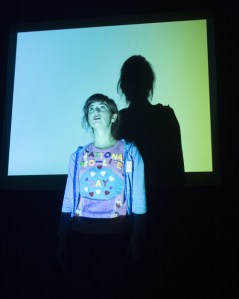
Madeline Burrows in character in MOM BABY GOD (National Tour 2013-2015). Photos by Jessica Neria
AS: Since sound is subjective, the associations that you make with karaoke sing-alongs are probably slightly different from what I associated with karaoke sing-alongs. You may think karaoke sing-along = a group of drunk BFFs belting Mariah Carey after a long day of work. I may think karaoke sing-alongs = middle aged men and women shoulder to shoulder in a dive bar singing “Friends In Low Places” while clinking their glasses of whiskey and draft beer. The similarity in those two scenarios is people singing along to something, but the character and feeling of each image is very different. You bring that context with you as you read the description of the show and given the challenging themes of the show, this is a real draw for people usually resistant to solo and/or political theatre. The way the description is written and what it highlights intentionally invites the audience to feel invited, excited, and maybe strangely upbeat about going to see a show about reproductive rights.
As a sound designer and theatre artist, one of my favorite moments is when the audience collectively readjusts their idea of a karaoke sing-along to the experience we create for them in the show. I feel everyone silently say, “Oh, this is not what I expected, but I love it,” or “This is exactly what I imagined!” or “I am so uncomfortable but I’m going with it.” I think the marketing of the show does a great job creating excited curiosity, and the show itself harnesses that and morphs it into confused excitement and surprise (reviewers articulate this phenomenon much better that I could).
AT: In this video the intentionally black screen feels like deep space. What sounds [and techniques] are being used? Are we on a train, a space ship, in a Church? What can you [tell us] about this piece?
AS: There are so many different elements in this cue…it’s one of my favorites. This cue is lead in and background to Destinee’s first experience with sexual pleasure. Not to give too much away: She falls asleep and has a sex dream about Justin Bieber. I compiled a bunch of sounds that are anticipatory: a rocket launch, a train pulling into a station, a remix/slowed down version of a Bieber track. These lead into sounds that feel more harsh: alarm clocks, crumpling paper…I also wanted to translate the feeling of being woken up abruptly from a really pleasant dream…like you were being ripped out of heaven or something. It was important to reassociate for Destinee and the audience, sounds that had previously brought joy with this very confusing and painful moment, so it ends with heartbeats and church bells.
I shoved the entire arc of the show into this one sound cue. And Madeline and Kathleen let me and I love them for that.
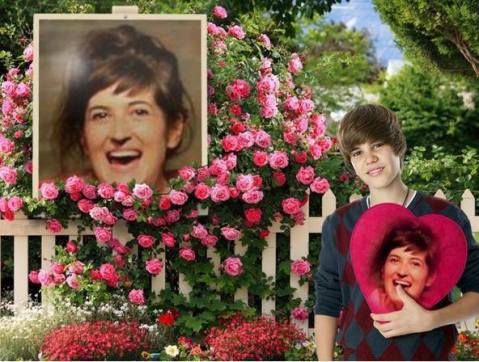
from madelineburrows.com
AT: What do individuals bring of themselves when they listen to music? How is music a way of entering conversations otherwise avoided?
AS: The answer to this question is deeper than I can articulate but I’ll try.
Talking about bias, race, class, even in MOM BABY GOD introducing a pro-life video blog – broaching these topics are made easier and more interesting through music. Why? I think it’s because you are giving the listener multiple threads from which to sew their own tapestry…their own understanding of the thing. The changing emotions in a score, multiplicity of lyrical meaning, tempo, stage presence, on and on. If you were to just present a lecture on any one of those topics, the messages feel too stark, too heavy to be absorbed (especially to be absorbed by people who don’t already agree with the lecture or are approaching that idea for the first time). Put them to music and suddenly you open up people’s hearts.
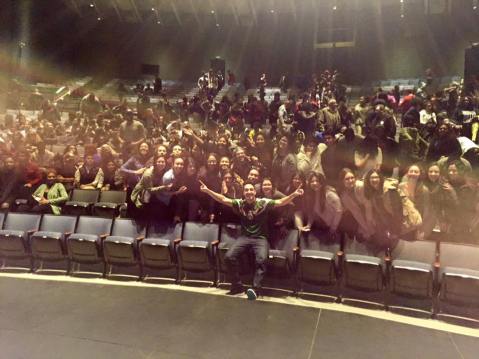
Post- Mixed-Race Mixtape love, William Paterson University, 2016 Photo credit: Allison Smartt
As a sound designer, I have to be conscious of what people bring to their listening experience, but can’t let this rule my every decision. The most obvious example is when faced with the request to use popular music. Take maybe one of the most overused classics of the 20th century, “Hallelujah” by Leonard Cohen. If you felt an urge just now to stop reading this interview because you really love that song and how dare I naysay “Hallelujah” – my point has been made. Songs can evoke strong reactions. If you heard “Hallelujah” for the first time while seeing the Northern Lights (which would arguably be pretty epic), then you associate that memory and those emotions with that song. When a designer uses popular music in their design, this is a reality you have to think hard about.
Cassette By David Millan on Flickr.
It’s similar with sound effects. For Mixed-Race Mixtape, Fig wanted to start the show with the sound of a cassette tape being loaded into a deck and played. While I understood why he wanted that sound cue, I had to disagree. Our target demographic are of an age where they may have never seen or used a cassette tape before – and using this sound effect wouldn’t elicit the nostalgic reaction he was hoping for.
Regarding how deeply the show moves people, I give all the credit to Fig’s lyrics and the entire casts’ performance, as well as the construction of the songs by the musicians and composers. As well as to Jorrell, our director, who has focused the intention of all these elements to coalesce very effectively. The cast puts a lot of emotion and energy into their performances and when people are genuine and earnest on stage, audiences can sense that and are deeply engaged.
I do a lot of work in the dance world and have come to understand how essential music and movement are to the human experience. We’ve always made music and moved our bodies and there is something deeply grounding and joining about collective listening and movement – even if it’s just tapping your fingers and toes.
AT: How did you and the other artists involved come up with the name/ idea for Mixed-Race Mixtape? How did the Mixed-Race Mixtape come about?
AS: Mixed-Race Mixtape is the brainchild of writer/performer Andrew “Fig” Figueroa. I’ll let him tell the story.
Andrew “Fig” Figueroa, Hip-Hop artist, theatre maker, and arts educator from Southern California
A mixtape is a collection of music from various artists and genres on one tape, CD or playlist. In Hip-Hop, a mixtape is a rapper’s first attempt to show the world there skills and who they are, more often than not, performing original lyrics over sampled/borrowed instrumentals that compliment their style and vision. The show is about “mixed” identity and I mean, I’m a rapper so thank God “Mixed-Race” rhymed with “Mixtape.”
The show grew from my desire to tell my story/help myself make sense of growing up in a confusing, ambiguous, and colorful culture. I began writing a series of raps and monologues about my family, community and youth and slowly it formed into something cohesive.
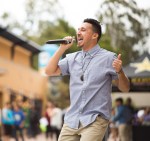
AT: I love the quote, “the conversation about race in America is one sided and missing discussions of how class and race are connected and how multiple identities can exist in one person,” how does Mixed-Race Mixtape fill in these gaps?
AS: Mixed-Race Mixtape is an alternative narrative that is complex, personal, and authentic. In America, our ideas about race largely oscillate between White and Black. MRMT is alternative because it tells the story of someone who sits in the grey area of Americans’ concept of race and dispels the racist subtext that middle class America belongs to White people. Because these grey areas are illuminated, I believe a wide variety of people are able to find connections with the story.
AT: In this video people discuss the connection they [felt to the music and performance] even if they weren’t expecting to. What do you think is responsible for sound connecting and moving people from different backgrounds? Why are there the assumptions about the event that there are, that they wouldn’t connect to the Hip Hop or that there would be “good vibes.”
AS: Some people do feel uncertain that they’d be able to connect with the show because it’s a “hip-hop” show. When they see it though, it’s obvious that it extends beyond the bounds of what they imagine a hip-hop show to be. And while I’ve never had someone say they were disappointed or unmoved by the show, I have had people say they couldn’t understand the words. And a lot of times they want to blame that on the reinforcement.
I’d argue that the people who don’t understand the lyrics of MRMT are often the same ones who were trepidatious to begin with, because I think hip-hop is not a genre they have practice listening to. I had to practice really actively listening to rap to train my brain to process words, word play, metaphor, etc. as fast as rap can transmit them. Fig, an experienced hip-hop listener and artist amazes me with how fast he can understand lyrics on the first listen. I’m still learning. And the fact is, it’s not a one and done thing. You have to listen to rap more than once to get all the nuances the artists wrote in. And this extends to hip-hop music, sans lyrics. I miss so many really clever, artful remixes, samples, and references on the first listen. This is one of the reasons we released an EP of some of the songs from the show (and are in the process of recording a full album).
.
The theatre experience obviously provides a tremendously moving experience for the audience, but there’s more to be extracted from the music and lyrics than can be transmitted in one live performance.
AT: What future plans do you have for projects? You mentioned utilizing sounds from protests? How is sound important in protest? What stands out to you about what you recorded?
AS: I have only the vaguest idea of a future project. I participate in a lot of rallies and marches for causes across the spectrum of human rights. At a really basic level, it feels really good to get together with like minded people and shout your frustrations, hopes, and fears into the world for others to hear. I’m interested in translating this catharsis to people who are wary of protests/hate them/don’t understand them. So I’ve started with my iPhone. I record clever chants I’ve never heard, or try to capture the inevitable moment in a large crowd when the front changes the chant and it works its way to the back.
.
I record marching through different spaces…how does it sound when we’re in a tunnel versus in a park or inside a building? I’m not sure where these recordings will lead me, but I felt it was important to take them.
—

REWIND! . . .If you liked this post, you may also dig:
Beyond the Grandiose and the Seductive: Marie Thompson on Noise
Moonlight’s Orchestral Manoeuvers: A duet by Shakira Holt and Christopher Chien
Aural Guidings: The Scores of Ana Carvalho and Live Video’s Relation to Sound
Share this:

Beyond the Grandiose and the Seductive: Marie Thompson on Noise

Dr. Marie Thompson is currently a Lecturer at the Lincoln School of Film and Media, University of Lincoln. Her new book Beyond Unwanted Sound: Noise, Affect and Aesthetic Moralism has just been published by Bloomsbury. We’ve been following each other on Twitter for a while(@DrMarieThompson and @AbstractTruth) and I have become very interested in her ideas on noise. I’m David Menestres, double bassist, writer, radio host, and leader of the Polyorchard ensemble (“a vital and wonderfully vexing force of the area’s sonic fringes”) currently living in the Piedmont region of North Carolina.
—
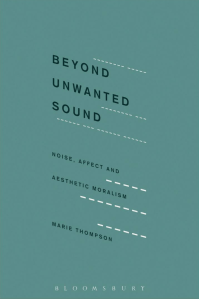
Cover of “Beyond Unwanted Sound Noise, Affect and Aesthetic Moralism,” By Dr. Marie Thompson
In her new book, Dr. Thompson covers a wide variety of ideas from Spinoza to Michel Serres’s cybernetic theory, acoustic ecology and the politics of silence to the transgressiveness of noise music, and many other concepts to show how we are affected by noise. Thompson is also the co-editor of Sound, Music, Affect: Theorizing Sonic Experience (Bloomsbury, 2013). Here is a conversation we had over email in February 2017 about Beyond Unwanted Sound.
David Menestres (DM): Why now? Why did you feel compelled to write this book? What do you hope this book will accomplish?
Marie Thompson (MT): I think my ‘academic’ interest in noise began as an undergraduate music student – I was interested in thinking ‘beyond’ distinctions of avant-gardism and popular culture and noise, as something that traverses such separations became an evermore appealing concept. So I’ve been circling some of these ideas for quite a while.
I felt compelled to write the book partly due to what I perceived as a gap between some of my ‘everyday’ experiences of noise and how noise was represented in discourse – particularly noise’s representation as an essentially negative phenomenon; or as a shocking, sublime, radical, overwhelming, transgressive force. Noise seems to be one of those topics that makes ordinarily quite progressive thinkers revert to quite uncritical and reactionary tropes – there’s something about it that ‘touches a nerve’. Consequently, much of the discourse around noise is underlined by an often-unacknowledged conservatism. I’ve always found the grandiose rhetoric of noise comparatively quite seductive but at the same time, more often than not, noise is quotidian and banal rather than overwhelming or sublime (which isn’t to say it can’t also be those things). Likewise, I felt like this grandiose rhetoric resulted in an amplification of certain sonic arts practices, while silencing others. I guess I was compelled by a desire to expand the (material and discursive) universe of noise while also trying to maintain some consistency in definition.
Quite simply, I hope the book will contribute something helpful to the recent discussions around noise in media theory, acoustic ecology and music.
DM: What is the difference between a subjective-oriented definition of noise vs. an object-oriented definition and how do both lead to the ethico-affective approach that you champion in the book?
MT: When I refer to subject- and object-oriented definitions I’m referring, quite simply, to noise being defined either in relation to the ear of the beholder, or in relation to the sound-itself. [MT also defines her “ethico-affective approach” as a perspective that “recognises the entanglement of the ethical and the affective: affective relations are also ethical relations.” –ed.]
What I think is useful about a subject-oriented definition is that it remains open to what noise might be, what form it might take – it might be your neighbour hoovering, it might be a fellow travelers mobile phone, or it might be a buzzing wasp. However, subject-oriented definitions of noise are typically wedded to liberal notions of subjectivity and the politics that carries. Noise becomes an issue of personal taste – one person’s music is another’s noise etc. Subject-oriented definitions also struggle to account for noise that isn’t ‘unwanted’, ‘bad’, ‘negative’, and so on; and for noise that might not be perceptible, or noticeable.

Noise as Negative. Sound Cancelling
Object-oriented definitions which treat noise as a type of sound are helpful insofar as there is a consistency of definition and it does not assume noise to be a solely negative phenomenon; however, to my mind, they risk losing sight of context: a particular sound is noise irrespective of how it is heard, what it does.
The ethico-affective approach I develop can be understood to maintain aspects of both these definitional approaches. It maintains the separation created by an object-oriented definition of noise between noise and negativity, so that noise’s ‘unwantedness’ becomes secondary and contingent. It also maintains the contextual focus of a subject-oriented definition, so that noise is not tethered to particular types of sound or sound sources.
DM: I’ve been very interested in the idea of noise as a weapon: the use of sound cannons to silence and sicken protestors, the use of the “Mosquito” device (which produces high frequency pitches thought to be audible only to teenagers in order to keep them from loitering), or the use of classical music to annoy young people.
You talk in one section about the noise of neighbors and the “policed silence of the suburbs.” I am also interested in the use of noise as protest. At the Women’s March in Raleigh on January 21, there were so many fascinating sounds: the sounds of thousands of voices bouncing off tall buildings, drummers, people leading chants with the crowd shouting back, the singing of classic protest songs (“A Change is Gonna Come,” “This Land Is Your Land,” etc.).
What do you think the role of noise will be in our current political climate? I can definitely see noise being used as a weapon by both sides: the government trying to use it as a weapon against the people and the people using noise to amplify their voice against the government. But there is a stark difference between these two sides: the use of sound weapons is clearly for their intended negative affect on people (both the physical effects of sound weapons and the psychological effects of the endless noise that comes from Trump’s press conferences and general bullshit), but I see the protestors intending to use sound in a positive way, to amplify their message, to make sure those in charge hear their voices, to ensure the message arrives intact.
MT: As a concept, noise seems evocative of much about our current political climate: be it the ‘noise’ of ‘fake news’, and ‘alternative facts’ (how does one determine ‘signal’ from ‘noise’, and who gets to determine that distinction); be it the ‘white noise’ of the Trump campaign administration (I recently saw a performance lecture with Barby Asante which effectively performed the ‘tuning out’ the noise of recently-bolstered white supremacy); or be it the collective noise of protest against the brutality of borders, white supremacy and police-state violence.
That noise can be both a force of domination and resistance is revealing of its ambiguity more generally – what I refer to as the ‘both-and’ of noise. Of course, that is not to conflate these uses of sonic force. One of the ways in which I’ve thought about this ethico-political difference in sonic forces is through the Spinozist distinction of power-over/power-to. The ethico-political entangles ethical questions (good-bad) with political questions (power over/power to).
So, when sound is weaponized to exert authority, to bring people into line, by diminishing their capacity to act and do, then this can be thought of as an exertion of power-over. Likewise, when sound becomes a means of collective resistance, or of connectivity (I’m thinking partly here of various ‘noise-protests’ at prisons and detentions centres, where sound is used to traverse walls and borders) then it might be understood as an expression of ‘power-to’ – a (collectivized) body’s capacity to act, to be, to do.
DM: You talk in the book of the “conservative politics of silence.” How does this conservativism affect both how people perceive sound and how we relate to it? Is there something at the other end of the scale, a “liberal politics of silence” so to speak?
MT: To my mind, the conservative politics of silence informs a number of assumptions that are frequently made about what are ‘good’ and ‘bad’ sonic environments; it relates to a preference for the simple over the complex, sameness over difference, past over present, predictability over unpredictability, the ‘synthetic’ over the ‘natural’ (whatever that might mean) and, ultimately, quietude over noise. This ideological framework underlines much ‘common sense’ about auditory experience, however it frequently remains unacknowledged.
We might consider a liberal politics in opposition to this conservative politics of silence, which recognises responses to sonic environments as ‘personal’ and therefore refuses overarching moral judgements about ‘good’ and ‘bad’ sound. However, I’m also wary of endorsing a politics that treats the individual, autonomous subject as the primary site of the political. Indeed, the conservative politics of silence that we see in the work of figures such as R. Murray Schafer is often indebted to a liberalism that prioritises control and the freedoms and rights of the individual – I’m thinking here of Schafer’s complaint that you can rid your private property of a physical intruder but not an aural one: “A property-owner is permitted by law to restrict entry to his private garden or bedroom. What rights does he have against a sonic intruder?” (1993, 214)
DM: One of the sections I particularly liked was the “What does noise do?” section where you delved into information theory through the work of Claude Shannon to show how noise was an essential part of a communications system, how noise can be a necessary, amplifying presence, needed to successfully transmit a message (voice over phone lines, data packets over the internet, etc.), how noise can enrich a system. I found myself thinking about this section a lot, often in relation to R. Murray Schaffer’s Platonic ideal state of silence. (“a Platonic, transcendent realm of a pure and ideal sonority, which paradoxically exists as undisturbed and eternal silence”).
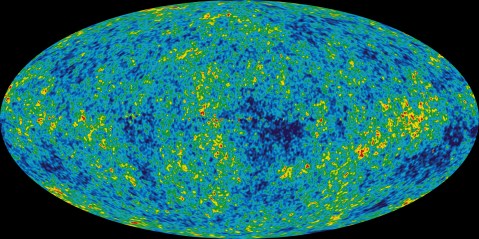
Cosmic Radiation from the Big Bang- Sound Makes Up Our Universe
I was also thinking about Cosmic Microwave Background radiation, the residual signature of the Big Bang, the background noise that carried all the information that formed our universe. It seems like noise is an intrinsic part of our world, both human made and naturally occurring, and fighting against it seems like such a waste of energy.
MT: It strikes me that when Schafer and other acoustic ecologists talk about fighting noise, they’re fighting a symptom rather than a cause. In these discourses, there is much talk of noise and environmental destruction but very little on how these processes relate to capitalism and settler-colonialism. In that regard, while I don’t think fighting against noise in absolute terms is futile, I do maintain that there are still fights to be had against high levels of noise. While I am critical of liberal notions of privacy and control and the ‘right’ to silence, I do also recognise that noise can feel oppressive in some contexts. That said, more often than not high levels of noise is a symptom of bigger social and political problems – for example, of poor quality housing, and a lack of economic choice over where one lives.
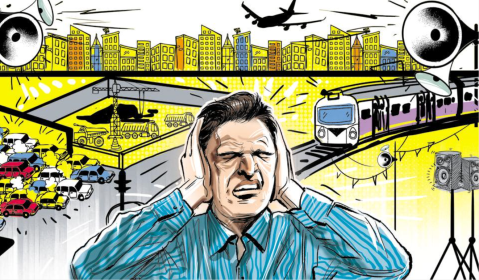
Noise Pollution, Sociological Restrictions, Sound Intrusion. From the Hindustan Times
DM: One of the themes explore in the book is the idea of the parasite, based on the work of Michel Serres. How does the parasite relate to your idea of noise?
MT: I take from Serres’ figure of the parasite the idea of noise as a relational, transformative and ambiguous in its necessity. In Serres’ reading, the parasite changes things, for better or for worse. Either way, the parasite does something, it adds something to the mix. In other words, it is affective. And yet, there is no ‘mix’ without it. Parasitic noise is the ‘excluded middle’ that must be included: it is the necessary ‘third term’, which pertains to the necessity of the material medium/milieu. From this perspective, there is no original state of calm, which is then broken by noise. If there is mediation there is noise, if there is the relation there is the parasite.
DM: Could you talk some about “the poetics of transgression” as you call it? How does this “transgression” relate to your ethico-affective approach?
MT: The poetics of transgression refers to the centrality of ‘line-crossing’ narratives in accounts of noise’s use in the sonic arts and art more generally. It’s predicated on what Henry Cowell calls the ‘time-honoured axiom’ that noise and music are opposites. Bringing noise into music, or music into noise relies on the crossing of boundaries, of material and discursive borders. This ‘line-crossing’ is often accompanied by a rhetoric of extremity and radicalism, shock and awe.
While different notions of transgression have certainly been influential for various noise music practitioners, I seek to decentre it as a way rather than the way of understanding noise’s use as an artistic resource. I argue that the dominance of the poetics of transgression has risked reducing noise music to its most ‘extreme’ manifestations. In light of the ethico-affective approach to noise that I develop throughout the book, which understands noise as a transformative force and necessary component of mediation, I suggest that noise music can be understood as an act of exposure, which, rather than bringing noise into music (or vice versa) exposes, extends and foregrounds the noise that is within the techno-musical system so as to generate new sonic sensations. With this approach, I hope to make more space for noise music practices that do not fit comfortably with the poetics of transgression and its aesthetics and rhetoric of extremity.
—
Featured Image: Noise Music
—
REWIND! . . .If you liked this post, you may also dig:
Sounding Out! Podcast #60: Standing Rock, Protest, Sound and Power (Part 1)–Marcella Ernest
The Noises of Finance–N. Adriana Knouf
Learning to Listen Beyond Our Ears: Reflecting Upon World Listening Day–Owen Marshall
Share this:


Current Top Posts





April 2021

January 2020

November 2019

October 2019

August 2019

April 2014

November 2017

March 2015

December 2017

October 2015
 Sounding Out!
Recent Comments