
#MMLPQTP Politics: Soccer Chants, Viral Memes, and Argentina’s 2018 “Hit of the Summer”
Note: all translations of quotations from linked media are the author’s own.
In early March, viewers of the Argentine public television cooking show Cocineros Argentinos were treated to a jaunty bit of live interstitial music as the program returned from a commercial break. In keeping with the day’s Italian theme, a small band consisting of an accordion, violin, and sousaphone played a lively but simple minor-key melody in a brisk tarantella rhythm. “Those boys can play anything,” one of the hosts remarked approvingly. The other observed, “It’s the hit of the summer!”
These sixteen seconds of seemingly innocuous instrumental music on a government-sponsored television program sparked a minor firestorm in the Argentine press. One channel wondered whether they were deliberately “picking a fight with [President] Mauricio Macri,” while another categorized the musical selection as “polemic.” Social media voices in support of the embattled president called for Cocineros Argentinos to be cancelled. Ultimately, the program’s directors apologized to the public for having “bothered or disrespected” their viewers with “ingredients that do not belong in the kitchen.”
How could a bit of instrumental, pseudo-Italian kitsch cause such an uproar? Understanding the offense – for the musical selection was indeed intended as an obscene insult to the nation’s president – requires a bit of a dive into the history and culture of Argentine politics, protest, and sports fandom. The “hit of the summer” of 2018 in Argentina is not a pop song, but a chant that started in a soccer stadium, and has become a viral sonic meme, multiplying across social media and fragmenting into countless musical iterations. By early March, listeners in Argentina heard a clear meaning in this melodic sequence, and no singer was necessary to hear the words it invoked: Mauricio Macri, you son of a whore.
The melody comes originally from a source that expresses quite a different political sentiment. In 1973, after eighteen years of forced exile, ousted populist president Juan Domingo Perón was allowed to return to Argentina, and was shortly thereafter re-elected president. Perón died in office ten months later and was succeeded by his vice president and third wife Isabelita. Isabelita’s reign would soon devolve into an infamously brutal military junta, but in 1973 populist national fervor was running high in the country, and the airwaves were full of catchy, simple patriotic marches:
“Es tiempo de alegrarnos” (“It is time for us to be happy”), by Raúl “Shériko” Fernandez Guzmán, is full of optimism for what Perón’s return means for the country. The second stanza celebrates: “I see that my people returns once more to laughter / It’s that my country has begun to live again / Pain and sadness are left behind / The days of happiness and bliss have returned.”
It’s a sentiment that would be difficult to find today in a country where political discourse is polarized and acrimonious. Macri was elected in November 2015 on a platform that was largely about undoing the policies of the decade of Peronist administrations that preceded him (his party itself is called “Cambiemos” [Let’s Change]). Since coming to power, Macri’s party has pursued a neoliberal agenda that has been increasingly unpopular with the working and middle class. Cuts to state subsidies have made the cost of utilities and mass transit skyrocket, and groups from truck drivers to teachers have organized large-scale protests in response to the austerity measures and budget cuts to the public sector. In response to these increasingly fervent protests, Macri has even authorized violent police repression of crowds. In short, as of the beginning of 2018, he’s politically embattled and a target of widespread criticism from a wide range of sectors.
Yet the “hit of the summer” is not merely an ironic repurposing of an old bit of patriotic musical fluff in a time of unrest. In fact, as the phenomenon first went viral, most Argentines were unware of the music’s original source, which had been a fleeting fad. Instead, the melody had lived on and been transformed through the great repository of popular musical memory that is Argentine soccer culture.
Soccer fandom in Argentina is a full-throated affair. As Kariann Goldschmitt has observed in the case of Brazil, the soundscape of mass gatherings in the soccer stadium, and the affective charge of crowds experiencing the collective pain of loss or the exultation of victory, is a fundamental ingredient of popular identity in Argentina. But it is not the commercial, mediatized end of what Goldschmitt calls the “sports-industrial complex” that is primarily influential here.
Rather, hinchadas, or fan clubs, pride themselves on being able to sing loudly throughout the match, arms extending in unison, typically accompanied by bombos (bass drums), trumpets, and other loud instruments. Fan clubs pride themselves on the variety and creativity of their cantitos – the ‘little songs” that repurpose popular melodies with new lyrics that praise their own side, and insult their opponents’ lack of fortitude. Any memorable melody is fair game: for example, fans of Creedence Clearwater Revival’s “Bad Moon Rising” might have found the cantito that Argentina embraced during the 2014 World Cup vaguely familiar. In the decades since its release, “Es tiempo de alegrarnos” had been used periodically by the clubs of several teams, in variants whose unifying factor was the use of the obscenity “la puta que te parió” (literally, “the whore that birthed you”) for emphasis.

Hinchada Argentina – Copa do Mundo Brasil 2014 – Estádio Beira-Rio – Porto Alegre, June 24, 2014, Image by Flickr User Felipe Castilhos
It was San Lorenzo’s fans who gave the cantito a new life in politics, during a match against Boca Juniors. The connection between Boca and President Macri was obvious for fans of both teams; Macri began his political career as the president of that team. When San Lorenzo fans felt they had been the victim of biased refereeing, the song began: “Mauricio Macri, la puta que te parió…”. All four phrases of the melody repeated the same words.
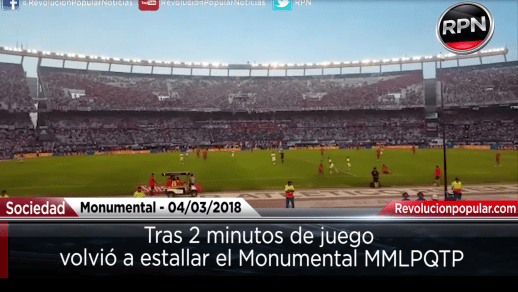
Unusually for a soccer cantito, the chant was soon picked up by the fans of another team, River Plate, who used it in similar circumstances when facing Macri’s Boca Juniors, their archrivals. Even more unusual, though, is the life that the chant has since taken on outside of the soccer stadium, where it is directed at the President not due to his association with his former club, but because of growing discontent with his political career. In the last weeks of February the cantito, now popularly known by its initials as “MMLPQTP” was heard in concert halls, basketball stadiums, and even in a crowded subway station (where, despite fare prices that have risen at eight times the rate of inflation, service remains irregular and delays are common). Journalists covering the phenomenon began to refer to it as “el hit del verano,” or “the hit of the summer.”

“Suena en las canchas, suena en los recitales, suena en el subte… Ahora también suena en los celulares!!!” Click to download an Mp3 Ringtone of “MMLPQTP”
Using the English-language “hit” made clear that the allusion was not merely to the season (February is, of course, summer in the southern hemisphere, and a popular vacation time for Argentines) but to the seasonal nature of pop music consumption. The popular music critic’s thinkpiece seeking to define the essence of the summer song, celebrate it or lament its banality is almost as much of a trope as the phenomenon of the hit summer song itself. The sonic zeitgeist of summer 2018, these journalists suggested, could best be defined not with a breezy club banger, but with the hoarse and irate voices of a nation embroiled in an economic crisis that would make idle days at the beach unthinkable for many of its citizens.
There were attempts to curtail the spread of MMLPTQTP: the national referee’s association debated suspending future soccer matches if the chant broke out, characterizing it as potentially “discriminatory” speech (some cantitos do traffic in racist, anti-Semitic, and homophobic epithets, and referees have suspended games in the past to control them). In the end, no such suspensions occurred, perhaps because soccer fans and other musicians alike had already realized that the MMLPQTP chant had re-signified its melody so strongly that the lyrics were no longer necessary. One political cartoonist pointed out the referees’ conundrum perfectly: “They’re not singing the lyrics, sir, just humming the music,” the referee observes, asking, “should I suspend [the game] anyway?” Faced with the specter of censorship, Argentines embraced the full expressive potential of non-linguistic sonic signifiers, and the democratic possibilities of virally distributed, user-created content. A sonic meme was born.
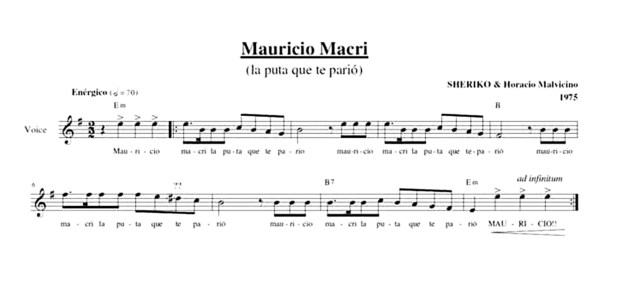
The term “meme” was coined by Richard Dawkins, who used it to mean a basic unit of information analogous to a gene, only for information or ideas. I use the term here, though, in keeping with the more contemporary popular usage, to refer to user-generated humorous content – generally captioned images — shared online. Meme sharing sites often provide templates to help users easily generate variations on a theme. In this case, the structural template was a melody and two simple chords (which musicians helpfully transcribed and shared, both in standard Western notation and instructional video formats).
Musicians of all backgrounds flocked to Twitter, Facebook and YouTube to riff on MMLPQTP. In a catalog too long to list in its entirety here, a greatest hits compilation might include solo versions for piano and charango, covers in popular genres from blues to cumbia to metal. Argentines with a strong sense of national identity might prefer tango, but Brazilian-style Carnival samba also made an appearance (playfully invoking the possibility of censorship with Spanish “subtitles” that replace the offending phrase with “la la la”). And thus finally, scandalously, the hit song made its way to national television on a cooking show, where despite its transformation into an Italian-style instrumental ditty, the sting of its insulting words was still clearly heard.
The viral success of instrumental versions of MMLPTQP is a prime example what ethnomusicologist Anne Rasmussen has recently called “the politicization of melody.” In music’s potential to comprise and thus link simultaneous linguistic and non-linguistic codes lies its ability to render those linguistic codes superfluous. These linkages provide the potential to signify political messages through melody alone, opening up possibilities for protest that are more difficult to prevent through legal means (broadcasters’ obscenity clauses, for example), or easier to circumvent through technological means (amplified instruments). It would be easy to overstate the durability or pervasiveness of such linkages, however. One need only look back to that same melody’s entirely differently politicized origin, which is today largely forgotten or seen as a curiosity, to imagine that the linkage between the melody to “Es tiempo de alegrarnos” and its current manifestation of partisan abuse might one day fade from popular memory like the one-hit wonders of summers past.
—
Featured Image: Screencapture from “Monumental MMLPQTP”
—
Michael S. O’Brien is an assistant professor of music at the College of Charleston. He has been conducting ethnographic field research on music and cultural politics in Argentina since 2003. His article examining the use of thebombocon platillo in Carnival music, soccer fandom, and political culture is forthcoming in the journal Ethnomusicology this fall. He has also published research on protest music in the U.S. in the journal Music and Politics and Smithsonian Folkways Magazine.
—
 REWIND!…If you liked this post, you may also dig:
Heard Any Good Games Recently?: Listening to the Sportscape–Kaj Ahlsved
In Search of Politics Itself, or What We Mean When We Say Music (and Music Writing) is “Too Political”–Elizabeth Newton
Twitchy Ears: A Document of Protest Sound at a Distance–Ben Tausig
The Sounds of Selling Out?: Tom Zé, Coca-Cola, and the Soundtrack to FIFA Brazil 2014–Kariann Goldschmidt
Share this:

SO! READS: Melissa Mora Hidalgo’s Mozlandia: Morrissey Fans in the Borderlands
 These days it’s a challenge to be reviewing a book that has anything to do with the English singer-writer Morrissey, given his support for Brexit and anti-immigrant nationalist political parties in the UK. In a fake interview, Moz recently used his website to attack non-compliant media that had criticized him. His vegetarianist pitch was that Muslim meat is murder. Oh, and the Mayor of London Sadiq Khan shouldn’t be running the city because he doesn’t speak English properly. With each new provocation in a long career of trolling, one wonders, in the words of one of his songs, ‘Little Man, What Now?’ How can it get worse? So it isn’t a good time to be a fan of Morrissey and/or the Smiths (deceased 1987), an ex-fan or someone who now claims they preferred guitarist Johnny Marr from the get-go. Who then would want to reside in a land named after Moz, even if he is only its symbolic head of state?
Thankfully Mozlandia: Morrissey Fans in the Borderlands (Headpress, 2016) nudges Bigmouth to the background, even if an almost holy portrait graces the book’s cover. For Melissa Mora Hidalgo, Mozlandia is the territory of the US-Mexico border region, and Greater Los Angeles in particular, with its cultures and communities of Morrissey Smiths fans as ‘active, creative producers’ in ‘transnational circuits of exchange’ that reveal ‘fandom’s potential for enacting resistance and creating new spaces of belonging’ (14). Hidalgo is an independent scholar from Whittier, California with research expertise in Mexican American literature, US ethnic studies and queer studies. This book is oriented by Gloria E. Anzaldúa’s canonical text in Chicana/o studies Borderlands/La Frontera: The New Mestiza (1987) and Gilles Deleuze and Félix Guattari’s contention in A Thousand Plateaus: Capitalism and Schizophrenia (1987) that the form of the book is about surveying and mapping rather than signifying. Hidalgo describes it also as a ‘storybook’ that includes field notes, journal entries, riffs on lyrics, fanecdotes (fan anecdotes) and her own personal voice as a participant in these fan cultures and a citizen of Mozlandia.
 What is immediately striking is the way these different forms of writing are woven together in an accessible, honest, affecting, playful, and queer bilingual prose by someone deeply connected to the communities and activities of Smiths Morrissey fans in Los Angeles. This is an academic page-turner that wears its scholarly rigor as lightly as Morrissey wore gladioli in his back pocket. The book opens with a rush and a push to move beyond the now much reported ‘novelty’ or surprise factor of Irish-English Morrissey from Manchester in the northwest of England having so many Chicana/o fans in Southern California.
Mozlandia builds on the model of Smiths Morrissey tourism in Manchester to map out a potential tour of Los Angeles, a city where he lived from 1997-2004 and has played very often, and featured in songs and videos. After this psychogeography, Hidalgo hones in on the East LA neighborhood of Boyle Heights, where Morrissey karaoke or MorrisseyOke nights at Eastside Luv Bar y QueSo have taken place since the early 2000s. Hidalgo describes the variety of performances of local and visiting Smiths Morrissey fans including dressing up and singing songs in Spanish, Japanese and other languages. The argument embeds this bar and the fan phenomenon in the contradictory and ambivalent politics of ‘gentefication’ in which upwardly mobile Chicanas/os invest in their old neighborhoods. While describing the venue as a community space for the crossing of ethnic and gendered borders, the argument is sensitive to how the place is also ‘prone to hypermasculine heteronormative homophobic aggression from attendees’ (78).
The following chapter focuses on Smiths Morrissey tribute bands in ‘Moz Angeles’ such as Sweet and Tender Hooligans, These Handsome Devils, This Charming Band, Strangeways, Maladjusted, Nowhere Fast, El Mariachi Manchester and Sheilas Take a Bow, the latter of which includes the author on vocals. Musicians in these bands share their stories of attachment to the repertoire, genre and modes of performance and dramaturgy. This tribute band activity is much deeper and more varied than the more visible media attention for mariachi outfit Mexrissey.
From tribute bands, Hidalgo moves to the fan listenership of the tweet-in radio show Breakfast with the Smiths, The World of Morrissey on Indie 103.1 FM, a now defunct online station owned by Latino media company Entravision that played alternative/indie music with a strong British quotient. This chapter explores Twitter’s function as a remediated request line that also features as an audience forum that is rich with photos of tickets to gigs, selfies, memes and graphics alongside social media chatter and verbal performance (such as anagrams) around songs. Hidalgo then moves on to literary performances of Morrissey in poetry, fiction, theatre and film. Morrissey-inspired events are rooted here in the musical and broader artistic histories of East LA with its rock, punk and Anglophilic new wave scenes. The range of works jumps off Morrissey to articulate the experiences of growing up and rework the forms of class, ethnic and gender alienation that feature so strongly in the singer’s work.

The book concludes with a trip to the UK where Morrissey’s hairdresser refuses to cut Hidalgo’s hair because they only serve male patrons. This encounter is part of a fan letter to Morrissey. Hidalgo writes, ‘I am forty-two, and you mean just as much to me now as you did when I was seventeen going on eighteen. Even when I want to scold you for saying that shit about the Chinese, or liking Nigel Farage, or calling dykes lazy, or playing shows in Israel’ (184). The awkwardness of being a fan is also described earlier in the book:
Fandom is also sometimes difficult to sustain. It gets tested. It ebbs and flows. We break up and make up with our fan object. We get mad sometimes, and we want to hold our fan object accountable when they do or say some stupid shit, something confounding, something that goes against our own principles (28).
As a Pakistani-British fan of the Smiths and Morrissey who has written a fair a bit about the critical and imaginative space opened up for postcolonial and transnational perspectives on Morrissey, I welcome Hidalgo’s desire in the latter part of the book to explore border-crossing Irish-Mexican/Latinx affinities in her future work. But I was also left yearning for more fan studies scholarship that addresses issues of disaffection, disidentification and the difficulty of negotiating one’s relationship with the object of one’s fandom. But this is a beautifully written celebration of Morrissey fandom rather than one that explores how hard it is to keep on loving that person(a).
—
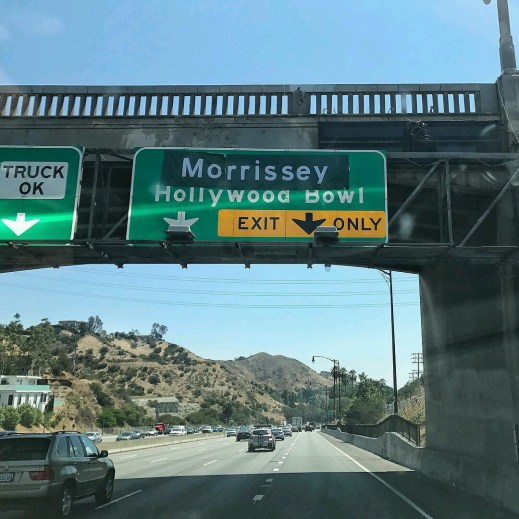
Featured Image: in August 2017, Morrissey Fans changed the offramp sign of the 101 Freeway after Moz announced his Hollywood Bowl shows. Picture credit: michaelanthonytorres on Instagram.
—
Nabeel Zuberi is Associate Professor in Media and Communication at the University of Auckland. His publications include Sounds English: Transnational Popular Music (U of Illinois Press, 2001), Media Studies in Aotearoa/New Zealand 1 & 2 (Pearson, 2004 and 2010) and Black Popular Music in Britain since 1945 (Ashgate/Routledge, 2014).
—
 REWIND!…If you liked this post, you may also dig:
SO! Reads: Dolores Inés Casillas’s ¡Sounds of Belonging!–Monica De La Torre
SO! Reads: Roshanak Khesti’s Modernity’s Ear–Shayna Silverstein
SO! Reads: Licia Fiol-Matta’s The Great Woman Singer: Gender and Voice in Puerto Rican Music
Share this:


Current Top Posts





April 2021

January 2020

November 2019

October 2019

August 2019

April 2014

November 2017

March 2015

December 2017

October 2015
 Sounding Out!
Recent Comments