
Doubled Double Consciousness and the Sound of New Afrikan Expression

 Inspired by the recent Black Perspectives “W.E.B. Du Bois @ 150” Online Forum, SO!’s “W.E.B. Du Bois at 150” amplifies the commemoration of the occasion of the 150th anniversary of Du Bois’s birth in 2018 by examining his all-too-often and all-too-long unacknowledged role in developing, furthering, challenging, and shaping what we now know as “sound studies.”
It has been an abundant decade-plus (!!!) since Alexander Weheliye’s Phonographies “link[ed] the formal structure of W.E.B. Du Bois’s The Souls of Black Folk to the contemporary mixing practices of DJs” (13) and we want to know how folks have thought about and listened with Du Bois in their work in the intervening years. How does Du Bois as DJ remix both the historiography and the contemporary praxis of sound studies? How does attention to Du Bois’s theories of race and sound encourage us to challenge the ways in which white supremacy has historically shaped American institutions, sensory orientations, and fields of study? What new futures emerge when we listen to Du Bois as a thinker and agent of sound?
Over the next two months, we will be sharing work that reimagines sound studies with Du Bois at the center. Pieces by Phillip Luke Sinitiere, Kristin Moriah, Aaron Carter-Ényì, Austin Richey, Jennifer Cook, Vanessa Valdés, and Julie Beth Napolin move us toward a decolonized understanding and history of sound studies, showing us how has Du Bois been urging us to attune ourselves to it. To start the series from the beginning, click here.
Readers, today’s post by Austin Richey considers the possibilities of Du Bois’ idea of double consciousness, as it applies to the Black Atlantic in general. He approaches “doubled double consciousness” through the case study of two artists: Tendai “Baba” Maraire and Efe Bes.
–Jennifer Lynn Stoever and Liana Silva, Eds.
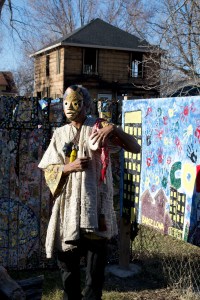
Efe Bes with his tama at Ohana Gardens, Highland Park, MI – taken by the author
In his 1903 text The Souls of Black Folk, W.E.B. Du Bois expresses the “otherness” of Black American identity as a “double consciousness,” an internalized condition whereby an individual’s self is contested by what Du Bois describes as the “sense of always looking at one’s self through the eyes of others…One ever feels his two-ness, an American, a Negro; two souls…; two warring ideals in one dark body” (2). This in-between status requires one to negotiate between these dual perspectives, and through the sonic expressions of cultural mediation, we may hear the tactics with which Black American culture creators select and present a particular version of their cultural identity.
In this essay, I argue for a doubled double consciousness that extends Du Bois’s conception into an increasingly interconnected space that Paul Gilroy called the Black Atlantic, a space which includes the histories and traditions of distinct African cultures, diasporic African communities, and Pan-African ideology. Based on the sonic practices of two artists, Seattle-based Zimbabwean American rapper and multi-instrumentalist Tendai Maraire, and Detroit-located Afrikan drummer and storyteller Efe Bes, we may hear doubled double consciousness as a multi-dimensional site of negotiation whereby musicians source from plural geographic, temporal, and cultural springs to compose a sonic “mix” of Black musical histories; this “mix” echoes the space where the hip hop DJ “noisily bring[s] together competing and complementary beats without sublating their tensions” (Weheliye 13). This anti-anti-essentialist tactic, as Carter Mathes describes in “The Sounds of Anti-Anti-Essentialism: Listening to Black Consciousness in the Classroom,” demonstrates that “it is the open space of sound that invests the project of black radical thought with the uncanny spontaneity of experimentation.”

“Tendai Maraire of Shabazz Palaces, Sub Pop Silver Jubilee, Pop Stage” by Flickr user Jeff Few, CC BY-NC-ND 2.0
Importantly, doubled double consciousness is a challenge to the received status of the “other,” and reveals a multiplicity of gazes through which an individual is viewed. As Maraire reflected,
I always felt that America saw us the same; not as African-American, Zimbabwean or even Black. Just Ignorant Negroes. As I got older my friends and I learned we’re all in the same social and economic positions. But I still had American friends who thought I felt better than them because I was Zimbabwean, and friends that were from Zimbabwe who thought I was better than them, or lost my culture because I had a curl and wore Jordans. (quoted in Devriendt)
Maraire assumed a singular, hegemonic gaze, yet his lived experience in America and Zimbabwe exposed him to critiques from black Americans, diasporic Africans, cosmopolitan and rural Zimbabweans, not to mention advocates, and sometimes appropriators, of different cultural lineages in a diverse city like Seattle.
While Du Bois claimed that the doubly conscious individual “does not wish to Africanize America,” the sonic expressions of doubled double consciousness reflect a particular Afrikan perspective, that is, a redefined social discourse which emerged from the intertwining of Black American activist efforts and knowledge derived from plural ancestral histories and African culture. By positioning themselves as Afrikan – not American, not African, but in-between – these artists showcase how doubled double consciousness is not a condition, but a tactic of negotiation and re-presentation.
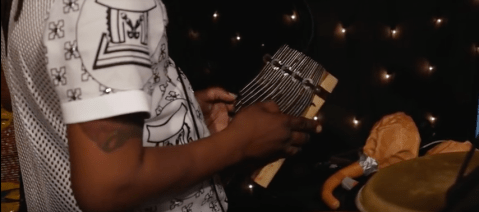
Screenshot of Maraire playing the nhare mbira, from the video “Chimurenga Renaissance – The B.A.D. Is So Good (Live on KEXP)”
Rapper and multi-instrumentalist Tendai “Baba” Maraire has been a staple of the Seattle hip hop scene since the early 1990s. While he honed his lyrical style in the cyphers of Seattle’s Columbia City, his parents Dumisani Maraire and Lora Chiorah-Dye, a renowned Zimbabwean ethnomusicologist and performer, and Zimbabwean dancer and instructor respectively, fostered a cosmopolitan Zimbabwean household; musically, Maraire performed live with his parents’ drum, dance, and marimba ensemble, sung Christian hymns in Shona, and opened for hip hop legends Snoop Dogg and Slick Rick. This provided Maraire with an extensive sonic palette to source from, yet his early attempts to bring these worlds together into an Afrocentric message were met with resistance:
[Audiences] didn’t even know what I was playing when I pulled out an mbira [a Zimbabwean lamellaphone] on stage 20 years ago and rapped with it. No one cared, rappers laughed. The world just wasn’t ready for that. With gangsta music at the time…they didn’t want to accept a dude with an mbira talking about political views out in Zimbabwe.” (Maraire interview)
Today, as half of the Afrofuturistic hip hop duo Shabazz Palaces, Maraire has continued to incorporate the mbira, ngoma (drums), and hosho (gourd rattles) into his musical production; as Shabazz Palaces toured with artists such as Radiohead and Lauryn Hill, Maraire’s Afrikan hip hop style reached a global stage.
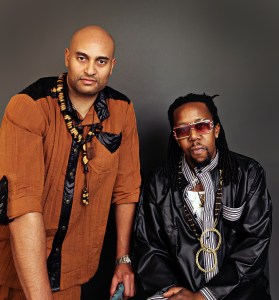
Tendai Maraire and Hussein Kalonji – courtesy of the artists
Doubled doubleness tactics come out forcefully in Maraire’s side project Chimurenga Renaissance, a moniker which connects chimurenga, a Zimbabwe-specific political struggle, to a global Black consciousness movement. Maraire and musical partner Hussein Kalonji, son of the famous Congolese Rhumba guitarist Raymond “Braynck” Kalonji, blend the melodic elements of Zimbabwean mbira and Congolese guitar with the sounds of the Roland 808 drum machine, funk and soul samples, topped by Maraire’s stream-of-consciousness lyrical flow.
Chimurenga Renaissance’s single “Pop Killer,” from 2013’s Defenders of the Crusades EP, exemplifies the power of doubled double consciousness to signify complex ideas to a variety of audiences: through his dismantling of problematic pop musicians who have left their culture behind, Maraire aims his Afrikan hip hop at American and Zimbabwean communities who have critiqued his cultural claims, as well as encourages other black musicians to dig deep and proudly represent their heritage. The video for the track follows Maraire as he travels to the ruins of Great Zimbabwe, the capital of the Kingdom of Zimbabwe (11th-15th centuries), with his mbira to confer with his ancestors. Sonically, the song has three distinct sections whose juxtaposition showcases the multiple sound cultures which make up Maraire’s complex identity.
The track opens with sound of wind, followed by a sampled and chopped up boom-bap drum beat. As Maraire improvises on his reverb-drenched mbira he is joined by a sampled walking bassline, while the chorus and reverb effects Kalonji uses for his arpeggiated melodies complement the timbre of Maraire’s amplified mbira. In the second section, the mbira remains while sampled drums are replaced by hand clapping, hosho, and ngoma, signifying a shift from the reproduction of electronic sounds to the liveness of group participation. Over this, Maraire’s unremitting lyrics call out those who reject their histories, telling them, “This ain’t a show, this a sacred ritual. You can’t possess it because your life is hypocritical.” As Kalonji’s guitar re-enters, the track slows to a third section where Maraire’s raps: “The gold on my pinkie represents where I’m from. If you ain’t never seen it then we ain’t close enough. I got some bigots in my wallet, sativa’s in my pocket, passport to touch the world cause the man can’t stop me.”
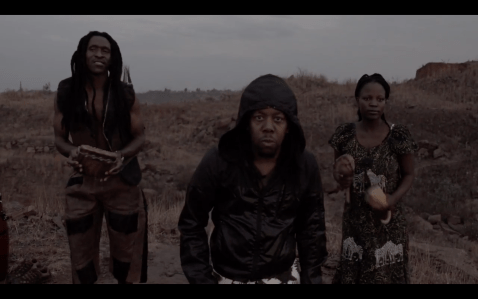
Jacob Mafuleni, Tendai Maraire, and Martha Thom in a still from Chimurenga Renaissance’s “Pop Killer”
The official video also includes a bonus verse, featuring Maraire rapping live in a field accompanied by Zimbabwean musicians Jacob Mafuleni and Martha Thom; this rural scene, featuring an unamplified mbira and driving rhythms from the hosho, further amplifies Maraire’s connection to ancestral life, while his raw vocals and intense delivery are reminiscent of a rap cypher.
In Detroit, Afrikan drummer and storyteller Efe Bes has used doubled double consciousness as a platform to critique those who have lost a cultural connection to African ancestors.

Efe Bes performing at Dabls’ MBAD African Bead Museum, Detroit, MI – taken by author
His own Afrikan-ness is marked not just visibly by his self-made Afrikan masks but also aurally through his unique musical instrumentation and style: Bes plays a collection of drums from across the African continent, including Senegalese sabar drums, West African tama and dundun, and South African ngoma, as well as a modified kora, balafon, and multiple drum machines. Bes performs complex patterns that source from the polyrhythms of West African music to the shuffle of American Blues, occasionally over instrumental recordings of popular hip hop singles, such as rapper Future’s “Fuck Up Some Commas.” For Bes, these musical traditions are connected by an emphasis on the drum, and his performances are marked by shifting patterns that easily move from the deep swing of the blues to the automated soul of techno, a tactic which he developed while DJing for Aretha Franklin in the early 1990s. Weaving these multiple black musical traditions, Bes creates a soundscape that simultaneously looks back to ancestral sound cultures while pushing the boundaries of what Detroit’s musical legacy will sound like in the future.
In addition to live performances, Bes produces his own music videos and promotes his music through YouTube. His archive of over 200 videos shows the breadth of his musical abilities, ranging from spoken word poetry combined with talking drum, to his most viewed original song, “Gimme Back My Shit,” an Afrikan funk tune in which Bes demands reparations for the devastation of Black culture worldwide.
The song begins with Bes humming and performing the main melody of the piece on electric piano. While his humming is laid back, the insistent rhythms of the piano foreshadows the lyrical intensity of this “real reparation song”; this is highlighted by the piano’s synthesized guitar sound, whose bright, cutting timbre and plucked sound are reminiscent of an amplified kora. This introduction leads to the main groove, where looped samples of syncopated funk drums and guitar accompaniment create a foundation for improvised tama drumming and his soulfully styled yet acerbically lyrical vocal performance.
“Give me back my shit, you done had it for so long you think that you own it.
I’m not talking about some, I’m talking all of it.”
Bes’s lyrics go beyond simple criticism, and instead, demand reparations in the form of cultural repatriation, or as Bes sings, “Give me back my ancestors you grave-robbing bitch.” In the self-produced music video, visuals of Pan-African statues, masks, and Mbuti pygmies are juxtaposed with images of Cecil Rhodes, starving children, and cellphones which rely on conflict materials like coltan; these images are punctuated by the sounds of African languages, such as the clicks and pops of Xhosa, as well as the sound of deforestation, such as gas-powered saws, further emphasizing the degradation and destruction of African cultures through the loss of music, language, tangible culture, and environment.
Through the sonic practices of Tendai Maraire’s Afrikan hip hop and Efe Bes’s Afrikan drumming, we may hear how doubled double consciousness is a tool used to negotiate complex ancestral recall. For these artists, doubled double consciousness is not simply a condition, but a powerful space to negotiate and re-articulate what it means to be Afrikan in America.
—
Featured image: Screenshot from video “Pop Killer” by Chimurenga Renaissance
—
Austin T. Richey is a Ph.D. candidate in Ethnomusicology at Eastman School of Music in Rochester, New York. His current dissertation research is based in his hometown of Detroit, Michigan, where he is exploring the resonances between diasporic African musical, dance, and visual arts and Detroit-specific musical genres, such as techno, in this historically multifaceted American city.
Richey has published original research in African Music, and has forthcoming articles in the Routledge Handbook of Music in the New African Diaspora and Opioid Aesthetics: Expressive Culture in an Age of Addiction, published by West Virginia University Press. Support for his work has come from the Society for Ethnomusicology’s African Libraries Prize, the Frederick Douglass Institute, as well as the Society for American Music, where he is an Adrienne Fried Block Fellow. Richey is also an active performer, playing regularly in the New York area with Serevende Mbira and Mounafanyi Drum and Dance.
—
 REWIND! . . .If you liked this post, you may also dig:
“Most pleasant to the ear”: W. E. B. Du Bois’s Itinerant Intellectual Soundscapes–Phillip Luke Sinitiere
On Whiteness and Sound Studies–Gustavus Stadler
Unlearning Black Sound in Black Artistry: Examining the Quiet in Solange’s A Seat At the Table–Kimberly Williams
Share this:

The Queer Sound of the Dandiya Queen, Falguni Pathak


co-edited by Praseeda Gopinath and Monika Mehta
Our listening practices are discursively constructed. In the sonic landscape of India, in particular, the way in which we listen and what we hear are often normative, produced within hegemonic discourses of gender, class, caste, region, and sexuality. . . This forum, Gendered Soundscapes of India, offers snapshots of sound at sites of trans/national production, marketing, filmic and musical texts. Complementing these posts, the accompanying photographs offer glimpses of gendered community formation, homosociality, the pervasiveness of sound technology in India, and the discordant stratified soundscapes of the city. This series opens up for us the question of other contexts in India where sound, gender, and technology might intersect, but, more broadly, it demands that we consider how sound exists differently in Pakistan, Sri Lanka, the Maldives, Bangladesh, Bhutan, Nepal, and Afghanistan. How might we imagine a sonic framework and South Asia from these locations? —Guest Editors Praseeda Gopinath and Monika Mehta
For the full introduction to the forum, click here.
To read all of the posts in the forum, click here.
—
The late 1990s was a pivotal time for activism around queerness in India. The violent response of the Hindu right to Deepa Mehta’s Fire (1998), a film portraying a romantic and sexual relationship between two women, prompted widespread debate on the question of censorship generally and of sexual-minority rights in particular. By rendering homosexuality explicit in its visuals and dialogues, and charting a linear trajectory of queerness—the protagonists move from unhappiness to happiness, denial to acceptance—Fire valorizes “coming out.” In the film, as in liberal strands of LGBT activism, it matters not only that one is out, but that one is seen as such. The premium placed on visibility in this formulation is undercut by the “queer” figure of Falguni Pathak. A tomboyish singer with a high-pitched voice, Pathak shot to fame with her debut album Yaad Piya Ki Aane Lage in the same year that Fire was released in India. Her performances mobilize disparate, even contradictory, signs of gender and sexuality at once, inviting us to examine the relationship between visuality and aurality in constructing queerness.
Falguni Pathak’s stardom is typically understood in the context of economic liberalization and the reconfiguration of Indian public culture that followed. The 1990s boom in the music industry was facilitated by the spread of satellite television, which gave non-film singers a new platform and a new set of audiences. Pathak’s “cute” and catchy love songs circulated endlessly on television countdown shows, turning her into an unlikely sensation. I say “unlikely” because Pathak’s apparent tomboyishness seemed at odds with the hyper-femininity and heteronormativity of the narratives in her music videos. Romantic quests, schoolgirls giddy with love, feminine bonding over make-up and men—these are standard features of Pathak’s videos, as is her own smiling presence as the singer-narrator. Through her gestures and lyrics, she comments on the lovesick teen’s plight and steps in occasionally to comfort or help the young girl, as in her first hit, “Chudi.”
For instance, in “Maine payal hai chhankai” (“The tinkling of my anklets,” 1999) she cheers on a group putting on a dance and puppet show for a school function. In songs like “Chudi/Yaad piya ki aane lagi” (“Bangles/I remember my lover,” 1998), “O piya” (“O beloved,” 2001), and “Rut ne jo bansi bajai” (“The music of the weather,” 2012) she is portrayed as a pop star.
The singer-as-pop-star was a common trope in early Indipop music videos (Kvetko). But Pathak dressed very differently than other pop stars. Whether on or off screen, she was (and is) always in men’s clothing, with a short, unfussy haircut and little make-up. Pathak’s style was mirrored on occasion by a minor character in her music videos. (“Chudi” includes a tomboyish school girl who struggles with the dance moves her friends choreograph.) Thus, Pathak’s visible presence in her videos brushed against the pitch, timbre, and style of her singing, which together articulated a hyper-feminine pop sensibility.
This sense of a “mismatch” (Fleeger) continues in Pathak’s contemporary performances. She is the most sought-after vocalist for Navratri festivities in Mumbai each year. On each night of this nine-day long Hindu festival, the “Queen of Dandiya” appears on stage dressed in a brightly colored kurta, vest, and trousers, and sings traditional Gujarati songs and hymns. The women in her audience dress more conventionally and more elaborately, in saris, salwaar kameez, and ghaghra-cholis. They dance in circles, performing recognizable garba moves. Meanwhile, Falguni Pathak saunters around the stage, engaging cheerfully with her fellow musicians and fans. Neither Pathak’s clothes nor her unfeminine dance moves bother the revelers as they dance the night away. For example, note how Pathak sways and rocks to the beat 34 seconds into this lively 2012 stage performance of Suneeta Rao’s hit song “Pari hun mein.”
Falguni Pathak’s temple performances at other times of the year are similar. They draw huge crowds unconcerned with the apparent mismatch between sound and image in her star persona. She tends to be as immersed in the devotional songs she sings as her audience. But her movements, plain clothes, and floppy hair-style make her look more like the male percussionists who accompany her, rocking and whipping their heads from side to side as they keep the beat, than the middle-class women clapping and singing along.
Performative traditions of mimicry and cross-dressing abound in India. But Pathak’s gender performance does not align with those religious, folk, and filmic traditions (and tropes) because it never registers as masquerade. The very casualness of her look, the fact that she dresses in t-shirt and trousers in all of her public appearances, suggests that this is not a temporary or theatrical adoption of a gender role. When asked in interviews why she eschews traditionally feminine clothing, Pathak always responds that she never has worn anything other than pants and t-shirts and is comfortable as she is. There were certainly other pop stars in the 1990s whose musical performances had masculine elements to them. Recall, for instance, Shweta Shettty’s suited look in “Johnny Joker” (1993). But none of Pathak’s peers sported a butch look as consistently and nonchalantly as she did—and none of them sang in as saccharine a voice. After six decades of Lata Mangeshkar’s vocal hegemony in Hindi cinema, such a “sweet,” contained, and unadorned voice has come to represent ideal Indian femininity. Pathak sounds charming and benign in her songs and interviews, but she does not dress the part.
 Pathak’s challenging of conventional gender norms through her appearance and through the fact that she has never been married raises the specter of queerness in public discourse. But even that is difficult to pin down. Popular commentators and fans sometimes suggest that she looks like Kiran Bedi, a high-ranking (retired) police officer who enjoys celebrity status, making it hard to read the masculine details of Pathak’s persona as “gay.” Even as she is a queer icon (Giani), Pathak never comments on her sexuality or love life. She either evades questions about relationships or simply states that she is single. Where some celebrities come out publicly or keep alive innuendoes about their sexuality (Singh), she treats it as a non-issue. All in all, what we get in Falguni Pathak’s music videos and star persona is a queerly gendered performance that seems both utterly “natural” (because it seems comfortable and casual) and profoundly mismatched.
To be clear, my argument is not so much that Falguni Pathak looks or sounds queer. The latter point is as hard to prove as the former is easy. If, for just a second, we manage to shut out of our mind’s eye the image of Pathak singing, her voice sounds thoroughly conventional. She sings in a traditional idiom, of traditional themes. No matter how intently I listen, no “queer timbre” (Bonenfant, Chaves Dasa), no “butch throat” (Glasberg) reaches out to touch me. Thus on the one hand, Pathak, like the other “mismatched women” Jennifer Fleeger writes about, confounds heteronormative expectations about gender and sexuality. On the other, her voice eludes “queer listening” (Bonenfant). What do we do with a queer figure who doesn’t sound queer? How might we understand her voice vis-à-vis queerness in Indian public culture? How do her live performances today continue to disrupt the emphasis on visibility in queer studies and politics—that is, the fixation on visual representations and “coming out” of the closet? Finally, how might Pathak’s “vocalic body” (Connor) help us conceive of the intersection of aurality and queerness in South Asian public culture?
Falguni Pathak intervened in a cultural field that was just beginning to deal with LGBT visibility. This becomes apparent when we remember that the 1990s was a period not just of economic liberalization but of vibrant queer activism as well. Pathak’s non-feminine image was startling for a pop star, but her voice was familiar and “good.” Her safe sound allowed her to push the boundaries of desire in televisual representations of the time. But it did more than that, too. The disjuncture between her feminine voice and butch look was critical to the complex landscape of desire her music videos evoked. It created space for ambiguity and incongruity amid charged debates about alternative sexual identities.
In “Main teri prem diwani/Indhana winva” (“I am madly in love with you,” 2001), Pathak stars as the neighbor to whom the protagonist turns for advice in matters of love. In an amazingly campy move, Pathak urges the young woman to seduce her lover by donning outfits inspired by Moulin Rouge (2001), specifically the song “Lady Marmalade” (00:36-00:55), and The Mummy Returns (2001) (1:59-2:03). Queerness is also writ large in “Meri chunnar udd udd jaye” (My scarf flies away, 2000), where Pathak appears as the beloved friend of a young girl in exile. The girl misses her friend intensely and attempts to recreate the dance moves and games she played with her older friend, this time with another mysterious woman who steps out of a painting.
Men’s roles in this and other Falguni Pathak music videos are ambiguous at best (Giani). Thus, despite the happy ending to the teen love stories, what lingers is Pathak’s simultaneous disruption and enabling of straight romance. This is why she is remembered fondly as a queer icon, even as the music scene in India has moved on from the “cuteness” of the 1990s. She offered LGBT audiences a way to read and revel in non-normative desires (Giani), without completely unseating “traditional” ways of living and loving.
The broader lesson in Falguni Pathak’s performances is that we cannot think of visuality apart from aurality, and vice versa. No matter how hard NBC’s “The Voice” tries to convince us (Tongson), we cannot in fact understand the sound of a singer’s voice as separate from the image of her as a performer and the contexts in which she emerges on the scene. It is not Pathak’s tomboyish appearance so much as the apparent disjuncture between that look and her voice that is key. What is queer about her voice is the look of it.
—
Featured Image: Falguni Pathak’s classic pose.
—
Pavitra Sundar is Assistant Professor of Literature at Hamilton College, where she teaches courses on global film and literature. Her scholarly interests span the fields of cinema studies, sound studies, postcolonial literary and cultural studies, and gender-sexuality studies. She is currently completing a book manuscript on the politics of Bollywood film sound and music. Her work has been published in journals such as Meridians, Jump Cut, South Asian Popular Culture, and Communication, Culture, and Critique, as well as in anthologies on South Asian and other cinematic traditions.
—
REWIND!…If you liked this post, you may also dig:
Ritual, Noise, and the Cut-up: The Art of Tara Transitory—Justyna Stasiowska
Moonlight’s Orchestral Manoeuvers: A duet by Shakira Holt and Christopher Chien
If La Llorona Was a Punk Rocker: Detonguing The Off-Key Caos and Screams of Alice Bag–Marlen Rios-Hernández
Share this:


Current Top Posts





April 2021

January 2020

November 2019

October 2019

August 2019

April 2014

November 2017

March 2015

December 2017

October 2015
 Sounding Out!
Recent Comments