
On Donuts, Sandwiches and Beattapes: Listening for J Dilla Six Years On

"J Dilla aka Jay Dee R.I.P." by Flickr user Ohm 17 under Creative Commons License
It has been six years this week since the passing of James “J Dilla” Yancey, considered by many in hip-hop as the quintessential producer’s producer. Over the course of his career the Detroit-born beatmaker garnered production credits with artists ranging from The Pharcyde to Janet Jackson. Since his passing there has been a substantial amount of posthumous output, including a Yancey Boys album with his brother Illa J, Ruff Draft, The Shining and Jay Stay Paid. There have also been the tons of unofficial releases by artists using material from his beattapes without prior permission. An unofficial discography of projects ‘featuring’ Dilla’s work could eclipse his official one.
Dilla’s beattapes, which he shared amongst friends and associates via CDs, eventually traveled the globe via message boards years prior to his passing. His legacy became what it is, at least in part, due to the reach of these CDs, but unfortunately it has also made monetizing the work after his passing a difficult task. There were early issues between Dilla’s family and the legal estate, but for the last couple of years there has been a process established which allows for the use of tracks from his vaults. They are currently set to release The Rebirth of Detroit, which boasts unheard Dilla beats featuring the Detroit artists he came up with:
In addition to posthumous releases under Dilla’s name the estate also licenses tracks for projects by other artists. With over 4000 tracks in their possession, it stands to reason there will be plenty more Dilla in the future. Yet still there is a sense that ‘new Dilla’ will never be new again, as in the future we will only be able to look at Dilla’s past. How would his process as an artist have grown? Surely whatever he was doing before he passed sounds nothing like what he would be doing in 2012.
Fortunately, the creativity of Dilla lives on through his influence on others. In the years since his passing, that influence has gone beyond hip-hop into jazz, indie rock, classical, and electronic music; some might argue Dilla’s influence has spawned new styles or even genres of music . The LA beat scene was seemingly born in homage to him; with its off kilter drums and wild sample chops, it extends beyond the initial influence, projecting into the future a lineage which will forever trace back to Dilla. Another of those lineages takes Dilla to perhaps the least likely place for a hip-hop producer: late-night television, through the figure of Ahmir “?uestlove” Thompson of The Roots.
At the end of the 90s until around 2001, Dilla was a member of The Soulquarians creative team that produced albums for Erykah Badu, D’Angelo, Common, and Bilal:
During this time Dilla worked closely with drummer, producer, and founding member of The Roots ?uestlove. There was a musical bond established over countless studio hours which allowed for a fusion of styles between them that carried Yancey from his Jay Dee period into his J Dilla period, and which ?uestlove continues to carry to this day.
Since Dilla’s passing, ?uest has been an instrumental voice in keeping Dilla’s legacy alive. He regularly DJ’s events celebrating Dilla’s work. On all of The Roots albums except for the most recent one, there have been musical dedications to Dilla. It is when ?uest goes into the studio with The Roots, however, that the living continuation of their musical fusion can be found.
The studio is where ?uest spends a lot of his time, rehearsing The Roots for their role as the house band on the Late Night with Jimmy Fallon show; ?uest records the sessions to listen back before and after the show. On Late Night The Roots play new songs in front of a live audience five nights a week. These songs only air for ten to twenty seconds going in and out of commercials. If you run to grab something from the refrigerator you might miss them. Or, coming back you might find your head nodding to them. Not only are they original works (other than walk on music for show guests, and musical performances), they are an insight into the creative process which shaped both ?uest and Dilla.
?uest names the tracks Sandwiches, a nod to his former collaborator’s Donuts. Donuts was the last official project that Dilla worked on, quite literally on his death bed, and is considered his instrumental opus. It opened up the notion of the short-form instrumental hip-hop work, which traces its own lineage to the history of beattapes. Today, a beattape is a collection of hip-hop instrumentals released as a product through distribution channels (free or paid). In the beginning however, beattapes were physical cassette tapes (and later CD-Rs) passed around from hand to hand. Tracks from beattapes were snippets of beats often recorded right after they were made so the producer could listen to them again outside of the studio setting. They were passed amongst friends and eventually within the industry as a means of selling the producer’s beats.
Early beattapes were not meant for public consumption or as cohesive projects. It’s important to remember that at the time you didn’t finish productions in a home or project studio. Artists, labels, producers etc. would listen to a beattape and select tracks to be purchased for a project. If a beat was bought, the producer would meet the artist in a large studio with an engineer, which is where the beat went into production. The beattape at the time was not considered a final anything, but a sketch of what could become a production.
In addition, beattapes had a secondary purpose as a measure of skill and technique. They became a format for rehearsal and practice. Where a traditional instrumentalist may practice chord changes on their instrument, a beat maker makes beats and records them for easy playback later. For example, a producer could decide to sample the same record as another producer to show how they would use the sample differently. There would be no intent to turn such a track into a full fledged song (though it could happen), instead it would be recorded so they could play it back to a friend or even the producer who originally used the sample for bragging rights.
Dilla was an active participant in this trade. His beat CDs became his calling card particularly for the techniques displayed on them. Donuts was his expansion of that beattape format. Rather than a display of short rough sketches that serve as indications of productions to come, Dilla produced intricate and layered flaunts of technique compacted into short sketches.
The most recognized technique from Donuts is the chop. The chop comes out of the stab line of techniques. A stab is a single instrumental hit played on a sampler. On the MPC line of samplers (which Dilla was famous for using), stabs could be spread across trigger pads pitch shifted chromatically allowing melodic sequences to be played using a single stab. The chop takes that a step further by using multiple samples from the same source (chops) to replace the chromatic stabs, and play melodically. What Dilla displayed on Donuts however, is not merely the chop but the variety of techniques available by which a producer can chop. Working outside the limitations of loops and stabs, new techniques like drum and instrument isolation, de-quantization, vocal stabs and more come at you, one layered technique after the other.
Many of these techniques have been canonized today, but some quality has been lost with that normalization. With de-quantization by example, overuse has practically rendered the technique cliché because its depth was reduced by its definition. De-quantization translates to simply turning off the preference in software programs or hardware beat machines that align all sound triggers to the grid of the tempo and time signature. That definition speaks nothing to what Dilla actually did with that preference off, which was impose his own humanized sense of timing onto the de-quantized patterns of the machine.
Of those that followed Dilla, most got the de-quantization part but missed his sense of time. While de-quantization has shown influence, outside of the ‘stock Dilla’ pattern, his sense of timing has been continued by only a few. At the top of that list is ?uestlove, as he is as responsible for the development of that sense of timing as Dilla is his own. The root of that development can be found in the The Soulquarians period, which can be marked as the time both artists came into their own by working together. That they would come together at all was quite serendipitous, as no player has a better sense of timing than a drummer. It was the mutual sense of timing between Dilla and ?uest that worked to produce the amazing material that resulted.
In The Soulquarians studio sessions ?uest and Dilla created a feedback loop between the drum machine and the drums. This pushed their sense of time as they fused a sonic texture for their drums, which can be heard between their productions. There is a shuffling urgency with a tick of hats between pulses that lead one into the other; the snare or clap crisp, never aggressively cracking, the kick big but not over dominant. It is sequence-based music turned into grooves that maintain the variable constraints of the sequence. They each took these elements with them in their post Soulquarians work, and after Dilla’s passing, you can frequently hear ?uest calling back to those days through his music.
Take a Sandwich like “Gross Understatement.” At the onset a drum loop with a prominent clap is layered into the snare on alternate hits, while a keyboard moves through presets until an organ sound is found. The bass noodles patiently until, with a chord, they meet. When ?uest comes in it takes a couple of bars of him pushing the drums to get everyone else to fall in on his time, but once it hits he can’t control himself, letting out a holler, “something flew out the gate.” What follows is three minutes of magic as the band jams to a grove that is the perfect cross between Dilla and ?uest.
Gross Understatement (G minor) #Sandwich 1397
Up until November 2011, by ?uest’s count, The Roots had created almost 1800 Sandwiches. He has released a stream of Sandwiches through his Swift FM account (the page is currently down until the site relaunches). By his own admission though, all of the Sandwiches aren’t as good as “Gross Understatement.” Out of the 2 to 23 they record each day, he says only about 1 in 19 are bangers. At 94 out of 1800 it isn’t a bad count, enough for nine albums. The only format in these tracks exist however, is as they appear on Late Night, on ?uest’s harddrive and whatever Sandwiches he decides to share. What would a studio project of this material sound like? As big of an audience as they receive on Late Nite, Sandwiches are buried in the mix of television things where it’s not easy to give them the musical attention they deserve. Perhaps in the future an official release of a project from this line will emerge. In the meantime catch them on NBC when you can and stay tuned to ?uest’s social stream.
—
Primus Luta is a husband and father of two (maybe three by the time this goes up). He is a writer and an artist exploring the intersection of technology and art, and their philosophical implications. He is a regular guest contributor to the Create Digital Music website, and maintains his own AvantUrb site. Luta is a regular presenter for the Rhythm Incursions Podcast series with his monthly show RIPL. As an artist he is a founding member of the live electronic music collective Concrète Sound System, which spins off into a record label for the exploratory realms of sound in 2012. Luta is currently working on completing his first book, BeatGenealogy: A History of the Electronic Beat From WWII to Now.
Share this:

The Specialty Record Shop

Harold Kelley holds "Blue Danube," a 78 record. Single 78s are visible on the rack below. Behind him is the store's soundproof listening booth. Circa 1949.
In 1947, my grandparents converted a room connected to their small home in downtown Richmond, Indiana, into a record shop. According to my grandmother, my grandfather—perhaps enamored with the family’s new “Airline” table model automatic phonograph (purchased from Montgomery Ward the year before)—somehow managed to persuade her, my great aunt Ina, and my great uncle Henry to embark on the venture. On May 12, 1947, the Monday after Mother’s Day, the Specialty Record Shop opened its doors. It would become the first black owned and operated retail establishment in the area to serve both black and white customers. (The store closed in 1980.)
Many years later, so many things strike me about this ambitious undertaking. Mostly, I realize that their actions were, particularly at that time, a very bold step across a profoundly demarcated color line in American life and music, even in Richmond, which was, with its Quaker history, somewhat more tolerant of African Americans. While Richmond’s public schools had been integrated by 1947, official segregation in the City of Richmond didn’t end until 1965. Long after my mother graduated from high school (1957), blacks and whites lived mostly separate lives—and listened to different music.

The shop's second location on Main Street in Richmond, Indiana, circa 1955.
This seems especially true in the early days of the shop, although among the nearly 100 78 rpm, ten-inch breakable shellac records that comprised the store’s first inventory were records by Nat King Cole, who by 1947 had himself made it across the color line into popular music. For the week ending January 3, 1947, King Cole’s “I Love You (For Sentimental Reasons)” was among Billboard’s top ten “Honor Roll of Hits,” a tabulation of the most popular tunes in the nation. Other popular songs carried by the shop on opening day were Alvino Rey’s “Near You” and Tex Williams’s “Smoke! Smoke! Smoke! (That Cigarette).”
.
Specialty would come to distinguish itself from its five Richmond competitors by carrying all kinds of music and special ordering any sound a customer wanted: classical, country and western, bluegrass, jazz, R&B, spiritual, folk. Music that other stores didn’t stock, Specialty carried, and its inventory eventually included more than 400 different labels. White customers who listened to sounds outside of mainstream popular music of the day found a home at Specialty, but on occasion would still feel the need to discreetly whisper their requests for the latest country and western or bluegrass hit, as if embarrassed by their own musical tastes. Such was the climate in those early days.
.In the 1950s, the Specialty Record Shop, which had from its inception boasted the “Greatest Variety in Recordings,” was in its advertisements not only marketing all genres of music but also both white and black musicians. A November 24, 1954, advertisement, for example, promotes Specialty’s wide variety of “albums and single records of popular, children’s, classical, religious, western, rhythm and blues, and jazz.” And an earlier advertisement from May 19, 1954, for example, promotes Tommy Dorsey (“Little White Lies”), Artie Shaw (“Special Delivery Stomp”), Fats Waller (“Honeysuckle Rose”), Duke Ellington (“Solitude”), Jimmie Lunceford (“Jazznocracy”), and Coleman Hawkins (“Body and Soul”).

A "Tips on Tops" Specialty advertisement promoting music by Perez Prado, Sarah Vaughn and Dinah Shore, Johnny Desmond, Les Baxter and Roy Hamilton, and Sauter-Finegan. This ad also features Specialty's outlet store in Connersville, Indiana. Richmond Palladium-Item, May 11, 1955.
Still, what’s painfully clear from the majority of advertising during that time is that mainstream music of the day reflected “popular” (that is, white) tastes. While black teenagers like my mother listened to “Ain’t That a Shame” by Fats Domino, her white counterparts listened to “Ain’t That a Shame” by Pat Boone. On and on, two versions of records—black and white—and two audiences: Among black songs covered by white artists that my mother remembers from her youth (most certainly carried in my grandparents’ store in both incarnations) are “Fever” by Little Willie John and “Fever” by Peggy Lee, “Long Tall Sally” by Little Richard and “Long Tall Sally” by Pat Boone, “Good Night, Irene” by Leadbelly and “Good Night, Irene” by the Weavers, and “Hound Dog” by Big Mama Thornton and “Hound Dog” by Elvis Presley.
.
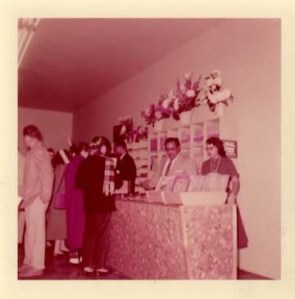
Marilyn Kelley, fifteen, helping customers with Henry Bass and Harold Kelley at the Main Street shop, 1955.
The R & B sounds that my mother, Marilyn Kelley, favored in musical artists in the 1950s were the familiar sounds of (or “sepia” as it was called early on), gutbucket, and melisma—black musical sounds and pronunciation not acceptable to the parents of white teenagers (although white youth were of course becoming familiar with these sounds). Covers changed that sound and made popular rhythm and dance music acceptable to white parents while satisfying white teens and keeping them “inside the fold.” White people (and black people) regularly heard and saw Dinah Shore, Peggy Lee, Pat Boone, Elvis Presley, and other white performers on radio and television, as the record companies heavily promoted these artists and their versions of popular songs. Black performers, on the other hand, were much harder for black people (or everybody else, for that matter) to discover. In the Midwest you had to catch Randy, a white disc jockey out of Nashville, who played black performers’ records and sold them through mail order (see WLAC—Radio). My mother listened to Randy’s show from her bedroom nearly every Saturday night.
.
I had never heard of Little Willie John or his version of “Fever” until my mother mentioned it, but when I listened to his voice for the first time I immediately understood what compelled my parents as teenagers to desire this song, even without lots of radio play or the benefit of television. When I sent my mother a link to Gayle Wald‘s review of a book about the musician (Fever: Little Willie John: A Fast Life, Mysterious Death and the Birth of Soul), she remarked that as a young girl in the rural Midwest she knew not a single thing about him except for the sound of his voice on that one song, which has stuck in her memory all these years. Few people in rural America knew what budding black artists looked like in those days. For listeners like my mother it was all about sound because there was practically nothing else. Pure sound drove her to enjoy these artists and made her want to hear their music again and again.
Into this world jumped two ordinary black couples, moved by their own phonograph player and records to turn a space they had leased to a succession of black beauty parlor operators into a small storefront: Harold Kelley, my grandfather, a carpenter by training who tended as carefully to the foundations of the store as to its customers; my grandmother, Elizabeth, who handled the register and advertising; my great aunt Ina, who mostly worked behind the scenes as the bookkeeper; and my great uncle, Henry Bass, known among the family as “the promoter,” likely as much for his knowledge of music, particularly jazz, as for a habit of walking up and down the street talking to people (a young African-American man named John would join the four after first lingering in the shop as a customer, then helping as a volunteer, until finally becoming an invaluable employee in 1955.)

Kelleys and Basses: Left to right: Henry Bass, Mary Ina Bass, Elizabeth Kelley, and Harold Kelley, co-owners of the Specialty Record Shop, circa 1963.
Benefiting first from their proximity to downtown at 611 South A Street, beneath a rose-colored neon sign, and later in the more spacious Main Street shop—with its “high fidelity” room in the basement—that I remember, the Kelleys and Basses managed to put several other record stores out of business, but more significantly they forged a small community—white and black—around music at the heyday of a vast industry and at one of the peaks of cultural segregation, which even now, so many decades later, seems like no small accomplishment.
Last year, my mother and I traveled to Richmond to visit both Specialty locations, maybe thinking that in all their metaphorical glory they would inspire us to write down what we remember. We went first to the storefront on Main Street, the place that I knew, and then to the small frame house on South A Street, the early shop and my mother’s childhood home. The drabness of the place knocked any hint of nostalgia out of both of us: The bushes and flowerbeds were gone, and the building looked cold and empty, slightly seedy, and a little miserable—these days no doubt valued more for the land it sits on than for the property itself. Thinking now of how my mother must have felt to see her childhood home diminished so mercilessly by time and progress still pains me.
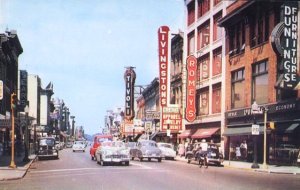
Main Street, Richmond, Indiana in the 1950s
She said then and I write with certainty now that it was more than it looked, which brings me back to what Specialty was, which must be something larger than what stands in our memories or I would not be writing this. It is difficult to attach particular significance to the place in a simple essay about music except to say that as with sound with Specialty meaning was everywhere, and as with music, Specialty reached everyone, at least in Richmond. Its soundproof booth, five-by-five feet square, drew high-fidelity enthusiasts to listen longer than perhaps should have been allowed. A single door connecting the store to my grandparents’ home, sometimes left open by chance, invited curiosity and even boldness from some customers who, stumbling upon the family’s dining room table with its treasure trove of uncataloged records may well have lingered too long in a private space but were never scolded or turned away. The record company representatives who, swept up in the excitement of Specialty’s open house in 1955, began helping customers buy any record, regardless of its label. Taken together, these shared experiences become a narrative of human experience as intricate and complicated as music itself, not so unlike the tapestry of sound that compelled my mother to listen to the magnetic voice of Little Willie John.
In the musical amalgam of today, it is at times difficult to imagine an America so rural, isolated, and segregated, at least in these particular ways. These days “black” music—that is, music by African-American performers—is likely more accepted by and certainly more fully integrated into mainstream America than is the black population itself. Virtual musical communities like turntable, Spotify, Grooveshark, and Pandora are as much growing purveyors of music as are iTunes and Amazon, the new corner record stores, and as such hold much promise for unprecedented global musical cross-pollination and exchange.
 As we may rightly celebrate the cultural integration of more sounds into a larger and perhaps more democratic musical landscape, it is also appropriate to mourn the passing of brick and mortar record stores (and bookstores and libraries, too, I might add) like Specialty, as much for their fidelity as for the ephemeral things these spaces once contained: qualities that bring kinship and serendipity to human experience—sound, yes, but also light, smell, touch, and color, with all its complications.
—
Jacqueline Dowdell received a B.A. from the University of Michigan and an M.F.A. from Cornell University. She is a communications coordinator at Cornell Law School. Thanks to her mother’s memories, her grandmother’s meticulous archive of Specialty history, and a newfound enthusiasm for sound, she is working on a memoir about the Specialty Record Shop.
.
Share this:


Current Top Posts





April 2021

January 2020

November 2019

October 2019

August 2019

April 2014

November 2017

March 2015

December 2017

October 2015
 Sounding Out!
Recent Comments