
Reflective Sound Gathering via the New England Soundscape Project

DOI: https://doi.org/10.59350/m7gze-zef59
Beyond the confines of recording studios, stages, and music classrooms, a vast and shifting sonic canvas exists for field recorders. This personal essay explores my awakening to a new creative recording process through the New England Soundscape Project , an ongoing sound-gathering mission whereupon I use small digital recorders—paired with various microphones, an iPhone, and a genuine sonic curiosity—to record brief moments throughout New England’s rich coastal, urban, and rural landscapes across six U.S. states. I received a modest seed grant from my University to pursue some creative work in field recording and sound studies. Over the next year, my travels will take me to the National Parks, cities, and historic landmarks in Connecticut, Vermont, Rhode Island, Maine, New Hampshire, and Massachusetts.
While near limitless possibilities on where and how to produce sonic and electroacoustic musical compositions endure, starting theNew England Soundscape Project challenged me to hone my listening skills while simultaneously dealing with nature’s unpredictability. Moreover, as a budding sound artist, I had to contend with the cognitive and emotional issues affecting a brand-new and unexplored creative practice. I came to believe that a holistic method of field recording offered me certain advantages—enabling an emerging sound artist to detach from rigidly defined agendas and instead focus on reflection, deep breathing, environmental awareness, gratitude, and an observational spirit. The listening exercises I detail in this post made me a newly introspective practitioner—one capable of a heightened sensitivity that improved my production and composition skills across multiple media.
Field Recording: An End Goal in Mind?
Field recording involves a delicate balance of technical skill, careful planning, and patience. Stepping away from a controlled environment, capturing audio on location presents many random and often erratic trials. From wind noise and poor site accessibility to recording malfunctions and user error—a host of issues arise once the recordist enters unfamiliar territory. Here, unfamiliar territory includes both new places and nascent approaches to research-based production and artistic data collection. Where do I situate a project like the New England Soundscape Project among new media production, sound studies, and music composition? Does that issue even matter?
The notion of practice-based work usually implies an end goal in mind. What if there is not an end goal in sight? What happens then? Would the New England Soundscape Project be “enough” of a contribution to creative scholarship when approached as a type of audio ethnography—much like the immersive storytelling recently curated by Leonardo Cardoso? The New England region is lush and robust, with many diverse landscapes. I hoped to document these in some way, but wondered how to continue. Truthfully, I had some hesitation on where to start.
Media artists and music composers learn the mechanics of their craft in colleges, universities, conservatories, at home, and on the job. Some of these techniques include audiovisual production, computer programming, coding, editing, and arranging using digital software. I am both self-taught and a product of an academic and Eurocentric, conservatory training system. This presents some tension, as I discuss below. Although traditional audio engineers and music composers often work towards completing a project without a predefined trajectory, how can budding sound artists develop and hone an inner acuity to find the “right” material during their creative processes?
While the process remains largely subjective, I found it helpful to begin by answering the following questions:
- What kind of project is this?
- How is the sound to be used?
- Where and how will the project be displayed?
- Who is the intended audience?
- What are the sound artist’s intentions?
- What tools are needed?
I draw inspiration from the Sound Studies Lab’s position that this type of work is diverse, fluid, and balances technical, artistic, and theoretical aims. The challenge is that the answers to the questions above are not immediately clear and require me to look inward at who I really am.

Following the Sonic Muse
Beyond the obvious technical and aesthetic factors affecting an expansive multisite recording project, we know little about how a nascent sound artist begins. Whom do they emulate? Should they take notes? pictures? What should they pay attention to onsite?
If the project is exploratory, the recordist may experience hesitation—as I did— and frustration that can block their creative process, especially because the pathways toward a finished sound project aren’t as established as those of a sound engineer, for example, or a songwriter. Nevertheless, my experiences have shown me that a nascent sound artist/recordist can also find intrinsic meaning and realize their mission—particularly by establishing a detached yet perceptive listening ethos, as I did to begin my work on the New England Soundscape Project.
For me, framing a detached and perceptive mindset involved:
- Remaining sensitive to my surroundings at each location;
- Focusing on stillness, deep breathing, and a quiet mind while recording;
- Adopting a respectful, unobtrusive manner at each site—taking care not to disrupt or distract others;
- Calmly monitoring my technology and its use;
- Trusting that I am intended to be in that exact moment at that exact time;
- Avoiding being overly concerned with the “end game” of their practice;
- Embracing the role of a sound gatherer and observer;
It is perhaps the final objective—adopting the philosophy of sound gatherer and observer—where truly sensitive listening begins. Here, the recordist aims to remove their personal goals and agenda from the field recording process. Before proceeding, the attentive recordist looks around them, focuses on quiet breathing, and views their microphones as lenses and without fear of what the result should be. To what or whom am I observing?
Here’s the problem. It dawned on me that I know little about who I am as a sound artist, and how my voice positively contributes to the world, if at all. I need to learn to listen—not just to the sounds in nature, but also to the sounds of the voices of the persons with whom I interact. Could solitude and introspective listening lead me to listen through a newly formed self, capable of deeper connections with my peers and environment? I found that my detachment involved investigating, acknowledging, and, whenever possible, setting aside my own biases, fears, and, importantly, my own agendas. By removing my ego and cluttered mind from the process, I could start to be an inclusive practitioner—one whom cultivates positive relationships daily and is capable of crafting a deeper sonic art that embraces rather than one that marginalizes.

The Art of Meditative Listening
Rather than taking on a stringent approach with little flexibility, I practice observational recording by gathering audio as my muse and as environmental conditions dictate. By remaining attentive to my recording levels, I gather source materials up close, from afar, and for any length of time. Meanwhile, as this creative progression unfolds, I stay quiet—bringing almost meditative quality to my practice. Moreover, concentrating on deep breathing and stillness allows me to adopt a grateful mindset—one that is appreciative of my surroundings and for being present at that precise moment. It is then that the environment becomes the focus of sound gathering and not notions of a “final product.”
I found an artistic renewal—even healing—by adopting this meditative practice. As the New England Soundscape Project takes shape over the coming months and years, I hope to document the beauty of the Northeast through music, sound, and images. Yet, it is enough simply to be present in each location while aspiring to produce thoughtful and reflective sound art. Although there is no overarching method that best describes every aspect of a multisite field recording process, the “art” in the sound can truly emerge by striving to banish fear and doubt from the recording process. Addressing the “why” during each moment is just as important as addressing the “how” and the “why” in pre- and post-production. The recordist’s humanity plays a key role in determining how creative decisions are made, and the ability to remove the need for control determines how free—and freeing—the process can be.
This Thursday, SO! will feature my podcast on reflective listening with audio examples from the New England Soundscape Project thus far. I look forward to producing future episodes (and essays) on this project in the coming months. I hope you can tune in on Thursday and thank you for listening!
—
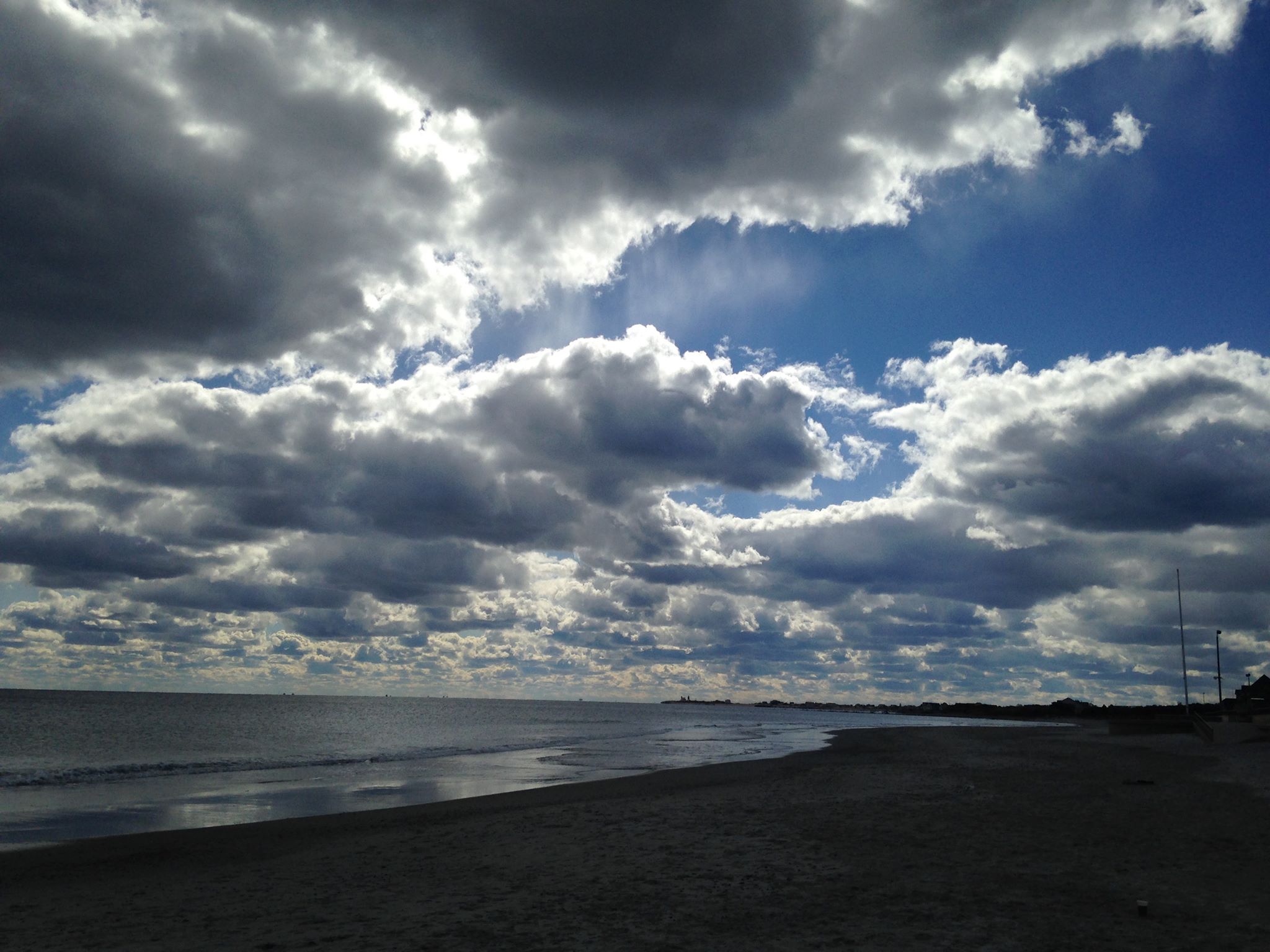
Featured Image: Scarborough State Beach, Newport, Rhode Island, USA. All images by author.
—
Acknowledgements
An Internal Seed Grant from the University of Massachusetts Lowell supports the New England Soundscape Project.
—
Daniel A. Walzer is an Assistant Professor of Composition for New Media at the University of Massachusetts Lowell. Walzer’s research and reviews appear in the Leonardo Music Journal, the Journal of Music, Technology & Education, the Journal of Radio & Audio Media and forthcoming articles in TOPICS for Music Education Praxis, and the Music Educators Journal. Walzer received his MFA in Music Production and Sound Design for Visual Media from Academy of Art University, his MM in Jazz Studies from the University of Cincinnati and his BM in Jazz Studies from Bowling Green State University. Walzer is currently pursuing doctoral studies in education at the University of the Cumberlands. Read more at http://www.danielwalzer.com
—

REWIND!…If you liked this post, you may also dig:
SO! Amplifies: Ian Rawes and the London Sound Survey–Ian Rawes
SO! L.A.: Sounding the California Story–Bridget Hoida
Sound-politics in São Paulo, Brazil–Leonardo Cardoso
—
Share this:

The Amplification of Muted Voices: Notes on a Recitation of the Adhan

Where do we begin?
On Tuesday January 13th, 2015, my first-year students and I gathered for the second meeting of our seminar, “Soundscapes: Artistic, Social, and Biological Approaches to Acoustic Environments.” We were just a few steps away from the iconic Duke chapel, almost in its shadow.
The chapel is an example of a revivalist architectural style known as “Collegiate Gothic.” Its steps were constructed with soft stone, intended to wear down quickly and provide an accelerated impression of age and prestige. The chapel’s cruciform blueprint is an unambiguous symbol of its Methodist Christian roots, as is the university’s motto: “eruditio et religio” (“erudition and religion”). In true Gothic revivalist style, the phrase is a Latin translation of a line from an 18th-century, English-language Methodist hymn titled “Sanctified Knowledge.”
.
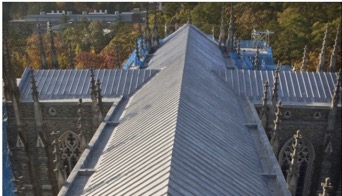

On Tuesday, January 13th—the second day of my Soundscapes seminar—Duke’s Office of Communications announced that the Islamic call to prayer, the adhan, would sound from a bell tower of its iconic chapel in Durham, North Carolina. According to a press release, Duke’s chapel administrators and Muslim Students Association felt the three-minute long, “moderately amplified” recitation “represents a larger commitment to religious pluralism” on campus and that the sound of the adhan “connects the university to national trends in religious accommodation.”
The story was picked up by WRAL, the television news outlet based in nearby Raleigh. The web-based stories included a photo of the student slated to be the muezzin, the person appointed to recite the call to prayer. In the photo, the student was shown rehearsing from the bell tower. I read the announcement just before walking to class and thought the event would be a historic opportunity for my students and I to make field recordings of their university soundscape.
Where do we begin?
The adhan was scheduled to take place on the afternoon of Friday, January 16th. On Wednesday, January 7th—a week before the announcement of the adhan at Duke—twelve people were murdered during an attack on the Paris offices of the satirical newspaper Charlie Hebdo. Ostensibly, the murders were committed on behalf of Al-Qaeda in the Arabian Peninsula as a retaliation for the newspaper’s cartoon depiction of the prophet Mohammed.

Image of “Je Suis Charlie” solidarity demonstrations in Hamburg, Germany, by Flickr user Konrad Lembcke
Where do we begin?
Islamic theology posits that the adhan is not music. It is recited, not sung. Likewise, the text of the Qu’ran is not poetry. These sacred texts are certainly musical and poetic, but they are neither music nor poetry. These theoretical distinctions have complex and profound implications: more than soundscapes or sound art or acoustemology, the Islamic premise underlying recitations of the adhan and Qu’ran provoked my students to reconsider entire constellations of historical, cultural, linguistic, political, and—indeed—spiritual phenomena.
My students and I conducted a survey in which they asked classmates to identify a recording of the adhan. Only 2 out of 48 students recognized it as a recitation of the Islamic call to prayer; most guessed it was “Arab” or “Middle Eastern” music, but it seemed universally familiar as a “soundtrack” for a film sequence. One student who had lived in Morocco recognized the adhan immediately; another recognized it as the sound of his Lebanese grandmother’s alarm clock, automated to remind her to pray. We became acquainted with Cairo in One Breath, a documentary film project about post-revolutionary Egypt’s 2010 Adhan Unification Project, an effort to “replace individual muezzins with a single voice, broadcast to Cairo’s [thousands of] mosques from a radio station.”
 We also became familiar with the mythology of the first muezzin: Bilal, who was born in Mecca to Abyssinian slaves—in other words, a black man who was freed from slavery.
Where do we begin?
On Wednesday January 14th, the Reverend Franklin Graham posted a reaction to Duke’s announcement on his Facebook account. Franklin is the son of evangelical Baptist preacher Billy Graham, close friend and advisor to American presidents from Dwight D. Eisenhower to George W. Bush and known as “America’s pastor.” Franklin Graham is a resident of High Point, North Carolina (an hour’s drive from Duke) whose salary from tax-exempt, non-profit religious organizations is reported to be $880,000 per year.

Graham’s post “went viral,” and his threat of financial sanctions—aimed squarely at donors and alumni—seemed to land on its mark. Within hours, Duke’s proposed adhan recitation became the subject of a flood of media coverage, and the university received “credible threats” of violence; public relations and financial concerns were quickly compounded by “safety concerns.” My students and I—whose safety was being threatened—wondered whether the phrase “safety concerns” was a euphemism for terrorism, or vice versa.
On Thursday January 15, the university’s administration announced that they were canceling the planned recitation from the chapel bell tower. Instead, the adhan would be recited just outside the chapel, at the top of the steps leading to the chapel’s front doors. Franklin Graham celebrated the decision—again, on Facebook.
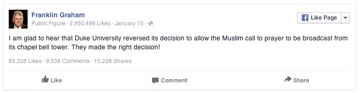
Later in the day, Richard Hays, the dean of the Duke Divinity School, released a letter outlining his objections to the proposed recitation. Hays’ letter revealed a somewhat obscure but significant division between the Divinity School and the chapel administration, each of which see themselves—in their own ways—as custodians of Duke’s Christian image. For the Divinity School administration, the chapel is a symbol of the university’s Christian identity. For the chapel administration, its Christian heritage is an aspect of a fundamentally pluralistic identity.
It is worth pausing here to emphasize that the controversy—now national in scope—was provoked by the mere prospect of sound. More specifically, a sound amplified at “moderate volume.”
By this point, the student muezzin and his family requested that his photo and name be removed; like the university, the young man and his family expressed “safety concerns.” Duke removed his image and name from the official online version of the announcement immediately. WRAL, the Raleigh television station, have still not removed the student’s image or name from their website.

Screen Capture of WRAL’s website by author
Where do we begin?
On the morning of Friday, January 16th?
The adhan was scheduled to take place at 1PM. At 12:30, I met two of my students—Tanner Waters and Jee Yoon—near the chapel. A large crowd was already gathering. Tanner, Jee, and I equipped ourselves with identical digital audio recorders so we could make a trio of stereo recordings, each from a distinct position; later, we would synchronize the recordings, mixing them in different ways to experiment with sonic “versions” of the event.
A half-dozen news vans were parked around the circular driveway leading to the chapel, their satellite antennas projecting into the clear blue sky. This was news. The news’ cameras were arranged on tripods in a straight line at the rear of the crowd; university security were maintaining a perimeter around the chapel that kept broadcast media at a distance. As I approached with my headphones on and my audio recorder in my hand, a chapel staff member asked mildly, “Excuse me, sir. Are you with the media?” I smiled and shook my head. No.
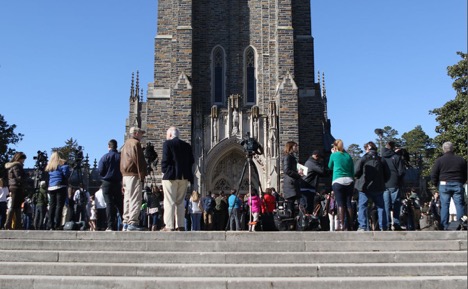
Photo by Elysia Su, The Duke Chronicle
A small PA sat at the top of the steps. Very small. There were no cables attached to it, and a small radio antenna extended from the top. It took me a few minutes to realize that this was the amplification, the moderate “loudspeaker” for the adhan. It took me another moment to realize the student muezzin would not appear: instead, he would transmit his recitation remotely. I was told later that he was just behind the closed doors of the chapel. Like so many recitations of the adhan, the transmission, amplification, and conceptual layers of it seemed uncannily like a sound art installation.
We all faced the loudspeaker, waiting for sounds to happen. The crowd went from murmurs to whispers, then silent. After a few seconds, the voices of members of the Muslim Students Association began to broadcast from the loudspeaker.
A young man’s voice introduced the adhan—a brief, prosaic context for what we would hear. Then a woman’s voice (also young) offered a literal English translation of the the adhan’s Arabic text. She spoke plainly, without the melodic contours of a recitation.
Now, before sharing recording of the Duke student muezzin’s recitation, I offer a bit of context—not an explanation or translation, but a comparative musical example. First, let’s listen to an iconic recitation style—albeit with a bit of YouTube-style hyperbole—recorded in Medina, Saudi Arabia. This recitation lasts four minutes—a fairly typical length of time for a complete recitation.
Now, let’s listen to the entire recitation of the adhan at the Duke chapel.
.
The prevailing quality of the Duke recitation is extraordinarily subdued. It is a vocal expression of the “moderate” sound and Muslim identity at the center of the controversy. At one minute and thirty seconds, it is less than half as long as most recitations.
Where do we begin?
Perhaps we might analyze this adhan as a peculiar instance of acousmatic sound: the student muezzin, like Pythagoras or the Wizard of Oz behind a curtain, was separated or dissociated from a discernible source by a curious bit of technology. When I asked Omid Safi, the director of Duke’s Islamic Studies Center, about this aspect of the story—the unseen and moderate voice of the student—he responded that for Muslims at Duke, the entire episode was about “safety and inclusion.”

Author’s screencapture of comments underneath a CBS.com broadcast about the Duke adhan.
Safi is a Duke alum. He studied there as undergraduate, co-founding the Muslim Students Association as a freshman, and went on to earn his Masters and PhD degrees at Duke. Since returning as director of the Islamic Studies Center two and a half years ago, he has been vocal and visible in the mass media. Safi himself has been labeled a “radical Muslim professor” by white conservatives and subjected to online “takedown articles,” particularly surrounding this event. Safi told me,
Part of the reason why … there was amplification but no person in sight [was] that people were scared. And it sounds hysterical … In retrospect, knowing what took place in Chapel Hill a few weeks later, [it was] not so unreasonable.
On Tuesday February 10, 2015, three Muslim college students—Deah Barakat, Yusor Abu-Salha, and Razan Abu-Salah—were murdered in their Chapel Hill home, just a twenty-minute drive from Duke. Less than a year earlier, Yusor Abu-Salha had been interviewed by her third-grade teacher for the StoryCorps oral history project.
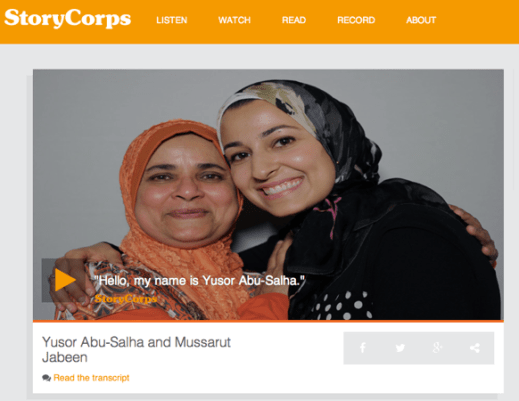
Click on image to hear Story Corps interview
.
At horrifying moments like these, I think to myself, “This is why people pray.”
I was deeply ambivalent about discussing the murders with my students. After speaking to a handful of students individually and discreetly, I found most of them were completely unaware of the murders. I wondered—mostly silently, to myself—what impact the news might have on them, then decided to share the story obliquely: I discussed StoryCorps (“listening is an act of love”) in class, an important resource for those of us interested in oral history and I concluded by mentioning the recording of Yusor Abu-Salha. I never asked if they listened to Yusor’s voice, and I cannot know how they might have been affected. I simply did not know what to ask, nor what to say.
Less than one year later, in September, I surveyed my next cohort of incoming freshman. Less than half of them knew anything about the adhan controversy. Among the few who had heard something about it, the event had already acquired dubious mythological qualities: in one account, Muslim students were forced to move their call to prayer from the chapel tower to the nearby Sara Duke Gardens.
Analyses of the event varied considerably. In an op-ed for Duke’s student newspaper titled “Deconstructing the National Fear of Duke’s Adhan,” freshman Eidan Jacob—an Israeli Jew—offered a brilliant context and synthesis, expressing “surprise and disappointment” that the adhan was “so poorly received.” He observed that in his hometown of Haifa, “recitations of the adhan are simply part of the soundscape.”
A broad cultural and political context reveals that xenophobia and—more specifically—Islamophobia, remain cultural common sense in the post-9/11 United States. Both supporters and opponents of the adhan at Duke were disappointed by the controversy, and I do not discern a tidy moral to the story.
The sounds and discourse of the adhan at Duke suggest a narrative preoccupied with “decibels and debate,” but the subtle dynamics and textures of thoughtful, moderate conversation suggest an audible alternative to the loudness and noise of mass media discourse. The diverse qualities of the voices in this story—musical and otherwise—are more than poetic metaphors: the “voices of moderates” and “moderate-sounding voices” deserve close attention; regardless of the causes or motives underlying their subdued tones, their very quietness demands nuanced, high-fidelity listening. The literal and metaphorical amplification of voices might be a distraction from more important matters of range and intimacy.
Where do we begin?
—
In May 2015, the Duke chapel was closed for restoration. It is scheduled to reopen in May 2016.
Plans for a weekly adhan recitation elsewhere on the Duke campus are under consideration.
—
Featured Image by Elysia Su, The Duke Chronicle
—
David Font-Navarrete is an artist, musician, and ethnomusicologist. He is currently a Lecturing Fellow at Duke University’s Thompson Writing Program.
—
REWIND!…If you liked this post, check out:
“Beat-ification: British Muslim Hip Hop and Ethical Listening Practices” –Jeanette Jouili
“Rallying Cries as Suffering Sounds: “Allah-O-Akbar” and the Aurality of Feminized Iranian Suffering–Roshanak Kheshti
“An Ear-splitting Cry: Gender, Performance, and Representations of Zaghareet in the U.S.“-Meghan Drury
Share this:




Current Top Posts





April 2021

January 2020

November 2019

October 2019

August 2019

April 2014

November 2017

March 2015

December 2017

October 2015
 Sounding Out!
Recent Comments