
Hearing “Media-Capitalism” in Egypt

DOI: https://doi.org/10.59350/746jq-hqk39
As I began researching my first book Ordinary Egyptians, a study of Egyptian culture from the 1870s until the eve of the 1919 revolution, sounds and early sound media were the last thing on my mind. However, When I dug more deeply into the historical sources, I realized the importance of music and the comedic theater in the urban culture of turn of the century Egypt. This made me expand the scope of my research to incorporate the vernacular culture of Egypt as an entire media-system, which as I showed in my book, was instrumental in constructing a modern Egyptian national identity. Music, songs, plays, chants, speeches, conversations and chatter, were very influential in forming an Egyptian national culture at the end of the nineteenth century, especially in a society with low literacy rates. By incorporating performance and sound media–especially the rising record industry–my book strives to expand the historical study of this period beyond just the visual and the printed to include sound, and aural/oral expressions of culture.
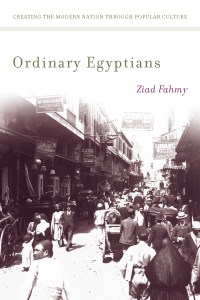
Ordinary Egyptians also engages with some of the theories of nationalism and tests their applicability to Egypt and the Arab world. It introduces the concept of “media-capitalism,” which expands the historical analysis of Egyptian nationalism beyond just print and silent reading, through the incorporation of audiovisual, sound, and performance media. By integrating these new media, especially the burgeoning record industry, my book attempts to make room for both the “ear” and the “eye”—for the aural and oral alongside the visual—and in the process provides a more comprehensive explanation for how individuals and communities digest and embody cultural information. As this excerpt explains, cultural productions, in any form, are not socially relevant unless they are communally and socially activated; they must be discussed, breathed, and animated in the routine of everyday life.
The following is an excerpt from Ordinary Egyptians, with thanks to Stanford University Press. Notes have been included in the text to conform to Sounding Out!‘s style sheet.
—
Mundane Nationalism
Egypt’s new mass media reflected on relevant everyday political, economic, and cultural concerns, and amplified them on the national stage in a comprehensible, locally pertinent and entertaining form. The repeated themes of many of these media included: bemoaning the lack of economic opportunities for native Egyptians, portraying the economic exploitation of Egyptians by foreigners, warning of perceived declines in national “morality,” satirizing and at times insulting British and native officials, and rousing patriotism and a sense of collective national solidarity.
However, the most effective way that national identity and a sense of nationhood was ‘absorbed’ was not only through these overstated themes and methods, but through the mundane media portrayals and representations of everyday “national” life and the internalization of these modes in actual practice. As Michael Billig describes in Banal Nationalism, nationalist ideology “might appear banal, routine, almost invisible,” however, these “subconscious” matter-of-fact representations create a common sense “naturalness of belonging to a nation” (15-16). Billig explains that often there is “continual ‘flagging’, or reminding, of nationhood,” as on a daily basis, citizens are reminded of their national identity. This reminding however, is “so familiar, so continual, that it is not consciously registered as reminding” (8). Mundane and unstated representations of Egyptian-ness abounded in most forms of mass culture, where “Egyptians” distinctively spoke and acted and were clearly, though tacitly, differentiated from non-Egyptians. Most of the media examined in this study implicitly addressed their listeners, viewers and readers as members of an Egyptian “nation.” To be sure, the most influential aspect of vaudeville and the satirical press were not necessarily the outwardly nationalistic messages of many of their articles, cartoons, and dialogues, but the recurring and mundane representations of colloquial Cairene as the de-facto dialect of all Egyptians, and the implicit understanding that flawlessly speaking and understanding it was the basic marker of a “modern” Egyptian national identity. Only an “authentic” ibn or bint al-balad (son or daughter of the country) would employ Egyptian Arabic and grasp its multiple meanings and nuances and hence participate in this new mass-produced colloquial culture. In fact, many of the comedic dialogues depicted in political cartoons and vaudeville repeatedly contrasted the mispronunciations of foreigners—who often played unsympathetic or villainous roles—with the “correct” pronunciation of affable Egyptian characters. This repeated portrayal of Cairene as the only “authentic” Egyptian accent reified it as an unofficial dialect of all Egyptians, even if back in the villages and towns of the Sa‛id more localized modes of expression were employed. By way of media-capitalism, Cairo’s dialect and culture was overwhelming—colonizing, if you will— the multitude of other localized dialects and cultures in Egypt. Thus, paradoxically, Cairene Arabic was the primary tool for nationalist, anti-imperialist discourse, and simultaneously, through internal-colonialism, it imposed its own culture on the “nation” [Note: This is very similar to what was happening in France during roughly the same time period. See Eugen Weber’s Peasants Into Frenchmen: The Modernization of Rural France, 1870-1914, 486-88].
The Sensorium and the Public Sphere
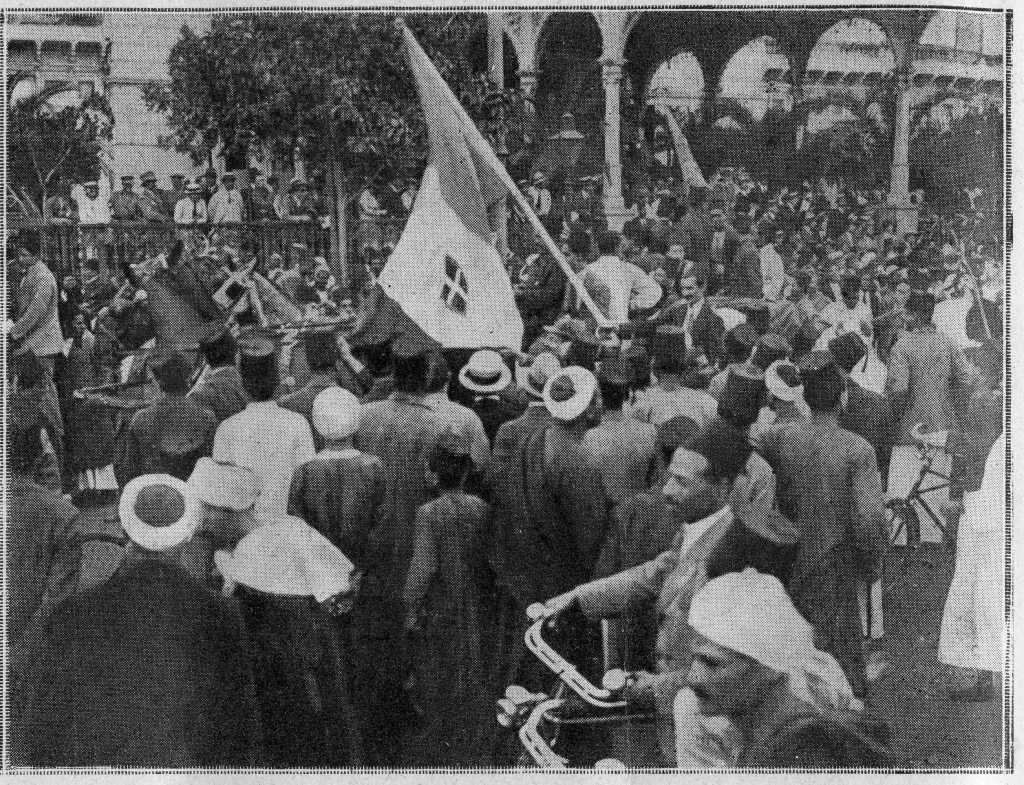
The efficacy of the new mass media and its potential for mass mobilization was best demonstrated during times of national crisis. The 1906 Dinshaway Incident and the 1919 Revolution in particular reveal how all forms of mass media functioned together to effectively document, memorialize, celebrate, and mobilize on a national scale. The growth of popular Egyptian mass culture, articulated almost exclusively in colloquial Egyptian, was the pivotal factor in the popularization and dissemination of an Egyptian national identity. The evolution and universalization of a colloquial Egyptian middle culture, made possible especially through the utilization of sound and audiovisual media, allowed for a shared and “uniquely” Egyptian cultural landscape. It is primarily within this non-official web of colloquial Egyptian mass culture, driven in large part by media-capitalism, that Egyptian national identity was widely disseminated and popularized.
One crucial aspect of this study was the critical role coffee shops played as cultural hubs, where differing mass media from newspapers to recorded music were publicly merged, negotiated, and digested. Many of the songs initially written for musical and comedic plays were recorded and played, or performed by street musicians at coffee shops and even in the streets and sidewalks. The role of the thousands of urban cafés and other public meeting areas in the broadcasting and reception of these new cultural productions is central to understanding the potency and effectiveness of this developing nationwide culture. Indeed, coffeehouses, as Peter Burke has remarked in A Social History of the Media, “inspired the creation of imagined communities of oral communication” (30).
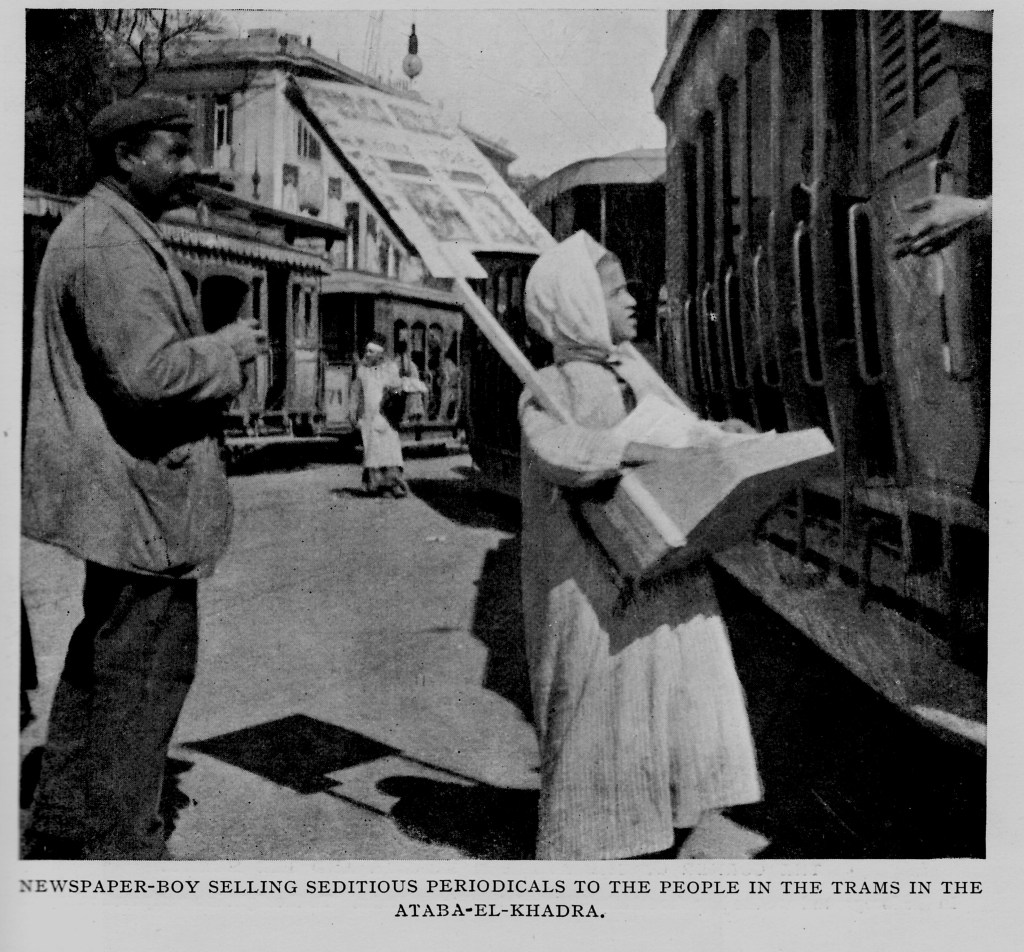
However, as discussed in previous chapters, this was never a one way conversation, as writers of these vernacular media were plugged into the streets and public squares through these very same cafés. As we have observed in this study, it can be said that the entire vaudeville theater industry arose out of the cafés on ‘Imad al-Din Street, where most of the vaudeville theaters were housed [Note: See Ibrahim Ramzi, Masrahuna ’Ayyam Zaman wa Tarikh al-Fananin al-Qudama’ (Cairo: Matba‘at al-Salam (1984), 25. There were at least three major cafés in Imad al-Din Street that were frequented by actors, singers, writers, and musicians— Qahwat al-Fan (The Arts Café), Qahwat Barun (The Baron Cafés), and Qahwat Misr (The Egypt Café)]. It was through these dialogical “physical” interactions with the people in the streets, market places, and cafés that the writers, musicians and performers of these media (re)calibrated with the subtleties, textures, and flavors of everyday Egyptian life. As Mikhail Bakhtin cautions in The Dialogic Imagination, we must not ignore the “social life of discourse outside the artist’s study, discourse in the open spaces of public squares, streets, cities and villages;” for it is in these public spheres that Egyptian mass culture is embodied into everyday life, acquiring its socio-economic, political relevance, and more importantly perhaps, its perceived authenticity, and contemporaneity (259). Indeed, access to any form of knowledge— be it visual, aural, tactile, gustatory or olfactory—is corporally mediated and is acquired through a living dialogical engagement. Or as Bakhtin elaborates in Problems of Dostoevsky’s Poetics, “the single adequate form to verbally expressing authentic human life is the open ended dialogue . . . In this dialogue a person participates wholly and throughout his whole life, with his eyes, lips, hands, soul, spirit, within his whole body and deeds” (293). In other words texts alone are meaningless when viewed in isolation of the socially embodied realities of their production, and more importantly perhaps, their reception on the street. It is in their interrelationship with social life that texts become meaningfully activated and authenticated as genuinely reflecting popular concerns and realities. As we have seen throughout this book, colloquial Egyptian culture is better equipped in engaging in this dialogue with the everyday, and hence guaranteeing its circulation and popularity.
(Ordinary Egyptians, p. 170-172)
—
Featured Image: View 042: Egypt – Street in Native Quarter, Cairo., n.d., T. H. McAllister, Manufacturing Optician. 49 Nassau Street, New York. Brooklyn Museum Archives (S10|08 General Views_People, image 9785).
—
Ziad Fahmy is an Assistant Professor of Modern Middle East History at the department of Near Eastern Studies. Professor Fahmy received his History Ph.D. in 2007 from the University of Arizona, where his dissertation “Popularizing Egyptian Nationalism” was awarded the Malcolm H. Kerr Dissertation Award (2008) from the Middle East Studies Association. His first book, Ordinary Egyptians: Creating the Modern Nation through Popular Culture (Stanford University Press, 2011), examines how, from the 1870s until the eve of the 1919 revolution, popular media and culture provided ordinary Egyptians with a framework to construct and negotiate a modern national identity. His articles have appeared in the International Journal of Middle East Studies and in Comparative Studies of South Asia, Africa and the Middle East. Professor Fahmy is currently beginning another book project tentatively titled, Listening to the Nation: Sounds, Soundscapes, and Mass Culture in Interwar Egypt. In 2011-2012, he was a Faculty Fellow at the Society for the Humanities at Cornell University, where the focal theme was “Sound: Culture, Theory, Practice, and Politics.”
—
Share this:

Park Sounds: A Kansas City Soundwalk for Fall

DOI: https://doi.org/10.59350/mpxhh-2z625
Fall refuses to stay put in Kansas City. The past month Kansas City temperatures have skyrocketed to 70 comfortable degrees fahrenheit and plummeted to 20 chilly degrees. I decided to partake of a wonderfully mild Sunday afternoon last Thanksgiving weekend to do another one of my Kansas City soundwalks, this time the fall edition. Fortunately the weather was cooperating, and I didn’t have to worry about how long I could resist standing in the cold.
Even though the weather was wonderful for a soundwalk, I couldn’t choose where to go. I have blogged about three soundwalks so far, and for each of them the choice seemed more organic: for my first soundwalk, in 2010, I wanted to walk around my new neighborhood and begin to understand it from an aural point of view. For my second soundwalk (in 2011) I went to one of my favorite places in Kansas City, the Country Club Plaza, and provided a snapshot of the sounds of spring in this busy area of Midtown. On my personal blog, in time for World Listening Day 2011, I talked about sounds from my own porch for a summer edition of my KC Soundwalks series, in order to think about the soundscape where I live. However, for this fourth soundwalk my only requirement was that it be a place I had not been to before. I wanted to venture out to somewhere new and encounter it not just with my eyes but also with my ears. Technically, I could go anywhere in Kansas City and do a soundwalk, but that was the one thing keeping me from doing a soundwalk: I couldn’t choose.

Last Sunday I decided I had to just get in the car and go. I had planned (and postponed) several soundwalks up until that day (I had even tweeted that I was leaving the house, in hopes of that forcing me to commit), so that day I planned to finally take some time to do my soundwalk before I went back to work. I got in the car with my daughter, destined for the West Bottoms neighborhood. I figured I’d take the long route instead of the quick and easy highways. As we drove along the side streets, I saw a park—a park neither of us had been to before, Jarboe Park—and I figured we could stop there, play for a while, and then drive off for my soundwalk. In any case, she might be good and tired by the time we arrived at our final destination, and I could put her in the stroller while I recorded and took notes.
That’s not what happened.
Once we arrived at the park, a moment of inspiration hit when I saw some musical instruments of sorts as part of the jungle gym, something I hadn’t seen before.
LISTEN: Walking_to_Jarboe_Park._Cars_coming.
When we arrived, Jarboe Park was deserted. The bare trees didn’t make it any more inviting, but the park is in newly minted condition and full of bright colors. It showed no signs of life, or wear and tear; in fact, the jungle gym and the swings seemed new. (According to The City of Kansas City, MO’s website, this park was remodeled in 2011.) Jarboe Park is located in a residential neighborhood, across from Primitivo García Elementary School. During the semester it surely gets more use. Perhaps it was too early on a Sunday for families to be out and about at the park. Coincidentally, a family appeared about an hour after we arrived, but they went to the basketball court across the street.
LISTEN: Swings._A_Child’s_Laughter._
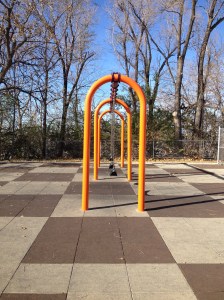
The first thing that caught my attention at the park was the presence of musical instruments set up at the entrance. I do not remember seeing anything similar before at a children’s jungle gym. There was a set of bells, a xylophone, some rainmakers, a whistle, and a drum set. Their presence seemed to indicate that making sounds/music/noise was also part of the experience of being in the park as well as part of the experience of growing up. Sound, specifically making sounds, became part of play, in this context.
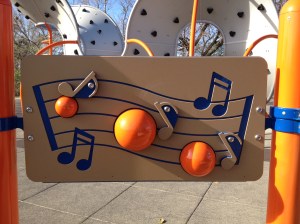
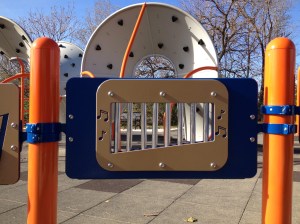
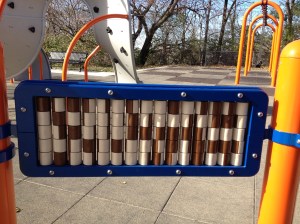
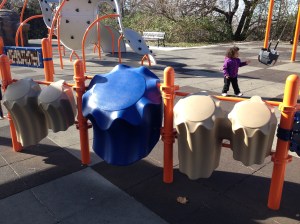
In the quietude of the noon time the sounds these instruments made felt a little sad instead of happy; the fact that there was only one child (ok, two, including myself!) playing with these instruments made their sounds stand out more, in relation to, say, the sounds of the trains and the highways (which I will discuss below). At the same time they drew attention to the fact that they were the only sounds that the park was making. If the park were busy, the sounds of the instruments would probably fade into the soundscape instead of being the loudest sound. However, the fact that we were playing with these instruments–versus playing instruments–made the park seem less lonely. We were part of the sounds, we were making sounds, and that seemed to distract me from the fact that we were the only people there making sounds. Although the plastic and metal instruments were not like traditional instruments, I wondered what their purpose in the jungle gym were. If the spider web and the swings are meant to exercise certain parts of the body and practice certain ways of socializing, what did the instruments teach? Perhaps the instruments are meant to teach children that instruments produce sounds, and they produce them in different ways. Lastly, the instruments and the act of creating sounds must use a different part of the brain–and my daughter was quite excited to play with the drum set!
LISTEN: Playing_musical_instruments_at_Jarboe_Park
Other than the sounds of the instruments, I also noticed the sounds of the highway and the train. I found a corner of the park where I could stand and record the sounds of the city:

LISTEN: Train_whistles._Miss_E_calls._
Kansas City is intersected by train tracks, and it almost feels like if you pay close attention, you can hear a train in the distance at any corner of the city. In fact, in the dead of a lazy afternoon or the quiet of the wee hours of the night I can hear the trains’ whistles, announcing their passing through the city, from my neighborhood of Rosedale in Kansas City, Kansas. If soundwalks can be a sonic ethnography of a city, my soundwalks have so far revealed that the sound of trains are an essential part of the KC soundscape as well as a reminder of the city’s history: the Kansas City Stockyards. I could also hear the low buzzing of the cars on the highway, another sound I’ve come to recognize as uniquely Kansas Citian, or at least part of my soundsscape. The murmur of the traffic ways is like the sound of Kansas City’s blood coursing through its veins.
LISTEN: Hum_of_the_highway._A_car._Train._
This spur-of-the-moment soundwalk made me think of how listening and sound can prompt reflection about the identity of a neighborhood and of a city. As I wrote down notes, I wondered: how do parks add to a community’s soundscape? The sounds add to the community’s identity as a residential area as an area that is amenable to the presence (physically and in aural terms) of other people. Soundscapes are connected to our ideas of what constitutes a neighborhood, and specifically how important common spaces like parks are, with all the sounds that may ensue. On a broader level, my Kansas City soundwalks are helping me piece together a soundscape of Kansas City, and to think through sound as a way to understanding the urban culture of this city, with its music, its fountains, its sports, and its trains, among other things. I feel like my listening practices are directly tied to my developing connection to this Midwestern city.
Postscript: I never did make it to the West Bottoms that Sunday. But it’s still on my list of KC spots to visit.
Featured Image: “Downtown from Top of Liberty2″ by Wikimedia user Hngrange, under Creative Commons 3.0 license.
–
Liana M. Silva is co-founder and Managing Editor of Sounding Out!
—
Share this:




Current Top Posts





April 2021

January 2020

November 2019

October 2019

August 2019

April 2014

November 2017

March 2015

December 2017

October 2015


Recent Comments