
Radical Listening and the People’s Microphony: A Conversation with Elana Mann
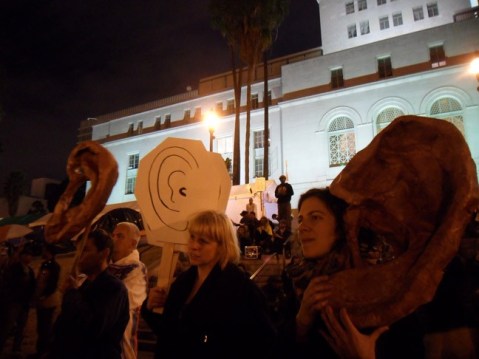
Members and collaborators of ARLA (Paula Cronan, Juliana Snapper, and Elana Mann) participating in a General Assembly at Occupy LA City Hall, November 11, 2011
Listen to everything all the time and remind yourself when you are not listening–Pauline Oliveros
“CAN YOU HEAR ME?!” “I CAN HEAR YOU!!” “IT’S A VAN GOGH PARADE!!” . . .were some of the enthusiastic replies when artist Elana Mann, musician Juliana Snapper, and other members of ARLA (Audile Receptives Los Angeles) arrived on the scene at Occupy LA with giant hand-made ears. Mann co-founded ARLA in the Spring of 2011 with Snapper, filmmaker Vera Brunner-Sung, and choreographer Kristen Smiarowski. After studying scores and techniques on listening developed by composer Pauline Oliveros, ARLA developed a workshop geared toward Occupy LA that included a listening parade in which they held up the giant ears and protest signs with ears on them. Snapper recalls, “The simple physical presence of people carrying large paper-mache ears was met with a kind of hungry recognition…recognition of what it meant that we were holding the symbols (giant ears).” They led workshops, listening sessions, and discussion groups. They performed Oliveros’ sonic meditation “Teach Yourself to Fly” and a composition written by Mann and Snapper entitled “People’s Microphony.” And a project was born. Through personal interviews and audio-visual examples, I document, contextualize, and analyze its work. 
Mp3=The People’s Microphony Camerata performing “Teach Yourself to Fly” Pauline Oliveros
I am happy that Elana Mann chose to use my Sonic Meditations for the People’s Microphony project. These pieces are meant for anyone that wants to perform them regardless of musical training.” –Pauline Oliveros
For Mann, active listening is “a process of tuning in simultaneously inward and outward. Active listening allows for an awareness of and an opening up to sounds around me and also a digestion of what is happening inside of me in relation to these sounds.” Much of the recent focus on this practice comes from the music and sound art worlds, as well as acoustic ecology, a field formed from the overlapping area between science and art that concentrates on the importance of experiencing and investigating our sonic surroundings with detailed care and respect to understand its importance on our world and our place within it. Mann’s work addresses a unique angle at the intersection of these fields: listening’s empathetic effect on those whom you are listening to, a consideration arising from a project she worked on between 2007-2010 with Iraq war veteran Captain Dylan Alexander Mack, called “Can’t Afford the Freeway.”
. “Can’t Afford the Freeway” highlights how her collaborations emerge as conversations between involved artists as well as the audience. Speaking to Mann about the project, she stated,Alex created some recordings for me and I kept listening to them over and over again trying to figure them out. I eventually produced more interviews with him and realized that he needed his story to be heard and I needed to try and understand his story. So I created a project in which I attempted to listen as best I could. Listening to his recordings made me feel close to him, but I also recognized that no matter how many times I heard his words they were still foreign to me. Still the very act of me struggling to listen was important for both of us, and I think this is true of many interpersonal/political and social situations. You can never experience what it is like to be someone else, but active listening opens up a space of empathy and connection. I also think we can see how a lack of active listening is affecting the political landscape in the United States so negatively, by producing a highly polarized and vitriolic environment.
And what about at Occupy LA?
At Occupy LA I was hopeful that there would be a place for listening to voices that had not been heard before and sometimes that happened. Other times people used the space for projecting, not receiving. I think that there needs to be strong voices making themselves heard, but I don’t want to lose the other part of that equation, which is those voices being quiet and listening to others, and themselves.

ARLA Ear Strengthening Workshop, Occupy LA site, November 11, 2011, Photo by Carol Cheh
Mann, thinking and researching about social, aesthetic, and political points of listening and voicing, felt there was something to be considered about the “radical receptivity and the core message of the OWS movement” and its global amplification of voices struggling to be heard. In the Spring of 2012, she formed The People’s Microphony Camerata with Snapper, a radical experimental choir based in Los Angeles exploring the process of the People’s Microphone. The exact history of the “People’s Microphone,” or “People’s Mic” is unclear, but its use in the Occupy Movement has already become iconic. Ted Sammons discusses the implications of the People’s Mic for communication in his October 2011 post, “‘I didn’t say look; I said listen’: The People’s Microphone, #OWS, and Beyond.” The human microphone is a way to deliver one person’s message to a large group of people in situations where amplification tools, such as bullhorns, are either not allowed or unavailable, or if the acoustics of a space distort amplification. The speaker calls, “mic check!” to alert their intentions. Those around them call back, “mic check!”, until the gathering understands something will be said. The speaker breaks their statement into short sentences, pausing to allow those around them, or the “first wave,” to repeat them in unison. They then pause for those further away, or the “second wave,” to repeat again…and so on until those in the back of the gathering have heard the statement.
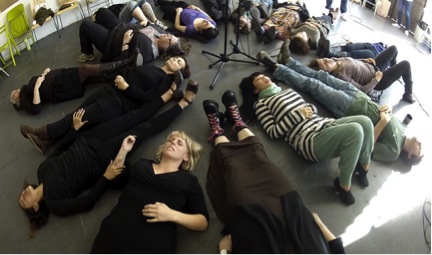
Members of People’s Microphony Camerata rehearsing in Los Angeles, April 15, 2012, Photo by Jean-Paul Leonard
The group’s trademark intensity sometimes carried over to the audience. Mann discovered such transference often had to do with prior associations with a location or context. Mann recalled a particular performance at the Occupy movement called “Chalkupy” that was formed in response to a protest running simultaneously with the LA Art Walk, in which activists had handed out chalk and told stories of police repression while chalk drawings were created on the walkways. The police shut down the art walk and a violent struggle ensued. The Occupy LA movement called for people globally to take to the street with chalk in protest, and the day was called “Chalkupy”. The audience of protestors was mixed and tense, and when the PMC began their performance of a highly emotive score called “Sob-Laugh” by Daniel Goode, people were either drawn to or repelled by the performance.
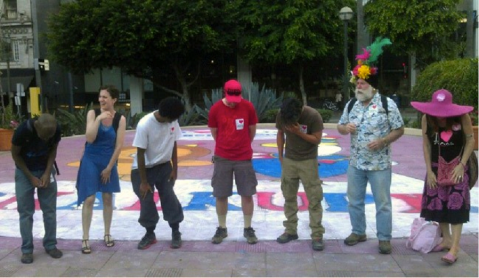
The PMC performing “Sob Laugh” at the “Chalkupy” protest in downtown Los Angeles, Image by Daniel Goode
I think there was some fear about the vulnerable revelation of emotions in the space of the protest. Many of the Occupy LA protests were so risky that everyone had to be extremely tough to exist in that activist space. I respect that. Still I think there are other things that can happen in a space of protest that bring out different feelings. Some activists wanted us to be more musically conventional, “why can’t you just sing some folk songs like normal protest choirs,” we were asked. But we really were not into that kind of thing. . .
In most protest situations, the audiences welcomed their activities. Many shared that it opened up a new space where people could meet each other as humans rather than adversaries or collaborators. Mann edited and published a monochromatic grassroots songbook with the various scores the PMC received for performance, opening up the circle for anyone and everyone to perform and feel that closeness.
Sometimes it was hard to translate a piece that worked during a group rehearsal to something for an audienceperformer situation. . .The PMC never fully developed how to deal with audience participation, but this is something I have been developing on my own in working with students on PMC materials. The scores from the People’s Microphony Songbook and the techniques Juliana and I developed when we first formed the PMC create an immediate closeness within a group, which is remarkable.

From the “People’s Microphony Songbook”: Many voices that were once silenced are now resonating through large crowds, not only of activists, but ordinary people all over the world, assisted by internet networks, and a simple technology called the People’s Microphone. The People’s Mic expressed the interrelated desires of collective and individual voices to speak and be heard, to hear one’s words spoken back through different mouths, and to digest someone else’s words through one’s own body. Beyond projecting an individual’s voice further then it can resonate on its own, the People’s Mic has implications for all of the bodies in its vicinity. It energizes listeners in ways the microphone or megaphone cannot by making listening active, vocal, and embodied. The project, like the Occupy movement, holds all the complexity, beauty, and drive of being human, whether you consider it “working” or not. When I asked Mann about how changes within and towards the Occupy Movement affected the choir, and whether they were winding down or taking a new form, she answered:
I think more than anything else, our group faced a lot of the same challenges that the Occupy Movement faced challenges in horizontality, in the push and pull between interior and exterior exploration, in the sometimes painful vulnerability of investigating the intimate personal and political space with others. I think the project is still developing. The choir still communicates, and some members are currently collaborating with composer Daniel Corral, but the PMC does not meet and rehearse like we used to I think it will continue to wax and wane. In the meantime, I am still working on ideas of active listening. I am currently creating a project called “Listening as (a) movement” within an under-served neighborhood in Pasadena, CA, exploring ideas of radical listening within a specific neighborhood.
In an age of constant bombardment of stimuli, our heads scream with thoughts, opinions, arguments, and expressions. With our current technology, our input and output can be a constant rush of snap reactions and impulses, which has a profound effect, of course, on our day-to-day lives, on our culture(s), on our politics. But these circles cannot be affectively complete without the other side. We need someone to hear us, and, more then that, we need someone to listen to us. And we, in turn, need to listen to them.
—
Maile Colbert is a multi-media artist with a concentration on sound and video who relocated from Los Angeles, US to Lisbon, Portugal. She is a regular writer for Sounding Out!
—
 REWIND! . . .If you liked this post, you may also dig:
“Sensing Voice”–Nina Sun Eidsheim
“Within a Grain of Sand: Our Sonic Environment and Some of Its Shapers”–Maile Colbert
“Listening to #Occupy in the Classroom”–Travers Scott
Share this:

Listening to Whisperers: Performance, ASMR Community and Fetish on YouTube
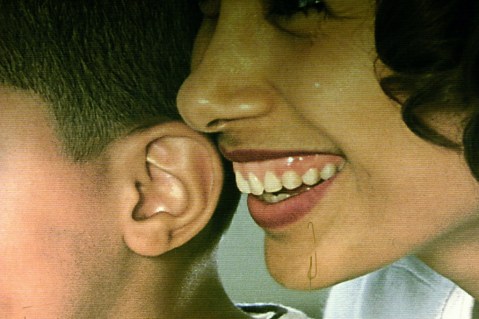
Imagine this, only virtual. Image borrowed from Genista @Flickr.
PercussiveThoughts is giving me a facial. The voice tells me about the “little scrubbies” in the exfoliant, and I begin to hear their delicate sibilance on my temples. If I’m lucky, a pleasurable, tingling sensation might begin somewhere on the back of my head and travel down my spine, turning my facial into something closer to a massage. The sole caveat is that I’m not really being touched at all.
This is ASMR, “Autonomous Sensory Meridian Response,” a pseudo-medical designation whose native soil is YouTube. The term pulls together a range of physiological and affective states: goosebumps, chills, relaxation, melting, tingles, and so forth. PercussiveThoughts and her fellow vloggers (I call them “Whisperers” here and explain why below) aim to trigger these frissons through a cornucopia of techniques. Sound is paramount; Whisperers scratch rough surfaces with their fingernails and percuss everyday objects with fingertip drum-rolls. And, of course, they whisper, sometimes using lozenges or gum to increase the opportunities for swallowing and lip-smacking.
What’s interesting about these videos is how they manage to traverse the gap between the sonic and the haptic. There is, of course, something familiar about this leap. Like the magician’s hat that produces rabbits and endless handkerchiefs, an audio speaker produces a volume and variety of sound out of proportion with its small, blank visage. In the case of Whispering, however, sound is transduced into touch, and the taut membranes of the listener’s headphones become coterminous with his own skin.
Apart from Steven Novella’s suggestion that ASMR might be a mild form of seizure, it does not yet appear to be a subject of scientific research. So Whisperers have taken on the role of amateur scientists themselves, with YouTube serving as a public petri dish. For this very reason, Novella has also cautioned against the assumption that ASMR is a real physiological phenomenon at all, since feedback loops of suggestion on the Internet might create “the cultural equivalent of pareidolia.”
Whisperers, however, have no doubts. And while the ASMR acronym is a recent development, many Whisperers say their first encounters with the phenomenon occurred sometime before their first exposure to the Internet and often before adulthood: during make-believe tea parties, while watching their classmates draw or braid each other’s hair, and, perhaps most commonly, while watching The Joy of Painting with Bob Ross.
The audience for Whispering is anyone who can have this experience, which apparently isn’t everyone. Contrary to the soporific themes of their videos, Whisperers and their fans identify themselves as having awakened to a special form of pleasure. Some have even made videos recounting their first experiences. The downside of this ability is the anxiety about its social acceptance. Whisperers sometimes opt for anonymity in their videos, revealing their faces only after much encouragement from fans. Rarely do they they let their family and friends in on the secret.
That this familiar, tingly feeling has assumed a pseudo-medical acronym is hardly coincidental. ASMR isn’t just pleasurable, it’s therapeutic. Hundreds of YouTube comments attest to the power of ASMR to help relieve them of insomnia, anxiety, and panic attacks. Nor has this dimension been overlooked by Whisperers themselves, who regularly perform as doctors or therapists in their roleplay videos. This is particularly interesting in light of recent scholarship on human/machine interactions. In Addiction By Design, Natasha Schüll shows how therapy for video-poker addiction can take the same format as the gambling itself, namely, “ongoing technological self-modulation to maintain equilibrium” (250).
Homemade Whisper videos, while habit-forming, are clearly not the sort of intricately-engineered machines that Schüll writes about. Nor do they wreack the same sort of havoc (depletion of one’s life-savings, deterioration of one’s physical health, etc.). And yet, both are arranged in problematic feedback loops of self-medication. The slow-paced, low-volume respite that Whisper videos offer is made all the more necessary by the fact that viewers must go online to watch them. This paradox is amplified by YouTube’s advertisements, which will sound especially abrasive because viewers tend to turn the volume up while listening to Whisper videos. That some of the more popular Whisperers earn money from their videos only complicates things further.
*
“No, we don’t get as many men here as women,” PercussiveThoughts says, as though responding to a question from me. Of course, I wouldn’t be so rude as to contradict her – I know better. To judge from the comments below, she gets plenty of male visitors. And her colleague ASMR Velous confided during an interview that around 70 percent of her viewers are men. For this reason, some Whisperers have made gender–neutral or male-oriented videos.
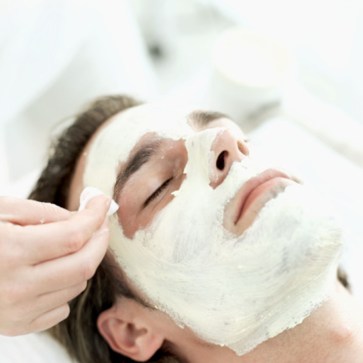
A man getting a facial. Borrowed from FoundryParkInn @Flickr.
Gender is a major, and sometimes contentious, topic of discussion in the Whisper Community. In the YouWhisper web forum, the discussion topic “Gender Preference?,” has the greatest number of views (more than 170,000). In general, female Whisperers are more popular than their male counterparts. The three most popular male Whisperers that I could find–WhisperMister1, MaleSoothe, and TheLyricalWhispers–each have fewer than 5,000 subscribers and their per-video view-counts tend to peak around ten or twenty thousand.
Not long ago, GentleWhispering, one of the better-known names in the Whisper community, set off a series of heated back-and-forths with her ~FeminineGrace & Charmforsleep~ video. In it, she discusses universal traits of femininity while brushing her hair absent-mindedly. Whatever one might think of her opinions, the fact that GentleWhispering’s viewership dwarfs all other Whisperers to date suggests that something in her technique is working. My guess is that it has a great deal to do with her hands.
While giving Russian language lessons on a chalkboard, she points to a word with her middle, ring, and pinkie fingers while keeping the chalk poised delicately between her thumb and index finger. When she is about to touch the fabric of an armchair, her fingers arch back–rather than claw forward–as though to ensure that the contact is as light as possible. And, like so many other Whisperers, she takes any opportunity to tap hard objects with her well-kept fingernails.
The “femininity” of GentleWhispering’s hands is the performance of a soothing, caring touch, and her whispering voice is the transubstantiation of this touch through sound. Sometimes, she even short-circuits the analogy by massaging the microphone directly.
*
But even the performance of gendered touching does not quite explain how these sounds and images manage to reach through the speaker and screen. After a second glance at these videos, we might wonder if the preponderance of partial objects has something to do with it.
I’m talking about all of those disembodied hands stroking opposite hands or displaying objects detached from their collections. Often, for the sake of anonymity, the Whisperer’s eyes are kept out of frame, leaving only an expressive mouth, like CalmingEscape’s, with its signature tics and swallows. If even the mouth is too revealing, the camera gazes down at covered breasts, ”objects,” in a Freudian panoply of sexual cathexis (is it a coincidence that some Whisperers even roleplay as the viewer’s doting mother?). One has to wonder what effect is achieved by this strange summation of partials.
In spite of widespread insistence that these videos are not sexual, the comparison with sexual fetish is too obvious not to make. Sticking with Freud for a moment, the hyper-presence of the Whisperer would seem to disavow the separation implicit in internet communication. Her mouth speaks individually into each of the listener’s ears while also hovering on screen. Her hands animate dead objects through rappings and close-ups. In her omnipotence, she can even tell us what to do.
Fetish or not, the word “whisper” is a perfect synecdoche for this fragmentary whole, and that’s why I’ve used it instead of ASMR. A whisper is, by definition, “unvoiced.” The cheeks, mouth, teeth, and tongue accomplish the acoustic filtering that gives words their shapes, but the larynx produces noise rather than tones. Lacking pitch, a whisper might be called only a “part of speech.” And yet it speaks volumes by shifting the register of communication. Whatever is said in a whisper gains the aura of genuineness, honesty, and intimacy.
Of course, in a YouTube video, these qualities are suspect from the moment one clicks the play button. But perhaps this is what makes Whispering work. One hears in these videos, above all, the effort of performance. It is the performance of gender, as discussed above, but more generally the performance of interaction, intimacy, and proximity. What every Whisper video whispers is “Let’s pretend!” And nothing proves this better than the fact
that some popular Whisper videos contain rather unpleasant sounds. Consider TheWhiteRabbitASMR’s dentist appointment video. If one is willing to grit one’s teeth through the long sections of abrasive drilling, it’s because she so adeptly crafts the intimate space of fantasy in which it takes places.
The pleasure of pretending was made clear to me when ASMR Velous recounted her childhood tactic for inducing ASMR. “I would constantly trick people into pretending to do things. I had this little play kitchen set, and I would cook up imaginary food for people and make them pretend-eat it really slowly and make those eating sounds like [chewing sounds], and I would just sit there and be all tingly. And I just loved it….I made up this game with my friends, where we would basically mime a profession and the other person would have to guess the profession you were miming. That was another way for me to trick my friends into pretending to do stuff.”
*
PercussiveThoughts is wrapping things up. “That completes your facial… So you can sit up. Well, thank you. Thank you so much. I’m really glad you enjoyed it.”
I did enjoy it! But thank goodness it’s not really over; I can just hit the reload button. No matter how many times I do, I know that my pores won’t be any cleaner when I look in the mirror. But that’s not the point. Rather, Whisper fans take pleasure in the intimacy and complicity of pretending. That complicity applies even to the skin of the listener, a surface as vibrant as the skin of the speaker.
—
Share this:


Current Top Posts





April 2021

January 2020

November 2019

October 2019

August 2019

April 2014

November 2017

March 2015

December 2017

October 2015
 Sounding Out!
Recent Comments