
How Svengali Lost His Jewish Accent
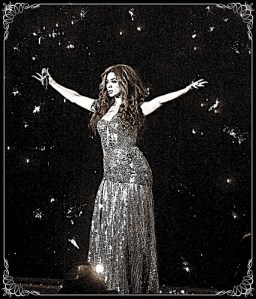
Diva as Svengali: Beyoncé by Lucas Lopez
The pop juggernaut Beyoncé recently made headlines when she confessed her plans for world pop domination to an AP reporter. She said:
“I am starting my company, my label. I want to create a boy band. I want to continue to produce and do documentaries and music videos. I eventually want to start directing for other artists.”
While Beyoncé’s business ambitions are hardly newsworthy—like many a multitasking pop idol, she helms several successful ventures, including a line of perfumes and a ready-to-wear fashion line—the announcement that she wants to be a musical impresario puts Beyoncé in more relatively selective company, especially as a woman. “Beyoncé as music industry boy band Svengali?” asked Amy Sciaretto, a tad incredulously, on PopCrush, “Yes, it’s true.”

Sunglassed Svengali: Cameron Grey portrait of Phil Spector, photo by Flickr user Lord Jim
In pop music writing, the idea of the Svengali pops up with regularity, usually to describe a man obsessively managing the careers of his younger, often vulnerable, charges. Classic examples include Phil Spector and the Ronettes. Berry Gordy and Diana Ross. Malcolm McLaren and the Sex Pistols. Lou Pearlman and the Backstreet Boys. To call Beyoncé a Svengali is both to insert her into this overwhelmingly male trajectory and to associate her, rather unflatteringly, with a long tradition of the producer-control freak, officiously meddling while passing himself off as his protégé’s protective sponsor.
Both associations, in fact, take us back to the origin of the term Svengali, from Trilby, an 1894 bestseller by the English writer and illustrator George Du Maurier. In that work, Trilby, a young Englishwoman of great likability but dubious honor (she is the daughter of a barmaid, and occasionally works as an artist’s model), is living la vie bohème in Paris, where she encounters Svengali, a sinister but charismatic musical genius who uses his mesmeric powers to turn her into the singing sensation of the European concert stage. Trilby can only sing, however, under Svengali’s spell—she must literally look at him while she performs—and so when one day he expires, mid-performance, of a weak heart, she loses her own vocal powers and later dies. The cause of her death is partly shock, but partly unrequited love. For although Svengali, a rather hideous Jew, had vainly sought Trilby’s affections, which she could only return when in hypnotic thrall to him, Trilby has long been in love with Little Billie, the handsome scion of a wealthy English family, who cannot marry her because she is tragically beneath him in rank.
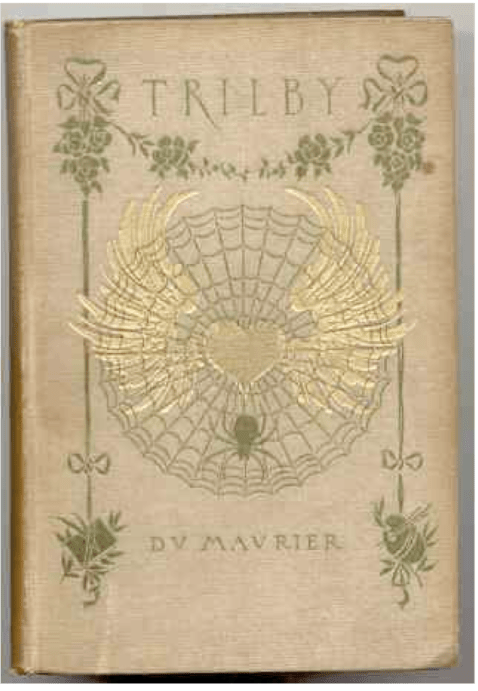
Trilby, 1894. The cover illustration shows an angel’s heart caught in Svengali’s web.
First serialized in Harper’s, Trilby was a transatlantic sensation, igniting what the press at the time, neatly anticipating Beatlemania, dubbed “Trilbymania.” Trilby’s success—and Svengali’s emergence into our cultural lingua franca—is attributable to its canny marriage of late 19th-century sentimentalism (the plot of a heroine who desires the unattainable good man but succumbs to the ogling bad man) with contemporary anti-Semitism, particularly the Wagnerian stereotype of the cultured Jew as musical parasite. In Das Judenthum in der Musik (Judaism in Music), an 1850 pamphlet, Wagner infamously excoriated Jewish musicians, claiming their inherent artistic inferiority relative to Gentiles.
It is important here that although Wagner was partly responding to the influx of Polish and other Eastern European Jewish peasants in 19th-century Germany, his attack was primarily aimed at the assimilated German-Jewish bourgeoisie. It was those Jews, as Wagner’s contemporary, the German music critic and journalist Franz Brendel put it, who “have fallen into a hopeless contradiction, i.e., of possessing our culture and yet remaining Jews, of wishing to be Jewish and Christian in one person.” Wagner’s Jew makes music in a tainted vernacular. Jews “can only imitate the speech of any European nation,” he wrote, “and because song is an extension of speech, … can never be great singers.”
Du Maurier’s Svengali, Polish-born but culturally German, enters late 19th-century Anglophone culture bearing the marks of the Wagnerian stereotype. In the novel he is introduced as a tall bony individual of any age between thirty and forty-five, of Jewish aspect, well-featured but sinister.
“He was very shabby and dirty… His thick, heavy, languid, lusterless black hair fell down behind his ears on to his shoulders, in that musician-like way that is so offensive to the normal Englishman. He had bold, brilliant black eyes, with long heavy lids, a thin, sallow face, and a beard of burnt-up black, which grew almost from under his eyelids; and over it his moustache, a shade lighter, fell in two long spiral twists. He went by the name of Svengali, and spoke fluent French with a German accent and humorous German twists and idiom, and his voice was very thin and mean and harsh, and often broke into a disagreeable falsetto.”
In short, Svengali is a prototypical Jew of late 19th-century anti-Semitic fantasy: Jewish in “aspect” and Jewish in nature: Jewish in his effeminacy and his indeterminate age and nationality; Jewish despite his ennobling Germanness and cultural accomplishment; Jewish even in his mysterious one-word appellation, Svengali, a name that renders his character both cosmopolitan and menacingly foreign, like the villain of a Donizetti opera. Like all embodiments of stereotype, Svengali exudes an embarrassing surfeit of Jewishness; at one point, Du Maurier’s narrator refers to him as “a dark black Hebrew sweep”; at another, as “an Oriental Israelite Hebrew Jew.” He is a bottom-feeder even in the 19th-century hierarchy of European and English Jews: dark, accented, coarse in his mannerisms and customs, a repellent mixture of East and West.

Svengali hypnotizing Trilby as she prepares for a performance. Illustration by George Du Maurier, 1894
Although it was not the case in the late 19th century, when parents took to naming their daughters Trilby, ultimately Svengali would prove more culturally durable than Du Maurier’s heroine. Today, the term, if not the memory of its origins in a forgettable 19th-century fiction, persists as a prototype of the charismatic, driven, and authoritative male starmaker. Like Du Maurier’s Svengali, the Svengali of contemporary usage craves money, but is driven by something greater than wealth. Like the fictional character, he is often himself a gifted artist, and yet he can never be the frontman, only the guy behind the scenes. Above all, he excels at playing other performers, especially feminized ones, as his “instruments.” Like the Svengali who mesmerizes Trilby with his eyes, he is creepily alluring, exerting a mysterious power over his musical charges—at least until the spell wears off (which it inevitably does).
Svengali is one of three Jewish characters—the others are Shylock and Fagin—whose names have become archetypes in English. Yet whereas Shakespeare’s and Dickens’s characters name Jewish stereotypes—and one would think before calling, say, Lou Pearlman, impresario of the Backstreet Boys and ‘NSync, now serving a jail sentence at a federal penitentiary in Texarkana for his involvement in a Ponzi scheme, a “Shylock”—Svengali carries little trace of its specifically anti-Semitic provenance.
This isn’t a post-Holocaust occurrence. In the course of a few decades after the serialization of Trilby the figure of Svengali had been almost entirely stripped of his ethnic accent. Whereas an 1897 Viennese stage production of Trilby provoked anti-Semitic agitation—forebodingly, given what was to come, forcing the producers to recode Svengali as a Hungarian Gypsy—by 1902, the Kansas City, Kansas American Citizen records the usage of “Svengali” to name a man who mesmerizes respectable women. Caught up in the late Victorian vogue for hypnosis, early 20th-century Americans attributed to “real-life” Svengalis a range of moral infractions that could not be credited to the women who committed them. No reason save hypnotic enticement could be found to explain the 1905 case of a Michigan woman, the wife of a veterinarian, who ran away with a balding, middle-aged white man, before returning to him when the “hypnotic effect began to wear off.”

John Barrymore as Svengali (1931)
In the 1931 film Svengali, starring John Barrymore, which follows the novel very closely, Svengali is Semiticized (the actor speaks with an accent and wears a nose prosthesis) and yet, quite assiduously, not named as a Jew, although he is associated with the Orient. By the time of the 1983 made-for-TV movie Svengali, starring Jodi Foster as the pop star Zoe Alexander, not only is the anti-Semitism excised, but also the character Svengali is missing. In this post-Helen Reddy world, moreover, Foster’s character eventually outgrows the need for her old teacher-manager (Peter O’Toole), who in the film’s end must go hunting for new students.
.
It’s not particularly remarkable that we still use the term Svengali despite its reprehensible heritage. We still recite the schoolyard rhyme “eenie meenie miney moe,” with its roots in antebellum racial stereotype, and know well the minstrel stage song repertoire.
On the other hand, the fact that “svengali” has shed its associations with Jewish masculinity, all the while retaining something of the ambivalence of anti-Semitic stereotype, is noteworthy. Svengalis are useful in crafting modern pop mythologies. Where money is concerned, they deflect agency away from pop stars—who, notwithstanding the degree of commercialism of their music or the loudness of their boasts, are still not supposed to want wealth more than making art or pleasing their fans. More generally, the Svengali figure intercedes to “manage” the excess of their desire, otherwise so often unbound in their musical performances and their excessive real-life behavior. In his delightful romp of a book Starmakers and Svengalis, the British music journalist Johnny Rogan recounts how Tam Paton, the manager of the Bay City Rollers, was ultimately unable to contend with the bad-boy shenanigans of the “tartan teen sensations” whose squeaky clean image he had carefully cultivated. It’s perhaps not incidental here that Paton was gay, inhabiting a public sexual identity associated with otherness and indeterminacy, and thus hearkening back to the archetype’s Jewish origins.
Du Maurier’s character drew from the notion of Jewish men as perversely sexually powerful, combining attractiveness and repulsiveness in one body. Sexual titillation in Trilbyis never far from the surface. Ultimately, the figure of the Svengali is a means of containing and deflecting expressions of desire in pop music. Through him, we can personify the larger predations of the music industry, its constant hunger for product and profit. By vilifying the powerful headmaster of the Motown “charm school” or the evil father figure behind the Jackson 5, for example, we can turn our attention away from our own complicity in the objectifying dynamic.

Svengali as spider. Illustration by George Du Maurier. The caption reads: “An Incubus.”
Here Svengali’s power of hypnosis—the quality that attached itself to the Svengali-figure in the early 20th century—is a potent metaphor for what pop music does to us, in making us listen despite (sometimes) our intellectual rejection of it. In Du Maurier’s original illustration for his novel, Svengali is a spider who entraps Trilby in his web. Pop music is often like that spider and that web: supremely sticky and, once we are hooked, indifferent to our resistance.
—
Gayle Wald is Professor of English at George Washington University. She is author of Shout, Sister, Shout!: The Untold Story of Rock-and-Roll Trailblazer Sister Rosetta Tharpe (Beacon, 2007) and working on a book about the TV show Soul!, which brought a black power sensibility to PBS circa 1968-73. Wald’s post is adapted from a “Keyword” talk she gave at the Experience Music Project POP Music Conference in Los Angeles in March 2011, where it caused quite a stir. Peep these links to read some initial responses from music critic Bob Cristgau and Flavorwire.
Share this:

“Take ‘Em to Chuch”: OutKast and the Sounds of the Southern Black Church
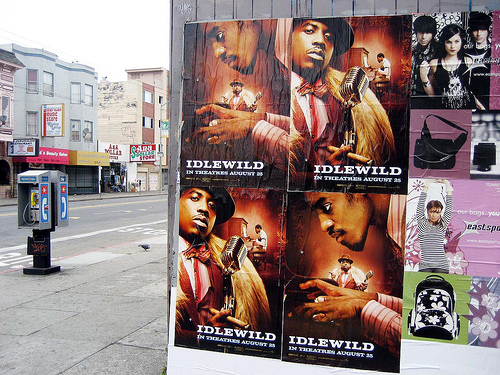
Advertising for Outkast
In 2006, I ventured into Hoosier Country. I found myself in the middle of…nowhere. And I was depressed. No, not because I decided to move to Indiana all by my lonesome on a huge leap of faith to pursue a graduate degree – I was too smooth for that – but because I found myself in a town where I couldn’t watch Outkast’s debut film Idlewild. Where they do that at? I am a Southern-bred, Southern-fed kinda girl. And Outkast was my muse. Hell, as a certified Down South Georgia Girl, all things Georgian were my muse. I planted my feet in red clay. My soundtrack was Organized Noise, the production team and heavy hitters that worked with OutKast, Goodie Mob, and a slew of other folks out of a rinky dink house basement that would later become known as the Dungeon (Family). I took pride in being from the Dungeon. And here I was, hundreds of miles away, frantically trying to find a theatre that would, if only for a brief 90 minutes, thrust me back into that familiarity of Southern life.
Of course, OutKast (comprised of members Andre Benjamin and Antwan “Big Boi” Patton) is hardly considered strictly Southern today. However, their 1994 release Southernplayalisticadillacmuzik shattered perceptions that Southern Rap was an oxymoron. In fact, OutKast’s initial sound updated tropes of southern black resistance and retaliation, fusing a lethal mastery of lyricism and flecks of a contemporary Southern culture too easily dismissed by non-Southerners. Calling upon and subverting the stereotypical traits of the Southern black voice – drawn out, slow, and heavy – OutKast sets up shop in hip hop by showcasing a rich history of Southern flair and homegrown sounds. The album made this intervention at the precise moment when hip hop became much more accessible to a mainstream white American market and the idea of being “post-Civil Rights” gained cultural traction. Combining narratives of being young, black, and frustrated with a sonic backdrop that includes an instrumental arsenal of horns, harmonicas, organs, drums, and bass, OutKast challenged and reconfigured how Southernness, Americanness, and contemporary black experience sounded at the turn of the millenium. Their initial releases seem to pick up the question of what it means to be displaced, Southern, and black after the South settled from its liberatory movements, pulling from the voices, images, and music of Southern protest like the Freedom Singers or Sweet Honey in the Rock and fusing these sounds with hip hop.

Andre Benjamin Onstage in 2003, Photo by Tulane University Public Relations
In order to discuss how they challenge and reconfigure notions of Southerness, Americanness, and contemporary black experiences, we should look at their musical nods to the black church. OutKast draws heavily on the Southern black church through sermon-esque flow, call and response, and snatches of “chuch” (lose the ‘r’) music. The black church is a staple in OutKast’s sound, reflecting what Guthrie Ramsey refers to in Race Music as community theatre, a site where “cultural, communal, and family memories associated with forms like music often become standards against which many explore and create alternative and highly personal identities for themselves” (33). The Southern black church provides such a site for communal and collective memory not only in Outkast’s music, but in African American history. Celebrated and upheld as a site of refuge from an abrasive and openly racist white supremacist environment, the black church provided a safe haven for freedom of cultural expression and social commentary unavailable in Southern white public space and discourse. OutKast challenges this older, static definition by updating its purpose to reflect the shifting social climate of the late-20th century American South. While they continue the resistance narrative tradition by bringing their marginalized experience to the forefront, they also sonically reorient mainstream views of contemporary Southern black life.
Instantly recognizable across OutKast’s recordings, their funky blend of sacred and secular musics–the blues, gospel, and hip hop–give sonic texture to something quiet-as-its-kept in black churches, how the so-called “bad” folks still come to church on Sunday, even if they were unholy on Saturday night. OutKast plays upon this unspoken understanding in songs like “Jazzybelle” from 1997’s ATLiens, “B.O.B. (Bombs Over Baghdad)” from their 2000 release Stankonia, and the straightforward “Church” from SpeakerboXXX/The Love Below (2003).
A particularly striking instance is heard on “B.O.B.,” a song which brazenly discusses issues that are often reserved for closet prayer and silent suffering. As Andre weaves a lyrical assault on the poor conditions of living in the black working class:
One-Nine-Nine-Nine, Ano Domini, anything goes, be whatchu wanna be
Long as you know consequences are given for livin – the fence is
too high to jump in jail
Too low to dig, I might just touch hell – HOT!
Get a life, now they gon’ sell
Then I might cast you a spell, look at what came in the mail
A scale and some Arm and Hammer, slow grow grid and a baby mama
Black Cadillac and a pack of pampers
Stack of question with no answers
Cure for cancer, cure for AIDS
Make a nigga wanna stay on tour for days
Get back home, things are wrong
Well not really, it was bad all along
Andre rhymes across an instrumental blend of bass and the church organ, inundating his listener’s ear with agency and anger. The church organ is as angry and explosive as his flow, with riffs and keys banged out loudly, quite different from the soft accompaniment often heard in a church setting. By heavily utilizing the organ and church choir at the end of the track, chanting “Bible music electric revival” OutKast subverts and updates the celebrated Black Church Revival, a gathering of church folk and the lost, swinging church music to give a voice to the marginalized black working class. The hybrid, urban sound of “B.O.B.” provides a space for the reclamation of a disenfranchised southern African American narrative that blends the suffering trope mandating much of African American religion with current trends in cultural expression reflected in Hip Hop. In Idlewild (which I FINALLY saw a year later, by the way), Andre and Big Boi visually annotate their secularized black church by creating an imagined community in rural Georgia that revolved around the jukejoint Church. OutKast’s audio-visual syncretism paved the way for later acts like Pastor Troy, who secularizes tropes of black masculinity and leadership in the black church, likening them to the struggles of being at war with those who don’t understand the struggles of a young black south.
The black church provides OutKast with a blueprint for reconciling displacement and authenticity by creating a sound that maneuvered a Post-Civil Rights landscape of shifting markers of social-economic identities and race. By connecting the historical context of the Southern black church with Hip Hop, OutKast’s sound reflects not only the historical residue of a pre-Civil Rights Movement South but also the constant search for a space of expression in an era where a stagnant or nonexistent “modern South” is a popularly comfortable disbelief. Perhaps this is why I was so desperate to find a theatre showing Idlewild; I found myself a geographically displaced Southern black youth searching to situate and sustain a new layer of my own post-Civil Rights narrative.


Share this:


Current Top Posts





April 2021

January 2020

November 2019

October 2019

August 2019

April 2014

November 2017

March 2015

December 2017

October 2015
 Sounding Out!
Recent Comments