
A Day on the Dial in Cap Haïtien, Haiti
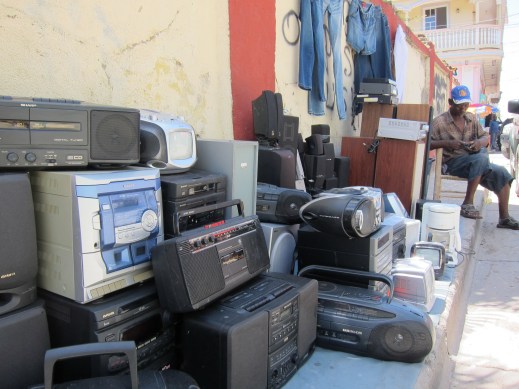

Radyo Ayisyen
Learning from other scholars’ work on Haitian radio was, and still is, one of the greatest pleasures in the process of writing Isles of Noise: Sonic Media in the Caribbean (UNC 2016). People living in or from Haiti widely acknowledged and almost took for granted radio’s outsized role in public and political life. Edwidge Danticat and Jonathan Demme also understood this and paid tribute in Claire of the Sea Light and The Agronomist respectively, but historians remained largely fixated, understandably, on pivotal moments in Haiti’s rich history. Radio is different. Not pivotal, but witnessing the pivotal. Less dramatic and more long lasting and adhering to the same format for days, years, decades. It speaks to people who wouldn’t read newspapers or books. It floods private and public space with the sounds of music, talking, ruling, dissenting, explaining, satirizing, creating, crying, testifying, lying. But it leaves few archival traces. This is why the work of the five scholars in this series is so important. They allow us to hear a little and honor the listeners who make the medium what it is.
Liveness, and company: Ian Coss’s finely tuned account of a “day in the life” of a radio station follows the programming rhythm of days and nights, from rollicking to quiet and back again. Radio is a predictable presence, an intimate friend who anticipates your needs even before you do. Coss draws from his years of listening to the listeners as he marks radio time and space in Cap Haïtien. Guest Editor– Alejandra Bronfman
——-
Fabrice Joseph is a mender, set up on a street corner in Cap Haïtien, Haiti’s second largest city. He shows me a red plastic toolbox filled with supplies — thread, wires, scraps of fabric—which he can use to fix a jammed zipper or stitch up a torn backpack strap. I stop because he’s cradling a radio set in his hands, tuned to the city’s most popular station: Radio Venus.
We meet on a quiet day; Fabrice has been sitting on the stoop for five hours already with no work. Another day he’s engrossed in assembling a large umbrella—the kind food vendors use for shade—but the radio is still on, now propped on a ledge just behind his head. He replaces the batteries almost weekly, because the radio is always on. In the morning Radio Venus plays news, Fabrice tells me, followed by music as the day heats up. Then in the afternoon he’ll hear sports or perhaps a religious program, before the station returns to music in the evening.
This arc Fabrice describes is designed to follow the arc of his day. In this post, I trace that link: between the rhythms of radio programming and the rhythms of daily life, to show how formatting choices create a heightened sense of ‘liveness’ on Haiti’s airwaves, with all content located in a specific moment: the present moment.
In a technical sense, terrestrial radio broadcasting has always been defined by real time or ‘live’ transmission (an dirèk in Creole), a characteristic that is often invoked in discussions of the medium’s capacity to create shared experiences or even ‘imagined communities.’ And yet where I live in the United States, the passage of time is barely discernible on most commercial stations. Where radio schedules once varied from hour to hour (often reflecting gendered and classed norms of listening), today market research has driven the rise of so-called “format stations” that target specific interest groups and demographics with an equally targeted form of programming: non-stop sports, news, top 40, easy listening, etc.
When I first visited Haiti in 2015, I was surprised to find a radio format unlike any I had grown up with, and not unlike those broadcast schedules of the 1920s and 1930s. While doing research in Cap Haïtien, I conducted a series of bandscans—systematic reviews of the entire radio dial—in order to identify the different types of programming heard on stations throughout the day there. I found the full range of talk and music-oriented shows you might expect, and yet of the 31 stations I picked up, only a handful carried the same type of programming all day. The vast majority carried every kind of program, including Fabrice’s favorite station, Radio Venus.
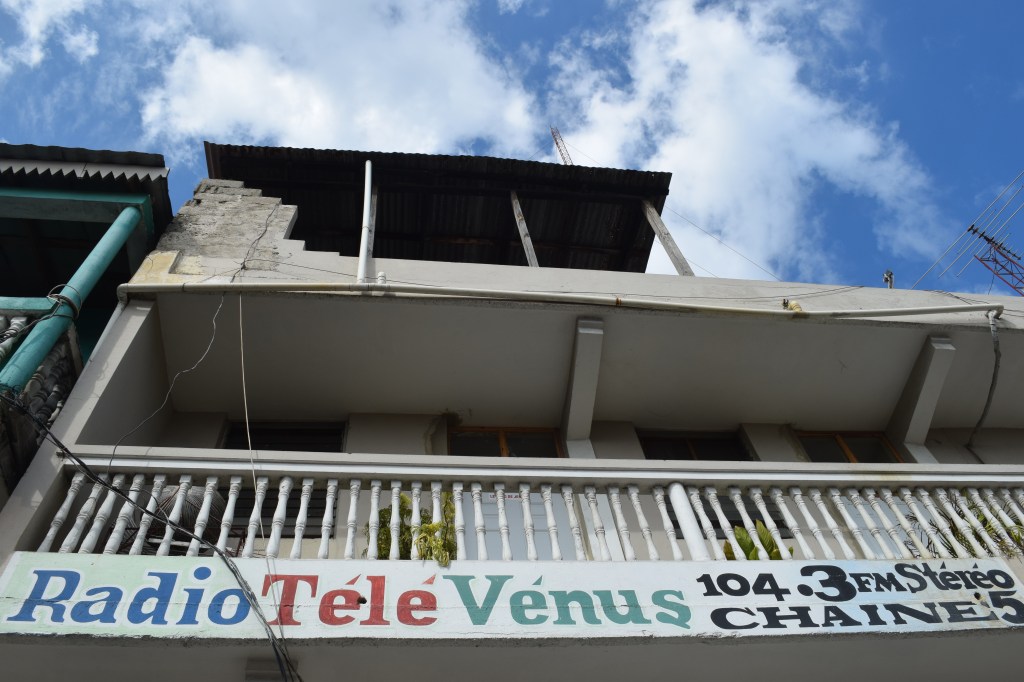
The Radio Venus studio sits on top of a three-story building, with a door leading straight out onto an open roof deck where the transmitter tower rises several more stories up in the air. That tower operates at 10 watts, just enough to relay the signal to a nearby mountain, where it’s then rebroadcast at roughly 450 watts, blanketing the country’s whole Northern Department. The person in charge of this whole system, as well as the overall flow of the day’s programs, is known as the opérateur. The station employs four operators—Molliere, Louis, Wilkonson and Simon—who work in shifts to cover the 24-hour schedule. This rotation provides stability as the hosts (or animateur) of different programs come and go—often showing up late, and sometimes not showing up at all. For long stretches of the day there is no host, so the operator just cues up a folder of songs in Windows Media Player, occasionally leaning over to trigger a station ID: a chesty voice that declares, “W’ap koute Radio Tele-Venus”—‘You are listening to Radio Tele-Venus.’
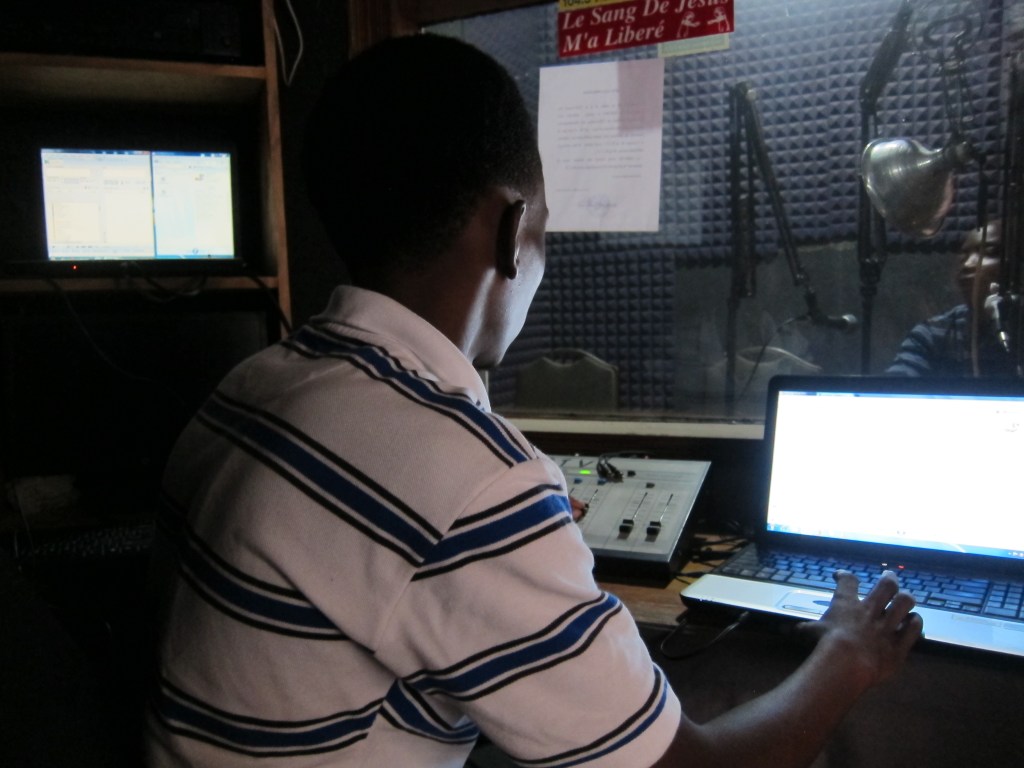
One day, while sitting behind the board of the cramped control room, Simon explains that the goal of the station’s format is to satisfy all of the listeners’ interests and to provide “stability” in their often unstable lives. That last descriptor, “estabilite,” strikes me as somewhat ironic, given that the station’s programming is constantly changing. But for Haitians like Fabrice, who listen all day while they work, the description fits: he never needs to touch the dial, and at the same time he knows exactly what he will hear. Indeed, most of the radio listeners I meet in Cap Haïtien praise the medium’s consistently variable nature; if they wanted to hear the same thing all day they could get a stereo that takes a kat memwa—a memory card—and load it up with their favorite mp3s. Radio should change with the hours of the day; that’s part of what makes it radio.
Many of the staff at Radio Venus describe the art of matching programming to the mood of the moment, in terms of ‘hotness’ (cho). For example, it’s important to have a lively host on the air between about 10am to noon, usually playing konpa music, so that the radio ‘heats up’ to give listeners more energy for their day. This shift takes place simultaneously across virtually every station on the dial, such that it’s literally audible on the street, from countless battery-powered radio sets. The timeliness of this ‘heating up’ is further emphasized by the host—at Venus, a local favorite named Don Lolo—who constantly reads the exact hour and minute off of a large analog clock on the studio wall. Lolo’s job is to make the music live in the moment; to make it ‘hot.’ By the same token, when I interview the overnight operator, Louis, he tells me that since many listeners keep the radio on all night, it’s important that he doesn’t play any music that’s ‘too hot,’ so as not to disturb their sleep. Everything in its right time.
The most dramatic shift in programming, however, begins on Friday evening. For the entire weekend, the station drops most of its talk-oriented shows and plays constant music—almost all of which is bootlegged recordings of live concerts. The idea is to convey the freewheeling mood of a night out on the town, even for those who won’t be at a bar or concert. To keep up this atmosphere, the station operators can choose from whole folders of “konpa live” tracks dating back decades—most of which run twelve to fifteen minutes long. Again, this programming convention of playing live recordings on weekends is ubiquitous across the dial, and indeed across Haiti. Turn on the radio on a Saturday night and you will be hard pressed to find any music that was recorded in a studio.

My first weekend at Radio Venus, I step out of the studio at dusk, and find the station’s signal is suddenly all around me—far more present than just a few hours earlier. Around the corner from the station, an electronics store has set up a row of folding chairs in the street, and is blasting Radio Venus for a small audience. At the end of the same block is a barbershop; there too the stereo is tuned to Venus, with one cabinet speaker set in its arched entryway.
At this hour, both the street and the shop are definitively male spaces—save for some market women packing goods and a mother overseeing her son’s haircut, those listening in public are men. A cell card vendor is perched on top of the stereo speaker itself; a man with two live chickens—their heads poking out of the bottom of plastic shopping bags—stops by and quickly exchanges some money with one of the barbers, who plays some air guitar as the next customer takes his seat. One of the other remaining barbers is perched sideways in his stool, feet in the air and a bottle of Barbancourt rum in one hand. The energy is loose, encouraged by the radio announcer.
Back at the station, the small studio is lit only by a single fluorescent bulb, whose harsh light spills through the glass pane into the neighboring control room. Don Lolo is on the air once again, but his style is different. No more telling the time or giving long monologues. Instead he sings along in a full-throated voice, occasionally adding personal shout-outs. We learn that Gerald is celebrating a birthday today, just as Claire and Alex are marking their anniversary. When his phone then rings, instead of picking it up Lolo silences the call and responds by radio: “Sorry, I can’t talk now!”
It’s late when Don Lolo wraps up his show and we head out of the studio, leaving Louis alone to cool the music back down for the overnight shift. The evening operator, Simon, offers to walk me home. At this hour, we can stroll down the middle of the street side by side, the city’s elaborate facades cast in silhouette by the occasional streetlight. As we head up the hill towards my place, Simon cocks his head and gestures across the street. I turn just in time to catch the station ID—“W’ap koute Radio Tele Venus”—coming out of a barbershop. The radio is still on.
Tune into a livestream of Radio Tele-Venus via Tune In: https://tunein.com/radio/Radio-Tele-Venus-1043-s181945/
—
Featured Image: “An electronics vendor in Cap Haïtien, Haiti” by Ian Coss
—
Ian Coss is an audio producer, composer and sound designer whose work spans the worlds of podcasting and performance. He has produced several critically acclaimed series with the Radiotopia network, including Ways of Hearing, The Great God of Depression, and Over the Road. His audio work has been reviewed by the New Yorker and the Guardian; featured on NPR, Al Jazeera and the BBC; and recognized with an Edward R. Murrow Award for ‘excellence in sound.’ Additionally, Ian has premiered live sound works at the Boston Museum of Science and Harvard University, and collaborated on immersive audio tours for the Isabella Stewart Gardner Museum, Richmond ICA, and other major art institutions. Ian holds a PhD in ethnomusicology from Boston University, where he conducted research on Haitian radio broadcasting and Indonesian shadow-puppetry. He continues this work as musical director for The Brothers Čampur, an international puppetry collaborative that has performed at major festivals in Indonesia, and at universities throughout the eastern United States. More on all these projects at iancoss.com.
—

REWIND! . . .If you liked this post, you may also dig:
Radio de Acción: Violent Circuits, Contentious Voices: Caribbean Radio Histories–Alejandra Bronfman
Radio Ambulante: A Radio that Listens –Carolina Guerrero
The Sweet Sounds of Havana: Space, Listening, and the Making of Sonic Citizenship–Vincent Andrisani
Share this:

Black Excellence on the Airwaves: Nora Holt and the American Negro Artist Program
—Co-authored by Chelsea Daniel and Samantha Ege—
Nora Holt (c.1885 – 1974) was a leading voice in Black America’s classical music scene. Her activities as a composer, performer, critic, commentator, and more shaped the Harlem Renaissance and its Chicago counterpart. As the fervor of the Black Renaissance progressed into the Civil Rights era, the energy that drove Black women’s activism sought greater outlets, one of which was the male-dominated world of radio. In radio, Holt continued her mission to broadcast Black excellence and there, her voice found greater power.

Photograph of Nora Holt by Carl Van Vechten. Retrieved from the Library of Congress website.
As two classical pianists of African descent, we—Chelsea M. Daniel and Samantha Ege—were accustomed to Black women’s voices (as embodied in their compositions, performances, and criticism) being minimized, or muted all together in the Western art music narrative. Hearing Holt for the first time was powerful.
Chelsea never knew that someone who looked like her existed in classical music, especially someone who had as great of an impact as Holt. Starting her piano studies at five, Chelsea was consistently the only Black female pianist in both her high school and college programs and she felt very isolated. It was nearly impossible for her to find any representation of Black female pianists and she was only encouraged to play a “standard” repertoire, which is dominated by white male composers. In her sophomore year of college, Chelsea took a music history course that taught her about diverse musicians who were omitted from her textbook. This discovery and a meaningful partnership with friends who shared similar experiences to her prompted the beginnings of numerous projects dedicated to showcasing music by diverse musicians, one being her junior degree recital where she programmed Sonata in E minor by the groundbreaking African-American composer Florence Price (1887 – 1953). With few performances of the piece existing online, Chelsea found Samantha’s recording and decided to reach out asking for guidance with the music.
Samantha’s journey had been very similar to Chelsea’s, from looking to see some part of herself reflected in her studies to actively seeking a classical music history that celebrated the truth of its diversity. These similarities are what led them to Price, and eventually to this collaboration. At the time Chelsea reached out, Samantha was developing her research on Price’s network and its impact during the Chicago Black Renaissance. As Samantha began to piece Holt’s influence together, she couldn’t help but lament the radio silence around her life and legacy in the mainstream musical consciousness. The following tweet from the Red Bull Music Academy certainly rang true. Or so she thought.
https://twitter.com/RBMA/status/879617104030420992
Chelsea came across Holt’s literal voice during her internship at WQXR-Radio, to which Samantha’s reaction was: “Oh. My. God.” Chelsea had been trying to track down locations in New York where Price’s friend and collaborator composer-pianist Margaret Bonds (1913 – 1972) had performed. She was shocked to find a live recording of the artist on the American Negro Artist Program, something that does not even exist on YouTube. For us to hear Bonds on the piano and Holt’s actual voice, with the crisp mid-Atlantic elocution of a bygone era but a message of Black excellence for the ages, was to feel inspired, renewed, significant, and empowered (much like Holt’s listeners during her time).
***
Born Lena Douglas in Kansas City to a minister father and musically-inclined mother, Holt’s music education began with playing organ in the church. Her musical pursuits aligned with the Talented Tenth thinking that W.E.B. Du Bois promoted around the turn of the century; it was believed that the highly educated top ten percent of the African-American population would uplift the race and that the study of classical music would provide a tool for mobility. However, Holt also lived beyond the limits of early twentieth-century respectability. As a young adult, she challenged the archetype of the modern day Black woman. By the time she had graduated from Kansas’s Western University, a prestigious HBCU, she had been married three times while still managing to graduate at the top of her class.
In 1917, she married her fourth husband, George Holt, who was a rich hotel owner thirty years her senior. She changed her name to Nora Holt. Prior to meeting her husband, she moved to Chicago and earned her living as a cabaret performer while also actively performing, composing, and promoting classical music. In 1918, Holt became the first person African-American person in the United States to attain a Master of Music degree, which she earned at the Chicago Musical College. For her thesis composition, she presented an orchestral piece called Rhapsody on Negro Themes. The rhapsody was one of over 200 compositions that Holt wrote. Unfortunately, many of them were lost and have yet to be recovered. Holt had kept her manuscripts in storage during her time away in Europe, but returned to find that all had been stolen. The only surviving works were those that had appeared in her publication, Music and Poetry: the art song “The Sandman” and Negro Dance (1921) for solo piano.
Negro Dance with Samantha Ege, piano
Holt’s advocacy for Black artistic excellence became even more far-reaching with her work as a music critic for the Chicago Defender and the New York Amsterdam News. She reviewed all of the concerts with African-American performers and composers that she could find and made history as one of the first women to write for a major newspaper as the Chicago Defender’s first ever music critic.
Holt moved into radio during the 1940s. Her American Negro Artist Program on WNYC began in 1945 and spanned almost a decade. It was upon this platform that she used her voice to further amplify the work of Black classical practitioners.
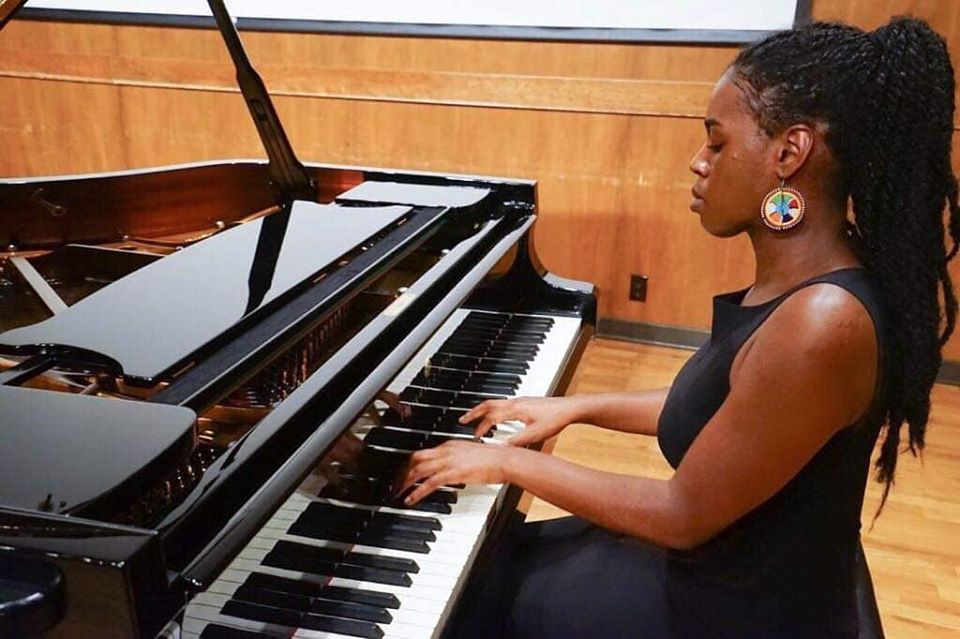
Chelsea M. Daniel, Butler School of Music, University of Texas at Austin. Image courtesy of the authors.
Chelsea found that the NYPR Archive Collections had published Holt’s 1953 American Negro Artist Program. This half an hour segment aired on February 12 at 5pm and was part of WNYC’s 14th annual American Music Festival. Though the scope of the festival was far broader, Holt’s program specifically highlighted the classical artistry of African-descended practitioners. February 12 fell in the middle of Negro History Week–the forerunner of today’s Black History Month–which New York Governor Thomas E. Dewey had proclaimed from February 8 to 15 (a span selected by the Week’s founder, Dr. Carter G. Woodson, in the 1920s to encompass the birthdays of Abraham Lincoln and Frederick Douglass). With this program, Holt led her listeners through the multifarious layers of Black diasporic representation.
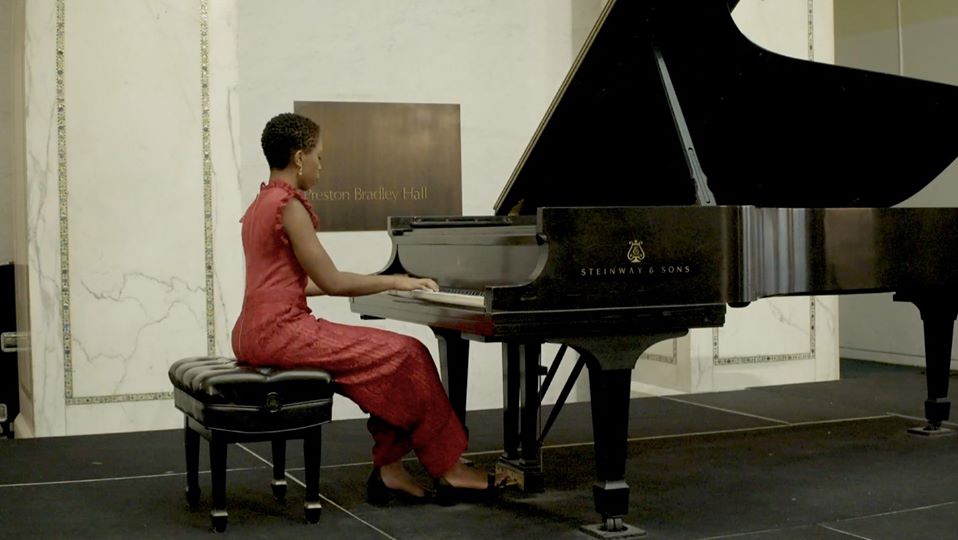
Samantha Ege, Preston Bradley Hall, Chicago Cultural Center. Images courtesy of the authors.
February 12 was also the commencement date of the festival, which was first announced in early February, in 1940. WNYC planned to broadcast an all-American series of concerts (forty in total) that would begin on February 12 and end on February 22, as marked by the dates of Abraham Lincoln’s and George Washington’s birthdays, respectively. Morris. S. Novik, WNYC director, told the New York Times (February 3, 1940) that the purpose of the festival was two-fold. He elaborated:
One purpose is to build the municipal radio station into an even greater force in the cultural life of the community, and the second is to promote the cause of good American music. American broadcasters have done a splendid job in developing appreciation of classical music. Radio must do still another important job by focusing attention on American music, and by demonstrating that Americans have written good–even great music.
The American Music Festival was the first of its kind to promote music that encompassed the nation’s musical past and present on such a scale, and with such stylistic variety. According to Novik, no other radio station had attempted to broadcast such a wide cross-section of American music with the same grand vision that he had. The New York Times reported on just how extensive this cross-section was (February 12, 1940):
The concerts will cover nearly all types of American composition. Simple ballads which the pioneer sang as he plodded his way Westward will be included, along with the professional orchestral works of today. Spirituals and blues, indigenous to American soil, will vie with compositions that incorporate the latest innovations. All types of compositions: mountain songs, barber-shop ballads, vaudeville melodies, marches and the more serious forms of composition which make up the musical life of America will be represented. The festival offers an affirmative answer to the question, “Do we have American music?”
Holt’s program not only evidenced a resounding “yes,” it presented a pan-diasporic purview that affirmed the socio-sonic pluralities of Black artistry. Samantha uses the term “socio-sonic pluralities” to ground the musical developments of Black cultural creators in their environment and to recognize how various social conditions can shape artistic expression. She identifies this as a central component in Holt’s 1953 American Negro Artist Program, particularly as the program went beyond the United States to embrace the Americas. With composers whose backgrounds encompassed Canada (R. Nathaniel Dett) and St. Kitts (Edward Margetson) and musical influences that merged different diasporic folk traditions with Romantic, neo-classicist, modernist, and Black Renaissance aesthetics, the American Negro Artist Program celebrated the interconnected, yet also distinct audiovisual histories of the African diaspora.
Program:
“The Breadth of a Rose”
William Grant Still, composer
Viola John, contralto and Margaret Bonds, piano
“I want Jesus to Walk With Me”
Negro Spiritual arranged by Edward Boatner
Viola John, contralto and Margaret Bonds, piano
“His Song” and “Juba Dance” from In the Bottoms
- Nathaniel Dett, composer
Una Hadley, piano
“One” and “Genius Child,” based on poems by Langston Hughes
Edward Lee Tyler, composer
Edward Lee Tyler, bass-baritone and Norma Holmes, piano
“First Movement” from Fantasy on Caribbean Rhythms
Edward Margetson, composer
The American String Quartet: David Johnson, 1st violin; Frank Sanford, 2nd violin; Felix Baer, viola; and Marion Combo, cello
“By the Sea”
Julia Perry, composer
Adele Addison, soprano and Margaret Bonds, piano
“The Negro Speaks of Rivers,” based on a poem by Langston Hughes
Margaret Bonds, composer
Adele Addison, soprano and Margaret Bonds, piano
On a scholarly level, Holt’s American Negro Artist Program adds another dimension to the way Samantha interprets the socio-sonic pluralities of Black artistry in the post-war era. Accessing Holt’s voice in the context of radio reifies connections between growing technologies and Black classical propagation at this time. In the absence of Holt’s full composition catalogue, hearing Holt amplify the work of her esteemed peers gives an enhanced perspective on her musical developments—from composer to curator, off the score and onto the airwaves.
On a personal level, however, it is upsetting to not have learned about Holt sooner and, as Chelsea elaborates, to not have a face like Holt’s to look up to during the loneliest moments of our education. Holt’s work validates Chelsea’s own pursuits, particularly in radio. Holt successfully created her own space in classical music, and did so unapologetically. She provided opportunities for Black musicians to be at the forefront and challenged a system that was not built for first-person Black narratives. And so, we take a leaf from her book, recognizing that the (re)sounding of her story is also the celebration of our own.
Listen to Holt and the American Negro Artist Program here.
—
Featured image:”Music stand (1)” by Flickr user Rachel Johnson, CC-BY-ND 2.0
—
Chelsea M. Daniel is a senior at the University of Texas, Austin, pursuing her Bachelor’s in Piano Performance. She is devoted to showcasing the stories and music of marginalized people and musicians. Daniel is the co-founder of the award-winning Exposure TV, which was created to highlight composers and musicians from underrepresented backgrounds. Daniel came across the American Negro Artist Program during her internship at WQXR-FM.
Samantha Ege is a scholar, pianist and educator. Her PhD (University of York) centres on the African-American composer Florence Price. Ege’s upcoming article on Price, Holt and the Chicago Black Renaissance women is called “Composing a Symphonist: Florence Price and the Hand of Black Women’s Fellowship” and appears in Volume 24 of Women and Music: A Journal of Gender and Culture. As a concert pianist and recording artist, Ege continues to amplify Black women composers in her repertoire.
—
 REWIND! . . .If you liked this post, you may also dig:
My Music and My Message is Powerful: It Shouldn’t Be Florence Price or “Nothing”-Samantha Ege
Spaces of Sounds: The Peoples of the African Diaspora and Protest in the United States–Vanessa Valdes
Deejaying her Listening: Learning through Life Stories of Human Rights Violations– Emmanuelle Sonntag and Bronwen Low
Share this:


Current Top Posts





April 2021

January 2020

November 2019

October 2019

August 2019

April 2014

November 2017

March 2015

December 2017

October 2015
 Sounding Out!
Recent Comments