
Workshopping the Derry Soundscape: Mobile technologies as Creative Tools for Third Age Adults
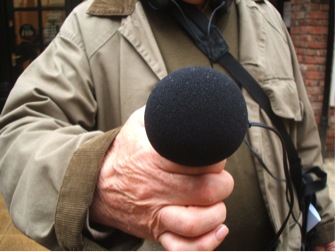
 This April forum, Acts of Sonic Intervention, explores what we over here at Sounding Out! are calling “Sound Studies 2.0”–the movement of the field beyond the initial excitement for and indexing of sound toward new applications and challenges to the status quo.
Two years ago at the first meeting of the European Sound Studies Association, I was inspired by the work of scholar and sound artist Linda O’Keeffe and her compelling application of the theories and methodologies of sound studies to immediate community issues. In what would later become a post for SO!, “(Sound)Walking Through Smithfield Square in Dublin,” O’Keeffe discussed her Smithfield Square project and how she taught local Dublin high school students field recording methodologies and then tasked them with documenting how they heard the space of the recently “refurbished” square and the displacement of their lives within it. For me, O’Keeffe’s ideas were electrifying, and I worked to enact a public praxis of my own via ReSounding Binghamton and the Binghamton Historical Soundwalk Project. Both are still in their initial stages; the work has been fascinating and rewarding, but arduous, slow, and uncharted. Acts of Sonic Intervention stems from my own hunger to hear more from scholars, artists, theorists, and/or practicioners to guide my efforts and to inspire others to take up this challenge. Given the exciting knowledge that the field has produced regarding sound and power (a good amount of it published here), can sound studies actually be a site for civic intervention, disruption, and resistance?
Acts of Sonic Intervention began with “Listening to and Through Need” by Assistant Director at Binghamton University’s Center for Civic Engagement, Christie Zwahlen, who argues that any act of intervention must necessarily begin with self-reflexivity and examination of how one listens. Last week, artist/scholar Luz María Sánchez gives us the privilege of a behind-the-scenes discussion of her latest work, detritus.2/ V.F(i)n_1–1st prize winner at the 2015 Biennial of the Frontiers in Matamoros, Mexico —which uses found recordings and images to break the deleterious silence created by narco violence in Mexico. Next week, we will close with from artist, theorist, and writer Salomé Voegelin, who will treat us to a multimedia re-sonification of the keynote she gave at 2014’s Invisible Places, Sounding Cities conference in Viseu, Portugal, “Sound Art as Public Art,” which revivified the idea of the “civic” as a social responsibility enacted through sound and listening. Today, Linda O’Keeffe catches us up with her newest public project, a pilot workshop with older people at the U3A (University of the Third Age) centre in Foyle, Derry, “grounded in an examination of the digital divide, social inclusion and the formation of artists collectives.”
–JS, Editor-in-Chief
—
In 2014, the Irish Research Council funded a project that looked to increase the access of older people to creative opportunities while at the same time generating interest in research examining the social implications of sound, music, and performance produced by older people. The project ran over a 9-month period and included a two-week workshop with a group of third age adults based in Derry, Northern Ireland. This fulltime workshop consisted of training three people aged between 65-70 in the area of gesture based audio technologies on iOS devices.
My initial impetus behind the project was to find different ways to engage older adults with technologies outside of the typical education programs which focus on internet training and learning how to use communication applications like email and VOIP software. I designed the workshop to introduce the participants to a range of audio-based applications designed specifically for an iPad. They learned how to use digital audio recorders, including the different file types associated with sound quality, such as compressed audio mp3 and mostly uncompressed audio WAV (windows audio video format). For clarity, I organized the audio applications into three distinct types: audio editing apps, gesture based performance apps and sound synthesis apps.

Participants working with Auria and Dropbox // Photo by author
Learning sound production, I felt, would offer elder people a different kind of value than basic workplace digital skills, something perhaps even more important for third age adults, what Fisher and Specht describe as a “positive sense of future” in “Successful Aging And Creativity In Later Life” (459). Training in digital activities such as multi-track editing, performance and synthesis applications, the use of digital audio recorders, soundscape recording, using cloud based applications for sound sharing, and mastering finished works of sound offered more than just a “skill” for workshop participants, it also held out a new sense of purpose, a means to continue engaging with community, continued intellectual stimulation, and the possibility of a new period of productivity in their lives.
Work Shopping Sound
One of the key components to the workshop involved talking about sound and sound art, and discussing the kinds of art made from sound, including work made for radio. Such conversation presented difficulties for people who were largely unfamiliar with fine art, a problem compounded by the fact that, as an emerging art form, sound is not always visible in mainstream cultural spaces.
To ease the transition, I centered our early discussions on important sounds in the participants’ lives: sounds remembered and now lost, the difference between rural and urban soundscapes, and unique perhaps for this particular group, the sounds of civil war. All of the participants had lived in Derry most of their lives and experienced some aspect of the violence within Northern Ireland; through our conversations, sound became an interesting way to memorialize and process this event. We then discussed how these soundscapes could be documented, changed and presented as works of art. Later, workshop conversation consisted of listening to sound art pieces. This helped the group get a sense of the potential of sound as an expressive art form.
Sound as Process
During the workshop, I emphasized the process and practice of sound making over the technology required to undertake the production of their art works. In this way, by focusing on an artistic concept, the technology just became the means in which they could be creative. Each participant was given a digital audio recorder (Zoom), which they brought home to record sounds they found interesting. Every meeting, the group discussed how–through the act of recording and listening–their perception of familiar sounds was being altered. They began also to experiment when recording, using their voices – singing – reading poetry etc. in different spaces, getting close up to sounds – exhaust pipes in cars, for example—and placing the microphone in unusual places such as a neighbours pig shed. Gradually, participants began to think of the sounds they collected as being part of a larger project and they became much more selective about what they would record. In addition, the group began to critique the sounds they recorded as well as sharing their sounds using Dropbox folders. These recordings became the basis for their final works; even if their sounds were eventually altered beyond recognition, the sounds inspired their artistic concepts.
The first Saturday of the two-week workshop included a soundscape recording day in Derry city. Each participant was asked to walk the city, recording sounds they found interesting. What emerged during the sound walks was unexpected. Members of the group began to engage with spaces and people, interviewing some, asking others to make sounds. For example, two participants went into a music store and asked the staff to sing or play an instrument so that they could record these sounds. They also went to the main cathedral in Derry and had the bells rung especially for them and a trainee organist play some traditional organ music. One participant, a poet, had different people read lines from a selection of his poems. He stated later that he was hoping to collect the sounds of women, children and men, as well as the multiple accents of Derry people, because his poetry was about Derry and therefore Derry should be its voice. I had not anticipated this engagement with community and space when I designed the workshop.

Participants recording water feature, Photo by author
During the focus group discussion after the sound walk, each participant talked primarily about how the recorder allowed them access to sounds and people. The technology acted as an interface between them and a sound that they wanted; it gave them the confidence to approach strangers, because they felt they were working on something important.
Gesture Based Performance Applications

Still from Auria, a gesture based performance app
In addition to conversation and artistic process, the first week of the workshop introduced participants to three applications: Auria audio editor, TC11 gesture based performance app and Animoog (a music synth app designed for iPad). A number of papers argue that it is the complexity of software applications, including the internet, which proves difficult to older users. Overlapping and contrasting colours are defined as difficult to engage with and can be distracting to users whose vision is in any way impaired through ageing. The Auria editor is as complex visually as most computer DAW’s, with one key difference: all interactions are gestural. This simple difference meant that each of the users found engaging with the application less difficult than if they had to deal with a mouse, keyboard, shortcuts and OS’s (see figure).  None of the participants felt that the screen and its multiple windows were so difficult that they could not engage. In fact, we had initially worked with a much simpler audio editing app, Hokusai, which they felt was too simple in its design and usability. By the end of the two-week workshop, the participants had produced at least one complete work of sound, with some creating up to 4. Selected works were compiled in a CD that was launched in November 2014 at the U3A in Derry. Listen to a sampling below.
.
Track Two: “Made in Belfast” by Sam Burnside, read by John Dunlop
Track Four: “The Haunted Valley,” by Florence Forbes
.
In a final focus group discussion, the participants all responded very positively to the experience while offering suggestions about future workshops. Most agreed that the digital audio recorders allowed them to open their ears to the possibility of working with sound, but from an ethnographic perspective. The recorders allowed the participants engage actively with people and spaces in a way that had not been anticipated, empowering them with a sense of purpose, and allowed them give voice to both their creative ideas and the voices and soundscapes of Derry. In addition, the iPADs and audio recorders allowed them a sense of technological and creative mobility; they could access sounds on the move, place and share them in the cloud, perform/compose and edit in different spaces.

Participants working with their iPads, Photo by the author
Working on this project altered a number of preconceptions I had inadvertently brought with me about older peoples’ capabilities, even though my proposed project challenged other assumptions about aging. For example, I chose some of the audio applications for their simple design, mostly because previous research had highlighted older adults’ limitations in regards to the digital, based on principles of design, where technology is often shaped for a younger, often male, user. The participants in this workshop proved they could learn and even be creative with complicated applications such for synthesis and sophisticated editing. Even though I have written about older peoples use of audio technologies dating back to the 1940s–and how they developed sophisticated hacked mechanisms in order to broaden their sound/media sphere (O’Keeffe 2015)–I failed to consider that my participants would also have a contemporary relationship to mobile technologies. Yet all three participants, in varying degrees, used some form of mobile technology, from tablets to android phones. But what was evidenced through our conversations was the limited way in which they used their tech. After the workshop, most talked about buying and using audio applications or recording technology for creative or documentary use.

The author, recording sounds in the workshop
Prior to the workshop, I myself rarely used iPad audio apps; for me, it required thinking differently about mobility and sound design, and it was only on seeing the very creative ways in which the participants used the iPad that I started to rethink how IOS apps could support my sound practice. Following from this project, I am now in the process of developing a performance collective with third age adults. We will examine ways in which sounds can be assigned meaning and then used in a performance setting. The project will take about a year to complete and the hope is that, when finished, the performance collective will continue, with a tool kit to sustain their practice.
—
Featured Image: “Workshop participant interviewing poetry readers,” photo by Author
—
Linda O Keeffe isis a lecturer in sound at Lancaster Institute of Contemporary Art. She is also secretary to the Irish Sound Science and Technology Association and editor of the Interference Journal. She has several papers and book chapters published and due for release in the fields of sound studies. Her practice is concerned with an exploration, both academic and creative, of the ways in which sound alters our experience of different spaces. Her art training was within the sculpture department of IADT under the tutelage of Finola Jones. She completed a Masters in Virtual Reality in NCAD with Kevin Atherton, and just finished a PhD in sociology in NUIM. Her research examined the urban of Dublin city soundscape as socially and technologically co-constructed. She has composed for dance, theatre, quartets, and new instrument performers, installed sound installations for commissions in Ireland, China and Holland, and has had radio works performed both nationally and internationally. In 2008 she was mentored under Eric Leonardson in Chicago, a sound artist and performer. More recently, she was commissioned by Resonance FM to create a work for radio for the 2013 Derry city of culture event. In November 2014 Linda had a solo exhibition called “Spaces of Sound and Radio Spaces” for the Limerick Sculpture Centre, a creative realization of her PhD research.She will be releasing an album next year with the composer Tony Doyle on spatialisation and sonified memories with Farpoint Recordings, her third album. You can find her at www.lindaokeeffe.com.
—
 REWIND! . . .If you liked this post, you may also dig:
Of Sound Machines and Recording, Sharing that Transcends Time and Space–Maile Colbert
Audio Culture Studies: Scaffolding a Sequence of Assignments–Jentery Seyers
“We wanted to tell stories about sound”: Opening Ears Through the “Everything Sounds” Podcast–Craig Shank and George Drake Jr.
Share this:

Alan Lomax’s Southern Journey and the Sound of Authenticity

 Welcome back to 100 Years of Alan Lomax, Sounding Out!‘s series dedicated to remembering, rethinking and challenging our understanding of this crucial figure in folk music history.
In contrast to the first post in the series by Mark Davidson, which looked at how we have branded Alan Lomax, Parker Fishel‘s post considers how Alan Lomax fashioned himself—as both a collector and a publisher of other peoples’ music. The complexity of this task is inherent in the social and political ramifications of “saving” sound by making it “ours,” both in terms of singular ownership of singular recordings that had previously “belonged” to a community as well as the extent to which this practice brought these sounds to the wider culture.
Here, Fishel invites the reader to consider this complicated history that surrounds collecting and copyrighting folk music, what (and whom) the practice has excluded as well current performers who have been inspired by this preservation of our sound culture to perpetuate the practice: making it “theirs” and “ours” once again.
— Guest Editor Tanya Clement
—
The more one listens, views, and reads the work of pioneering folklorist Alan Lomax, the more inscrutable it becomes. Even if we set aside the sheer size and diversity of his collection, we are still left with a set of materials that eludes easy interpretation. Too mainstream for the academics and too academic for the mainstream, Lomax’s defiant, passionate quest to bridge the two worlds pioneered the study of sound as an embodiment of social and community dynamics. Yet in promoting American vernacular culture, Lomax also fashioned himself a folk hero, leaving us a legacy where the collector threatens to overshadow the collection. As arguably the world’s most famous folklorist, Lomax is responsible for much of the sound understood as authentic Americana.
Consider one vignette of many: the “Southern Journey,” a 1959-1960 recording trip that Alan Lomax undertook with Shirley Collins throughout Virginia, Kentucky, Tennessee, Arkansas, Mississippi, Alabama and Georgia. A world unto itself, the story of the Southern Journey reveals how these tensions shaped Lomax’s work and, to an extent, our understanding of a national cultural heritage.

“Radio Recording, Late 20th Century” by Flickr user Mike Licht, CC BY 2.0
To begin with, the Southern Journey sounded different than previous collecting trips due to the technological sophistication of the field recording set-up. Starting with a 1933 trip accompanying his father John A. Lomax, Alan Lomax’s previous recording expeditions in the South had relied first on Edison cylinders and then on disc-based recorders that had particular weaknesses in terms of fidelity. Surface noise obfuscated certain frequencies and reminded the listener that his or her experience was mediated. During the Southern Journey though, open reel magnetic tape, excellent microphones, and a mixer were employed to make what Lomax, in his tendency towards self-aggrandizement, claimed to be the “first” stereo field recordings in the South. Whatever the reality, the recordings were early efforts to use stereo in the service of field recording to capture more detail and nuance of a performance and its context.
Writing of the opportunity stereo presented for folklore, Lomax noted that “Folk music which, in its natural setting, is meant to be heard in the round, comes into its own with multi-dimensionality, for more than concert music, designed to project from the stage into an auditorium.” According to this reasoning, a good recording in stereo is more inclusive, grounding the listener’s position inside the soundscape of folklore’s community-based practice.
Yet, by nature folklore recordings have certain limitations. As jazz record producer Orrin Keepnews noted, “Our job is to create what is best described as ‘realism’ — the impression and effect of being real — which may be very different from plain unadorned reality.” This murky dividing line is problematic in the context of ethnographic documentation. In the case of Alan Lomax, it’s further complicated by multiple motivations and goals that transform this line into a shifting set of markers.

“30th January 2014” by Flickr user themostinept, CC BY-SA 2.0
Luckily, through diligent scholarship and Lomax’s own documentation, we are fairly aware of how this “realism” tension shaped his recordings in real-time performance and its public reception. Lomax sometimes auditioned performers when arriving in a new area; his book The Land Where The Blues Began (in part an reconstruction of the Southern Journey) was written 30-plus years after the fact from memory and a few scribbled notes on the back of tape boxes. However this knowledge impacts the supposed reality of the field recordings, it would be a mistake to reduce the extensive documentation of Lomax’s decision-making process to debunking. Rather, it is an aid for understanding what we’re hearing. By accounting for ethnographic and popularizing tendencies, what is really being developed is a guide for critical listening.
Part of that involved bringing in the recording industry. Starting with the 1939 Musicraft release of Leadbelly performances on 78-RPM discs, Lomax consistently used record companies as one means of bringing folklore to a wider audience. Commenting on the flurry of activity that accompanied Lomax’s 1959 return to the United States after nearly a decade abroad, noted folklorist Roger Abrahams commented, “To this writer it would appear that Mr. Lomax stayed up nights thinking of ways to sell folk-things to publishers, record companies, etc., ergo to the public.”
The Southern Journey was one such project, bankrolled by Atlantic Records. From nearly 80 hours of recorded material, Lomax curated two sets of releases in 1960, a seven LP Atlantic Records collection named the “Southern Folk Heritage Series” and the 12-LP “Southern Journey” series for Prestige International. In notes for reissues of the Atlantic set, Lomax admitted, “The set reflects, to some extent, what the Erteguns [Ahmet and Nesuhi, founders of Atlantic] felt might best reach their pop audience.” Examining how these recordings became canonical is to look at how new modes of cultural transmission affected folklore traditions.

Sales Fact Sheet for Atlantic’s “Southern Folk Heritage Series”
We can hear another tension being negotiated in the way Lomax celebrated performances, which today justly rank alongside those of the Great American Songbook. Yet, to see them that way negates the core strengths of folklore: flexibility to situation and contingency to community. In the field, Lomax asserted that “every performance is original, a fresh and intentionally varied re-creation or rearrangement of a piece.” At the same moment, however, Americanizing processes were transforming these flexible local improvisatory practices into fixed inscriptions of national character. With his public visibility and prestige, the pieces in Lomax’s books and records carried weight as definitive versions – claims Lomax perpetuated in order to unify some of his cultural theories. (It also didn’t hurt that the practice of early folklorists was to copyright these compositions, giving them a financial stake in perpetuating those performances as examples of exceptionalism.) As a result, the public adopted a set of arbitrary songs and sounds as markers of authenticity.
These concerns remain important in the music’s continuing, living traditions. Groups like the Carolina Chocolate Drops or The Ebony Hillbillies perform the full, eclectic spectrum of early African-American string and jug bands traditions. While Jerron ‘Blind Boy’ Paxton forges similar terrain using the African-American songster and blues singer as a model, Frank Fairfield addresses Anglo-American folk traditions. All of these projects remind listeners of the arbitrary divisions of authenticity forced on musicians practices by the race recording industry, which partitioned sounds as white and black and led to our modern taxonomy of genres. These performers use folklore to expose parts of the under-documented past, re-appropriating musical styles and often re-creating that world through the adoption of early 20th century language, clothes, and mannerisms.
Other contemporary performers handle these issues differently. Megafaun, Fight The Big Bull, and Justin Vernon (of Bon Iver) form the nucleus of Sounds of the South, a “loving reinterpretation of the sound, structure, lyrics, and spirit” of the Southern Journey recordings. Engaging both the African-American and Anglo-American traditions documented on that trip, the group finds its sound in their overlap. This a space shaped in part by the popularizing processes Lomax set in motion, a space where generations of listeners have been introduced to Mississippi Fred McDowell through a Rolling Stones cover. Approaching the music from this perspective and not from the background of a Forest City Joe or an Almeda Riddle, authenticity necessarily exists in a different realm: re-interpretation. The resulting arrangements, such as that of Estil C. Ball’s sacred composition “Tribulations,” give one illustration of how these dynamics play out sonically within the world of folklore and music that Lomax left behind.
For this particular piece, the words and melody of Ball’s “terrifying meditation on the end of days” are kept as links to the original recording. This frees the ensemble to follow its muse into the musical landscapes of the intervening 50-plus years, shaped as they were by the introduction of the vernacular into the mainstream (and vice versa). Ball’s melody evokes an archetype, the high lonesome sound of Appalachia; a trope it inspired in the first place. Yet, in this cultural confluence, there is also space for something like Matthew E. White’s soul-influenced electric guitar. In introducing of a style, tradition, and sound beyond the original recording, a color line is crossed that, while maybe not explicitly heard, was certainly present in the Jim Crow context of the Southern Journey. For Sounds of the South, authenticity exists beyond mere re-creation.
What might Lomax’s reaction to the Sounds of the South project be? Reflecting on the 1960s folk scene, Lomax wrote, “The American city folk singer, because he got his songs from books or other city singers, has generally not been aware of the singing style or the emotional content of the folk songs, as they exist in tradition.” On the other hand, Lomax might be heartened that many, whether cultural heritage institutions or record labels, are following in the footsteps of his own Association for Cultural Equity. Working on the scale that digital resources facilitate, these organizations are providing access to field recordings and their context in ways never before possible. (What remains to be seen is how this might impact the process of codification discussed above.)
In another way, the Sounds of the South marks a return to tradition. While the Southern Journey recordings are the primary inspiration, Sounds of the South member Joe Westerlund describes the project as something larger: “We wanted to include everything that we’re into, not just the traditional folk music that’s on this box set…We’re doing our whole experience as musicians.” That experience involves collaboration with folk artists like the Blind Boys of Alabama and Alice Gerrard, as well as investment in their local cultural communities of Durham, NC, Richmond, VA, and Eau Claire, WI.

Alan Lomax (left) with Richard Queen of Soco Junior Square Dance Team at the Mountain Music Festival, Asheville, North Carolina; via the Library of Congress Lomax Collection
Lomax’s pedagogy of folklore situates authenticity as a function of these very types of activities. “Folk song lives in a rather mysterious world close to the heart of the human community and it is only through extended and serious contact with living folk traditions that it can be understood.” The particular tradition in which one participates makes little difference; rather emphasis is on the process of engagement and contact, which replicate older patterns of folklore transmission. So even if Lomax may have claimed there was a bit too much bel canto to suit his tastes, one can imagine his appreciation for Sounds of the South’s dedication to the meaning and spirit of the music.
Considering Alan Lomax, his work, and his legacy is a complex and often frustrating enterprise. Yet amidst parts that give us pause, there remain bits of enduring wisdom. Addressing a gathering of folklorists, Lomax asserted that “Underneath we are all morally, emotionally and esthetically involved with our material, and so all of us are artists and cultural workers, and there is no escape from that.”
Few of us devote ourselves to this kind of music (or any kind of music for that matter) as a detached academic exercise. It can take an example of the living tradition like Sounds of the South looking backwards and forwards to remind us of the full scope of our responsibilities. I can’t think of any more fitting tribute on the occasion of his centenary than to re-commit ourselves not to Alan Lomax, but to what caught his ear in the first place: the transcendent experience of sound.
—
Parker Fishel is an archivist, writer, and researcher living in Brooklyn, New York. Presently he is the archivist at Grey Water Park Productions and an occasional DJ on WKCR-FM. As co-founder of Americana Music Productions, Parker is the producer of a forthcoming set of music, photographs, and scholarship documenting the 1969 Ann Arbor Blues Festival. He is also at work on Georgia Griot, a bio-discography of jazz musician Marion Brown. While getting an MSIS from the University of Texas at Austin, Parker worked with the UT Folklore Center Archives and the John Avery Lomax Family Papers at the Briscoe Center for American History.
—
Featured image: “This Machine Surrounds Hate and Forces It to Surrender” by Flickr user Bee Collins, CC BY-NC-SA 2.0
—
 REWIND! . . .If you liked this post, you may also dig:
“Ain’t Got the Same Soul” — Osvaldo Oyola
On the Lower Frequencies: Norman Corwin, Colorblindness, and the “Golden Age” of U.S. Radio — Jennifer Stoever
Six Years in Nodar: Sound Art in a Rural Context — Rui Costa
Share this:


Current Top Posts





April 2021

January 2020

November 2019

October 2019

August 2019

April 2014

November 2017

March 2015

December 2017

October 2015
 Sounding Out!

Recent Comments