
Listening to MAGA Politics within US/Mexico’s Lucha Libre


This series listens to the political, gendered, queer(ed), racial engagements and class entanglements involved in proclaiming out loud: La-TIN-x. ChI-ca-NA. La-TI-ne. ChI-ca-n-@. Xi-can-x. Funded by an Andrew W. Mellon Foundation as part of the Crossing Latinidades Humanities Research Initiative, the Latinx Sound Cultures Studies Working Group critically considers the role of sound and listening in our formation as political subjects. Through both a comparative and cross-regional lens, we invite Latinx Sound Scholars to join us as we dialogue about our place within the larger fields of Chicanx/Latinx Studies and Sound Studies. We are delighted to publish our initial musings with Sounding Out!, a forum that has long prioritized sound from a queered, racial, working-class and “always-from-below” epistemological standpoint. —Ed. Dolores Inés Casillas
—
This post is co -authored by Esther Díaz Martín and Rebeca Rivas
DOI: https://doi.org/10.59350/9w0h7-6cy40
—
“Lucharaaaaaán a dos a tres caídas sin limite de tiempoooo!“
[“They will fight two out of three falls, with no time limit!”]
Announcer at Lucha Libre, El Paso, Texas
“This ain’t no sideshow.”
George Lipsitz on the role of popular culture
The announcer’s piercing “lucharaaaaaán” cries from the middle of the ring proclaims the constitutional two-out-of-three-falls rule of lucha libre. But before the famous cry rings out to set the stage for the spectacularized acrobatic combat between costumed warriors, their theatrical entrances set the all-important emotional stakes of the battle. The entrances are loud, campy, interactive exchanges between luchadores and spectators. An entrance song itself cues the luchador’s persona: a cumbia could signal a técnico (a good guy); a heavy metal song more than likely indicates a rudo (a bad guy) typically donning black, death-themed getups. Luchadores saunter into the arena, stopping to pose, high five their fans, and verbally heckle their opponents. The storylines of good versus evil, betrayal and revenge, or humility versus arrogance are some of the more standard plots that motivate spectators to adamantly cheer for the favorite and jeer for the foe.
The sonic exchanges between luchadores’ and spectators before, during, and after the fight positions lucha libre as much more than a sport. And while the term spectators, suggests the privileged act of watching or viewing; here, we expand spectators within lucha libre arena to mean “a call to witness” (á la Chela Sandoval). Put simply, lucha libre is a cultural phenomenon where contemporary cultural, social, and political anxieties are often tapped as fodder for theatrical plots. In the U.S./Mexico’s sister cities of El Paso, Texas and Ciudad Juarez, Chihuahua, the political realities of border enforcement, immigration politics, and racial tensions are loudly heard and placed on display. As part of Rebeca Riva’s ongoing research about the history of lucha libre at the border—which too often gets skipped over for Mexico City as the epicenter of the sport—we listen for the exchanges between luchadores and spectators as resonant participants in the ritual of this sport. Specifically, we tune into lucha libre and its accompanying mega-spectacle to analyze how fans scoff at lucha libre’s MAGA-spectacles. In Time Passages, George Lipsitz (2001) reminded scholars of popular culture decades ago that “this ain’t no sideshow.” In a similar vein, lucha libre directly engages in the larger social and political arena that contextualizes the sport.
In lucha libre, spectators are resonant participants in the construction of an essential “hi-fi” sonic ambiente. Like in football, as Kaj Ahisved notes, the “noise of the crowd” (building on Les Back’s concept) are essential to a “hi-fi” sound where a high degree of information exchange occurs between listeners and the sound environment.Or, as David Hendy describes Olympic arenas, “cauldrons of concentrated sound, [where] the roar of the spectators took on a collective force of its own – a volatile quality rich with cultural and political repercussions.” The crowd’s response, experienced by athletes as ambient noise, bolsters athlete’s spirits and develops an emotional plot for the contest. In certain cases, for instance in Algeria as Stephen Wilford documents, it is a venue for social critique; football stadiums served as “safe zones” where fans could dissent the Abdelaziz Bouteflika dictatorship through chanting political slogans and songs as an anonymous crowd (139).
By listening to lucha libre, we gain a deeper understanding of the embodied components of fan activism, collective identity, and political action. Visual spectacle, bodily gestures, and musical choices, coupled with verbal taunts and visceral grunts serve as interactive storytelling tools. Yet, the crowd’s noise and, importantly, the sonic memories evoked by visual parafenalia amplify a shared political consciousness and prompts the expression of their allegiance with and opposition to the symbolic representations staged.

* * *
The following audio was captured in November 2023 at a parking lot across from El Paso City Hall during a children’s fundraiser. We hear Chris Watson, a previous college wrestler from Oklahoma, make his debut appearance in lucha libre as a white supremacist character. Wearing a clichéd U.S. flag-themed bandana and waving a Trump 2024 campaign flag, he points towards the crowd and makes swimming motions with his arms to communicate the pejorative “wetback.”
Aligning these symbols of MAGA ideologies with Watson’s role as a rudo in the match positions him as a willing vessel for the scorn of the mostly Mexican American spectators. His red-white-and-blue echoes Trump’s xenophobic statements burned into Latinx consciousness: “they’re all rapists,” “bad hombres,” from “shithole countries” as well as renewed promises to “build a great wall… and Mexico will pay” and enact the largest deportation effort in U.S. history since Eisenhower’s “Operation Wetback.”
The reactions from spectators are visceral and cathartic, eliciting camaraderie, anger, or empowerment. They retaliate strongly: “Fuck you! Fuck Donald Trump!”‘ and “Fuera!”, a seemingly hateful exchange interjected with cheering and laughter. Spectators are amused by the insults and retaliations. Watson’s staged “gimmick” prompts spectators to playfully rage against the violence he embodies. Their taunting in Spanish represents both resistance as cultural pride and insider knowledge. The joke is on Watson, who (presumably) does not understand the double entendres hurled at him.
A MAGA luchador evokes the memory of violence carried out against Mexicans and African Americans in Texas since at least the mid 1800s by white enslavers, colonial settlers, Texas Rangers, border patrol, and the modern police force. White supremacist violence is not mere political rhetoric but an ongoing contemporary reality. On August 3rd, 2019 a white man motivated by the “Great Replacement” theory popular in MAGA circles, drove 9 hours from his home in Allen, Texas to a Walmart in El Paso, a majority Latino city, to carry out a mass shooting with the intent of discouraging immigration. He killed 23 people and left 22 injured. Listening and yelling at Watson and his MAGA symbols at the US/Mexico border vocalizes the cultural, political and humanitarian crisis propelled by neoliberalism, the militarized police, and the exploitation of White supremacist sentiments by a wannabe fascist dictator.

Watson comes from a line of “gringo” white supremacist luchadores such as Sam Adonis (Sam Polinsky) who sprays himself orange and waves a US flag stamped with a Trump portrait. El Migra (Gonzalo Garcia), a U.S.-born Mexican American border enforcer performed during the Bush/Clinton era, who threw tortillas while taunting “traguense estas tortillas frijoleros nopaleros” (“choke on these you cactus-eating beaners”) and growled the U.S. national anthem into the mic. Spectators jeered and threw their drink cups at him; an opportunity to retort white supremacist rhetoric.
In another instance from the 1990s, a major showdown between Love Machine (a gringo wrestler turned técnico) and Blue Panther (a tejana wearing feline-themed rudo) the crowd favor turned against the yankee when his neck-breaking illegal move prompted fans to reconsider their alliances in the context of massive Mexican emigration prompted by the devastating yoke of the country’s debt to the IMF and subsequent neoliberal economic reforms. Love Machine’s fake benevolence would seem to embody U.S. gleeful exploitation of Mexico’s expatriated campesinos while simultaneously introducing legislation to further marginalize them.

Unlike Karen Yamashita‘s staging of SUPERNAFTA vs. El Gran Mojado in her 1997 novel Tropic of Orange, or the masked Chicano poetry of the Rudo Revolutionary Front, MAGA-spectacles within lucha libre are not intentionally staged to politicize the public but tap into the raw political nerve of the moment. They allow fans to emotionally resolve social and political anxieties when excoriating the “bad guy,” be it an anti-social character or the symbols of the oppressor, even if only for dos de tres caidas.
—
Featured image by Flickr User C-Monster, taken in Ontario, CA (2017) CC BY-NC 2.0
—
Esther Díaz Martín is an assistant professor of Latin American and Latino Studies and Gender and Women’s Studies at the University of Illinois Chicago. Her book, Latina Radiophonic Feminisms: Sounding Gender Politics into the Digital Age, (forthcoming UT Press, Spring 2025) theorizes Chicana feminist listening attending to the political work of Latina voices in contemporary sound media.
Rebeca Rivas is a graphic artist and doctoral student in History at the University of Texas at El Paso. Her research examines the lucha libre and community building in El Paso, Texas and Ciudad Juárez, Chihuahua. She is currently conducting an extensive oral history and archival project documenting this spectacular sport at the border.
—

REWIND!…If you liked this post, you may also dig:
Xicanacimiento, Life-giving Sonics of Critical Consciousness—Esther Díaz Martín and Kristian E. Vasquez
Ronca Realness: Voices that Sound the Sucia Body—Cloe Gentile Reyes
Echoes in Transit: Loudly Waiting at the Paso del Norte Border Region—José Manuel Flores & Dolores Inés Casillas
Share this:

The Sound of What Becomes Possible: Language Politics and Jesse Chun’s 술래 SULLAE (2020)

“To this day I think about all the strange words I missed out on, all the losses I’m still carrying from faraway…I still think of the time when I spoke one language, and that language was whole.”
Chun 2020
Language can be a site of loss, a wholeness with which one, due to migration, has never really known. In the above passage, artist, Jesse Chun, reflects on how her grandmother spoke words in a language she did not understand, but yearned to hear and feel those sounds after her passing. There is a sonic residue that sticks to diasporic experiences. There are sounds that can stir up a blend of affect and ideation that is comforting when whiteness is unsettling. It is this disjuncture between words, meaning, and their sounds, that drew me to Chun’s work, 술래 SULLAE (2020). This piece reminded me of how sound, in its most ambiguous and queer forms, can hold the contingencies of history, language, memory, family, and the genealogies of loss that mark these sites of colonial dispossession.
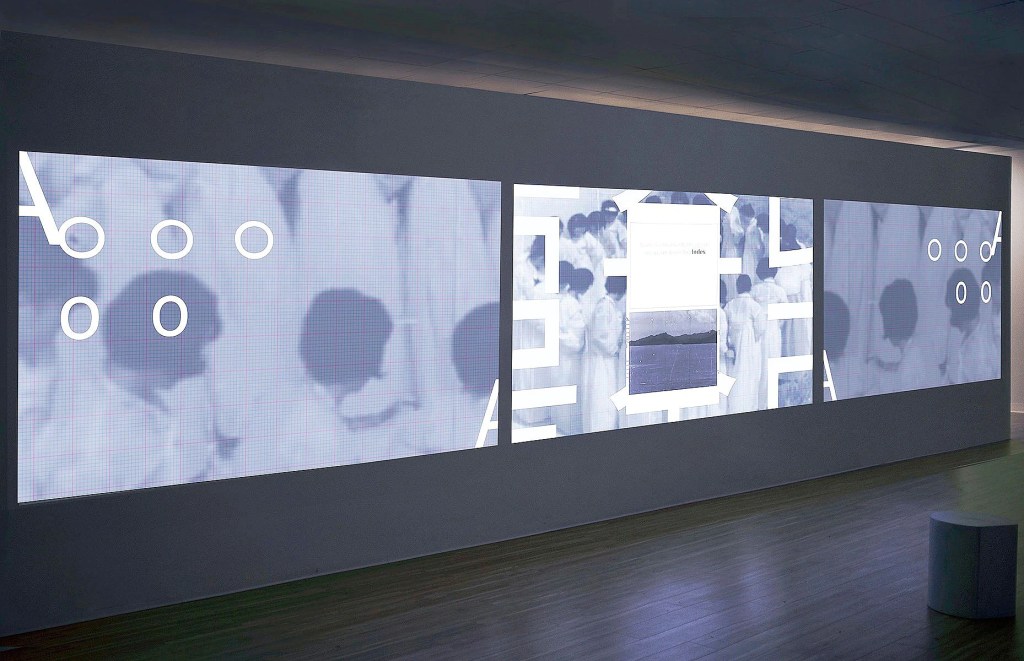
술래 SULLAE (2020) is a single channeled video that draws from ganggang sullae, a Korean seasonal harvest and fertility ritual that integrates song and dance and is typically performed by women under the glow of moonlight. The participants hold hands forming a circle that through their movement, expands, disassembles, and changes its form. The songs can be both impromptu or pre-determined and encourages the participants to express their feelings in chorus with one another.
Diana Seo Hyung Lee (2020) suggests that historically ganggang sullae was meant to provide a forum for its participants to express emotions connected to living within patriarchal systems of power and oppression. She writes: “the women participating would not have been able to, in their everyday lives, sing, speak loudly, nor leave the house at night, in the patriarchal society of ancient Korea. This dance was a license for their one release.” In 술래 SULLAE, the dance proves to be a defiant presence. The women flash on screen as an unbreakable chain reinscribing a gendered history with new sounds and images that gesture to emancipatory possibilities.
술래 SULLAE combines archival clips of ganggang sullae, index pages from intonation books, images of Hangul and English consonants and audio splices from YouTube tutorials on how to pronounce English correctly. In the video, language becomes unhinged from expectation but at the same time, given form through history. The sound of the English language is disembodied and spliced into phonemic pulses. In 술래 SULLAE, Chun has created an encounter with the grammars of polyphony; a simultaneity of sounds that are both restrained by and resistant to the imposition of English on the Korean diaspora. Through what Chun has described as a form of “unlanguaging” following Rey Chow, her audience is witness to new meanings produced through the abstraction, manipulation, and redaction of sounds and symbols from the English language.

Chun’s editing and manipulation of English sounds is intentional. In an interview with Art Forum, Chun shares: “Taking the sound apart but still keeping it within the conceptual framework of English made me think about what else is embedded in making a language. English is tied up with legacies of imperialism; there’s so much unseen violence that is part of how this language is institutionalized.” What remains after the edits is an inventory of sounds that disrupts the primacy of the vowel as central to English word construction and thus, central to colonial imagination.
Like Chun, I realize that my conceptualizing of language is within an English framework, but my hope is that when we turn to the affective and when we begin to pull language a part, something different, something resistant, is produced. I am neither an expert in English nor Korean linguistics, it was the sounds in this work that pulled me into it. In thinking with 술래 SULLAE, I’m interested in what becomes possible in the absence of the vowel. I turn to the interruptive potential of consonant sounds to affect and incite methods of communication outside of those steeped in colonial dominance. What does it mean to de-emphasize the function of vowel sounds in language and reorient our listening to the consonant? What do consonant sounds teach us about the sonics of race that underwrite hierarchies of language? What methods of communication become possible when we do away with words and are left with only their sonic substance?
Through her assemblage of consonant sounds in 술래 SULLAE, Chun is making a deliberate choice to describe and animate a politics of language through refusing its colonial enclosures and turning to the aesthetic in order hold the excesses of description. She refuses the vowel in this piece, not by denying its presence, but instead relegating it to the soundless and the unfamiliar, a space of, in her words, “untranslatability.” In this undoing, consonants become the emotive force where new meanings and orientations to the sounds that mark our words are forged.
술래 SULLAE opens with the sound ssshhh; a pairing of consonant sounds that is often associated with insisting on silence, a sound meant to reprimand. Chun extracts and emplaces this sound in a new aesthetic landscape that is independent and unregulated by colonial schemas of enunciation and translation. The prominent soundscapes of the video are consonant sounds and when removed from their phonetic relations to vowels these sounds undo the presumptive structuring or potential reprimand of English. In 술래 SULLAE, we are meant to experience the fullness of the consonants’ timbre…ssshhh, ppp, ddd, tttt, kkkk…these edited clips of sound originally meant to instruct and assimilate speech into English pronunciations now serve a different function. For me, they secure Chun’s political orientation: one that is about the crafting of a world that involves the careful consideration of the logistics, function, and embedded emotions of the sounds that inhabit it.

graphite, watermarks, paper, aluminum frame, 13 x 16 inches
All languages contain their own unique set of vowels and consonants, but, Anne Carson reminds us that: “The importance of vowels to human speech has remained. There are words in English without consonants, but so central are vowels to word construction that there isn’t a word in English that doesn’t include a vowel.” In speech, consonants sounds are meant to break up the intended agenda of vowels. The ssshhh, ppp, ddd, tttt, kkkk, are antithetical to the circle or the rounded mouth needed to voice a vowel sound. Unlike the openness of a vowel, producing consonant sounds involves a narrowing of the vocal tract. This narrowing is referred to as constriction or the obstruction of breath whereby sound is produced by a form of corporeal tension. Consonant sounds also demand all the mechanics of the mouth: the lips, the teeth, the tongue, and the palette. Shhhh, requires the corners of the lips to lower and rather than rounding, the lips become pursed, and teeth become exposed. Parts of the mouth are drawn in. The soft palate is raised, and the tongue reaches upwards towards the roof of the mouth without touching it and then the tip of the tongue lowers behind the teeth.
Consonants emerge out of collectivity. Where a vowel is sounded without vocal constraint, consonants require more effort. Their sounds are produced through intricate bodily choreographies in the mouth that involve both constriction and collaboration. Ganggangsullae likewise relies on effort and interdependence. Participants collectively determine the speed and/or shape of their dance. They may even become serpentine or separate into smaller circles depending on what the group decides. The dance also provides an aesthetic space for its participants to voice frustration, anger, and tension through song with the hopes of producing reprieve from gendered hardships. Chun has decided to withhold these songs from her audience; we never hear the women singing. Through this erasure, Chun embeds the consonant sound with affective force whereby a politics of language and gendered presence is enunciated through and beyond a form of silencing. The dance redirects trajectories of dominance whereby the shushing takes on a new voice imbued with agency and hope. Because of how Chun isolates and amplifies its sound, ssshhhh is free to take on different meanings and associations. For me, I was reminded of rushing water or gusts of wind, or the sound used to lull my child to sleep. I was brought into another index of knowing and relating.
The sounds of language hold erasures and layered histories often obfuscated by our mundane encounters with them. Largely understood as the most sonorous part of the syllable, vowels produce the loudest speech sounds and their capacity for holding larger amplitudes or louder volumes have been linked to the sonic expression of emotion. Consonant sounds are more pragmatic than vowels. They are known for their functionality, for the ways in which they assemble the semantic structure of words and for their capacities to hold vowels in place or as Anne Carson describes as “delineating meaning amid the flow of open vowel sounds.” Consonant and vowel sounds map out different functional trajectories by virtue of the shape of mouth and orientation of breath that these sounds demand. Like Chun, I’m interested in what political orientations become possible when we source emotion elsewhere, beyond the confines of spoken words imposed upon us.
The word consonant is a noun, a word used to identify or classify, a semantic enclosure that establishes a subject or object. But unlike the word vowel, consonant is also an adjective. A consonant possesses the capacity to describe, to name, to tell us more. Adjectives parcel out description on states of being, in this way, they are inherently phenomenological. In 술래 SULLAE, Chun empties vowels of their sonic substance leaving behind traces of fragmented characters and differently shaped circles in their wake. They are stripped of breath and their symbolic value forming a new method of communication that reroutes expectations of what language, as we know it, can do and sound like. Like, ganggang sullae, the vowel is premised on the shape of a circle, but in 술래 SULLAE, Chun provokes us to think about what becomes possible beyond the circular structuring device, what becomes possible beyond the purview of the violent embeddedness of English and its colonial exigencies.

untitled (ㄷ), 2020, a functional concrete stool, courtesy of artist
Chun has noted that the moon that hovers above the ganggangsullae is yet another site of imperial conquest. In Art Forum, Chun states: “when I look up at it to feel comforted or to find solace, I’m reminded of colonial violence and an agenda that’s projected onto it. In that way, the moon also reflected how I see language.” Chun’s turn to consonants signals a reshaping of the colonial frame that does not disavow or idealize the legacies of imperialism on systems of communication, but instead highlights the tensions and obstructions produced in its shadows.
—
Featured image: 술래 SULLAE, 2020, single-channel version, courtesy of artist
—
Casey Mecija is an Assistant Professor in the Department of Communication & Media Studies at York University. Her current research examines sound as a mode of affective, psychic and social representation, specifically in relation to diasporic experience. Drawing on sound studies, queer diaspora studies and Filipinx Studies, her research considers how sensorial encounters are enmeshed and disciplined by social and psychic conditions. She is also a musician and filmmaker, whose work has received a number of accolades and has been presented internationally.
—

REWIND! . . .If you liked this post, you may also dig:
Blank Space and “Asymmetries of Childhood Innocence” –Casey Mecija
Re-orienting Sound Studies’ Aural Fixation: Christine Sun Kim’s “Subjective Loudness”–Sarah Mayberry Scott
Tape Hiss, Compression, and the Stubborn Materiality of Sonic Diaspora–Chris Chien
Share this:


Current Top Posts





April 2021

January 2020

November 2019

October 2019

August 2019

April 2014

November 2017

March 2015

December 2017

October 2015
 Sounding Out!
Recent Comments