
From Illegitimate to Illmatic: On Tiger Mothers, Ethnoburbs, and Playing the Violin While Dreaming of Nas
“Don’t tell me you’re still listening to that shit.”
“I told you, I like it.”
“This is why we have so much trouble with you.”
“You don’t know anything about it.”
“Listen to that cursing…it’s nothing but garbage!”
“What are you doing?”
“All of these CDs are going in the basement. No more rap until you start listening to your parents! Now, go practice your violin!”
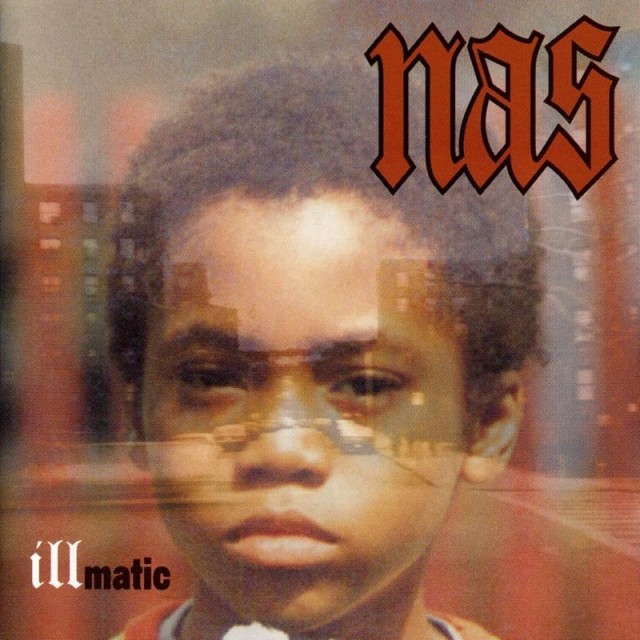
Growing up, exchanges like these were common between my Korean American mother and me—a multiracial Korean Euro-American. In her eyes, there was no such thing as enough violin practice. Rap—the vulgarity! The noise! It was turning me into a juvenile delinquent! She was convinced I had it in me to be the next Korean-American classical music virtuoso, the next Sarah Chang—if only I would practice more scales and stop trying to imitate “black men shouting.” (However “conversational” the rap world considered Nas’s flow, my mother still heard yelling.)
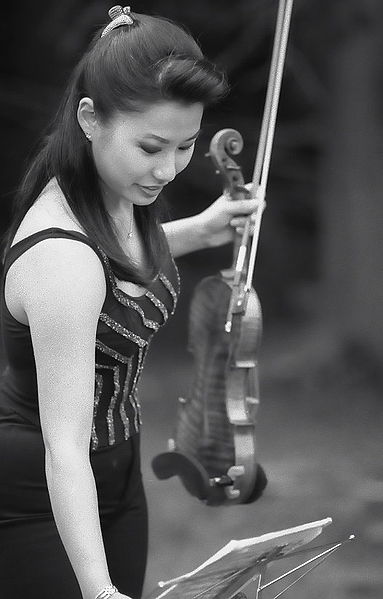
Violinist, Sarah Chang
It’s not that I didn’t like classical music—I watched Amadeus on loop until the VHS squealed—but my mother, like the mothers of most all my Asian friends, insisted on it consuming a fairly large chunk of my life. While immensely diverse in its makeup, most of the Asian population where I lived was either Korean or Chinese, and were forced by their parents to learn violin, piano or cello. Not only was it criminal to play an instrument other than one of these; but, whichever one (or two) you chose, you had better be the best at it.
Author and Yale Law Professor, Amy Chua, recently incited an online firestorm when the Wall Street Journal published an excerpt from hercontroversial new memoir, Battle Hymn of the Tiger Mother, in which she recounts calling her daughters “worthless” and “garbage” if they couldn’t perform a piece of classical music up to her exacting standards. University of Hawai’i at Manoa Professor, Mari Yoshihara’s study, Musicians from a Different Shore: Asians and Asian Americans in Classical Music(2008) describes similar instances of “tiger mothering,” such as virtuoso violinist, Midori Goto’s, mother, Setsu Goto, who (it was rumored) was so strict that it forced Midori into a mental breakdown and an eating disorder. Many would likely agree that “Tiger Mothering” such as this is morally questionable (and in some cases abusive), but I should note that instances like these are only part of a much bigger picture. Scores of students and performers would no doubt concur with Dr. O’C’s recent SO! account of the potential for classical music praxis to have ameliorative effects. Despite this, however, classical music training seems to have become a central tenet of “Tiger Mother” methodology. In all the kerfluffle over Chua’s book, no one has been asking the most foundational question: Why is it so important to Asians and Asian Americans that their children play classical music?

Amy Chua, (CC) Larry D. Moore
In a recent interview on why she chose classical violin and piano for her children, Chua fancifully suggests that classical music is the antidote to materialism. She says that “classical music all about depth” and calls the violin and piano “very respectable instruments.” Indicative of more than just a love of classical music, Chua’s statements imply that other forms of music lack comparable artistic value and require less cultivation to perform and enjoy. In a similar vein, the Asian-descent classical musicians interviewed in Yoshihara’s Musicians From a Different Shore divulge their belief that playing classical music anchors one to a high social stratum. Acknowledging the contradiction between classical music’s high cultural status and its mostly poor compensation, the musicians identified social factors such as educational attainment and musical taste and ability as more important determining factors of class standing than income. Yoshihara thus links the importance Asians and Asian Americans place on classical music praxis to class consciousness and the production of cultural capital.
Class consciousness no doubt accounts for some of the zealousness exhibited by Tiger Mothers with regard to their children’s classical music training, but it’s not the only thing that keeps them roaring. Chua’s Battle Hymn illustrates that, in addition to class consciousness, the pressure to study classical music stems from an intra-racial expectation to perform Asianness adequately. Chapter 5 of Chua’s memoir, titled, “On Generational Decline,” is her cut-and-dried summarization of how subsequent generations of Chinese Americans become lazier as they’re allowed to revel in the comforts of middle class life. Chua chooses classical music for her children because it is “the opposite of decline, the opposite of laziness, vulgarity, and spoiledness.” Constructed as an appeal to Chinese Americans, Chua essentially argues that classical music training is key to an Asian person’s cultural and racial legitimacy. Unwilling to relinquish “the high cultural tradition of [her] ancient ancestors,” she expects her children to uphold a racially and culturally endorsed standard of melody-making that reinforces Asian gender norms and encourages other Asian parents to do the same.
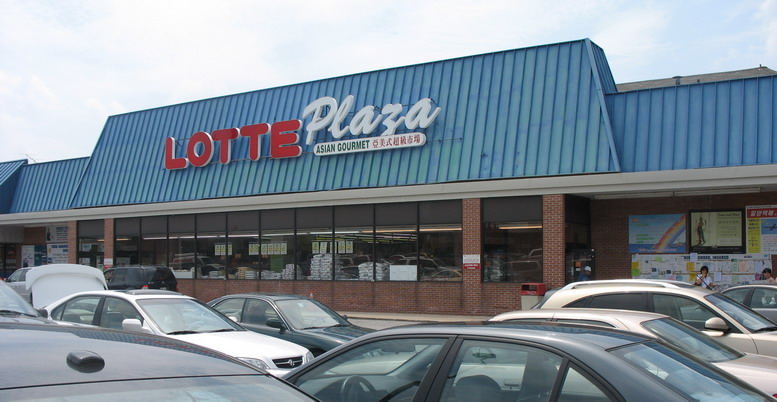
One of Ellicott City’s Korean Shopping Plazas, photo by Barbara Fisher
In Ellicott City, Maryland, the wealthy, culturally diverse “Ethnoburb” of Baltimore where I grew up, Asian American classical musicians abound and Asian American rappers are few. Here, (where the community-wide motto is “Choose Civility”) Asian youth gained a sort of “cred” for mastering the violin or piano, and this pressure to “prove” oneself along racial lines was something I always felt—particularly as a teen of mixed race. It was probably the biggest reason why I didn’t quit the violin until I graduated from high school. I hated it, but resentfully continued attending orchestra and private lessons in the fear that I would lose the meager amount of “cred” I’d built up. It hardly mattered, though. There was no chance of me getting into an Ivy League school or playing Carnegie Hall—I listened to rap and sometimes didn’t do my homework. In short, I would never be a “Super Asian” (a term coined by my Indian music stand partner and me), and as any Asian kid knows, if you’re not the best, you needn’t bother trying. None of the “Super Asians” had any interest in rap, and one even joked that I was a “chocolate-filled twinkie” for wearing a Pelle Pelle jacket to practice one week.
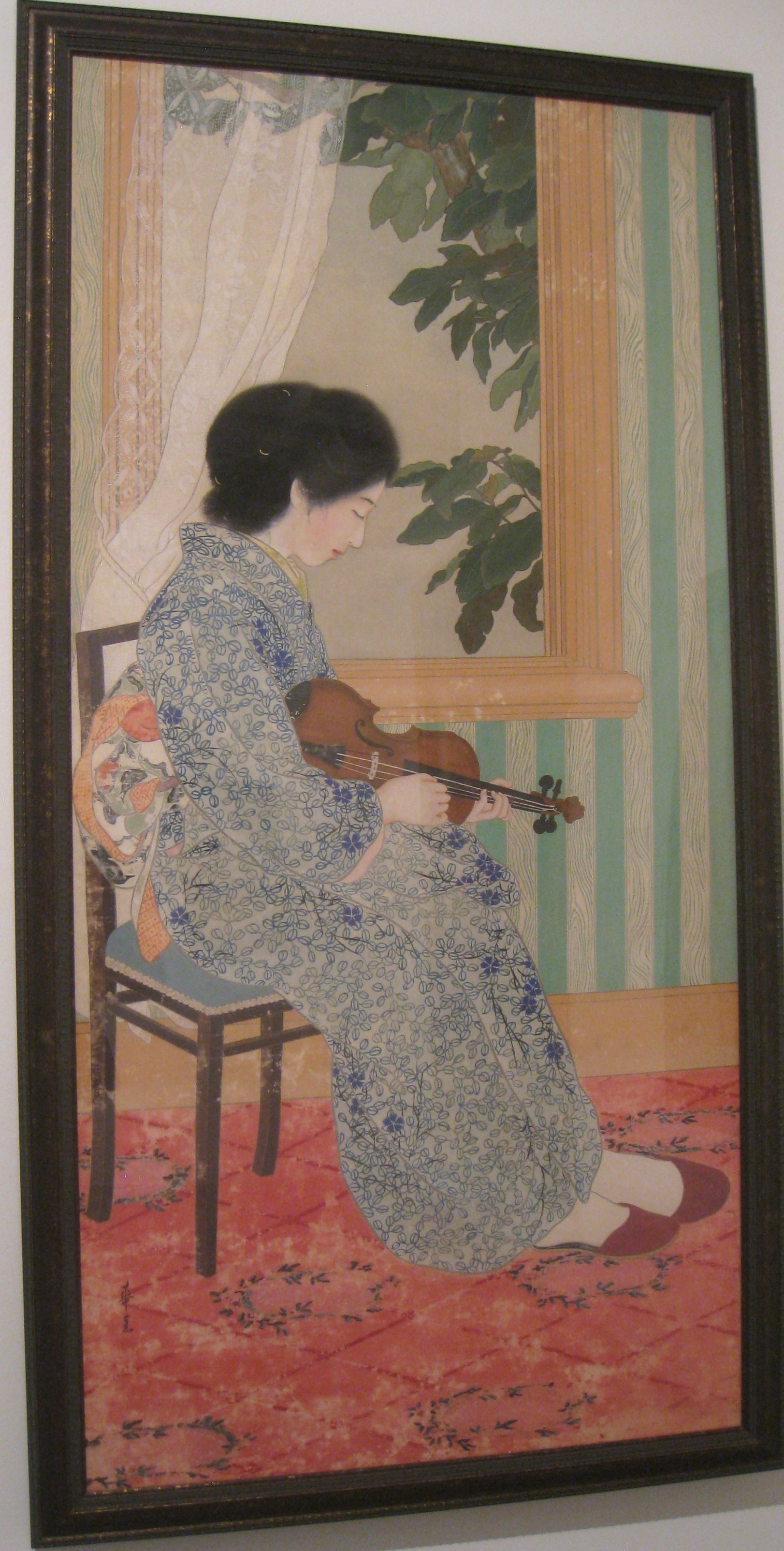
Wolfosonian Museum, Unknown Artist
People who looked like Sarah Chang were supposed to be in the business of making melodies, not rhymes. Chang performing a violin concerto is a comforting scene, a sonic image that reaffirms a familiar cultural narrative of femininity and class stature associated with Asianness in the US. A result of the gradual process of East Asian modernization (instigated by Western Imperialism), classical music was initially adopted by the people at the behest of the state, eventually becoming a integral part of middle class life in East Asia and a social marker of bourgeois womanhood that functioned to situate women vis à vis the domicile. Uncomfortable defining myself in this way (and feeling, also, that I never truly could), I gravitated towards something more “disruptive” that would allow me to show a different face to the world.
Rap became a vehicle for me to explain myself in more hybrid terms. On drives into Baltimore City, I heard it bellowing from the windows of the West Side’s crumbling row homes. The loud, curt, interjections! The spontaneity and candor! This loudness was initially what drew me in, but eventually I realized that rap had just as much profundity as anything classical you could throw at it. Listening to rap, I was finally on offense. It was a medium that spoke to me, because it made me feel capable of speaking back. And there was an entire legion of disaffected youth who seemed to feel the same way.
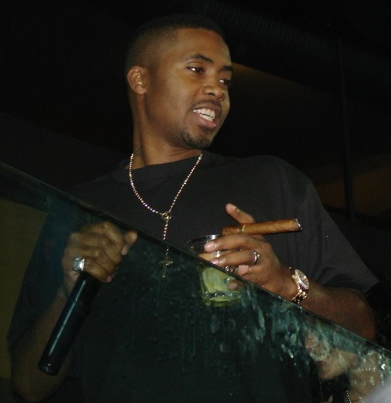
Nas performing in 2007
Despite this popularity, however, critics of rap maintain that the sounds that (predominately African American) rappers produce are nothing more than “noise.” In Black Noise, Tricia Rose observes that despite (and perhaps because of) rap’s widespread popularity and cultural relevance, it is often pitted as classical music’s polar-opposite—“unintelligible yet aggressive sound that disrupt[s the] familial domain” (63). Against charges that rap lacks “depth,” purveyors of hip hop (despite their hefty salaries) often accrue little to no widespread artistic acclaim. Evidence of what Jennifer Stoever-Ackerman terms the “sonic color-line,” this demotion and “Othering” of non-white sounds into “noise” (discussed further in her recent SO! post) has historically functioned to both generate and underwrite public attitudes about race, class and gender and to create dominant ideas about listening that she dubs “the listening ear.”
It seems that dominant modes of listening have everything figured out. If you look like this, you sound like that. But, what about people who look like me? What are we supposed to sound like? With which sonic cultural productions am I supposed to ally myself, and do I have a choice in the matter? How does “the listening ear” interpret a biracial Korean Euro-American or any person of mixed race heritage? Was there a distinction to be heard? I was sure there was, but didn’t quite know how to voice it.
For most of my life I have lived on the precipice of Asianness and something else, leaving me to feel—at times—confused, demoralized and illegitimate. As Michael Omi and Howard Winant famously note in their seminal work, Racial Formation, “Without a racial identity [in America], one is in danger of having no identity.” Acutely aware of my difference, I searched for ways of being heard as a multiracial subject in a fiercely stratified, race-conscious society. In the Introduction to The Sum of Our Parts: Mixed-Heritage Asian Americans, Michael Omi notes that within the historical and political context of the United States, (the “one-drop rule,” eugenic fears of racial intermixing, anti-miscegenation laws, etc.) multiracial identities have consistently been “contained, disregarded, [and] denied.” Disruptive to fixed notions about race, it is often a challenge for multiracial subjects to be recognized or understood by the state or the ear.
Rap assisted me in my effort to be heard as a multiracial person. While my Asian friends in All-State Orchestra were polishing their four-octave chromatic scales for the judging panel at Julliard, I was conscientiously studying Rakim’s flow and the RZA’s beats, hoping that one day it might make sense for me to show my face at a rap battle, if only as an observer. After the realization that Nas wasn’t the reason I could never be a “Super Asian,” my mom returned my copy of his masterpiece debut, Illmatic. As previously, I spent the hours before bedtime reciting the lyrics to Nasty classics like “It Ain’t Hard to Tell,” moved by every skillful turn of phrase: “Nas is like the Afrocentric Asian/half man-half amazin,” I would repeat over and over until I got the cadences just right. Whatever the hell he was talking about, I was sure it applied to me.


Share this:

New Wave Saved My Life*
*The title of this piece is inspired by the short story, “Minnie Riperton Saved My Life,” by the poet & playwright, Luis Alfaro.
(Shuffle)
I watch you breathe,
I cannot sleep,
I touch your hair,
I kiss your skin,
And hope the morning sun won’t wake you too soon.
For when you wake,
and look at me,
You never know,
you just might see,
Another boy who crept in your room…
Take your time…(that’s what you told me),
Take your time…
But I fell head first, and I just don’t know what to do—“Nothing Looks the Same in the Light,” Wham!
I was a teenager in the 80’s. I grew up in South East Los Angeles, Huntington Park, to be exact, H.P. for short—home of the Huntington Park Senior High Spartans and the local after game hangout, Spartan Burgers. In those years, almost everyone in my school was Mexican and most kids were either preppy or cholos or Florentine Gardens disco-types—almost no one was “alternative.” That is, until we caught our first glimpse of Boy George on Video One with Richard Blade – that MTV style video show that came before MTV. If you remember, or have YouTubed it recently, a key scene in the video for Culture Club’s “Do You Really Want to Hurt Me?” begins with Boy George stepping out of a swimming pool, fully clothed and dry (a lo-tech effect even by 80’s standards), wearing a flowing tunic, white-boy dreadlocks, and expertly applied makeup. I remember being instantly fascinated watching him dance to a reggae beat and hearing him sing so longingly about a mysterious “you.” I had never seen anyone who looked or sounded like that before, and I went from listening to my brothers’ heavy metal records, my mom’s cumbias, and my grandpa’s Beethovens to listening to Culture Club, Eurythmics, Wham!, and Bow Wow Wow almost overnight.
Soon after, I started noticing in my neighborhood sprinklings of pink, purple and green hair, spikey egg white mohawks, brown boys in skirts and makeup, and the girls from St. Mathias High wearing black chunky combat boots with their proper, pleated, Catholic school uniforms–my personal favorite look. And when I bought my very own first pair of 8-hole lace-up Doc Marten’s, I was forever transformed. I sensed that crossing fashion lines somehow meant crossing other lines too, although, I was perhaps I bit too young to really cross anything. As a questioning adolescent, I embraced the freedom that music, fashion, and expression represented. It’s strange to think about how such a global phenomenon took shape in my little eastside town. That time of 80’s new wave, the “Second British Invasion,” told me something about who I would become. I learned fearlessness from the bold and transgressive acts of fashion and wit my favorite gender bending pop stars regularly deployed on American network TV. And I learned to “tune in” to the sexually ambiguous language of songs like “Time Clock of the Heart” or “Nothing Looks the Same in the Light.” All of those blurred lines felt “normal” to me. And it meant later on that I didn’t have to have an identity crisis when I was coming out. And I really didn’t. I didn’t really think about “identity” in this way again until much later.
(Shuffle)
I’m only sad in a natural way
And I enjoy sometimes feeling this way
The gift you gave is desire
The match that started my fire—“The Paris Match,” The Style Council
As I copy and sometimes re-purchase 25-year old lost albums for my new e-music library, I’ve started to wonder about some of my musical choices. Why did I still like what I liked? How do I trace my musical habitus? Culture Club, George Michael, The Style Council – they’re all on my iPod right now. And I ask myself, is my musical taste really so wrapped up in what I perceived to be my pop idols’ alternative sexuality so long ago? In this post-gender, post-queer, post-race (rhetorically speaking), trans-border era, is there even such a thing as “alternative” anymore?
Because when I listen to those old songs now, part of me still “hears” the skillful crossing of gender lines in every ambiguously phrased lyric, like the Pet Shop Boys’ clever line, “Which do you choose, a hard of soft option?” And I recall vivid images of Annie Lennox at once crossing and keeping those lines in the video for “Who’s That Girl?” which ends with an impossibly queer kiss. (She queered the Lacanian mirror long before Black Swan!) I still sense how all of these wildly public expressions of queer desire, with all of its spectacle and taboo, flowed into my childhood home through the sturdy Zenith television set that brought us together to “listen” to music anew. And this kind of hearing has to do with a particular way of remembering my adolescence – the memory of how felt for the first time to hear those songs and see the images of Boy George winking his long painted lashes at the video camera, seriously putting pressure on the word “Boy”; or seeing George Michael dancing with Andrew Ridgley in the macho ditty “Wham Rap”, their two beautiful and stylish female band mates conspicuously superfluous in that dance. And also remembering how the combined effect put something like the question about boys on hold for me in a really powerful way. There were options out there, is what I understood, and that was all I needed to survive – to save my queer soul.
(Shuffle)
Don’t make me feel any colder
Time is like a clock in my heart
Touch we touch, was the heat too much?
I felt I lost you from the start
In time it could have been so much more
The time is precious I know
In time it could have been so much more
The time has nothing to show because
Time won’t give me time
And time makes lovers feel like they’ve got something real
But you and me we know they’ve got nothing but time–“Time Clock of the Heart,” Culture Club
But I also detect another kind of crossing, or rather, multiple crossings in those same songs. Somewhere between the funk inspired bass line of “Nothing Looks the Same in the Light” and the soulful oohs and ahs of Helen Terry’s backup vocals in “Time Clock of the Heart,” I sense this music also crossed a race and a class line, however precariously treaded. From the perspective of a young, working class Chicana, quickly interested in all things British and gay, it seemed to me that these young white British boys took up a mic and pen and left their own working class accents behind for the promise of America. Clearly raised on a diet of soul and R&B, their eventual collaborations with Luther Vandross, Stevie Wonder, and Mary J. Blige – American musical royalty – seemed only natural on the Grammy stage. And I wondered in my youthful, pop star fantasies, how did they feel when they learned they could sing like that? What did it mean to be queer and black at the same time? Musically speaking. What was the bigger transgression? Because the 80’s were deadly years for many of us, on both sides of the Atlantic, who were confronted with the authority of the lines drawn by Reagan, Thatcher, and AIDS. Maybe the transgression is to survive. And to remember.
Listening as an adult now to George Michael’s greatest hits collection Twenty Five, it is easy to see that there is no longer any doubt about his sexual orientation. In songs like “An Easier Affair,” he celebrates that he’s “dancing with the freaks now/I’m having so much fun/I do my dance with everyone.” So I wonder, when your pop idols sex lives stop being curiosities or taboo, what still fascinates? Even their notorious falls from grace, and their celebrated “come backs” didn’t really provoke the public imagination in the same way again. But I detect there are still clues in the music. In his brilliant cover of “Feeling Good,” George Michael pays humble homage to Nina Simone saying: “It’s a new day, it’s a new dawn, it’s a new life, it’s a new low/Oh we all know it’s too much to expect a man, a white man, to do it like Nina” (my emphasis). That simple musical gesture, a crossing of many sorts, tells me something about what she means to him. And I think that it has ever been and ever will be music that will save our collective souls… I was seventeen when I left HP for a much larger Los Angeles. In some ways I was too young to leave home and sometimes I thought that I didn’t survive some things that came my way. But I always had a song to guide me and show me something new–a different way. I know I’ll never fully rebuild my archive on something like iTunes. But as I contemplate my growing digital library, I really do believe that new wave saved my life.
(Shuffle)


Share this:


Current Top Posts





April 2021

January 2020

November 2019

October 2019

August 2019

April 2014

November 2017

March 2015

December 2017

October 2015
 Sounding Out!
Recent Comments