
Caterpillars and Concrete Roses in a Mad City: Kendrick Lamar’s “Mortal Man” Interview with Tupac Shakur

I’ve been hesitant to write about Kendrick Lamar’s 2015 album To Pimp a Butterfly (TPAB) because there are layers to the shit. Sonic, cultural, and political layers that need time to breathe and manifest. Some of those layers are pedagogical. For example, Brian Mooney brilliantly paired the album with Toni Morrison’s The Bluest Eye to help students work through themes of Black consciousness and self-love. Mooney’s lesson plan garnered Lamar’s attention and a recent visit with Mooney students. Lamar’s open grappling with art and blackness throw him into heavy debates about his worth as a cultural and even literary icon. Yet Lamar’s formula of introspective angst – the use of battling his own demons to shed light on broader American society – pulls me to think about how Lamar and TPAB fit into a long standing trajectory of Black folks’ self-examination in art as a frame for larger critiques of racial politics in American society.
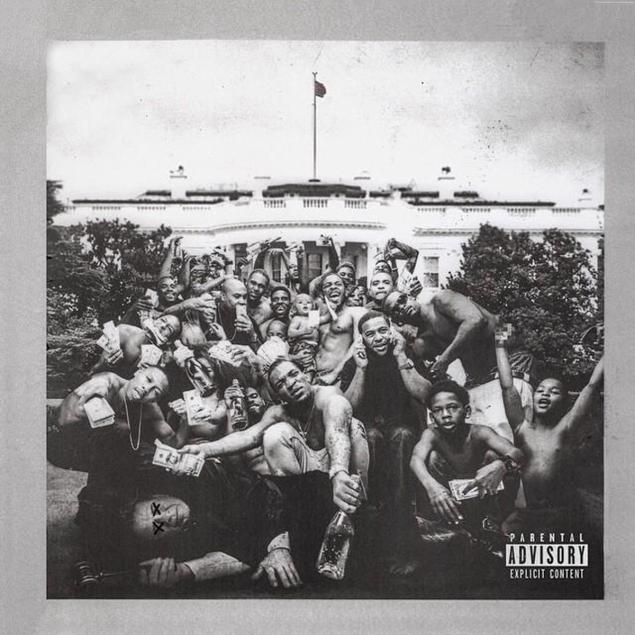
Screenshot of album cover
I’m drawn to TPAB’s outro of the final track of the album “Mortal Man.” “Mortal Man” sonically invokes Lamar’s struggle to assume a position as a gatekeeper of a branch of hip hop that focuses on Black community and self-actualization. The track includes a sample from a 1994 Tupac Shakur interview with Swedish music journalist Mats Nileskär. Lamar positions himself as the interviewer, asking a different set of questions that engages Shakur about walking the fault lines of fame, fortune, and Black consciousness in this current cycle of hip hop. The construction and execution of the interview revisits the lines between hip hop’s collective and generational responsibilities via Lamar and Shakur’s interaction. Their conversation moves from creative (and creating) political protest to larger philosophical questions within hip hop: self-consciousness, mortality, and death. Lamar parallels his angst with Tupac using his voice, with Tupac himself heralded as hip hop’s martyred t.h.u.g. with a conscience. In this contemporary moment where Black men’s mortality and worth is attached to being a thug and a problem, Lamar poses Shakur in “Mortal Man” as a keystone for connecting popular scripts with cultural expectations of Black masculinity and agency in the United States.
The song “Mortal Man” launches the interview. The track can be considered a double sample – it uses Houston Person’s cover of Fela Kuti’s song “I No Get Eye for Back.” Lamar’s voice is clear but the background track soft and subdued, forcing the listener to pay full attention to Lamar’s voice, which interrogates what it takes for one to be loyal or respected in mainstream America. Percussion (bass kicks, acoustic drums, soft piano chords) and bass guitar chords annotate Lamar’s solemn lyrical delivery. A horn and woodwind medley – lead by Houston’s tenor sax playing – punctuate Lamar’s chorus:
When the shit hit the fan, is you still a fan?
When the shit his the fan, is you still a fan?
Want you to look to your left and right, make sure you ask your friends
The instrumental accompaniment is soft and steady, suggesting Lamar’s question is a continuous negotiation or checklist for one’s proclamation of loyalty and respect. Lamar’s repetition of “when the shit hit the fan is you still a fan” addresses his fanbase and the followers of other notable Black cultural and creative leaders. They, like Lamar, are usefully flawed – whether by accusation or self-proclamation – and use their flaws to further their cause. Nelson Mandela, Martin Luther King, Moses, Malcolm X, and Michael Jackson all exhibited social-cultural and political agency for (Black) folks. Yet they also suffered scrutiny and disregard because of their personal lives or less-than-respectable experiences.

Malcolm X at Queens Court. Source=Library of Congress. New York World-Telegram & Sun Collection. http://hdl.loc.gov/loc.pnp/cph.3c11166 Author=Herman Hiller, World Telegram staff photographer
I am especially intrigued by Lamar’s reference to Malcolm X as “Detroit Red,” a nickname X had as a young hellraiser before his conversion to Islam. Lamar’s reference to X in his youth here speaks to larger questions of respectability, Black youth, and protest. Detroit Red is young, flawed but influential, similar to Lamar and other young Black folks leading protests in this contemporary moment. Lamar’s roll call suggests a struggle with the question of authority, both as a creator of Black culture and how his music implies a larger struggle of contemporary Black agency and angst. Interviewing Tupac brings Lamar’s struggle to a head, evoking Shakur’s voice as a culturally recognizable authority of hip hop’s commercial progress and cultural process. The trope of a flawed nature as a departure point for creative expression and agency is a theme that runs throughout TPAB and the rest of Lamar’s musical catalogue.
The musical accompaniment to the “Mortal Man” song fades out and against a backdrop of silence Lamar begins to recite what he states is an unfinished piece. He begins, “I remember when you was conflicted,” which implies he is talking to himself or talking to someone else. The background silence that leads to Lamar and Shakur’s conversation is as telling as the conversation itself, sonically alluding both to Lamar’s ‘quiet’ struggles of self-affirmation and the possibility that someone other than the audience is listening. The quiet is Lamar’s moment of clarity; the listeners are with him at his most vulnerable moment. He uses the silence to focus attention on himself and without the ‘outside noise’ of others’ beliefs and impressions of his music and purpose.

“2Pac” By Flickr user
Tupac Amaru Shakur, CC BY-NC-ND 2.0
Although the interview takes place over 20 years earlier, Tupac’s answers are clear and ‘live.’ Shakur’s initial voice is pensive and calculating – he sounds like he is thinking through his responses as he speaks – but later sounds more relaxed, laughing and talking louder and faster. The decreasing formality of Shakur’s answers suggests his increasing comfort with the interviewer as well as confidence in his own answers (and ultimately in sharing his beliefs). Lamar’s use of Shakur’s voice serves as the ultimate form of crate digging, using an obscure (or rare) radio interview sample to create his own voice in hip hop. Lamar’s engagement with Shakur serves memory as a cultural archive and as a cultural production. He not only preserves Shakur’s legacy in his own words but uses Shakur as a departure point for how to blur acts of listening for hip hop fans in a digital age.
The act of listening takes center stage for the interview. The interview is presented as an informal sitdown, reminiscent of what takes place during studio sessions: artists share new material and garner advice from veteran artists. Both rookies and veteran artist listen for new perspectives and listening for suggestions to approach a topic or track. Listening here shows Lamar’s awe and respect of Shakur’s perspective and artistry but also hints at how his conversation with Shakur is ultimately a conversation with himself. Lamar starts the conversation with an unfinished piece about his angsts regarding commercial success and how it conflicts with his creative process. He then moves on to asking Shakur about how he grapples with his creative and political consciousness. The listening work taking place here is critical and archival: without Lamar’s (and Lamar’s audience) interest in Shakur’s creative process his voice loses authority and ultimately its power.
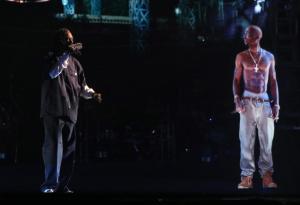
Image From NY Daily News
Tupac’s sonic ‘resurrection’ signifies his lasting effect in hip hop while serving as a springboard for Lamar’s own pondering about the purpose of his music and the burden of its success. Unlike the visual representation of Shakur via hologram at the 2012 Coachella Music Festival, Lamar’s use of Tupac’s sonic likeness offers an alternative entry point for engaging Tupac’s work outside of his rapping. For example, much of Shakur’s social-political work takes place in his poetry i.e. his collection of poetry The Rose that Grew from Concrete. Further, the ‘thingness’ of the hologram, a physical and technological manifestation of hip hop fans’ and artists’ revering of Tupac’s image and death, makes me think about the type of work the hologram was expected to perform as compared to the sonic ‘ghostliness’ of Tupac’s voice on Lamar’s track. If, as John Jennings suggests, the hologram manifested Tupac as a “ghost in the machine,” how does Tupac’s voice work as a ghost in the machine? On a visceral level hearing Tupac’s voice in conversation with Kendrick Lamar stirs feelings about whether or not he is dead or alive and his immortality as a hip hop icon.
Where the Coachella hologram visualized Tupac Shakur spirit, “Mortal Man” sonically evokes his spirit and the connection between his (im)mortality and storytelling. Lamar says: “Sometimes I be like. . .get behind a mic and I don’t what type of energy I’ma push out or where it comes from.” Shakur responds “because the spirits, we ain’t really even rappin’, we just letting our dead homies tell stories for us.” Listening to Shakur’s use of “we” out of historical context – the interview took place in 1994, 21 years before “Mortal Man” – suggests that Tupac himself is among the dead. He is a “dead homie” and telling a story that Lamar himself is trying to relay to his audience and himself. Yet the lingering possibility of Tupac’s mortality – most embodied in Tupac’s silence after Lamar’s discussion of the significance of a caterpillar to the album – is a powerful moment of protest. Shakur’s quiet and Lamar’s attempt to “call him back,” signifies a period in the conversation. Lamar is left to fend for himself, fighting a “fight he can’t win.” There is also the possibility that his exchange with Shakur is “just some shit he wrote,” an unfinished idea and story that he is still figuring out. Lamar’s rendering of Tupac’s voice makes me think about the DJ Spooky statement “the voice you speak with may not be your own.” Tupac’s ghostly voice and Lamar’s search for his own voice blend to present Tupac as a mouthpiece for not only himself but Lamar.
At surface level Lamar resurrects and interviews Tupac Shakur because of regional ties to West Coast hip hop and a nearly standard declaration in rap of Shakur’s influence and fandom. He is arguably the most celebrated and iconic figure in hip hop. Shakur’s untimely death and open struggles with seeking balance between fame and personal responsibility mold him as hip hop’s shining prince. Shakur’s family ties with the Black Panther Party – a member of the Panthers once called him an “eternal cub” – positioned him to use hip hop as a mouthpiece for contemporary Black protest. But Shakur’s branding of protest and hip hop was messy, in part because of a working understanding and maneuvering of his image as controversial and commercially successful.

“KENDRICK LAMAR” by Flickr user
Pemberton Music Festival (Credit: Andy Holmes), CC BY-NC 2.0)
The “Mortal Man” interview signifies sound’s ability to usefully bridge past and present social, cultural, and political moments. Lamar’s sonic evoking of Tupac Shakur demonstrates hip hop as a space of Black youth political protest. Lamar uses sound to render hip hop temporality and re-emphasize Black popular culture as a departure point for recognizing contemporary Black angst. The shrinking mediums of spaces available to indicate why and how #BlackLivesMatter position the sonic as a work bench for engaging race relations in a deemed post-racial era. The “Mortal Man” interview serves as a blueprint for connecting hip hop to longstanding conversations about Black protest as a (messy) cultural product.
—
Featured image: “Shot by Drew: Kendrick Lamar” by Flickr user The Come Up Show, CC BY-NC-ND 2.0
—
Regina Bradley recently completed her PhD at Florida State University in African American Literature. Her dissertation is titled “Race to Post: White Hegemonic Capitalism and Black Empowerment in 21st Century Black Popular Culture and Literature.” She is a regular writer for Sounding Out!
—
 REWIND!…If you liked this post, you may also dig:
I Been On: BaddieBey and Beyoncé’s Sonic Masculinity — Regina Bradley
Saving Sound, Sounding Black, Voicing America: John Lomax and the Creation of the “American Voice”— Toniesha Taylor
Como Now? Marketing “Authentic” Black Music— Jennifer Stoever
Share this:

detritus 1 & 2 and V.F(i)n_1&2 : The Sounds and Images of Postnational Violence in Mexico
 This April forum, Acts of Sonic Intervention, explores what we over here at Sounding Out! are calling “Sound Studies 2.0”–the movement of the field beyond the initial excitement for and indexing of sound toward new applications and challenges to the status quo.
Two years ago at the first meeting of the European Sound Studies Association, I was inspired by the work of scholar and sound artist Linda O’Keeffe and her compelling application of the theories and methodologies of sound studies to immediate community issues. In what would later become a post for SO!, “(Sound)Walking Through Smithfield Square in Dublin,” O’Keeffe discussed her Smithfield Square project and how she taught local Dublin high school students field recording methodologies and then tasked them with documenting how they heard the space of the recently “refurbished” square and the displacement of their lives within it. For me, O’Keeffe’s ideas were electrifying, and I worked to enact a public praxis of my own via ReSounding Binghamton and the Binghamton Historical Soundwalk Project. Both are still in their initial stages; the work has been fascinating and rewarding, but arduous, slow, and uncharted. Acts of Sonic Intervention stems from my own hunger to hear more from scholars, artists, theorists, and/or practicioners to guide my efforts and to inspire others to take up this challenge. Given the exciting knowledge that the field has produced regarding sound and power (a good amount of it published here), can sound studies actually be a site for civic intervention, disruption, and resistance?
Last week, we heard from the Assistant Director at Binghamton University’s Center for Civic Engagement, Christie Zwahlen, who argues that any act of intervention must necessarily begin with self-reflexivity and examination of how one listens. In coming weeks, we will catch up with Linda O’Keeffe‘s newest project, a pilot workshop with older people at the U3A (University of the Third Age) centre in Foyle, Derry, “grounded in an examination of the digital divide, social inclusion and the formation of artists collectives.” We will also hear from artist, theorist, and writer Salomé Voegelin, who will treat us to a multimedia re-sonification of the keynote she gave at 2014’s Invisible Places, Sounding Cities conference in Viseu, Portugal, “Sound Art as Public Art,” which revivified the idea of the “civic” as a social responsibility enacted through sound and listening. This week, artist/scholar Luz María Sánchez gives us the privilege of a behind-the-scenes discussion of her latest work, detritus.2/ V.F(i)n_1–1st prize winner at the 2015 Biennial of the Frontiers in Matamoros, Mexico —which uses found recordings and images to break the deleterious silence created by narco violence in Mexico.
–JS, Editor-in-Chief
—

—
There is no document of civilization which is not at the same time a document of barbarism.
Walter Benjamin, Illuminations
detritus is an open-ended art project I started in 2011, that has as its main subject the portrayal of violence in Mexico. I introduce the sounds and images of what I call the Postnational Violence in Mexico using the concept of detritus as the nucleus; I use the cultural objects I produce through my artistic practice as the vehicle. detritus actually explores violence (1) as it is portrayed through media (radio, TV, newspapers and online platforms) and (2) as it is registered, manipulated and transmitted by the different participants of it –civilians, the government, NGOs, the military, the cartels–.
detritus
The first stage of detritus deals with Mexican media, specifically online newspapers, radio and TV, during the Presidency of Felipe Calderón (2006-2012). The whole strategy of [former] President Calderón —even before he took office— was to knock down violence associated to drug trafficking in Mexico and, actually, just a few days after he did his pledge as President of Mexico, he declared the war against drug trafficking that underwent from 11December 2006 —when Calderón actually started this war by sending 5,000 soldiers and police officers to the state of Michoacán— until the last day he was in Office: 31 November 2012.
During the six years that this war took place, former President Calderón appeared in military garments as “Mexico’s Drug War Commander in Chief.” The main target of this military strategy was to re-claim the control on those states where Mexican cartels were in charge. As Guillermo Pereyra argues in México: violencia criminal y “Guerra contra el narcotráfico” (2012), “Mexico’s Drug War” began as a decision to recover sovereignty in a context of political and social crisis. At the end of this period, there were more than 45,000 officers deployed in the states of Mexico, Baja California, Tamaulipas, Michoacán, Sinaloa and Durango, and more than 60,000 casualties. US media called this war “The Mexican War on Drugs” or “Mexico’s Drug War.”
 The research for the visuals of detritus included every single [online] edition of Milenio and Jornada —Mexican national newspapers—from 11 December 2006 until 31 November 2012, and eventually it also included Proceso magazine and El Blog del Narco, an online independent news outlet. This research allowed me to investigate how the media has steadily been increasing the volume of news and images dealing with this war, therefore contributing to the “normalization” of the very violence it covers. As Colombian artist Doris Salcedo states the normalization of barbarism comes from the excessive number of deaths that violence is leaving to the society and, [I will add] to the excessive number of images and sounds that media and individuals put on circulation and make it viral through social networks and online independent outlets. All of us are, either as transmitters or as receivers, building this texture of violence.
 At the end of 2013 detritus was completed: more than 10,200 images, all of them categorized in a database that includes: title of newspaper, section, header, author of the photograph, caption, and a brief description of the image itself. I used a very simple process of photographic manipulation to alter those 10,200 images. Once transformed, these images are projected, for a very short period of time [2 seconds each] in a large screen. We could be standing in front of this projection for hours and never see any of those images repeated. For those who are drawn to numbers, we could see that at the beginning of this war, during a whole weekend, there will be four or five images related to the subject; by the end of 2012, there were more than 40 images during the same period of time.
detritus.2
But the description of the horror through Mexican media does not include all the necessary voices. That is why civilians started a process to empower themselves using the tools they have at hand–such as mobile phone’s cameras–a medium they can use without restrictions. Over the Internet, civilians circulated images, videos, and sounds of their day-to-day experiences dealing with extreme violence. They are not alone on this viralization of violence through audiovisual documents: members of drug cartels and self-defense groups are also uploading their combats. The big difference is each group’s “agenda.” Civilians are in search of an arena to share their experiences; cartels and other military groups are either in search of validation or in search of documenting the systematic violence used in order to control whole populations.
Therefore, the audio complement I designed for detritus, first detritus.2 and then its current iteration V.F(i)n_1 , features the sounds of shootings, recorded by civilians who happened to be at close range. Generally this footage was taken via mobile phone and uploaded onto YouTube, and, unlike the newspaper representations, the image is not necessarily what is most engaging, since the individual that is making the recording is usually at floor level, protected, in order to avoid being hit by a stray bullet. But the sounds are pristine: even if the image is almost motionless -in the corner of a room, looking through a small part of a window-, the sound describes better what is at stake: violence at a very close range. The sounds on these recordings are very similar: the shootings are placed in the background, and we generally listen to voices in the foreground.

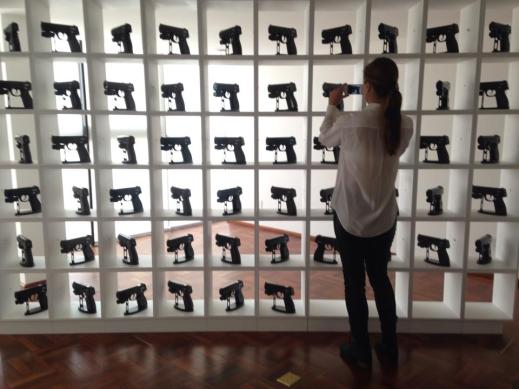
Each of the twenty recordings that integrate to create detritus.2 was taken from You Tube. The shootings occurred in the cities of Nuevo Laredo, Reynosa, Zupango, Orizaba, Saltillo, Juarez, Changuitiro, Purépero, Xalapa, Jiquilpan, Santa María del Oro and Mexico City. All of them, played together, contribute to the assembly of what Salcedo calls a texture of sound. The recordings are reproduced/played by twenty portable digital speakers in the shape of guns. These sound-reproduction machines are completely autonomous–no power or sound cables attached–and each speaker is a sound component by itself. Once the battery is worn, the sound is gone until the battery is recharged, therefore restarting the process performance / sound – waste / silence. Silence is one of the worst problems when dealing with violence.The government and the drug cartels alike don’t want anybody to openly discuss these issues. Working with families within specific communities in Mexico and the US will help make their stories visible -out of the anonymous data- and visibility could empower them.
The Inferno
But exploring the “normalization” of violence through media is not my only intervention with detritus and detritus.2. Far from the sound art movement, where soundscape often functions as a neutral label that includes organized sounds taken from the surroundings, detritus.2 deals with Mexican contemporary cities’ sounds, recorded and disseminated by the same individuals that live within these acoustic situations. Those are the sounds that [also] construct the Mexican landscape, telling the story of the failed nation. Taken together, the sounds of detritus.2 amplifies the fact that we are standing in front of the failure of the Mexican state as we know it, and its civilian population has been dealing with this irregular situation for many decades. We have witnessed drug cartels infiltrate every layer of life; and just because many civilians end up surviving —with and around it—does not make the problem disappear. On the contrary, every broken boundary makes the problem harder and harder to be resolved.
 The failure of the Mexican State, or the “inferno” as is being called now, is something Mexico can no longer hide. When I say Mexico here, I am not referring to its general population–already exhausted already from decades on “survival mode”– but rather the Capitol elite: the government, investors, intellectuals, and journalists alike. This situation is not new to civilians living outside of Mexico City. Entire communities in the north of Mexico have been abandoning their belongings-jobs-lives, in extremely fast exodus, either to the US or to tranquil states like Yucatán. Thousands of mothers and fathers are looking for their sons and daughters taken by the cartels, in the best-case scenario they are put to work as slaves either at the drug camps or as prostitutes, in the worst they may be in the thousands of mass graves that pollute the country. Civilians understood early in the story that any complaint to the police would result in an even worse situation. For years, it has been known in the bus industry that a lot of young male and female travelers have been kidnapped to make them join this industry of slaves, and only recently they started to admit it: tons of luggage at bus terminals on the northern states of Mexico speak for those that went missing, and nobody said a word. Just the past 19 October 2014 a corpse of a went-missing-police-officer’s mother was placed in front of the Ministry of the Interior’s building: they never pursued an investigation over the disappearance of the young officer, and the last will of this ailing mother was her coffin to be placed in the street outside of the Ministry of the Interior as a way of extreme protest.
Listening Ahead: V. (u)nF_2
In the next phase of detrius.2, V. (u)nF_2–an acronym for Vis. (un) necessary force–I am making sculptural objects and sounds to construct a multi-channel sound-installation exploring the question: how do civilians in Mexico live through the extreme violence product of the fight against drug cartels in a state that has revealed its own failure? The artwork consists of a multiple series of custom-made ceramic-sound devices/megaphones in the shape of human heads/faces, molded after living family members of civilians that are still on the “missing” lists, maybe kidnapped and/or killed by drug cartels. In order to make an archive that includes each family’s data, I will collaborate with organizations that assist civilians on finding their relatives. To make a representative selection, I plan to analyze data through a mathematic-algorithm; chosen families will be invited to be part of the project. Each family will designate a member to participate symbolically as the “missing” person. A 3D-scan data portrait will be made of each participant, followed by a ceramic-3D-print. I will then install an electronic-circuit and megaphone inside of the hollow-human-head/faces-ceramic-objects. To develop the sound element –a thick stratum of noise– I will digitally modify a multiple-layered-construction of sounds after the stored data. The specifics of each story/participant will be presented at the exhibition space through an interactive database. Custom-made ceramic-objects/megaphones will be resting on the floor; in in order to cross the exhibition-space, visitors will have to carefully move these 3D-ceramic-portraits, each one representing an individual story.
V. (u)nF_2 is a gesture that listens forward, taking those 24,000–and counting–missing-individuals outside of data-archives and rehumanizing them through storytelling, 3D-scan/print technology and sound. The fact that I will use traditional methods to approach my subject —the horror of this war against civilians– but will also use state-of-the-art-technology in order to shape the hardware needed for sound-installation, combines a human-scale project with the possibilities of the digital-world, which places this project within the so-called Third-Industrial-Revolution but grounds it in the real.
—
Listen to other sound installations by Luz María Sánchez:
Frecuencias Policiacas// Police Frequencies: “Las grabaciones que forman parte del audio multicanal de la instalación, fueron llevadas a cabo en la central de radiocomunicación de la policía de Nuevo Laredo, y fueron facilitadas a la artista por reporteros del diario El Mañana en agosto de 2005. Los audios registran una confrontación entre la policía de Nuevo Laredo y un grupo criminal no identificado, y por las características de los mismos, se pueden escuchar a diversos elementos policiacos, así como a las controladoras de la radiocomunicación. La re-transmisión de estos sonidos en una matriz multi-líneal, colocan a la obra en nuevos niveles de codificación en los que la complejidad visual, auditiva y político social de esta realidad, se hacen patentes.” –Description by Roberto Arcaute y Manuel Rocha Iturbide
Frecuencias Policiacas// Police Frequencies: “The recordings are part of the multichannel audio installation carried out in the central police radio Nuevo Laredo, provided to the artist by El Mañana newspaper reporters in August 2005. The audio recorded a confrontation between police and an unidentified criminal Nuevo Laredo group. . .The re-transmission of these sounds in a multi-linear matrix placed to work in new levels of encryption that make evident the social visual, auditory and political complexity of this reality.” –Description by Roberto Arcaute y Manuel Rocha Iturbide
2487: “2487 speaks the names of the two thousand four hundred eighty seven people who died crossing the U.S./Mexico border . The work employs digital technology and sound as a means for transborder memorialization and protest, imposing the absence of those lost into the public sphere. Sánchez’ immersive sound environment remaps social history as the names of the deceased fly across the border through soundscape and digital media. Drawing from data acquired from activist websites, Sánchez created a sound map of names which she recorded digitally. Her final score, along with the database, has been exhibited widely but lives permanently on the world wide web, in commemoration and quiet protest. Sánchez’ work connects the digital and geographic landscape to the listener’s body, gaining entry through sound and transcending political and physical barriers”– Description from UCR Critical Digital 8/19/2012
—
Sound and visual artist Luz María Sánchez studied both music and literature. Through her doctoral studies Sánchez has focused on the role of sound-in-art since its inception in the 19th century through its evolution as an independent art practice in the 20th century. Sánchez then examined the radio-plays of Samuel Beckett linking them to the sound-practices that emerged in the mid-20th century. Sánchez has continued her research on technologized-sound: she was part of the conference Mapping Sound and Urban Space in the Americas at Cornell University, and her book Technological Epiphanies: Samuel Beckett’s Use of Audiovisual Machines will be published in 2015. Her artwork has been included in major sound-and-music festivals such as Zéppellin-Sound-Art-Festival (Spain), Bourges-International-Festival-of-Electronic-Music-and-Sonic-Art (France), Festival-Internacional-de-Arte-Sonoro (Mexico), and has presented exhibitions at Marion-Koogler-McNay-Art-Museum, Dallas Center for Contemporary Art, Galería de la Raza (San Francisco), John-Michael-Kohler-Arts-Center (Sheboygan), Illinois State Museum (Chicago/Springfield), and Centro de Cultura Contemporánea (Barcelona) amongst others. She was granted a special distinction in the category Nouvea-Musiques at the Phonurgia-Nova-Prix (Arles), was the recipient of a Círculo-de-Bellas-Artes-de-Madrid’s grant, and Yuko Hasegawa selected her for the Artpace-International-Artist-in-Residence. She is member of the Board-of-the-Sound Experimentation-Space at Museum-of Contemporary-Art (MUAC). Sanchez was recently awarded the First Prize of the Frontiers Biennial (2015).
—
 REWIND!…If you liked this post, you may also dig:
“A Listening Mind: Sound Learning in a Literature Classroom”–Nicole Brittingham Furlonge
“Soundscapes of Narco Silence”—Marci R. McMahon
“Listening to the Border: ‘”2487″: Giving Voice in Diaspora’ and the Sound Art of Luz María Sánchez”-D. Ines Casillas
Share this:


Current Top Posts





April 2021

January 2020

November 2019

October 2019

August 2019

April 2014

November 2017

March 2015

December 2017

October 2015
 Sounding Out!
Recent Comments