
The (Magic) Upper Room: Sonic Pleasure Politics in Southern Hip Hop
 After a rockin’ (and seriously informative) series of podcasts from Leonard J. Paul–a three part “Inside the Game Sound Designer’s Studio”– our summer Sound and Pleasure series keeps giving you the good stuff, this week with SO! Regular Regina Bradley, making it rain. . . with some serious knowledge. What is the connection between sound and enjoyment, and how might black women’s sexual freedom be manifested via sound? –-JS, Editor-in-Chief
—
At fifteen, while in church service, I learned how to clutch pearls after hearing a woman moan during the altar call.
It was not a “Jesus done found and saved me” moan, either. A friend forgot to turn his cell phone off for church. As the church prayed, his phone started to ring. It was not the usual digital beeping or quick calypso ring tone. His phone calls were annotated by a woman’s moan during sex. She moaned from his cell phone to pick up the call. Each ring the woman moaned louder and adamant until she hollered like she was just saved. The kids in the back snickered as the ushers – including my grandmother – silently and angrily screened each pew to see who would pick up the phone. Quaking church ladies and my grandmother’s wide-eyed glare and heaving chest suggested they were about to pass out from embarrassment. Wringing their white gloved hands and grabbing at their pearl necklaces in angst, they looked everywhere but at each other: the back of a man’s head, the cross at the front of the church, the stain glass windows. A flush of warmth entered my cheeks and neck as I tried to contain my laughter and creeping embarrassment. I was embarrassed for my grandmother and the ladies of the church because I was aware of the unspoken rule that women – especially middle-class black women – don’t do sex. Being embarrassed of sex is proper and “ladylike.”
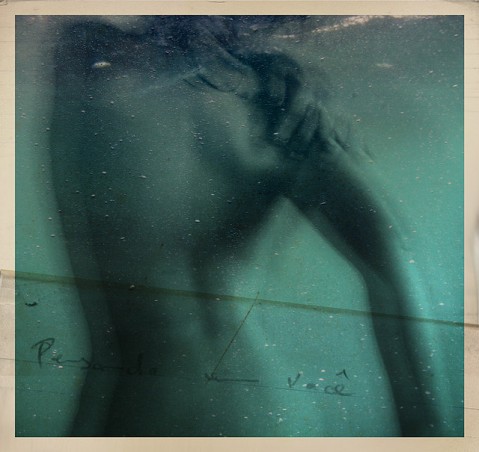
“Dancing underwater II” by Flickr user Miss Cartier, CC BY-NC-SA 2.0
Ashon Crawley’s contextualization of the praise and worship in Black Pentecostal church as a sonic public zone is useful for using sound to complicate the church as an erotic space. Crawley’s suggestion of sound as a “vessel. . .for the exchange of ecstasy and ecstatics” collapses the more tangible notions of gender and respectability via physical displays –i.e. the quaking church ladies and clutching pearls – to recognize the overlap of moaning as a marker of sexual joy, moaning as a form of praise and worship, and moaning as an indicator of shame. Crawley’s observations bring to mind Helga Crane’s run in with the storefront church in Nella Larsen’s Quicksand. It is not the physical aspect of the church and its embodiment of respectability that draws Helga into the space. Rather, it is the singing, weeping, and moaning – the sonic elements of praise and worship–that parallel her own suppressed sexual frustrations. Her weeping is not necessarily a “come to Jesus moment” but rather a sonic release acknowledging her sexual agency.
Looking back at when this dude’s phone went off in church, I realize the bulk of discomfort in acknowledging sexual pleasure exists in how it sounds. The woman’s moan highlighted an alarming reality for the women at my church: pleasure was being presented outside of its respectable physical and sonic boundaries. I wish to identify what I call sonic pleasure politics to address new developments in 21st century southern gender identity politics. Sonic manifestations of pleasure point to a younger generation’s rearticulation of sexuality as a site of agency and self-definition in an otherwise suppressed southern experience.
![Purity-Rings.jpg by Wikimedia user Bibleknowledge, CC-BY-SA-3.0 (http://creativecommons.org/licenses/by-sa/3.0)], via Wikimedia Commons](http://commons.wikimedia.org/wiki/File:Purity-Rings.jpg)
Purity-Rings.jpg by Wikimedia user Bibleknowledge, CC-BY-SA-3.0, via Wikimedia Commons
As a southern black woman, I’ve always been struck by the anxiety sex and pleasure invoked in the women in my life. Sex and pleasure were never articulated in the same breath, as sex was a wifely duty and responsibility for procreation. Pleasure was never synonymous with sexual joy, even when I snatched whispers of conversation about sex from my elders. Moreover, I was taught that sex (or even an interest in it) would plummet my stock as a good girl and put me in the ranks of “fast-tailed” girls who used sex as a desperate plea for attention. Nope, sex – pleasurable sex – was always for men’s gratification. Aside from the abstinence manifesto – “just don’t do it, chile” – for women, enjoying sex was the devil’s work. Respectable sex was quiet, for marriage, and never discussed outside of the house.
Sound as a signifier of sexual pleasure is considered by many to be counterintuitive because of the history of sexual trauma associated with black women’s bodies in the south. Reading sex as a genesis point of southern black women’s pleasure and empowerment is a difficult undertaking. The forced silence of slave women’s rapes and other physical violence that took place on southern soil parallels the silence that is deemed to be necessary for survival in a racist society. Further, the far-reaching residual effects of black women’s inferred lacking virtue lurk in how black folks navigate their southern experience and identities. Conservative attitudes towards sex in the southern black community are no doubt associated with the constructed attempts to humanize and validate blacks outside of hypersexual scripted blackness.
However, the sonic dimension of sex and pleasure in the south goes largely without analysis even though sound is a primary space in which recognition of sexual and nonsexual pleasure takes place. Consider blues women and, more recently, women in [southern] hip hop culture. The sounds of women’s giggles and moans as representative of sexual pleasure in bass music and the heavy use of moaning in the work of Trina, Jacki-O, Khia, Erykah Badu, Beyoncé, and Missy Elliott points to a need to recognize sound as a reservoir of pleasure, raunchiness, and sexual work—what I call “sonic pleasure politics.”
Studies of sonic pleasure including those of Robin James contextualize pleasure via the technical production of sound to induce a particular set of cultural and visceral responses. However, I ground my theorization of sonic pleasure politics in the growing body of scholarship offered by the “Pleasure Ninjas” collective consisting of Joan Morgan, Brittney Cooper, Treva Lindsey, Kaila Story, Yaba Blay, and Esther Armah. They utilize pleasure as a site of healing and reclamation of black women’s identities. Morgan’s interrogation of pleasure as a form of survival, for example, is especially useful in thinking about how southern women’s sexuality stems from the trauma of the transatlantic slave trade. She suggests pleasure’s palpability as an alternative space to reclaim slaves’ humanity. The Pleasure Ninjas’ construction of pleasure lends credence to my theorization sonic pleasure politics as a space for mediating the historical implications of abusive sexual power and the use of sexual pleasure as a form of resistance in the south.
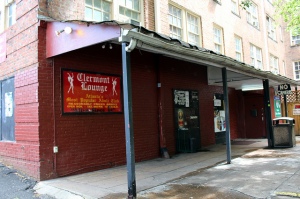
“Atlanta – Poncey-Highland: Clermont Lounge” by Flickr user Wally Gobetz, CC BY-NC-ND 2.0
Situating women’s pleasure in southern hip hop is messy as it reflects both men’s investment in women as objects of pleasure – i.e. bass music – and women’s subversion of this expectation of their sexuality a way to express themselves. For example, Lil Wayne’s lyrical affirmation of his sexual prowess via cunnilingus in songs like “Pussy Monster,” “She Will,” and “Lollipop” parallels singer Joi’s demonstration of pleasure as a form of sexual consent via the use of (presumably her) moans and sounds of cunnilingus on her popular song “Lick.” Sonic pleasure politics become a workspace for bridging the south’s historical construction of [black] women’s sexuality-as-respectability and the recent, more fluid form of younger women’s embrace of sex-as-empowerment heard in southern popular culture.
Sonic Pleasure Politics and Strip Club Culture
A primary space for teasing out the multi-layered significance of sounds and sexuality in southern hip hop is the strip club. The production of sonic and visual representations of strip clubs are inextricably linked: bass heavy musical tracks keep time with the “clapping cheeks” of exotic dancers. Further, the loudness of the strip club denotes patrons’ attempts to drown out the world while pivoting off of the fantasy of sexy women dancing, moaning, and sexually gesturing for their entertainment. The dominance of strip clubs in southern hip hop contribute to the erotic map(s) of a younger generation of southern black women. My contextualization of strip clubs as a cartographic point of interest pivots off of Kaila Story’s description of erotic maps as an entry point for recognizing black women’s sexual agency. Erotic maps are the touchstones through which people address sexual pleasure. Story uses black women’s social-historical narratives to map out black women’s use of sexuality as a measure of self-definition. These maps are complex as they are intertwined with historical-cultural biases and cultural preferences frequently outside of black women’s experiences.

“IMG_0478” by Flickr user Ferrum College, CC BY-NC-SA 2.0
Strip club anthems, like Memphis rapper Juicy J’s “Bandz a Make Her Dance,” riff on the sonic and physical components of strip club culture. The bass kicks complement what sounds like clapping hands, a signifier of strippers’ clapping butts. Juicy J talks at length about his love of the strip club, distinguishing between “real” and fake strip clubs by the amount of nakedness and strippers wrangling for high-paying patrons’ bands of money. The snapping sound of rubber bands holding wads of cash together authenticates the duality of the women’s sexual posturing as physically pleasurable for men and profitable – economically pleasurable – for women. “Bandz a Make Her Dance” is grounded in the appeal of strip clubs as spaces of empowerment for black men. From this perspective, the clapping heard across the track could also signify the snapping of rubber bands against money to sonically signify men’s power as a strip club patron. Yet the physical and sonic presence of black women’s bodies – i.e. grunting as they maneuver and climb the dancing pole – also makes strip club culture a useful space to pivot southernness and sonic pleasure.
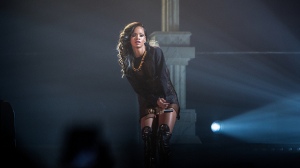
An example of establishing black women’s sonic pleasure narratives in strip clubs is singer Rihanna’s panning of “Bandz a Make Her Dance” titled “Pour It Up.” Although Rihanna is a pop singer from the “Global” South, she sonically signifies if not subverts southern hip hop gender politics via sampling the instrumental from Juicy J’s record. The majority of “Pour It Up’s” instrumental accompaniment is a subdued if not washed out sample of “Bandz a Maker Dance” that helps highlight Rihanna’s voice. The clarity of Rihanna’s voice “garbles” the accompaniment in the sense it is background noise to her narrative of enjoying herself and taking pleasure in the bodies of other women present in the club. The accompaniment serves as a brief nod to Juicy J’s initial intentions of crafting the strip club as a sexual space but ultimately uses the track as a testament to her own pleasure narrative.
In particular, Rihanna’s sing-song holler before the chorus “All I see is signs…all I see is dollar signs,” points to a subversion of the hypermasculinity in strip club culture to establish her own pleasure in a similar space. Parallel to Juicy J’s indulging of exotic dancers via throwing bands of money, Rihanna enjoys herself at the strip club using other people’s money:
Strip clubs and dolla’ bills (Still got mo’ money)
Patron shots can I get a refill (Still got mo’ money)
Strippers going up and down that pole (Still got mo’ money)
4 o’clock and we ain’t going home (Still got mo’ money)
Bands make your girl go down (Still got mo’ money)
Lot more where that came from (Still got mo’ money)
“Rihanna – Oslo 2013” by Flickr user NRK P3, CC BY-NC-SA 2.0
In particular, Rihanna’s verse not only demonstrates an alternative viewpoint of black women’s bodies in the strip club but destabilizes the idea of the strip club – and intercedes on the understanding of southern hip hop – as a heternormative hypermasculine space. The line “bands make your girl go down” alludes to not only a possible sexual encounter by Rihanna or for the girl in question but doubly signifies upon the potential for pleasure via the strip club culture for women and the hypersexuality of Juicy J’s track. “Pour it Up” reflects the messiness of [southern] hip hop gender politics because it builds upon the reputation of the strip club as a site for men’s pleasure to excavate women’s dancing as pleasurable for their own purposes. In addition to Rihanna’s sonic signifying of strip club culture, the “Pour It Up” reveres pole dancing as an art form rather than an exploitative practice. Rihanna’s pleasure in watching the dancers perform parallels the exertion of joy – and consent – that the dancers exhibit in their movement.
Trekking back to the sexy moaning phone in church, the sonic cue of sexual pleasure and joy conflicted with the gender norms associated with southern black women’s identities. Consideration of sonic pleasure narratives stirs discussion of the unarticulated experiences of southern black womanhood that may be overlooked in favor or a larger, more conservative, and familiar narrative of sex as tool of victimization. Sonic pleasure politics makes room to remap the contemporary southern social-cultural landscape as a complex yet living space of cultural production and sexual freedom.
–
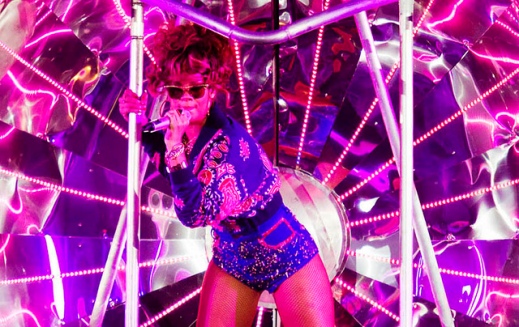
Featured Image: “RIHANNA EM BELO HORIZONTE” by Flickr user http://www.rihannafentyforum.com, CC BY-NC-SA 2.0
–
Regina Bradley recently completed her PhD at Florida State University in African American Literature. Her dissertation is titled “Race to Post: White Hegemonic Capitalism and Black Empowerment in 21st Century Black Popular Culture and Literature.” She is a regular writer for Sounding Out!
–
 REWIND!…If you liked this post, you may also dig:
Thrills, Chills, and Safe Sexuality: The Sounds of Michael Jackson’s “Thriller” – Osvaldo Oyola
“I Love to Praise His Name”: Shouting as Feminine Disruption, Public Ecstasy, and Audio-Visual Pleasure – Shakira Holt
I Like the Way You Rhyme, Boy: Hip Hop Sensibility and Racial Trauma in Django Unchained – Regina Bradley
Share this:

Sounding Out! Podcast #31: Game Audio Notes III: The Nature of Sound in Vessel
This post continues our summer Sound and Pleasure series, as the third and final podcast in a three part series by Leonard J. Paul. What is the connection between sound and enjoyment, and how are pleasing sounds designed? Pleasure is, after all, what brings y’all back to Sounding Out! weekly, is it not?
Part of the goal of this series of podcasts has been to reveal the interesting and invisible labor practices which are involved in sound design. In this final entry Leonard J. Paul breaks down his process in designing living sounds for the game Vessel. How does one design empathetic or aggressive sounds? If you need to catch up read Leonard’s last entry where he breaks down the vintage sounds of Retro City Rampage. Also, be sure to be sure to check out last week’s edition where Leonard breaks down his process in designing sound for Sim Cell. But first, listen to this! -AT, Multimedia Editor
–
CLICK HERE TO DOWNLOAD: Game Audio Notes III: The Nature of Sound in Vessel
SUBSCRIBE TO THE SERIES VIA ITUNES
ADD OUR PODCASTS TO YOUR STITCHER FAVORITES PLAYLIST
–
Game Audio Notes III: The Nature of Sound in Vessel
Strange Loop Game’s Vessel is set in an alternate world history where a servant class of liquid automatons (called fluros) has gone out of control. The player explores the world and solves puzzles in an effort to restore order. While working on Vessel, I personally recorded all of the sounds so that I could have full control over the soundscape. I recorded all of the game’s samples with a Zoom H4n portable recorder. My emphasis on real sounds was intended to focus the player’s experience of immersion in the game.
This realistic soundscape was supplemented with a variety of techniques that produced sounds that dynamically responded to the changes in the physics engine. Water and other fluids in the game were difficult to model with both the physics engine and the audio engine (FMOD Designer). Because fluids are fundamentally connected to the game’s physics engine, they takes on a variety of different dynamic forms as players interact with the fluid in different ways. In order to address this Kieran Lord, the audio coder, and I considered factors like the amount of liquid in a collision with anything, the hardness of the surface that it was colliding with, the type of liquid in motion, whether the player is experiencing an extreme form of that sound because it is colliding with their head, and, of course, how fast the liquid is travelling.
Although there was a musical score, I designed the effects to be played without music. Each element of the game, for instance a lava fluro’s (one of the game’s rebellious automatons) footsteps, entailed required layers of sound. The footsteps were composed of water sizzling on a hot pan, a gloopy slap of oatmeal and a wet rag hitting the ground. Finding the correct emotional balance to support the game’s story was fundamental to my work as a sound designer. The game’s sound effects were constantly competing with the adaptive music (which is also contingent on player action) that plays throughout the game, so it was important to provide an informative quality to them. The sound effects inform you about the environment while the music sets the emotional underscore of the gameplay and helps guide you in the puzzles.

The lava fluro foosteps in FMOD Designer. Used with permission (c) 2014 Strange Loop Games
Defining the character of the fluros was difficult because I wanted players to have empathy for them. This was important to me because there is often no way to avoid destroying them when solving the game’s puzzles. While recording sounds in the back of an antique shop, I came across a vintage Dick Tracey gun that made a fantastic clanking sound when making a siren sound. Since the gun allowed me to control how quickly the siren rose and fell, it was a great way to produce vocalizations for the fluros. I simply recorded the gun’s siren sound, chopped the recording into smaller pieces, and then played back different segments randomly. The metal clanking gave a mechanical feel and the siren’s tone gave a vocal quality to the resulting sound that was perfect for the fluros. I could make the fluros sound excited by choosing a higher pitch range from the sample grains and inform the player when they approached their goal.
I wanted a fluid-based scream to announce a fluro’s death. I tried screaming underwater, screaming into a glass of water, and a few other things, but nothing worked. Eventually, when recording a rubber ear syringe, I found squeezing the water out quickly lent a real shriek while it spit out the last of the water. Not only did this sound really cut through the din of the gears clanking in the mix, but it also bonded a watery yell with the sense of being crushed and running out of breath.
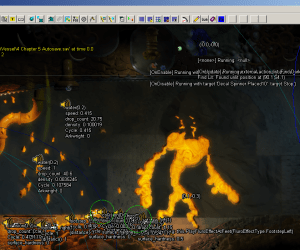
Vessel’s Lava boss with audio debug output. Used with permission (c) 2014 Strange Loop Games
For the final boss, I tried many combinations of glurpy sounds to signify its lava form. Eventually I recorded a nail in a board being dragged across a large rusty metal sheet. Though it was quite excruciating to listen to, I pitched down the recording and combined it with a pitched down and granulated recording of myself growling into a cup of water. This sound perfectly captured the emotion I wanted to feel when encountering a final boss. Although it can take a long time to arrive at the “obvious” sound, simplicity is often the key.
Anticipation is fundamental to a player’s sense of immersion. It carves a larger space for tension to build, for instance a small crescendo of a creaking sound can develop a tension that builds to a sudden and large impact. A whoosh before a punch lands adds extra weight to the force of the punch. These cues are often naturally present in real-world sounds, such as a rush of air sweeping in before a door slams. A small pause might be included just for added suspense and helps to intensify the effect of the door slamming. Dreading the impact is half of the emotion of a large hit .
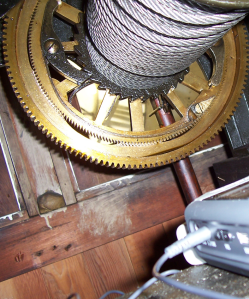
Recording inside of a clock tower with my H4n recorder for Vessel. Used with permission by the author.
Recording all of the sounds for Vessel was a large undertaking but since I viewed each recording as a performance, I was able to make the feeling of the world very cohesive. Each sound was designed to immerse the player in the soundscape, but also to allow players enough time to solve puzzles without becoming annoyed with the audio. All sounds have a life of their own and a resonance of memory and time that stays with the them during each playthrough of a game. In Retro City Rampage I left a sonic space for the player to wax nostalgic. In Sim Cell, I worked to breathe life into a set of sterile and synthesized sounds. Each recorded sound in Vessel is alive in comparison, telling stories of time, place and recording with them, that are all their own.
The common theme of my audio work on Retro City Rampage, Sim Cell and Vessel, is that I enjoy putting constraints on myself to inspire my creativity. I focus on what works and removing non-essential elements. Exploring the limits of constraints often provokes interesting and unpredictable results. I like “sculpting” sounds and will often proceed from a rough sketch, polishing and reducing elements until I like what I hear. Typically I remove layers that don’t add an emotive aspect to the sound design. In games there are often many sounds that can play at once, so clarity and focus are necessary when preventing sounds from getting lost in a sonic goo.

Cherry blossoms for new beginnings. Used with permission by the author.
In this post I have shown how play and experimentation are fundamental to my creative process. For an aspiring sound artist, spending time with Pure Data, FMOD Studio or Wwise and a personal recorder is a great way to improve their skill with game audio. This series of articles has aimed to reveal the tacit decisions behind the production of game audio that get obscured by the fun of the creative process. Plus, I hope they offer a bit of inspiration to those creating their own sounds in the future.
Additional Resources:
- My GDC 2012 talk – My site includes an MP3 recording of the talk and the full powerpoint presentation. A full video of the talk is in the GDC Vault but requires membership
- See the Jon Hopkins Soundtrack in the Video Game Vessel video game soundtrack video by me on YouTube – shows use of Lua with music in the custom level editor : https://www.youtube.com/watch?v=KOyjMPPvaY4
–
Leonard J. Paul attained his Honours degree in Computer Science at Simon Fraser University in BC, Canada with an Extended Minor in Music concentrating in Electroacoustics. He began his work in video games on the Sega Genesis and Super Nintendo Entertainment System and has a twenty year history in composing, sound design and coding for games. He has worked on over twenty major game titles totalling over 6.4 million units sold since 1994, including award-winning AAA titles such as EA’s NBA Jam 2010, NHL11, Need for Speed: Hot Pursuit 2, NBA Live ’95 as well as the indie award-winning title Retro City Rampage.
He is the co-founder of the School of Video Game Audio and has taught game audio students from over thirty different countries online since 2012. His new media works has been exhibited in cities including Surrey, Banff, Victoria, São Paulo, Zürich and San Jose. As a documentary film composer, he had the good fortune of scoring the original music for multi-awarding winning documentary The Corporation which remains the highest-grossing Canadian documentary in history to date. He has performed live electronic music in cities such as Osaka, Berlin, San Francisco, Brooklyn and Amsterdam under the name Freaky DNA.
He is an internationally renowned speaker on the topic of video game audio and has been invited to speak in Vancouver, Lyon, Berlin, Bogotá, London, Banff, San Francisco, San Jose, Porto, Angoulême and other locations around the world.
His writings and presentations are available at http://VideoGameAudio.com
–
Featured image: Courtesy of Vblank Entertainment (c)2014 – Artwork by Maxime Trépanier.
—
 REWIND! . . .If you liked this post, you may also dig:
Sounding Out! Podcast #30: Game Audio Notes I: Growing Sounds for Sim Cell- Leonard J. Paul
Sounding Out! Podcast #31: Hand Made Music in Retro City Rampage– Leonard J. Paul
Papa Sangre and the Construction of Immersion in Audio Games- Enongo Lumumba-Kasongo
Share this:


Current Top Posts





April 2021

January 2020

November 2019

October 2019

August 2019

April 2014

November 2017

March 2015

December 2017

October 2015
 Sounding Out!
Recent Comments