
Radio and the Voice of the Aymara People

 Welcome back to our continuing series on radio in the Caribbean and Latin America: Radio de Acción. A consideration of the multilingual history of radio from Cuba, Jamaica, and Haiti to the Southern Cone and beyond, Radio de Acción turns this week to the Aymara in Peru, Chile, and especially Bolivia in a fascinating piece from anthropologist Karl Swinehart.
If you missed our first post, Alejandra Bronfman’s stunning history of radio and violence in the Caribbean, you can find it here. In the meantime, keep your dials tuned to Karl Swinehart’s study of the micropolitics of language and power on Aymaran radio.
– Guest Editor Tom McEnaney
—
“What do you like most about working at this radio station?” was a simple question I had asked Celia Colque Quispe, an Aymara language radio broadcaster on Radio San Gabriel in El Alto, Bolivia during an interview I conducted in 2007 as part of my dissertation research on Aymara-language media. Her response was simple, but profound.
“Clearly, here, being Aymara. I like to be Aymara.”
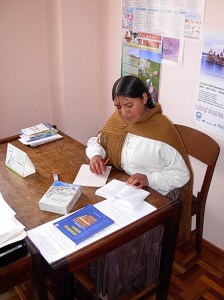
Celia Colque Quispe; photo by the author, all rights reserved
Quispe came to Radio San Gabriel from a small, rural community on the shores of Lake Titicaca. One day, she had heard an announcement on the radio that Radio San Gabriel would be hiring personnel through an open selection process involving an Aymara language fluency assessment. Competing against university-trained linguists and graduates of communications programs, Quispe stood out for her eloquent Aymara speech and was hired, beginning a career in radio where she came to not only to work as an announcer, but as a member of the Aymara Language Department where she wrote and approved scripts for the station’s programs. Stories like this are not unusual at Radio San Gabriel, but are otherwise rare in this multilingual Andean republic, still profoundly marked by anti-Indian racism. What “being Aymara” means in Bolivia remains highly contested. One thing was clear from my conversation with Quispe, however—her work at the radio allows her “to be Aymara.”
The presence of the Aymara language on Bolivian airwaves contrasts sharply with its general absence within other Bolivian media. There are some notable exceptions: Bolivian state television occasionally runs Aymara language programming on programs like Entre Culturas (‘Between Cultures’), and, famously, the neorealist director Jorge Sanjinés’ work has dramatized the struggles of highland Aymara and Quechua Indians in films like Yawar Mallku (Blood of the condor) and Nación Clandestina (Clandestine Nation).
These are exceptions, however, that prove the rule of Spanish language dominance within Bolivian television and film, leaving radio to stand out as the medium that most reflects the country’s multilingualism. In this post we will tune in to Radio San Gabriel, Bolivia’s oldest and most prominent Aymara language radio station, to ask how Aymara language radio might not just reflect Bolivia’s multilingualism, but also actively intervene in it, shaping how Aymaras hear their own language.
Aymaras and Bolivia

Geographic distribution of the Aymara language, public domain
The Aymaras are one of the the largest ethnolinguistic groups within Bolivia, a nation that is now officially a “Plurinational State” in which 36 indigenous languages are recognized as co-official with Spanish. Aymara is among the most widely spoken of these and Aymaras constitute a majority of the population in a contiguous territory surrounding the nation’s capital of La Paz, and crossing national borders into neighboring Chile and Peru. With approximately two and a half million people (and many more than this if speaking Aymara is removed as a criterion of ethnicity), Bolivia has the largest concentration of Aymaras in the region. Perhaps because Bolivia’s political capital sits within Aymara territory or because of their sheer numbers with respect to other indigenous populations, the Aymara have long played a significant role in Bolivian politics. Increasing the presence of the Aymara language in public space, on the airwaves or otherwise, is thus a prominent component of a multifaceted politics of indigenous resurgence in contemporary Bolivia.
Aymar Markan Arupa – “The Voice of the Aymara People” – Radio San Gabriel
As Bolivia’s first and longest running Aymara language radio station, Radio San Gabriel (RSG) calls itself “Aymar markan arupa” (the voice of the Aymara people). In the wake of the 1952 Bolivian revolution, a major social upheaval in which miners’ militias played a crucial role, Maryknoll Jesuit priests founded RSG in 1955 with aims of Christian evangelization within a broader effort at rural uplift. RSG’s mission was also in line with the new government’s hopes of integrating indigenous rural communities into national political life. Jesuits had experience with radio in mining communities, a broadcasting milieu dominated by radical syndicalist and communist political currents, where Jesuits had also founded radio stations of their own. Although miners are remembered as the central protagonists in the 1952 revolution, also crucial to its victory were the highland indigenous communities who overturned nearly feudal relations of the haciendas through insurrectionary land expropriations.

The offices and studios of Radio San Gabriel in El Alto, Bolivia; photo by the author, all rights reserved
In its early days, RSG approached the Aymara language as a bridge to Spanish language literacy and integration into the mainstream of the Catholic faith, an approach consistent with a mid-twentieth century view which formulated the “the Indian problem” as one of national integration. Yet these early assimilationist efforts would quickly change due to both developments in the Catholic Church, such as the Second Vatican Council (1962-1965) and the rise of “liberation theology,” and also political ferment in Bolivia in opposition to military rule. During the 1970s radical Aymara nationalism, or katarismo, was on the rise, finding institutional expression through organizations like the Movimiento Revolucionario Tupak Katari (MRTK, ‘Revolutionary Movement Tupak Katari’), and the founding of the Confederación Sindical Única de Trabajadores Campesinos Bolivianos (CSUTSB, ‘Trade Union Confederation of Rural Workers of Bolivia’) under katarista leadership in 1979.

“Tawa Chakana” by Wikimedia user Huhsunq, CC BY-SA 2.5
Influenced by Aymara nationalism, RSG made a dramatic shift in its orientation towards Aymara language and culture. Their adoption of an Aymara-centric idiom resonated with other nationalist currents, while maintaining Maryknoll Jesuit aims of social justice and service to the poor by reformulating “liberation theology” as a “theology of inculturation.” Practices earlier demonized by the Catholic Church as pagan were now celebrated as being essentially Christian—with the spilled blood of a sacrificed llama, for example, recast as analogous to the wine of the sacrament. This remains in many ways the orientation of RSG today, and the station positions itself as an authority on questions of Aymara linguistic and cultural authenticity.
Broadcast language – dehispanicized “pure” Aymara
One of the ways that RSG’s authority becomes audible to its Aymara audience is through the language used on the air. On RSG, radio announcers speak without using Spanish loan words, using what radio announcers and other Aymaras refer to as “Aymara puro” (pure Aymara). This is ensured through the radio’s Aymara Language Department, which intervenes prior to each broadcast by either writing or editing scripts, and is responsible, along with the radio’s director, for these scripts’ ultimate approval. However, its responsibilities do not end with broadcasts’ content. The department is also responsible for a protocol extending through and beyond the actual broadcasts called seguimiento, or “following.”
Seguimiento involves two procedures: the real-time monitoring of broadcasts for “aberrations,” and a follow-up interaction with those who utter them on air.The department finds alternatives or invents neologisms for the many loan words in Aymara from Spanish. These loan words include words as common as the verb “to speak”—parlaña from the sixteenth-century Spanish parlar—and are testament to 500 years of contact with Spanish. Contact, of course, is a euphemism for what was first colonial and later republican subjugation, making the aberración serve as a linguistic reminder of this painful history. This is why, rather than simply “Aymara puro,” a more apt term might be deshispanized Aymara. While Spanish loan words are purged from the broadcasts, many words shared between Quechua and Aymara escape the protocols of seguimiento, even though these also likely entered the language as the result of earlier subjugation of the Aymara under the Inca Empire. It was not the Inca period, however, but the domination of all Indians, whether Quechua, Aymara, or otherwise, by the Spanish under the colony, then by their descendants during the Republican period and into the 21st century that has most profoundly shaped Bolivia’s dynamics of race and class and, it turns out, the linguistic phenomena that accompanying them, leaving the loan word, the aberración, to be understood as the residue of this history.

Outside the studios of Radio San Gabriel in El Alto, Bolivia; photo by the author, all rights reserved
Decolonization over the Airwaves
Is the linguistic purism of the RSG any different from that of, say, the Academie Française? In terms of aims and procedures, much remains the same—both groups identify loan words and push for consensus to implement neologisms. Such a comparison, however, would obscure the starkly different social context in which this process unfolds in Bolivia. If “protecting” the language is commensurate with protecting the people, at RSG, this means targeting loanwords that serve as reminders of the painful processes of colonialism. In this light, many at RSG understand their work as fitting within a larger project of decolonization, a project not without its contradictions or ironies, particularly considering the role of the Catholic Church in both the past and the present. I explore these ironies more in a longer ethnographic account of the process of seguimiento at RSG.
Whatever the ironies, RSG’s cultivation of a model of refinement in Aymara speech has created opportunities for people who are otherwise profoundly marginalized in Bolivian society, particularly rural women, to advance professionally in a labor market that too often shuts them out. Where Celia Colque Quispe’s wearing of long braids, broached shawl, and full pollera skirt of rural Aymara women, for example, would have her barred from other employment whose job descriptions might demand of employees a euphemistically racist and sexist requirement of buena presencia, at RSG her traditional dress and status as a rural Aymara woman was valued and bolstered her authority within the institution. In a society still steeped in legacies of colonialism, it is no wonder, then, that what Quispe likes most about her work is simply that she can be Aymara.
In the broader media landscape, stations like RSG surely fill a gaping hole of Aymara language programming. Yet as “the voice of the Aymara people” extends across the high plain, radio introduces new absences: the absence of speech deemed too marked by colonialism to appear on air. Linguistically, then, the static on the frequencies of Aymara language airwaves are many. Both the neologisms of the voices cultivated for the airwaves and the incursion of Spanish into the speech of those whose tongues are less trained complicate any notion that the voice of the radio resonates free of the static of history.
—
Featured image: Aymaras marching to commemorate the uprising and massacre of 1921 in Jesús de Machaca, La Paz.
—
Karl Swinehart is Collegiate Assistant Professor and Harper-Fellow at the University of Chicago. He is currently working on a manuscript on hip-hop in Bolivia, Clear, Hidden Voices: Language, Indigeneity and Hip-Hop in Bolivia. He is a linguistic anthropologist with interests in media, popular music, social movements, racialization and multilingualism. He is co-editor of Languages and Publics in Stateless Nations, a special issue of Language and Communication. His work can also be found in the Journal of Linguistic Anthropology, Language in Society, and Social Text.
—
 REWIND!…If you liked this post, you may also dig:
“Violent Circuits, Contentious Voices: Caribbean Radio Histories”-Alejandra Bronfman
“Chicana Radio Activists and the Sounds of Chicana Feminisms”-Monica De La Torre
“On the Lower Frequencies: Norman Corwin, Colorblindness, and the ‘Golden Age’ of U.S. Radio”-Jennifer Stoever
Share this:

À qui la rue?: On Mégaphone and Montreal’s Noisy Public Sphere
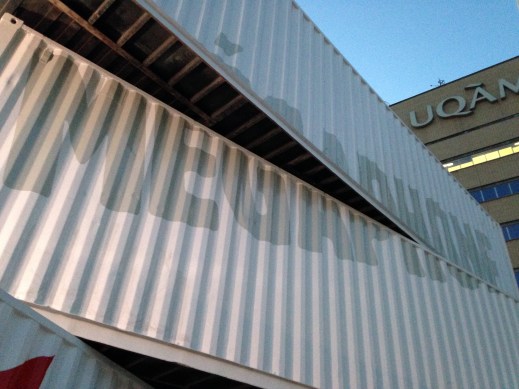
 Editor’s Note: This month Sounding Out! is thrilled to bring you a collection of posts that will change the way you hear cities. The Sounds of the City series will prompt readers to think through ideas about urban space and sound. Are cities as noisy as we think they are? Why are cities described as “loud”? Who makes these decisions about nomenclature and why?
We kicked things off three weeks ago with my critical reading of sound in Lorraine Hansberry’s A Raisin in the Sun, a play about African Americans in Chicago that still rings/stings true today. Two weeks ago, guest writer Linda O’ Keeffe took readers on a soundwalk of Smithfield Square in Dublin, Ireland and specifically of the Smithfield Horse Fair, in order to illustrate how urban renewal disrupts city soundscapes and how sound reclaims those spaces. Last week, regular SO! writer Regina Bradley discussed the dichotomy of urban and suburban in the context of sound (noisy versus quiet) and hip hop.
Today’s post comes from CFP winner Lilian Radovac, who shares with us a critical photoessay on the sound installation Megaphóne in Montreal.–Managing Editor Liana M. Silva-Ford
Updated with edits as of 12:28 pm EST
***
October, 2013. I’m waiting for the 80. It’s already dark and bitterly cold for fall, and the bus is predictably late. As the line of people waiting lengthens, traffic rushes past on President-Kennedy and north along Jeanne-Mance, punctuating the larger roar of rush hour in Montreal.
Suddenly, a woman’s voice lifts up out of the din. It’s hard to make out what she’s saying at first, but then a single phrase escapes from the thrum of traffic: “…freedom and democracy…” I look around, trying to place the sound. It’s gone. Several minutes later, the voice rises again: “Tell us again about freedom and democracy!” This time, my ears get a lock on the words and I leave my place in the line to follow them to their source.
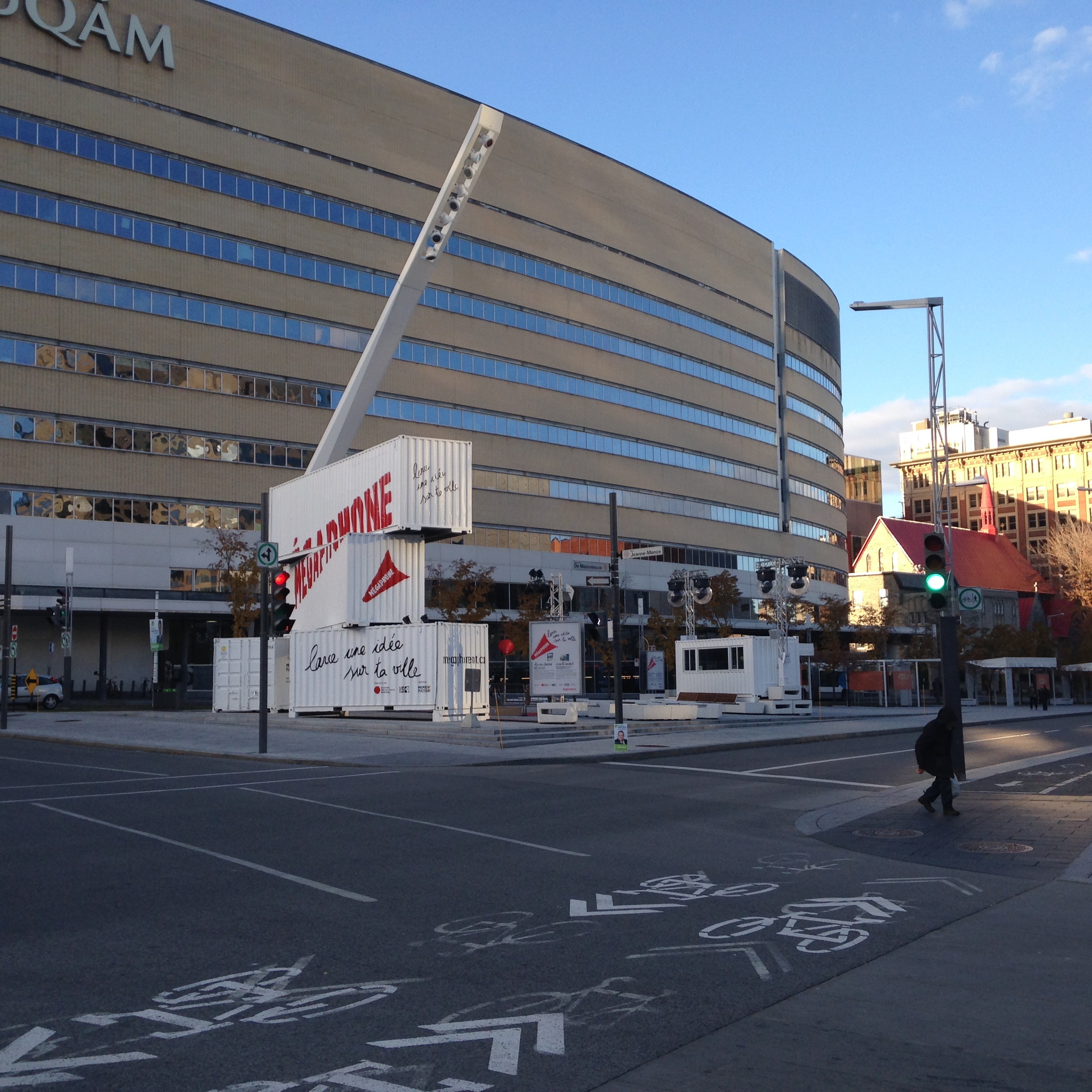
“Promenade des artistes”
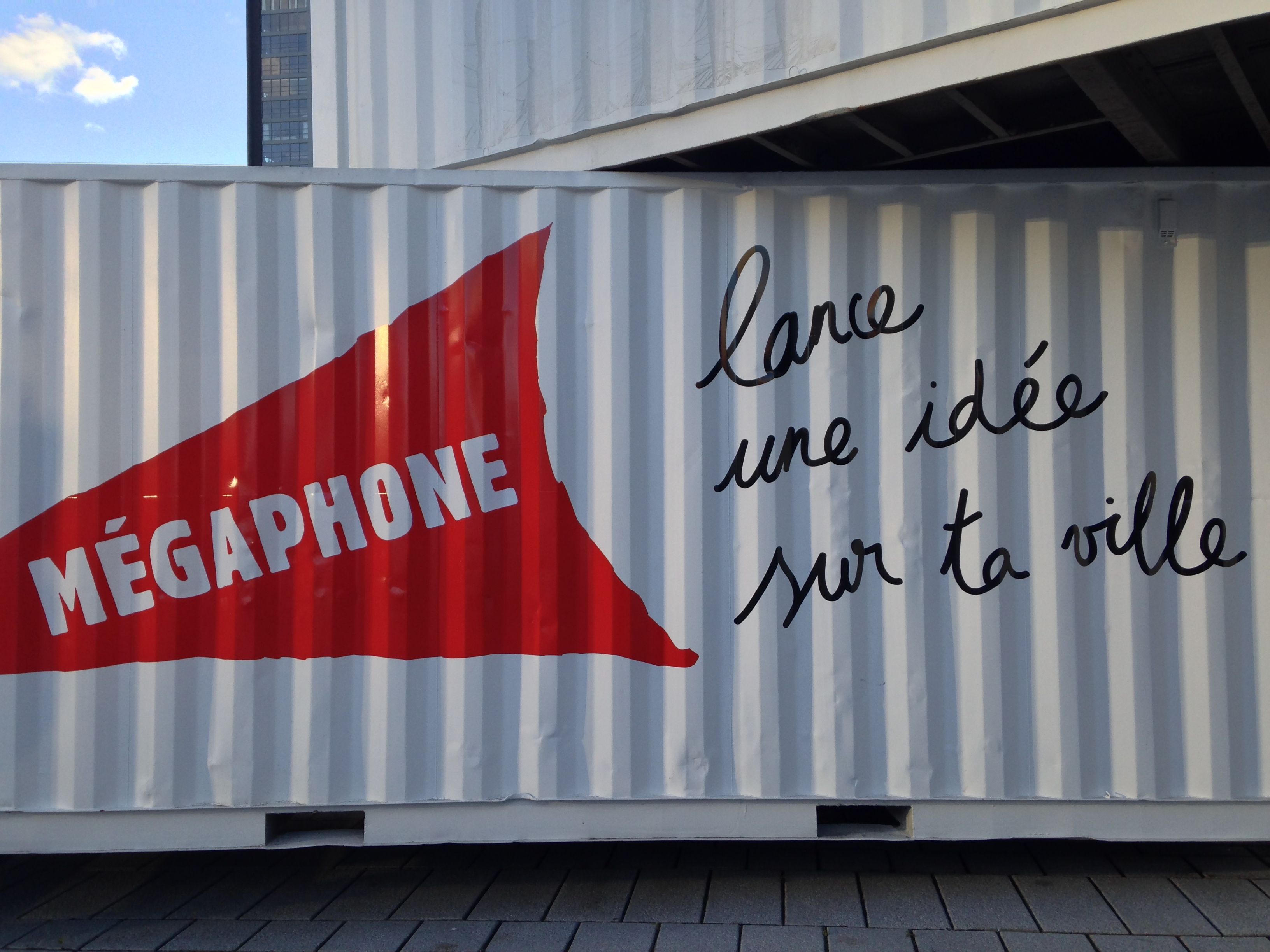
“Light up the city with your idea”
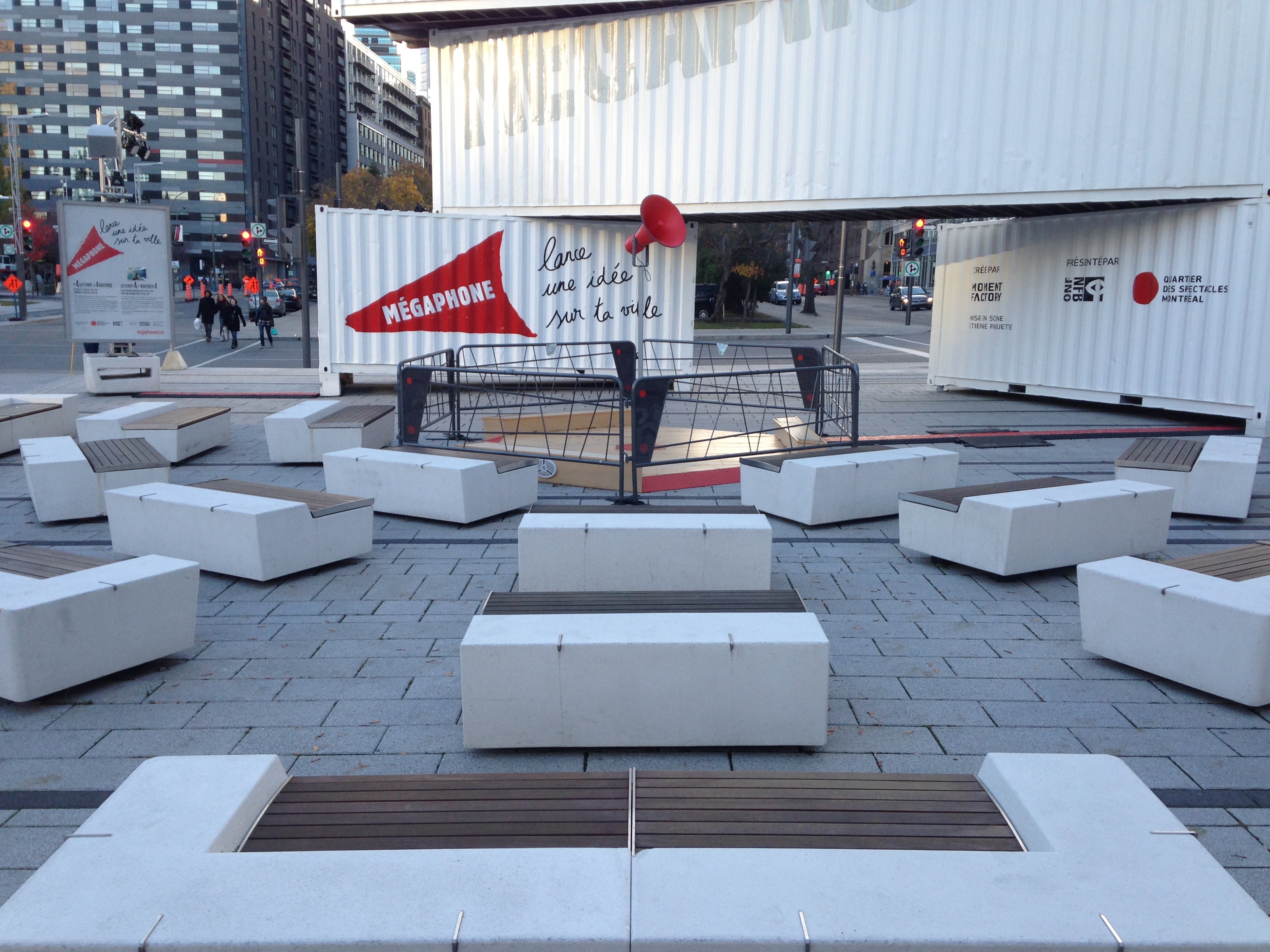
The amphitheater
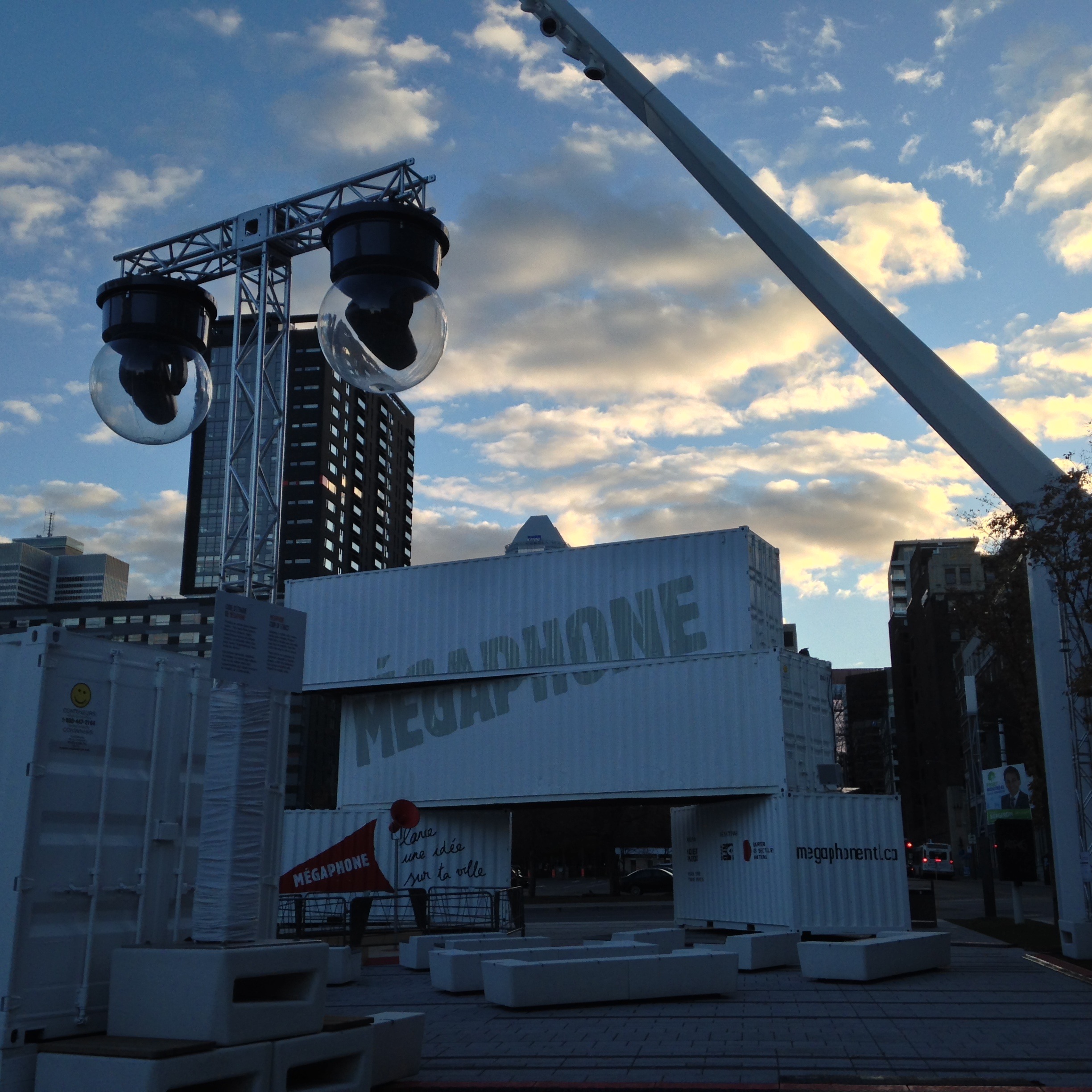
My feet bring me to the Promenade des artistes, a slim triangle of concrete that separates President Kennedy Avenue from De Maisonneuve Boulevard, and the sounds of Mégaphone. The promenade is the temporary home of the audiovisual installation produced by the multimedia studio Moment Factory, co-sponsored by the National Film Board of Canada and the Quartier des spectacles partnership. The installation is composed of three zones: to the west, a small outdoor amphitheater arranged around a large red megaphone; across the street, the University of Quebec at Montreal’s science pavilion, which doubles as a projection screen; and to the east, housed in a series of “event vitrines,” an audio exhibition of recordings by notable Quebec speakers who have “shaped public space in Montreal with their words.”
According to the accompanying press kit, Mégaphone is inspired by London’s Speaker’s Corner and Montreal’s interwar tradition of popular assemblies. Its stated goal is to “bring the art of public speaking back into the city.” It’s designed as an interactive experience, which encourages visitors to take to the stage during designated open mic periods and, by speaking into the megaphone, to “light up the city” with their ideas. Their speeches are first acoustically amplified, then processed by voice recognition software and projected onto the façade of the science building, which becomes a canvas for randomly generated keywords. Mégaphone is also timed to coincide with the run-up to Montreal’s November 4th municipal election, and features a program of scheduled speakers that includes an appearance by the city’s mayoral candidates.
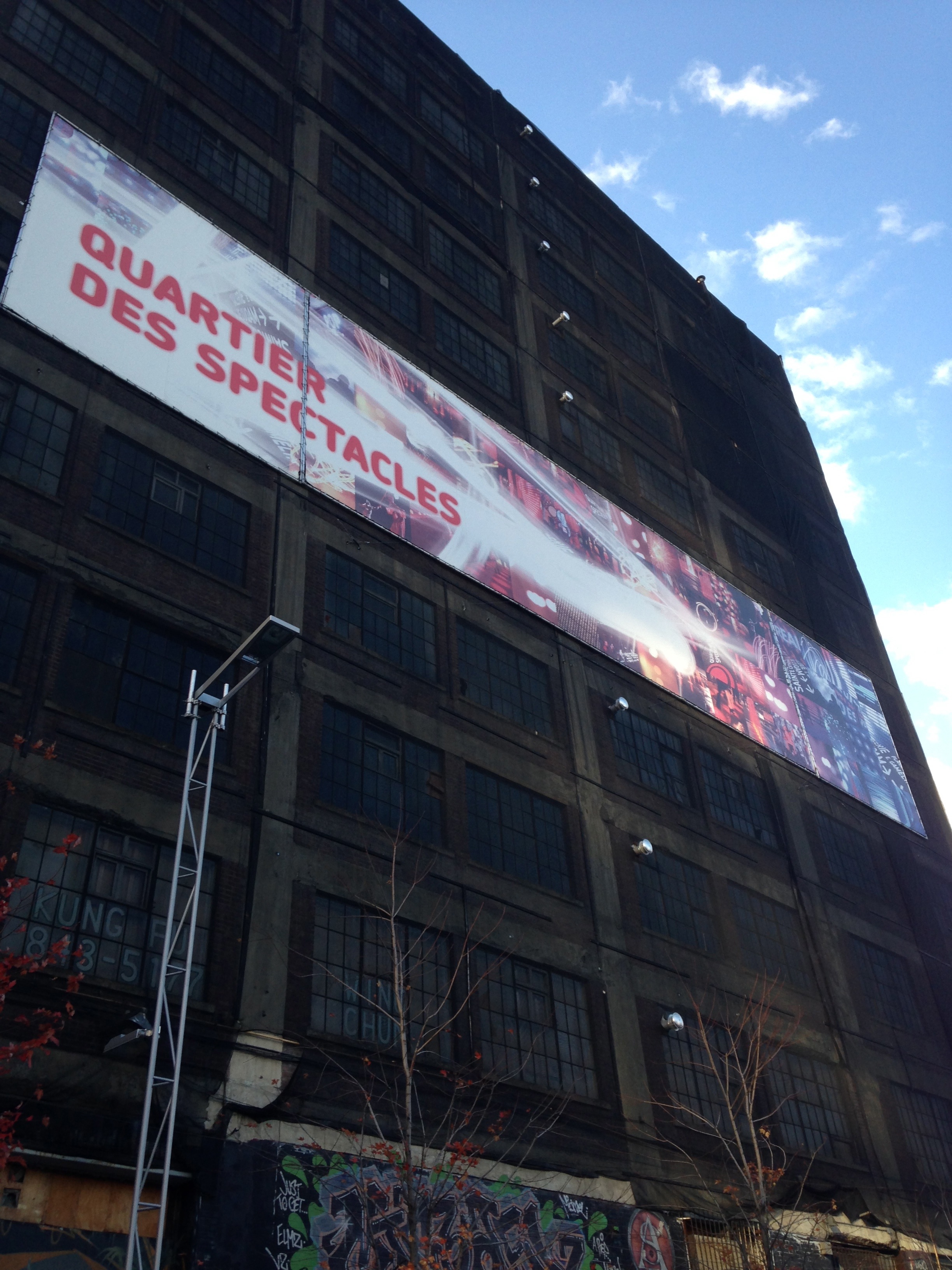
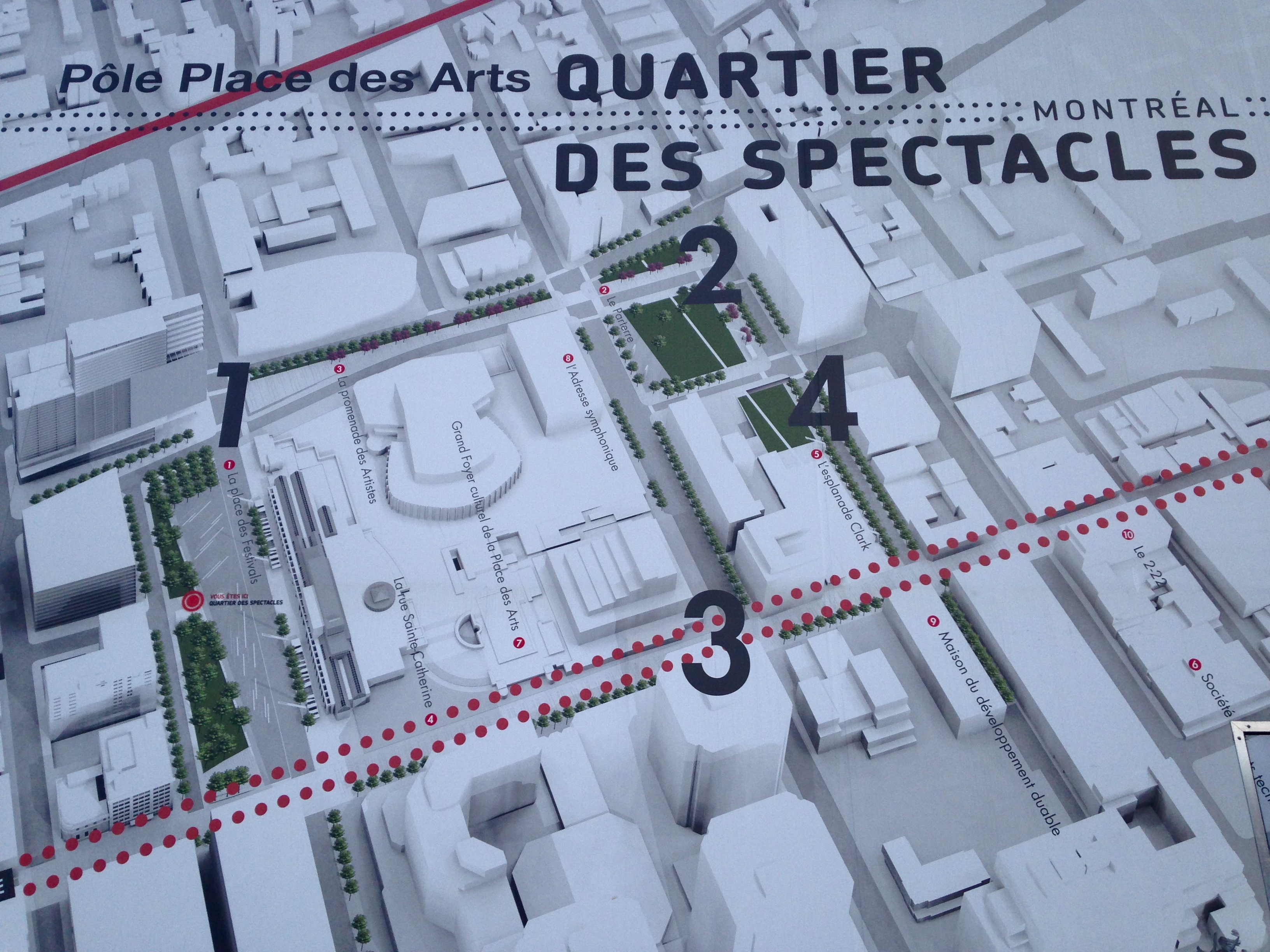
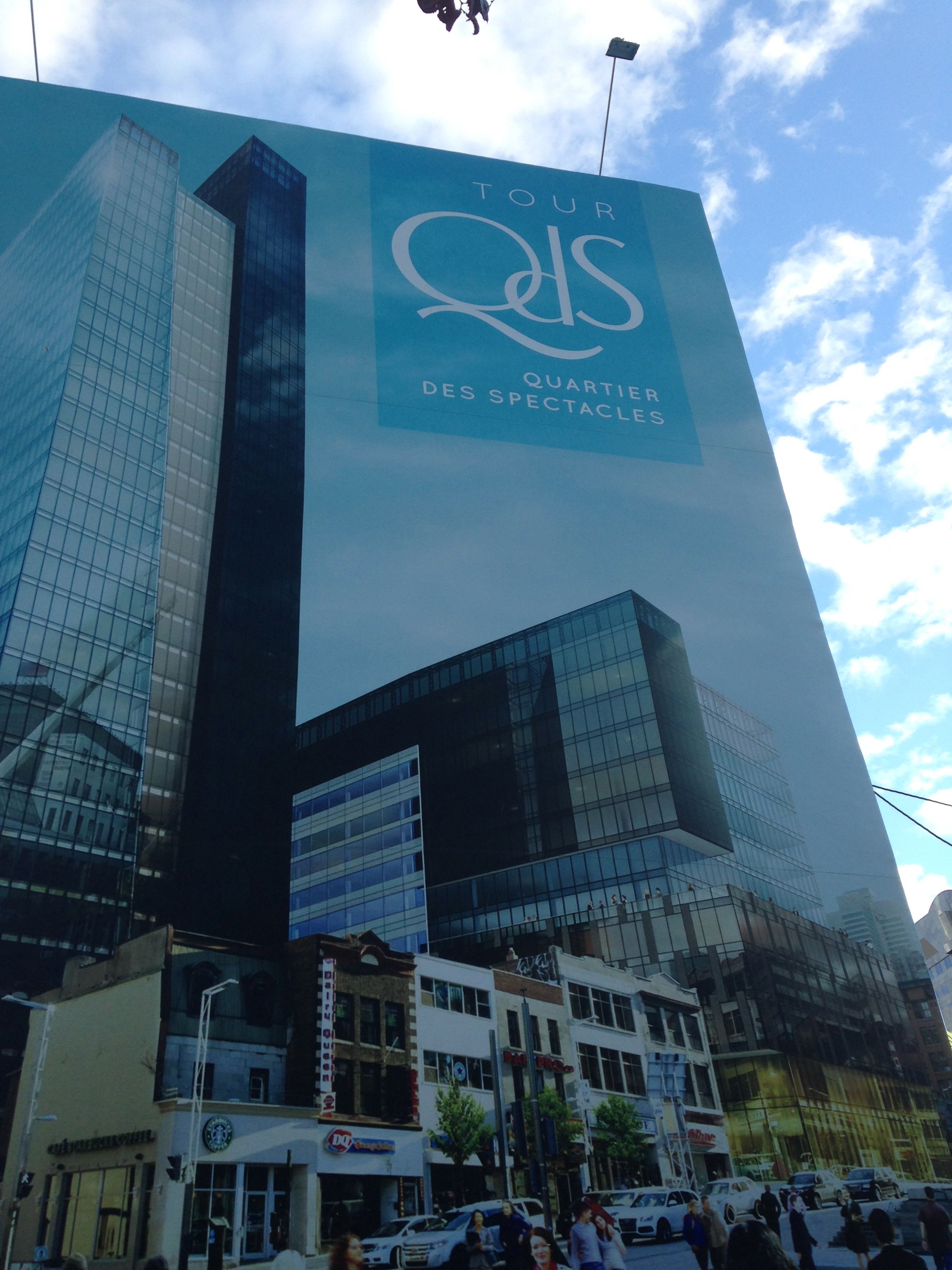
As I wander through the empty amphitheater, I find myself thinking that it’s a strange place for a sound installation. The Promenade des artistes is sandwiched between UQAM’s science campus and the northern border of Place des Arts, a Lincoln Center-style performing arts complex that occupies several city blocks. Jane Jacobs would have called this a “dead place,” lost as it is between a set of bicycle lanes and the science building’s indoor food court, which draws pedestrian traffic away from the open space of the street. On the day of my visit, I’m the only person there. Beyond the Promenade des artistes lies the larger Quartier des spectacles, an ongoing culture-led regeneration project which, in an effort to cement the city’s “brand” as a creative city, has concentrated Montreal’s outdoor cultural activities into a single, sprawling site. Traces of the working-class neighborhood it displaced peek out from behind construction fences, quietly attesting to the area’s industrial past.
Still following the voice, I walk towards the line of event vitrines, where seven audio exhibits map the aural contours of an imagined community made real. The speeches on display tell a story of Quebec’s emergence from its colonial past, when the province’s French-speaking majority was dominated by the Catholic church and a minority Anglophone elite. Each voice, in its way, speaks to a period of enormous social transformation fuelled by the dream of Quebec’s independence: Irving Layton delivers a lecture from an amplified podium; Gilles Vigneault sings “Gen du pays” from a stage at Parc Mont-Royal; Pierre Bourgault gives a firebrand speech at the Third Congress of the Parti Québécois. Only the seventeenth century Wendat Chief Kondiaronk remains eerily mute, his voice buried in the memoirs of his colonial French counterparts.
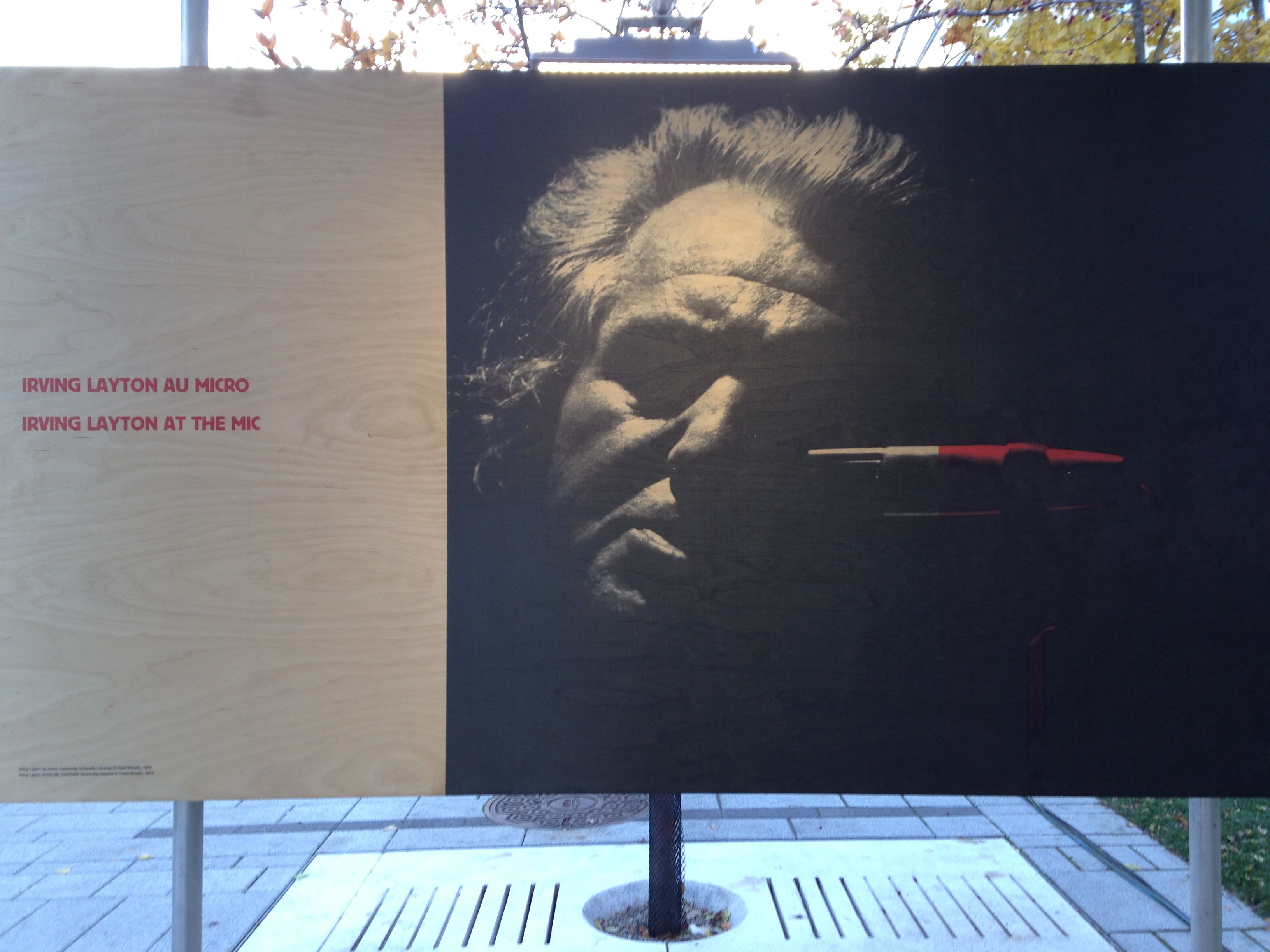
Irving Layton exhibit
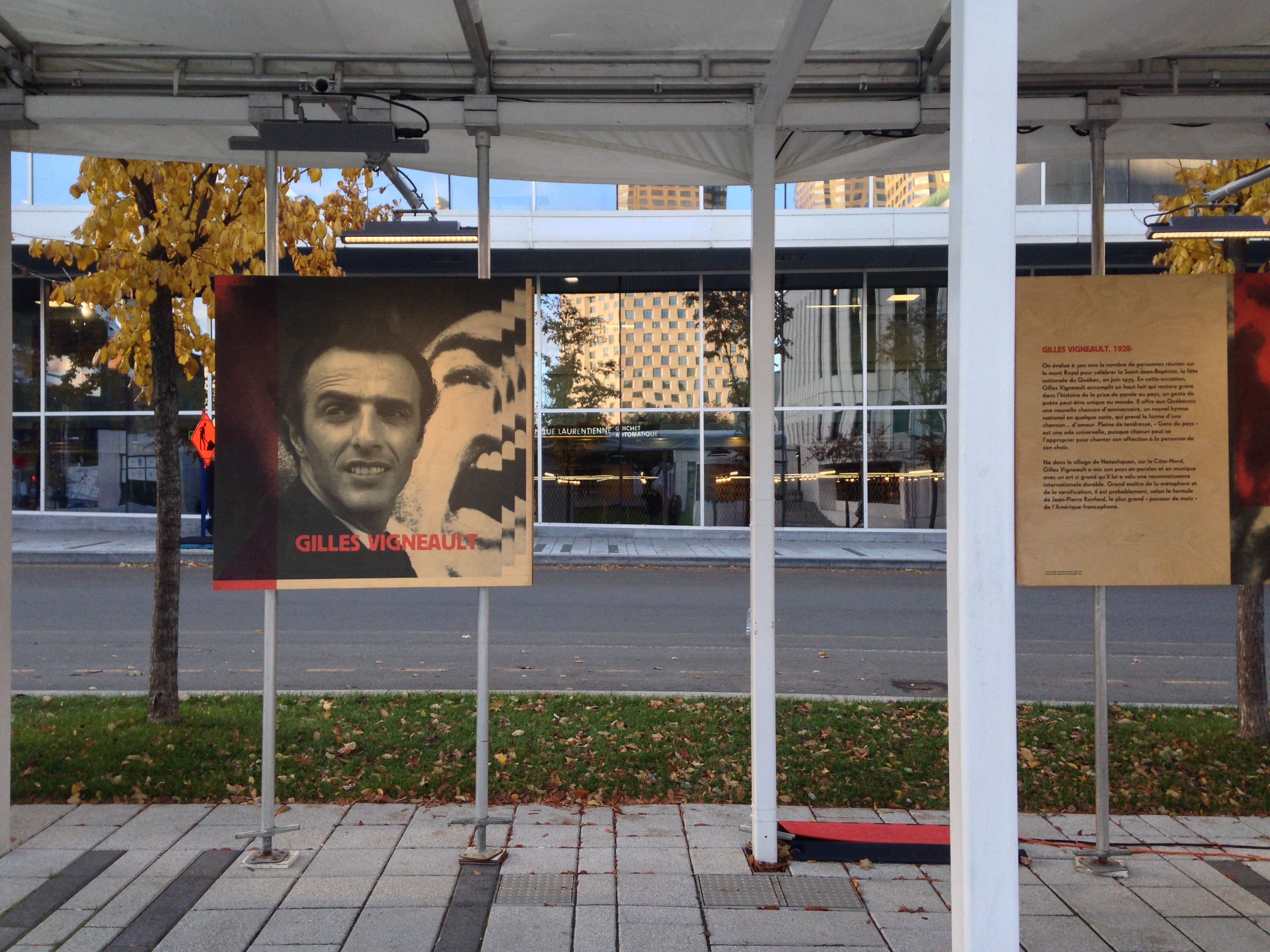
Gilles Vigneault exhibit
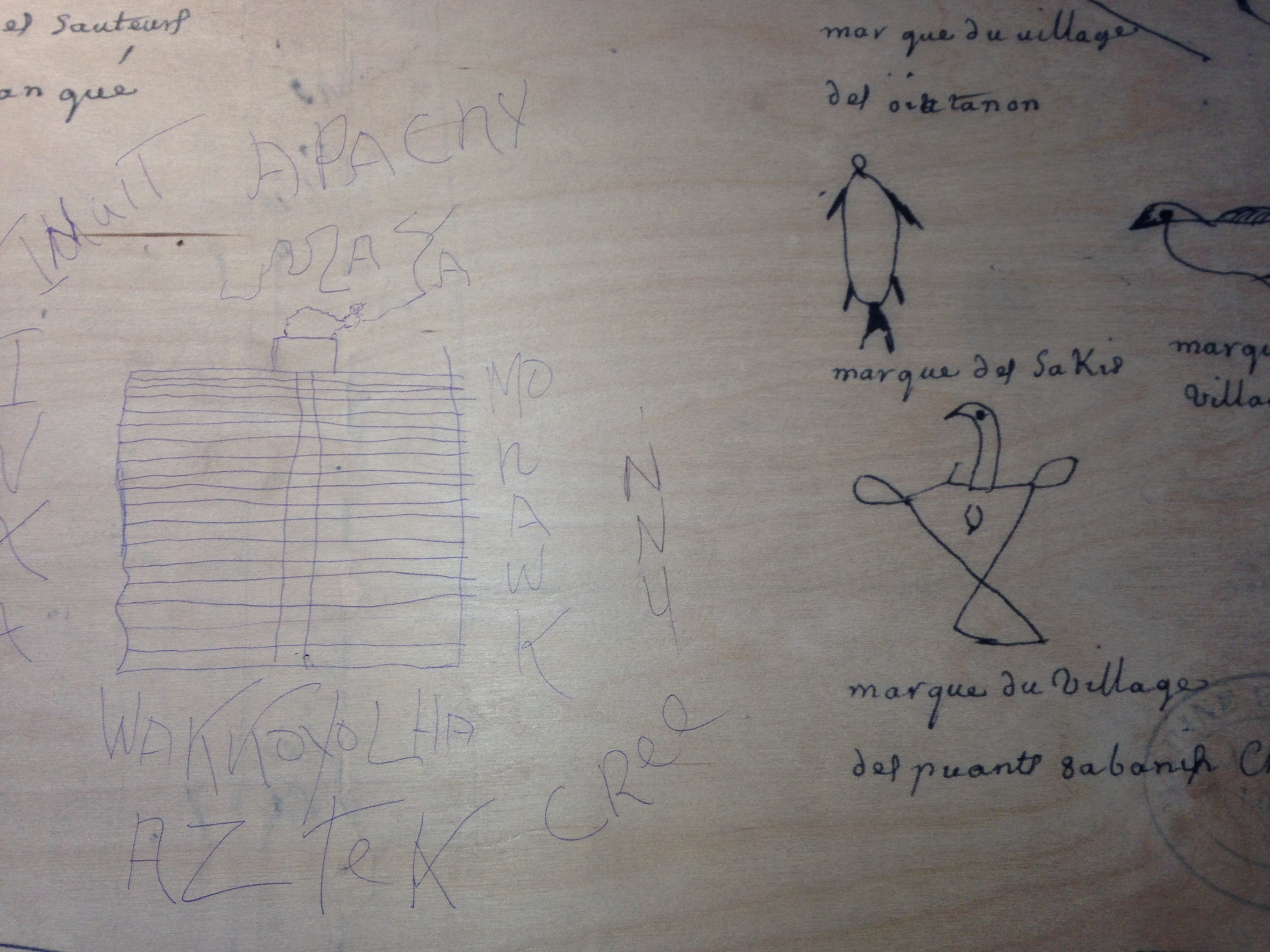
Kondiaronk exhibit, with graffiti
Poet Michèle Lalonde’s voice, however, dominates the space of the exhibit. It’s noticeably higher in pitch than the drone of traffic, and when it rises to meet the words “freedom and democracy” it pierces the low rumble of passing buses and trucks, filling the husk of the surrounding streets. The poem she reads is well known in Quebec, and the version on display here is central to the province’s history and identity as a nation. Recorded at La nuit de la poésie in 1970, the poem was first read at a 1968 benefit performance to support imprisoned members of the Front de libération du Québec, one of whom was Pierre Vallières, the author of Nègres blancs d’Amérique.
Inspired by Vallières’ memoir, “Speak White” is a double appropriation: of the English admonition to Francophones to abandon their mother tongue and, simultaneously, of the revolutionary potential of the Black Power movement of the 1960s, with which the most militant factions of the Quebec independence movement aligned themselves. It is, as Sean Mills has observed, an uncomfortable alliance in a province that struggles to recognize its own racism and status as a settler colony, but in the poetic space of Lalonde’s recitation the words still shudder with subaltern rage.
[Read English translation]
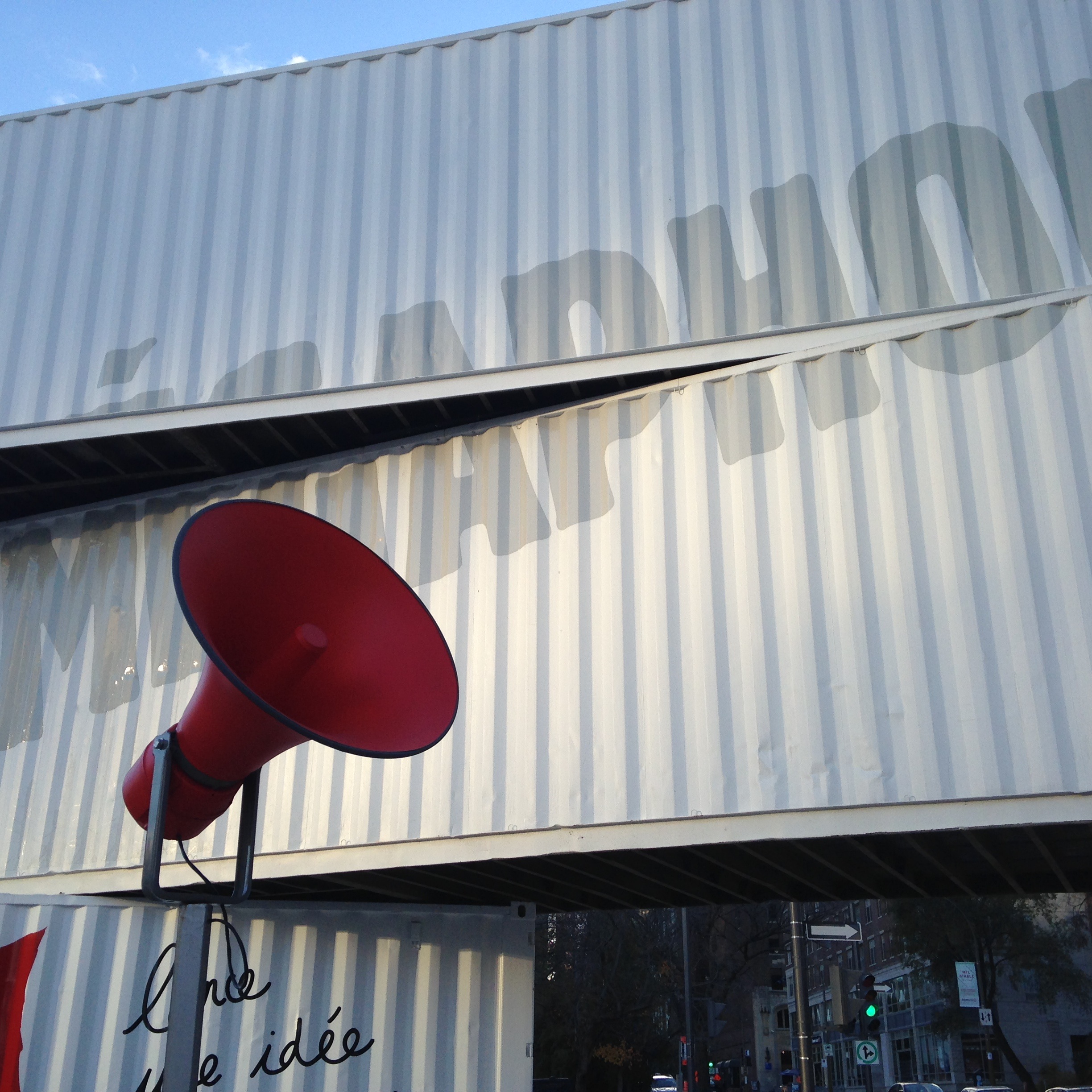
The term “megaphone” is something of a misnomer. The voices of participating speakers are amplified using a hand-held microphone that is connected to a stationary loudspeaker, which actually makes the megaphone more of a rudimentary public address system. It’s an important distinction, since the aural uses of the megaphone are shaped above all by its portability. Megaphones are a mobile audio technology and therefore a nomadic one; like boomboxes and iPods, they’re designed to be easy to carry and to be used while moving from place to place. The public address system, by contrast, is rooted in space: the speaking subject is anchored to the microphone and to the apparatus of amplification, which is composed not only of cables and loudspeakers but also the architectural elements (podium, stage, seating) of the auditorium.
More importantly, the portable megaphone is intended to be used outdoors and in crowds. Thomas Edison’s acoustic megaphone, which he patented in 1878, was soon used at sporting events and to magnify the voices of political leaders at outdoor public events. By 1900, street hawkers began selling makeshift megaphones to the politicians’ audiences, and their wares contributed to a new and noisy public sphere. When the megaphone was married to the transistor and to battery power in the 1950s, the technology was seized by social movements around the world, which used it to appropriate and disperse the power of the individual public speaker. Among them were the student and labor unions that flourished in the wake of Quebec’s Quiet Revolution, which had opened up a space for the province’s democratization.
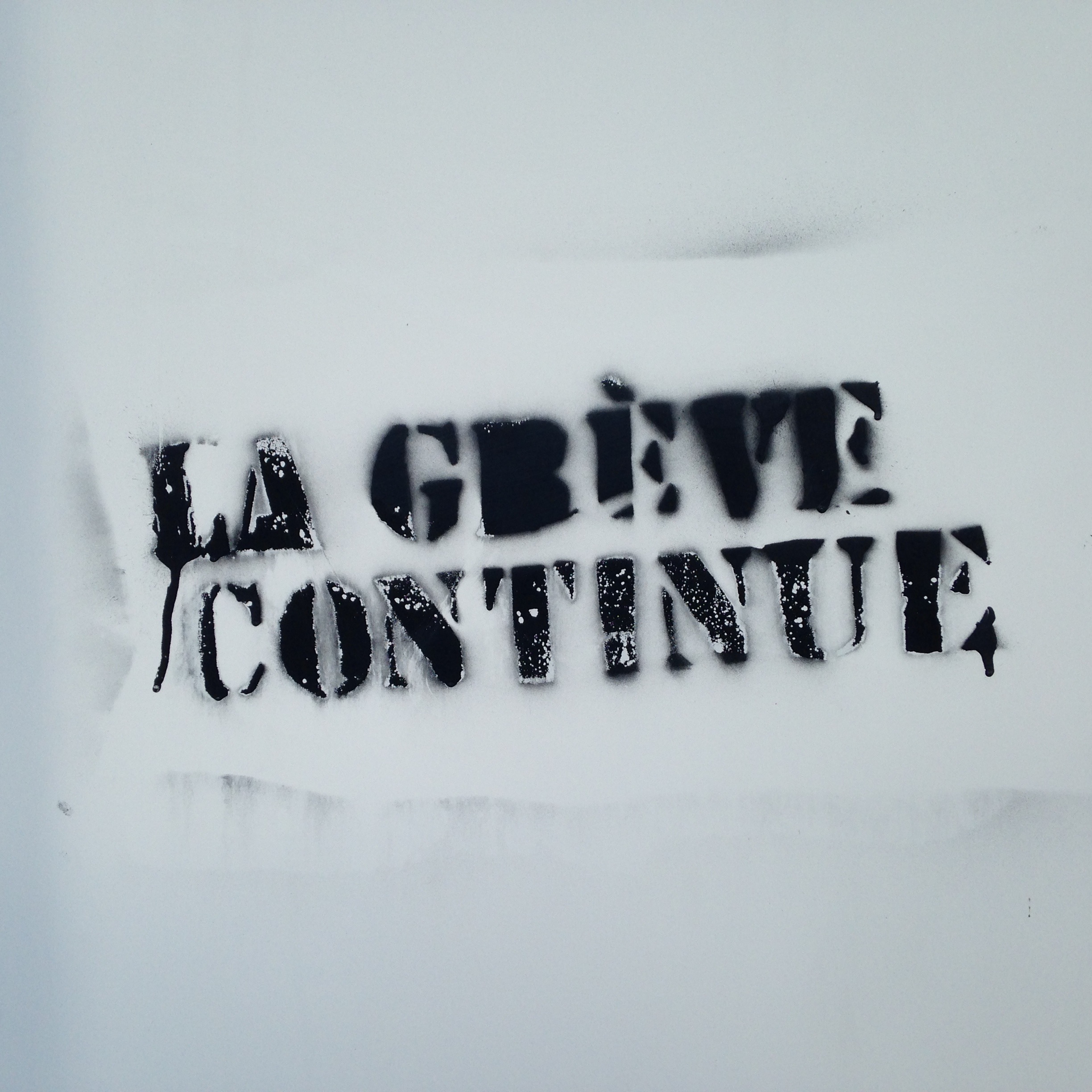
Strike graffiti
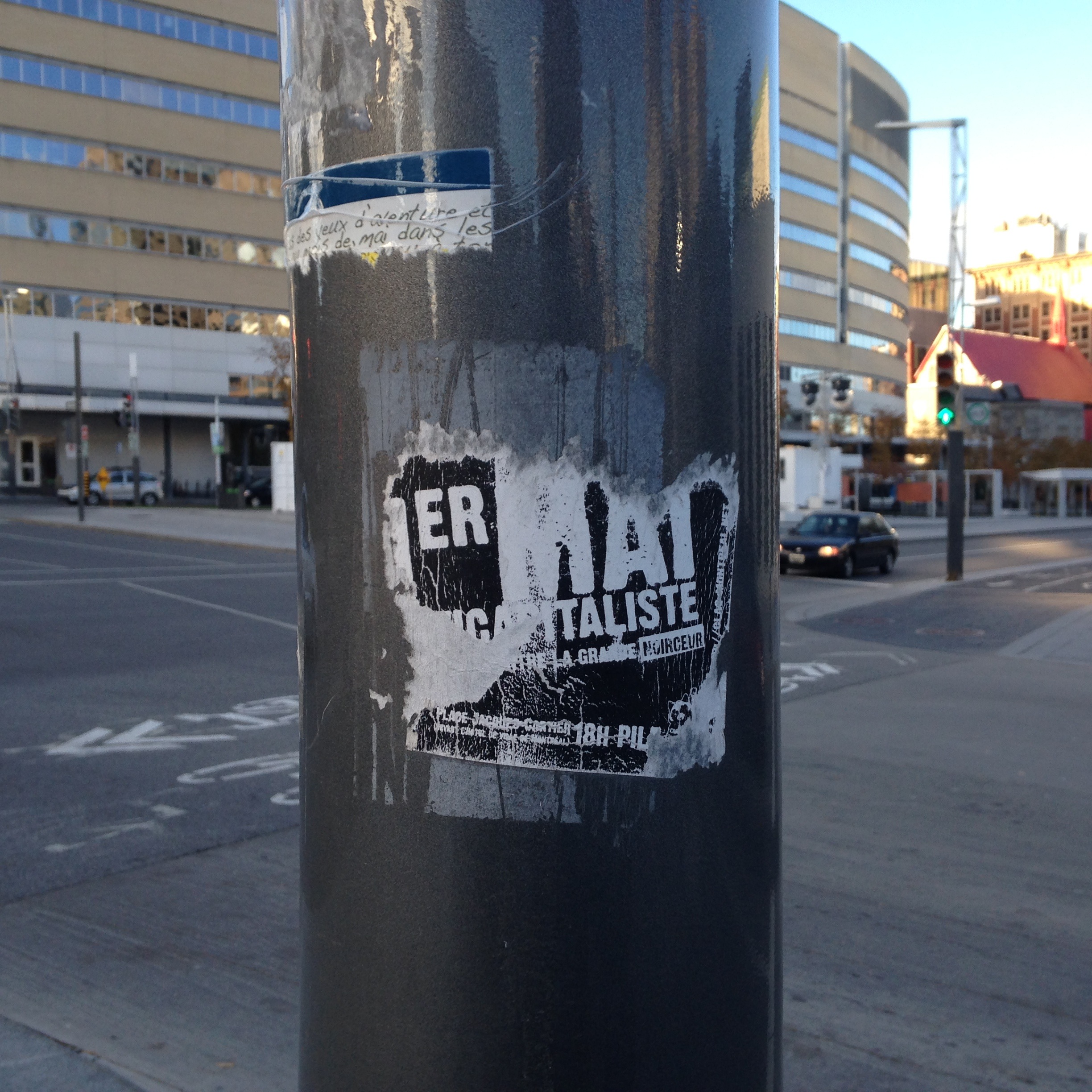
May Day poster
The year before Mégaphone opened, the promenades of the Quartiers des spectacles were crossed by hundreds and sometimes thousands of bodies that spilled out of Parc Émilie-Gamelin, where students and their supporters gathered for the nighttime demonstrations that became a hallmark of the Quebec student strike, or printemps érable. Each night at about 8:30 pm, we set off on marches that had no planned route and no final destination, walking for hours along streets that we claimed with nothing but our voices and the feet that carried them along. If you arrived late you could find the #manifencours on Twitter, or you could listen for the sounds of the crowd’s chants and the police helicopters that hovered constantly overhead, keeping large swaths of the downtown core awake until the early morning hours.
When the Liberal government attempted to break the strike with the reviled Bill 78, which required protest organizers to submit itineraries to the authorities in advance, the night marches dovetailed with a sudden explosion of casserole protests, which coalesced around autonomous popular assemblies organized at the neighborhood level. Within days, demonstrators fanned out across the city as roving bands of casserolières set off from Villeray, Mile End, Hochelaga, St-Henri and even staid, sleepy Outremont, erupting into cacophonous clangs and cheers as we found each other at the borders of our quartiers and merged into ever larger assemblages. If a city can light up with sound, then that is what happened here in Montreal.
These echoes of the printemp érable form the acoustic backdrop of Mégaphone, and the sounds of the installation are designed to bleed into listeners’ memories of the strike. But Mégaphone is as much about the management of acoustic space as a celebration of its potential. Walking through the Promenade des artistes, I’m struck by a palpable but unintended theme: containment. The voices on display, already tethered to their microphones, are further limited by a series of overlapping spatial and temporal boundaries. The stage is accessible only on certain days and during designated hours, and then only when not reserved for previously scheduled speakers. Like the Quartier des spectacles that surrounds it, the installation is segregated from the lived spaces of the city, out of earshot of most residents and removed from the rhythms of their everyday. As if to belabor the point, speakers are bound by the Mégaphone “code of ethics,” which permits “no tolerance for aggressive, obscene or hateful speech, or for any behavior that is not consistent with respect for public order [emphasis mine].” Presumably, the code does not apply to the Quebeckers whose commitment to radical politics earned them a place in Mégaphone’s pantheon of speakers.
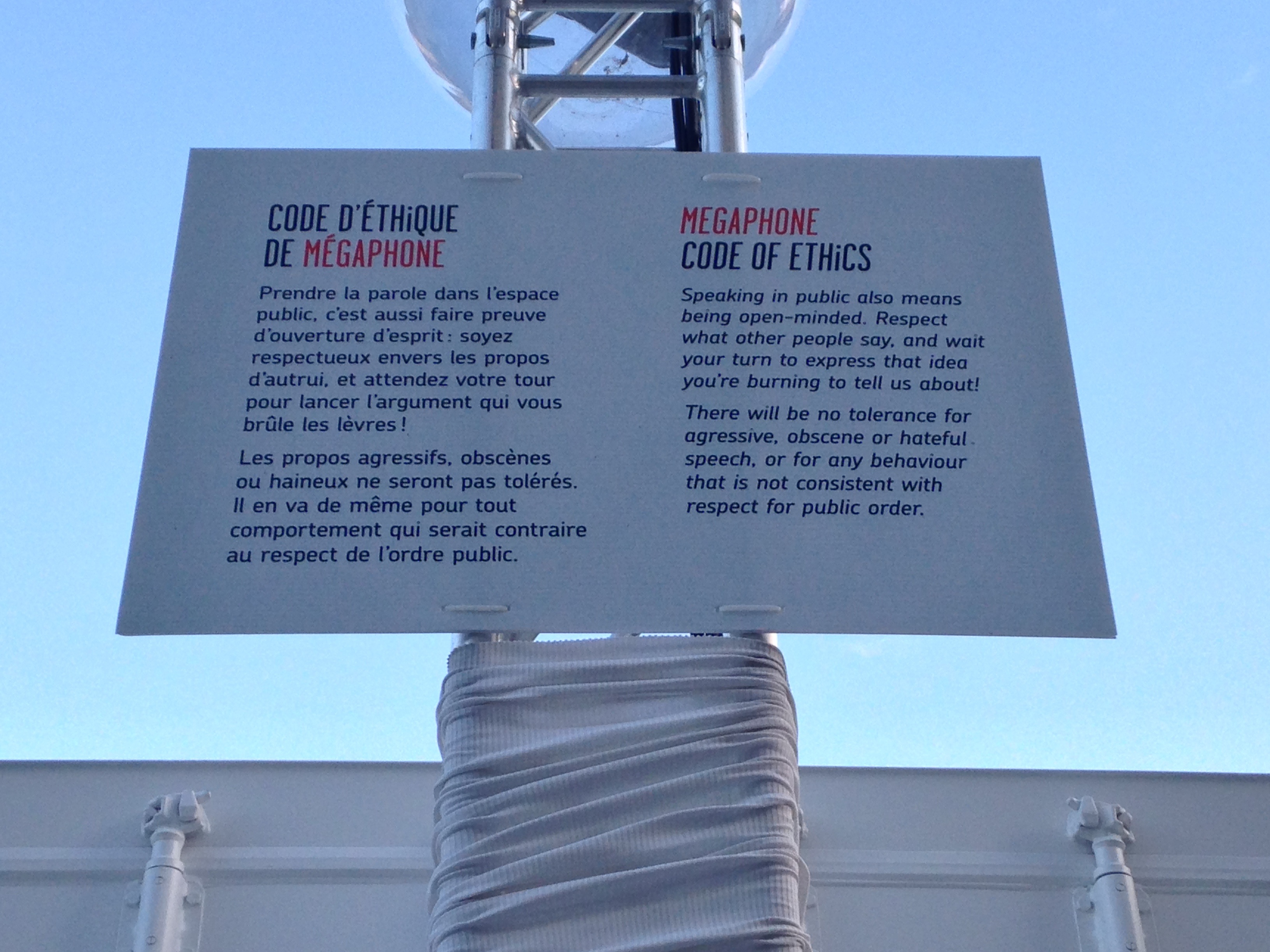
Code of Ethics
With its endlessly wandering marches and casseroles, the printemps érables was willfully inconsistent with respect for public order and its tactics reflected the anti-authoritarian impulses of the Quebec student movement. Simply by walking together, noisily and spontaneously, we recreated our city as a utopian space in which citizens, not governments, would chart their own course. By contrast, Mégaphone constrains the mobility of political speech, fencing it off in time and space and stripping it of its collective character. In doing so, it subjects the auditory space of the public sphere to what Don Mitchell terms a process of liberalization, drawing it away from the field of autonomous action and back under the stewardship of the state.
Philosophy professor Julien Villeneuve (better known as Anarchopanda) made this connection explicit when he and a group of fellow activists took to the Mégaphone stage to denounce municipal bylaw P-6, which, like Bill 78, requires protesters to inform the police of their activities under threat of arrest and massive fines. While Bill 78 (later Law 12) was repealed after a national outcry, P-6 remains in effect and its enforcement is in large part responsible for ending the strike and for the continuing suppression of public protest in Montreal.
As I walk back towards the bus stop, my fingers numb inside my mittens, I consider how much Mégaphone feels like a memorial to the city’s noisy public sphere, which, for the moment at least, is safely confined to the past.
—
Acknowledgements:
Sincere thanks to Jonathan Sterne, Erika Biddle, Magdalena Olszanowski, Ted Rutland, Liz Miller and the Tapas Gals for the conversations that contributed to this post.
—
Featured image: by Lilian Radovac
—
Lilian Radovac is a writer, organizer and doctoral candidate in communication studies at McGill University. She is currently finishing her dissertation on the cultural history of noise control in New York City, a chapter of which, “The ‘War on Noise’: Sound and Space in La Guardia’s New York,” was published in Sound Clash: Listening to American Studies (John Hopkins, 2012). Her work has also appeared in Times Higher Education, The Chronicle of Higher Education, TOPIA: Canadian Journal of Cultural Studies, and Communication and Critical/Cultural Studies.
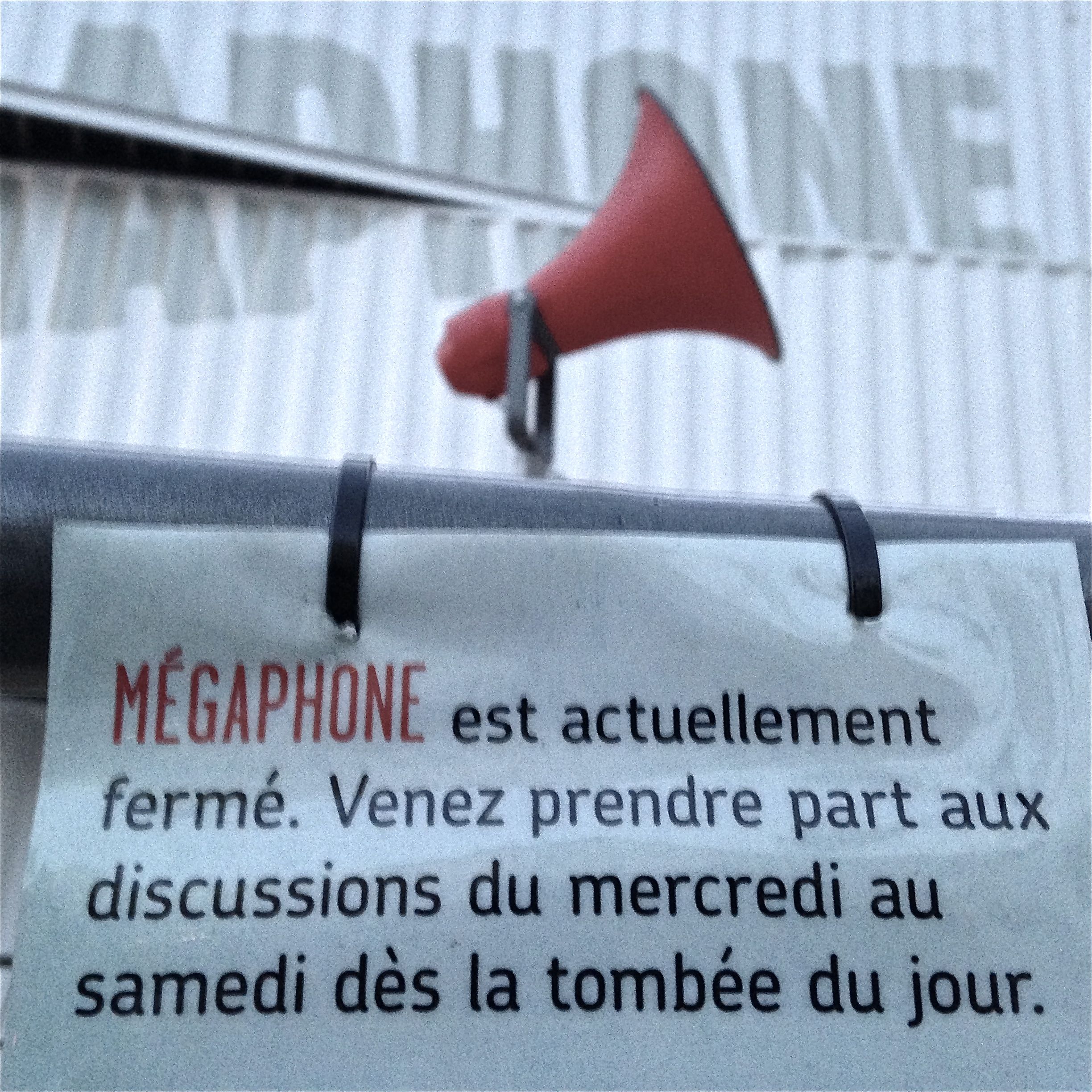
Fermé
—
REWIND!…If you liked this post, you may also dig:
“Quebec’s #casseroles: on participation, percussion and protest”-Jonathan Sterne
“Deejaying her Listening: Learning through Life Stories of Human Rights Violations”-Emmanuelle Sonntag and Bronwen Low
“Listening to the Border: ‘”2487″: Giving Voice in Diaspora’ and the Sound Art of Luz María Sánchez”-D. Ines Casillas
Share this:


Current Top Posts





April 2021

January 2020

November 2019

October 2019

August 2019

April 2014

November 2017

March 2015

December 2017

October 2015
 Sounding Out!
Recent Comments