
Sound at SEM/CORD 2011
DOI: https://doi.org/10.59350/64xgw-rg530

THURSDAY PANELS
8:30 am -10:30 am
Sounding Religion in the Public Sphere
SEM: 1E Freedom Ballroom (Section F) Chair: Monique M Ingalls, Rutgers University
Monique M Ingalls, Rutgers University. Worship in the Streets: Performing Religion, Nation, and Ethnicity through Music in Toronto’s Jesus in the City Parade
Carolyn Landau, King’s College London. Pluralism, Tolerance and Engagement with the “Mainstream”: Navigating Ismaili-Muslim Identities in Public Musical Performances
David M Kammerer, Brigham Young University-Hawaii. Anything But a “Silent Night”: Tonga’s Royal Maopa Brass Band and the Tradition of Christmas Eve Serenading
Deborah Justice, Indiana University. When Sacred Space becomes Secular Space: How a Church’s Saturday Dinner Show for Charity Eases Sunday Morning Tensions
.
Recovering and Composing Hybridity through Histories of Music and Violence
SEM: 1I Salon 5/6 Chair: Jessica A Schwartz, New York University
Jessica A Schwartz, New York University. Between Continuity and Disruption: Strategic Hybridity in the Musical Activism of Rongelapese Women
T. Christopher Aplin, independent scholar. Martial Cosmopolitans: Apache War and Song Beyond Borders during the “Loco Outbreak”
Kristy Riggs, Columbia University. Musical Fabulation and the Retelling of Violence in 1840s Algeria
Sarah McClimon, University of Hawaii at Manoa. War Memories Revisited: Hybrid Nationalism and Discourses of Cultural Purity in Japanese Military Song Festivals
.
Dancing Matter(s): Embodied Practices in Music and Dance
SEM: 2A Freedom Ballroom (Section E), Live Video-Streaming Room Chair: Tomie Hahn, Rensselaer Polytechnic Institute
Tomie Hahn, Rensselaer Polytechnic Institute. Dancing with Sensible Objects
Sean Williams, Evergreen State College. Dancing with the Drum: Teaching and Learning Sundanese Jaipongan
Sally Ann Ness, University of California, Riverside. Dancing Instruments; Objectivity in Musical Performance
.
Vocal Epistemologies: Bodies, Pedagogy, Practice
SEM: 2H Salon 3/4 Chair: Robert O Beahrs, University of California, Berkeley
Robert O Beahrs, University of California, Berkeley. Echoing through the Nine Skies: Embodied Knowledge Production in Tuvan Throat-Singing Pedagogy
Marti Newland, Columbia University. Cocolo Japanese Gospel Choir: Mediating Spiritual and Racial Difference through Vocal Adduction
Sumitra Ranganathan, University of California, Berkeley. Dwelling in my Throat: Sound and Experience in a North Indian Classical Dhrupad Tradition
.
Local Philadelphia Communities
CORD: Independence Ballroom D
Laura Vriend. Sufjan Stevens and the Magic Snowflake: Sound and Spatiality in Headlong Dance Theater’s Explanatorium
Christine Dang. My Laudations Shorten for me the Journey to the Saints’: The Poetics of Exile in an Islamic Community of Philadelphia
Abimbola N. Cole. Welcome to the United Stated of Africa: Kwame Nkrumah’s Philadelphia Years, African Nationalism, and Hip-Hop Perspectives on Unity in the New Africa
.
Sacred Journeys, Spaces, Sounds
CORD: Logans 1
Andrea Mantell Seidel. Sacred Sound: Tuning the Cosmic Strings of the Subtle Dancing Body
Emily Wright. Sacred Spaces: History and Practice in Christian Sacred Dance
Lizzie Leopold. Voyager, A Journey into Our Outer Spaces: A Choreographic and Scholarly Exploration
.
1:45-3:45pm
Techno-Mediated Performance: Virtual, Visceral, Spectacular
SEM: 3E Freedom Ballroom (Section F) Chair: Kiri Miller, Brown University
Kiri Miller, Brown University. Virtual Transmission, Visceral Practice: Dance Central and the Cybershala
J. Meryl Krieger, Indiana University-Purdue University Indianapolis. From Live Performance to Mashup: Mediated Performance in Popular Music
Judith Hamera, Texas A&M University. Dances with Zombies: Michael Jackson and Movement in the Age of Post-Industrial Reproduction
Sydney Hutchinson, Syracuse University. Downloading Dance: OK Go, YouTube, and the Future of Pop
Gendered Intimacies and Musical Negotiations of Space
SEM: 3F Freedom Ballroom (Section G) Chair: Ian R MacMillen, University of Pennsylvania
Anna Stirr, St. John’s College, University of Oxford. Sensuality, Exchange, and Violence in Nepali Nightclubs
Gavin Steingo, Columbia University. On the Sonic Politics of Spinning
Ian R MacMillen, University of Pennsylvania. Conscription into Intimacy: Young Men, Power, and the Gendered Inclusion of Croatian Tambura Musicians
Jane Sugarman, CUNY Graduate Center, Discussant
.
Round Table – Sound and Sense in the Muslim World: The Politics of Listening
SEM: 3J Parlor A Chair: Deborah Kapchan, New York University
Jonathan Glasser, College of William and Mary
Rich Jankowsky, Tufts University
Galeet Dardashti, independent scholar
Deborah Kapchan, New York University
Michael Frishkopf, University of Alberta
.
THURSDAY INDIVIDUAL PAPERS
Noel Lobley, University of Oxford, Pitt Rivers Museum. Recording, Remembering and Using the Sounds of Africa
2:15 SEM: 3H Salon 3/4
Gregory Weinstein, University of Chicago. An “Acoustically Perfect Hall”?: Engineering Space in Classical Recordings
3:15 SEM: 3H Salon 3/4
.
Sound Studies has been celebrated, as Kara Keeling and Josh Kun recently pointed out in American Quarterly, as both the result of and inspiration for an increasing number of scholars, who “not only take the culture, consumption, and politics of sound seriously but are making it the centerpiece of their research, publishing, and pedagogy.” But what significance does Sound Studies hold for ethnomusicology, a discipline that for over half a century has focused directly on the social and political dimensions of what John Blacking famously called “humanly organized sound”? This question will be one of many circulating in Philadelphia this week at the 56th annual meeting of the Society for Ethnomusicology (SEM).
Despite the centrality of ethnographers of music, including Steven Feld and Veit Erlmann, to the emergence of this new interdisciplinary body of knowledge, many ethnomusicologists saw room for greater dialogue with other disciplines for whom the sonic was a relatively novel epistemological filter. To this end, in early 2009 a group of young SEM members formed the Sound Studies Special Interest Group (SSSIG) in order to foster cross-disciplinary discussions and highlight work within SEM that reimagined sound beyond “the music itself.” This year’s conference will mark the end of my tenure as co-chair of the Sound Studies SIG, and elections will be held for a replacement at our annual lunch meeting on Thursday, November 17th. If you are interested in joining the group and can attend the conference, please join us. If you can’t make it to Philadelphia, you can still join the group’s active discussion forum.
The past few years have witnessed an increasing number of presentations at SEM that fall under the umbrella of Sound Studies, a trend acknowledged in the theme of last fall’s meeting in Los Angeles, “Sound Ecologies.” This year is no different, and from a preliminary glance at the program, I have taken the liberty of highlighting a few acoustic currents running throughout the conference. A large number of panels this year are devoted to issues of embodiment, which can, for the most part, be attributed to the fact that SEM has paired up with the Congress on Research in Dance (CORD) for a joint conference. In the summary below I have noted which group is sponsoring each panel listed, although the conference requires only one registration and all panels are open to all participants and attendees.
The theme of this year’s joint conference is “Moving Music / Sounding Dance: Intersections, Disconnections, and Alignments between Dance and Music.” Many of this year’s panels focus on the relationship between sound and bodies, including embodied practices in music and dance and bodily communications of carnality, empathy and affect, and music and movement, for example. The voice is also prominent this year, in panels on its relationship to the body and music, dance performance in the Pacific Islands, pedagogy and practice, and female Iranian vocalists in exile. As in other years, the relationship between ethnomusicology and medicine is also represented, as are music’s connection to healing and the sporting body.
Technology, another area of interest for Sound Studies, will receive thorough attention this year. Panels on techno-mediated performance, sound and technology, online gamespaces and prosthetic technologies of queer expression, and material culture and labor.
Looking beyond sound toward intersensoriality, many panels discuss the relationship between the aural and other senses, in terms of music visualization, sound, sight and time, ethnographic film, and sensing movement and sound in dance.

- The Painted Bride Art Center
Two events that promise to be of special interest will focus on language, one a roundtable on keywords in music and motion, the other a panel on the lexicon of music, noise, sound, and silence.
A number of panels hearken back to early work on soundscapes, from discussions of field recordings and ethnography and gender and negotiating space, to the sounds of post-industrial society, protest and public spaces, and boomboxes and dance parties. My last official duty as SSSIG co-chair will be to lead a soundwalk through Philadelphia’s city center. This soundwalk is an event that the SSSIG would love to see annually as a way to connect meetings to their immediate environs.
All in all, this year’s joint conference promises to be an enjoyable one, with plenty of fascinating presentations and more good music than you can shake a tailfeather at. Even if you can’t attend, you can follow along virtually on twitter. Both #SEM2011 and #2011SEM seem to be in use.
—
Bill Bahng Boyer is co-chair of the Society for Ethnomusicology Sound Studies Special Interest Group and a lecturer in music, writing and rhetoric at Dartmouth College. He is also a doctoral candidate in music at New York University, completing a dissertation on public listening in the New York City subway system.
Jump to FRIDAY, November 18
Jump to SATURDAY, November 19
Jump to SUNDAY, November 20
EVENTS
SEM Sound Studies Special Interest Group Meeting
12:30 pm – 1:30 pm Salon 5/6
SEM Audio Visual Committee
12:30 pm – 1:30 pmFreedom Ballroom (Section G)
SEM Student Open Meeting, Sponsored by the Student Concerns Committee
12:30 pm – 1:30 pm Independence Ballroom (Section A)
SEM SSSIG Philadelphia Soundwalk
Led by Bill Bahng Boyer, SSSIG co-chair
4:00 pm – 5:30 pm 4K Hotel Lobby
SEM/CORD Joint First-Time Attendees and New Members Reception
5:30 pm – 6:30 pm Horizons Rooftop Ballroom
.

FRIDAY PANELS
8:30 pm -10:30 pm
Round Table— Keywords of Music and Motion
SEM: 5D Independence Ballroom (Section C) Chair: Christina Zanfagna, Santa Clara University
Christina Zanfagna, Santa Clara University
Jason Stanyek, New York University
Melvin Butler, University of Chicago
Tamara Roberts, University of California, Berkeley
Martin Daughtry, New York University
.
Intimately Political: Bodily Communications of Carnality, Empathy and Affect in Dance Practices and Criticism.
CORD: Freedom Ballroom H
Evandne Kelly. Embodied Affects of Nationalism and Ethnicity in the Dances of Fijian Diasporas in Canada
Emma Doran. Dancing in Your Seat: Reading Empathy in Print Media
Shawn Newman. It’s all in the hips: Sexual and Artistic Minority in Canadian Concert Jazz Dance
.
10:45am-12:15pm
Rethinking Music Visualization
CORD: Independence Ballroom D
Paul Scolieri. Ruth St. Denis, Walter Benjamin, and the Mimetic Faculty
Daniel Callahan. Absolutely Unmanly: The Music Visualizations of Ted Shawn and His Men Dancers
Stephanie Jordan. Troubling Visualisations: Mark Morris Marks the Music
.
1:45-3:45pm
Sounds of Difference and Recognition: Music, Interculturalism, and Belonging in the European Nation-State
SEM: 7C Independence Ballroom (Section B) Chair: Benjamin Teitelbaum, Brown University
Joshua Tucker, Brown University. New Latinos in the Old World: Music, Multiculturalism, and Ethnogenesis in a Changing Spain
Benjamin Teitelbaum, Brown University. Unity Intoned: Music and the Rhetorical Paradoxes of Swedish Radical Nationalism
Adriana Helbig, University of Pittsburgh. The Influence of Paul Robeson?s Musical Legacy on Soviet and Post-Soviet Racial Ideologies
Timothy Rice, University of California, Los Angeles. Discussant
.
SEM: 7I Salon 5/6 Chair: Leslie Gay, University of Tennessee, Knoxville
Trevor S Harvey, Florida State University. Live from Second Life: Social Actualization through Musical Participation in Virtual Worlds
Alan Williams, University of Massachusetts, Lowell. All Hands On Deck: Choreographed Intimacy in the Analog Mixing Process
Tim Miller, University of North Carolina at Chapel Hill. Instruments as Technology: Co-constructing the Pedal Steel Guitar
Lauren Flood, Columbia University. Arduino Revolution: Hacking the Way to New Sounds and Moveable Art with Open Source Technology
.
SEM: 7J Parlor A Chair: Elizabeth Tolbert, Peabody Conservatory, Johns Hopkins University
Max M Schmeder, Columbia University. At One With One’s Instrument: Transcending the Body-Instrument Divide
Katherine L Meizel, Bowling Green State University. Hearing Voices: Toward a Model for the Study of Vocality
Peter Williams, University of Kansas. Docile Bodies Improvising: Gender and Constraint in Improvised Music and Movement
John R Pippen, University of Western Ontario. Moving New Music: Disrupting the Mind/Body Divide in Western Art Music
.
CORD: Independence Ballroom D
Toni Shapiro-Phim. A Sacred Melody and Innovative Choreography in Cambodia
Karen Schaffman. Kinesthetics of Crying and Soundtracks of Tears: Performing Grief in Works by Deborah Hay and Ralph Lemon
Carlos Odria. Improvising Transcendence for Health and Healing: Spontaneous Sounds and Bodies in a Dance Composition Class
Rodrigo Caballero. Sound, healing and the body: acoustemologies of health in the Pacific Northwest
.
4:00-5:30
The Body in Flow: Sport as Dance
SEM: 8A Freedom Ballroom (Section E), Live Video-Streaming Room Chair: Jonathan M Dueck, Duke University
Jonathan M Dueck, Duke University. The Big Dance: Sound, Gender, and Flow in Collegiate Basketball
Timothy J Cooley, University of California, Santa Barbara. To Surf is to Dance: Hawaiian Mele and Hula and the History of Surfing
Judy Bauerlein, California State University, San Marcos. A Wave is A Body In Motion
.
SEM: 8E Freedom Ballroom (Section F) Chair: Gregory Barz, Vanderbilt University
William Cheng, Harvard University. Acoustemologies of the Closet: Online Gamespaces and Prosthetic Technologies of Queer Expression
Sarah E Hankins, Harvard University. “The Disguise Will Never Work All the Way”: Realness, Queerness and Music in a Gender Performance Community
Mark D Swift, Washington and Jefferson College. Dance Style, Masculine Identity, and the Gay Ethnographer in a Suburban Brazilian Scene
.
Sounding Bodies, Moving Voices: Dance Performance in the Pacific Islands
SEM: 8F Freedom Ballroom (Section G) Chair: Adrienne Kaeppler, Smithsonian Institution
Jane Freeman Moulin, University of Hawai’i at Manoa. The Dancer’s Voice
Lisa Burke, Framingham State University. “A Wind that Penetrates the Skin”: Understanding Kiribati Music through Dance
Brian Diettrich, New Zealand School of Music. Stirred Spirits, Adorned Bodies: Sound and Gesture in Chuukese Community Performances
.
Issues of Representation and Presentation in Public Culture Media Production
SEM: 8G Logans 2 Chair: Clifford R Murphy, Maryland State Arts Council
Clifford R Murphy, Maryland State Arts Council. Visiting With Neighbors: Fieldwork on Radio in Maryland
Nathan Salsburg, Lomax Archives/Association for Cultural Equity. Folk Revival 2.0: Presenting and Representing Vernacular Music in 2011
Maureen Loughran, Tulane University. Five Years After the Storm: Authority and Public Engagement in Radio Production
.
Louise J Wrazen, York University. The Displaced Voice: Assertions of Selfhood and Belonging Amidst Change
9:00 am SEM: 5H Salon 3/4
Sharon F Kivenko, Harvard University. Listening for the Call and Knowing When to Come In: “Performance Sociability” in Mande Dance
9:30 am SEM: 5I Salon 5/6
Farzaneh Hemmasi, Hunter College. At a Distance: Voice, Dance, and Display among Female Iranian Vocalists in Exile
2:15 pm SEM: 7E Freedom Ballroom (Section F)
Chun-bin Chen, Tainan National University of the Arts. Hybridity in Taiwanese Aboriginal Cassette Culture
4:30 pm SEM: 8C Independence Ballroom (Section B)
Samuel Araujo, Universidade Federal do Rio de Janeiro. Amidst Walls, Wired Fences and Armored Cars: The Sound Heritage of Post-Industrial Society
5:00 pm SEM: 8K Parlor C

EVENTS
British Forum for Ethnomusicology High Tea Party
5:30 pm – 6:30 pm Liberty D
The Drexel University Mediterranean Ensemble Presents
A Mostly Balkan Party . . . Philly Style
7:30 pm – 9:30 pm The Stein Auditorium, Drexel University Campus 3215 Market St.
A.J. Racy and The Arabesque Music Ensemble in Concert
Presented by Al-Bustan Seeds of Culture
8:00 pm – 10:00 pm Trinity Center for Urban Life, 22nd and Spruce Streets
Dance Workshop: Sound and Vibrational Signals in Buto Dance
Led by Tanya Calamoneri
8:00 pm – 10:00 pm Independence Ballroom D, free to all registered CORD attendees
Dance Workshop: Singing Dance and Sensing Sound
Led by Amy Larimer
8:00 pm – 10:00 pm Salon 10, free to all registered CORD attendees
SEM Dance Section, CORD and CCDR Reception
10:00 pm – 11:00 pm Salon 5/6 (Free to all registered attendees)
.
SATURDAY PANELS
8:30-10:30am
Listening to the Field: Sonic Presentations of Ethnographic Material
SEM: 9A Freedom Ballroom (Section E), Live Video-Streaming Room Chair: Ben Tausig, New York University
Ben Tausig, New York University. Playing Under Protest: Diffusion and Decay
Mack Hagood, Indiana University. Audio Production as SEO Services: Sounds and Stories in the Path of I-69
Senti Toy Threadgill, New York University. Voice in the Box: The Politics of Affect and Acoustemology in Nagaland
Deborah Wong, University of California, Riverside. Discussant
.
Engaging Ethnomusicology and the Health Sciences
SEM: 9D Independence Ballroom (Section C) Chair: Frederick J Moehn, New York University
Theresa A Allison, University of California, San Francisco; Jewish Home, San Francisco. Music and Memory, Dementia and Song: Engaging the Health Sciences in Research on Music, Memory and Relationships
Heather B White, University of California, Berkeley. You are the Music, While the Music Lasts: The Neuroscience Behind Social Music Production and Identity
Jeffrey W Cupchik, Eastman School of Music, University of Rochester. Teaching Medical Ethnomusicology: Engaging the Science(s) of Healing
Dane Harwood, independent scholar. Integrating Quantitative Methodology in Ethnomusicological Research: The Challenges to Moving towards Reproducible Results
.
Music, Sound, Noise, Silence: Towards A Conceptual Lexicon
SEM: 9H Salon 3/4 Chair: Matt Sakakeeny, Tulane University
Matt Sakakeeny, Tulane University. Music
Thomas Porcello, Vassar College. Sound
David Novak, University of California, Santa Barbara. Noise
Ana María Ochoa, Columbia University. Silence
.
Music in Oman: Interculturalism, Time, Space, and Politics in the Sultanate
SEM: 9I Salon 5/6 Chair: Anne K Rasmussen, College of William and Mary
Anne K Rasmussen, College of William and Mary. The Musical Design of National Space and Time in Oman
Nasser Al Taee, Oman Royal Opera House. Mozart in Muscat: Politics, Performance, and Patronage in Oman
Majid Al Harthy, Sultan Qaboos University. African Identities, Afro-Omani Music, and the Official Constructions of a Musical Past
Salwa El-Shawan Castelo-Branco, Universidade Nova de Lisboa, Portugal. Discussant
.
The Commercial, the Popular, and the Crazed
CORD: Independence Ballroom D
Mary Fogarty. Musical Tastes in Popular Dance Practices
Mary Elizabeth Anderson. Oprah Feelin’: The Commercial Flash Mob’s Affective Game
Jennifer Fisher. When Good Adjectives Go Bad: “Lyrical Dance,” Romanticism, Brain Science, and the Competition Dance Machine
Ok Hee Jeong. The politics of Korean Wave
Asheley Smith. “Crank That”: The Work of Dance Crazes as Collective Memory and in Mechanical Reproduction
.
CORD: Freedom Ballroom H
Candace Bordelon. Finding “the Feeling” Through Movement and Music: Oriental Dance, Tarab, and Umm Kulthum
W. Eric Aikens. Using Entropy as a Measure of the Dispersal of Temporal Energy in the Music/Dance Relation
Stephanie Schroedter. Music as Movement – “Kinesthetic listening” in the Creation and Reception of Dance
Wendy Rogers. Dancing in a Sound Space
.
The Sonic, the Visual, and the Temporal
CORD: Salon 10
Freya Vass-Rhee. The sounds (and sights) of silence: William Forsythe’s compositions of quiet
Allen Fogelsanger. The Play of Visual and Sonic Actions: Watching Dance and Music
Wen-Chi Wu. Beyond Spontaneity Acquired Through the Lived “Habit-Body” vis-à-vis Performing Techniques
.
10:45-12:15
SEM: 10F Freedom Ballroom (Section G) Chair: Daniel Reed, Indiana University
Kate Galloway, University of Toronto. Ecological Auditory Culture: The Relationship Between Ethnographic Soundscape Composition and How We Listen to the Environment
Devin M Burke, Case Western Reserve University. Sign Language Music Videos: Analyzing Embodied Musicking in a Culturally Hybridistic and Technologically Mediated Audio/Visual Artform
Leona N Lanzilotti, Eastman School of Music. Musical Theatre of the Deaf and Hearing: Understanding Musical Embodiment in a Mixed-Cast Production of Guys & Dolls
.
SEM: 10H Salon 3/4 Chair: Beth K Aracena, Eastern Mennonite University
Rebecca A Schwartz-Bishir, independent scholar. Music that Moves: Musique dansante and the Sensory Experience of the Dancing Body
Lynda Paul, Yale University. Liveness Reconsidered: Sound and Concealment in Cirque du Soleil
Beth K Aracena, Eastern Mennonite University. Towards a “Natural History” of Corpus Christi Processions in the New World
.
INDIVIDUAL PAPERS OF INTEREST
Donna A Buchanan, University of Illinois, Urbana-Champaign. Choreographic Encounters of an Ethnomusicological Kind: Sound, Movement, Spirituality, and Community where the Balkans and Caucasus Converge
9:00 SEM: 9G Logans 2
Rachel Goc, University of Wisconsin, Madison. Global Practices of Motown Visual and Sonic Aesthetic
9:30 SEM: 9F Freedom Ballroom
Michael S O’Brien, Luther College. This is What Democracy Sounds Like: Mediation and Performativity in the Soundscapes of the 2011 Wisconsin Pro-Labor Protests
11:15 SEM: 10J Parlor A
Corinna S Campbell, Harvard University. Sounding the Body, Dancing the Drum: Integrated Analysis of an Afro-Surinamese Performance Genre
11:45 SEM: 10A Freedom Ballroom (Section E), Live Video Streaming Room
Rachel Mundy, Columbia University. O Bird of the Morning: Sound, Silence, and Information at the Species Boundary
11:45 SEM: 10K Parlor C
.
EVENTS
SEM Seeger Lecture
Randy Martin: “Complex Harmonic Movements: Politicalities of Music and Dance”
4:00 pm – 5:30 pm Liberty Ballroom B, C and D
PhillyBloco Dance Party
7:30 pm – 10:30 pm Liberty Ballroom B, C, and D
(Ticket Required – $10.00 per attendee in advance or $15.00 per attendee at the door)

SUNDAY, November 20, 2011
SUNDAY PANELS
8:30-10:30am
Musical Advocacy: Mediation, Creativity, and Social Engagement
SEM: 12A Freedom Ballroom (Section E), Live Video-Streaming Room Chair: Carol Muller, University of Pennsylvania
Marié Abe, Harvard University. Reimagining Oaxacan Heritage through Accordions and Airwaves in Central Valley, California
Michael Birenbaum-Quintero, Bowdoin College. Process, Network, and Knowledge: Theory and Praxis of a Grassroots Music Archive in the Afro-Colombian Hinterlands
Shalini R Ayyagari, American University. “Postcards from Paradise Weren’t Meant for Me”: Community Affiliation and Advocacy Work through South Asian American Hip Hop
Kay Shelemay, Harvard University. Discussant
.
Material Culture and Musical Labor
SEM: 12C Independence Ballroom (Section B) Chair: Allen Roda, New York University
Allen Roda, New York University. Resounding Objects: Scripting Sounds and Making Music in Banaras Tabla Workshops
Darien Lamen, University of Pennsylvania. Crafting Sound: Sound Systems, Skilled Labor, and Artisanship in Belém do Pará, Brazil
John Paul Meyers, University of Pennsylvania. Stickers, Strings, and Sgt. Pepper Jackets: Resources for Re-Creating the Past in the Tribute Band Scene
Paul Greene, Pennsylvania State University. Discussant
.
Screening and Round Table—From Fieldwork to “Film-work”: Representing Realities Through Ethnomusicological Film
SEM: 12F Freedom Ballroom (Section G) Chair: Elizabeth Clendinning, Florida State University
Discussants
Tim Storhoff, Florida State Univeristy
Todd Rosendahl, Florida State Univeristy
Sara Brown, Florida State Univeristy
Kayleen Justus, Florida State Univerisity
.
SEM: 12H Salon 3/4 Chair: Ken Prouty, Michigan State University
Brett S Pyper, Klein Karoo National Arts Festival, South Africa. Listening Made Visible: Dance as Kinetic Listening Within South African Jazz Appreciation Societies
Yoko Suzuki, University of Pittsburgh. She’s a Japanese Jerry Lee Lewis!: Body, Mind, and Spectacle in Hiromi’s Jazz Piano Performance
Michael C Heller, Harvard University. Modeling Community in the Loft Jazz Era
Colter J Harper, University of Pittsburgh. Jazz, Race, and the Visual Narrative: Constructing Identity through the Photography of Charles “Teenie” Harris
.
Modes of Analysis, Modes of Listening
SEM: 12G Logans 2 Chair: Matt J Rahaim, University of Minnesota
Shayna Silverstein, University of Chicago. Microrhythms and Metric Variation in Groove-Based Dance Music of the Arab East
Cornelia Fales, Indiana University. Provoking Modal Listening In Music
Mark Hijleh, Houghton College. World Music Theory: Issues and Possibilities
Michael Tenzer, University of British Columbia, and Matt J Rahaim, University of Minnesota. Discussants
Round Table: Ethnicity, Culture and Body
CORD: Freedom Ballroom H
Dr. Suzana Martins, Dr. Daniela Amoroso, MA. Nadir Nóbrega, Sandra Santana
.
INDIVIDUAL PAPERS OF INTEREST
Marc Gidal, Ramapo College of New Jersey. Audible Boundary-Work: “Crossing” and “Purifying” Afro-Gaucho Religions through Sound and Music
8:30 am SEM: 12I Salon 5/6
Michael B MacDonald. Decentralized Dance Party Manifesto: Boomboxes, Anarchy, and the Commons
10:00 am CORD: Independence Ballroom D
Emily J McManus, University of Minnesota. Listening to a Body and a Sound: Female Leading and Same-Sex Tango in the United States
11:15 am SEM: 13B Independence Ballroom (Section A)
Michael O’Toole, University of Chicago. How the City Sounds: Festivals and Urban Space in Contemporary Berlin
11:45 am SEM: 13I Salon 5/6

Share this:

The Sound of Hippiesomething, or Drum Circles at #OccupyWallStreet
DOI: https://doi.org/10.59350/mkjxk-ckf41
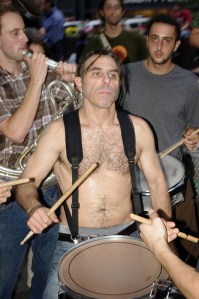
Last week’s news was been full of alarming stories of real and threatened violence at various #Occupy sites around America. But also disturbing were the reports that complaints about the continuous drumming at the Occupy Wall Street site in Lower Manhattan were threatening to shut the entire operation down. According to stories in N + 1, slate.com, Mother Jones, and New York, the ten hour marathon drum circles at Zuccotti Park have been a focal point of mounting tensions, both between the occupiers and the drummers, and between the occupiers and the community at large. Last week, community members asked that the drummers limit their drumming to 2 hours a day, a request backed by actual OWS protesters. The drummers, loosely organized in a group called PULSE, initially resisted the restriction, claiming that such requests mimicked those of the government they were protesting against. Since then, a compromise has been worked out, but the situation gives rise to a host of questions about race, sound, drums, and protest.
Community organizers both inside and outside OWS said they were distressed by the continuous noise that these protesters are making, and certainly they had reason: as Jon Stewart put it in his episode of talking points, “it’s a public space, it’s for everyone, including people who don’t consider drum circles to be sleepy time music.”
Writer and singer Henry Rollins agrees, telling LA Weekly that he dreams of an #Occupy Music festival, because “So far [he has] heard people playing drums and other percussion instruments” but still wonders “if there will be a band or bands who will be a musical voice to this rapidly growing gathering of citizens.” Rage Against the Machine guitarist and frequent #Occupier Tom Morello also seems to concur, telling Rolling Stone, “Normally protests of this nature are furtive things, It’ll be 12 people with a small drum circle and a couple of red flags. But this has become something that people feel part of.” Stewart, Rollins, and Morello all have a point: not everyone likes drum circles, in fact some people feel quite strongly about them, which has the potential to be divisive for a movement famously representing “the 99%.”
But over and above the questions of musical taste, the very audible presence of snare drums, cymbals, and entire drum sets at OWS—more often found in marching bands or suburban garage band practice spaces than the usual drum circle staple, the conga—raises a different set of questions, both sonic and social, around the interrelated issues of “noise,” public space, and privilege.
That a drum circle populated by a large number of bad, mostly white drummers is being touted as “the sound” of occupation isn’t that surprising, at least not for alumni of UC Berkeley.
In my day, a more conga-oriented drum circle sprouted up on Sproul Plaza every Sunday; today, a similar one occupies a green space in Golden Gate Park right across from Hippie Hill, pretty much 24/7. (I walk by it every Thursday on my way to the gourmet food trucks: happily, the delicious smell of garlic noodles and duck taco obliviates all other senses.)
These kinds of regular, yet impromptu, circles abound in California and elsewhere: indeed, the sound of drum circles à la OWS has characterized certain types of social spaces for the last forty years. But what exactly does the sound of drum circles characterize? What meaning is being made by them, and why?
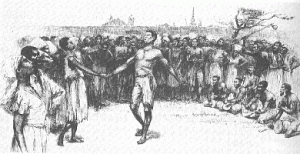
In the Americas, drum circles go back hundreds of years– many indigenous peoples have drumming traditions, for example, and, in Congo Square in New Orleans, slaves of African ancestry gathered weekly to dance to the rhythms they played on the bamboula, a bamboo drum with African origins, beginning in the early 1700s. The notion of the “circle” was a fundamental part of the dancing and music making at Congo Square—according to Gary Donaldson, the circles represented the memories of African nationalities and various reunited tribes people—and was echoed in various types of “ring shouts” across the West Indies and the Southern U.S. The contemporary drum circle stand-by, the conga, also came to the Americas via the forced migration of slaves; it is of Cuban origin but with antecedents in Africa, like the bamboula. The black power movements of the 1960s drew on this history—and sound—to good effect, reigniting semi-permanent drum circles in many U.S. neighborhoods– like the formal gathering that meets in Marcus Garvey Park in Harlem on Saturdays that is currently also under fire from a nearby condo association –audibly announcing their presence and enacting new community formations.
Given this history–and without erasing the presence of drummers of color at OWS--it can seem puzzling how the drum circle has come to occupy such a curiously whitened position in America’s cultural zeitgeist. Furthermore, one of the more problematic aspects of the OWS drum circle debate is the racialized implications of the instrumentation there—implications borne out by videos of OWS that show an overabundance of snares, some of the loudest drums available. According to percussionist Joe Taglieri, “no conga is louder than a fiberglass drum with a synthetic head.” If snares are louder than congas, then noise – actual decibel level — is probably not the sole issue when community groups attempt to control or oust drummers like those in Marcus Garvey Park. It does seem to be a key point of contention at OWS, however.
While there is also a history of African American marching bands, especially in the South, snare drums speak to a different set of American cultural traditions. Drum kits themselves evolved from Vaudeville, when theater space restrictions (and tight pay rolls) precluded inviting a large marching band inside. Mainstream associations with snares include but are not limited to army parades, high school marching bands, and of course hard rock music. Sometimes, like in the case of Tommy Lee, it is an unholy alliance of several of these contexts.
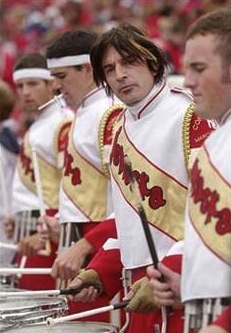
In other words, outside of OWS, snares are hardly the sound of social upheaval.
How the drum circle became associated with political protest in the first place is interesting. Although people sometimes associate drum circles with beatniks rather than hippies, a case could be made that they actually connect more strongly to an electrified Woodstock rather than an acoustic Bleecker Street, thanks in part to Michael Shrieve’s widely mediated turn during Santana’s performance of “Soul Sacrifice” at the 1969 festival.
It is important to note that Shrieve is playing the traps in this sequence, not the conga, which is one reason I’d like to suggest that something about that scene – the hands on the congas, the grins of the other guys, the ecstatic face of a 20-year-old as he slams his kit, and the fetishistic gaze of the camera on the sticks, the skins and the cymbals – caught the imagination of a particular segment of American society. Santana’s band – two Mexican Americans (Carlos Santana and Mike Carabello), a Nicaraguan (Chepito Areas), two whites (Shrieve and Gregg Rolie, who later plagued the world in Journey) and an African American (bassist David Brown)—was truly multi-racial, creating a “small world” visual that furthered Woodstock’s utopian rhetoric in ways that were surely not borne out by the demographics of its audience. More importantly perhaps, the Woodstock movie showed a white suburban hippie guy as an equal participant in a multi-ethnic rhythmic stew, a powerful image in the 1960s. Indeed, the Santana performance may be precisely the moment when the idea of the drum circle was lifted from the context of “black power” and moved into the hippie mainstream.

Woodstock made congas hip to the mass of America—not just in Santana’s set but also in the performances of Richie Havens and Jimi Hendrix—and Woodstock helped define what the drum circle meant, in part by encapsulating certain discursive tropes that were very particular to those times. For example, drum circles epitomize the ’60s idea that political action is simultaneously self-expressive and collective. If a crowd of people sing “We Shall Overcome” or chant “Ho Ho Ho Chi Minh/The NLF is going to win,” it is a a collective act. It’s collective even if the crowd is singing “Yellow Submarine” and it’s not overtly political. By contrast, drum circles are about improvisation, so each drummer can “do his own thing” while participating in the groupthink. (The “his” is implied: video of drum circles show few women participants. Apparently Janet Weiss, Meg White, and Sheila E.’s “own thing” can actually be done on their own.)
In terms of sound, drum circles also project well beyond their immediate location, compared to singing and chanting (in fact, OWS has had problems with the drum circles drowning out its “human microphone”). Plus, since the drummers can take breaks and change out, the actual drumming never stops, unlike a performing musician. Thus, drum circles are celebrations of self expression that are actively imposed on an audience that is well beyond eyesight. This summarizes a modern view of personality rooted in the 1960s: that it’s not enough to participate, you’ve also got to “be yourself.” I think these two notions account for the enduring idea of the drum circle as a supposedly political sound, even when it’s not. Drumming in a drum circle allows for a public display of self-expression that simultaneously allows the participant to belong to a group. The appeal of that is obvious, especially in our contemporary iCulture. However, the politicization of the sound of drum circles only makes sense when you add in the lingering sonic traces of black protest, modulated through a hippie lens. You can see this clearly in New York magazine’s “Bangin’: A Drum Circle Primer” (10.30.11), whose visual imagery prominently features a West African djembe drum and describes only the “hippie-era use of traditional African instruments” rather than their actual, snare-heavy configuration at OWS. Despite the snares and in spite of the oft-commented on lack of black faces at OWS—see Greg Tate’s piece in the Village Voice—drum circles still carry enough connotations of militant blackness to annoy the bourgeoisie.
One key thing differentiates OWS’s drummers from the demonstrations of yore, however: in the 60s and early 70s, there was a notion that drum circles were for drummers. Santana’s band, though young, was made up of world class musicians from the San Francisco scene. But to a certain type of viewer – young, white and male—the drum circle must have seemed so doable. Compared to the singular virtuosity of Jimi Hendrix or sheer talent of Pete Townshend, Santana’s music was the sonic equivalent of socialism. No wonder the drum circle scene has had more of a half-life in the hearts and minds of would-be Woodstockians than just about any other: it is a visceral depiction of music as communal, ecstatic, and accessible. Today, thanks to the far-reaching waves of the movie Woodstock: 3 Days of Peace & Music (1970), the percussive noise such a circle makes creates a particular sonic backdrop that clearly—and nostalgically—says hippiesomething.

And yet, politically speaking, nostalgia is, as theorists like Antonio Gramsci, Guy Debord, Jacques Attali and Theodor Adorno have frequently reminded us, invariably associated with Fascism. From Mussolini to Hitler to Reagan to Glenn Beck, it’s a tactic that has been explicitly invoked to thwart social progress. The nostalgia conundrum seems to have escaped both mainstream news media—which uses the drum circle to signify to viewers that OWS is a radical leftist plot—as well as the drummers themselves. For the drummers are hippies, and hippies young and old really believe in drum circles. Hippies take part in them, hippies enjoy them. It’s fair to say, however, that few others do, just as no one ever really enjoyed the 45- minute drum solos on live records by Cream, Led Zeppelin, and Iron Butterfly. (I’m thinking about Ginger Baker’s “Toad,” John Bonham’s “Moby Dick,” and “In-a-Gadda-Da-Vida,” respectively. Also about the time I went to the bathroom and bought popcorn at the LA Forum during a drum solo by some band I know forget, and still had to sit through ten more minutes.) .
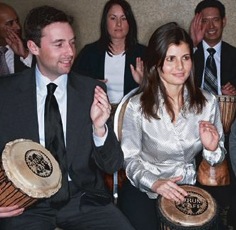
However, that fact does not seem to bother those involved in drum circles, and herein lies the great problem with the whole equation drum + hippie = activism. To any members of the mainstream media who hears and records them, a drum circle instantly conjures up a chaotic, possibly even violent, scene: Chicago ‘68, Seattle 2000, Oakland 2011. But the truth is that, outside Fox News, the noun “hippie” no longer means “liberal,” or possibly even politically engaged. The curious thing about drum circles, then, is that while they sound progressive, they can actually mean conservative. A 2006 piece from NPR, for example, describes how drum circles have been adapted as teambuilding exercises for corporations like Apple, Microsoft, and McDonald’s.
The OWS situation illustrates such conservatism in different ways. In another recent article in New York Magazine, a 19 year old drummer from New Jersey is quoted as saying, “Drumming is the heartbeat of this movement. Look around: This is dead, you need a pulse to keep something alive.” This is said in the face of opposition from the movement’s own management, who fear a shutdown due to severe problems with neighborhood groups and restrictions on the General Assembly’s call-and-response “mic checks” that have been so galvanizing. His words are instructive as well as ominous, illustrating that young hippies like him believe that the sound of drums is a suitable replacement for protest or action itself.
The idea that sound alone can energize a movement is not just wrong, it also showcases a willful misunderstanding within the ranks of OWS. In Oakland last week, a small band of anarchists threw bottles at the police, whose wrath rained down in the form of tear gas canisters and a fusillade of dowels: one protester, an Iraq veteran, has been seriously injured.
The incident highlights a kind of cognitive dissonance that is hindering the ability of OWS to achieve political progress. The drumming problems at Zuccotti Park highlight the way that history can repeat itself as farce, as the distance between nostalgia and action — and between sound and meaning — disturbs the peace in more ways than one. Just as drummers in Sproul Plaza refuse to acknowledge that UC Berkeley is now mainly host to computer science and business majors, and drummers in Golden Gate Park refuse to deal with a Haight Ashbury that is gentrifying in front of their eyes, so too do the drummers at OWS refuse to acknowledge that their sound is no longer the sound of social activism. Indeed, the sound of a drum circle is reminiscent of the ring of a telephone, the scratch of a needle dropped on a record, or the clip clop of horse hoofs on hay-covered streets. No wonder it sounds out of place at OWS.
—
Gina Arnold recently received her Ph.D. in the program of Modern Thought & Literature at Stanford University, where she is currently a post doctoral scholar. Prior to beginning graduate work, she was a rock critic. Her dissertation, which draws on historical archives, literature, and films about counter cultural rock festivals of the 1960s and 1970 as well as on her own experience covering the less counter cultural rock festivals of the 1990s, is called Rock Crowds & Power. It is about rock crowds and power.
—
Share this:




Current Top Posts





April 2021

January 2020

November 2019

October 2019

August 2019

April 2014

November 2017

March 2015

December 2017

October 2015


Recent Comments