
Hearing the Tenor of the Vendler/Dove Conversation: Race, Listening, and the “Noise” of Texts
In the beginning there were no words. In the beginning was the sound and they all knew what the sound sounded like. –Toni Morrison, Beloved
DOI: https://doi.org/10.59350/zssew-bpa12
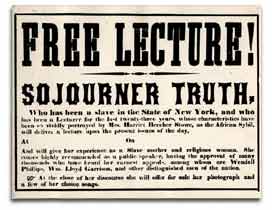
A conversation in my Black Feminist Theories class on the two versions of Sojourner Truth’s famous speech from the Ohio Women’s Convention—the one published in 1863 that renders her words in a black southern dialect or the 1851 version that does not—elicited the following story about listening. A black male student was student teaching/observing in a classroom — the teacher was white, the student teacher black. The exercise he observed involved transcribing speech and then reading it back. A black male student in the classroom spoke and the white teacher and black student teacher each transcribed the speech and read their transcriptions aloud. The white teacher’s transcription/recording was in dialect, the black student teacher’s was not. The student teacher maintained that what and how the white teacher heard the black student was not, in fact, either what or how the black student spoke.
Discussions like these have spurred me to meditate more deeply on sound. And now that I’ve really begun to consider it, texts have become much noisier places; the white spaces and black marks becoming places for reading and hearing. Thinking more deeply about sonic affinities and communities has helped me really begin to understand how sound shapes sight and sight shapes sound.
An example: Since reading Fred Moten’s In the Break, in particular “The Resistance of the Object,” it’s not only impossible for me to read the scene of Captain Anthony’s beating/rape of Aunt Hester in Frederick Douglass’s Narrative without hearing Abbey Lincoln’s hums, moans, and screams, it is not possible for me to read the entire text without populating it with sound, even as those sounds are, in my imagining of them, not always specific.
.
Perhaps it’s most accurate to say that I am aware that the world that the text references is a world filled with sounds peculiar to it, many of which may no longer be present in our contemporary world. At the same time, I try to bring at least some of those sounds—talking drums, field hollers, whips cracking, the sounds of chains, etc.—and approximations of sounds into the classroom when I teach Douglass’s Narrative and My Bondage and My Freedom (as well as when I teach other texts).
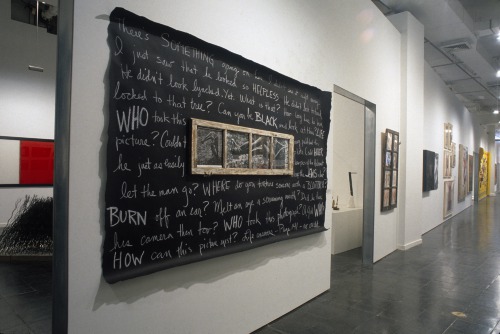
In “The Word and the Sound: Listening to the Sonic Colour-line in Frederick Douglass’s 1845 Narrative” (2011) Jennifer Stoever-Ackerman writes, “The emphasis Douglass places on divergent listening practices shows how they shape (and are shaped by) race, exposing and resisting the aural edge of the ostensibly visual culture of white supremacy, what I have termed the “sonic colour-line” (21). Stoever-Ackerman riffs on Elizabeth Alexander’s “Can you be BLACK and Look at This: Reading the Rodney King Video” (and Alexander riffs on Pat Ward Williams’s “Accused, Blowtorch, Padlock”) to ask, “Can you be WHITE and (really) LISTEN to this?” or alternatively, “Are you white because of HOW you listen to this?” (21).
.
In his review of Shane White and Graham White’s The Sounds of Slavery: Discovering African American History Through Songs, Sermons, and Speech (Beacon Press, 2005) in the July 2009 issue of the Journal of Urban History, Robert Desrochers contrasts the abolitionists who were attuned to how to make a white audience hear the sounds that surrounded and produced the (performances of the formerly) enslaved, to the “Virginia patriarch who failed to mention the singing of his slaves even once in a diary that ran to hundreds of manuscript pages” (754). Given these examples of the ways that many white ears had to be systematically attuned to hearing slavery’s sounds as well as the understanding that, “the very things that made slave sounds distinctive—chants, grunts, and groans; melismatic, repetitious, and improvisational lyric play; pitch and tonal inflections and cadences; timbral variations, polyrhythms, and heterophonic harmonies—struck whites mostly as strange, inappropriate, wrong” (754)—the answers to Stoever-Ackerman’s questions may be respectively “no” and “yes” (or several combinations of no and yes), particularly if we engage “whiteness” as an ideology and not simply (or not only) a “raced” description of those people constituted socially and legally as (presumably) white.

It was with these kinds of questions of sound and sonic whiteness on my mind (especially this question of who hears, who doesn’t hear, and then again what is and isn’t heard) that I read and was brought up short by Helen Vendler’s recent November 24, 2011 New York Review of Books review of Rita Dove’s The Penguin Anthology of 20th Century American Poetry. In this piece, Vendler takes Dove to task for what she considers the anthology’s over-inclusiveness (“No century in the evolution of poetry in English ever had 175 poets worth reading”), the “accessibility” of the poems (“short poems of rather restricted vocabulary”), and the appearance of a large number of black and other non-white poets in the latter part of the twentieth-century. In short, from Vendler’s perspective, Dove is choosing “sociology” and complaint over artistry; mixing the wheat and the chaff.
Vendler writes, “Rita Dove, a recent poet laureate (1993–1995), has decided, in her new anthology of poetry of the past century, to shift the balance, introducing more black poets and giving them significant amounts of space, in some cases more space than is given to better-known authors. These writers are included in some cases for their representative themes rather than their style. Dove is at pains to include angry outbursts as well as artistically ambitious meditations.”
And Vendler on Dove on Hart Crane: “sometimes one wonders whether Dove is being hasty. She speaks, for instance, of ‘the cacophony of urban life on Hart Crane’s bridge.’ But the bridge in his ‘Proem’ exhibits no noisy ‘cacophony’; its panorama is a silent one. The seagull flies over it; the madman noiselessly leaps from ‘the speechless caravan’ into the water; its cables breathe the North Atlantic; the traffic lights condense eternity as they skim the bridge’s curve, which resembles a ‘sigh of stars’; the speaker watches in silence under the shadow of the pier; and the bridge vaults the sea. The automatic—and not apt—association of an urban scene with noise has generated Dove’s ‘cacophony.’”
Why does Vendler insist on silence where Dove joins sight and sound? That Vendler imagines silence and takes Dove to task for attaching cacophony to the city scene in the bridge poem is a struggle over meaning, over epistemology and ontology. How is Vendler registering not only the poem but also the entire text differently? This isn’t the only instance of Vendler’s insistent sonic “whiteness” whereby and wherein the reading of the poem, the anthology, and the anthologizer herself are disciplined.
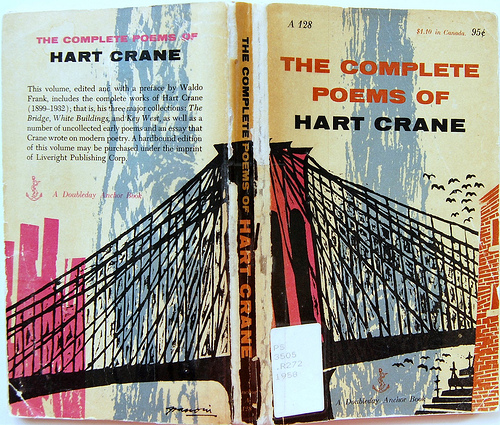
Speechlessness though, is not soundlessness, and it seems to me that Dove locates herself on the bridge (and in the soundscape of the contemporary written poem) such that she hears the water, the seagull, and the leap and curve and flap of gull and man. As Dove herself responded (also in the New York Review of Books), “A cursory sweep over just the section [Vendler] excerpted in my anthology yields a host of extraordinary sounds: what with trains whistling their “wail into distances,” chanting road gangs, papooses crying—even men crunching down on tobacco quid—my gasp of surprise at Vendler’s blunder can barely be heard.”
In Vendler’s remarks and Dove’s response we might read the kind of cultural dissonance that continues to both construct and give insight into how different communities of readers and listeners are formed and the ways they are and aren’t racialized. By the end of the review, Vendler wants to be heard by those whom she imagines as the anthology’s likely readers: she wants to turn to them and “say,” to “cry out,” that there are better poems than those included here. For the sounds that in this anthology that Vendler hears most often in the “minor” poems, in the “minority” poets, and the “minority” anthologizer, are simplicity, noise, and needless complaint. And Vendler and Dove have been here before – see Vendler on Dove and Delaney on Vendler and Dove.)
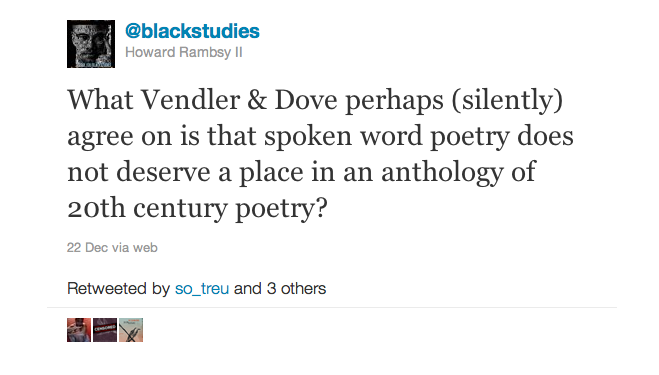
But despite the debate putting poetry front and center and enacting ways that it matters, Vendler’s critique and Dove’s response are each conservative, though in quite different ways. Neither Vendler nor Dove in the review, anthology, and defense of the anthology imagines the inclusion of spoken word, hip-hop (see Howard Rambsy II), and other forms of contemporary rhyme and verse that speak to a broad range of audiences across race, sex, and class. The inclusion of rap might further change the tenor of the conversation, opening up in important ways the debate over what counts as poetry, and expanding how black musical and poetic forms are heard and by whom.
—
Christina Sharpe is Associate Professor of English and American Studies at Tufts University where she also directs American Studies. Her book Monstrous Intimacies: Making Post-Slavery Subjects was published in 2010 by Duke University Press. Her current book project is Memory for Forgetting: Blackness, Whiteness, and Cultures of Surprise.
—
Share this:

“I didn’t say look; I said listen”: The People’s Microphone, #OWS, and Beyond
DOI: https://doi.org/10.59350/ks1pf-z7v73
On a Tuesday right after Valentine’s Day in 2011 thousands of people marched on the Wisconsin capitol and good-naturedly, but firmly, took over the building. They came for a hearing scheduled by the state government’s Joint Finance Committee, and as crowds swelled out on the snow-covered lawn a long line of citizens formed indoors, waiting their turn to address the Committee and give brief remarks about proposed changes to the state budget.
Up for discussion was the Governor’s proposal to cut public employees’ benefits and eliminate their collective bargaining rights, and having gotten word of widespread outcry, the co-chairs of the Committee had released this statement:
We welcome public participation in our representative democracy. Unlike two years ago when Democrats did not hold a public hearing for the last budget repair bill, we want to listen to individuals’ concerns. Due to the large number of participants, each person will be given up to 2 minutes to address the committee. This will ensure that everyone has their voice heard.
Late that night, the Committee cut off public testimonies in spite of a line still stretched down the hall. One group refused to leave and staged an occupation of the capitol building in protest of both the bill and the foreclosure of public input.

Over the next few weeks, people slept overnight on the marble floor while bigger groups assembled there each day, reportedly in numbers reaching between 70,000 and 100,000. Many carried signs backing public sector workers, but the overall majority showed their solidarity with the protest simply by wearing bright “Badger red” hats, coats, sweaters, and shirts, University of Wisconsin memorabilia now transformed into signs of political support for all of the state’s public institutions. The view from upper levels of the capitol rotunda struck a dramatic portrait as people ringed the center of the room facing inward. One person who spent a lot of time there told me he liked to call it the “eye of the storm.”
Domed spaces tend to be noisy. Sound bounces off of the curvature of the ceiling at so many different angles that what’s audible on the floor quickly takes on so many threads of reverberation that a single voice gets easily obscured. In the Wisconsin capitol, handheld electric bullhorns became instrumental for leading chants and making announcements, but people found they didn’t always do the trick. In one reported instance, a megaphone still wasn’t enough for one woman’s voice to be heard across the rotunda, and so she broke her announcement into fragments and waited in between them as people standing near her repeated each one in loud unison. “State Senator Dale Schultz [repeated]…has withdrawn his vote for the bill [repeated].”
Today that variation of call and response is widely regarded as an iconic feature of the Occupy Wall Street campaign, where it has been likened to liturgy, to brainwashing, to a game of “telephone,” to Garrett Morris’s “News for the Hard of Hearing” bit from Saturday Night Live, and to Monty Python’s Life of Brian.
.Yet also, as the practice was manifest at lower Manhattan’s Zuccotti Park, it has attracted great interest and variety of comment regarding how it might reflect the values and objectives of those gathering in downtown New York City. It was purported to unite a crowd; it helps ensure that “no one is left to feel isolated and alone;” it accelerates the exchange of information because it “forces everyone to edit group public speech down to the essentials;” it slows the campaign and gives it valuable time to develop; it is “a lesson in the obstinacy required for intentional, durable citizenship.”
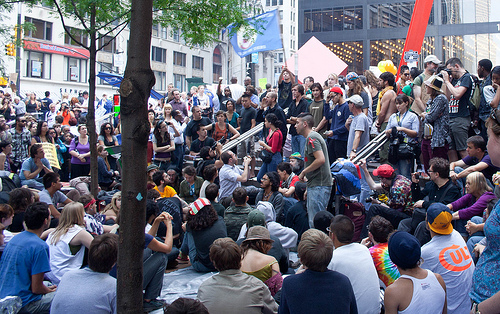
Although one need only consider the depth of history stretching out prior to the invention of electric amplification to be certain that the method of communication isn’t new to this year nor even to this century, the question of its recent emergence remains important for identifying possible affinities across boundaries that might otherwise divide protest actions. Last winter in Wisconsin, after transmitting the message about Senator Schultz, the demonstrators apparently didn’t carry on with it the way people did in lower Manhattan, but one need not stop at noting that this proves the technique wasn’t invented this fall in New York. In the capitol building, members of the Wisconsin public instituted a different audio innovation that reflects a shared sense of purpose between the two protest actions. And if one follows a similar connection recently posited in Rolling Stone Magazine between Occupy Wall Street and factory takeovers in Argentina, one might bring into focus a call and response operating across even broader stretches of time and space.
In Wisconsin, the civil disobedience broke out immediately after lawmakers ended the budget hearing with citizens still waiting to speak, and in the following days an alternative system of public testimony took shape on the floor of the capitol rotunda. According to one member of the collective who facilitated its operation, the forum emerged in conjunction with a circle of drummers, who, during pauses in their playing, invited individuals to sequentially address all those gathered using megaphones carried in by the public. Soon after moving up to a single-speaker amplifier that had been provided on friendly loan, some of the drummers pooled their money and purchased a 70-watt (RMS) portable public address system, an additional extension speaker, and a Shure SM58 for, according to one, “whomever wanted to speak, ensuring their voices were heard, never cutting anyone off or denying anyone the right to speak.” With what I submit as telling coincidence, they called the apparatus “The People’s Mic.”
Here is a clip that came up when I used Google to search with the terms “people’s microphone Wisconsin video.”
.
.
There are important contrasts between this platform for testament and the call and response technique that has garnered recent notoriety under the same name. In its Zuccotti Park incarnation, the people’s microphone is often celebrated as a clever workaround designed in response to the prohibition against using electric sound amplifiers in public without a permit. However, its key feature is the reciprocity it demands between the person speaking “into” the microphone and others gathered in the space. In this way it not only attenuates the hierarchy usually exerted by one amplified person over the soundscape, but it also fosters the pursuit of accord within the group overall, because the method’s very functioning relies so heavily on the crowd’s ongoing willingness to participate:
.
.
In Wisconsin, the People’s Mic did provide citizens a platform otherwise reserved for government and union officials (and the celebrities of their choosing), but individual testimonies were still unidirectional and the system proceeded without the same means of direct and immediate exchange, at least in the realm of sound. As we see in these clips, in Wisconsin, the People’s Mic required the largest number of people to keep quiet for the longest amount of time. Sometimes people had to keep especially quiet because the sound of chanting from outside was bleeding into the space.
.
.
However, while much of the discussion of the people’s microphone constructed in Zuccotti Park centers on its horizontal, consensus-oriented nature, why reduce the method’s oppositional potential to a matter of challenging government’s increasing control over the audible city? Fortunately, as though taking a more direct cue from the People’s Mic as it was instigated in Wisconsin, people have recently begun pushing the call and response version adopted in New York past the confines of community building, realizing its practical potential to channel a message and grab the attention of leaders far too often unavailable, unwilling, or uninterested in taking time to—as the Wisconsin Joint Finance Committee had grandly promised—“welcome public participation in our representative democracy.”
The following clips show how the people’s microphone in its new iteration has been used to satisfy the goal more explicitly associated with its Wisconsin variation—that of getting heard. The first comes from an October 25,2011 meeting of the New York City Panel for Education Policy, where a crowd packing a public forum forced board members to relinquish control of the proceedings and allow a statement conveyed on behalf of parents and teachers.
.
.
And here in a clip from a November 3, 2011 breakfast meeting at the upscale Union League Club in Chicago, people used the technique as it is now most widely associated with the New York City campaign and directly reconnected it to the efforts in Wisconsin, not only in the sense that they focused their amplifying echo at a particular intended audience, but also by virtue of whom they chose to address:
.While some might take exception to these two examples as uses of the people’s microphone without enough reciprocity in mind, I have some confidence that viewers will look upon the second clip, especially, as an overdue carriage bearing a bit of just that. But more importantly to the issue of how the different iterations fit together—Madison, New York City, and beyond—both of these scenes are peaceful, attention-grabbing, and they appear to stem from no more seditious an effort than to urge democratically elected leaders to entertain the voices of their constituents even, and especially, if they aren’t using a “corporate microphone” to speak. Now, with New York police having cleared Zuccotti Park and thrown the Wall Street campaign into yet another bout with uncertainty, it will be especially interesting to find out where, how, and by whom, the people’s microphone is picked up and repurposed again. In Wisconsin, a drive to recall Governor Scott Walker just got underway, and if demonstrations break out again at the capitol, I expect the portable PA will be back up and running. How will people use the people’s mic this time? How will they speak to those recently evicted from Zuccotti Park?
—
Ted Sammons is completing a doctorate in anthropology at the Graduate Center, CUNY.
—
Share this:




Current Top Posts





April 2021

January 2020

November 2019

October 2019

August 2019

April 2014

November 2017

March 2015

December 2017

October 2015


Recent Comments