
Reflective Sound Gathering via the New England Soundscape Project

DOI: https://doi.org/10.59350/m7gze-zef59
Beyond the confines of recording studios, stages, and music classrooms, a vast and shifting sonic canvas exists for field recorders. This personal essay explores my awakening to a new creative recording process through the New England Soundscape Project , an ongoing sound-gathering mission whereupon I use small digital recorders—paired with various microphones, an iPhone, and a genuine sonic curiosity—to record brief moments throughout New England’s rich coastal, urban, and rural landscapes across six U.S. states. I received a modest seed grant from my University to pursue some creative work in field recording and sound studies. Over the next year, my travels will take me to the National Parks, cities, and historic landmarks in Connecticut, Vermont, Rhode Island, Maine, New Hampshire, and Massachusetts.
While near limitless possibilities on where and how to produce sonic and electroacoustic musical compositions endure, starting theNew England Soundscape Project challenged me to hone my listening skills while simultaneously dealing with nature’s unpredictability. Moreover, as a budding sound artist, I had to contend with the cognitive and emotional issues affecting a brand-new and unexplored creative practice. I came to believe that a holistic method of field recording offered me certain advantages—enabling an emerging sound artist to detach from rigidly defined agendas and instead focus on reflection, deep breathing, environmental awareness, gratitude, and an observational spirit. The listening exercises I detail in this post made me a newly introspective practitioner—one capable of a heightened sensitivity that improved my production and composition skills across multiple media.
Field Recording: An End Goal in Mind?
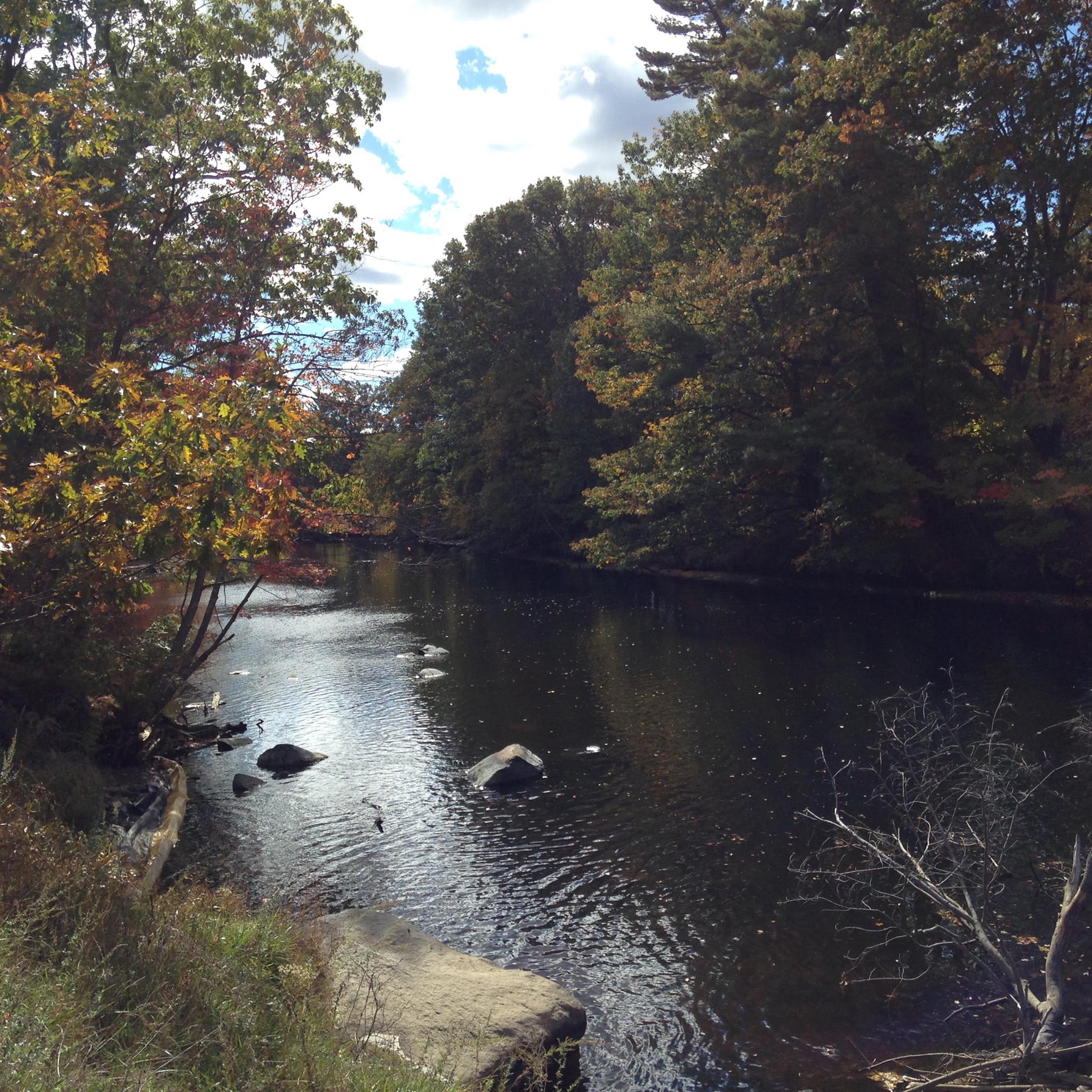
Field recording involves a delicate balance of technical skill, careful planning, and patience. Stepping away from a controlled environment, capturing audio on location presents many random and often erratic trials. From wind noise and poor site accessibility to recording malfunctions and user error—a host of issues arise once the recordist enters unfamiliar territory. Here, unfamiliar territory includes both new places and nascent approaches to research-based production and artistic data collection. Where do I situate a project like the New England Soundscape Project among new media production, sound studies, and music composition? Does that issue even matter?
The notion of practice-based work usually implies an end goal in mind. What if there is not an end goal in sight? What happens then? Would the New England Soundscape Project be “enough” of a contribution to creative scholarship when approached as a type of audio ethnography—much like the immersive storytelling recently curated by Leonardo Cardoso? The New England region is lush and robust, with many diverse landscapes. I hoped to document these in some way, but wondered how to continue. Truthfully, I had some hesitation on where to start.
Media artists and music composers learn the mechanics of their craft in colleges, universities, conservatories, at home, and on the job. Some of these techniques include audiovisual production, computer programming, coding, editing, and arranging using digital software. I am both self-taught and a product of an academic and Eurocentric, conservatory training system. This presents some tension, as I discuss below. Although traditional audio engineers and music composers often work towards completing a project without a predefined trajectory, how can budding sound artists develop and hone an inner acuity to find the “right” material during their creative processes?
While the process remains largely subjective, I found it helpful to begin by answering the following questions:
- What kind of project is this?
- How is the sound to be used?
- Where and how will the project be displayed?
- Who is the intended audience?
- What are the sound artist’s intentions?
- What tools are needed?
I draw inspiration from the Sound Studies Lab’s position that this type of work is diverse, fluid, and balances technical, artistic, and theoretical aims. The challenge is that the answers to the questions above are not immediately clear and require me to look inward at who I really am.
Following the Sonic Muse
Beyond the obvious technical and aesthetic factors affecting an expansive multisite recording project, we know little about how a nascent sound artist begins. Whom do they emulate? Should they take notes? pictures? What should they pay attention to onsite?
If the project is exploratory, the recordist may experience hesitation—as I did— and frustration that can block their creative process, especially because the pathways toward a finished sound project aren’t as established as those of a sound engineer, for example, or a songwriter. Nevertheless, my experiences have shown me that a nascent sound artist/recordist can also find intrinsic meaning and realize their mission—particularly by establishing a detached yet perceptive listening ethos, as I did to begin my work on the New England Soundscape Project.
For me, framing a detached and perceptive mindset involved:
- Remaining sensitive to my surroundings at each location;
- Focusing on stillness, deep breathing, and a quiet mind while recording;
- Adopting a respectful, unobtrusive manner at each site—taking care not to disrupt or distract others;
- Calmly monitoring my technology and its use;
- Trusting that I am intended to be in that exact moment at that exact time;
- Avoiding being overly concerned with the “end game” of their practice;
- Embracing the role of a sound gatherer and observer;
It is perhaps the final objective—adopting the philosophy of sound gatherer and observer—where truly sensitive listening begins. Here, the recordist aims to remove their personal goals and agenda from the field recording process. Before proceeding, the attentive recordist looks around them, focuses on quiet breathing, and views their microphones as lenses and without fear of what the result should be. To what or whom am I observing?
Here’s the problem. It dawned on me that I know little about who I am as a sound artist, and how my voice positively contributes to the world, if at all. I need to learn to listen—not just to the sounds in nature, but also to the sounds of the voices of the persons with whom I interact. Could solitude and introspective listening lead me to listen through a newly formed self, capable of deeper connections with my peers and environment? I found that my detachment involved investigating, acknowledging, and, whenever possible, setting aside my own biases, fears, and, importantly, my own agendas. By removing my ego and cluttered mind from the process, I could start to be an inclusive practitioner—one whom cultivates positive relationships daily and is capable of crafting a deeper sonic art that embraces rather than one that marginalizes.
The Art of Meditative Listening
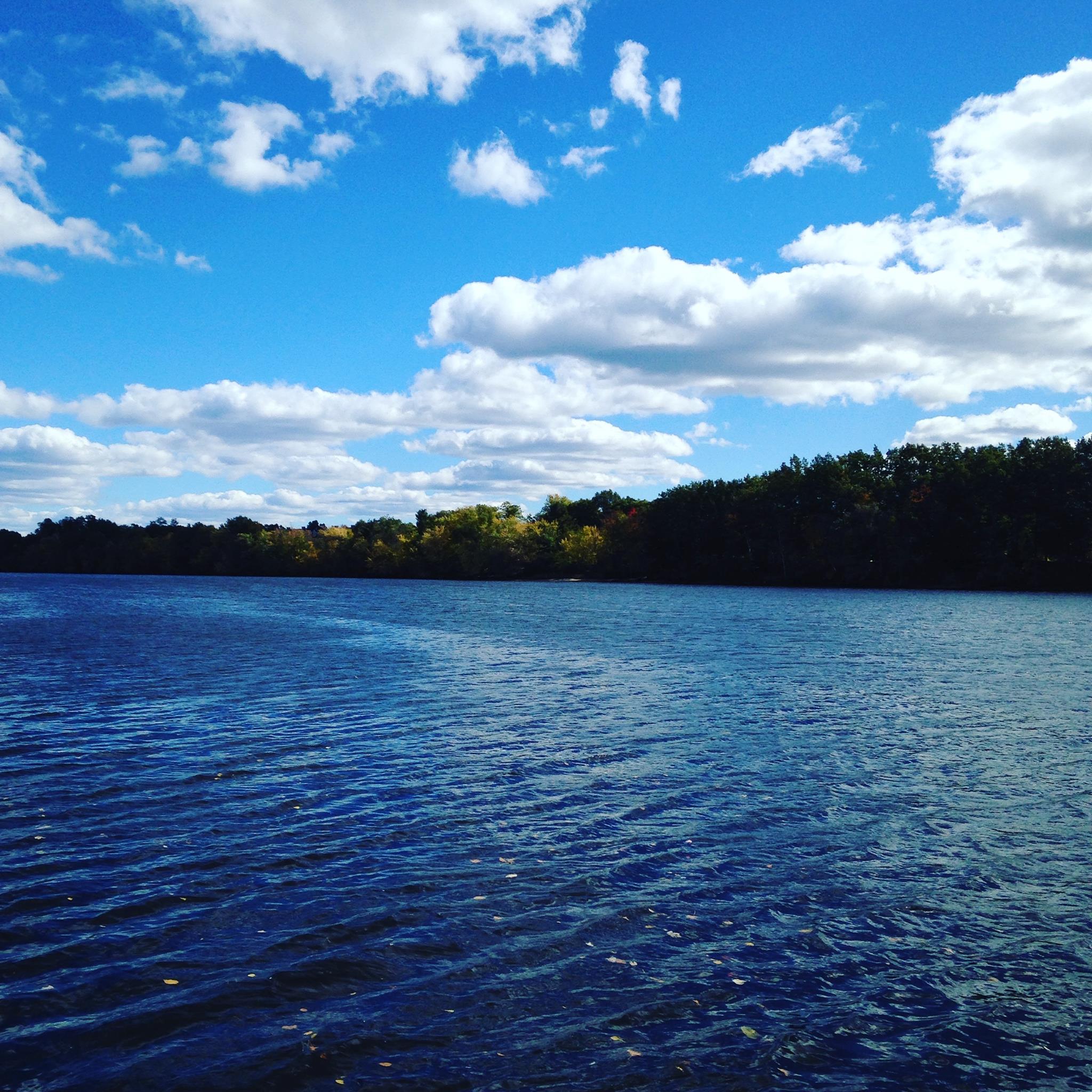
Rather than taking on a stringent approach with little flexibility, I practice observational recording by gathering audio as my muse and as environmental conditions dictate. By remaining attentive to my recording levels, I gather source materials up close, from afar, and for any length of time. Meanwhile, as this creative progression unfolds, I stay quiet—bringing almost meditative quality to my practice. Moreover, concentrating on deep breathing and stillness allows me to adopt a grateful mindset—one that is appreciative of my surroundings and for being present at that precise moment. It is then that the environment becomes the focus of sound gathering and not notions of a “final product.”
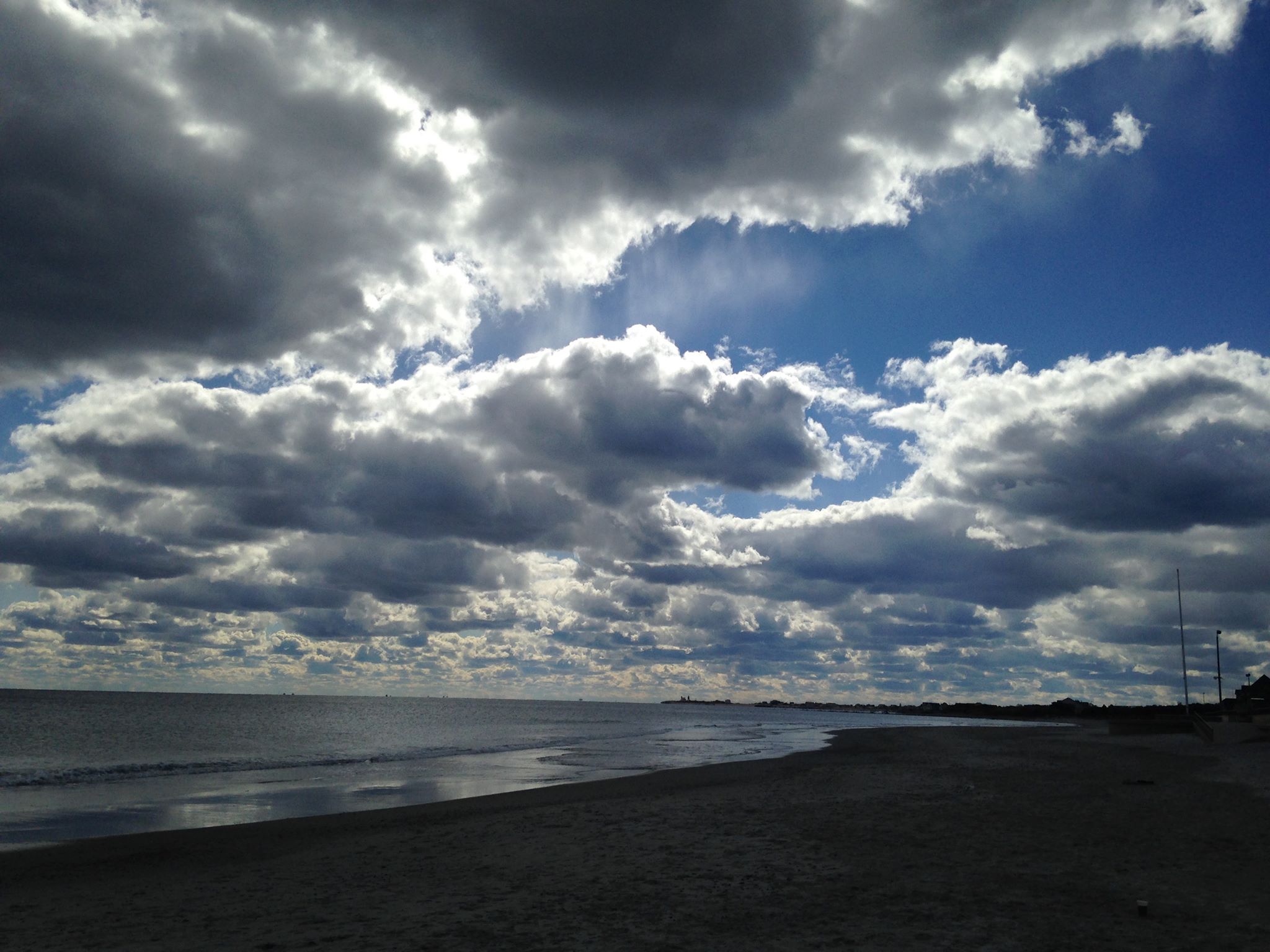
I found an artistic renewal—even healing—by adopting this meditative practice. As the New England Soundscape Project takes shape over the coming months and years, I hope to document the beauty of the Northeast through music, sound, and images. Yet, it is enough simply to be present in each location while aspiring to produce thoughtful and reflective sound art. Although there is no overarching method that best describes every aspect of a multisite field recording process, the “art” in the sound can truly emerge by striving to banish fear and doubt from the recording process. Addressing the “why” during each moment is just as important as addressing the “how” and the “why” in pre- and post-production. The recordist’s humanity plays a key role in determining how creative decisions are made, and the ability to remove the need for control determines how free—and freeing—the process can be.
This Thursday, SO! will feature my podcast on reflective listening with audio examples from the New England Soundscape Project thus far. I look forward to producing future episodes (and essays) on this project in the coming months. I hope you can tune in on Thursday and thank you for listening!
—
Featured Image: Scarborough State Beach, Newport, Rhode Island, USA. All images by author.
—
Acknowledgements
An Internal Seed Grant from the University of Massachusetts Lowell supports the New England Soundscape Project.
—
Daniel A. Walzer is an Assistant Professor of Composition for New Media at the University of Massachusetts Lowell. Walzer’s research and reviews appear in the Leonardo Music Journal, the Journal of Music, Technology & Education, the Journal of Radio & Audio Media and forthcoming articles in TOPICS for Music Education Praxis, and the Music Educators Journal. Walzer received his MFA in Music Production and Sound Design for Visual Media from Academy of Art University, his MM in Jazz Studies from the University of Cincinnati and his BM in Jazz Studies from Bowling Green State University. Walzer is currently pursuing doctoral studies in education at the University of the Cumberlands. Read more at http://www.danielwalzer.com
—

REWIND!…If you liked this post, you may also dig:
SO! Amplifies: Ian Rawes and the London Sound Survey–Ian Rawes
SO! L.A.: Sounding the California Story–Bridget Hoida
Sound-politics in São Paulo, Brazil–Leonardo Cardoso
—
Share this:

SO! Amplifies: Sounding Board Curated by Leonardo Cardoso
—

SO! Amplifies. . .a highly-curated, rolling mini-post series by which we editors hip you to cultural makers and organizations doing work we really really dig. You’re welcome!
—
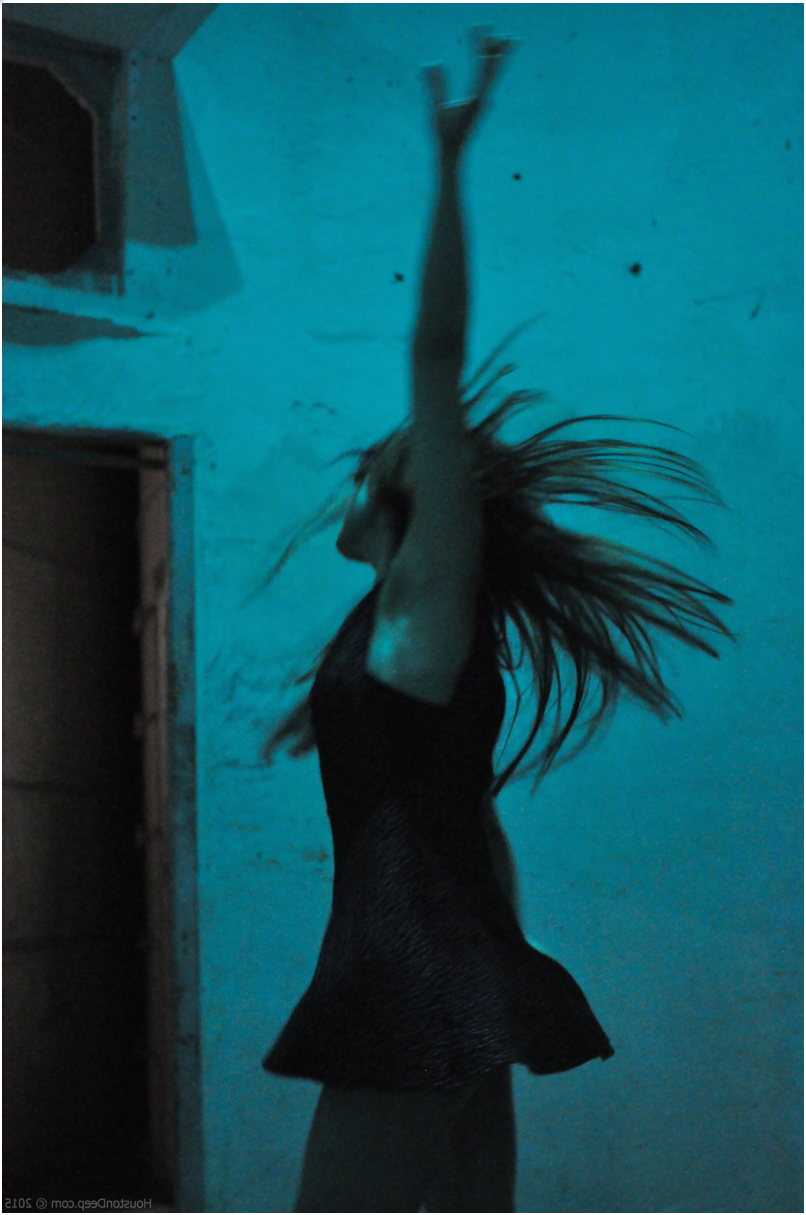
The first annual Sounding Board sound exhibit was held at The Companion Gallery in Austin, Texas on December 3 – 6, 2015, as part of the 60th anniversary meeting of the Society of Ethnomusicology (SEM). In the promotional literature for the show, the curator, Leonardo Cardoso (Texas A&M), described its objective: to give students, ethnographers, ethnomusicologists, and any “sound-minded” people an opportunity to share research and contemplate fieldwork from different perspectives. Cardoso hoped that SEM Sounding Board would “stimulate dialogue between ethnomusicology and other fields, especially sound studies, sound art, ecomusicology, anthropology, and media studies.” He also sought to facilitate interaction between the local community in Austin and SEM scholars who traveled to attend the conference.
I spoke with Cardoso about this exhibit on several occasions. When I asked him why name the exhibit “Sounding Board”?, he told me that Veit Erlmann (University of Texas Austin), described once described his role as a mentor as someone to bounce ideas off of, like a sounding board. In a similar way, Cardoso’s vision for the first annual SEM sound art exhibit was to create opportunities for scholars and local people to meet and discuss sound, ethnography, art, and fieldwork in an open context, and learn from each other while interacting in that space. He designed Sounding Board as a place where “ideas are amplified” and scholars and community members can make fruitful connections because they have an opportunity to reflect and discuss research with people from different backgrounds.
In his invitation to SEM attendees, Cardoso described Sounding Board as
[eight] sound works that probe into sonic in-placements (water and wind), sonic displacements (the telephone, the radio, and the microphone), sonic emplacements (the acoustic territories of urban Taiwan, the Brazilian hinterlands, and West Texas), and sonic mix-placements (in Mexico City).
This collective sound exhibit showcases the creative work of scholars attentive to the spatial, acoustemological, and ethnographic potential of sound. SEM SOUNDING BOARD challenges distinctions between sound-as-episteme and sound-as-performance, sound-as-ethnography and sound-as-art.
Interactive, Immersive, Ethnographic Sound Art
The playfully engaging work, Pool of Sound, welcomed me to the interactive SEM Sounding Board exhibit. As soon as I walked into The Companion Gallery, I noticed the eye catching 1st Annual SEM Sounding Board poster near a studio monitor on a stand, facing another monitor, placed directly across from it, about 20 feet away. A large illuminated circular area gleamed in between the silent speakers. When I moved into the light, I suddenly heard the clear sounds of gently rushing water, but only for an instant, then there was silence again, as soon as I stood still. As I turned and stepped towards one of the speakers I heard the rushing water return. The gurgling sound mirrored my movement and when I stopped, the sound of the water stopped.
Lina Dib (Rice University) created the piece, with an
enchanted zone [that] literally becomes a pool of sound where sound becomes substance, something to be physically and playfully encountered. In other words, sound with this installation becomes palpable, sound is made (in)to matter. The larger the visitors’ gestures, the louder and stronger the sound of water becomes.
Dib cites Jean-Luc Nancy in her work’s description, understanding her piece as an embodiment of Nancy’s observation in Listening that sound envelops the listener: “Sound has no hidden face; it is all in front, in back, and outside inside, inside-out.”
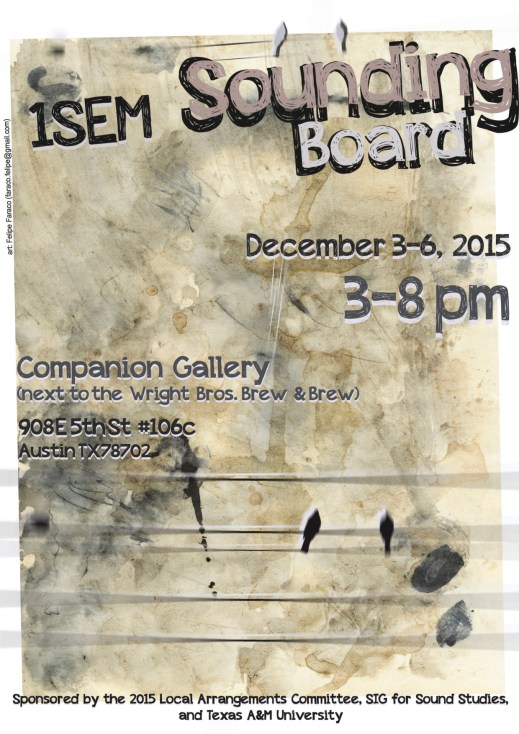
While experimenting with the intersections of sound and gesture in Dib’s Pool of Sound, I noticed someone sit down at an antique-looking wooden desk across the gallery, pick up an old school, land line telephone, dial a number, and start writing on a notecard. The person at the desk was experiencing Schizophone, Calling Son Jarocho, a installation by Craig Campbell (University of Texas Austin) and collaborators, Julian Etienne, Juan-Pablo Gonzalez, and Cameron Quevedo. When the person hung up and left, I sat down, braced the phone between my ear and shoulder and listened to a dial tone.

“Calling Son Jarocho,” image by Leo Cardoso
I dialed a few numbers and started to hear a conversation through the receiver: musicians were speaking in Spanish, discussing certain subtleties of a Son Jarocho performance. I felt like I was eavesdropping. I dialed another number and the sounds of Son Jarocho music flooded my ear. This installation provides numerous sound bytes of field recordings related to Son Jarocho music of Mexico. Each recording is described on a notecard that gives ethnographic descriptions of the situation. Campbell also asks the listener to participate in the piece by filling out a card to leave a record of their experience. The artist says that his “work builds on R. Murray Schafer’s ‘schizophonia’ to signal the profound but also banal experience of listening to recorded sound. The schizophone recruits the telephone–a mundane, though now largely residual technology–to frame and structure an encounter with archival recordings.”
A few feet away from the Schizophone desk, a poster stand held a flyer for the piece Wind Noise by Marina Peterson (Ohio University). A pair of headphones clung to the stand.
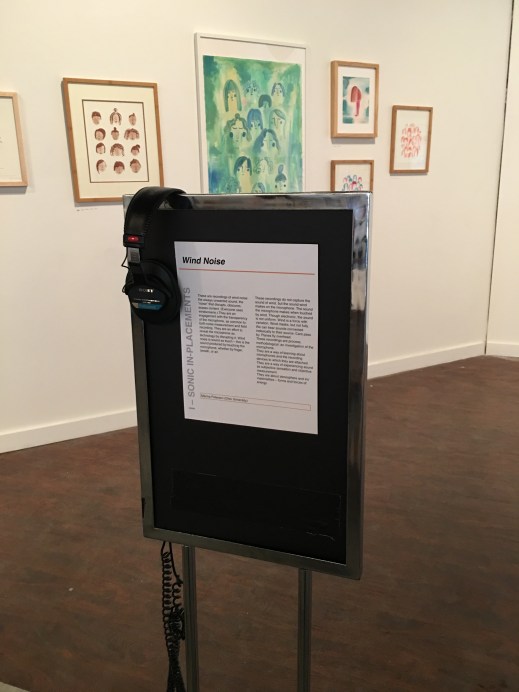
“Wind Noise” by Marina Peterson, Image by Leo Cardoso
When I put the headphones on I expected to hear some cinematic blowing, or the soft sound of a summer breeze. Instead, I heard a familiar, dreaded, thumping noise. Peterson’s work indulges in a recording taboo: the clipping, dull thud of wind hitting an unprotected microphone.
As I listened, I thought about noise and how to define it. Usually, this thudding sound would bother me and I would cut out chunks of recordings to get rid of it. But in the context of a sound art exhibit, I found myself examining this noise, and listening to it as art. This reinterpretation of sound in relation to space reminded me of David Novak’s discussion of “Noise” as a genre in the context of Japanese music coffeehouses in his article, “2.5 meters of space: Japanese music coffeehouses and experimental practices of listening.” Peterson discusses her work as an exploration of technology, mediation, and the microphone. She describes these recordings as
an effort to reveal the microphone as technology by disrupting it. Wind noise is sound as touch – this is the sound produced by touching the microphone, whether by finger, breath, or air. These recordings do not capture the sound of wind, but the sound wind makes on the microphone. The sound the microphone makes when touched by wind.
In a recessed corner of the gallery I saw a music stand with a piece of paper on it. I didn’t know if it was part of the Sounding Board installation, or just a piece of equipment, set aside. As I stepped up to the stand to read the paper, I unexpectedly stepped into a chamber of sound. A Holosonics AudioSpotlight AS-24i directional speaker, mounted on the ceiling, beamed a column of music into that area, which a listener can hear only when directly below the speaker.
The piece is called Resting Place, by Michael Austin (Howard University). In the description of this work Austin states:
Resting Place is based on the old cowboy song ‘Bury Me Not on the Lone Prairie.’ Not only does this work confront listeners with thoughts of mortality and final resting places, it embodies the wide open spaces of my childhood home and serves as a place of peace and relief for the here and now.
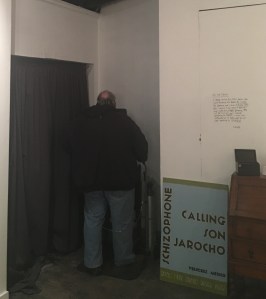
“Resting Place” visitation, image by Leo Cardoso
Austin grew up in the countryside of the Texas Panhandle, and his work intends to bring a piece of that Texan soundscape to a corner of the gallery. I could hear the sounds of birds, wind, and water combined with chant and meditative, drone music; they were all sounds that would usually communicate rest and peace. Unfortunately, I had a difficult time entering that relaxed frame of mind because the recording of the Texan soundscape often clipped, which disrupted my concentration on the calming aspects of the field recording. Composers such as Annea Lockwood and Janet Cardiff use binaural microphones to capture nature sounds up close and create an intimate surround sound experience for the listener; although I am fascinated by the concept of creating a “soundscape chamber” by using a hyper directional speaker, I would love to hear the details of Austin’s field recordings through a nice pair of headphones.
Resting Place and Wind Noise invite contemplation as the listener receives sound. In contrast, the broadcasting sound piece by Tom Miller (Berkeley College) is intensely interactive. In Radio Texas International, a Micro Radio Station in the Austin Wavescape, Miller creates an experience where it is possible to broadcast sound and listen to recordings.
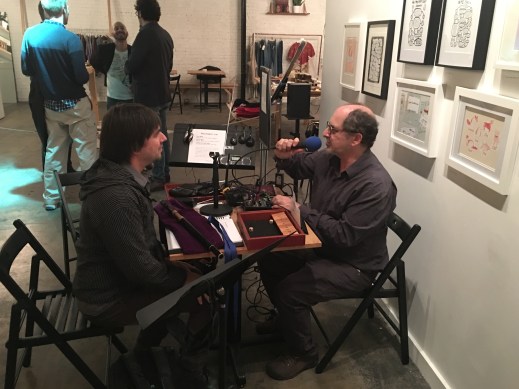
Tom Miller’s “Radiophonics Lab,” Image by Leo Cardoso
Resting Place and Wind Noise invite contemplation as the listener passively receives sound. In contrast, the broadcasting sound piece by Tom Miller (Berkeley College) is intensely interactive. In Radio Texas International, a Micro Radio Station in the Austin Wavescape, Miller creates an experience where it is possible to broadcast sound and listen to recordings. Miller explains that for this piece he
operate[s] a low power Mini FM Micro Radio station in the gallery… Tuning to open frequencies, a legal micro power transmitter broadcast[s] to receivers distributed within a 200-foot radius as a hyperlocal, pop-up intervention into the FM band. Using headsets, listeners will tune the radio dials seeking to locate the signal interspersed with the music, religious broadcasts, news, foreign language programming and static of the local radio wavescape.
In the video of his work you can hear several different ethnographic recordings that are broadcasted by Miller in the gallery, and at the same time intertwine with the sounds of local radio stations in Austin. Besides broadcasting field recordings, Miller also aired live interviews and music throughout the three-day exhibit. I was delighted to have the chance to play some traditional Irish music on the air for Radio Texas International.
雜 (dza) is a piece by Yun Emily Wang (University of Toronto) and Wendy Hsu (Dept. of Cultural Affairs, City of Los Angeles), who created a work that inhabits a cardboard box. The artist Zimoun often uses percussive elements to explore acoustics and cardboard, but in 雜 (dza), Wang and Hsu employ the box as a resonator to amplify and combine sounds emitted from headphones playing loops. The listener is asked to put their head in the box to hear a cacophony of intermingled field recordings that create a decontextualized soundscape of Taiwan.
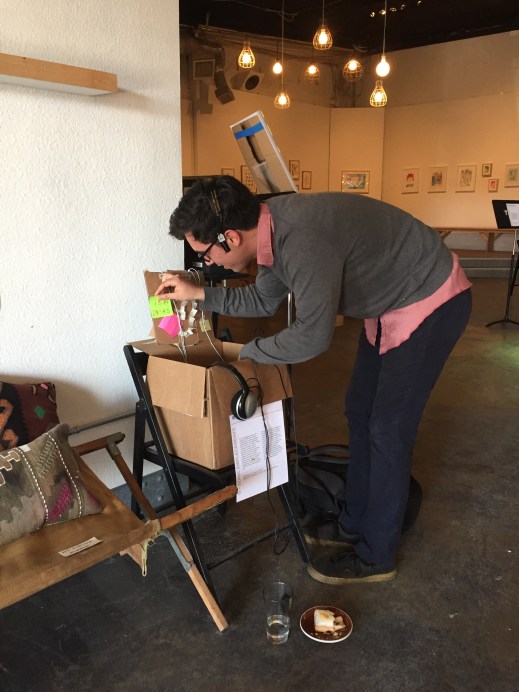
Listener experiencing “雜 (dza) ,” image by Leo Cardoso
The artists explain that “These composed loops recontextualize the sonic materiality of the informal economy and quotidian life exemplified at a Taiwanese night market, and interact with the spatial and sonic elements of the venue and its role within the emerging art-as-enterprise share economy.
There were two pieces of interactive, ethnographic sound art that integrated both audio and visual elements of fieldwork in Mexico City, and Brazil. Dry Signals by Michael Silvers (University of Illinois Urbana – Champaign) invites the auditor to “touch the screen” and listen to field recordings. The touchscreen of the laptop displays an image of a painting of a small town surrounded by mountains, near water.

“Dry Signals,” Image by Leo Cardoso
I put the headphones on and touched a part of the image of the town that caught my attention: a traditional forró trio standing on the porch of small pink house (no.8). In the headphones I immediately heard the rhythmic music produced by the musicians playing the drum, the accordion, and a triangle.
Silvers describes the inspiration for Dry Signals as an exploration of
the sounds of drought in northeastern Brazil. From trickling reservoir spillways… to the music and shuffling feet of dance parties in dusty fields, these sounds tell stories of labor, birds, politics, agriculture, plants, mass media, corruption, water, and the quotidian experience of life in the semi-arid Brazilian hinterlands.
The artists take advantage of touchscreen technology to give the viewer a chance to curate their own soundtrack of their experience of the painting. There is no lag in the experience of touching, listening and viewing the village and surrounding landscape. Even though the field recordings are not uniform in sound quality, I enjoyed the experience of hearing an ethnographic audio record of a small town in northeastern Brazil, by touching an image of it.
Anthony Rasmussen (UC Riverside) provides an opportunity to peek in on urban street scenes filmed throughout Mexico City in his work, El Caracol: A Stroll through Space and Time in Mexico City.
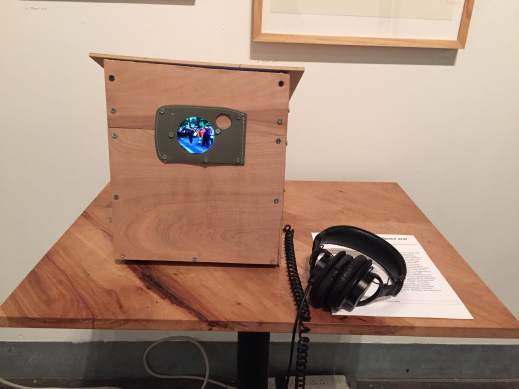
“El Caracol,” Image by Leo Cardoso
Some of the most compelling scenes in the 20 minute loop of video and audio depict street protests in Mexico City which are accompanied by ambient sounds from the field recording, combined with subtle music, and seemingly unconnected background conversation.
The artist explains that
the video element consists of footage captured while walking through various sites in Mexico City and represents the phenomenological ‘present’. The audio element provides a counterpoint to the visual; as the loop begins the audio corresponds to the action on screen, but with increasing frequency (based on the ‘Fibonacci Spiral’) the contemporary sounds will be ‘ruptured’ by historical recordings of Mexico City that drift further back in time.
I particularly enjoyed the sections where the connection between the audio and the video was unclear. Toby Butler’s article “A walk of art: the potential of the sound walk,” traces the efforts of different artists and their uses of the sound walk in their work, but he does not describe any endeavors like Rasmussen’s, where ethnographic footage is the prime source of the walk. I wondered about the position of peering through the hole to watch Rasmussen’s field recording of Mexico City, and I realized that at times, gazing through the hole gave me the sense that I was the ethnographer gathering footage.
“always more sound to experience”
I visited the Sounding Board exhibit several times while attending the SEM conference. Every time I left I felt like there was always more sound to experience. I wanted to hear all of the numerous field recording of Son Jarocho material presented by Campbell’s Schizophone; Miller’s Radio Texas International changed every time I listened and I wondered what ethnographic material I might encounter the next time I tuned in. I never tired of Lina Dib’s Pool of Sound because it gave me the chance to perform the gurgling of water, using gesture. Apart from the evocative expressions of ethnology as art, Sounding Board converted The Companion Gallery into an interactive playground of sound.

Son Jarocho Community Fandango at SEM Sounding Board, Image by Leo Cardoso
The live performances in the gallery on Friday night brought the ethnographic sound art to life. When I listened to at least twenty members of the Comunidad Fandango of Austin perform and dance Son Jarocho music in the gallery on Friday evening, I began to make connections to the field recordings that I heard in Schizophone. When Bruno Vinezof and Forró de Quintal took the stage to play forró music from northeastern Brazil, I could feel the groove of the drum that was merely suggested in the field recording that I had listened to in Dry Signals. It was a unique pleasure to observe and participate in these musical traditions with my body, after having encountered them earlier through headphones as sound art.
When I spoke with Cardoso he was especially grateful to the Son Jarocho community of Austin, who volunteered to participate in the show by gathering in The Companion Gallery for a Fandango. He emphasized the grassroots aspect of this community music making event which came about because Cardoso knows the group and their passion for Son Jarocho music.
Cardoso plans to expand the variety of works and disciplines involved in next year’s Sounding Board to include media studies, literature, film, and the visual arts. As SEM 2016 will be meeting in Washington DC and co-hosted by Smithsonian Folkways Recordings (and George Washington University), this should not only be possible, but especially exciting.
—
Featured image: Lina Dib’s “Pool of Sound” by Matt Morris
—
Jay Loomis is a composer, a performer, and a graduate student in ethnomusicology at Stony Brook University with a particular interest in transnationalism, soundscapes, improvisation, wind instruments, and electronic music. He hosts a radio show called “Face the Music,” and recently curated a sound installation called “SOUNDREAMS” at Stony Brook University, which used geo-located sounds and music strategically placed around the university campus which people heard by using a smart phone app called Recho. Jay hand crafts Native American and other kinds of flutes, and leads flute making workshops in local libraries and schools. He plays a variety of wind instruments from around the world. He recently led workshops in a contemporary music festival in Cuenca, Ecuador (FIMAC: Festival Internacional de Musica Academica Contemporanea). Participants in Jay’s workshops arranged music and created flutes as a practical way to examine how indigenous music making practices and pre colonial instruments can contribute to the world of contemporary academic music.
—
REWIND!…If you liked this post, you may also dig:
Sound and Curation; or, Cruisin’ through the galleries, posing as an audiophiliac–reina alejandra prado
SO! Amplifies: Shizu Saldamando’s OUROBOROS–J.L. Stoever
SO! Amplifies: Mendi+Keith Obadike and Sounding Race in America–Mendi + Keith Obadike
Share this:




Current Top Posts





April 2021

January 2020

November 2019

October 2019

August 2019

April 2014

November 2017

March 2015

December 2017

October 2015
 Sounding Out!
Recent Comments