
Tomahawk Chopped and Screwed: The Indeterminacy of Listening

 I’m happy to introduce the final post in Guest Editor Justin Burton‘s three part series for SO!, “The Wobble Continuum.” I’ll leave Justin to recap the series and reflect on it a little in his article below, but first I want to express our appreciation to him for his thoughtful curation of this exciting series, the first in the new Thursday stream at Sounding Out!. Thanks for getting the ball rolling!
Next month be sure to watch this space for a preview of sound at the upcoming Society for Cinema & Media Studies meeting in Seattle, and a new four part series on radio in Latin America by Guest Editor Tom McEnaney.
— Neil Verma, Special Editor for ASA/SCMS
—
I’m standing at a bus stop outside the Convention Center in downtown Indianapolis, whistling. The tune, “Braves,” is robust, a deep, oscillating comeuppance of the “Tomahawk Chop” melody familiar from my youth (the Braves were always on TBS). There’s a wobbly synthesizer down in the bass, a hi hat cymbal line pecking away at the Tomahawk Chop. This whistled remix of mine really sticks it to the original tune and the sports teams who capitalize on racist appropriations of indigenous cultures. All in all, it’s a sublime bit of musicality I’m bestowing upon the cold Indianapolis streets.
Until I become aware of the other person waiting for the bus. As I glance over at him, I can now hear my tune for what it is. The synthesizer and hi hat are all in my head, the bass nowhere to be heard. This isn’t the mix I intended, A Tribe Called Red’s attempt at defanging the Tomahawk Chop, at re-appropriating stereotypical sounds and spitting them back out on their own terms. Nope, this is just a guy on the street whistling those very stereotypes: it’s the Tomahawk Chop. I suddenly don’t feel like whistling anymore.
*****
As we conclude our Wobble Continuum guest series here at Sounding Out!, I want to think about the connective tissues binding together the previous posts from Mike D’Errico and Christina Giacona, joining A Tribe Called Red and the colonialist culture into which they release their music, and linking me to the guy at the bus stop who is not privy to the virtuosic sonic accompaniment in my head. In each case, I’ll pay attention to sound as material conjoining producers and consumers, and I’ll play with Karen Barad’s notion of performativity to hear the way these elements interact [Jason Stanyek and Ben Piekut also explore exciting possibilities from Barad in “Deadness” (TDR 54:1, 2010)].
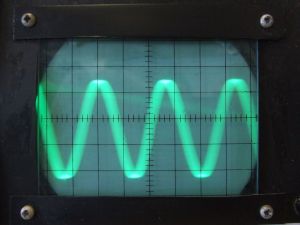
“Sound Waves: Loud Volume” by Flickr user Tess Watson, CC BY 2.0
Drawing from physicist Niels Bohr, Barad begins with the fact that matter is fundamentally indeterminate. This is formally laid out in the Heisenberg Uncertainty Principle, which notes that the more precisely we can determine (for instance) the position of a particle, the less we can say with certainty about its momentum (and vice versa). Barad points out that “‘position’ only has meaning when a rigid apparatus with fixed parts is used (eg, a ruler is nailed to a fixed table in the laboratory, thereby establishing a fixed frame of reference for establishing ‘position’)” (2003, 814).
This kind of indeterminacy is characteristic of sound, which vibrates along a cultural continuum, and which, in sliding back and forth along that continuum, allows us to tune into some information even as other information distorts or disappears. This can feel very limiting, but it can also be exhilarating, as what we are measuring are a variety of possibilities prepared to unfold before us as matter and sound become increasingly unpredictable and slippery. We can observe this continuum in the tissue connecting the previous posts in this series. In the first, Mike D’Errico tunes into the problematic hypermasculinity of brostep, pinpointing the ways music software interfaces can rehash tropes of control and dominance (Robin James has responded with productive expansions of these ideas), dropping some areas of music production right back into systems of patriarchy. In the second post, Giacona, in highlighting the anti-racist and anti-colonial work of A Tribe Called Red, speaks of the “impotence” visited upon the Tomahawk Chop by ATCR’s sonic interventions. Here, hypermasculinity is employed as a means of colonial reprimand for a hypermasculine, patriarchal culture. In sliding from one post to the other, we’ve tuned into different frequencies along a continuum, hearing the possibilities (both terrorizing and ameliorative) of patriarchal production methods unfolding before us.

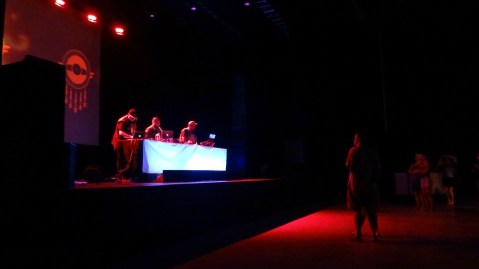
“Skrillex at Forum, Copenhagen” by Flickr user Jacob Wang, CC-BY-SA-2.0
Barad locates the performative upshot of this kind of indeterminacy in the fact that the scientist, the particle, and the ruler nailed to the table in the lab are all three bound together as part of a single phenomenon—they become one entity. To observe something is to become entangled with it, so that all of the unfolding possibilities of that particle become entwined with the unfolding possibilities of the scientist and the ruler, too. The entire phenomenon becomes indeterminate as the boundaries separating each entity bleed together, and these entities only detangle by performing—by acting out—boundaries among themselves.
Returning to Giacona’s discussion of “Braves,” it’s possible to mix and remix our components to perform them—to act them out—in more than one way. Giacona arranges it so that ATCR is the scientist, observing a particle that is a colonizing culture drunk on its own stereotypes. Here, “Braves” is the ruler that allows listeners to measure something about that culture. Is that something location? Direction? Even if we can hear clearly what Giacona leads us to—an uncovering of stereotypes so pernicious as to pervade, unchallenged, everyday activities—there’s an optimism available in indeterminacy. As we slide along the continuum to the present position of this colonialist culture, the certainty with which we can say anything about its trajectory lessens, opening the very possibility that motivates ATCR, namely the hope of something better.
“ATCR 1” by Flickr user MadameChoCho, CC BY-NC-SA 2.0
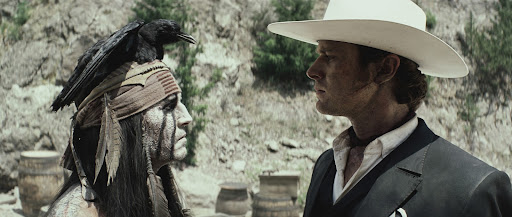
But listening and sounding are tricky things. As I think about my whistling of “Braves” in Indianapolis, it occurs to me that Giacona’s account is easily subverted. It could be that ATCR is the particle, members of a group of many different nations reduced to a single voice in a colonial present populated by scientists (continuing the analogy) who believe in Manifest Destiny and Johnny Depp. Now the ruler is not “Braves” but the Tomahawk Chop melody ATCR attempts to critique, and the group is measured by the same lousy standard colonizers always use. In this scenario, people attend ATCR shows in redface and headdresses, and I stand on the street whistling a war chant. We came to the right place, but we heard—or in my case, re-sounded—the wrong thing.

“Knob Twiddler” by Flickr user Jes, CC BY-SA 2.0
Jennifer Stoever-Ackerman’s “listening ear” is instructive here. Cultures as steeped in indigenous stereotypes as the United States and Canada have conditioned their ears to hear ATCR through whiteness, through colonialism, making it difficult to perceive the subversive nature of “Braves.” ATCR plays a dangerous game in which they are vulnerable to being heard as a war chant rather than a critique; their material must be handled with care. There’s a simple enough lesson for me and my whistling: some sounds should stay in my head. But Barad offers something more fundamental to what we do as listeners. By recognizing that 1). there are connective tissues deeply entangling the materiality of our selves, musicians, and music and 2). listening is a continuum revealing only some knowledge at any given moment, we can begin to imagine and perform the many possibilities that open up to us in the indeterminacy of listening.
If everything sounds certain to us when we listen, we’re doing it wrong. Instead, for music to function productively, we as listeners must find our places in a wobbly continuum whose tissues connect us to the varied appendages of music and culture. Once so entangled, we’ll ride those synth waves down to the low end as hi hats all the while tap out the infinite possibilities opening in front of us.
—
Featured image: “a tribe called red_hall4_mozpics (2)_GF” by Flickr user Trans Musicales, CC BY-NC-ND 2.0
—
Justin Burton is a musicologist specializing in US popular music and culture. He is especially interested in hip hop and the ways it is sounded across regions, locating itself in specific places even as it expresses transnational and diasporic ideas.He is Assistant Professor of Music at Rider University, where he teaches in the school’s Popular Music and Culture program. He helped design the degree, which launched in the fall of 2012, and he is proud to be able to work in such a unique program. His book-length project – Posthuman Pop – blends his interests in hip hop and technology by engaging contemporary popular music through the lens of posthuman theory. Recent and forthcoming publications include an exploration of the Mozart myth as it is presented in Peter Shaffer’s Amadeus and then parodied in an episode of The Simpsons (Journal of Popular Culture 46:3, 2013), an examination of the earliest iPod silhouette commercials and the notions of freedom they are meant to convey (Oxford Handbook of Mobile Music Studies), and a long comparative review of Kanye and Jay Z’s Watch the Throne and the Roots’ Undun (Journal for the Society of American Music). He is also co-editing with Ali Colleen Neff a special issue of the Journal of Popular Music Studies titled “Sounding Global Southernness.” He currently serves on the executive committee of the International Association for the Study of Popular Music-US Branch and is working on an oral history project of the organization. From June 2011 through May 2013, he served as Editor of the IASPM-US website, expanding the site’s offerings with the cutting edge work of popular music scholars from around the world. You can contact him at justindburton [at] gmail [dot] com.
—
 REWIND!…If you liked this post, you may also dig:
“Musical Encounters and Acts of Audiencing: Listening Cultures in the American Antebellum”-Daniel Cavicchi
“Musical Objects, Variability and Live Electronic Performance”-Primus Luta
“Further Experiments in Agent-based Musical Composition”-Andreas Duus Pape
Share this:

“HOW YOU SOUND??”: The Poet’s Voice, Aura, and the Challenge of Listening to Poetry
This post is dedicated to the memory of Amiri Baraka, who passed away on January 9, 2014 in Newark, New Jersey.
I began writing this post while my wife, Sarah, was at a conference on writing curriculum for high school literature. Over the phone one night she asked how to help students better understand the language of Shakespeare, and at a loss for suggestions (not only because I don’t study early modern drama), I recalled my own adolescent struggles with Macbeth, Hamlet, and Julius Caesar. I recalled well-intentioned teachers who gave me recordings, telling me that they would help me get an “ear” for Shakespeare’s language—yet all I remember, maybe all I learned, while listening to the Caedmon recording of Macbeth on vinyl, was that, to my mid-1990s ear, Shakespeare (anachronistically) sounded like Star Wars (which appeared 15 years after the 1960 Caedmon album).
My high school confusion has not completely faded when it comes to the sound of recorded poetic language, even more so when the notion of the poet’s voice is thrown into the mix. As opposed to verse recited by actors (the Caedmon Macbeth featured Anthony Quayle), or the sound of the syllables when we read a poem silently to ourselves, I find it tough to parse the idea of the sound of the poem in terms of the poet’s voice because “voice” is a slippery category—a constructed one, contingent upon the given historical moment of inscription and reception. It is tough because this idea of the sound of the poem, located in the voice of the poet, gets complicated with sonic technologies where voice is subject to the shifting conditions of fidelity.
“Record Player” by DeviantArt user SomeAreLove, CC-BY-NC-ND-3.0
The act of listening to recorded poetry thus poses particular analytic challenges, which become more complex when the politics of identity are brought to bear on these questions of voice and poetry. As a site for identity production, the recorded poetry performance projects a mediated voice that is a potential self. The “sound” of this poetic subjectivity is different from recording to recording, even of the same poem. In an effort to work through these complexities, this post takes up three different recordings of Amiri Baraka’s poem “Black Dada Nihilismus,” which offer variations in delivery and performance that each depend upon the social, political, and aesthetic dimensions of the soundscape that each recording is embedded within.
“Black Dada Nihilismus” is an excellent opportunity to consider the overlapping challenges of voice, performance and the politics of identity in recorded poetry. Published in the early 1960s, this poem was written before Baraka’s shift in politics, which was precipitated by the assassination of Malcolm X in 1965, yet the poem anticipates the intersection of aesthetics and politics during the Black Arts Movement in the late 1960s into the 70s. This shift can be tracked in the sonic details of the first two recordings, made in 1964 and 1965. In the third version, a 1993 remix by DJ Spooky, we can hear how this shift reverberates beyond its historical moment.
In a statement of poetics included in Donald Allen’s classic 1959 anthology The New American Poetry, Baraka (then Leroi Jones) asked: “HOW YOU SOUND??” How a poet’s poem sounded mattered most for him: “you have to start and finish there … your own voice … how you sound” (425). Primarily referencing the poem on the page, he wasn’t whistling in the dark: often thought of as a vocal performance of language, poetry has a long history with sound. One thread of this history is the Homeric tradition of an “oral poetics,” a tradition where, as Albert Lord notes in The Singer of Tales, socialized performances of poetry were simultaneously modes of composition. The feel of language in the body remained inseparable from the poetry that relayed the heroic tales of the ancient world. In The Sounds of Poetry, Robert Pinsky offers a similar account of sound and voice, suggesting that the “sound” of language, the sensuous play of speech, is the material for poetic composition. Or as Charles Bernstein has it in Close Listening, “poetry needs to be sounded” because it is a way to understand it better (7).
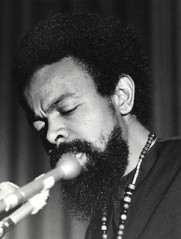
“Le Roi Jones” by Flickr user UIC Digital Collections, CC BY-NC-ND 2.0
Poetry is often said to be difficult—but how would a poet’s “sounding” of a poem help a listener better understand it, as Bernstein suggests? How is the recorded voice resonating in air different from inert marks on a page? What is the status of that difference? Why or how would the sound recording signify differently than the poem on the silent page? In short, is listening easier than reading? My answer to the final question is a resounding “no.” For me, the challenge is how to consider the recorded poetry performance in both formal and aural terms so as to remain tuned in to the aesthetic and the poetic as well as the social and historical dimensions of a particular poet’s work. This is not easily done.
“Black Dada Nihilismus” was first published in The Dead Lecturer (1964) and later included in Transbluesency (1995). Written in two parts, it asserts a black aesthetic by critiquing the dominance of (white) light in Western art and suggesting a connection between this light, ethnic violence, and religious ideology. This is how the poem opens:
.Against what light
is false what breath
sucked, for deadness.
Murder, the cleansed
purpose, frail, against
God, if they bring him
Bleeding, I would not
forgive, or even call him
black dada nihilismus.
The protestant love, wide windows,
color blocked to Modrian, and the
ugly silent deaths of jews […]
(Transbluesency 97)
Through critique the poem develops the connections between aesthetics and racial dominance and violence. These connections take on different inflections in each recorded version of the poem, and with each inflection another aspect of them is amplified.
The first version is a bootleg of a reading at the Asilomar Negro Writers Conference that was held in Pacific Grove, California, in early August, 1964.

Asilomar Conference Grounds, site of 1964 Negro Writers Conference
In addition to the preamble, where Baraka explains some of the poem’s key terms such as Dada, which he describes as a movement in France (rather than Germany or Switzerland), another sonic detail that marks this as “live” is at the 2:59 minute mark when we hear the flap of a turning page, reminding us that Baraka is treating the poem as a script in these recordings. In this version, the opening lines are sharply delivered, the voice fully pausing at the linebreaks and acutely pronouncing the hard vowels (e.g. “sucked”). Against the continuous background hush of the original reel-to-reel recording, Baraka punches his words into the air, as if trying to find a rhythm between these harder vowels and the softer ones that often denote the poem’s object of critique (e.g. “light”).
The next version is off the A side of New York Art Quartet and Imamu Amiri Baraka (ESP Disk 1965), where the poem’s rhythm is immediately established by the musical accompaniment.
Between the first recording and this one a shift began in Baraka’s development as a poet. The assassination of Malcolm X pushed him to think even more about race, politics, and art. In this version the opening lines, delivered with punch and pause in the bootleg, take on a different register when juxtaposed with the smooth coolness of the quartet. Overall, though, the poem is delivered more militantly here. In the first version the opening lines are delivered forcefully, but ultimately this forcefulness subsides over the course of the reading. The opposite is the case in this studio version that slowly builds to the apex of the poem, the point of most force, this stanza:
Black scream
and chant, scream,
and dull, un
earthly
hollering.
(Transbluesency 99)
In the bootleg, the turn of the page—between “earthly” and “hollering”—interrupts this stanza, and Baraka hesitates and slowly finds his way toward the poem’s close, while in the studio version, the musical accompaniment reaches a fevered pitch here, making it feel as if it is at the edge of the scream that it names. This prepares us for the closing litany of names of black figures of “black dada nihilismus,” which goes like this:
For tambo, willie best, dubois, patrice, mantan, the
bronze buckaroos.
For Jack Johnson, asbestos, tonto, buckwheat,
billie holiday.
(Ibid.)
In the final version, which is DJ Spooky’s remix of the second one, included on the CD Offbeat: A Red Hot Soundtrip (TVT Records 1996), this litany feels more like the outro (that is meant as) against Spooky’s beats and moody reverb.
An aspect of the poem amplified in the remix is the stanzas leading up to the apex stanza of the “black scream.” In a series of tercets that open the second section, the speaker addresses the experience of racial oppression and a growing need to strike back:
The razor. Our flail against them, why
you carry knives? Or brutaled lumps of
heart? Why you stay, where they can
reach? Why you sit, or stand, or walk
in this place, a window on a dark
warehouse […]
(Transbluesency 98)
The “why” is significantly amplified in the remix, forcing us to hear the ironic indictment of the oppressive “light,” not as audible in the other two tracks, explicit in Baraka’s tercets.
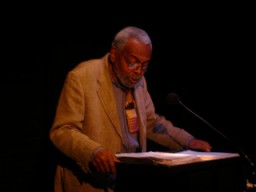
“IMG_0433″ by Flickr user Beyond Baroque, CC-BY-NC-SA-2.0
The original recordings of these versions of “Black Dada Nihilismus” are each in a different format: vinyl LP, tape-to-tape reel, and CD. I have been working with digitized versions, so the way I am hearing these recordings—through a smooth digitized MP3 file or Youtube clip—is not the same as the crackle of a needle running an LP’s groove or a nearly noiseless laser tracing a CD. These variations in format mean that the different ways these versions individual signify—their respective “sounds”—are flattened out by compression. Despite this loss of material context, Baraka still sounds different in each of these tracks. Each version of Baraka’s poem offers us another iteration of his “voice,” and the poem, but listening to each of them does not necessarily provide a better understanding of it. We are, though, given different sonic experiences that depend upon the purpose of Baraka’s performance, the listener imagined during the reading, and the voice enunciated through the mediated environment.
Some of the voice details do remain consistent across these recordings. For example, the delivery of one of the poem’s most memorable phrase—“Hermes, the/the blacker art”—that occurs toward the close of the poem’s first section is steadily delivered in a lower register, in the hush of an aside, and might be taken as the motif of each of these variations.
“Stage Microphone TTV” by Flickr user Keith Bloomfield, CC-BY-NC-ND-2.0
A vast archive of recorded poetry exists. Mid-century recording projects by Caedmon and Folkways made “voices” of well-known poets, such as Robert Frost and Dylan Thomas, available for mainstream consumption. More recent anthologies and series like Poetry Speaks and The Voice of the Poet suggest that the “voice of the poet” still holds appeal. The proliferation of online sound archives such as Penn Sound and From the Fishouse further attest to an ongoing investment in recording, storing, and making available sound files of poets reading their work. And this fascination with the “sound” of poetry is not limited to mainstream cultural spheres or web-based archives. Several scholarly collections on this convergence of sound, voice, and poetry such as Bernstein’s already-mentioned Close Listening, Adelaide Morris’s Sound States, and Marjorie Perloff’s and Craig Dworkin’s The Sound of Poetry/The Poetry of Sound have appeared over the last decade.
The idea of the sound of the poem, located in the mediated voice of the poet, therefore remains relevant today. In many of these instances, however, the poet’s voice falsely takes on an authoritative “aura,” as Walter Benjamin used that word in his (recently re-translated) “The Work of Art in the Age of Its Technological Reproducibility.” Benjamin uses “aura” to talk about authenticity in art and how that is lost when images (or sounds) can be reproduced and widely distributed, and this is not a bad thing: “technological reproducibility emancipates the work of art from its parasitic subservience to ritual. To an ever-increasing degree, the work produced becomes the reproduction of work designed to be reproduced” (24). When Benjamin’s concept is applied to recorded poetry, two key points emerge. First, the “sound” of a poet’s voice is the product of technological conditions. Second, just as a book editor makes aesthetic judgments based on a perceived audience, a listener is imagined when a poetry performance is recorded. Too bad I didn’t know this in high school.
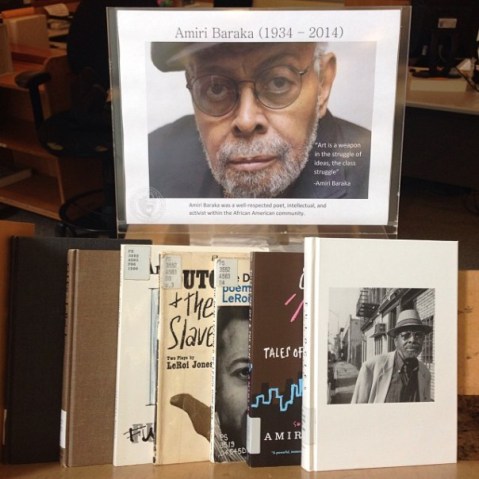
“A Poem for Speculative Hipsters by Amiri Baraka” by Flickr user Shawn Calhoun, CC-BY-NC-2.0
—
Featured image: “Paula Varjack” by Flickr user Very Quiet, CC-BY-SA-2.0
—
John Hyland recently completed his dissertation on sound, poetics, and the black diaspora, titled “Atlantic Reverberations: The Sonic Performances of Black Diasporic Poetries,” at the University at Buffalo, SUNY. His poems, essays, and reviews have appeared (or are forthcoming) in a range of journals, such as The Journal of Postcolonial Writing, College Literature, and Borderlands. Recently, he has enjoyed performing with the Buffalo Poets Theater and co-edited a special issue of the poetry journal kadar koli on the relationship between violence and the expressive arts.
—
REWIND! . . .If you liked this post, you may also dig:
Hearing the Tenor of the Vendler/Dove Conversation: Race, Listening, and the “Noise” of Texts-Christina Sharpe
Pretty, Fast, and Loud: The Audible Ali–Tara Betts
The Sounds of Anti-Anti-Essentialism: Listening to Black Consciousness in the Classroom-Carter Mathes
Share this:


Current Top Posts





April 2021

January 2020

November 2019

October 2019

August 2019

April 2014

November 2017

March 2015

December 2017

October 2015
 Sounding Out!
Recent Comments