
Wayback Sound Machine: Sound Through Time, Space, and Place
 This is the second post in Sounding Out!’s July forum on listening in observation of World Listening Day on July 18th, 2013. World Listening Day is a time to think about the impacts we have on our auditory environments and, in turn, its affects on us. To read last week’s post by Regina Bradley (and to read more about World Listening Day) click here.
—
When I travel to somewhere I’m unfamiliar with to create a work, I’ve become in the habit of bringing my VLF receiver, hydrophones, and underwater camera in order to explore. Whether what comes out ultimately becomes part of the work or not, my interest in these particular tools stems from a fascination with obscure events around me, real and happening, that I cannot perceive. But it also marks my wonder at events and elements in our world that have been, while changing, continuous in a time line extending much further than my own. Similar to the sense one may get when experiencing a desert, or an ocean, with time and patience, what might at first seem bleak, barren, or monotonous, begins to give hint to a rich world hidden from our day to day.

Photo by the author, Saint Michael’s Mound, Marazion, Cornwall
Two autumns ago, finding myself with a day off from a project I was working on near Penzance in Cornwall, I decided to take the day to hike the lesser known British arm of the Santiago Pilgrim Route: the St. Michael’s Way. Dating back tens of thousands of years, St. Michael’s Way enabled pilgrims and missionaries traveling from Ireland or Wales to choose to abandon their ships and walk across the peninsula, rather than navigating the treacherous waters around Land’s End. In the days of such pilgrimmages, the way was fraught with all sorts of dangers, and the path itself splits a few times, veering off towards a church near the harbor where they would get the boat to cross them. There they would meet a guide who would offer safe passage from the many thieves and pirates along the way. Still marked with the iconic scallop shell symbol of the pilgrim route, the path was nevertheless neglected, and overrun with all sorts of modern obstacles such as busy roads and farm irrigation systems.

Photo by the author, Gulval, Cornwall
As I got lost time and time again making my way towards Saint Ives, I found myself marveling at all sorts of new and heretofore unknown sensations. My ears tuned from the project I was there working on, I was especially taken by the sound. Toward the middle of the path–located at the top of the hills inland of the peninsula –the wind from both sides carried over pieces of the day to day from the villages; a tractor, grazing animals, bits of conversation in Cornish, and church bells wisping by as quickly as they came, like ghosts. It is fitting that St Michael, after whom the route was named, is the patron saint of high places.

Photo by the author, Ludgvan, Cornwall
I began to wonder what this path may have sounded like back in the time of thieves and pirates, back when the occasion to use it was a shared occasion celebrated with the voices of people, priests, prayers, and the markets and fairs along the way to fuel all this activity. As I continued walking, I began to wonder how it may have sounded even before then, before the hills were blanketed with crops and cattle, before the many battles that must have been waged, and villages built and grazed. . .were there more birds then? Were there more trees? Were there more boar and foxes? What about even before these hills were hills, could there be a way to sonify these hills forming? I started to dream of a “wayback machine” for sound. What if as you walked this path, you could listen to time spinning back, listen to how it might have sounded, listen to its history? And what could you take from that experience? Could something be taken from this? In the two years since that happenstance, this idea has since stuck with me. Beginning tentative research and practice to apply these thoughts, I continue to unearth more questions than answers, so I began to seek others experimenting in a similar vein. While acoustic ecology is a growing field, I still have not found many researchers working with sound in/as time.
One person who has come close to this idea is acoustic ecologist, musician, and sound recordist Bernie Krause, whom last year I interviewed in an article on the sound of disaster about disappearing sounds as a signal of impending crises. The prelude of Krause’s book The Great Animal Orchestra: Finding the Origins of Music in the World’s Wild Places, is the beautifully written, “Echoes of the Past,” which takes a meandering listen to how the world might have sounded sixteen thousand years ago. With that trip in mind, perhaps something could come from working with people in various fields of statistical analysis to see what sounds are projected to go extinct from a soundscape with time, and what this could mean in terms of how the sound line will be extended into the future. In the section “First Notes,” Krause describes working with a graduate student, Kristin Junette, who reasoned that based on fossil records and the known sounds of insect species today, we might be able to re-create the insect ambience of about sixty-five million years ago. Then, based on acoustic physiology of the skull of a Hadrosaur, a dinosaur of the time, Krause and Junette were able to re-create a representative vocalization of its call to place in this early soundscape (for the Discovery Channel’s vision of how the hadrosaur might have sounded click here).
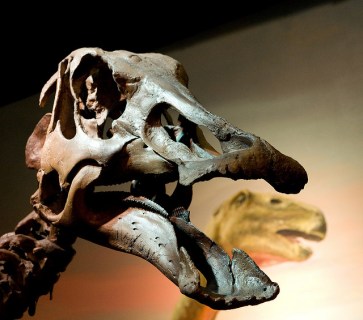
Hadrosaur skull, Image by Flickr user e_monk
I was also excited to learn of the research of Miriam Kolar, who has been working with various techniques and with people in various disciplines on a team studying and “recreating” the acoustic architecture of the Chavín de Huántar, a 3,000 year old ceremonial center, predating the Inca in the Peruvian Andes. Chavín de Huántar is a complex underground maze of rooms and twisting corridors connected by air-ducts. When they were being excavated, archeologists noticed the rooms played strange acoustic tricks on them. “This environment is not only a physical maze, but it’s a sound maze,” says Kolar. For one example, some rooms have interconnected spaces that multiply echoes and bounce them back to the ear so rapidly that the sounds appear to emanate from all directions at once, while other areas seem designed for absorption. The team has been using 3-D computer modeling and specialized recording equipment to try and recreate the auditory effect. “If you have archaeology and no acoustics, you’re deaf,” says archaeoacoustician David Lubman. “And if you have acoustics and not the other, you’re blind. You need both” to understand ancient places like Chavín.

Chavín De Huántar
Inspired in part by the research of Krause and Kolar, “Passageira em Casa/The Traveller at Home,” one of my projects from the two years since my walk in Cornwall, begins to explore the notion of the wayback machine with sound in geography. Passageira em Casa is an intermedia and interdisciplinary performance inspired by the journey to define the concept of home. The narrative is a partially fictionalized and personalized account of the Maritime history of Portugal, enacted by a dancer, vocal performer, live video, and live electronic sound composition that creates a geography through the narrative and space of the project. From a dawn chorus in Lisbon to underwater earthquakes in the Pacific, field recordings along a maritime navigation route flow throughout the performance, giving a soundscape to the narrative’s location.
.
The recent Australian version “Passageira australis” begings to explore sound in time. Recently developed at the iAir residency at RMIT, holds a focus on the debate behind whether the Portuguese were the first Europeans to arrive in Australia, based on the 16th century Dieppe maps of Jave la Grande and the myth/history of the Mahogany Ship. The soundtrack reveals a soundline based on the impact on flora, fauna, and overall soundscape on both countries.
.
A two channel composition, different then stereo, one speaker represents Europe, the other Australia. As the dancer, our sailor, moves from one end of the space to the other, the sound in each channel is changed based on her approximate location to each “country”. With this experience, my hope is the audience comes away thinking about interconnectivity of the world, and how we impact the places we touch. Although I will continue to research when I return to Australia, already the project had me working with a map historian at the Victoria State Library, as well as consulting the thesis of geologist Andrew Pickering on using GIS technology to search for the location and story behind the presumed mythological Mahogany Ship.
Based on hearing, listening (from an anthropological point of view) is the very sense of space and of time. . .By her noises, Nature shudders with meaning: at least this is how, according to Hegel, the ancient Greeks listened to her. The oaks of Dodona, by the murmur of their boughs, uttered prophecies, and in other civilizations as well. . .noises have been the immediate raw materials of a divination, cledonomancy: to listen is, in an institutional manner, to try to find out what is happening. –Roland Bathes, “Listening”
Sound has a special importance to emotion, instinct, and memory, both individual and historical.. Hitting the oldest part of our brain, sound provides immediate information telling us where we are, whether it is safe, and how we should feel about it. The wayback machine would function as a sonic database that would not only help us to remember and learn about the past, but also to create new experiences within the complexity of changing soundscapes over a period that usually defies our human comprehension. I see this tool being helpful to researchers in many disciplines as a new kind of living archive, but also having a place in libraries, museums, centers, and perhaps “in the field” along paths such as the Santiago’s Way, where one could download an audio file from the map online, then listen with wonder and unique sensation as they walk back through history.

Photo by the author, Saint Michael’s Mound, Marazion, Cornwall
—
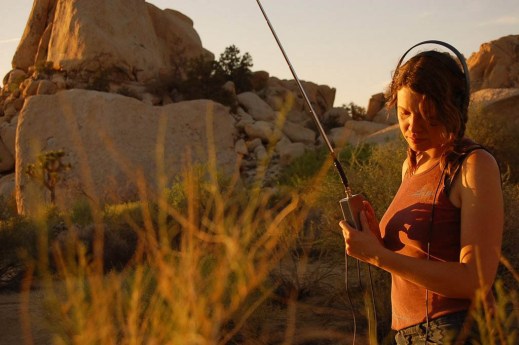
Featured Image photo credit: Vahid Sadjadi, Joshua Tree State Park, California
—
Author’s Note: A version of this post was presented at Musique et Écologies du Son/ Music and Ecologies of Sound: Theoretical and Practical Projects for the Listening of the World, Universitê Paris 8, May 2013. I slightly changed the original title of the paper to: “Sound through time, space, AND place.” Frank Vanclay said quite nicely in “Place Matters.” “‘Place” is generally conceived as being ‘space’ imbued with meaning. Thus, it refers more to the meanings that are invested in a location than to the physicality of the locality.” He goes on to state sometimes it’s the biophysical characteristics that make the foundation for those personal meanings.
—
Maile Colbert is a multi-media artist with a concentration on sound and video who relocated from Los Angeles, US to Lisbon, Portugal. She is a regular writer for Sounding Out!
—

REWIND! . . .If you liked this post, you may also dig:
“Listening to Disaster: Our Relationship to Sound in Danger”–Maile Colbert
“Within a Grain of Sand: Our Sonic Environment and Some of Its Shapers” –Maile Colbert
“Animal Renderings: The Library of Natural Sounds”--Jonathan Skinner
Share this:

Sonic Brownface: Representations of Mexicanness in an Era of Discontent

Image by Flickr User Thomas Hawk
In the current anti-immigrant climate, the visual, sonic, and textual modes of representation are becoming battlegrounds we must consider. Arizona, Georgia, and Alabama’s takes on immigration policy and eliminations of ethnic study course offerings from college and high school curricula, are signs of a climate fraught with discontent. However, these fights are not limited solely to the political sphere; in fact, the arena of cultural production—music, literature, theater, and film—facilitates a generalized outlook on Latinidad in the United States by representing Dreamers (the generations of children who were raised in the U.S. from a young age but are not citizens), and/or the thousands of undocumented immigrants who sustain an infrastructure of cheap labor. Within these often stereotypical representations, it is frequently sound that produces the strongest sense of social, cultural, and political difference for Latino subjects.
In this post, I analyze the 2006 film Nacho Libre, a comedy starring Jack Black as a friar who becomes a Lucha Libre fighter, as symptomatic of what I term “sonic brownface,” an aural performativity of Mexicanness. My interest on Nacho Libre is to elucidate how sonic brownface manifests on the big screen, and what is at stake through these seemingly innocent (re)presentations of Mexicanness. I characterize “sonic brownface” as a “speedification” of a Mexican accent, named after Speedy Gonzalez’ infamous call “¡Ándale! ¡Ándale! ¡Arriba! ¡Arriba! ¡Epa! ¡Epa! ¡Epa!” Although comedian Jack Black intends to present a respectful portrayal of a Mexican, his speech enables my analysis of “sonic brownface” within popular culture, a sound that reproduces ideologies about an invisible majority that is also perceived as non-American: Latinos, undocumented immigrants, and dreamers.

The May 1, 2006 protest in Los Angeles, Image by Flickr user The Korean Resource Center 민족학교
Voicing the Other…

Popular silent-era leading man Ramon Novarro (née José Ramón Gil Samaniego) as photographed by Carl Van Vechten in 1935
The last scene of the Academy Award winning film The Artist (2011), presents why the silent film Artist was against the industry’s move toward the “talkie.” His voice collided with the visual representation of the suave debonair cosmopolitan man—and audience expectations of what such privilege sounds like. Though French actor Jean Dujardin plays the lead character in the film The Artist, it must be noted that several Mexican and Latin American actors did quite well in those early years of Hollywood cinema. Their exotic looks made them desirable and allowed audiences to fantasize about the man or woman on the screen because they could not hear them speak. Moreover, their physicality allowed some actors to “pass” as white. When talkies became the norm, Latino actors began performing now familiar stereotypical characters because in the U.S., their voices were indelibly associated with their “foreignness.”
In the realm of popular culture, both Disney and Warner Brothers created their own “Mexican” characters. In 1944, Disney introduced a Mexican and a Brazilian in the animated film Three Caballeros. Joaquin Garay was a Mexican voice actor featured in the voice of Panchito Pistoles in the Three Caballeros.
.
His accent and his singing sounded like someone who is Mexican speaking English, as oppose to an exaggerated Mexican accent heard later in the cartoon character of Speedy Gonzalez. Panchito Pistolas showcases a pride in being Mexican as heard in the singing of a ranchera and wearing his gun like the Mexican Revolutionaries of the 1910s. In the 1950s, Warner Brothers introduced Speedy Gonzales to their pantheon of animated characters, coinciding with the next wave of anti-Mexican sentiment during the campaign of Operation Wetback.
In his essay “Autopsy of a Rat,” William Nericcio posits that viewers come to recognize a series of stereotypes about Mexicans through the animated character of Speedy Gonzales. Nericcio incorporates historical references that influenced the design and creation of Gonzalez. He stipulates that this animation creates visual cues which American audiences connect as qualities of Mexicanness, “how this popular animated star comes to function in a way that reinforces politically charged, visions/versions of the ‘Mexican’ on ‘American’ soil” (212). Nericcio emphasizes the “visuo-ethnic clues” to deconstruct the Speedy Gonzales cartoon, and his definition of the stereotype helps corroborates my interest in how “sonic brownface” manifests as a “Speedification” of a Mexican accent. “Strapped for existential input as to the dynamic of Mexican subjects, we turn to stereotypes to provide us with visuo-ethnic ‘clues’ that fill in for empirical data and satisfy the lazy desire of our collective curiosity (219). Whereas Nericcio emphasizes the visual, however, I argue that sound has also held a strong purchase on the American racial imaginary in the case of Latinos. When audiences see and hear Jack Black as Nacho Libre, for example, they already recognize the accent.
Nacho Libre, sonic brownface personified
I propose the concept of “sonic brownface,” which pairs auditory with visual signs of Mexicanness as mediated in popular culture, to characterize the Mexican as a perpetual foreigner within the national imaginary. My interest in a film like Nacho Libre is to elucidate how audiences already recognize “Speedification,” a voicing of Mexicanness that manifests as a performance of “sonic brownface.” This conceptualization of “sonic brownface” is informed by Jennifer Stoever-Ackerman’s work on the “sonic color-line.” In “Splicing the Sonic Color-Line: Tony Schwartz Remixes Postwar Nueva York,” she posits that “sound is not merely a scientific phenomenon—vibrations passing through matter at particular frequencies—it is also a set of social relations … the “sonic color-line” begins to theorize the mutually constitutive relationship between sound, listening, and race.” She elaborates how “aural signifiers of race are thoroughly enmeshed with the visuality of race [because] they never really lose their ultimate referent to different types of bodies” (65). In the case of “sonic brownface,” Jack Black does not need to be a Mexican actor, he just needs to sound “Mexican” to conjure a physical referent.
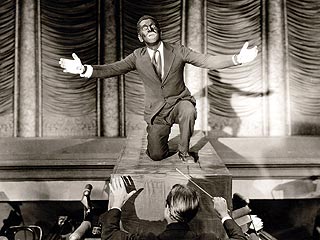
Still from The Jazz Singer
In utilizing the term “brownface,” I also reference minstrel entertainment in which blackness fetishized and simultaneously disavowed African American entertainers consequently framing racial codes onto a spectrum of racialized bodies. In his analysis of the first talkie The Jazz Singer (1927) “Blackface, White Noise,” Michael Rogin proposes that the “protagonist adopts a black mask and ventriloquiz[es]the black, sings through his mouth” (419). Through this masking, the Jazz Singer becomes Americanized through “appropriat[ing] an imaginary blackness” (421). Even as our contemporary sensibility would call out any form of contemporary blackface performance, we have yet to identify a similar masking when it occurs with Mexican or Latino characters. I contend that the models seen in blackface entertainment have already placed familiar scenarios of seeing White or Jewish actors performing an ethnic Other. When American audiences see Jack Black as “Nacho Libre,” they do not need to see him brown his skin; it is enough to hear a “speedification” of Spanish to have us entertain his believability. When “sonic brownface” occurs, it does not Americanize the performer, rather it perpetuates the Mexican and by extension Chicanos and Latinos as always already foreigners.
In order to recognize how “sonic brownface” is performed in the comedy Nacho Libre, it is also necessary to understand how its sound echoes a political climate that conflates “Mexican” with “Immigrant,” thereby representing Mexicans as undocumented people who have no right to be on this side of the U.S./Mexico border, and lumps all Latinos together as “Mexican.” The film was released a month after the nation’s largest immigrant rallies on May 1, 2006, occurring throughout many cities. The timing of the film also coincided with the first series of policy measures on immigration reform proposed by Congress. Whereas before the May Day marches, some members of congress discussed immigrants as criminals, after the big turnout Congress changed their tune, beginning to consider amnesty or easier paths to citizenship for undocumented immigrants, including generation Dreamers, already raised and finishing their schooling in the States. Cue Jack Black.

Image by Flickr User Thommy Browne
Speedification del Celluloid: “sonic brownface” in Nacho Libre
Nacho Libre, directed by Jared Hess (of Napoleon Dynamite fame) presents a comedic fictionalization of the story of Fray Tormenta, a career Lucha Libre fighter who was actually Reverend Sergio Gutiérrez Benitez. The film highlights Black’s strengths as a singer and presents him in a character that is the classic underdog trying to achieve his wrestling dream. As Nacho, the cook for the orphanage, he also wishes to provide the children a better meal, at least once in a while. I will highlight a few scenes in which Black’s sonic brownface performance stands in contrast to the other Mexican cinema actors who speak English. I will conclude with a proposition as to why sonic brownface is already so familiar to us.
From the opening sequence, we see the quaint orphanage located in a small Mexican pueblo. “Sonic brownface” is introduced in the film from Black’s first words “Be grateful Juan Pablo today is especially delicious.” In the next sequence, Hess films the Father saying mass in Spanish with no translation, or subtitles. I point this out because it sets up a type of authenticity with the Mexican orphanage, and that the film brings together both American actors speaking “Es-Pan-ish” and Mexican actors speaking in English. Ana de la Reguera, “Sister Encarnación,”–a nun who arrives to teach the children–also does not perform sonic brownface. She sounds like a Mexican actress speaking English, very much like other Mexican actors preceding her in Hollywood, adding a third later of sonic representation that actually works to heighten sonic brownface’s effects.
However, the sequence that most prominently presents the visual and auditory cues of sonic brownface appear in a twenty-minute segment when Nacho recruits his partner, Esquelito, and they transform into luchadores. In the midst of Nacho’s transformation, he must also contend with his carnal feelings for Sister Encarnación and to instruct the boys that wrestling is not good. Black goes from Italian in “taste of glory” (19:114-16); to Cuban “take it easy” (24:03); to urban Mexican American “my life is good, really good. It’s fantastic” (35:50). The sequence ends as Nacho cannot defend Sister Encarnación and blames Esqueleto for the mishap. Here sonic blackface culminates this performativity of Other with “get that corn outta my face. I looked like a fool last night. What took you so long?!” (39:54-40:29).
One could read this performativity of Otherness in the remix of accents as Black’s self-awareness that he is voicing something not of his experience. However, that he is Jewish and a comedian implies a privileged position already granted to him through blackface performances: the permission to co-opt ethnic and racial identities. When he inflects a Cubanesque accent, audiences can recall Al Pacino in Scarface, an earlier articulation of “sonic brownface.” Or the urban Chicano accent as seen in Born in East L.A. when Cheech Marin teaches the Mexicans waiting to cross the border how to blend in with Chicanos. By the time Black performs sonic blackface, as audiences we have been cued to these auditory references, thus we do not need him to alter his physicality to match the accent. It is enough to hear it to understand the referent. The sequence reaffirms Nacho as the luchador, since we also see his persona of the fighter come to life.
Rogin’s analysis can help us understand these slippages, as well as the role of “sonic brownface” in representations of Latinos by white actors. Rogin posits how Jolson’s performance in the first talkie simultaneously killed Vaudeville entertainment and reintroduced blackface into popular media (429). It is Rogin’s conclusion that it is with the appearance of “Jack Robin” in blackface, that the Jewish individual “Jakie Robinowitz” becomes white and thereby successful, mediating this success through visual codes of blackness. Similarly, in Nacho Libre, sonic brownface operates as both the visual and sonic cues of Mexicanness that enable Jack Black to become the luchador who doesn’t need to live behind a mask. As the film ends, Nacho is content, becoming a hero to the orphans who no longer bemoans his lot in life. This ending is contrary to the plight of immigrants from Latin America who must leave their home in search of better economic opportunities.
By identifying sonic brownface, we can see how American audiences fetishize the sounds of the Mexican/Latin Other yet simultaneously disavow their presence by placing non-Latino actors in these roles. Through the performativity of sonic brownface, popular media and film reify codes of Mexicanness as always foreign, silencing their accents because español is still an unwelcomed sound. Sonic brownface can also be a useful tool by which to investigate similar auditory articulations of Latino sounds. I’m thinking here of Rita Moreno in West Side Story (1961)—see Priscilla Peña Ovalle‘s Sounding Out! post “Aurally Other: Rita Moreno and the Articulation of ‘Latina-ness’” (January 2011)–George Lopez in Beverly Hills Chihuahua (2008), Wilmer Valderrama “Fez” in the television series That 70s Show, and the panoply of Latino actors in Machete (2010) by Richard Rodriguez. Given that media tends to recycle tropes and stereotypes, as audience members we have developed a keen awareness of these sonic markings of Otherness.
Most importantly, my intent in identifying sonic brownface concerns its re-appearance during another surge of anti-immigrant rhetoric. The rallies that occurred on May Day 2006 became synomous with immigrant rights. The release of Nacho Libre shortly after these rallies unknowingly silenced immigrant Spanish speaking voices in the popular imaginary until the film A Better Life (2011) staring Demián Bichir, connected undocumented immigrants with an empathetic experience. The strongest counteractions, however, have not been channeled through Hollywood. With the 2012 election, another surge of immigrant rallies happened at the Democratic National Convention with UndocuBus riders arriving in time to call attention to immigrant rights (start at 8:10-11:24).
As seen in this video clip, undocumented immigrants, Dreamers, Latina/s, and Chicana/os committed acts of civil disobedience because their voices will not be silenced.
—
reina alejandra prado saldivar is an art historian, curator, and an adjunct lecturer in the Social Science Division of Glendale Community College in Glendale, California.As a cultural activist, she focused her earlier research on Chicano cultural production and the visual arts. Prado is also a poet and performance artist known for her interactive durational work Take a Piece of my Heart as the character Santa Perversa (www.santaperversa.com) and is currently working on her first solo performance entitled Whipped!
—
REWIND! . . .If you liked this post, you may also dig:
Sound and Curation; or, Cruisin’ through the galleries, posing as an audiophiliac-–reina alejandra prado saldivar
Chicana Radio Activists and the Sounds of Chicana Feminisms–Monica De La Torre
Listening to Modern Family’s Accent–Juan Sebastian Ferrada and Dolores Inés Casillas
Share this:


Current Top Posts





April 2021

January 2020

November 2019

October 2019

August 2019

April 2014

November 2017

March 2015

December 2017

October 2015
 Sounding Out!
Recent Comments