
Love and Hip Hop: (Re)Gendering The Debate Over Hip Hop Studies
Today’s post from Cornell professor Travis Gosa (Africana Studies) marks the return of our “Sound and Pedagogy” Forum for a spring semester refresher course. It’s a hard time of the school year–fatigue can creep up in exponential relation to the sudden increase in sunshine. We at SO! want to put some spring back into your classroom with Gosa’s discussion of the relationship between hip hop and the university classroom–to sample De La Soul, stakes is high–followed up next week with Emmanuelle Sonntag and Bronwen Low‘s (McGill) exploration of hip hop pedagogies in the urban classroom in their joint post on “The Student as Broadcaster and DJ of Her Listening,” and rounded out with a hands-on self-assessment of how sound media can be a productive classroom tool in teaching black political history by Carter Mathes (Rutgers). Grab a new notebook, sharpen some pencils, and enjoy some (funky) fresh perspectives this spring. And now, I pass the mic to Dr. Travis Gosa–Editor-in-Chief Jennifer Stoever-Ackerman
—
The three-year appointment of DJ Afrika Bambaataa at Cornell University has caused me to think about the sexual politics of sound created by the artist-centered hip hop studies movement. College students have been reading hip hop textbooks since the early 1990s, and Arizona University students can now earn a minor in hip hop studies. However, the recent professorial appointments of artists like Bambaataa, Bun-B of UGK (Rice University), M1 of dead prez (Haverford College), Wyclef Jean (Brown University), and 9th Wonder (Harvard University) is shaping how hip hop is heard.
The embodied collision of instrumentation, lyricism, and experience in the artist-centered classroom can create spaces for empowerment and emancipatory learning. There is also a risk, however, that the artist-professors trend will reproduce the same sexist logic about hip hop and women that recirculates in mass-mediated rap music.
Since Common’s 1994 song “I Used to Love H.E.R,” the bodies of women of color have served as the sonic battlefield for wars over the authentic boundaries of hip hop culture. On the track, Common falls out of love with H.E.R (“hip hop”) when White corporations and West-Coast emcees gangbang his once virgin, “untampered” girl, and turn her into a promiscuous, weed-smoking “gangsta bitch.”
.
Compared to Lil’ Wayne’s lyrics about “beating the pussy up like Emmett Till,” or Rick Ross’ molly-infused date rap anthem, Common’s nostalgic back-in-the-day rhymes are tame. The love affair is sonically wrapped in the thick intertexuality of George Benson’s mellow jazz guitar of “The Changing World,” timeless emcee clichés like “yes yes ya’ll,” and classic quotables like Easy-E’s “Easily I approach…” (minus the punchline about having sex with your momma).
Rap legends Scarface and Nas use the H.E.R. trope to frame the appropriation of hip hop by colleges. On the DJ Khaled assisted track “Hip Hop,” they describe hip hop as a “middle-aged cougar,” and threaten to murder the “bitch” for being a gold digging “whore.”
.
According to Scarface, he has fallen out of love with Ms. Hip Hop because she is sleeping around with everyone, including college professors:
Now you all in the lectures
Being studied by the college’s professors
Now I regret the day I met ya, Bitch
I’ll be the first one to say it
She ain’t the one you want to play with
I fucked Hip Hop
When the imaginary borders of hip hop are expanded or violated by academia, Scarface defends hip hop by slut shaming Black women. The hegemonic masculine frame perpetuates the virgin/whore dichotomy of womanhood, justifies violence against women, and evaluates women (“hip hop”) according to their ability to fulfill the needs of men. DJ Khaled’s production reinforces the message by sampling Mott The Hoople’s “She Does It.” The 1975 British glam rock song is a little ditty about cocaine and/or rough sex with groupies.
Too often, loving hip hop involves remaining uncritical about sexualized violence and the silencing of women in the culture. “Sentimental attachment” to music, as Barry Shank described at the 2013 IASPM conference, is not the same as “interrogative listening,” the recognition that musical pleasure can involve dominance and oppression. Interrogative listening begins by acknowledging that being a member of a musical community comes with responsibility.
Hip hop studies professors face the monumental task of reeducating students in the art of interrogative listening. As scholar Tricia Rose noted in her keynote address at the opening of the Cornell Hip Hop Collection in 2008, the commercial rap industry has trained young people to nod to the beat while passively accepting misogyny and oppression. Rose writes in her book The Hip Hop Wars that pointing to real life “tricks” and “hoes” is often a strategy used to absolve male hip hop artists of their culpability in profiting from rape culture.
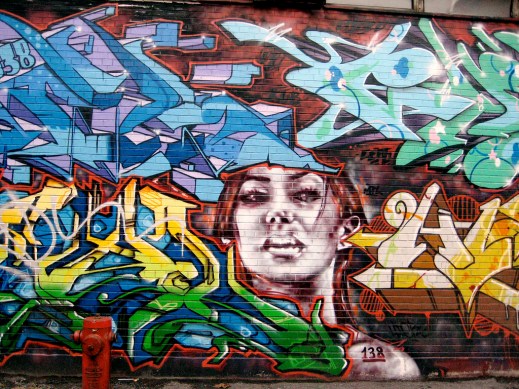
I have been impressed by the ability of pre-rap, 1970s hip hop artists to demonstrate a love for the culture without reproducing the woman-hating narrative found in rap music. The South Bronx DJs (i.e., BreakBeat Lou), graffiti artists (i.e., Carlos “Mare 139” Rodriguez), photographers (i.e., Joe Conzo, Jr.), and break-dancers (i.e., Richard “Crazy Legs” Colon and Jorge “Popmaster Fabel” Pabon) who make guest appearances in my courses explicitly disassociate themselves from the logic of commercial rap industry. Not surprisingly, it has been most intriguing to listen to the sexual politics created by the Afro-futuristic DJ Bambaataa.
Bambaataa is known for transforming the notorious Black Spades gang into the fledgling 1970s South Bronx hip hop scene. His Universal Zulu Nation has forcibly removed drug dealers from neighborhoods, rallied around political prisoners, and just last month, warned WorldStarHipHop.com to stop pandering violent and sexual images to youth.

Image by Pete Best, Courtesy of Cornell News
Less obvious is Bambaataa’s political work through sound performance. His signature soulsonic soundspace mocks the boundaries of music genre and the specificities of race, social class, and place, in favor of the universal. For example, when asked to explain early hip hop to my undergraduate class last fall, he sat back and played Ray Steven’s 1969 hit “Gitarzan” and The Music Man’s “Ya Got Trouble.” Hilarity and cognitive dissonance ensued, as the country-rock and Broadway tunes shattered the commonsense of hip hop as “rap music,” “black,” “youth,” or “urban.”
His universalism is not meant to obscure the contributions of women with a generic masculine narrative. Bambaataa has spent the first year of his appointment mapping out the centrality of women’s role in creating hip hop culture. Like Kyra Gaunt in Games Black Girls Play: Learning The Ropes from Double-Dutch to Hip Hop, Bambaataa traced rap and dance to double-dutch, hand-clipping, and rhythm games played by Black girls. To demonstrate how women pioneered rapping, he played Shirley Ellis’ The Name Game and The Clapping Song. During his first official sound lecture, a DJ set at an Ithaca nightclub, the music of Aretha Franklin and Miriam Makeba were interwoven into the more recognizable hip hop staples like James Brown.
Observing Bambaataa’s musical performances at Cornell gives me hope that sound and listening can be used to disrupt dominant modes of gender politics in the hip hop classroom. However, the ability of Black male artists to articulate the contributions of women is in no way a replacement for creating spaces which are actually inhabited by those who are not Black, male, or heterosexual. There is nothing universal about male bodies, thoughts, or voices. Unfortunately, this new trend of artists in the classroom is being constructed almost exclusively around Black/Brown, heterosexual men.
To date, no “b-girls,” “femcees,” or “flygirls” have been appointed to high profile positions in the academy. I struggle with this at my home institution, as Cornell’s “Born in the Bronx” archival project risks perpetuating the myth of a woman-less birth. This gender-limited vision of hip hop’s roots has been compounded by the silencing of legendary battle emcee Roxanne Shanté, whose relationship with Cornell ended after a witch-hunt surrounding her academic credentials back in 2009. MC Sha-Rock, an early female emcee, will end the four-year estrogen drought when she participates in Cornell’s 2013 Unbound From the Underground hip hop celebration on April 4-7, 2013.
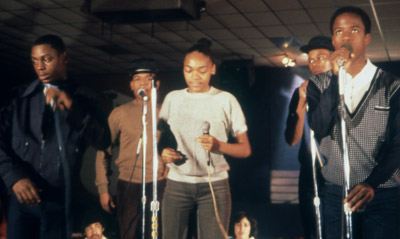
MC Sha-Rock in 1982’s Wild Style, Charlie Ahearn/Cornell Hip Hop Collection
Our efforts to connect academic hip hop studies to its cultural practitioners must honor women and empower female agency. The critical praxis has already been constructed by Black feminist scholars, such as Tricia Rose, Joan Morgan, Patricia Hill-Collins, Gwen Pough, Kyra Gaunt, Ruth Nichole Brown, and countless others. Hip hop feminism or “Crunk feminism” dictates that academic spaces support emancipatory gender politics, which starts with teaching and celebrating a truthful history focused on the agency of women of color. It does not involve participating in Black male violence under the guise of loving hip hop.
Every university that claims to teach or “preserve” hip hop should appoint female/feminist/queer artists. No doubt, fierce emcees like Yo-Yo, MC Lyte, Missy Elliott, and Lauryn Hill should be on the short list at many colleges. Still, we have to be wary of gender tokenism; the end-game should not be finding a honorary female artist to provide “a woman’s point of view.” Rather, the goal should be to create opportunities for women to narrate history, redefine the spaces occupied by hip hop, and to rearticulate the logic of critical listening.
Regendering hip hop studies will require a paradigm shift and a new soundtrack about love. Perhaps we can begin the work by replacing the H.E.R. tracks with Akua Naru’s “The World is Listening.” It is a dope, feminist homage to women’s journey through hip hop history, without all the slut shaming.
—
Featured Image by Flickr User LizSpikol
—
Travis L. Gosa is an Assistant Professor at Cornell University’s Africana Studies & Research Center. He teaches courses on hip hop culture, African American families, and education. He is an advisory board member of Cornell’s Hip Hop Collection, the largest archive on early hip hop culture in the United States. He can be reached at tlg72@cornell.edu and on Twitter @basedprof.
—
 REWIND! . . .If you liked this post, you may also dig:
“‘I’m on my New York s**t’: Jean Grae’s Sonic Claims on the City”––Liana Silva
“Ill Communication: Hip Hop Studies & Sound Studies @ Show And Prove”— J. Stoever-Ackerman
“The Victoria’s Secret Fashion Show and the Soundtrack of Desire“— Marcia Dawkins
Share this:

Video Gaming and the Sonic Feedback of Surveillance: Bastion and The Stanley Parable

The world of Bastion is beautifully illustrated and affectively evocative. Image borrowed from darkzabimaru @DeviantArt.
As the practice of sound design becomes ever more refined as a key factor in the immersive aspects of gameplay, it is essential to develop a conceptual vocabulary of the ways that sound is implemented as a cultural facet. In particular, it is important to recognize the power relations at stake within the implementation of the human voice as an interactive narrative trope. And, while I’ve already discussed the ways in which the voice of GLaDOS in Portal invites players to reflect on how they internalize a set of mediated perspectives about how their body ought to be, it is equally important to consider the other ways that a narrator’s voice invites players to reconsider the intersection of agency and surveillance.
This post compares the use of narration in Bastion and The Stanley Parable in an effort to understand how the voice is used as what Karen Collins would refer to as an “interactive non-diagetic sound,” or, in other words, a sound that is triggered by player actions, but not experienced by the character in the game. Specifically, I argue that the voice in these examples is an essential point in the feedback loop between player and game. And, as part of the cybernetics of gameplay, it produces a dispositif of surveillance, akin to Bentham’s panopticon, which lets the player know their actions are constantly being monitored, calculated, and considered by the game’s algorithms. But, while the original panopticon produced the effect of surveillance through the clever use of light, these games use sound to effect surveillance.
Bastion, was developed by the small indie game company Supergiant Games, but was distributed and released by Warner Bros. Interactive Entertainment, first through Microsoft’s distribution service, XBOX Live Arcade, but has since been released more broadly after receiving much critical acclaim. In Bastion, players take the role of a young boy, referred to only as “The Kid,” and adventure around gradually rebuilding a world that has fallen apart since a cataclysmic sundering referred to only as “the Calamity.” Although the world of Bastion is beautiful and visually stimulating, it is the game’s sound design that has earned it much critical acclaim. The game is narrated by a character named “Rucks,” who speaks in a deep weathered voice, with somewhat of a western twang. And, even though The Kid eventually encounters and is able to interact with Rucks within the game, Rucks still relays dialogue in the third-person.
When The Kid and Rucks meet, Rucks evinces with trademark grit, “Sure enough, he finds another. He finds me.” And, while that is a scripted plot point within the game, at other points Rucks’ narration modulates to best reflect the player’s actions. A player who begins the game slowly, exploring nooks and crannies, might hear “The kid walks slowly down the path, checking everything,” while a player who runs straight ahead could hear, “The kid barrels forward, not looking once behind him.” These quotes force the player to recognize that the game is watching, and actively staging narrative commentary about their in-game decisions. This commentary unfolds in aural space, through narration, discrete from the old text (and controller) triggers of “look” and “examine” which used to prompt text-box commentary about the environment of the game. In short, Bastion’s sound design succeeds because it is balanced in such a precise way: players are being constantly engaged with a narration which confirms that they are, in fact, properly interacting within the game world and story.

Games used to use text boxes to interrupt gameplay with narrative elements. Image borrowed from ultrapublications.com
The Stanley Parable, on the other hand, works deliberately to turn the paradigm of narration on its head. Where Rucks, in Bastion, frequently alluded to how many secrets he was yet to reveal about himself and the game-world, his character ultimately plays a supportive role, helping The Kid to understand the chaotic environment of the game. The narrator in The Stanley Parable, however, plays the antagonist in many ways, attempting to foreshadow and predetermine the actions of the player, or “Stanley.” On the game’s website, a short sentence contextualizes the endeavor, “The Stanley Parable is a Half Life 2 mod about video games.” The game itself is a mod of the “Source engine,” which runs both Half-Life 2, and Portal, was developed by the very small development team of Davey Wreden and William Pugh, and released for free. It is meta-fiction that stages a critique of the context of narrative within interactive games and fiction. Specifically, the game questions the idea of narrative itself by showcasing the ways that players are able to undermine the scripted plots and spaces of a videogame by exploring and experimenting with exploits and bugs in the game’s code and narrative.
Although the narrator in The Stanley Parable will prescribe several decisions to the player over the course of the game, the player is given the agency to contest the story as told by the narrator, and, therefore, to experiment with the plot. As the player reaches a set of two open doors on the way to the employee lounge the narrator reads, “When Stanley came to a set of two open doors, he entered the door on his left.” If the player chooses to travel through the door on the right instead, the narrator will attempt to steer the player back to the main plot tree by saying, “This was not the correct way to the employee lounge, and Stanley knew it perfectly well.” And, then as an open door is revealed, “So he turned left at the first open door, and walked back in the right direction.” If the player continues to ignore the narrator’s advice, he comes to somewhat of a dead end and the narrator reads, “Stanley was so bad at following directions, it’s incredible that he wasn’t fired years ago. Maybe this was why everyone left. No one wanted to be around someone as bad at listening as him.” The player is given several other opportunities to make decisions and lead the story to completion in achieving one of seven endings; each based the decisions the player has made when interacting with the narrator’s dialogue.
The Stanley Parable allows players the agency to see the limitations of linear storytelling where Bastion does not. Where some paths in The Stanley Parable will lead the player into direct conflict with the narrator, other paths do not. There is never a point where the narrator ceases to comment on the player’s actions and activities. Because the sonic feedback of surveillance remains a constant in both games the player remains engaged, in both cases, with the logic of the game-system. In other words, no matter how many times the player defies the narrator in The Stanley Parable, it never seems like the game is breaking. The game world remains constant because the motif of surveillance holds; players know the game still works because the narrator continues to stage commentary – even if it is commentary about the player’s failure to keep to the plot.
For Marc Andrejevic, author of iSpy (2007)—who has written extensively about the abundance of surveillance techniques implemented in digital spaces–the danger of surveillance lies in the production of an asymmetrical power relationship between media producer and media consumer. And, while this is certainly best argued about instances of dataveillance–how companies like Amazon, for example, track customer clicks on and off their website via web cookies in order to better produce exploitable (and in some cases saleable) consumer profiles–it is important to also consider the ways that the implementation of sound also functions as a technique of control.
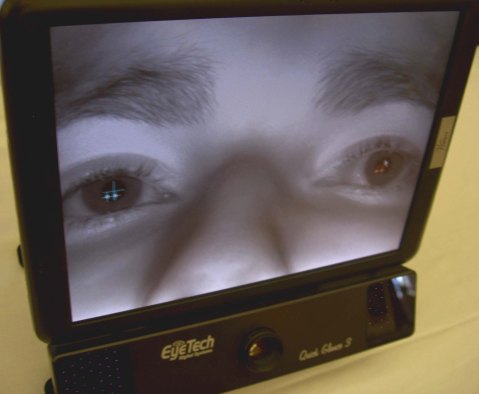
Paradigms of surveillance have changed a lot in the past 30 years. Image borrowed from cobalt123 @Flickr.
At its most positive, the sonic panopticism of Bastion and The Stanley Parable offer players a sense of comfort in knowing that the game is operating properly, and not glitching out. Further, players are invited into a more immersive game, which leverages both visual and audio interactivity to lull players into an environment of almost trancelike feedback and play. Clearly, this is the promise of good sound design; it gently alerts players to the presence of a tightly designed and well-implemented game, and produces affects of brand loyalty and trust within a game’s player contingent.
But, while there are clearly aesthetic and market benefits to the implementation of narration in both games, one cannot help but wonder, in the context of post-feminism and self-surveillance, what implications there are in the implementation of the male voice as surveil-er in both games. Just as it was curious in Portal 2 how GLaDOS acted as a critical female voice constantly judging the player’s body image and intelligence, it is curious how much authority is given to the voice of Rucks in Bastion. And while several good critiques have already been written about how the game features only one (somewhat silent, and certainly helpless) female character, and how the game’s villain is portrayed, concretely, as the racially exotic other, it is sadly fitting that the most comforting and well-acclaimed aspects of the game come from the interactivity produced by the voice of its distinctively white male narrator.
The sound design in The Stanley Parable, of course, is more cutting in the ways it stages a commentary about how the voice of the narrator (this time distinctively British), exacts a form of social coercion through techniques of surveillance, and how these techniques serve, namely, to hamper player agency. But, even its own narrative of resistance fails to compel; in fact, it is the uneasy ending of compliance and conformity that is, perhaps, the happiest. This, ironically, reveals one of the key cultural problems of our era: the reciprocal aspects of surveillance and interactivity. If affective resonances of trust, knowledge, and comfort come bundled with the male voice, is it in the vested economic interests of sound design communities to leverage these to make profit? Even though both games have earned critical praise, it is only Bastion that has won awards for sound design. In other words, are we caught in our own feedback loop of comfort, industry, and design?
–
Aaron Trammell is co-founder and Multimedia Editor of Sounding Out! He is also a Media Studies PhD candidate at Rutgers University. His dissertation explores the fanzines and politics of underground wargame communities in Cold War America. You can learn more about his work at aarontrammell.com.
—
REWIND! . . .If you liked this post, you may also dig:
DIANE… The Personal Voice Recorder in Twin Peaks— Tom McEnaney
The Role of Sound in Video Games: Pong, Limbo, and Interactivity— Aaron Trammell
Orality and Cybernetics in Battleship— Aaron Trammell
Share this:


Current Top Posts





April 2021

January 2020

November 2019

October 2019

August 2019

April 2014

November 2017

March 2015

December 2017

October 2015
 Sounding Out!
Recent Comments