
The Sound of Radiolab: Exploring the “Corwinesque” in 21st Century Public Radio

 Editor’s Note: Today, radio scholar Alex Russo, author of Points on the Dial: Golden Age Radio Beyond the Networks , continues our summer series “Tune In to the Past,” which explores the life and legacy of radio broadcaster Norman Lewis Corwin, the “poet laureate of radio” who died last summer at the age of 101. Sounding Out!‘s three-part exploration of his legacy by radio scholars Neil Verma (June), Shawn VanCour (July), and Russo (August) not only gives Corwin’s work new life (and critique), but also speaks to the growing vitality of radio studies itself. And now, hey everyone, you are listening to . . .Alex Russo Alright? Okay? Alright?–JSA
P.S. Look for a special bonus fall installment of the Corwin series in September!
—
Voice 1: What if you were the best in the world at something…
Multiple Voices: [background] He is the greatest….most stupendous…. most thrilling…most inventive
Voice 1: and then your entire industry collapsed.
Voice 2: [continuing and fading out] Radio[?] Writer.
Voice 1: But you kept on working?
SFX: Typewriter, continuing until coming to a dead stop when return bell rings and the carriage returns with a clunk on “pass away”
Voice 1: Outliving all your peers, until, 77 years later, you pass away?
Voice 3: Norman Corwin? Never heard of him. He defined a generation’s engagement with sound?
Voice 1: And there is no one left to eulogize you? What is your legacy?
This post is the third in a series that engages with the legacy of Norman Corwin, a – perhaps the – preeminent radio writer and producer of the late 1930s and 1940s. Specifically, it picks up on Neil Verma’s challenge back in June to consider the legacy of the “Corwin-esque.” Verma devotes considerable space to mapping the aesthetic syle of Corwin in his post and his incredibly insightful and astute book, Theater of the Mind.
The analysis that follows leans on Verma’s argument with a caveat. The question of legacy stems in part from Verma’s assertion that Corwin lived for so long, few were left to speak for his legacy. Corwin may not have the name recognition that he should within the broader public, but for radio practitioners, he is regarded with considerable reverence. In this sense, the Corwinesque style lives on by inspiring contemporary radio producers, especially, I will argue, in the aural style of the syndicated WNYC public radio program Radiolab, hosted by Jad Abumrad and Robert Krulwich. Radiolab describes itself as “a show about curiosity. Where sound illuminates ideas, and the boundaries blur between science, philosophy, and human experience.” While ostensibly a science program, designed to make complicated scientific phenomena comprehensible to a general audience, the show engages in fundamental questions about nature, being, and experience in creative ways.

Certainly, Abumrad and Krulwich regard Corwin as an inspiration, such as when Krulwich responded to a claim by This American Life‘s Ira Glass that the turn of the 21st century is the true Golden Age of Radio, by describing Corwin as “Homer in a modern form. . .a lyrical reporter who wrote and spoke like he was wearing a toga and sometimes was so spectacular you’d get dizzy listening and sometimes seems a little too old fashioned and oratorical.” In his earlier post, Verma defines Corwin’s aesthetic style through a number of formal elements, including what he describes as a kind of “overworked literary calisthenics.” Putting their own spin on Corwin’s dizzy oratory, Abumrad and Krulwich mark Radiolab with complicated and intentionally convoluted speech patterns. The program features Abumrad and Krulwich in rapid fire banter – far faster than typical public radio fare. Often, this onslaught of language crowds and overlaps, producing a highly staged simulation of conversational flow. Often, Abumrad is a voice of enthusiastic discovery, while Krulwich plays the role of skeptic, particularly in the early seasons. Abumrad’s voice is more nasal, higher pitched and, notably, recognizably younger than that of grizzled veteran Krulwich, creating a contrapuntal effect.

Radiolab Producers/Hosts Robert Krulwich (l) and Jad Abumrad (r), Image by Flickr User ThirdCoast Festival
These voices usually interact with a third voice, what typically radio documentary calls the “actuality.” However, instead of than separating “the real” from the narration’s voice of authority, Radiolab juxtaposes sentence fragments from all the voices (analysis, counter-argument, evidence) to create a conversation that proceeds dialectically, on parallel parts that intersect at points to lead to a thematic conclusion. While Radiolab’s dialogic style has been explored by other radio scholars, like Andrew Bottomley and Eleanor Patterson, its link to Corwin’s model of radio drama deserves more attention. While not exactly the same as Corwin’s signature “choral” vocal style, with voices chiming in from all directions, it performs a similar function, aurally representing a multiplicity of viewpoints.
Furthemore, Abumrad and Krulwich work hard to create a feeling of liveness and connection with Radiolab‘s listeners, much like Corwin did. Radiolab is certainly not a live program, but we must also remember that much of Corwin’s work was also developed to be recorded and sold–as Shawn VanCour discussed in his offering to this series. Although violating typical news protocols, mangled sentences, mis-matched vocal levels, and cross-talk are not removed during Radiolab‘s editing process; rather they are left in to create the feeling of spontaneity. Krulwich and Abumrad as quite conscious of this effect, with the latter noting in a New York Times profile, “It’s a funny thing, when you find yourselves laboring for weeks to create what you felt at that first moment.”

Abumrad and Krulwich, performing a live version of Radiolab, Image by Flick’r User Jared Kelly
A final connection, Abumrad and Krulwich blend two aural styles, “intimate” and “kaleidosonic,” descriptors Verma coins in Theater of the Mind as the hallmark of Corwin’s formal mastery. Verma defines broadcast intimacy through radio’s address to the listener as an individual, its placement of a program’s “audioposition” alongside the narrator, as well as its emphasis on place-centered narratives. Kaleidosonic style addresses the listener as a public, uses a multiplicity of auditing positions, and creates a broad model of engagement with narratives centered on events (70). A wonderful representative example of this combination of styles on Radiolab can be heard at several points in season two’s episode, “Detective Stories.” First, the end of the opening beat features the stylized repetition of a New York Sanitation official describing the Fresh Kills sump as a “time capsule.” As the phrase “time capsule” echoes eight times, Krulwich begins to chant “time capsule” in a lightly mocking and metallic sounding tone. Abumrad tells him, “You can stop that now.”
Later in that episode, a segment entitled “Goat on a Cow,” follows Laura Starcheski across the country as she investigates the twelve-year story behind of a box of old letters found by the side of the road.
This segment takes place at different locations, a hallmark of the intimate style. At the same time, it also uses elements of the kaleidosonic style because the narrative turns on particular events, moments where new evidence is found and new theories of the story of Ella Chase, the letters’ recipient. Throughout this segment Starcheski’s voice fades in and around those of her actualities. When she intervenes to provide context, the other voices are not stopped, they continue, telling their story under hers until at specific moment both voices say an identical phrase. This juxtaposition suggests that the letters hold different meanings for the individuals who come in contact with them: For Starcheski they are a reminder of her childhood desire to invent life stories of strangers; For Erick Gordon, an English teacher who found the letters, they are a great mystery on which he can project his own imagined histories and build a teaching curriculum; Finally, for Robert Chase, they represent a relief that he is no longer the archivist of his grandmother’s life. Like Corwin’s work, “Goat on a Cow” combines intimate and kaleidosonic styles, creating pleasures that are linked not to narrative closure but to the process of sonically representing investigation and theorization.

Letters, by Flickr user aroid
In allowing the pleasures of aural storytelling to enable the show’s narrative, Radiolab’s Corwin connection expands conceptions of the imagination. Like Corwin (and radio writers of the network-era), Abumrad sees radio as both an act of “co-authorship” and “co-imagining” between the writer/performer and the listener. However, he also sees his “job” as “put[ting] certain images and feelings in your head.” This link to discourses of the imagination is clear in the series’ opening episode, “Who Am I?” One segment in this episode, “The Story of Me,” suggests that what defines humanity is “introspective consciousness,” the ability to abstract images or events into a story of self.
Citing neuroscientist Dr. V. S. Ramachandran, Krulwich notes: “Only humans can take images from the real world, pull them into their heads, divide them into parts, and take those parts and turn them into abstractions.” To demonstrate, Krulwich leads Abrumrad through an example where the latter conjures the image purple striped red canary in his head. Ramachandran follows, noting that only humans can rearrange and manipulate “tokens” of “bird,” “striped,” and “red” to “imagine” something that doesn’t exist. The “peculiar human muscle” is that “ability to experience things and abstract them into a story. This definition is telling, while ostensibly it is about human consciousness, I would argue it could just as easily be seen as a description of the job of radio writing, taking recognizable symbolic tokens, manipulating them, and turning them into story. By equating human consciousness with radio, Krulwich and Abumrad exemplify a final theme that Verma attributes to network-era radio drama, its evolution “from being a theater in the mind to being a theater about the mind” (3).
Indeed, the segment of “The Story of Me” finishes by noting that neural actions can only be understood in a group: “Even the thought ‘I am a one’ springs from a hundred million cells connecting through a trillion synapses and that all of this multiple activity paradoxically creates the you of this moment. You are always plural.” I imagine that Corwin, no stranger to celebrations of plurality, would completely agree.
—
Featured Image by Flickr User Jared Kelly
—
Alexander Russo is an Associate Professor in the Department of Media Studies at The Catholic University of America in Washington, DC. He is the author of Points on the Dial: Golden Age Radio Beyond the Networks (Durham, NC: Duke University Press, 2010) as well as assorted articles and book chapters. His research interests include the technology and cultural form of radio and television, the aesthetics of sound, the development of “old” new media, the history of music and society, the relationship between media and space, and the history of popular culture.
Share this:

Listening to Disaster: Our Relationship to Sound in Danger
 Editor’s Note: Welcome to Sounding Out!‘s World Listening Day Extravaganza! Enjoy this special bonus “soundtracked” post by multimedia artist (and new Sounding Out! regular) Maile Colbert –full of field interviews with artists and acoustic ecologists such as Marc Behrens, Andrea Polli, Bernie Krause, and Peter Cusack–as well as a podcast produced by Eric Leonardson, Director of the World Listening Project. (Click HERE to go to the podcast). For the full introduction to the World Listening Month! series click here. To peep the previous posts, click here. And remember, here at Sounding Out! every day is for listening. . .so meet us here for the 364 days between WLDs for more aural treasures and sonic thought.–JSA
—-
Even the surrounding hills were hushed, as if brought low by language. –from Grendel by John Gardner
Under good weather conditions in 2007, six artists, two curators, and two guides set out towards the Brenndalsbreen glacier in Vestlandet, Norway. An arm of the largest glacier in continental Europe, the Brenndalsbreen is maintained by high snowfall rates rather than cold temperatures, so the glacier has high melting rates. Since 2000, Brenndalsbreen has retreated 276 meters (820 feet). The group was the first to venture there that spring, the winter being too dangerous. Marc Behrens, one of the artists present, received permission to follow a guide down a crevice in a tongue of the glacier. There, surrounded by walls of ice, he began to record the melting drops that feed the glacial river flowing underneath. It was in this moment that Marc heard a change in the sound that signaled to him he may be in life-threatening danger, but due to the focus of the equipment he was using, he had no way to perceive how dangerous that threat may be.
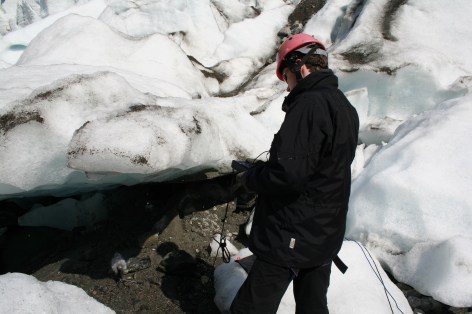
Photo of Marc Behrens by Jørgen Larsson.
A question to Marc Behrens: “Can you describe your process of perception between thought and hearing within your personal story of disaster?”
When the crashing ice announced itself by the little crunch, I assumed it was merely a modulation in the noises the glacier made anyway – I was very calm listening to the beautifully trickling melt water drops – basically a stream of the same minuscule sounds over a long period of time. I appreciated this and it did not occur to me that it could have been the start of a more dramatic and quick development.
Then, as a surprise I heard that loud crash, which, as I had (bad) headphones on and listened to the microphone input which was directional, I could not relate the spatialization in the headphones to the physical surrounding. In the recording it seems smaller than it was – but it seemed as if the whole glacier just came down on me – sonically. I could not localize the sound, so I could not escape in any direction as I did not know where to. So I decided to stay where I was and just raise my hands/arms to protect my head as much as possible. I perceived a rush of adrenalin but remained lucid, especially as there was nothing else to do, and hence no possibility to fail. I mean: I could just wait and hope I would not be injured. And so, I waited for a moment more after the crash, then stopped the recorder and went out from the protruding ice to signal the others that I was okay.
In 2011, the disastrous 2011 Tohoku earthquake and tsunami devastated Japan. Within its horrific footprint, a number of nuclear accidents affected hundreds of thousands of residents with radiation levels up to eight times what are considered normal. Many other radioactive hot spots were also found outside the evacuated radius, including within Tokyo. All over social networks, people posted photos, videos, and sound clips of their Geiger counters reading the radioactivity in their homes and neighborhoods. The process a Geiger counter uses is called sonification, a form of auditory display that uses non-speech audio to convey information. As I played a sound file from a friend of the above-normal readings in his kitchen in Tokyo, I was unnerved by the ominous, staticky click, like the chirping of some robotic insect.
In fact, the entire event was sonically terrifying. Some of the most chilling recordings I heard from the underwater earthquake and the birth of the tsunami were picked up by the hydrophones of the National Oceanic Atmospheric Administration’s VENTS Program. The Tohoku earthquake was the largest sound they had ever picked up.
Using the seismic data from this same quake, audio programmer and artist Micah Frank used his creation Tectonic, a real-time seismic analysis and sound synthesis system, to sonify the sounds of the earth shifting and opening that fateful day. With Tectonic, sound is created in real-time by seismic activities as they occur across the globe. Using magnitude, elevation, time of day, and geographical coordinates, the data is mapped to synthetic spectrums and processed by granular, aggregate and subtractive synthesis.
Tectonic: Earthquakes Generate Music in Realtime from Micah Frank on Vimeo.
But is this more artistic and emotive approach effective in conveying the disaster, if that is even the point? Most comments on his Soundcloud track range from “cool sounds” to “I’ll send you the remix when it’s done.” When compared to the hydrophonic recordings from the VENTS program, perhaps the use of data to sonify is too abstracted from the event itself.
Digital media artist Andrea Polli takes a different approach to sonification. During the 2007/2008 season Polli was on site in Antarctica conducting work through the National Science Foundation residency, working with scientists gathering weather and climate data. Here she created the project 90 Degrees South, which “aims to communicate both the aesthetic beauty and the scientific importance of Antarctica to global climate.” This project gave birth to the audio album, Sonic Antarctica, which uses field recordings, sonifications, and audifications of the collected data.
.
To Andrea Polli: “How can sonification help us understand climate change?”
One thing that comes to mind is that sound and music can provoke an emotional (or at least affective) response that is not always possible through graphs and images. For example I have used low, almost sub-aural sounds in data sonifications to promote a visceral response in the listener to various atmospheric events. . .
I have worked with weather and air quality data in real time, both using on-site data or remote data. To become attuned to the remote data takes some time and quiet listening, to me it is like being in two places at once, for example in a gallery or on-line and at a remote site near the North Pole.
Often we associate catastrophes with massive and sudden sounds. We give animalistic descriptions to the sounds made by what we call natural disasters, such as growling tornado, roaring avalanche, shrieking cyclone, groaning earth. This practice speaks to our complex relationship with nature, connecting us to it and taking us out of it at the same time. But what of the slow silencing that happens to our soundscapes when certain species die out? Such quiet disasters affect everything, sadly in ways we don’t (and won’t) notice until too late.

Dr. Bernie Krause in the field
In The Great Animal Orchestra, author, musician, soundscape recordist, bio-acoustician and naturalist Bernie Krause coins the term, biophony, to help ecologists, biologists, acoustic scientists, and others to understand the long-term impact of disasters, particularly silent ones. Biophony refers to the collective sound vocal non-human animals create in each given environment. We face many compounding problems with the silencing of certain species and the quieting of a whole biophony, not the least of which is our connection with the world.
Krause provides some powerful examples of silenced biophonies in his book, such as the story of the Wy-am tribe in the Northwestern United States, whose history has been intertwined with the Celilo Falls, a waterfall just west of the Columbia River’s midway point, for thousands of years. Wy-am means “the echo of falling water.” Krause writes: “so central were the falls to the tribe that the Celilo was considered a sacred voice through which divine messages were conveyed.” It was also their yearly source for fish. In 1957, when the Dalles Dam gates were ordered shut by the U.S. Army Corps of Engineers, the waterfall and fishing site were completely submerged, sending the Wy-am into a state of mourning that continued to subsequent generations.
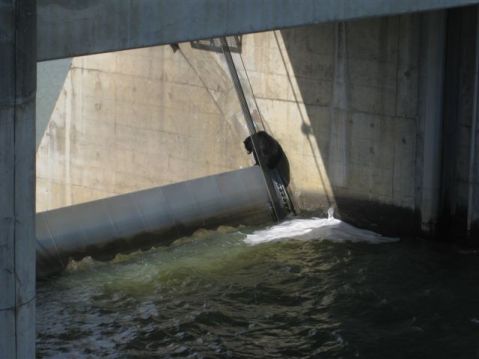
Black Bear at the Dalles Dam and Lock, Image by the Army Core of Engineers
Krause cites several similar “silencings” in his book using spectrographs. Similar to sonification, Krause’s spectrograms give form and shape to “silent” disasters. A particularly sad example for me, coming as I do from a family from the Hawaiian Islands, is the recorded comparisons of the coral reef in Vanua Levu, Fiji, that has been devastated by warming waters, shifts in pH, and pollution.
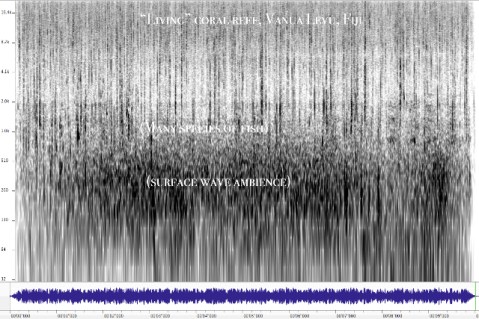
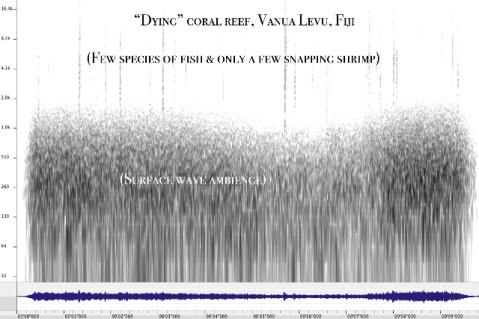
courtesy of Bernie Krause from The Great Animal Orchestra (72-73)
Krause also recorded twice at the Lincoln Meadow “forest management area” in the Sierra Nevadas, once before mass logging went into effect, and once after, a year later on the same date, time, and same weather conditions. While visually it seemed that little had changed, Aurally it was a different story:
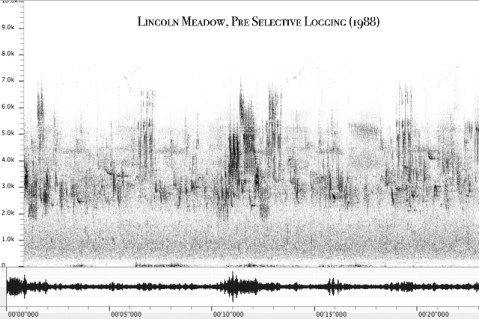
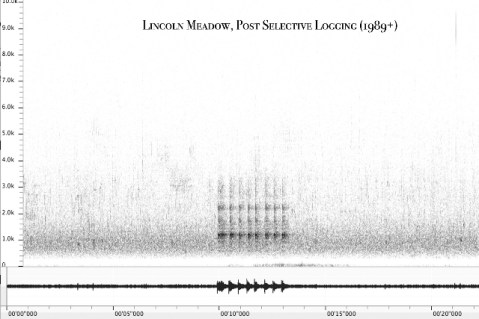
courtesy of Bernie Krause from The Great Animal Orchestra (69-71)
To Bernie Krause: “We have a tendency to attribute ‘loud’ to the perspective of a disastrous event. Can you discuss the relationship of silence to disaster?”
In the natural world there are so many events that, to the “rational” human mind, appear to be contradictions. For instance, after the 11 September 01 disaster, which resulted in cancellation of all domestic and private aircraft flights and a reduction of automobile traffic around our house in the far western United States, the natural soundscape (biophony) returned in a way that we had never heard it before…even in September…late summer when almost all of the birds have fledged and gone elsewhere. And then there’s the reference in the book to the return of the biophony around Chernobyl, recorded by Peter Cusack from the UK. On the other hand, after some types of disasters, the immediate silence appears to happen because all of the vocal creatures have to reassess their acoustic territory, and, depending on the biome, takes anywhere from minutes to years, to recover a stable biophonic expression.
UK artist Peter Cusack’s Sounds from Dangerous Places, sought recordings from disaster sites like the Chernobyl exclusion zone in the Ukraine, the Caspian oil fields in Azerbaijan, the Chernobyl-fallout affected farmlands of Northern Wales, and the rivers of Eastern Turkey with their extensive, local climate altering dams. What is surprising and moving about these works is the strong human element, especially the lack of human presence and the evolving relationship of humans to these post-disaster soundscapes.
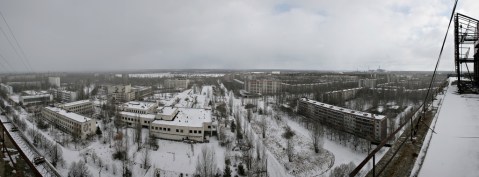
Chernobyl Exclusion Zone Panorama by Pedro Moura Pinheiro
Listening to some of Cusack’s recordings from Chernobyl, one might feel surprised to hear that iconic name attached to such rich and pastoral soundscapes. When we consider the massive industrial accident that killed thousands and created an exclusion zone of 30 kilometers (19 miles), some of us are compelled to imagine a wasteland…not a living creature in sight. But those like Cusack who have visited the area are met with quite a different experience, one we can share when listening to the recordings. Cusack says Chernobyl held the richest dawn bird choruses he has ever recorded; haunting full choruses of frogs and nightingales sound throughout the night. And again we hear that iconic sound of the Geiger counter increasing its metallic chirp as Cusack walks toward an infamous radioactive hotspot, at one point it makes an eerie duet with a calling cuckoo.
To Peter Cusack: “How has the sound of dangerous places surprised you?”
Dangerous places can be both sonically and visually compelling, even beautiful and atmospheric. There is, often, an extreme dichotomy between an aesthetic response and knowledge of the ‘danger,’ whether it is pollution, social injustice, military or geopolitical.
In the context of the Sounds from Dangerous Places project ‘dangerous places’ are mostly areas of major environmental damage, but also include nuclear sites or the edges of military zones. The danger is not usually to short-term visitors, but to local people who have no option but to stay or more widely through the location’s role in global power politics.
Many aspects of dangerous places are a surprise, mostly because ones expectations are often wide of the mark, especially in the smaller details. However different places surprise one very differently. For example the name ‘Chernobyl exclusion zone’ implies no one is there. Not so. Thousands still work at the site, some live there and some commute in every day (by rail, so trains are part of the soundscape). That many people also require restaurants, bars, administration and all the infrastructure of a small town. So people and work sounds of all kinds are still to be heard around Chernobyl town and the nuclear sites. Some of the villagers, originally evacuated out, have returned bringing their sounds too – horses, chickens, carts, hand farming, traditional songs, modern day TV. The zone is also now a wildlife haven and the sounds of the dawn and evening chorus of spring are intense. The vibrant recordings of wildlife show that many species, at least, are doing fine in the exclusion zone. . .
In other places, though, sounds gives no indication of the danger. In the borough of Uttlesford, also just outside London, one hears church bell, over flying aircraft, cats mewing, cars passing, lawn mowing and common birds singing. It’s exactly as expected for one of the wealthiest areas in South East England. It also produces the greatest amount of domestic greenhouse gas of anywhere in the country.
I want to leave you with the example of the elephant seal, not as a “success story” but as an example of the great responsibility that humans have to know and be aware of our impact on a whole biophony, a whole ecosystem, a whole planet. When we think to such scales, there can be the tendency to look at the dying out of a single species as not so catastrophic. But we forget the interconnectivity of things, and how one species affects another, as well as its surroundings and its future. Sound can herald disaster, but it can also signal the potential for renewal, too.
The northern elephant seals once boasted colonies of hundreds of thousands in the Pacific Ocean. By 1892 only 50 to 100 individual seals were left, until in 1922 the Mexican government gave protective status, pressuring the U.S. government into following suit, and today their numbers are up to approximately 160,000. Known for their distinct vocalization, especially in the males, the large proboscis of the elephant seal is used to emit a loud roaring sound. From chortles to growls to screams to melodic sighs, their frequency range and detailed expression is amazing to listen to.

Elephant Seals in Año Nuevo, Image by the author
With growing numbers, the seals started populating Año Nuevo in California in 1955, now dominating the biophony against the waves with various sea birds, sea lions from an offshore island, frogs, and the occasional bark towards the evening and night hours from coyotes and foxes. It is one of the most vibrant and unique soundscapes I have ever experienced, weighted with the thought of how close it came to me never hearing their calls in the wild.
There is a moment upon hiking into the park where you can hear the seals’ voices being carried on the ocean wind, but only sand dunes lay in front of your eyes. Skin pricks up at such a strange sound; my companion admitted excitement and a little fear upon hearing it. The look on her child’s face, however, was priceless wonder. Thousands of tourists come every year to see these magnificent beast, but mostly to listen to these calls, that were, once upon a time not too long ago, almost silenced forever.
—
This post is dedicated to Dr. Donald Allen Colbert, who sparked wonder in the world beyond what I could see…
__
Featured Image Credit: Air Raid Siren by Flickr User Wader
__
Maile Colbert is an intermedia artist with a concentration in sound and video, living and working between New York and Portugal. She is an associated artist at Binaural/Nodar and director of Cross the Pond, an organization based on arts exchange between the U.S. and Portugal. She holds a BFA in Studio for Integrated Media at Massart, and a MFA in Integrated Media/Film and Video from Calarts. She has had multiple screenings, exhibits, and shows, including The New York Film Festival, Ear to Earth Festival, LACE, MOMA, LACMA, the REDCAT Theater in Los Angeles, The PDX Film Festival, Future Places Festival Oporto, HOERENSEHEN 2.0 Berlin, Störung Festival Barcelona, Teatra Municipal in Guarda, Observitori Festival Valencia, and has performed and screened widely in Japan, Europe, Mexico, and North America, and co-composed for a featured installation at the 2009 UN Climate Conference. She was a visiting lecturer teaching at UCSD and Escola Superior de Teatro e Cinema, and guest artist and lecturer at NYU, MassArt, Calarts, SUNY Buffalo, SUNY Binghamton, Muhlenburg College, and Universidade Nova de Lisboa. She is currently in production on an interdisciplinary experimental opera based on Portuguese Maritime history, and will release two albums this year. You can find her at www.mailecolbert.com.
Share this:


Current Top Posts





April 2021

January 2020

November 2019

October 2019

August 2019

April 2014

November 2017

March 2015

December 2017

October 2015
 Sounding Out!
Recent Comments