
Rallying Cries as Suffering Sounds: “Allah-O-Akbar” and the Aurality of Feminized Iranian Suffering
By July of 2009 dozens of pitch-black videos began to appear on YouTube. Documenting ambient noise, in some cases narration and, most prominent of all, impromptu collective outcries of “Allah-o-Akbar,” these videos resonate with an urgent gusto, punctuated with an eerie sense of desperation through faint echoic reverberations. By the level of desperation audible in every voice, at once dulcet and melancholic in tone, there is a distinct sense that Allah very well may be called forth. While most of these videos received scant attention, one entitled “Inja Kojast”](translated as “Where is this Place”) received over 174,000 hits (as of writing).
It was dubbed with English, Spanish, and Japanese subtitles, was sampled by a music producer (“Tehran’s Roof Tops _Remix”) and also played a prominent role in the 2010 French film Fleur du Mal. What is enabled, invoked, and signified by the layering of these multiple and disparate incantations? What is affectively evoked in the widespread circulation of these chants by YouTube and in Fleur du Mal? Why was this video circulated so widely and deemed so affectively resonant by disparate audiences?
Due to the fact that the Iranian government had barred entry to representatives of foreign media and systematically jailed Iranian journalists accused of being hostile to the regime, the disputed 2009 Iranian elections and ensuing protests were largely reported on by a new breed of “citizen journalists”. Filling in the information vacuum, citizen journalists tweeted and uploaded to the Internet raw video footage of protest marches and confrontations with Basiji militiamen by day – and the voices of dissent performed on Iran’s many rooftops by night. Donning the cloak of darkness, residents of Iran’s major cities climbed to the rooftops of their buildings to chant “Allah-o-Akbar” in numbers – a brief reprieve from the violent suppression of their street protests by Basiji militiamen.

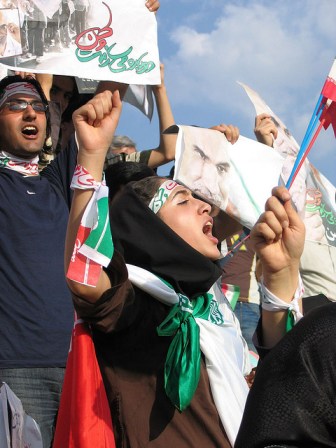
“Women Smash the Shah’s Crown,” Poster from the Iranian Revolution, Courtesy of Flickr User Voyou Reserve
As Negar Mottahedeh has written in her online essay “Allah-o-Akhbar”: “The cry of “Allah-o-Akbar” was the defining sound of the 1978 protests against the Shah of Iran, during a revolution that toppled the Pahlavi monarchy and established the Islamic Republic of Iran.” This earlier revolutionary context is represented in the video for “Allah o Akbar, Khomeini Rahbar”, which hailed a politically diverse citizenry to stand behind this “rahbar” or new “leader.” The chanting of “Allah-o-Akbar” was further exploited as a nationalistic call-to-arms during the Iran-Iraq war in the music video for the anthemic “Allahu Akbar Iran, Iran.” The chant’s versatility and instrumentality in this immediate post-revolutionary period is due not only to its capacity to appeal to the pious and patriotic backers of the newly formed Islamic Republic but also because of its power as a performative political rallying cry. Mottahedeh’s essay title employs a pun: the addition of ‘h’ to the word “Akbar” in transliteration changes the word to “Akhbar” or news. Although she does not elaborate on this, her title suggests that this chant is itself a form of citizen journalism, a broadcast calling forth the revolutionary spirit that Iranians pride themselves for always having at the ready. But what kind of journal is “Allah-o-Akbar”? Is it a call to arms, a rallying cry, a collective sound of suffering or all of the above?
Despite its pious provenance and deployment as the paradigmatic cry of the revolutionary uprising against the Shah, the Islamic Republic currently led by Ali Khamenei and Mahmood Ahmadinejad–which was inaugurated by these earlier revolutionary calls–has interpreted the post-2009 chanting of “Allah-o-Akbar” as blasphemous and an affront to their authority. Journalist Jalal Hosseini argues that this is due in part to the fact that opposition candidate Mir Hossein Mousavi called upon his supporters to remember the revolutionary history of this performative chant in an open letter, stating “Let’s not abandon the green colour which is a symbol of spirituality, freedom and religious mentality and moderateness and the Allah O Akbar slogan that tells us of revolutionary roots.”
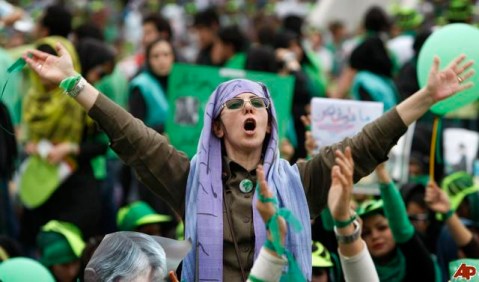
Women at the Front, 2009, Image by Flickr User Raymond Morrison
As Hosseini has written, “In a religious state, where religion is present in every aspect of life, Iran’s protestors have managed to turn religion against their government…Allah-o Akbar is perhaps the single most symbolic phrase in the Muslim world, yet Iran’s current rulers, who themselves employed this slogan in their struggle against the Pahlavi regime in the 1979 Revolution, did not tolerate the protesters’ cries of Allah-o-Akbar after the 2009 presidential election. Allah-o Akbar has essentially become a forbidden phrase.” Hosseini goes on to quote numerous Tehranis who testify to their disparate intentions behind the chanting, highlighting the ambivalence inherent to the slogan, which makes it available to Iranians of many stripes, and, as he argues, allows the calls to resonate even beyond the nation by appealing to other Muslims globally. But the widespread circulation of these videos and their popular impact on global YouTube audiences also suggests that the chanting has had an impact on non-Muslims as well.
Susan Moeller, who penned a Huffington Post piece right around the time of “Inja Kojast’s” semi-viral circulation, argues that this most recent phase of the chant’s resignification has helped to win Americans over to the protesting Iranian’s cause, writing, “watching Americans are learning to reframe the meaning of ‘Allah O Akbar’ and re-imagine the people of Iran. The pictures from Tehran are showing that Iranians are not monolithic in their beliefs.” Moeller suggests that this collective chanting has somehow cut through the status quo Islamophobic representations of a fundamentalist Iran to create an affective and empathetic pathway through which Americans can “re-imagine the people.” Moeller’s argument echoes the sentiment of the comments written on the YouTube page for “Inja Kojast,” comments like “This breaks my heart!” left by Annabanana23663 or “I have listened to this so many times already that you would think I would have moved on BUT I continue to listen and will continue to listen for there is truth in that voice of pain. And only by embracing pain can we love truth. And truth not only will set us free but without truth we cannot be free. Go you beautiful Persians. The people of the USA love you for your defiance” (by YouTube viewer HulkSmashPunyHumans).
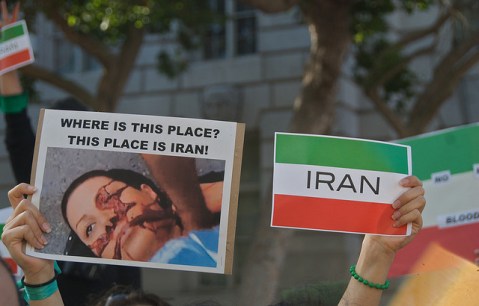
“Where is this Place?” San Francisco, CA, 20 June 2009, Image by Flickr User Steve Rhodes
Not only were YouTube users impacted by “Inja Kojast” but the video’s representation of Iran’s rooftop chants inspired the narrative arc of French filmmaker David Dusa’s Fleur du Mal (Flowers of Evil, 2010), a film that explores the precarity and instability of Iran after the 2009 elections. Through a chanting scene in which the two main characters, Gecko (Rachid Youcef) and Anahita (Alice Belaïdi), vociferously call out “Allah-o-Akbar” on the edge of a rooftop in the avowedly anti-Islamic nation of France, they thumb their noses at both nation-states at once while also sealing their romantic bond. Perhaps in an ironic play on Khomeini’s exile in the same city, the beautiful, educated and upwardly mobile Anahita is incubated in Paris for a time while the political instability following the 2009 elections settles down. Completely obsessed with the post-election struggles that she and her friends were actively engaging in on the streets of Tehran, she daily follows every new tweet and YouTube video. She bides her time in Paris by convincing Gecko, the bellhop at her swanky hotel, to give her a tour of the city and the two soon become lovers.
Despite the somber context of the film’s main narrative preoccupations with Iran’s botched 2009 elections, this plot point, I argue, enables the cathexis of an Orientalist drive that is shared by Western audiences: a drive to consummate the desire for the feminized Muslim woman seen to have suffered under the despotic rule of Muslim masculinity. It is this same desire that gets sublimated in a consumption of feminized Muslim suffering which has led to a reductive popular reading of “Inja Kojast” that eclipses the ambivalence of and disparate intentions behind the chanting it documents. In particular, it is through the cries of the narrator’s own female sounding voice that “watching Americans are learning to…re-imagine the people of Iran” as finally available to and eligible for their empathy, attention and yearning.
Fleur du Mal weaves narrative scenes with YouTube footage of Iranian post-election street protests and, in one scene, an image of Neda Agha Soltan’s assassination. Viewed over 1,200,000 times (as of this writing), there has been a wide-scale promotion through documentary films, video diaries, songs and various other imagery of what has been called Neda’s martyrdom for Iran’s “green revolution”. This representation of a feminized Iranian suffering at the hands of an Islamic fundamentalist Iranian masculinity has become a privileged symbol for Iran’s Green Movement outside of Iran. This has enabled an affective attachment to be made which has, quoting Moeller yet again, enabled Americans to “re-imagine the people of Iran.” This time, somewhat counter to Moeller’s claim, it is not only “pictures” that are functioning to transform perceptions of Iranians; sound operates as a critical conduit to an interiority characterized by pain and suffering that has particular appeal.

Image by Shahin Edlata, San Francisco
I argue that the suffering sounds of “Inja Kojast” resonate within what I have elsewhere termed an “aural imaginary” through which Americans and the West “re-imagine[s] the people of Iran.” Through the suffering sounds of an anonymous feminine-sounding voice–reflecting upon and poetically translating the suffering sounds of a nation’s nightly chanting of “Allah-O-Akbar”– a direct link has been made to the feminized victim of Islam.
As US-backed Israeli war-drums are beaten, and as conspiracy theories regarding Iran’s hand in the recent spike in oil prices resuscitate decades-long antagonisms, we must be mindful of the multi-sensorial cooptations of empathetic and affective attachment that have constructed feminized suffering as justification for military intervention and the instrumentalization of sound in support of this. The old Orientalist desire for a feminized opening through which to re-imagine and know the radical other that is Iran has been found through a new gateway: aurality.
—
Featured Image: “Iran 06” courtesy of Flickr User Chong Head
—
Roshanak Kheshti is Assistant Professor of Ethnic Studies and affiliate faculty in the Critical Gender Studies Program at the University of California, San Diego. She is currently completing a manuscript entitled “Modernity’s Ear: The Aural Imaginary and the World Music Culture Industry,” which theorizeshow an other to the listening self is racialized and gendered within the world music listening event. She has published in American Quarterly, Feminist Studies, Hypatia and Parallax.
Share this:

Sound-politics in São Paulo, Brazil

When I got to São Paulo in January, 2012, I had only a slight idea of how my fieldwork would unfold. Even though I had planned to investigate the relationship between everyday sounds and ways of using public spaces in São Paulo, Brazil, I was certain that that I wanted to observe São Paulo’s Anti-noise Agency (known as PSIU), responsible for supervising noise emission from bars, restaurants, nightclubs, and other commercial establishments. My original idea was to consider noise from an anthropological perspective – as a point of entry to discussions regarding social problems in the city. To meet this end, I began to focus on ‘controversial’ sounds. ‘Controversial’ sounds are interesting to study because they make audible the question of spatial rights and the intersections of private, public, and civil spheres in the constant (re)construction of a city.
More than 11 million people live in São Paulo; on average 110,ooo in each of the city’s 96 districts, a population higher than that of 95% of Brazilian cities. São Paulo is known for being Brazil’s economic hub. It boasts the highest rate of migrants from other countries and from other Brazilian cities (including many from the northeast of Brazil, which is a notably impoverished region). There is a striking economic disparity: 1.3 million people live in slums spread throughout the city. While the richest district holds 300 thousand jobs, in the poorest there are only 136. While some can afford to pay R$ 500 (roughly 245 US dollars) just to get into a nightclub, others will spend that amount over the course of a year, going to unlicensed bars in peripheral districts. São Paulo has more helicopters per capita than any other city in the world; and one third of its residents spend more than 1 hour commuting to work, usually in overcrowded busses and trains. There are two very different cities here – one which is impoverished, and the other wealthy.

Sao Paulo, Brazil. Borrowed from Fernando Stankuns on Flickr.
Within the context of a broader discussion of citizenship, controversial sounds need to be studied across social sectors. These sectors work in tandem to form the democratic society of São Paulo. For this reason, I have focused my research on four interrelated social branches.
As I said, first I went to PSIU, the executive branch of São Paulo. At PSIU I learned how certain sounds are regulated and how those responsible for making loud sounds are punished. I accompanied the agency’s engineer to a routine weekly inspection, and learned that people do not know much about legislation (sound limits allowed, zoning law, etc.), and that they know even less about what they need to do to achieve the sound pressure limits established by law.

Street art by El Bocho in São Paulo “shhhh…”. Borrowed from barretto-rodrigo on Flickr.
I also observed the legislative branch. There, I was happy to discover that the technical standards most related to urban noise and acoustic quality were going through a major revision in 2012. These standards are important because most city ordinances are modeled after their criteria of measuring and evaluating sound.
The third branch is economic. In 2010, a coalition of professionals (mostly from São Paulo) specializing in ‘acoustic quality’ created ProAcustica, a non-profit organization whose mission is “to disseminate the benefits of acoustic solutions in civil construction as a primary factor for comfort and health of users at home, work, or any other urban space, and also as a element for sustainability of enterprise and of the environment.” ProAcustica’s constituents are mainly architects, acousticians, civil constructors, engineers, and building material developers.
Over the course of my fieldwork, I have attended many ProAcustica meetings and interviewed many of its members. Only in the last few years has there been an articulation of acoustics and economics that demands more effective urban planning and, most importantly, quantitative criteria that can encourage civil constructors to deliver acoustically comfortable dwellings. ProAcustica members want to relate the risks of noise pollution to the greater public in order to expand their market. ProAcustica is particularly interested in traffic noise as a critical aspect of our urban soundscapes. Still, most people seem to consider traffic noise an inevitable consequence of urban life. They either get used to it or move somewhere else. For example, I live with my cousin next to Congonhas Airport. I can see the airstrip from my window. Even though he spent a few thousand dollars installing noise-isolating windows, I still wake up everyday when the first planes landing at 6AM. Thanks to these planes, the sound in my bedroom reaches 90 dB(A) with the windows open. My cousin says that he has gotten used to it. But if we leave the windows opened it is impossible to listen to the TV.
The last social branch that I examined was civil society. What is the practice of making and listening to sounds in São Paulo? Are there localized ‘controversial’ sounds? In 2012 loud music in public spaces has been at the center of debates in the press and community meetings.
The pancadão (‘big punch’ in Portuguese) are parties that happen mostly in the peripheral neighborhoods of São Paulo, where very little leisure space is able to accommodate large numbers of people. For this reason, these parties happen on the streets and plazas, attracting thousands of youngsters that go to flirt, drink, and dance to the sound of Brazilian funk. The music comes from car speakers. Sometimes three or more cars will park a few feet from each other, blasting Brazilian funk throughout the night. Most of the lyrics contain metaphors referring to sex, but recently there has also been a wave of more extreme “ostentatious funk” (funk ostentação) coming from São Paulo. Here are two examples of popular funk ostentação songs that can be heard emanating from the pancadão, the first is MC Guime’s “Tá Patrão,” and the second, MC Rodolfinho’s “Como é Bom Ser Vida Loca.”
There has also been a link between the pancadão and drug traffic. Tellingly, there is branch of ‘forbidden’ funk that exalts drug dealers and robbery while also affronting the police. These parties persevere because everything is mobile: the music, the drinks, the drugs, and even the place for having sex – everything is supplied by the cars and can move around whenever there is a risk of conflict with the police.

An example of a pancadão car. Photo by Leonardo Cardoso.

Other things kept within a pancadão car. Photo by Leonardo Cardoso.
Presently, I am conducting research in two peripheral regions. One is the place where most funk MCs originate, and the other is where new strategies of shutting down these parties have been implemented by the police. The Operação Pancadão is an operation that gathers military and civil police, PSIU agents, and other administration officers. This task force measures sound emissions, apprehends and punishes the responsible, then impounds the cars. Once you cut the sound, partygoers disperse – often seeking another pancadão close by. One police chief reports having mapped more than 200 places of pancadão in São Paulo.
Because of this fieldwork, I believe that the field of ‘applied sound studies’ needs to be developed further, both inside and outside of the academy. It is crucial for urban planners to develop qualitative methods to understand how residents evaluate the everyday soundscape. In Europe , for example, there is a group of scholars working on new methods for assessing and improving soundscapes based on how residents perceive the environments in which they live. I also see the potential for scholars interested in sound-related nuisance to work with conflict mediation. During the weekend 60% of all calls received by the police dispatcher (equivalent to 911 in the U.S.) are from people complaining about some nuisance, usually loud sounds. Understanding urban sounds as a phenomenon which impacts several different social sectors can empower interested parties to put forward alternatives. Ideally, these alternatives will allow marginalized youth to enjoy their music without being bullied by drug dealers or assaulted by policemen. At the micro level, conflict mediation scholars could provoke a sense of dialogue between neighbors and help them to find solutions for conflicting sonic behaviors.
Please listen to the accompanying podcast, “Listening to São Paulo, Brazil,” for the opportunity to listen to the soundscape of São Paulo, as I walk you through these spaces of sonic conflict.
—
Leonardo Cardoso was born in Porto Alegre, Brazil, where he studied music composition at UFRGS (Federal University of Rio Grande do Sul). In 2005 he entered the Ethnomusicology Group at UFRGS as a research assistant. From 2005 to 2008 he participated in projects with indigenous communities in Rio Grande do Sul. In 2008 he started his Master’s in ethnomusicology at the University of Texas at Austin under Prof. Veit Erlmann’s advising. His interest in film music led him to write his thesis on the experimental field of visual music in Los Angeles. He is working in São Paulo, where he is currently conducting fieldwork on urban noise, for his PhD. Leonardo is also a photographer, composer, and sound collector. Contact: cardoso@utexas.edu
Share this:


Current Top Posts





April 2021

January 2020

November 2019

October 2019

August 2019

April 2014

November 2017

March 2015

December 2017

October 2015
 Sounding Out!
Recent Comments