
President Obama: All Over But the Shouting?
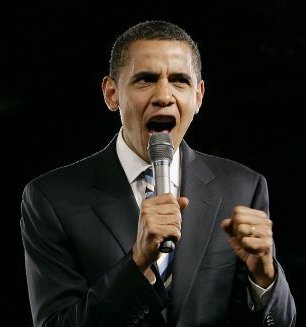
Ishmael Reed’s 12/12/2010 op-ed for the New York Times, “What Progressives Don’t Understand About Obama,” certainly struck a nerve amongst the Left. In the piece, Reed calls out far-Lefters for their misplaced–and dangerous–desire for President Obama to essentially “bust a can of whup ass” out on the Republicans over the tax cut debacle. Citing a lifetime of being labeled rhetorically “rowdy” by white teachers and peers, Reed calls attention to a deeply embedded and racialized double standard for the public expression of anger in the United States. Beyond turning a deaf ear their own pleas for a “sane” national debate back in October–see Mark Brantner‘s Sounding Out! analysis of the rhetorical logic of John Stewart’s Rally to Restore Sanity here–Reed argues that white liberals are also disregarding the racialized difference between white perceptions of their own anger (represented as righteous and authoritative) and their characterizarions of black anger (as a loud, dangerous “whup ass”–or as Reed phrases it “paranoid,” “bitter,” “rowdy,” “angry,” [and] “bull[ying]”). In other words, behind the cries in Reed’s comments for Obama to regain his “drama and passion” and to “stand up and tell these idiots to stuff it” lies a flirtation with and fear of “black anger,” which has a long history in the United States. As Reed mentions, black intellectuals have “been accused of tirades and diatribes for more than 100 years.”
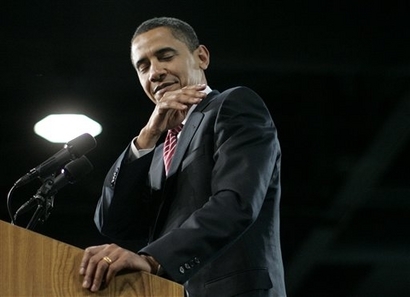
As someone who researches the racialization of sound and listening, I have been tracking Obama’s struggle with sonic stereotypes for quite some time now, and I think it is important to connect Reed’s recent thoughts with the utterance of another man named Reid almost a year ago. Woven into comments supposedly intended as praise of President Obama’s political prowess, Former Senate Majority Leader Harry Reid (D-Nevada) told two political journalists that he had known Obama would be elected president in 2008 because he was “light skinned” and had “no Negro dialect, unless he wanted to have one.” In this brief sound bite, the other Reid acknowledged the increased role that vocal grain and diction would play in a “post-racial” or “colorblind” world, linking the racialization of skin pigmentation with its less acknowledged yet perhaps more insidious counterpart, the racialization of sounds, voices and speech. Unfortunately, incendiary media coverage focused bluntly on Reid’s alleged racism for using the antiquated term “Negro” rather than sparking a more nuanced conversation about the role that race plays in perception and the multifaceted ways in which this racialized perception affects American politics and culture, down to the very level of the senses.
What was most disturbing about Reid’s comments (and the least talked about) was how they showed aural markers of race aligning with—and even superseding—visual codes of race, exposing the seeming comfort Americans have developed with this “sonic color-line,” as I have termed it. Inspired by and indebted to W. E. B. Du Bois’s concept of the visual color-line in The Souls of Black Folk (1903) and his later reimagining of that color-line as a suffocating plate-glass enclosure in Dusk of Dawn (1940), my notion of the sonic color-line posits listening as an interpretive site where racial difference is coded, produced, and policed. In short, we hear race in addition to (and sometimes even before) seeing it. As I have argued elsewhere, the socially constructed division between “sound/noise” marks one border of the sonic color-line; the hierarchies pointed out by Reed (quiet/loud) and exacerbated by Reid (proper/improper) mark still others. The sonic markers of whiteness (“sound”/”quiet”/”proper”) are culturally associated with both intellect and full citizenship privileges; the sonic markers representing blackness (“noise”/”loud”/”improper”) are repeatedly trotted out as signs of deviance, danger, and deserved abjection.
Though I very rarely find myself agreeing with Conservative linguist John McWhorter, I couldn’t help concede to the sentiment expressed in his January 9, 2010, blog for the The New Republic, “Reid’s Three Little Words; The Log in Our Own Eye”: “And who among us—including black people—thinks someone with what I call a ‘black-cent’ who occasionally popped up with double negatives and things like aks could be elected President, whether it’s fair or not?” Both Reid’s statement and McWhorter’s embellishment imply an unspoken sonic color-line, a racial “common sense” that African Americans are not only identifiable by a particular type of sound—the so-called “Negro dialect” or “black-cent” and its attendant loudness—but are aberrant and unelectable because of it, a sonic standard that does not appear to apply to white people. After all, the preceding two white presidents were known for their distinctive dialects and the ways in which they used them to mobilize their respective electorates; Bill Clinton’s soft-spoken Southern drawl was often read as smooth, intimate, and reassuring during the 1990s and George Bush’s folksy Texas-by-way-of-Andover twang attempted to sonically bridge the gaping class divides in the Republican coalition. But even before the recent debates that have pitted Obama’s “coolness”–itself a racialized jazz form of “quiet revolution” a la Miles Davis–against the imagined explosive heat of his anger, contemporary pundits heard the sound of Obama’s crisp, cosmopolitan voice with anxious and divisive ears, leading some to question his “blackness” and his political commitment to black people (Salon,“Colorblind,” 1.22.07)while still others called his baritone “magic” and immediately connected its resonant qualities with Martin Luther King Jr.’s, despite clear differences of tone, cadence, and regional inflection (Salon,“Does Obama’s Baritone Give Him an Edge?”2.28.2008).
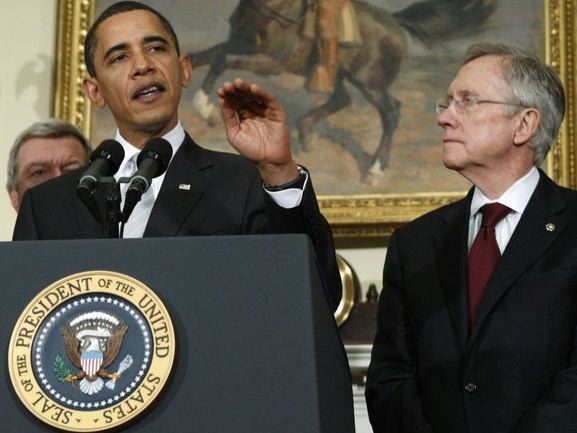
Senator Harry Reid (D-Nevada) Listens to Obama Speak
In other words, Americans continue to hear Obama’s voice through the historical filter of “loudness” and the so-called “Negro dialect” whether or not Obama wants them to and whether or not he “wanted to have one.” While Reid’s prompt and profuse apologies to Obama may have pulled the story from the news cycle—the President called the remarks “unfortunate”—the phenomenon Reid’s clumsy words exposed remains an invisible yet palpable cultural force in the U.S., one whose longer historical genealogy has yet to be reckoned with. Sure to be labeled “rowdy” for beginning to do so, Reed’s recent commentary suggests that Obama’s social and historical knowledge has led him to an astute awareness of “when not to shout” that white Liberals need to recognize. I offer a perhaps less consoling conclusion, that we need to concentrate less on the sound of Obama’s voice and more on the racialized listening practices that can radically distort public discourse in this country. Unless we understand (and eventually dismantle) the relationship between the dominant American “listening ear” and the sonic color-line that shapes it for many (white) liberals and conservatives alike, we will continue to shout into the wind.


Share this:

“Ain’t Got the Same Soul”
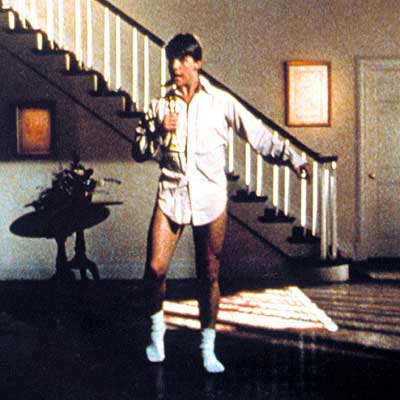 Bob Seger’s “Old Time Rock n’ Roll” has bothered me for a long time. I first heard it in Risky Business in 1983, four years after its initial release, as the soundtrack to a young Tom Cruise frolicking in his tightie-whities to his father’s sacrosanct (and expensive) hi-fi, expressing his repressed white suburban middle-class masculinity and sexuality. It was the song’s vague appeal that got me wondering even back then, how Cruise’s character was even old enough to remember the “old times” that Seger sang of. Hearing it on a “classic rock” station on a recent drive, it suddenly hit me – for many young people the song is a representation of what it clearly isn’t: “old time” rock n’ roll itself.
The song performs a form of hyper-nostalgia, not only eliding all potentially negative aspects of the “old times”—such as the racial erasure at rock n’ roll’s emergence into the mainstream—but eschewing any kind of specificity about “old time rock n’ roll” altogether. The song’s lyrical and sonic vagueness, punctuated by bland guitar solos and cheesy piano rolls, hearkens to an undefined sense of authenticity that casts doubt on other musical forms and implicitly marks itself as legitimate and authentic – laying a kind of homogeneous claim on rock itself.
The key phrase to Seger’s song, “Today’s music ain’t got the same soul / I like that old time rock n’ roll,” is leavened with irony, because it could be used as an example of “today’s music” itself – at least contemporary to the release of the song in 1979. And let’s face it, “Old Time Rock ‘n Roll” itself seems to be lacking in the soul department. Now, “soul” is a shibboleth. It is a call to a form of racial authenticity that many assume blacks have a natural, essential access to. When whites allegedly have it–it is something worthy of a NY Times article. However, when used by Seger, “soul” becomes a way of defining authentic music as having an unchanging “feel” anchored in a particular vision of the past. So distant it seems, that the lyrics can give us no real hint as to what constitutes “soul”; listeners are just supposed to know it when they feel it.
And yet, “Old Time Rock n’ Roll” arguably lacks that feel; leaving aside the happy accident of the repeated piano intro and the grain of Bob Seger’s voice, I’d make the argument that any close listening to the musical portions themselves makes the lack of “feeling” in the song evident. The song’s music can only be described as an attempt to present a generic portrait of rock n’ roll sounds, with Chuck Berry guitar licks deprived of all gusto and a sax so filtered it may have come from a late seventies synth. This could be attributable to the fact that Seger is singing over a demo meant as a model for his band to record its own version, but the fact remains that is the cut that was kept and that we all know.
The questions then arise: why so generic? Why the lack of specificity in sound and content?
The answer, I feel, can be found in the two listening practices described in the song and the preference of one over the other. The speaker’s unwillingness to be taken “to a disco / you’ll never even get [him] out on the floor” seems to be putting down a genre of music that emerges from a line of descent in the development of popular music in America that can be traced from the “blues and funky old soul” he claims he’d rather hear – Black American music. “Old Time Rock n’ Roll” can be seen as a kind of anthem of the disco wars, where rock fans violently objected to disco.
The rejection of disco then becomes part of a conflict at the time between “rock” as a dominant mainstream white musical form and disco, which Alice Echols has described in her recent book, Hot Stuff: The Remaking of American Culture, as a heterogeneous site that was black, queer, women-friendly and social and that eschewed the centrality of a ineffable “authenticity” that rock n’ roll always strove for. In order for Bob Seger’s “Old Time Rock n’ Roll” to establish its authenticity, it must contrast itself to disco, accomplishing this not only by pulling rock n’ roll into a personal listening sphere, but by eliding the sexual energy present in early rock n’ roll and still evident in the disco of the 70s. To heap upon this irony, the fact the high-hat cymbal moves into a disco off-time beat at several points in the song provides “Old Time Rock n’ Roll” with what catchy-rhythm it does have.
Leaving the disco after 10 minutes along with the opening lines of the song “Just take those old records off the shelf / I sit and listen to them by myself” one gets a sense of an anti-social listening practice that divorces the music he claims to love from its cultural context and transform it into a solitary act. Like nearly all forms of nostalgia, Seger’s view of the past of the music is problematic in its glossing over the complexities and specificities of the time he is ostensibly singing about.
 Another one of Seger’s hits may claim that “rock n’ roll never forgets,” but it seems like forgetting might be what it does best. Looking at Bob Seger’s professed influences— Little Richard and Elvis — we can see some of that forgetting in action. If the former suggests that the shifting, slippery, and flamboyant sexuality of disco has been present from rock’s very beginning, then the crowning of the latter as the “King of Rock n’ Roll” highlights just the kind of erasure that allows for a song like “Old Time Rock n’ Roll” to make sense as an anthem of whitewashed “heartland” rock. Seger’s clarion call to old timey-ness strips it of its sex even as he evokes a particular kind of “blackness” through the grain of his voice – a throaty howl full of a representation of sonic authenticity profiting of a vague sense of racial marking. In other words, Seger’s voice performs soulfulness through a growly working-class sound (typified in his “Like a Rock” Chevy commercials), itself a placeholder for race which is verboten in this construction of rock n’ roll. This kind of rock star class passing functions because of the racial erasure the songs enacts by means of white privilege.
Richard’s slippery sexuality and the way in which his most famous songs, like “Tutti Frutti” emphasize dance–and dancing as a euphemism for sex: “she rocks it to the east/she rocks it to the west/but she’s the girl that I know best”–brings me back to Seger’s denial of dance and the solitude of his idealized rock n’ roll, and thus back to Tom Cruise in his tightie-whities dancing around by himself in his parents’ fancy suburban Chicago house.
It makes sense that the scene in Risky Business is so isolated, middle-class and white – idealized rock n’ roll has been hijacked out of the heterogeneity of urban centers, and into the mythic American Heartland where white masculine sexuality can be extolled without threat. Seger’s reactionary song makes a world where it is safe for a teen-aged Cruise to enact his youthful rebellion by unproblematically participating in a form of class-passing of his own – lest we forget, the plot of Risky Business has his character playing the part of pimp to earn his way into Princeton – and yet retain his privileged position insulated from further influence of Black America on his music and on his life.
Share this:


Current Top Posts





April 2021

January 2020

November 2019

October 2019

August 2019

April 2014

November 2017

March 2015

December 2017

October 2015
 Sounding Out!
Recent Comments