
The Problem of Alan Lomax, or The Necessity of Talking Politics During the Lomax Year

 This week, Sounding Out! kicks off an exciting four-part series exploring the work of Alan Lomax, a key figure in sound culture studies, and one whose legacy is in the midst of being reconsidered and refreshed by many scholars, musicians and folklorists alike.
As Guest Editor, we are happy to welcome Tanya Clement, Assistant Professor in the School of Information at the University of Texas at Austin. Clement has expertise in a wide variety of fields, from scholarly information architecture and digital literacies to modernist literature and sound studies, and she is currently helping to lead the High Performance Sound Technologies in Access and Scholarship (HiPSTAS), a project you should know about that’s using new technologies to analyze and increase access to a range of spoken word recordings.
I’ll turn it over to Clement to introduce the series, an expertly-curated set of reflections on what Lomax and his recordings have meant in the past and could mean in the future.
— Special Editor Neil Verma
—
Alan Lomax (January 31, 1915 – July 19, 2002) was an archivist, ethnomusicologist, film-maker, folklorist, oral historian, political activist, scholar, and writer and many would say he has had the single most influential impact on the preservation of global music traditions. 2015 marks his centenary and this series of posts will both celebrate and interrogate his tireless and controversial crusade to bring attention to, understand, and preserve sound culture.
Below, Mark Davidson’s piece will introduce our collection with an exploration into the Alan Lomax “branding” as either saint or sinner with a call for transparency, context, and accuracy with regard to current scholarship and repatriation efforts surrounding the recordings Lomax made over six decades of work. In his approach to Alan Lomax’s Southern-based collecting work in our second article, Parker Fishel will consider the complex practice of documenting and preserving transforming dynamic community-based traditions into static texts that Lomax and others touted as authentic. Next, Toneisha Taylor will interrogate how the Federal Writers Project Folklore and Folkways collection projects, first formed by Lomax’s father, has framed how we encounter significant recordings about Black life in the Deep South during and after slavery. Finally, Tanya Clement will explore how Lomax’s ideas about Cantometrics and the Global Jukebox resound in recent work using computers to categorize and analyze sound in the 21st Century.
By revisiting Lomax’s collecting practices and the songs Lomax collected from alternate perspectives in the context of the diverse communities affected by his work, these posts are an attempt to use Lomax’s Centenary to celebrate the enduring resonance of folk songs in our sound culture and to bring awareness to the importance and complexities of its continued preservation.
— Guest Editor Tanya Clement
—
In 1987, two years after the three hundredth anniversary of Johann Sebastian Bach’s birth, musicologist Susan McClary published a now-classic article titled “The Blasphemy of Talking Politics during the Bach Year,” in which she reflected on her experiences at a number of Bach events in 1985. Using Theodor Adorno’s 1950 essay “Bach Defended against His Devotees” (written on the two-hundredth anniversary of the composer’s death) as a jumping-off point, McClary defied Bach scholars who viewed the German Baroque master’s music as sacrosanct and unimpeachable, and performed a brazen deconstruction of Bach’s most revered works: the Brandenburg Concerto No. 5 and Cantata No. 140 (“Wachet Auf”). For McClary, the turn was critical: “we must confront Bach and the canon and resituate him in such a way as to acknowledge his prominence in musical and non-musical culture while not falling victim to it (p. 60).”
What, one might ask, does a canonical “classical” music composer, a contemporary musicologist, and a twentieth-century German theorist have to do with folk music collector Alan Lomax? Aside from a heavy degree of fetishizing by pale male scholars (myself included), it turns out quite a bit.
The “Lomax Year” began on January 31, 2015, the 100th anniversary of Lomax’s birth, with events throughout the United States and Europe including concerts, marathon film screenings, and radio broadcasts devoted to his life and work. Centennial events are ongoing throughout the year, including a panel at SXSW on March 21st in Alan Lomax’s hometown of Austin, Texas.

Alan Lomax playing guitar on stage at the Mountain Music Festival, Asheville, N.C.
But the current Alan Lomax revival began long before January 31. Over the course of the past five years there have been numerous books, including Lomax’s first full-length biography, websites devoted to his recordings (e.g., Louisiana, Kentucky), and recording reissues, all of which have garnered considerable attention in the popular media. There has been an ongoing film and recording series, The 78 Project, in which the project’s founders lug across the nation a vintage 1930s Presto recording machine similar to the kind Lomax would have used in search of contemporary musicians playing modern renditions of folk songs. Alan Lomax was even featured on The Colbert Report in March 2012, around the time that the massive Alan Lomax Archive of Alan Lomax’s Association for Cultural Equity (ACE) launched. The TV spot included a discussion of Lomax’s legacy and a performance by Emmylou Harris, Elvis Costello, and ACE executive director and musician Don Fleming, with Colbert helping out the proceedings.
Alan Lomax has become a brand, a larger-than-life figure looming over the entirety of folk music collecting in the United States. His name is the first on people’s lips when one mentions the subject (as I have found again and again in my own research on 1930s folk music collectors not named Alan Lomax). And he went to great pains throughout his life to promote this brand. It was, after all, the way that he was able to continue his life’s work. This branding effort continues to the present day, largely due to the efforts of the Association for Cultural Equity, which Lomax founded in 1983, and the American Folklife Center at the Library of Congress, where the Archive of American Folk Song (now the Archive of Folk Culture) is housed. Alan Lomax became the first salaried employee of the Archive in 1937, working there until 1942 when he left for the Office of War Information. But Lomax kept in close contact with the Archive for the rest of his life, lording “Ayatollah-like” (I’ve been told) over the collections he did so much to foster.
The Lomax Year has also been the impetus for a healthy reappraisal of Lomax’s life and career, as evidenced by a recent Studio 360 radio segment, produced by Richard Paul and featuring Dom Flemons, Karl Hagstrom Miller, Dwandalyn Reece, and Patricia Turner. In the 13-minute-long spot, Lomax is at once heralded as the potential grandfather of rock ’n’ roll while also criticized for the time that he and his father spent recording black prison inmates in the South, and the overall “folk construction” in which they engaged. The intervention is not unlike McClary’s call to “confront [Lomax] and the [traditional music] canon and resituate him in such a way as to acknowledge his prominence in musical and non-musical culture while not falling victim to it.”

Lightnin’ Washington, an African American prisoner, in the prison hospital at Darrington State Farm, Texas
But the “re-situation” suggested by this exposé borders on the same sort of constructed truth of which Lomax himself is accused. By listening to the segment one might come to the conclusion that Lomax had no time for any types of African American music outside of prison inmates: “It would take 14 years before Lomax ever recorded in a black church and he never recorded at a black college.” Or one might think that the Lomaxes’ quest to find “pure” or “unadulterated” versions of songs was unique. Both statements are simply not true. Alan Lomax, in his official capacity with the AAFS, worked with numerous collectors who recorded all types of music. Just one example of many is his collaboration with John Wesley Work III of Fisk University to record African American folk songs and spirituals for use by Fisk and the Library of Congress. As far as fetishizing the untouched or “pure products,” it is a practice that persists in ethnographic research to this day.
Defending Alan Lomax in this way is not a position with which I am comfortable. But relegating him to a decade of his life, and conflating him with “the sins of the father” is no better a stance. There are plenty of places where Lomax can, and should, be justly criticized. There is his practice of taking composer credits for other musicians’ performances (which he somewhat awkwardly defended in a 1990 Fresh Air interview with Terry Gross). Then there’s the instructions he gave other AAFS fieldworkers to actively deceive their informants: “The recording interview can be as significant as the song itself and is valuable as a fresh field document, especially, if the informant does not know that the interview is being recorded, and if he never learns it.” And there’s a statement he made to Federal Writers’ Project historian Jerre Mangione in which he boasted that his father was “a fucking genius at getting blacks to sing” while describing, excitedly, the dangers of recording in the Jim Crow South. Not to mention Zora Neale Hurston putting Alan Lomax in blackface as they traveled the South. And these instances all fall within this same five-year period of Lomax’s life.

Stavin’ Chain playing guitar and singing the ballad “Batson” accompanied by a musician on violin, Lafayette, La.
What falls away in these discussions is perhaps the most critical piece to this puzzle: the individuals behind the recording. Who were they, and what were their lives like outside of the three minutes that are etched into a lacquered aluminum “acetate” disc? Aside from a few notable exceptions (e.g., Muddy Waters, Jelly Roll Morton), most of these performers remain unknown to the general public. Through this particular sin of omission, we fall victim to the fallacy that perhaps Alan Lomax really was the progenitor for the “never-ending folk music revival,” or that he really was the grandfather of rock ’n’ roll. Few scholars have even approached the problem of dealing with the performers in any substantive way, with the exception of perhaps Stephen Wade through his recent book The Beautiful Music All Around Us. The problem of the individual extends to the various recent “repatriation projects” that have been underway for some years. Given what we know about Lomax’s fieldwork co-creator-credit practices, how transparent have these repatriation efforts been able to be? What do these plans include for the forthcoming “definitive Centennial box set”?
Talking politics during the Lomax Year is not blasphemy. It is necessary. But the overall reliance on knocking down Alan Lomax™ misses an important point. It is nearly impossible to make the overly simplistic and poorly nuanced argument that Lomax was simply a product of his time, when that time spanned the better part of the twentieth century and into the twenty-first. The problem of Alan Lomax, then, is acknowledging his importance while resituating him within the larger narrative of traditional music research in the twentieth century, not as a brand, but as an individual in a larger network collectors, institutions, and musicians who fought against what the rapid disappearance—what Lomax called “cultural grey-out”—of music and culture throughout the world. Doing so won’t solve the problem, but it’s at least a start.
—
Mark Davidson is a Ph.D. candidate in cultural musicology at the University of California, Santa Cruz. He is currently finishing up a dissertation on WPA folk music collections, including Sidney Robertson Cowell’s California Folk Music Project; Herbert Halpert’s Southern States Recording Expedition; and the Florida Federal Writers’ Project’s statewide folk music recording survey (which included Zora Neale Hurston and Stetson Kennedy). Mark has also been working with Tanya Clement and the Briscoe Center for American History at the University of Texas to launch a website of the Lomax family’s recordings in Texas. He received an MSIS from the UT School of Information in August 2014, and has worked for the Journal of the Society for American Music since 2008.
—
Featured image: Alan Lomax (left) youngster on board boat, during Bahamas recording expedition. All images via the Library of Congress Lomax Collection.
—
 REWIND! . . .If you liked this post, you may also dig:
Como Now? Marketing “Authentic” Black Music — Jennifer Stoever
Prison Music: Containment, Escape, and the Sound of America — Jeb Middlebrook
Tuning Into the “Happy Am I” Preacher: Researching the Radio Career of Elder Lightfoot Solomon Michaux
— Suzanne E. Smith
Share this:

Como Now?: Marketing “Authentic” Black Music
With all the excitement over the new release of Mavis Staples’s You Are Not Alone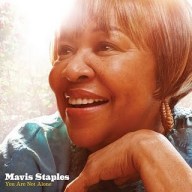 (Anti-, produced by Wilco’s Jeff Tweedy), I can’t help but be skeptical of the outpouring of Indie love for the album, even as I have been spinning (and enjoying) it myself. It isn’t the positive reaction to Staples’s talent that is surprising—at 70-plus years, Mavis has been exquisite for quite some time now—but rather the way in which critics have freighted her newest record with the “uplift” (AV Club) of a whole lot of souls that haven’t ever been to church (at least not in a good long while). Her voice is described as alternately “raw” (Paste) and full of a “depth, power, and warmth that seem increasingly rare in music today” (hear ya); Consequence of Sound, who cites Tweedy’s hand at the boards as the reason for all the current music blog attention, calls her voice “empathetic. . . powerful. . .soulful. . .touching” and “wise.” If the blogosphere is to be believed, Staples’s voice, “as authentic as it gets” (buzzine), could really save us all in these tough times. Come to think of it, the fervor of (white) faith in “authentic” black music shouldn’t be that surprising either, given the way in which race has always been entangled with popular music history in the United States.
Authenticity and the immediacy of experience it implies, have had a long history in the music industry—especially in reference to black artists—stemming back at least to the Fisk Jubilee Singers in the 1870s, an all-black acapella troupe celebrated for  powerful live performances whose breakthrough concert also happened to be for a crowd of hipsters: the wealthy congregants of Henry Ward Beecher’s Brooklyn church in 1871. Beecher gave the band his enthusiastic support, namely because he felt their sound gave listeners direct access to “the inner lives of slave hearts expressed in music” even after slavery had formally ended.
While the sound of You are Not Alone differs greatly from the Jubilee Singers, the reviews of the record belie and inflame a similar desire for unmediated access to the emotive qualities (a)historically associated with black life and sound in the U.S.: namely suffering, faith, and catharsis. And Staples’s record is indeed not alone in this. Many of the sentences from the Staples reviews could easily have been lifted from those of another recent gospel record to capture the indie imagination, Daptone Records’s 2008 release Como Now. Starkly different from the breezier, countrified sounds of You Are Not Alone, Como Now is an acapella gospel recording made in a small town in Panola County, Mississippi. The record was a risky release for Daptone, a Brooklyn-based label that has consistently produced new funk and soul records since its inception in 2002 by the likes of Sharon Jones and the Dap-Kings and The Budos Band. Although old school sound has always been a part of the label’s ethos—its engineers use primarily analog equipment, for example, a major reason Amy Winehouse recorded her throwback Back in Black album at Daptone studios in 2006—marketing stripped-down gospel to its audience of predominately white hipsters would nonetheless prove a daunting task. Treating Como Now as a labor of love and a paying of dues, Daptone attempted to spark interest in the release by relying on the familiar marketing strategies of immediacy, authenticity, and nostalgia.
 While Como Now’s tagline boldly proclaims that the music was “Recorded Live at Mt. Mariah Church on July 22, 2006”—and, thus, emphasizing the Now of the title—the cover’s vintage civil-rights era design evokes the Como of yesterday, or more accurately, encourages listeners to hear Como now and Como yesterday as one and the same through the vehicle of “raw gospel testimony.” Como Now’s depiction of the sounds of the past as echoes within the present is as ambiguous as it is uncanny, a sonic window thrown open to simpler times happening somewhere out there, “deep in the heart of Mississippi” right now.
The introductory promotional video from Como Now’s website (also uploaded on Youtube) represents the record as an aural time machine to a land and a people isolated from and largely unchanged by technology, modernity, and history.
Producer Michael Reilly’s voiceover locates rawness, emotional release, and “real religion” in the sound of black voices, in no small part because the video places his measured Yankee pacing in sonic tension with the song that accompanies it, Mary Moore singing “When the Gates Swing Open.” Over Moore’s impassioned singing, Reilly assures listeners in a muted deadpan that they will hear “no pretty piano playing or clever guitar picking, just voices. Pure soul stirring fire from the heart.” Reilly’s sentiments not only evoke the gushing Jubilee Singers’ press, but also the ethos of the infamous folklorist John Lomax, who made field recordings in Southern prisons in the 1930s because he sought “negro singers untainted by white musical conventions” (as he wrote in 1934’s “Sinful Songs of the Southern Negro”); singers in Como were actually recorded by John’s son Alan in the 1940s. Reilly’s voiceover goes on to frame the Como singers as practitioners of what the senior Lomax called “the real art of simplicity,” as stripped-down, natural singers who are artful mainly in their artlessness. While Reilly’s webcopy mentions how “children and grown folks alike have been living and breathing gospel for as long as they can remember,” for example, he fails to mention how the residents of Como have also been writing, rehearsing, and performing it.
Thus, Como Now’s marketing disavows the real artistry of the Como singers, even as it seeks to celebrate it. The simple, natural quality endowed to the singers of Como is visually accentuated by stark imagery representing the town as a down-at-the-heels, living museum of the black life of yesteryear. In the youtube clip, Moore’s soaring and spirited singing animates stills of blooming cotton fields, vintage RCA microphones, and splintering upright pianos.  Save for the album cover and one blurry still of a child, there are no shots of the people of Como in the introductory promo, effectively isolating Moore’s voice from her corporeal and historical body. This isolation allows listeners to supply their own fantastic imagery and forces them to rely on historical stereotypes about the naturally sonic qualities of black people. By choosing to disembody Como’s voices, the promotional video represents the album’s music as emanating from, and even haunting, Panola County’s lush green fields and battered strip-malls rather than showing it to be a hard-fought creation of the residents themselves. To quote Lomax again: “[The Negro’s] songs burst from him, when in his own environment, as naturally as those of a bird amid its native trees.”
Although the impulse to make the album reflects a progressive desire to respectfully pay tribute to the black gospel tradition in American popular music—and to provide quality artists like The Como Mamas with critical renown and monetary compensation—Como Now relies on well-worn racial tropes to do so. It also points to the continued presence in American culture of an essentialized “black voice” that is naturalized as more emotive, truthful, and soulful than other voices. While this phenomena is socially constructed and the sounds thought of as “black” have shifted considerably—when I play early recordings of the Jubilee Singers my students consistently tell me that they sound “white” like a “glee club”—I find it fascinating that the language used to describe them has largely remained the same. While Como Now’s producer at least acknowledges that, in Como, “no one has to pick up cotton anymore, thankfully,” the marketing trades on the possibility that, while slavery and sharecropping have ended, its sonic labors have not only endured, but are readily available for download.


Share this:


Current Top Posts





April 2021

January 2020

November 2019

October 2019

August 2019

April 2014

November 2017

March 2015

December 2017

October 2015
 Sounding Out!
Recent Comments