
Benefit Concerts and the Sound of Self-Care in Pop Music
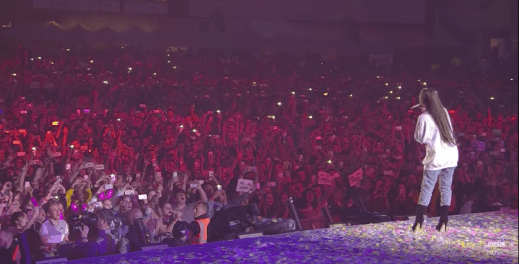
Less than two weeks after a suicide bombing killed 22 people at the Manchester Arena following an Ariana Grande concert, the singer was back on stage in the city. She capped her three-hour One Love Manchester benefit concert with the 2015 single, “One Last Time,” which had found its way back into the UK Singles chart in the days following the blast. It was technically a solo performance, but Grande was joined on stage by the many artists who had already held the mic that day. At one point she was too overwhelmed to sing, and the audience took over for her. Grande’s occasional loss of voice is moving to watch. Throughout the concert, she would frequently struggle to speak, mostly sticking to short introductions of singers and a variation of “Thanks for being here; I love you so much,” her voice often cracking or sounding uncharacteristically pinched, the tears barely held at bay. Until “One Last Time,” she could always find her full voice through song, but as dusk settled on the city and the concert drew to a close, Grande could no longer sing through the weight of the moment, so the community she’d called together so she could “see and hold and uplift” them lifted her.
Benefit concerts and the products surrounding them—as well as the critiques that target them—have become familiar fare since the 1984 Band Aid recording of “Do They Know It’s Christmas” spun off to form 1985’s Live Aid, a multi-site concert event complete with commemorative souvenirs and the performance of the USA For Africa single, “We Are the World.” Skeptical accounts of benefit concerts fall like crumbs from Marx’s beard: they’re capitalism deployed as band-aids on problems capitalism created; they’re opportunities for celebrities to enhance their brands; they’re colonial; they’re neo-colonial; they’re exaggerated performances of wokeness intended to absolve people of their complicity in systems of violence. As communal rituals in response to tragedy, though, benefit concerts also function as metaphorical keystones that hold the tension of competing emotions, politics, and sounds. Listening to music emerges as a form of self-care, but that act may not sound the same for different people. Looking at the case of Grande’s One Love Manchester, I will map self care in the context of this contemporary moment by filtering the Manchester concert through Cheryl Lousley’s feminist analysis of benefit concerts (2014). Specifically, in order to highlight what’s different about One Love Manchester, I’ll start with Lousley’s attention to the way feminized compassion is performed through benefit concerts as an outward-facing love. Here, Grande performs the same kind of feminized compassion but shifts the focus of the benefit to an inward self-care. But not all selves experience care or self-care the same way. I’ll end by listening to Grande’s “One Last Time” alongside Solange Knowles’s “Borderline” (2016) in an effort to situate those sounds in contemporary politics that shape who has access to what kind of care.

Screenshot from 1984’s Band Aid song, “Do They Know It’s Christmas?”
Cheryl Lousley, in “With Love from Band Aid: Sentimental Exchange, Affective Economies, and Popular Globalism,” grants that benefit concerts aren’t just about fake feeling, but she doesn’t lose sight of capitalist and imperialist critiques. For her, benefit concerts are events “where feeling is validated, where space is made for feeling.” For her, if we allow that participants (whether organizers, performers, audiences) can be aware of the capitalism-fueled problems of benefit concerts but choose to be involved with them anyway, then we can access further dimensions of cultural analysis. In Lousley’s case, that includes gender and emotion, as she keys in on how the performance of feminized compassion and love creates an “affective economy” of “feeling too much.” When confronted with tragedy enormous enough to press the limits of the social imaginary, society looks for somewhere to put their big feelings and turn them into some kind of action. Benefit concerts like Live Aid invoke a moral imperative to give of one’s own wealth to someone who needs it, a public moral activism Lousley grounds in feminized emotional labor, a gendered compassion that extends to the entire nation. She demonstrates that public Anglophone discourse surrounding the Ethiopian famine leading up to Live Aid revolved around domestic scenes of feminized affect performed across gender boundaries. The affect of Live Aid, then, included a gendered performance of love and compassion turned outward, and this has been the template for numerous benefit concerts since, including Farm Aid (1985), Concert for New York City (2001), and Hope for Haiti Now (2010), among others.
 The announcement of Ariana Grande’s One Love Manchester echoes Lousley’s idea of the benefit concert as a gendered performance of love and compassion. A skim of her Twitter post (which is a picture of a message longer than 140 characters) announcing the event reveals emotive terms and phrases throughout. Grande offers sympathy, compassion, admiration, solidarity, and, importantly, music, the latter in the form of a concert where she and her fans can feel too much together. What’s different about Grande’s benefit concert, though, is that it’s pitched not as an outward demonstration of compassion for others, but as an inward compassion for one’s self, what I call here “self-care”:
From the day we started putting the Dangerous Woman tour together, I said that this show, more than anything else, was intended to be a safe space for my fans. A place for them to escape, to celebrate, to heal, to feel safe and to be themselves…[The bombing] will not change that.
At the concert we can hear Grande model self-care for her audience as she struggles to maintain her composure and then gathers it through song, performing for herself the same kind of care she wants concert attendees to extend to themselves and their city.
Analyses and critiques of self-care generally start with Audre Lorde’s A Burst of Light quote, “Caring for myself is not self-indulgence, it is self-preservation, and that is an act of political warfare,” then contextualize how this quote functions for Lorde, a queer woman of color, differently than it does for the white women who have become the faces and consumers of #selfcare. Caring for one’s self when the world wishes to marginalize and destroy you is, indeed, warfare. And while white women suffer at the hands of the patriarchy, the long history of feminist movements also reveals that white women not only have access to privilege and resources unavailable to women of color, but also that they have wielded that privilege in ways that further marginalize and harm women of color. In other words, self-care means something different based on who the self is and—and Sara Ahmed has outlined this in characteristically brilliant terms—who else will show up to care for you. Intersectionality shows us that queer people and women of color and people with disabilities often must perform self-care because the world is not organized to care for them. “For those who have to insist they matter to matter,” Ahmed writes, “self-care is warfare,” a necessity for survival. What I want to explore below is how self-care can sound different based on who the self is and whether that self must “insist they matter to matter.”
 Ariana Grande’s performance of “One Last Time” at One Love Manchester presents self-care for a self who also receives support from others. Here, Grande mirrors the collaborative nature of Live Aid by performing alongside other pop stars whose presence—confirmed relatively last-minute, almost certainly with a degree of effort to rearrange busy schedules, and without the usual compensation for their performance—tells Manchester and those harmed by the bombing that they matter. For “One Last Time,” many voices join together to provide “a safe space for [Grande’s] fans” to take care of themselves, and they, in turn, are able to take care of Grande when her voice escapes her. The underlying theme of many critiques of white feminist self-care is that it is frivolous, a market-driven excuse to indulge, a selfish pursuit of happiness for happiness’s sake. And sure, as with benefit concerts, capitalism is a big problem here, and sometimes we call something self-care when it really is just self-indulgence. But I’d like to suggest we can make a finer distinction that doesn’t require the oversimplification that comes with divvying up some actions or products as care and others as indulgence (or: Schick’s self-care marketing of a razor may be exploitative at the very same time the razor actually functions as a form of self-care for some), and this is one reason I find the One Love Manchester concert compelling. Manchester and the survivors of the blast and Ariana Grande and her touring team could absolutely use the safe space the concert is trying to create. As Lousley reminds us, the performed compassion of benefits isn’t simply fake feeling; the trauma Grande and the city and her fans experienced was real, and it’s especially audible in the moments Grande’s voice is pinched off mid-lyric. Let’s consider others who could use the safe space One Love Manchester is trying to create: victims of bombings and terror throughout the world. The music industry isn’t as eager to remind them that they matter. Self-care, it turns out, is easier for some to perform because the world is literally willing to invest in the care of those selves.
By contrast, Solange Knowles’s “Borderline (An Ode to Self-Care)” (from her 2016 album A Seat At The Table) is lyrically rooted in the black feminist work of community organizing and activism. The singer explains to her lover that she needs a night off so that she can have the resolve to go back out to the “borderline” and fight again. Self-care as warfare, indeed. The singer’s self-care has more than one purpose: it’s a time to remind herself that she matters, and it’s a time to restore the energy needed to go out and insist that her community matters. Instead of a bevy of pop stars lending their voices to create a safe space for her or an audience of adoring and grateful fans ready to take over if she can’t, Solange’s “Borderline” calls forth a more intimate setting. She multitracks her voice so that she collaborates and harmonizes with herself, with a faint doubling on the hook from Q-Tip, who is turned down in the mix and following Solange’s lead. “Borderline” is a mostly solo act of self-preservation that enables the singer to go out and create safe spaces for others.
This inward-to-outward focus of self-care is evident in the instrumentation. After a smooth piano-and-bass duet in the introduction, the kick drum enters at the 0:28 mark, overblown and rough around the edges. The effect sounds like oversaturation, where the signal’s gain is driven so that we lose some of the fidelity of its lower frequencies. This effect gives the kick a brighter timbre as the higher frequency overtones shine through and also muddies the lower frequencies so that they sound as if you’ve blown your car speakers and are getting noise in the mix that isn’t supposed to be there. The drum kit also includes a white noise sound (think “tsshhh”) that hits on the upbeat of the first, third, and fourth beats of each measure, joining the kick drum in creating a generally rough texture. This texture stands out because it sounds imperfectly mixed, like a sound engineer who messed something up. I hear in this a sonification of what Solange describes in her lyrics – a world that has frayed her edges, a world at war with her, a world disinterested at its best and hostile at its worst to the idea of her preservation. Hence, she pleas to retreat and preserve her own self.
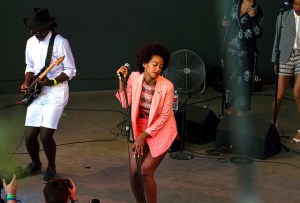
“Solange” by Flickr user Greg Chow, CC BY-NC-ND 2.0
The interlude that follows “Borderline” is the immediate payoff of this, as Solange sings with Kelly Rowland and Nia Andrews that she has “so much [magic], y’all, you can have it.” Then comes “Junie,” a fresh and energetic funk track that finds the singer back out on the activist grind after the night off that made it possible for her to return to the borderline.
As self-care proliferates in so many different practices performed by different selves, and as the term is emptied of meaning one hashtag at a time, one way we might track how power circulates through self-care is to listen to sonic representations of self-care. In Grande’s “One Last Time” performance at One Love Manchester we hear self-care staged and protected by cultural icons and government officials who assure attendees that their selves matter, while in Solange’s “Borderline” we hear self-care as an intimate, closed act that makes self- and community-preservation possible even when cultural icons and government officials refuse to participate in that preservation. In “One Last Time” we hear a community who shows up to help a singer when the world is hard, while in “Borderline,” we hear a singer having to reassure her own self that it’s okay to step away for a moment when the world is hard. By listening carefully in these moments, we can hear which selves are more readily recognizable as worthy of care—a chorus of voices surrounded and kept safe by heightened police presence—and which selves are more likely to have to perform care for themselves quietly or privately, for fear of retribution. Sound, in this instance, calls our attention to details that can let us more firmly hold onto a concept like self-care—a concept and series of practices that have been fundamental to the survival of black and queer women in a hostile world—that otherwise threatens to slip from our grasp. But hold on tight, and we just might make it back out to the borderline.
—
Featured image: Screenshot from Youtube video “Ariana Grande – One Last Time (One Love Manchester)” by user BBC Music
—
Justin Adams Burton is Assistant Professor of Music at Rider University. His research revolves around critical race and gender theory in hip hop and pop, and his book, Posthuman Rap, is available for pre-order (it drops October 2). He is also co-editing the forthcoming (2018) Oxford Handbook of Hip Hop Music Studies. You can catch him at justindburton.com and on Twitter @j_adams_burton. His favorite rapper is one or two of the Fat Boys.
—

REWIND! . . .If you liked this post, you may also dig:
Unlearning Black Sound in Black Artistry: Examining the Quiet in Solange’s A Seat At the Table-Kimberly Williams
Trap Irony: Where Aesthetics Become Politics-Justin Burton
Listening to Sounds in Post-Feminist Pop Music-Robin James
Share this:

What Feels Good to Me: Extra-Verbal Vocal Sounds and Sonic Pleasure in Black Femme Pop Music

The lyrics to Beyoncé’s 2008 song “Radio” treats listening pleasure as a thinly-veiled metaphor for sexual pleasure. For example, they describe how turning up a car stereo transforms it into a sex toy: “And the bassline be rattlin’ through my see-eat, ee-eats/Then that crazy feeling starts happeni-ing- i-ing OH!” Earlier in the song, the lyrics suggest that this is a way for the narrator to get off without arousing any attempts to police her sexuality: “You’re the only one that Papa allowed to hang out in my room/…And mama never freaked out when she heard it go boom.” Because her parents wouldn’t let her be alone in her bedroom with anyone or anything that they recognized as sexual, “Radio”’s narrator finds sexual pleasure in a practice that isn’t usually legible as sex. In her iconic essay “On A Lesbian Relationship With Music,” musicologist Suzanne Cusick argues that if we “suppose that sexuality isn’t necessarily linked to genital pleasure” and instead “a way of expressing and/or enacting relationships of intimacy through physical pleasure shared, accepted, or given” (70), we can understand the physical pleasures of listening to music, music making, and music performance as kinds of sexual pleasure.
Though Cusick’s piece overlooks the fact that sexual deviance has been, since the invention of the idea of sexuality in the late 19th century, thoroughly racialized, her argument can be a good jumping-off point for thinking about black women’s negotiations of post-feminist ideas of sexual respectability; it focuses our attention on musical sound as a technique for producing queer pleasures that bend the circuits connecting whiteness, cispatriarchal gender, and hetero/homonormative sexuality. In an earlier SO! Piece on post-feminism and post-feminist pop, I defined post-feminism as the view that “the problems liberal feminism identified are things in…our past.” Such problems include silencing, passivity, poor body image, and sexual objectification. I also argued that post-feminist pop used sonic markers of black sexuality as representations of the “past” that (mostly) white post-feminists and their allies have overcome. It does this, for example, by “tak[ing] a “ratchet” sound and translat[ing] it into very respectable, traditional R&B rhythmic terms.” In this two-part post, I want to approach this issue from another angle. I argue that black femme musicians use sounds to negotiate post-feminist norms about sexual respectability, norms that consistently present black sexuality as regressive and pre-feminist.
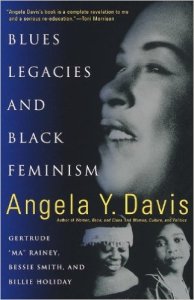 Black women musicians’ use of sound to negotiate gender norms and respectability politics is a centuries-old tradition. Angela Davis discusses the negotiations of Blues women in Blues Legacies & Black Feminism (1998), and Shana Redmond’s recent article “This Safer Space: Janelle Monae’s ‘Cold War’” reviews these traditions as they are relevant for black women pop musicians in the US. While there are many black femme musicians doing this work in queer subcultures and subgenres, I want to focus here on how this work appears within the Top 40, right alongside all these white post-feminist pop songs I talked about in my earlier post because such musical performances illustrate how black women negotiate hegemonic femininities in mainstream spaces.
As America’s post-identity white supremacist patriarchy conditionally and instrumentally includes people of color in privileged spaces, it demands “normal” gender and sexuality performances for the most legibly feminine women of color as the price of admission. As long as black women don’t express or evoke any ratchetness–any potential for blackness to destabilize cisbinary gender and hetero/homonormativity, to make gender and sexuality transitional–their expressions of sexuality and sexual agency fit with multi-racial white supremacist patriarchy.
It is in this complicated context that I situate Nicki Minaj’s (and in my next post Beyoncé’s and Missy Elliott’s) recent uses of sound and their bodies as instruments to generate sounds. If, as I argued in my previous post, the verbal and visual content of post-feminist pop songs and videos is thought to “politically” (i.e., formally, before the law) emancipate women while the sounds perform the ongoing work of white supremacist patriarchy, the songs I will discuss use sounds to perform alternative practices of emancipation. I’m arguing that white bourgeois post-feminism presents black women musicians with new variations on well-worn ideas and practices designed to oppress black women by placing them in racialized, gendered double-binds.
 For example, post-feminism transforms the well-worn virgin/whore dichotomy, which traditionally frames sexual respectability as a matter of chastity and purity (which, as Richard Dyer and others have argued, connotes racial whiteness), into a subject/object dichotomy. This dichotomy frames sexual respectability as a matter of agency and self-ownership (“good” women have agency over their sexuality; “bad” women are mere objects for others). As Cheryl Harris argues, ownership both discursively connotes and legally denotes racial whiteness. Combine the whiteness of self-ownership with well-established stereotypes about black women’s hypersexuality, and the post-feminist demand for sexual self-ownership puts black women in a catch-22: meeting the new post-feminist gender norm for femininity also means embodying old derogatory stereotypes.
I think of the three songs (“Anaconda,” “WTF,” and “Drunk in Love”) as adapting performance traditions to contemporary contexts. First, they are part of what both Ashton Crawley and Shakira Holt identify as the shouting tradition, which, as Holt explains, is a worship practice that “can include clapping, dancing, pacing, running, rocking, fainting, as well as using the voice in speaking, singing, laughing, weeping, yelling, and moaning.” She continues, arguing that “shouting…is also a binary-breaking performance which confounds—if only fleetingly—the divisions which have so often oppressed, menaced, and harmed them.” These vocal performances apply the shouting tradition’s combination of the choreographic and the sonic and binary-confounding tactics to queer listening and vocal performance strategies.
Francesca Royster identifies such strategies in both Michael Jackson’s work and her audition of it. According to Royster, Jackson’s use of non-verbal sounds produces an erotics that exceeds the cisheteronormative bounds of his songs’ lyrics. They were what allowed her, as a queer teenager, to identify with a love song that otherwise excluded her:
in the moments when he didn’t use words, ‘ch ch huhs,’ the ‘oohs,’ and the ‘hee hee hee hee hees’…I ignored the romantic stories of the lyrics and focused on the sounds, the timbre of his voice and the pauses in between. listening to those nonverbal moments–the murmured opening of “Don’t Stop Till You Get Enough,” or his sobbed breakdown at the end of “She’s Out of My Life,’ I discovered the erotic (117).
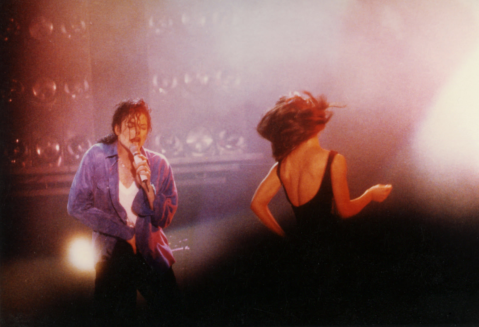
“Michael Jackson” by Flickr user Daniele Dalledonne, CC BY-SA 2.0
Royster references a black sexual politics in line with Audre Lorde’s notion of the erotic in “The Uses of the Erotic,” which is bodily pleasure informed by the implicit and explicit knowledges learned through lived experience on the margins of the “European-American male tradition” (54), and best expressed in the phrase “it feels right to me” (54). Lorde’s erotic is a script for knowing and feeling that doesn’t require us to adopt white supremacist gender and sexual identities to play along. Royster calls on this idea when she argues that Jackson’s non-verbal sounds–his use of timbre, rhythm, articulation, pitch–impart erotic experiences and gendered performances that can veer off the trite boy-meets-girl-boy-loses-girl stories in his lyrics. “Through his cries, whispers, groans, whines, and grunts, Jackson occupies a third space of gender, one that often undercuts his audience’s expectations of erotic identification” (119). Like shouting, “erotic” self-listening confounds several binaries designed specifically to oppress black women, including subject/object binaries and binary cisheterogender categories.
Nicki Minaj uses extra-verbal sounds as opportunities to feel her singing, rapping, vocalizing body as a source of what Holt calls “sonophilic” pleasure, pleasure that “provide[s] stimulation and identification in the listener” and invites the listener to sing (or shout) along. Minaj is praised for her self-possession when it comes to business or artistry, but such self-possession is condemned or erased entirely when discussing her performances of sexuality. As Treva B. Lindsey argues, “the frequency that Nicki works on is not the easiest frequency for us to wrestle with, because it’s about…whether we can actually tell the difference between self-objectification and self-gratification.’’ Though this frequency may be difficult to parse for ears tempered to rationalize post-feminist assumptions about subjectivity and gender, Minaj uses her signature wide sonic pallette to shift the conversation about subjectivity and gender to frequencies that rationalize alternative assumptions.
In her 2014 hit “Anaconda,” she makes a lot of noises: she laughs, snorts, trills her tongue, inhales with a low creaky sound in the back of her throat, percussively “chyeah”s from her diaphragm,among other sounds. The song’s coda finds her making most of the extraverbal sounds. This segment kicks off with her quasi-sarcastic cackle, which goes from her throat and chest up to resonate in her nasal and sinus cavities. She then ends her verse with a trademark “chyeah,” followed by another cackle. Then Minaj gives a gristly, creaky exhale and inhale, trilling her tongue and then finishing with a few more “chyeah”s. While these sounds do percussive and musical work within the song, we can’t discount the fact that they’re also, well…fun to make. They feel good, freeing even. And given the prominent role the enjoyment of one’s own and other women’s bodies plays in “Anaconda” and throughout Minaj’s ouevre, it makes sense that these sounds are, well, ways that she can go about feelin herself.
Listening to and feeling sonophilic pleasure in sounds she performs, Minaj both complicates post-feminism’s subject/object binaries and rescripts cishetero narratives about sexual pleasure. “Anaconda” flips the script on the misogyny of Sir Mix-a-Lot’s hit “Baby Got Back” by sampling the track and rearticulating cishertero male desire as Nicki’s own erotic. First, instead of accompanying a video about the male gaze, that bass hook now accompanies a video of Nicki’s pleasure in her femme body and the bodies of other black femmes, playing as she touches and admires other women working out with her. Second, Nicki re-scripts the bass line as a syllabification: “dun-da-da-dun-da-dun-da-dun-dun,” which keeps the pattern of accents on 1 and 4, while altering the melody’s pitch and rhythm.
Just as “Anaconda”’s lyrics re-script Mix-A-Lot’s male gaze, so do her sounds. If the original hook sonically orients listeners as cishetero “men” and “women,” Nicki’s vocal performance reorients listeners to create and experience bodily pleasure beyond the “legible” and the scripted. Though the lyrics are clearly about sexual pleasure, the sonic expression or representation of that pleasure–i.e., the performer’s pleasure in hearing/feeling herself make all these extraverbal sounds–makes it physically manifest in ways that aren’t conventionally understood as sexual or gendered. Because it veers off white ciseterogendered scripts about both gender and agency, Minaj’s performance of sonophilia is an instance of what L.H. Stallings calls hip hop’s “ratchet imagination.” This imagination is ignited by black women’s dance aesthetics, wherein “black women with various gender performances and sexual identities within the club, on stage and off, whose bodies and actions elicit new performances of black masculinity” renders both gender and subject/object binaries “transitional” (138).
Nicki isn’t the only black woman rapper to use extra-verbal vocal sounds to re-script gendered bodily pleasure. In my next post, I’ll look at Beyoncé and Missy Elliot’s use of extra-vocal sounds to stretch beyond post-feminism pop’s boundaries.
—
Featured image: screenshot from “Anaconda” music video
—
Robin James is Associate Professor of Philosophy at UNC Charlotte. She is author of two books: Resilience & Melancholy: pop music, feminism, and neoliberalism, published by Zer0 books last year, and The Conjectural Body: gender, race and the philosophy of music was published by Lexington Books in 2010. Her work on feminism, race, contemporary continental philosophy, pop music, and sound studies has appeared in The New Inquiry, Hypatia, differences, Contemporary Aesthetics, and the Journal of Popular Music Studies. She is also a digital sound artist and musician. She blogs at its-her-factory.com and is a regular contributor to Cyborgology.
—
 REWIND! . . .If you liked this post, you may also dig:
“I Love to Praise His Name”: Shouting as Feminine Disruption, Public Ecstasy, and Audio-Visual Pleasure–Shakira Holt
Music Meant to Make You Move: Considering the Aural Kinesthetic–Imani Kai Johnson
Something’s Got a Hold on Me: ‘Lingering Whispers’ of the Atlantic Slave Trade in Ghana–Sionne Neely
Share this:


Current Top Posts





April 2021

January 2020

November 2019

October 2019

August 2019

April 2014

November 2017

March 2015

December 2017

October 2015
 Sounding Out!
Recent Comments