
to follow an invisible creek: in search of a decolonial soundwalk praxis

i begin with an acknowledgement of the myriad of organizers, scholars, artists, and teachers that have shaped and continue to shape the way that i think and write. Édouard Glissant, Christina Sharpe, Lucille Clifton, Saidiya Hartman, Fred Moten, Sylvia Wynter, Katherine McKittrick, Dionne Brand, June Jordan, and Audre Lorde. it is through their profound reflections on questions of Blackness, place, belonging, earth, and love, that i have found meaning in and context for what follows.
—
in the context of the rapid rise of big tech in san francisco, california, the perspective of land as perpetually exploitable is ever-present. tech-sponsored development projects are always framed by the city as being motivated by care and consideration for residents, and sometimes as being motivated by environmentalism. in reality, the displacement and destruction that results from projects like these falls primarily on poor people of color, and their homes, gardens, businesses, community spaces, and schools. similarly, large-scale development projects more often than not have devastating impacts on the land – whether it’s the land that’s being built over or the sacrifice zone elsewhere. perhaps the electric cars of san francisco are thought to represent clean energy and a healthy modern city, but the manufacturing of these cars is predicated upon extensive mining and exploitative and extractive labor outside far outside the city’s borders. and these cars drive over flattened creeks and sand dunes turned to asphalt—through gentrified neighborhoods on stolen land of the Ramaytush Ohlone, people who are still alive and fighting for sovereignty on their traditional territory, and who remain stewards of the land.
these disparities are present in the sounds of the bay area. sound, quite literally, does not exist in a vacuum. the presence of sound thus implies the presence of something outside of that sound; in every sound we hear, there is also information about the context that surrounds it. and the sounds that we do hear say something about the value of the sounds that we don’t. however, i want to argue for a soundwalking praxis that does not settle for the sounds that most easily reach the ear, as in the freeway noise or the planes passing above or the white people on the street, but that reaches beyond to listen for the negative sonic space that is always present and creating itself in the spaces between what we perceive as audible. in my understanding, this is a practice of giving life to that which capitalism/white supremacy/colonialism renders dead, a practice of centering the life that is otherwise stepped on, forgotten, discarded, silenced. listening for the ecologies of the dispossessed. for proof of life, insisting. this is a decolonial soundwalk praxis.
Allie Martin describes “decolonial soundwalk praxis” as a way of listening that disrupts and disturbs dominant western understandings of sound and space, in “Hearing Change in the Chocolate City: Soundwalking as Black Feminist Method” (2019). to me, it also involves cultivating an embodied practice of centering that life which dominant pedagogies deem less than, exploitable, and extractable. in the specific geographies of the bay area, it has meant that my primary orientation while soundwalking has been to listen for the creek that runs through the land—even when the water runs dry, even when all we can see is an intersection.

the creeks i followed were mostly routed underground, culverted to run under parking lots, freeways, shopping malls, grocery stores, and other urban sites of development. the prioritizing of urban development/renewal/gentrification in the bay area over tending to the ecologies of its creeks points to the place that the land is seen to hold in so-called modern society: as a resource available to exploit as desired, as is convenient for the logistics of capitalist expansion and development. to listen in such a way, for the creek and for other forms of life forced underground and to the margins, requires methods perhaps alternative to the traditional soundwalk. we must renegotiate the categories of sound that are implied in western colonial pedagogies. we must reevaluate what constitutes a “creek sound” or a “nature sound” in the first place.
to listen for the creek when it is covered by concrete necessitates that we reach beyond thinking of a creek as something which exists in and of itself, in isolation.

∼∼∼might the sound of a creek be more than just trickling water falling through rocks? can it not be heard still in the place where it meets the ocean?∼∼∼

∼∼∼or in the rustling of the trees who drink from the same groundwater?∼∼∼
.

∼∼∼couldn’t a creek be heard in a voice that speaks of it, as in a prayer, or a promise, or a song?∼∼∼
.
if we understand space as relational, as Nigel Thrift offers in “Space: The Fundamental Stuff of Human Geography” (96), then perhaps we can reach an imagining of a creek as finding its life everywhere where water is sacred, running freely through the bodies of those that know it is there.
acknowledging the body as the point of contact between the self and the environment is an important part of a decolonial soundwalk praxis. “place is involved with embodiment” Thrift says (103), and in fact, when we truly acknowledge the body, the very boundary between the body and the environment begins to dissipate, because the body itself is constantly a part of place-making processes. if sound is a dimension through which we can understand place, then, similarly, listening for the life insisting in a place is not separate from listening for the people who are in relationship with it.
in my soundwalks, i leaned into the fact that i was experiencing every place principally through my body, and as i became more comfortable recording, i gave myself more permission to allow my experience to be subjective. what i realized is that my subjectivity, my specific presence to my body’s relationship with the places i was in, was an important orientation to be able to embody a decolonial soundwalk praxis – to be able to hear the sounds that otherwise may have been neglected.
∼∼∼while walking along lobos creek trail, for example, i noticed, growing out of the sand, plants that were familiar to me, that i had relationships with. the house finches were chirping, and my footsteps were clear∼∼∼
.
∼∼∼but the plants i recognized were not – could not be – audible to me until i spoke their names and touched their seed pods.∼∼∼
.
∼∼∼i pulled a few pods off a branch and holding them near the microphone i cracked them open, letting the seeds fall into my hands. i listened to the pods split down the middle and drop the seeds, and in their snapping i heard how much tension they were holding.∼∼∼
.
i felt how much strain it must be to make and carry all those seeds, how much release it must be to crack open and spill out of yourself, and i was grateful to bear witness. i held the seeds in my hand and some time later, i gave them to the creek. in allowing myself the trust to follow my body’s intuitive relationship with the given place, i found sounds that i otherwise would not have heard. ultimately, i found a depth of connection to and intimacy with a place that before listening to in this way, i was a stranger to.
the work of giving attention to the sounds that go unheard is necessarily an embodied exercise. it demands relationship and it demands entanglement. it demands crawling inside a mossy culvert to hear the creek talk.
curious to hear how the creek sounded differently in the tunnel, i went off the trail at piedmont park to climb inside the section where the culvert begins. with the dripping, there was a nuance to its rhythm distinct from its sounds outside of the tunnel. i was able to hear, but only by coming inside and joining the creek. we sat there together, in the dark, for a while.
it also meant sawing down a 20-foot-tall agave in order to save the seeds after the 30-something-year-old plant finally bloomed—with bright yellow flowers on branches shaped like coral—and then began to dry out and lean precariously. to keep the other plants safe, and to release some pressure from the agave, we cut its stalk and from it saved its branches, seed pods, and seeds. the pods are now hanging around the garden at the Land of Disturbance and Defiance as art.

i am principally interested in sound because i am interested in love, and when i imagine a decolonial soundwalk praxis, intimacy is surely at the center. this perspective offers a way of learning place from the position of a being who is co-creating it – not as a scientist but as a steward. a decolonial soundwalk praxis complicates traditional soundwalking’s aversion to the body. we cannot exist separate from the sonic space around us anymore than we can exist separately from the ecologies woven into our lives. to touch is to alter, and so the work here is to lean into the inevitability of connection, the impossibility of objectivity. a decolonial soundwalk praxis rejects the extraction of sound as data, pushing us instead to open our bodies/hearts/minds to receive the sounds of a place as the place is receiving us. how might we use sound to remove ourselves from the perspective of the observer? and what kind of responsibility to place does this open up? if we are a part of the places we are in and listening to, then surely we owe them reciprocity, love, conversation, patience; we must listen as we would a relative, a lover, or a friend.

i chose to record my final soundwalk at the garden on walnut and virginia street in berkeley, california, because it is a place that i know well and love dearly and i hoped to center that. the north side of the garden runs alongside strawberry creek.
rather than imposing a plan/route through the garden upon arriving, i allowed my relationship with the land to guide my movement through it. in my final mix, i layered pieces from this soundwalk together with selected excerpts from a meeting i attended with two fellow members of A.G.A.V.E., or Aspiring Gardeners Affirming Vibrant Ecologies (also Aspiring Gardeners Against Violent Extraction).in which we were trying to synthesize a manifesto using notes from previous conversations, itself a process of collective and layered creation. i chose to include portions of our conversation centered around ideas of relationship and care grounded in land, and i chose sounds from the walk that i feel hold in them intimacy and history:
∼∼∼the crows, who we feed every day and who plant seeds for us∼∼∼
∼∼∼the lock, which only those who know the land can open∼∼∼
∼∼∼and the marigolds, which we grow every year and which we harvest for offerings∼∼∼
.
these sounds are proof of relationship. small sounds that are easy enough to forget to hear, but that are important to remember – and so i try, as i would for an invisible creek.
if a decolonial soundwalk praxis is anything, it is that love is listening, and so, my promise to invisible creeks (and all quiet[ed] sounds) everywhere is to lean a little closer,
and feel your whisper on my neck,
and to listen well,
and to take notes,
and to remember,
and to conspire.
—
Featured Image: “California Pepper Tree” by Flickr user baird, CC BY-SA 2.0
—
ameia camielle smith (they/she) is an aspiring gardener, dancer, and writer based in the san francisco bay area (Ohlone land). they are of mixed Afro-Indian ancestry and are greatly shaped by the seeds/shells/lives that exist at the intersection of these diasporas. ameia’s work is anchored in cultural ecologies and Black feminist geographies, and they are most inspired by stories of survival and collaboration between people and plants.
ameia received their B.A in geography from the university of california berkeley in may 2024. they are currently traveling through the southern united states where they are exploring maroon swamp geographies, tracing the steps of Zora Neale Hurston, and listening to the swampy cicada sounds of their childhood in north-central florida.
—

REWIND! . . .If you liked this post, you may also dig:
Flâneuse>La caminanta–Amanda Gutierrez
Unsettling the World Soundscape Project: Soundscapes of Canada and the Politics of Self-Recognition–Mitchell Akiyama
Soundwalking on the Edges: Sound, Safety and Privilege in São Paulo, Brazil—Paola Cossermelli Messina
El Caracol: A Stroll through Space and Time in Mexico City–Anthony Rasmussen
Sonic Connections: Listening for Indigenous Landscapes in Kent Mackenzie’s The Exiles–Laura Sachiko Fugikawa
EPISODE 53: H. Cecilia Suhr’s “From Ancient Soul to Ether”
EPISODE 47: Finding the Lost Sounds of Kaibah–Marcella Ernest
.
Share this:

The “Tribal Drum” of Radio: Gathering Together the Archive of American Indian Radio

Over the next few weeks, Sounding Out! is proud to offer a new Thursday series spotlighting endangered radio archives across the United States, the kind of resources whose recognition and preservation could not only change media history, but also how we conceive of media history – and the voices that belong in it.
Our writers are part of an effort that is historic in its own right, the Radio Preservation Task Force (RPTF), part of the National Recording Reservation Plan at the Library of Congress. Over the past six months, under the guidance of Christopher Sterling (George Washington University) and Josh Shepperd (Catholic University), the RPTF has drawn together more than 120 faculty researchers and advisors from across the country who in turn have spread the word to create a network of more than 270 archives that hold recordings of broadcast radio, with the goal of creating a national inventory of finding aids and encouraging preservation and modernization through digital access.
If you’ve got archival broadcast radio that can’t be got online and maybe nobody even knows about — in any format or genre, national or local, high-powered or low, commercial or college, in a display or a shoebox – then we want you.
The coming months will see a second campaign of archive recruitment – I’ve taken on a role as Network Director to help coordinate that – as the RPTF rolls out a new working association with the American Archives of Public Broadcasting and gears up for a conference at the Library of Congress in early 2016, for which radio historian Michele Hilmes will be the Program Director.
Drawing on this vast effort, SO! will be bringing you stories of gaps in the record, voices we’ve long missed and need to recover, and some we are in danger of losing for good. We begin with a post by Josh Garrett-Davis, a PhD Candidate at Princeton University pursuing unique research into the long-unrecognized and uncatalogued history of Native American broadcasting.
Pursuing that history requires hard work and persistence; it also requires reimagining what counts as an archive in the first place.
— Special Editor Neil Verma
—
Despite dire poverty across most of the archipelago of semi-sovereign Native American land often called “Indian Country,” radio receivers had become a normal part of life there by the Great Depression. For example, as contemporary publications and later memoirs and oral histories reveal, after work hours in the camps of the Indian Emergency Conservation Work program (the Indian CCC) from northern Minnesota to the Southwest and the West Coast, many men and women listened to the wider world—even following Admiral Richard Byrd’s broadcasts from as far away as Little America, Antarctica.
Listeners, yes. But when did Native people take up the means of production, so to speak, and generate broadcasts themselves? In his history of Native radio, Signals in the Air, Michael C. Keith quotes several sources suggesting little sustaining programming existed until the first Native-owned and -oriented station appeared in New Mexico in 1972. As a sort of internal colony of the United States, Indian Country heard only imperial broadcasts for half a century. The “right to establish their own media in their own languages” in addition to “access to all forms of non-indigenous media without discrimination”—as described in the U.N.’s 2007 Declaration on the Rights of Indigenous Peoples—arrived remarkably late, and are still not fully granted to Native people. Quite recent are the 53 stations catering to Indian communities, and vital national programs like Native America Calling.
But Native people did speak and sing over the airwaves in earlier decades. In some cases a direct or indirect archive even exists, and undoubtedly more will emerge as radio archives more generally are preserved and cataloged through efforts such as the Radio Preservation Task Force of the National Recording Preservation Plan. The trouble is that the cumulative archive of early Indian radio has not been identified as a valuable record or really as a coherent archive at all, perhaps due to compounded misconceptions of radio as an inconsequential documentary record, and of American Indians as technological naïfs. In this post I call attention to the scattered fragments of this archive, which should be recognized as an important heritage for the recent progress in Indigenous media, echoing the various ways Native people seized limited opportunities once broadcast technology appeared.
Here is an initial attempt to quilt a few of those pieces into a pattern:
Widespread broadcasting started at about the same moment—the 1920s—as the first agitation toward tribal political sovereignty in the (constrained) twentieth-century sense. In March 1925, the Cayuga statesman Levi General, who held the ceremonial title Deskaheh, delivered an address from a Rochester, New York, studio. As transcribed in the Haudenosaunee (Iroquois Confederacy)–produced book A Basic Call to Consciousness, he began, “Nearly everyone who is listening to me is a pale face, I suppose,” and went on to appeal to those palefaces for Iroquois sovereignty on land that, like his radio signal, straddled the Canada–U.S. border (18). He urged his listeners to write to representatives in both governments and “ask them to tell you when and how they got the right to govern people who have no part in your government and do not live in your country but live in their own” (22). General certainly grasped the democratic and transnational possibilities of the new medium as he spoke directly to the citizens of two newcomer nations and plainly described to them a Haudenosaunee sovereignty that must have seemed radical.
Around the same time, the Yakama/Cherokee singer Kiutus Tecumseh (aka Herman Roberts) used his celebrity to perform on radio stations across the country, adding political commentary on Indian policy between songs. Often the songs he performed were Indianist compositions by non-Indian composers; Tecumseh was, in historian John Troutman’s words, “‘playing Indian’ with a pointed, political message” (250). Ojibwe bass singer Chief Roaring Thunder (aka George LaMotte), meanwhile, performed on KVOO from Tulsa in the 1920s, as mentioned in the contemporary press.
So far no audio transcriptions of any of these pioneering broadcasts have turned up, though in the 1970s the publication Akwesasne Notes produced a reenactment of General’s address and sold it on reel-to-reel, cassette, and cartridge.
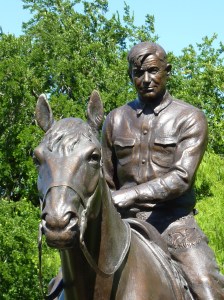
“Soapsuds and Will Rogers” by Flickr user Granger Meador, CC BY-NC 2.0
One Native radio voice of whom an audio archive remains is the humorist Will Rogers (Cherokee). Historians Lary May and Amy M. Ware have convincingly argued that Rogers espoused Cherokee values—which informed his communitarian politics—and sometimes advocated directly on Native issues. Part of the task of creating and preserving an Indigenous media archive is to recognize Rogers’s place in a genealogy: He united oratory like Levi General’s with the vaudeville sensibility of Kiutus Tecumseh and Chief Roaring Thunder. (Rogers could also stand in for a number of mainstream performers whose Indian heritage was not widely recognized, from Lee Wiley to Hank Williams to Jimi Hendrix.)
World War II brought about vast changes in Indian Country, including increased exposure on the air. Great numbers of Native people served in the war effort—notably, in terms of radio, the Navajo and Comanche “code talkers.” But back home, the first sustained radio program, aptly named the Indians for Indians hour, began in 1941 on WNAD in Norman, Oklahoma. Don Whistler (aka Kesh-Ke-Kosh), the first Sac and Fox chief elected under the reforms of the “Indian New Deal,” created the show as a model of participatory programming and (fortunately for later generations) recorded more than a hundred programs on acetate discs before he died in 1951. Indians for Indians, which served and drew performers from perhaps twenty tribal communities and several Indian boarding schools in Oklahoma, persisted in various forms until the 1980s. The only show available online is one from 1976.
I have listened to most of the extant shows from the first decade—which are not endangered except insofar as they have been ignored—and it is a remarkable institution that adopted Will Rogers’s humor and brio while also foreshadowing the vibrant Native radio networks of today.
Archives are more scarce from elsewhere in Indian Country, but traces endure in archives and history books: The renowned Chiricahua Apache artist Allan Houser performed on the air in New Mexico as “the Apache Kid.” In the 1930s and ’40s, students from Santa Fe Indian School and Flandreau Indian School performed on radio shows in Santa Fe and Omaha, respectively. I have not found any recordings of any of these instances, but a few audio archives suggest transcriptions yet to surface: A Tuscarora farm family can be heard singing “By the Waters of the Minnetonka” on Major Bowes and His Amateur Hour on NBC in 1935. NBC also covered an American Indian Exposition and the Flagstaff All-Indian Powwow in the ’30s, which gave Native singers and speakers a national hearing. A non-Indian couple recorded Hopi and Zuni singers on an unidentified station in 1955 and 1956 from Parks, Arizona, a tape which was dubbed by an anthropologist and deposited in the Archives of Traditional Music at Indiana University.
There must be many other fragments, and we can hope that broad efforts like the Radio Preservation Task Force—as well as archival efforts originating among Indigenous organizations like Native Public Media, Koahnic Broadcast Corporation, Native Media Resource Center, and Vision Maker Media—could turn up records of them.
Marshall McLuhan once wrote ominously of the “tribal drum of radio” leading the masses to totalitarianism. But that message, like the medium itself, could be interpreted in a much more constructive sense. When we gather together the early history of Native radio and assemble the intertribal quilt proposed above, the product seems to squarely refute the racial logic McLuhan implied. We may find instead that Indian people themselves recognized right away the importance this “drum” could and would have for maintaining vibrant language, musical, and oral traditions in the face of colonialism.
The Red Power movement is generally thought to begin with the occupation of Alcatraz Island in 1969–71. Part of that action was the Santee Dakota poet and activist John Trudell’s creation, “Radio Free Alcatraz” on KPFA in Berkeley, California. We might hear these programs (preserved in the Pacifica Network’s archives) as heralding a new era of reservation stations and media advocacy by Native people. We could also hear them as descending from efforts—still unrecognized and uncatalogued—by Native innovators over the previous half century.
—
Josh Garrett-Davis is a PhD candidate in history at Princeton University. His dissertation, “Resounding Voices: American Indians and Audio Technology, 1890–1969,” examines Native American use of phonograph and radio technology from the earliest ethnographic and commercial phonograph records to the founding of Indian-run labels and radio shows in the mid-twentieth century. He is the author of Ghost Dances: Proving Up on the Great Plains (Little, Brown, 2012), and a member of the collective M12, which promotes and creates art in rural places.
—
 REWIND! . . .If you liked this post, you may also dig:
A Tribe Called Red Remixes Sonic Stereotypes— Christina Giacona
Chicana Radio Activists and the Sounds of Chicana Feminisms — Monica De La Torre
Radio de Acción: Violent Circuits, Contentious Voices: Caribbean Radio Histories— Alejandra Bronfman
__
__
Special thanks to Daniel Murphy for the RPTF Logo.
Share this:


Current Top Posts





April 2021

January 2020

November 2019

October 2019

August 2019

April 2014

November 2017

March 2015

December 2017

October 2015
 Sounding Out!
Recent Comments