
LMGM’s “Lost: Choirboy” & El Jefe’s “Muñoz & La Mission: A Sermon. . .” (in memoriam José Esteban Muñoz)

 Come, let us sing of great men. Well, just one man, not men—and masculine gender is not essential for our purposes. Come to think of it, his greatness isn’t nearly as important as his fierceness, his queer significance, his brown sensibility. But we’re still committed to singing—or at least to music—well, to sound and noise, in any case. José Esteban Muñoz often wrote about queer scenes where music and sound were central to participants’ world-making activities. His archives buzzed with the sounds of West Coast punk, vogue-ball house, cruisy toilets, genderqueer burlesque, and salsa echoing down the barrio streets. And so, for this Round Circle of Resonance, we at La Mission are here to make some noise about a badass thinker who deeply impacted the way we dance/sing/talk/write/sweat about dance music, identity, and politics.
And this is just the beginning of our cacophonous, four-part response to Muñoz’s intellectual holler. The first installment, written by La Mission’s resident essayist / deranged propagandist LMGM (Luis-Manuel Garcia) provides a brief introduction to our collective, some reflections on Muñoz’s relevance to our activities, and a frame for the next three missives from our fellow cultists. It is backed with a rousing sermon-cum-manifesto from our charismatic cult-leader/prophet, El Jefe (Pablo Roman-Alcalá). In the coming weeks, our Naked Mennonite/randy dramaturge (Mandie O’Connell) will prepare and film a urinary performance piece; and our saucy Choir Boy/Linguist (Johannes Brandis) will compose a dirge to our dearly departed José (August 9, 1967- December, 4, 2013).
LMGM a.k.a. Luis-Manuel Garcia
—
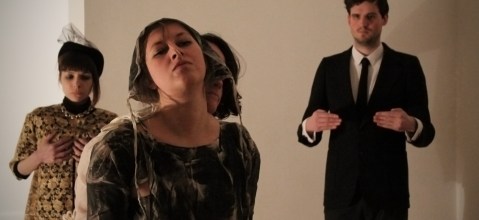
La Mission’s “(p/A)001: A non-Aristotelian Drama in Five Acts,” 2013, Image by Julien Barret
Lost: Choirboy (in memoriam José Esteban Muñoz)
La Mission
Named after San Francisco’s Latino barrio, La Mission is a satirical utopian doomsday cult, a music label, a queer situationist art-gang, a magazine, and a group of dancers with a very dirty sense of humor. We release music on vinyl, publish DIY ‘zines, and make performance art, aiming to re-politicize genres of dance music that have been important to queer people of color. La Mission’s identity is perhaps best summed up by cult-leader El Jefe’s manifesto-sermon, “The Sermon for the Steps of the Ziggurat in our Hearts,” published in our first La Mission magazine:
La Mission is a Community. La Mission is a Collective. La Mission is a Cult. La Mission is a Situationist Art Gang. La Mission is a Anarcho-Syndicalist terror cell. La Mission is a Family. La Mission is You. La Mission is Us. La Mission is gonna strip you butt nekkid, gonna check all your body cavities, gonna give you a shower, gonna give you a goodie bag, gonna give you a clean sheet and a towel. You at home with us now children, you understand me? You home with us now.

Founders Luis-Manuel, Pablo, and Mandie, caught on film at the performance for LM002, ‘a slow mutiny.'”
La Mission was first formed in 2012, in a small café in the Neukölln district of Berlin. The collective initially began with just three of us—Pablo Roman-Alcalá, Mandie O’Connell and Luis-Manuel Garcia—but like any good charismatic doomsday cult, it quickly expanded to include a broad network of lovers and collaborators, led by a core of four instigators (Johannes Brandis joined us later in the year). After a fundraising run in the fall of 2012 (witness our surrealist fundraising video here), we held our first two performances in the winter and spring of 2013, which involved experimental performance art pieces held in unusual spaces. The performances incorporated music and text from our vinyl EPs and their corresponding ‘zines, which were released at around the same time. These multi-channel productions were also conceptually coherent, with (kunst/WORK)001 introducing La Mission’s “mission” and (kunst/WORK)002 focusing on the relevance of utopianism to dance music. After a “quiet spell” where we released an out-of-series vinyl record of “lost remixes,” 2014 has been dedicated to preparing the next volume in the series (due in February 2015), which examines the depredations of capitalism, forced austerity, and false scarcity on music.
Hearing José
La Mission has no idols, but we do have influences—and José Esteban Muñoz is foremost among them. We share with Muñoz a focus on queer nightlife-worlds, a non-classical take on utopianism, a commitment to intellectual interventions outside of academic channels, and a certain brassy tone of voice. His revival of Ernst Bloch’s notion of a utopia based in real-life struggles was crucial in helping us reconcile revolutionary politics with dancefloor utopianism; or, put differently, Muñoz helped us find the critical politics latent in the queer, brown, sweaty gatherings that form the core of our scene of commitment. As “EDM” continues to blow up into a primarily white, hetero, cis, mainstream phenomenon, his insights have helped us maintain clarity and critical focus.
From the outset, we have also been profoundly influenced by Muñoz’s lifelong theorizations of brownness, affect, and (dis)identification. Since three of our four core members are Latina/os in varying states of stripped identity, we have been especially interested in Muñoz’s notion of the “brown commons,” as he was developing the concept in the last years of his life. In promotional texts that circulated ahead of his speaking engagements on the topic, he described brownness as “an expansive sense of the world, a feeling and being in common that surpasses the limits of the individual and the subject.” Notably, he understands brownness and the brown commons as being shaped not only by suffering and struggle, but also by thriving, providing a pool of resources for a better, more vibrant kind of life.
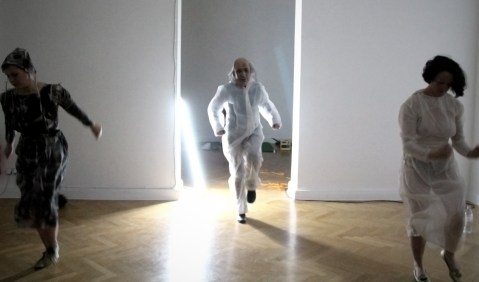
La Mission, (p/A)001: A non-Aristotelian Drama in Five Acts, 2013, Image by Julien Barret
The significance for La Mission’s project in dance music culture should be clear already, but we also take great inspiration in how Muñoz developed an expansive view of brownness and the brown commons, using Latina/o experience as an entry-point for “a vaster consideration of the ways in which people and things suffer and experience harm under the duress of local and global forces that attempt to diminish their vitality and degrade their value.” We here at La Mission are committed to exploring brownness for its potentials for lateral solidarities among people of color, who may have diverse cultural backgrounds but nonetheless share post-migrant experiences of struggle, devaluation, displacement, and inauthenticity. In fact, Muñoz’s work was a direct inspiration for the “Brown Corner” in our La Mission ‘zine (a parody of the “ladies’ corner” and “kid’s corner” of American mid-century lifestyle magazines). Published bilingually and featuring post-migrant authors, the Brown Corner reflects on aspects of brownness, as both specific to their contexts and generalizable to a wider “commons” of brown experience. In the process, we hope to highlight shared feelings, narratives, and resources for brown survival in a world of white supremacy.

A hand-drawn re-working of Frieda Kahlo’s own self-portrait, part of the Brown Corner for issue 001 of the La Mission ‘zine.
Singing into the Horizon
Brother Muñoz, what are we supposed to do with the vinyl records, the zines, the performance videos we had been accumulating for you? We’re trying to sing our way into a queer utopian horizon, and we had been counting on your voice. We know you’re not coming back. As a radical lefty utopian doomsday cult, we’re not so invested in the afterlife, anyway. But it still sucks for us and everyone else you left behind, left in the “here and now” that we struggle to turn into something less suffocating. The party was just getting started, dammit. Besides, we had such a kickass choirboy outfit picked out for you.
—
LUIS-MANUEL GARCIA aka “LMGM”: LMGM/Luis-ManuelLMGM/Luis-Manuel is a Canadian of Peruvian-Colombian origins, currently an Assistant Professor in Popular Music at the University of Groningen (NL), after migrating between Toronto, Berlin, Chicago, and Paris. He has managed to turn his love of electronic dance music into a PhD in Ethnomusicology at the University of Chicago, and into post-doctoral fellowships at the Max Planck Institute for Human Development and the Freie Universität Berlin. On the side, he writes about food and dances every chance he gets.
—

“Portrait of La Mission” by Ben Hammond, who has not seen any of its members naked
Muñoz & La Mission: A Sermon for the Imagined Sanctuary We Built Together
Welcome. La Mission is a family. A family of chosen comrades, chosen brethren, chosen hermanos, chosen сестры, chosen lovers, chosen students, chosen teachers, and chosen arms. Arms, linked and brandished through common thought, common feeling, common goals. It is with a heavy heart that we find ourselves here, remembering one of our family who (though never officially an acolyte or collaborator) was one who contributed to the ecstasy that we have felt and will feel for many years. José Esteban Muñoz was said to be a believer. Ernst Bloch and the New Revolutionary Epoch. Our utopias were described and imagined and realized and experienced. Rise up, my brown brethren, and let us celebrate Brother Muñoz’s legacy!

La Mission’s “(p/A)001: A non-Aristotelian Drama in Five Acts,” 2013, Image by Julien Barnet
The words and deeds of this fellow freedom-fighter, who infiltrated the bourgeois güero academy and infected it with a polylateral program for de- and reprogramming, has been our parallel and our inspiration. Colleague and comrade. A representative of our struggle. Not quite a patron saint—that honor we’ve reserved for communarde Louise Michel—but no less a visionary. As queers, as minorities stripped of identity, as angry and happy children in revolt for something better, we must all learn from each other as equals.
Brother Muñoz made utopia political again and located that utopianism in performance. La Mission’s performances bring forth utopias from our queer future through fleeting mindfuck happenings in the present. Through the work of Sister O’Connell and her band of terrorizing miscreants, we present a non-narrative and non-paternalistic path towards redemption, one of our own making. Can I get a “Fuck, yeah!”?

La Mission at Import Projects, 2013
Brother Muñoz loved music and dancing and life-worlds connected by the beat and said, “Take Ecstasy with Me.” He revealed to us the connections between collective dancing and feeling utopian. In his spirit, La Mission’s music strives to bring forth utopia through that ever-lasting beat. Through disassociation and reassociation, through transcendental repetition, and through getting the fuck down! Can I get a “Fuck, yeah!”?
Brother Muñoz believed in learning and critical thinking. Analysis and the great revolutionary trek through the jungle of our critically thinking minds. La Mission’s tracts enact utopia through a constant vomiting out of our recently digested learnings into the baby-bird mouths of those who read them. The brother was also a hilarious motherfucker, and from this we realize that it is not through the shrill screams of egoism disguised as activism that we will prevail. It is through the joy of laughter combined with thought that we will win our bread. Can I get a “Fuck, yeah!”?
Brother Muñoz loved fucking. La Mission’s fucking creates utopias through the ecstatic act in and of itself. If you aint fucking to make yourself a Temporary Autonomous Zone of happiness, then you aint doing it right. Can I get a copulatory “Fuck, yeah!”?
It is not all loss, though. The ideas live on. Caminamos juntos. On the dancefloor. In the reclaimed Torre David skyscraper and the Taller Tupac Amaru collective; in the informal classrooms and the sweaty bedrooms. Our hearts must burst after sagging, our heads must fill after hanging low, and our linked arms will raise! Oh honey, please don’t give your heart to a world system based on exploitation of the luckless, give your heart to US!
—

La Mission at Import Projects, Common Revilings Project, 2013, Image by Julien Barrat
—
All images courtesy of La Mission
—
PABLO ROMAN-ALCALA: Yo. I am Pablo aka “Beaner” aka “Skirtchaser” aka “El Frijolero” etc. I am an internationally working musician and dj who has enjoyed a modicum of success, but who doesn’t like what has happened to the musical landscape vis-a-vis “conservatism” in respect to both Money and Art. I mean the relationship of the two, okay? It sucks. And I want to change it.
—
 REWIND!…If you liked this post, check out:
Karaoke and Ventriloquism: Echoes and Divergences–Karen Tongson and Sarah Kessler
Freedom Back: Sounding Black Feminist History, Courtesy the Artists– Tavia Nyong’o
“New Wave Saved My Life*”-Wanda Alarcon
Share this:

“Sound Studies: A Discipline?”: Sound Signatures Winter School, Amsterdam, January 2014
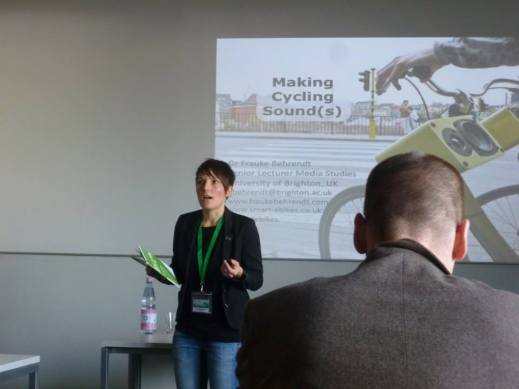
Has the ever-nascent field of sound studies finally “grown up”? After years of intellectual development and a constantly growing body of work, including quite a few classic texts and books, it has been rapidly establishing an identity of its own, independent from the many “parent” disciplines from which it originated. As with any teenager, this process of maturation comes with a dose of self-searching and, indeed, some navel-gazing. But are we ready to acknowledge sound studies as its own discipline?
At the first conference of the European Sound Studies Organization (ESSA) in Berlin in October 2013, a heated debate followed an otherwise routine announcement. The preliminary title for the second installment of the conference: “Sound Studies: A Discipline?” was not going to make it to Copenhagen in June 2014. Although the question mark suggested playfulness, many audience members either did not like the idea of an entire conference devoted to the meta-discussion on the pros and cons of interdisciplinarity or were not prepared to consider sound studies as a discipline at the first place.
Eventually, the Copenhagen conference was safely re-named “Sound Studies: Mapping the Field.” The discussion in Berlin however, continued at the opening session of the Sound Signatures Winter School in Amsterdam in early 2014. Co-organizer Mara Mills asked whether the publication of such anthologies as The Sound Studies Reader in 2012 and The Oxford Handbook of Sound Studies in 2013 meant that sound studies was a proper discipline. Is it, she asked, moving away from its roots as an interdisciplinary field consisting of displaced scholars formerly unable to tackle questions of sound within the confines of their traditional disciplines? The ensuing five days of the Winter School answered Mill’s question in a rather fittingly ambiguous way. The question remains: “Sound Studies: A Discipline?” Well, yes and no.

Hearing, public domain
One of the most significant conclusions of the Winter School’s thought-provoking workshops, keynotes, performances and debates was phrased by co-organizer Carolyn Birdsall during the final discussion on Friday afternoon; she had come to realize that sound studies and its older, more distinguished, but often somewhat stale brother musicology are not the adversaries one is often led to believe. A musicologist by training, I have always found sound studies’ habit of explicitly not dealing with music (in conjunction with its sometimes disproportionate focus on sound art) a little tiresome; and what these five intensive days in Amsterdam convincingly showed, among other things, was that the older brother and its younger sibling can be rather complimentary.

Manuscript of Bach’s Lute Suite in G minor, public domain
Of course, the traditional objects and methods of the discipline of musicology—in its most dusty and clichéd form studying black dots written on paper by great men—have long been what sound studies scholars avoided. In the late 1980’s, however, musicology already started moving away from this stereotype by incorporating more critical methodologies and broadening its scope. Moreover, ethno- or cultural- musicologists have been breaking the armor of Eurocentrism in mainstream musicology. Now, with the steady rise of sound studies’ academic momentum, musicology is even giving up its intellectual monopoly on determining what does and what does not count as relevant research on music. The highly interdisciplinary body of knowledge developed in this mature sound studies can indeed be very useful in more conventional musicological research; likewise sound studies benefits from work conducted within the disciplinary confines of musicology.
At the Winter School, a prime example of such an exchange was Julia Kursell’s keynote lecture “Motor Media: On Aural Feedback in the History of Musical Instrument Playing.” Focusing on the experiments of nineteenth-century French pianist and teacher Marie Jaëll, Kursell showed how, prior to the advent of recording technology, musical instruments like the piano offered valuable points of entry into the world of sound and hearing. The piano-keyboard, Kursell argued, was not just a site of aesthetic, musical development, but was also employed as an epistemological tool in itself. Moreover, studying such historical cases also opens the door for broader questions engaging musicology, sound studies and science and technology studies.This interdisciplinary overlap allows for discussions of the body politics of music teaching as well as the didactics of a specific aesthetic regime in a particular social milieu.

Frances Densmore recording Mountain Chief, 1916, public domain
Other sessions that explicitly dealt with music included Stephen Amico’s lecture combining sound studies, media studies and the “discipline formerly known as ethnomusicology” to discuss ethical difficulties facing ethnographic sound archivists. This discussion about the ownership and right of use of the recordings in such archives was among the most refreshing and timely raised through the week. On a much lighter note, Ashley Burgoyne’s Workshop “What Can You Learn from a Music Game?” represented yet another rapidly developing interdisciplinary field of music research: the study of music cognition.
Recently, after returning from the aforementioned ESSA conference in Copenhagen, Marcel Cobussen predicted in a Facebook update that “in 10-15 years from now, musicology will be a subspecies of sound studies.” He might be right, but rather than a “sub-discipline,” why not envision a continuum from “old-fashioned” musicology, via the much broader field of music studies towards the broader field of sound studies. As such, sound studies would maintain its interdisciplinary status as a field, rather than a discipline, allowing for engagement with the knowledge that has been produced and is still produced in musicology proper and music studies more generally.
It is up to a new generation, raised as sound studies natives, to further the developments toward such an exchange of scholarship. Judging by the presentations, workshops, performances, and most tellingly, student presentations, during these five days in Amsterdam, this will undoubtedly happen. Notwithstanding the very broad scope of topics and approaches, backgrounds and interests, among participants and presenters there was the tacit acknowledgement of communality in the one thing they all shared: a profound interest in sound in the broadest sense of the word that needed very little justification. Initiatives like this Winter School and its upcoming second installment in the form of a Summer School in Berlin leave one with an optimistic outset of the intellectual potential of the young field of sound studies; it forges interdisciplinary connections by virtue of the common interest in an object–sound–that is simultaneously a very specific and seemingly endless scope of scholarly possibilities.

“Sound Scape” by Flickr user Kent Yoshimura, CC BY-NC-SA 2.0
Perhaps the most telling example of this bright future was the fact that the keynote by Jonathan Sterne, without question the week’s big star, author of one of the founding books in the field, was a nice historical overview of the concept of the “soundscape,” although offering few new insights or questions. If anything, this unusually low-key performance from a very impressive scholar, underlined the most inspiring aspect of the Sound Signatures Winter School: there is still much to be done, and, as this very blog has been consistently showing since 2009, a new generation of sound scholars is already doing it. Therefore, I am looking forward to hearing our next generation of scholars weighing in on the question: “Sound Studies: A Discipline?” in the forthcoming discussion in Berlin. With an impressive, diverse and exciting program I’m sure I won’t be disappointed.
—
Melle Jan Kromhout is PhD-Fellow at the Amsterdam School for Cultural Analysis, University of Amsterdam. His research project entitled “Noise Identities” focuses on the revaluation of noise in recorded sound and music. The project aims to develop noise identities as a concept for assessing the relation between recording media and musical significance. He presented his work at conferences around the globe and published several articles including “‘Over the Ruined Factory There’s a Funny Noise’: Throbbing Gristle and the mediatized roots of noise in/as music” (2011), “As Distant and Close as Can Be. Lo-fi Recording: Site-specificity and (In)authenticity” (2012), “An Exceptional Purity of Sound: Noise Reduction Technology and the Inevitable Noise of Sound Recording” (2014) and “’Antennas Have Long Since Invaded Our Brains’: Listening to the ‘Other Music’ in Friedrich Kittler” (forthcoming, 2015). More information on www.mellekromhout.nl
—
Featured image: Carla Müller-Schulzke opening the first ESSA conference in Berlin, October 2013, by Jennifer Stoever, CC BY-SA 3.0
—
 REWIND! . . .If you liked this post, you may also dig:
Functional Sound (Studies): The First European Sound Studies Association Meeting— Erik Granly Jensen
“Once the word ‘sound’ was in the title, it opened up a kind of door”: A Conversation with Eric Weisbard— Liana Silva-Ford
“Sound at AMS/SEM/SMT 2012”— Bill Bahng Boyer
Share this:


Current Top Posts





April 2021

January 2020

November 2019

October 2019

August 2019

April 2014

November 2017

March 2015

December 2017

October 2015
 Sounding Out!
Recent Comments