
“You’re. . .#noangel. . . either”: Uneasy Politics and Dissonant Sonics in Beyoncé’s “No Angel”
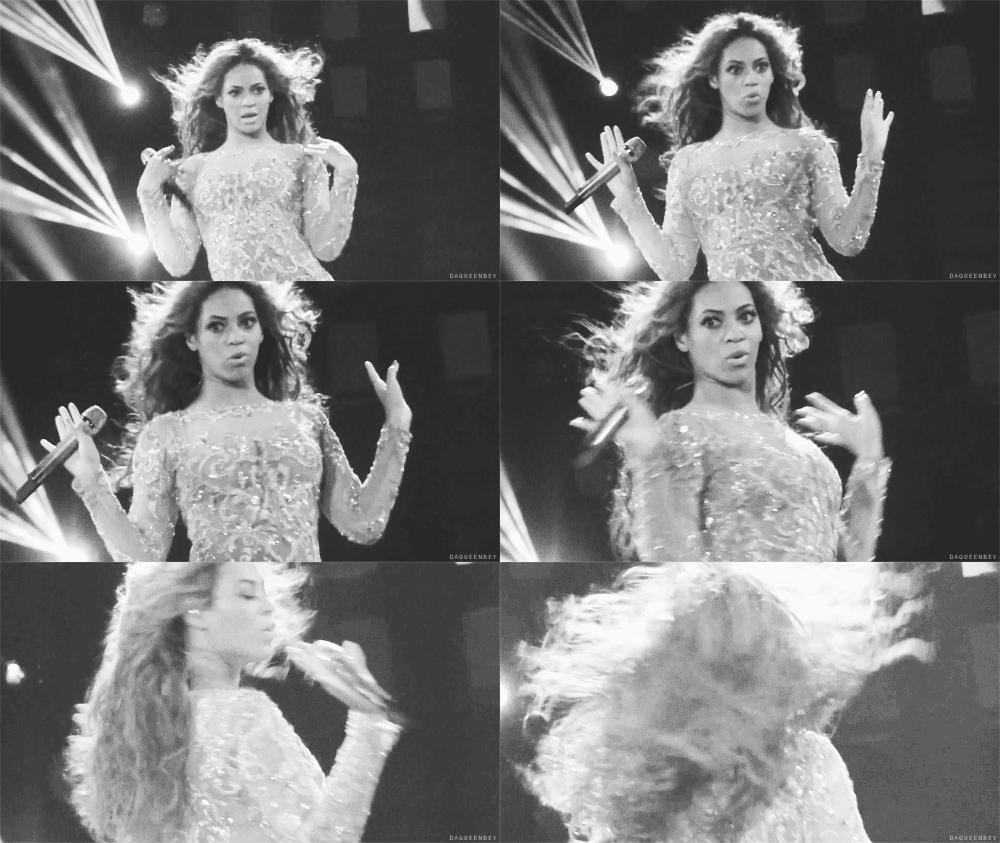

This September, Sounding Out! challenged a #flawless group of scholars and critics to give Beyoncé Knowles-Carter a close listen, re-examining the complex relationship between her audio and visuals and amplifying what goes unheard, even as her every move–whether on MTV or in that damn elevator–faces intense scrutiny. In the coming Mondays, you will hear from Priscilla Peña Ovalle (English, University of Oregon), Liana Silva (Editor, Women in Higher Education, Managing Editor, Sounding Out!), Regina Bradley (writer, scholar, and freelance researcher of African American Life and Culture), and Madison Moore (Research Associate in the Department of English at King’s College, University of London and author of How to Be Beyoncé). Today, we #wakeuplikethis with Kevin Allred (Women and Gender Studies, Rutgers), who refuses to let us fast forward past the understated and discomfiting video track “No Angel.”–Editor-in-Chief Jennifer Stoever
—
Michael Brown, an unarmed black teenager, was shot to death by white police officer Darren Wilson in Ferguson, Missouri on August 9, 2014, for no apparent reason [see author’s note below]. While the fact that the death of unarmed black men (and women and trans people) at the hands of those in power is, sadly, no unique occurrence, as Melissa Harris-Perry – among countless others – have pointed out, Brown’s death has sparked nation-wide outrage and protests about police brutality, racial injustice, and severely decreased resources for impoverished communities.
In the New York Times’ reportage on Brown’s death, reporter John Eligon found it appropriate to characterize the teenager as “no angel,” as if any amount of alleged wrongdoing or possible character flaws on Brown’s part somehow justified his murder. Both Eligon and the Times were called out on social media and in traditional publications such as the Atlantic, and, while the press quickly apologized, the phrase’s familiar interpellation of victims – especially when they are people of color – as “no angels” lingered: a journalistic gaze born of sympathy with white authority that invalidates an individual’s life, tarnishes their memory, and even rewrites histories.

A powerful counter discourse challenges these racist narratives, however; one we can hear in the dissonant sonics of Beyoncé Knowles-Carter’s “No Angel,” a song that anticipates–and adamantly refutes–the racist notion that people who live, and quite possibly die as Michael Brown did, are anything but valuable.
Released almost 9 months before Brown was killed, Beyoncé’s “No Angel” cannot explicitly be called a response, but the ghosts of black men–living and dead, unfairly judged and mistreated–haunt the entire song. “No Angel” begins with a slow-burning 4-count beat; a low, synthesized, slightly off-kilter kick drum sets the tone for the song while an eerily-lilting high-pitched synthetic warbling noise simultaneously pours out of the speakers. The sound, reminiscent of feedback, drifts between pitches for four painstakingly slow measures before Beyoncé’s vocals kick in. When they do, what we hear is unusual. Her voice reverberates in a breathy, almost too-high falsetto that sounds nothing like the soaring powerhouse vocals of “Halo” or “I Was Here;” nothing like the precise, punctuated staccato of “Single Ladies” or “Run The World (Girls);” and certainly nothing like any of the other songs on BEYONCÉ. Sonic and musical contradictions abound. Neither the kind of impressive falsetto showing a wide range, nor necessarily immediately pleasing to the ear, Beyoncé’s voice is forced. . .and it haunts. Further, the vocals seem to cut the time signature of the song in half, effectively doubling its pace. Its tempo, cadence and vocal dynamics signal “No Angel” as a very different kind of Beyoncé song, one forwarding a sonic and political statement over radio-readiness.
Admittedly, “No Angel” was not initially one of my favorite songs on Beyoncé’s new album. In fact, when teaching this song, most of my students – even the hardcore Beyoncé fans – admit sheepishly to skipping through it because of a feeling of discomfort mainly related to Beyoncé’s vocal delivery. But after a few listens, something clicks: “No Angel” is not supposed to be pleasant, easy listening, but rather it jars and unsettles, just like the impact of news of another unarmed black person killed by white police. We are neither supposed to immediately identify with the audio of “No Angel,” nor possibly even like it.
All about dissonance, the song’s innovation fuels itself with inconsistency and contradiction. Vocally speaking, there are incongruities between the highs and the lows (the bass and the treble or the bass and the soprano), and the abrupt shifts in pacing—the slow pace both in opposition to and contained within the faster pace of the song. Even the stretched and breathy falsetto Beyoncé puts on for most of the song strikes a dissonant chord. Simply put, dissonance is tension, and neither the sonic nor the political tension ends here.
.
Here’s the thing: we know Beyoncé’s voice doesn’t usually sound like it does on “No Angel.” It is a conscious manipulation. And when coupled with the refrain:
You’re no angel either baby
her voice even becomes a kind of accusation. If Michael Brown is “no angel;” if Beyoncé herself, as the singer and also as a black woman in a racist U.S. society, is also initially “no angel” then, Eligon in the NYT as Brown’s accuser and, by extension, we as the listeners, become “no angel either.” What’s more, Beyoncé ‘s delivery is so deliberately overdone that she can be heard taking deep breaths in between each word of the chorus – something most singers would attempt to hide. Beyoncé chooses instead to push it to the forefront of the recording, audibly projecting each word toward the listener; in effect, slapping us in the face with each syllable, driving that message/accusation straight home.
However, while this forum may be dedicated to the sonic qualities of Beyoncé’s work, I don’t believe we can completely divorce the sonic from the visual for “No Angel,” or anything on BEYONCÉ, as it was specifically marketed and publicized as audio and visual album. BEYONCÉ visual music experience is nothing knew to Beyoncé herself. As far back as Dangerously In Love, Beyoncé forwarded her belief “that harmonies are colors” on an interlude toward the end of the album. For her latest album, she went so far as to strike an exclusive deal with iTunes in which the album was only available as a complete package for the first week of its release – singles could not be purchased separately nor without videos (and vice versa). It would be a disservice to ignore the visual depiction of “No Angel,” directed by @LilInternet and its synaesthetic fusion of sound and sight.

Image by Flickr User Princess Mousy Cards
Just as the sonic qualities of the song provoke discomfort, unexpected imagery confronts the eye. First, the video is quite simply not about Beyoncé. She is rarely shown. Instead, Houston street culture and its struggles and poverty, represented largely through the faces of people of color, takes center stage. The video features mainly black men, although there are some images of black women throughout; a stark moment showing black women– raced and sexualized as “no angels”–working as strippers reveals an industry driven not by the agency/desire of the strippers themselves, but rather by the failures of capitalism that often offer few profitable choices to poor women other than sex work (as evidenced in the highlighting money shots/literal shots of money). But the video celebrates the lives of all theses alleged non-angels by showing small moments of happiness – a father smiling with his son; young boys flashing the peace sign with their fingers; sweet glances between lovers, community members proud to show off their jewelry and cars for the camera–redirecting the viewer’s attention to the structural inequality framing many of the images, provoking more voyeuristic viewers to reflect on their own responsibility and complicity in the systems that create poverty and segregation in the first place. Simultaneously, members of the Houston community–as well as diasporic Houstonians–can see themselves represented, even celebrated in the video, as opposed to the usual cinematic vilification and denigration of these very same bodies as “no angels.” Many Houston hop-hop legends appear in the video as well: Bun B, Scarface, Willie D, Z-Ro, and of course Beyoncé herself.

Still from “No Angel” video
When the camera does linger on Beyoncé, it juxtaposes her iconic image–associated with the wealth and power of her celebrity status–with everyday people of her Houston hometown, including its most impoverished. Beyoncé, the residents, and the city itself stare the viewer down – actively challenging us to see both life and death, both living people and memorials to those, such as Michael Brown, who have died too young. The dissonant tension between life and death, encapsulated in Beyoncé’s voice and the video’s mirroring visuals: the high and the low; the rich and the poor; and the fraught gap in between.
Beyoncé tries to bridge this gap, both visually, through her self-representation in Houston, and sonically, particularly the moment when the refrain “you’re no angel, either. . .baby” finishes and she swings her voice down out of falsetto, into her more powerful full-out throat voice. It is assuredly no coincidence that during those moments she repeats the word “no,” over and over again. With that “no,” she objects to mainstream news vilification, anticipating and objecting to Michael Brown’s characterization as “no angel.” Her voice shifts from the high-falsetto – a sound serving the dual purpose of exposing the above dissonance AND acting as a caress to black communities in Houston, and Ferguson, and on and on – and moves into the heavy throat-voiced complaint and objection. “No, you will not treat my people this way. No, you will not treat ANY people this way,” her sound testifies. And, for viewers not represented in the video, that “you” is them–and she means that realization to feel uncomfortable. Beyoncé’s vocal dissonance and visual images force a confrontation with this accusation: it is not Michael Brown and those represented and celebrated in the video who are “no angels,” but the rest of us who fall short.
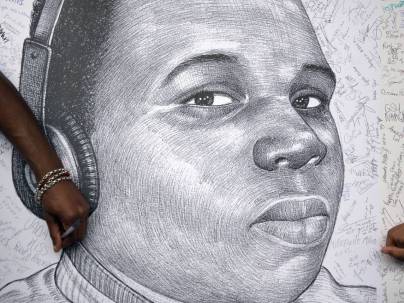
So, if we are “no angels, either” what do we do about it? Do we skip the track? Do we sit in front of our computer with the visual evidence of the failure of the American Dream staring us down as we groove to Beyoncé’s vocals? Do we turn off the news coverage in Ferguson, MO and pretend it’s not happening? Beyoncé’s voice provokes these uncomfortable questions and more: What does inequality sound like? What does hope and/or resolution/reparation sound like? Are they the same sound? This is a Beyoncé more in line with artists such as Nina Simone, who famously used her voice to express political critique, and not always in the most “pleasant” ways. “No Angel” is Beyoncé’s audio-visual “Strange Fruit,” positioning her alongside some of the most political and innovative protest singers of our time.
—
Author’s Note: At the time of Brown’s death, I had already been submitted this article. Due to the eerie coincidence between Beyoncé’s song “No Angel” and Eligon’s characterization of Michael Brown in the New York Times noted during the review process, I reworked the article to bring the two into conversation – which, in fact, they always were, even though I didn’t know it at the time.
—
Kevin Allred is a musician, activist, and teacher, currently at Rutgers University, where he teaches a signature course he created: “Politicizing Beyoncé.” He lives in Brooklyn, NY with his boyfriend and two elderly dachshunds. Join the Politicizing Beyoncé community at www.facebook.com/politicizingbeyonce. You can also find Kevin at www.kevinallredmusic.com and www.politicizingbeyonce.com.
—
 REWIND!…If you liked this post, check out:
The (Magic) Upper Room: Sonic Pleasure Politics in Southern Hip Hop–Regina Bradley
Freedom Back: Sounding Black Feminist History, Courtesy the Artists–Tavia Nyong’o
“HOW YOU SOUND??”: The Poet’s Voice, Aura, and the Challenge of Listening to Poetry— John Hyland
Share this:

The (Magic) Upper Room: Sonic Pleasure Politics in Southern Hip Hop
 After a rockin’ (and seriously informative) series of podcasts from Leonard J. Paul–a three part “Inside the Game Sound Designer’s Studio”– our summer Sound and Pleasure series keeps giving you the good stuff, this week with SO! Regular Regina Bradley, making it rain. . . with some serious knowledge. What is the connection between sound and enjoyment, and how might black women’s sexual freedom be manifested via sound? –-JS, Editor-in-Chief
—
At fifteen, while in church service, I learned how to clutch pearls after hearing a woman moan during the altar call.
It was not a “Jesus done found and saved me” moan, either. A friend forgot to turn his cell phone off for church. As the church prayed, his phone started to ring. It was not the usual digital beeping or quick calypso ring tone. His phone calls were annotated by a woman’s moan during sex. She moaned from his cell phone to pick up the call. Each ring the woman moaned louder and adamant until she hollered like she was just saved. The kids in the back snickered as the ushers – including my grandmother – silently and angrily screened each pew to see who would pick up the phone. Quaking church ladies and my grandmother’s wide-eyed glare and heaving chest suggested they were about to pass out from embarrassment. Wringing their white gloved hands and grabbing at their pearl necklaces in angst, they looked everywhere but at each other: the back of a man’s head, the cross at the front of the church, the stain glass windows. A flush of warmth entered my cheeks and neck as I tried to contain my laughter and creeping embarrassment. I was embarrassed for my grandmother and the ladies of the church because I was aware of the unspoken rule that women – especially middle-class black women – don’t do sex. Being embarrassed of sex is proper and “ladylike.”
“Dancing underwater II” by Flickr user Miss Cartier, CC BY-NC-SA 2.0
Ashon Crawley’s contextualization of the praise and worship in Black Pentecostal church as a sonic public zone is useful for using sound to complicate the church as an erotic space. Crawley’s suggestion of sound as a “vessel. . .for the exchange of ecstasy and ecstatics” collapses the more tangible notions of gender and respectability via physical displays –i.e. the quaking church ladies and clutching pearls – to recognize the overlap of moaning as a marker of sexual joy, moaning as a form of praise and worship, and moaning as an indicator of shame. Crawley’s observations bring to mind Helga Crane’s run in with the storefront church in Nella Larsen’s Quicksand. It is not the physical aspect of the church and its embodiment of respectability that draws Helga into the space. Rather, it is the singing, weeping, and moaning – the sonic elements of praise and worship–that parallel her own suppressed sexual frustrations. Her weeping is not necessarily a “come to Jesus moment” but rather a sonic release acknowledging her sexual agency.
Looking back at when this dude’s phone went off in church, I realize the bulk of discomfort in acknowledging sexual pleasure exists in how it sounds. The woman’s moan highlighted an alarming reality for the women at my church: pleasure was being presented outside of its respectable physical and sonic boundaries. I wish to identify what I call sonic pleasure politics to address new developments in 21st century southern gender identity politics. Sonic manifestations of pleasure point to a younger generation’s rearticulation of sexuality as a site of agency and self-definition in an otherwise suppressed southern experience.
![Purity-Rings.jpg by Wikimedia user Bibleknowledge, CC-BY-SA-3.0 (http://creativecommons.org/licenses/by-sa/3.0)], via Wikimedia Commons](http://commons.wikimedia.org/wiki/File:Purity-Rings.jpg)
Purity-Rings.jpg by Wikimedia user Bibleknowledge, CC-BY-SA-3.0, via Wikimedia Commons
As a southern black woman, I’ve always been struck by the anxiety sex and pleasure invoked in the women in my life. Sex and pleasure were never articulated in the same breath, as sex was a wifely duty and responsibility for procreation. Pleasure was never synonymous with sexual joy, even when I snatched whispers of conversation about sex from my elders. Moreover, I was taught that sex (or even an interest in it) would plummet my stock as a good girl and put me in the ranks of “fast-tailed” girls who used sex as a desperate plea for attention. Nope, sex – pleasurable sex – was always for men’s gratification. Aside from the abstinence manifesto – “just don’t do it, chile” – for women, enjoying sex was the devil’s work. Respectable sex was quiet, for marriage, and never discussed outside of the house.
Sound as a signifier of sexual pleasure is considered by many to be counterintuitive because of the history of sexual trauma associated with black women’s bodies in the south. Reading sex as a genesis point of southern black women’s pleasure and empowerment is a difficult undertaking. The forced silence of slave women’s rapes and other physical violence that took place on southern soil parallels the silence that is deemed to be necessary for survival in a racist society. Further, the far-reaching residual effects of black women’s inferred lacking virtue lurk in how black folks navigate their southern experience and identities. Conservative attitudes towards sex in the southern black community are no doubt associated with the constructed attempts to humanize and validate blacks outside of hypersexual scripted blackness.
However, the sonic dimension of sex and pleasure in the south goes largely without analysis even though sound is a primary space in which recognition of sexual and nonsexual pleasure takes place. Consider blues women and, more recently, women in [southern] hip hop culture. The sounds of women’s giggles and moans as representative of sexual pleasure in bass music and the heavy use of moaning in the work of Trina, Jacki-O, Khia, Erykah Badu, Beyoncé, and Missy Elliott points to a need to recognize sound as a reservoir of pleasure, raunchiness, and sexual work—what I call “sonic pleasure politics.”
Studies of sonic pleasure including those of Robin James contextualize pleasure via the technical production of sound to induce a particular set of cultural and visceral responses. However, I ground my theorization of sonic pleasure politics in the growing body of scholarship offered by the “Pleasure Ninjas” collective consisting of Joan Morgan, Brittney Cooper, Treva Lindsey, Kaila Story, Yaba Blay, and Esther Armah. They utilize pleasure as a site of healing and reclamation of black women’s identities. Morgan’s interrogation of pleasure as a form of survival, for example, is especially useful in thinking about how southern women’s sexuality stems from the trauma of the transatlantic slave trade. She suggests pleasure’s palpability as an alternative space to reclaim slaves’ humanity. The Pleasure Ninjas’ construction of pleasure lends credence to my theorization sonic pleasure politics as a space for mediating the historical implications of abusive sexual power and the use of sexual pleasure as a form of resistance in the south.
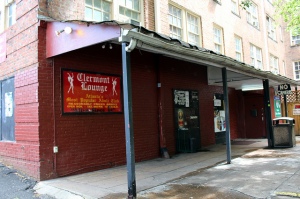
“Atlanta – Poncey-Highland: Clermont Lounge” by Flickr user Wally Gobetz, CC BY-NC-ND 2.0
Situating women’s pleasure in southern hip hop is messy as it reflects both men’s investment in women as objects of pleasure – i.e. bass music – and women’s subversion of this expectation of their sexuality a way to express themselves. For example, Lil Wayne’s lyrical affirmation of his sexual prowess via cunnilingus in songs like “Pussy Monster,” “She Will,” and “Lollipop” parallels singer Joi’s demonstration of pleasure as a form of sexual consent via the use of (presumably her) moans and sounds of cunnilingus on her popular song “Lick.” Sonic pleasure politics become a workspace for bridging the south’s historical construction of [black] women’s sexuality-as-respectability and the recent, more fluid form of younger women’s embrace of sex-as-empowerment heard in southern popular culture.
Sonic Pleasure Politics and Strip Club Culture
A primary space for teasing out the multi-layered significance of sounds and sexuality in southern hip hop is the strip club. The production of sonic and visual representations of strip clubs are inextricably linked: bass heavy musical tracks keep time with the “clapping cheeks” of exotic dancers. Further, the loudness of the strip club denotes patrons’ attempts to drown out the world while pivoting off of the fantasy of sexy women dancing, moaning, and sexually gesturing for their entertainment. The dominance of strip clubs in southern hip hop contribute to the erotic map(s) of a younger generation of southern black women. My contextualization of strip clubs as a cartographic point of interest pivots off of Kaila Story’s description of erotic maps as an entry point for recognizing black women’s sexual agency. Erotic maps are the touchstones through which people address sexual pleasure. Story uses black women’s social-historical narratives to map out black women’s use of sexuality as a measure of self-definition. These maps are complex as they are intertwined with historical-cultural biases and cultural preferences frequently outside of black women’s experiences.
“IMG_0478” by Flickr user Ferrum College, CC BY-NC-SA 2.0
Strip club anthems, like Memphis rapper Juicy J’s “Bandz a Make Her Dance,” riff on the sonic and physical components of strip club culture. The bass kicks complement what sounds like clapping hands, a signifier of strippers’ clapping butts. Juicy J talks at length about his love of the strip club, distinguishing between “real” and fake strip clubs by the amount of nakedness and strippers wrangling for high-paying patrons’ bands of money. The snapping sound of rubber bands holding wads of cash together authenticates the duality of the women’s sexual posturing as physically pleasurable for men and profitable – economically pleasurable – for women. “Bandz a Make Her Dance” is grounded in the appeal of strip clubs as spaces of empowerment for black men. From this perspective, the clapping heard across the track could also signify the snapping of rubber bands against money to sonically signify men’s power as a strip club patron. Yet the physical and sonic presence of black women’s bodies – i.e. grunting as they maneuver and climb the dancing pole – also makes strip club culture a useful space to pivot southernness and sonic pleasure.
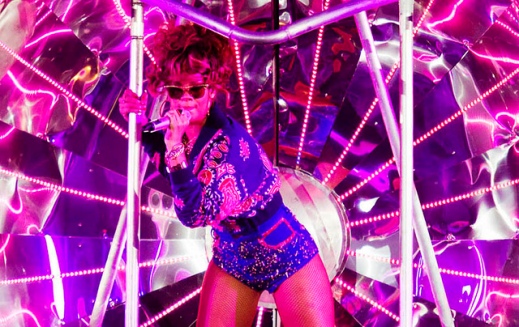
An example of establishing black women’s sonic pleasure narratives in strip clubs is singer Rihanna’s panning of “Bandz a Make Her Dance” titled “Pour It Up.” Although Rihanna is a pop singer from the “Global” South, she sonically signifies if not subverts southern hip hop gender politics via sampling the instrumental from Juicy J’s record. The majority of “Pour It Up’s” instrumental accompaniment is a subdued if not washed out sample of “Bandz a Maker Dance” that helps highlight Rihanna’s voice. The clarity of Rihanna’s voice “garbles” the accompaniment in the sense it is background noise to her narrative of enjoying herself and taking pleasure in the bodies of other women present in the club. The accompaniment serves as a brief nod to Juicy J’s initial intentions of crafting the strip club as a sexual space but ultimately uses the track as a testament to her own pleasure narrative.
In particular, Rihanna’s sing-song holler before the chorus “All I see is signs…all I see is dollar signs,” points to a subversion of the hypermasculinity in strip club culture to establish her own pleasure in a similar space. Parallel to Juicy J’s indulging of exotic dancers via throwing bands of money, Rihanna enjoys herself at the strip club using other people’s money:
Strip clubs and dolla’ bills (Still got mo’ money)
Patron shots can I get a refill (Still got mo’ money)
Strippers going up and down that pole (Still got mo’ money)
4 o’clock and we ain’t going home (Still got mo’ money)
Bands make your girl go down (Still got mo’ money)
Lot more where that came from (Still got mo’ money)
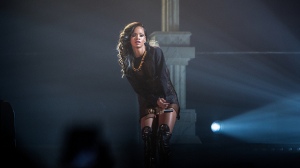
“Rihanna – Oslo 2013” by Flickr user NRK P3, CC BY-NC-SA 2.0
In particular, Rihanna’s verse not only demonstrates an alternative viewpoint of black women’s bodies in the strip club but destabilizes the idea of the strip club – and intercedes on the understanding of southern hip hop – as a heternormative hypermasculine space. The line “bands make your girl go down” alludes to not only a possible sexual encounter by Rihanna or for the girl in question but doubly signifies upon the potential for pleasure via the strip club culture for women and the hypersexuality of Juicy J’s track. “Pour it Up” reflects the messiness of [southern] hip hop gender politics because it builds upon the reputation of the strip club as a site for men’s pleasure to excavate women’s dancing as pleasurable for their own purposes. In addition to Rihanna’s sonic signifying of strip club culture, the “Pour It Up” reveres pole dancing as an art form rather than an exploitative practice. Rihanna’s pleasure in watching the dancers perform parallels the exertion of joy – and consent – that the dancers exhibit in their movement.
Trekking back to the sexy moaning phone in church, the sonic cue of sexual pleasure and joy conflicted with the gender norms associated with southern black women’s identities. Consideration of sonic pleasure narratives stirs discussion of the unarticulated experiences of southern black womanhood that may be overlooked in favor or a larger, more conservative, and familiar narrative of sex as tool of victimization. Sonic pleasure politics makes room to remap the contemporary southern social-cultural landscape as a complex yet living space of cultural production and sexual freedom.
–
Featured Image: “RIHANNA EM BELO HORIZONTE” by Flickr user http://www.rihannafentyforum.com, CC BY-NC-SA 2.0
–
Regina Bradley recently completed her PhD at Florida State University in African American Literature. Her dissertation is titled “Race to Post: White Hegemonic Capitalism and Black Empowerment in 21st Century Black Popular Culture and Literature.” She is a regular writer for Sounding Out!
–
REWIND!…If you liked this post, you may also dig:
Thrills, Chills, and Safe Sexuality: The Sounds of Michael Jackson’s “Thriller” – Osvaldo Oyola
“I Love to Praise His Name”: Shouting as Feminine Disruption, Public Ecstasy, and Audio-Visual Pleasure – Shakira Holt
I Like the Way You Rhyme, Boy: Hip Hop Sensibility and Racial Trauma in Django Unchained – Regina Bradley
Share this:


Current Top Posts





April 2021

January 2020

November 2019

October 2019

August 2019

April 2014

November 2017

March 2015

December 2017

October 2015
 Sounding Out!
Recent Comments