
This Past Weekend with Theo Von: Brocasting Trump, Part II

But first. . .
A Brief Synopsis of an Introduction to Bro-casting Trump: A Year-long SO! Series by Andrew Salvati
—
In total, Trump appeared on fourteen podcasts or video streams during his 2024 campaign, which together earned a combined 90.9 million views on YouTube and on other video streaming platforms, not even including audio podcast listens, which, because of the decentralized nature of RSS, are notoriously difficult to pin down.
That’s a lot.
In the following series of posts, I am particularly concerned with Trump’s success with the so-called podcast bros – partially because my own research interests are in the area of mediated masculinities, but also because they may have put him over the edge with a key demographic – with (white) Gen-Z men.
Over this series—which began in January 2026 with Logan Paul—I will examine several of Trump’s appearances on largely apolitical “bro” podcasts during the 2024 campaign season, including his interviews with Logan Paul, Theo Von, Shawn Ryan, Andrew Schulz, the Nelk Boys, and Joe Rogan. In the course of this examination, I will pay attention not only to what Trump said on these shows, but also to the way in which they established a sense of intimacy, and how that intimacy worked to underscore Trump’s reputation for authenticity. Along the way, I will also discuss the podcasts and podcasters themselves and attempt to locate them within the broader scope of the manosphere. Finally, given the passage of time since Trump’s appearances, I will consider to what extent, if any, individual hosts have become critical of his administration’s policies and actions – as Joe Rogan famously has.
Here’s the second installment, on This Past Weekend with Theo Von.
***
This Past Weekend with Theo Von: Brocasting Trump, Part II
DOI: 10.59350/qkwp6-e439
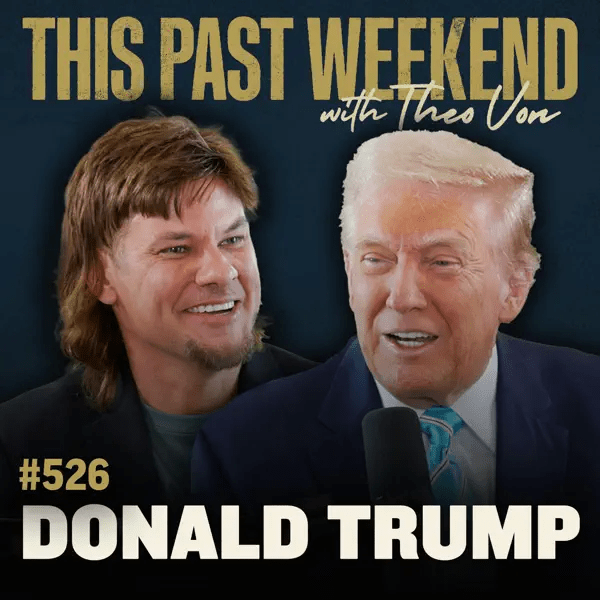
With about five-and-a-half minutes remaining in the podcaster and comedian Theo Von’s August 2024 interview with Donald Trump, the conversation turned to the U.S. southern border. Thus far, the interview had not shied away from policy concerns; however, though the questions were earnest, the answers were evasive and superficial. Noting that he had hosted Border Patrol agents on his show in the past, Von reported that one of the biggest problems that the agency faced was that its officers were arresting the same people over and over again. The reason, according to Von, was that “the people that are coming in illegally aren’t being prosecuted.”
The 44-year-old podcaster then asked the president in his lilting Louisiana accent what he would do differently to alleviate the problem and make the border more secure. Like many, it was a question that allowed Trump to indulge in his penchant for superlative and self-aggrandizement.
“So, the borders, well, I did it. I did it,” Trump declared. “We had the best border … we had the wall built. We had more going to come beyond, long beyond what I promised. I built hundreds of miles of wall, and it worked.”
Now, this post isn’t necessarily the venue for relitigating the failures of what was Trump’s signature project during his first administration, for reminding you, dear reader, that despite his promise on the 2016 campaign trail that he would “build a great, great wall on our southern border” (which Mexico would pay for), and despite signing an executive order just days after taking office that directed the Secretary of Homeland Security “to immediately plan, design, and construct a physical wall along the southern border,” by the end of his term in office in January, 2021, only 452 miles of wall had been constructed – much of which was not new, and had merely replaced existing barriers. Such reminders can be found elsewhere.
Rather, the moment captured the credulity which Von freely gave the former president throughout the interview, and thereby highlighted what I suggested in my last post is the problem – or, from the candidate’s perspective, the virtue – of a media strategy that allotted a significant amount of time to non-journalists: it was unlikely that he’d get much pushback.
***
And after listening through the episode a few times and trying to put myself in the place of an apolitical Theo Von listener, or one perhaps too young to remember the first Trump administration, I began to more fully appreciate the extent to which his apparent authenticity coupled with a sense that he is not just a political outsider, but an autonomous agent free of obligation to party. Typically, this last part comes out when Trump takes aim at “them” – Joe Biden, Kamala Harris, Chuck Schumer, Nancy Pelosi, and other unnamed Democratic elites, as well as any other members of the “deep state,” or “establishment” who oppose him.
In contrast to these shadowy figures, Trump presents himself as someone who, largely because of his wealth, remains independent, and as such, is uncorrupted by “them.” He can thus position himself as a man of the people, and in fact frequently trumpeted his own popularity during the episode – with Von only too happy to provide affirmation.
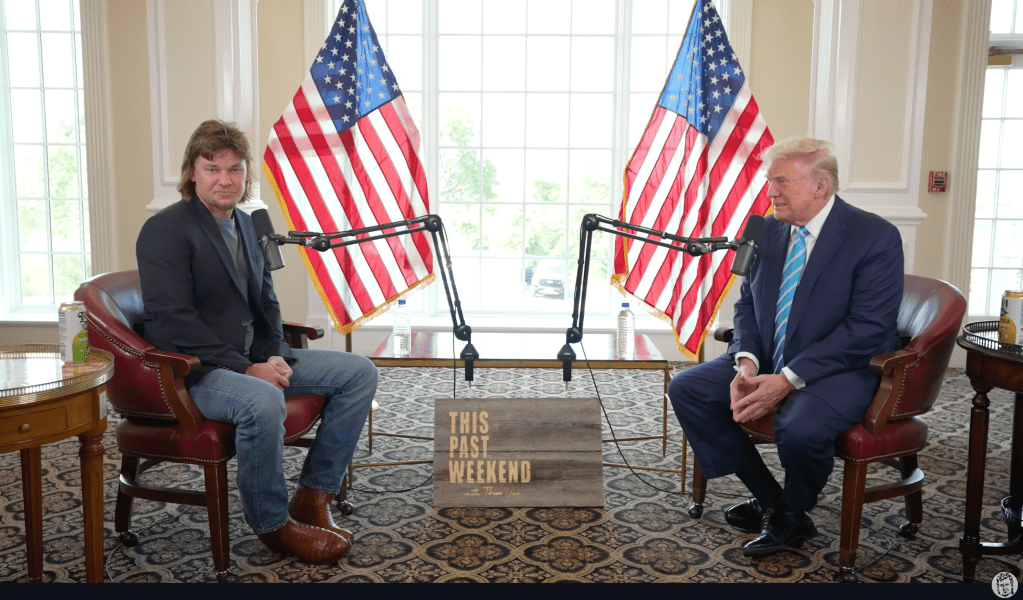
But this turn toward the border and to immigration policy is also significant in retrospect, given that Von has since been critical of the second Trump administration’s mass deportation policies, and of the Department of Homeland Security’s (DHS’s) unauthorized use of his image and voice in one of its marketing videos in a way that seemed as if he supported the department’s deportation efforts.
In the now-deleted video (part of which can be seen here), Von looks directly into the camera and says “Heard you got deported dude, bye.”
The comedian quickly took to X (formerly Twitter) to vent. “Yoo DHS I didn’t approve to be used in this,” he said in a post that he later deleted. “I know you know my address so send a check. And please take this down and please keep me out of your ‘banger’ deportation videos. When it comes to immigration my thoughts and heart are a lot more nuanced than this video allows. Bye!”
Roughly a week later, on October 2, 2025, Von returned to the subject on his podcast with an impassioned statement explaining to his listeners the situation with the video and outlined some of his own thoughts on immigration. Contextualizing the clip by saying that it had been made in a parking lot after one of his comedy shows as a joke – though in Von’s telling, what he said still comes off as callous, as the “girl” who approached him with the camera was trying to tell the comedian that her friend had recently been deported – Von went on to talk about the blowback he received as a result of the DHS video, which was in no way an accurate depiction of his complex thoughts on immigration.
“And my father immigrated here from Nicaragua, right?” he explained, his voice beginning to break. “Like one of my prized possessions is I have his immigration papers [from] when he came here. And I have them in a frame … and, so I have tons of thoughts about it, but this was just fucked up, right? It was fucked up. And it was everywhere. It was on all platforms and stuff.”
What Von seemed to be doing here was saying that, though he may have supported a tough line on illegal immigration and had little tolerance for those who had been admitted into the country with a criminal record, he could not necessarily get behind the Trump DHS’s indiscriminate deportation scheme, which was sweeping up immigrants who had come into the country the “right way” alongside those who maybe hadn’t.
However in listening to Von’s Trump interview from 2024, it’s hard not to hear the future president laying the groundwork for what would become a maximalist strategy on immigration. “We have over 20 million people, in my opinion, right now, that came into our country [the number of unauthorized immigrants in the U.S. was estimated at 14 million in 2023]. Many come from prisons, jails, mental institutions, many terrorists,” Trump claimed, later adding that “we’re going to spend a lot of time getting the criminals out … we have a lot of people, hundreds of thousands of murderers. We have people, drug dealers … it’s not even believable.”
Although it would have been difficult at the time of the recording to imagine the terror that Trump’s Immigration and Customs Enforcement (ICE) sweeps would unleash on communities like Los Angeles, Chicago, New York, and Portland in the months following his return to office, we can hear in his attempts to vilify unauthorized foreign nationals, and in his fear-mongering about how many of them were bad actors, a justification for the use of blunt force rather than nuanced policy.
And it seemed like Von agreed, at least in principle, with the law-and-order logic underpinning Trump’s statements. “Oh, I don’t think people should be allowed to be in our country if they’re criminals,” he stated.
To give this conversation a charitable reading, it is perhaps likely that Von assumed that, once in office, Trump’s administration would have the tools to determine which foreign nationals were authorized to be in the country and which were not. Further, he may also have believed ICE would know who among this group had a criminal record – and not conduct mass roundups based on race.
Yet, as we should have all probably known by the summer of 2024, for Trump and his chief advisers, blunt force (and cruelty) was the point. Recall the so-called “Muslim Ban” instituted during Trump’s first term, which was hardly an example of a well-calibrated policy, but was rather a “total and complete shutdown” of travelers and immigrants from seven Muslim-majority countries (though even this wasn’t without its conflicts of interest as it excluded several countries like Saudi Arabia and the United Arab Emirates where Trump had business dealings).
Even the wall, which was conceived by Trump insiders in 2015 as a mnemonic device intended to help their boss to remember to mention illegal immigration at his campaign rallies, was deemed effective precisely because it was not subtle. As Trump 2016 campaign adviser Sam Nunberg told Business Insider, “I think one issue is people did understand walls … the wall in 2016 was symbolic of Donald Trump: common sense, practical solutions, simplified answers – as opposed to long nuanced, detailed policy speak.”
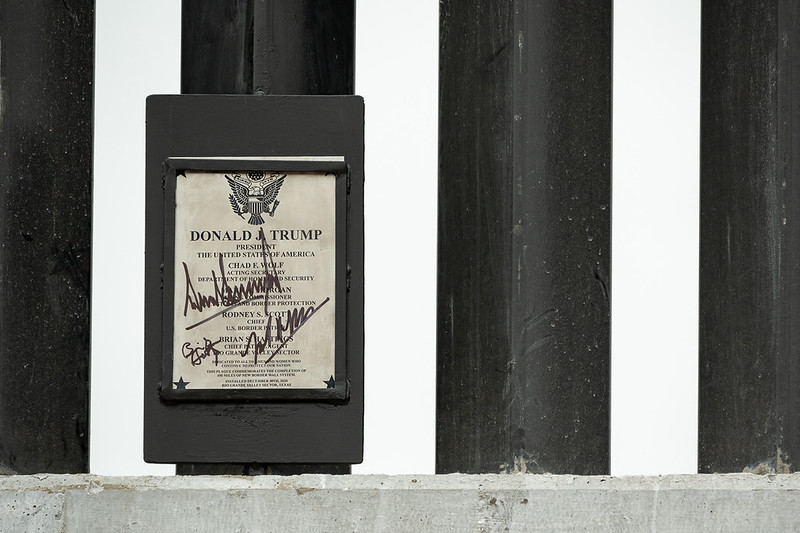
President Donald J. Trump’s signature is seen on a plaque on the border wall Tuesday, Jan. 12, 2021, at the Texas-Mexico border near Alamo, Texas. (Official White House Photo by Shealah Craighead) (PDM 1.0)
And this would be a fair characterization of Trump’s remarks on This Past Weekend – when Von asked earnest policy questions, Trump offered simplified, seemingly common sense responses that presented his own approach to the problems of government as something different than politics-as-usual, different because it was guided by an intensely practical, no-nonsense ethos.
Like his appearance on Logan Paul’s Impaulsive, Trump’s calm, yet forceful tone of voice on This Past Weekend tended to support his overall credibility as a leader capable of bringing logical solutions to a crisis-ridden government – of brining decisive, masculine order to the chaos in Washington. Such was the impression that listeners may have gotten, for instance, from Trump and Von’s discussion of the president’s first term executive order mandating price transparency for hospital care, which Von asked Trump about specifically, and which, Trump claimed, “would have brought down the cost of care by 50, 60%” if Biden and Kamala had enforced it.
But Trump’s appeals to common sense also provided cover for what might have otherwise been an embarrassing bit of hypocrisy. When Von began to turn the conversation toward the power of lobbyists, asking why it was that the government couldn’t seem to do anything about the so-called revolving door, Trump explained that there was a “whole constitutional thing there” (the First Amendment right to petition the government), and agreed with Von that it was “a problem and … a big problem,” adding that “we were [in his first term] doing things about it.”
What his administration did, was issue an executive order banning executive branch employees from becoming lobbyists for a period of five years. This move may have seemed like it indicated a genuine desire to “drain the swamp,” as Trump routinely promised to do on the campaign trail in 2016, but, as ProPublica revealed in a 2019 report, his administration had actually hired 1 lobbyist for every 14 political appointees that it had made since taking office (281 in total), which was four times more than Obama had appointed six years into office.
Given that they had provided ingress to the executive branch, it is perhaps unsurprising that they would eventually provide egress, executive order notwithstanding. Indeed, on the final day of his first term, Trump revoked the order without giving explanation, clearing the way for members of his administration to secure lucrative lobbying gigs. Such contradictions, however, were more or less concealed behind Trump’s populist rhetoric, behind his apparent recognition that conflicts of interest are a problem in politics, or that medical debt is crushing Americans.
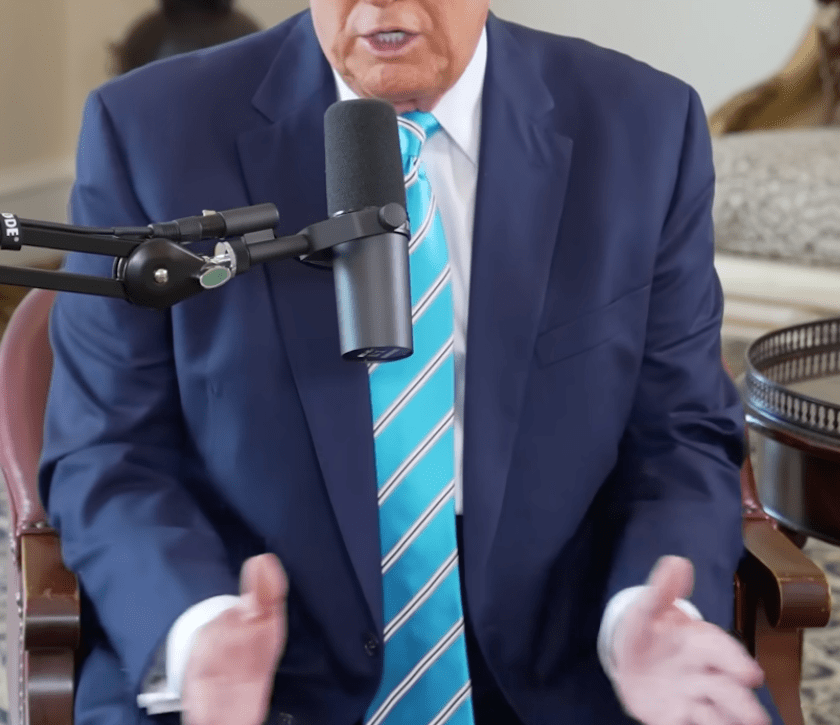
But taking a sound studies perspective, we can also see – or hear – how Trump’s tone of voice, which admittedly seems less energetic than it was during his Logan Paul interview, tended to convey an assurance that what he said was an authentic expression of his own thoughts and perspectives. Again, this was not the kind of stream-of-consciousness raving that we have come to expect from his rallies, but rather a low-key, intimate conversation about relevant issues and facts – or, at least facts as Trump saw them.
The implication here is that Trump as a political leader is free to operate in ways that mere politicians and government officials simply can’t because of their obligations to party, to donors, or to lobbyists. What is likely missed in all of this, however, is that what Trump is describing is a thoroughly authoritarian approach to political power, one that is of a piece with his claim that “I alone can fix it.” Positioning himself outside the political establishment – and even independent of the Republican Party of which he is nominally the leader – Trump can offer himself as a political messiah and claim the moral authority to act without regard for democratic processes in the name of a specious popular mandate.
In other words, by contrasting himself with “them,” and by holding himself at a distance from the dominant political order, Trump clears himself of the obligation to work with any group or individual that he deems to be opposed to his own quasi-populist agenda.
And for Von and those in his audience who are fed up with the status quo, that is a powerful appeal.
—
Featured Image: Theo Von, Edited James Tamim, Wikimedia Images (CC BY-SA 2.0)
—
Andrew J. Salvati is an adjunct professor in the Media and Communications program at Drew University, where he teaches courses on podcasting and television studies. His research interests include media and cultural memory, television history, and mediated masculinity. He is the co-founder and occasional co-host of Inside the Box: The TV History Podcast, and Drew Archives in 10.
—
REWIND! . . .If you liked this post, you may also dig:

Impaulsive: Bro-casting Trump, Part I—Andrew Salvati
Taters Gonna Tate. . .But Do Platforms Have to Platform?: Listening to the Manosphere—Andrew Salvati
Listening to MAGA Politics within US/Mexico’s Lucha Libre –Esther Díaz Martín and Rebeca Rivas
Gendered Sonic Violence, from the Waiting Room to the Locker Room–Rebecca Lentjes
—
Layout by Jennifer L. Stoever
—
Share this:

Blank Space and “Asymmetries of Childhood Innocence”

In 2015 a video of a child in an Internet café in the Philippines began to trend on social media sites. Titled, Kanta ng isang Anak para sa kanyang inang OFW “Blank Space“ (“Song of a child for her overseas foreign worker mother”), the video shows a girl singing via Skype to her mother who is working in an unnamed location, presumably outside of the Philippines. “Ma kakantahan ulit kita ha?” (I’ll sing for you again mom), she says, and starts singing Taylor Swift’s “Blank Space”. Her mother attentively watches and listens to her song, soon beginning to cry in longing for a daughter she has not seen in a long time. The girl’s attention is divided between the screen that shows the lyrics, the camera that films her singing, and her mother who quietly observes. This video has over 110,000 views and is one of many archived messages from a child singing or speaking to their mother who labours transnationally. Despite the videos’ jittery framing and low quality, the intended message of shared longing across cyber and transnational borders is clear.
The Spanish-American war (1899-1902) resulted in the relinquishment of the colony of the Philippines from Spain to the United States. This transfer of power instituted the imperial specter that continues to grip the archipelago. The many performances of American pop music on Youtube and on stages throughout the Philippines are what Christine Bacareza Balance calls the “musical aftermath of US imperial cultures” (2016). Having amassed over 97 million YouTube views in the Philippines, Taylor Swift’s overwhelming popularity is evidence of this continued imperial presence. In the video, the young Filipinx girl sings lyrics written by Swift: “I’m dying to see how this one ends. Grab your passport and my hand.” When sung by this child these lyrics take on different meaning than Swift likely intended. Perhaps she is anticipating an end to the necessity of separation between mother and daughter.
Using song, the video provides evidence of what Hannah Dyer calls the ‘asymmetries of childhood innocence’ (2019), reminding its audience of the ways transnational labour and global capital impact children’s experiences of kinship and development. Dyer suggests that some children are withheld the protective hold of childhood innocence. She writes:
“Childhood innocence is a seemingly natural condition but its rhetorical maneuvers are permeated by its elisions and attempted disavowals along the lines of race, class, gender and sexuality. That is, despite the familiar rhetorical insistence that children are the future, some children are withheld the benefits of being assumed inculpable (2)”
Ascriptions of childhood innocence thus require a child to replicate social norms including the production of the nuclear family. In the Philippines, where the liberalization of international trade and high levels of unemployment have disproportionately impacted the labour migration of women, structures of the nuclear family are being re-organized (Parreñas 2005; Tungohan 2013). Women who work outside of the Philippines and away from their families are paradoxically celebrated for their “sacrifice” while also subject to disapproval over their absence (Tungohan 2013). When mothers leave the Philippines, the care-arrangements for children are shifted. There is a growing recognition of the changing nature of motherhood within transnational contexts and the concomitant emotional consequences of negotiating “long distance intimacy” (Parreñas 2005). The demands for transnational labour reconfigure Filipinx family formations and necessitate fraught intimacies between parent and child across borders. Cyber technologies like cell phones and the Internet initiate creative opportunities for children to be “virtually present” in the lives of their mothers and vice versa.

“Parenthood” by Flickr user Saúl Alejandro Preciado Farías, CC BY 2.0
Drawing from Dyer, we might think of children who live without the physical presence of their mothers as “queer” to normative theories of childhood development that affirm overwrought expectations of maternal presence. She suggests that discourses of childhood innocence intend to subjugate the queerness of childhood and that these elisions hold bio-political significance. Faced with social inequities, Dyer emphasizes the importance of a child’s symbolic expression. She argues that children express their psychic and social conflicts aesthetically. A child’s imagination elaborates resistances to the enclosure of childhood innocence as a barometer of value. In this way, this article suggests a child’s singing and dancing are aesthetic expressions that take notice of the entangled traces of colonialism and nation, while resisting hierarchal structures that deem some childhoods more valuable than others.
The child’s sonic performance in the YouTube video is a queer offering that creatively procures transnational connection. Her singing registers a queer frequency that destabilizes normative theories of child development that assume a mother’s physical presence as necessary to developmental success. The girl’s performance suggests that psychic and political reparations can occur in the sounds the child makes. The tactile, spatial and physical qualities of her voice forge a new relation to her mother. Her voice is affecting, seemingly moving her mother to tears and rousing the onlookers at the Internet café to reorganize their bodies and sing along. In this video, we are invited to witness a child whose world has been altered by globalization and the continued geo-political violence’s enacted by the American empire. Given these circumstances, her “creative re-interpretation[s] of kinship” serves as a reminder that the affective fortitude of her voice tests physical and emotional borders (Dyer 2019). The restraint of normative conceptions of family is ruptured when the child remakes her relation to her mother in ways that stir joy, collectivity, and pleasure.

Screenshot from “
By observing and listening to the child’s song more closely, we can listen for its potential to re-sound and re-imagine the parent-child relationship across borders. The sounds of “OFW Blank Space” linger after the clip has ended. By listening for what is in excess of the video’s content, we can consider the affective registers that enunciate alternative understandings of migration, family and belonging. There is a humming that is ubiquitous in the video. Perhaps, it is the sound of the electric fans that run to combat the tropical heat of the Philippines. Maybe it is the collective buzzing from the computers that have been set up to provide the Internet to its cybercafé patrons. The acoustics of the space are at once mundane and haphazard, and at the same time, cogent indicators of the geopolitical truths echoing throughout the scene. With limited access to Internet in the home, the cybercafé has been a site that children frequent to communicate with family working in another country. The convergence of sound, technology and diasporic subjectivity becomes audible when the practice of listening is attuned to these methods of transnational connection.
While listening to the pedagogical potential of the cybercafé more broadly, a focus on the vocal performance of the child reveals my investment in what the sound of her voice tells us. The video starts with greetings spoken in Tagalog, the primary language of the Philippines. When the backing track begins, the child makes a seamless transition into singing in English. In her vocal performance of the lyrics, her Filipino accent is almost undetectable. She sings with a dulcet tone that is clear and appealing. Her voice sounds well-trained and confident. If not for the video, one might believe the child to be a professional American performer. In this scene, it is her voice that is marked and constituted by a narrative of American imperial conquest and Filipino assimilation. But in a creative adaptation of American cultural production, the child re-writes this racialized script and uses American pop songs as a mechanism of care for both herself and her mother.

“Mother and daughter at home” by Flickr user Dejan Krsmanovic, CC-BY-2.0
The economic instability in the Philippines has created a state instituted transnational workforce. Women have been disproportionately affected by the demand for work in care industries such as nursing, childcare and care for the elderly (Francisco-Menchavez 2018). These gendered and racialized structures of employment privilege the presence of Filipinx women in families other than their own. The child is withheld a future that assures her the presence of her mother and their physical proximity is denied as a result of the demand for labour and capital exchange between nation-states. However, despite these circumstances, the child uses her voice to summon a beautiful intimacy, one that does not disavow the imperial history that marks its possibility, but instead uses loss as a resource to creatively mourn their separation. For the child, the act of singing is a replacement for her lost object, her mother. In the video we witness a child who is full of joy and whose strength of voice quells, if not, temporarily, whatever longing for her mother she might have. Relatedly, the child is also perceptive of her mother’s needs and uses music as a method of offering her care. Her performance creatively re-routes the presumed directionalities of care (from mother to child) which globalization has fundamentally altered.
—
Featured image: “Children” by Flickr user Clive Varley, CC-BY-2.0
—
Casey Mecija is an accomplished multi-disciplinary artist, primarily working in the fields of music and film. She played in Ohbijou, the Canadian orchestral pop band, and released her first solo album, entitled Psychic Materials, in 2016. Casey is also an award winning filmmaker whose work has screened internationally. She is completing a PhD at The University of Toronto, where she researches sound, performance studies and Filipinx Studies as they relate to queer diaspora.
—
 REWIND! . . .If you liked this post, you may also dig:
Relocating Soundscapes of Schooling: Learning to Listen to Children’s Lifeworlds-Cassie Brownell
Top 40 Democracy: Taylor Swift’s Election Day Victory-Eric Weisbard
Hearing “Media-Capitalism” in Egypt–Ziad Fahmy
Share this:




Current Top Posts





April 2021

January 2020

November 2019

October 2019

August 2019

April 2014

November 2017

March 2015

December 2017

October 2015
 Sounding Out!
Recent Comments