
Can’t Nobody Tell Me Nothin: Respectability and The Produced Voice in Lil Nas X’s “Old Town Road”
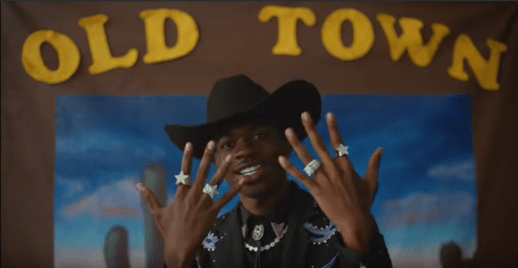
It’s been ten weeks now that we’ve all been kicking back in our Wranglers. allowing Lil Nas X’s infectious twang in “Old Town Road” to shower us in yeehaw goodness from its perch atop the Billboard Hot 100. Entrenched as it is on the pop chart, though, “Old Town Road”’s relationship to Billboard got off to a shaky start, first landing on the Hot Country Songs list only to be removed when the publication determined the hit “does not embrace enough elements of today’s country music to chart in its current version.” There’s a lot to unpack in a statement like that, and folks have been unpacking it quite consistently, especially in relation to notions of genre and race (in addition to Matthew Morrison’s recommended reads, I’d add Karl Hagstrom-Miller’s Segregating Sound, which traces the roots of segregated music markets). Using the context of that ongoing discussion about genre and race, I’m listening here to a specific moment in “Old Town Road”— the line “can’t nobody tell me nothin”—and the way it changes from the original version to the Billy Ray Cyrus remix. Lil Nas X uses the sound of his voice in this moment to savvily leverage his collaboration with a country music icon, and by doing so subtly drawing out the respectability politics underlying Billboard’s racialized genre categorization of his song.

Screenshot, “Lil Nas X – Old Town Road (Official Movie) ft. Billy Ray Cyrus”
After each of Lil Nas X’s two verses in the original “Old Town Road,” we hear the refrain “can’t nobody tell me nothin.” The song’s texture is fairly sparse throughout, but the refrains feature some added elements. The 808-style kick drum and rattling hihats continue to dominate the soundscape, but they yield just enough room for the banjo sample to come through more clearly than in the verse, and it plucks out a double-time rhythm in the refrain. The vocals change, too, as Lil Nas X performs a call-and-response with himself. The call, “can’t nobody tell me nothin,” is center channel, just as his voice has been throughout the verse, but the response, “can’t tell me nothin,” moves into the left and right speaker, a chorus of Lil Nas X answering the call. Listen closely to these vocals, and you’ll also hear some pitch correction. Colloquially known as “autotune,” this is an effect purposely pushed to extreme limits to produce garbled or robotic vocals and is a technique most often associated with contemporary hip hop and R&B. Here, it’s applied to this melodic refrain, most noticeably on “nothin” in the call and “can’t” in the response,
After Billboard removed the song from the Hot Country chart in late March, country star Billy Ray Cyrus tweeted his support for “Old Town Road,” and by early April, Lil Nas X had pulled him onto the remix that would come to dominate the Hot 100. The Cyrus remix is straightforward: Cyrus takes the opening chorus, then Lil Nas X’s original version plays through from the first verse to the last chorus, at which point Cyrus tacks on one more verse and then sings the hook in tandem with Lil Nas X to close the song. Well, it’s straightforward except that, while Lil Nas X’s material sounds otherwise unaltered from the original version, the pitch correction is smoothed out so that the garble from the previous version is gone.
In order to figure out what happened to the pitch correction from the first to second “Old Town Road,” I’m bringing in a conceptual framework I’ve been tinkering with the last couple of years: the produced voice. Within this framework, all recorded voices are produced in two specific ways: 1) everyone performs their bodies in relation to gender, race, ability, sex, and class norms, and 2) everyone who sings on record has their voice altered or affected with various levels of technology. To think about a produced voice is to think about how voices are shaped by recording technologies and social technologies at the same time. Listening to the multiple versions of “Old Town Road” draws my attention specifically to the always collaborative nature of produced voices.
In performativity terms—and here Judith Butler’s idea in “Performative Acts and Gender Constitution: An Essay in Phenomenology and Feminist Theory” that “one is not simply a body, but, in some very key sense, one does one’s body” (521) is crucial—a collaboratively produced voice is a little nebulous, as it’s not always clear who I’m collaborating with to produce my voice. Sometimes I can (shamefully, I assure you) recognize myself changing the way my voice sounds to fit into some sort of, say, gendered norm that my surroundings expect. As a white man operating in a white supremacist, cisheteropatriarchal society, the deeper my voice sounds, the more authority adheres to me. (Well, only to a point, but that’s another essay). Whether I consciously or subconsciously make my voice deeper, I am definitely involved in a collaboration, as the frequency of my voice is initiated in my body but dictated outside my body. Who I’m collaborating with is harder to establish – maybe it’s the people in the room, or maybe my produced voice and your listening ears (read Jennifer Stoever’s The Sonic Color Line for more on the listening ear) are all working in collaboration with notions of white masculine authority that have long-since been baked into society by teams of chefs whose names we didn’t record.

“Tools in a Recording Studio” by Flickr user Carol VanHook (CC BY-SA 2.0)
In studio production terms, a voice’s collaborators are often hard to name, too, but for different reasons. For most major label releases, we could ask who applied the effects that shaped the solo artist’s voice, and while there’s a specific answer to that question, I’m willing to bet that very few people know for sure. Even where we can track down the engineers, producers, and mix and master artists who worked on any given song, the division of labor is such that probably multiple people (some who aren’t credited anywhere as having worked on the song) adjusted the settings of those vocal effects at some point in the process, masking the details of the collaboration. In the end, we attribute the voice to a singular recording artist because that’s the person who initiated the sound and because the voice circulates in an individualistic, capitalist economy that requires a focal point for our consumption. But my point here is that collaboratively produced voices are messy, with so many actors—social or technological—playing a role in the final outcome that we lose track of all the moving pieces.
Not everyone is comfortable with this mess. For instance, a few years ago long-time David Bowie producer Tony Visconti, while lamenting the role of technology in contemporary studio recordings, mentioned Adele as a singer whose voice may not be as great as it is made to sound on record. Adele responded by requesting that Visconti suck her dick. And though the two seemed at odds with each other, they were being equally disingenuous: Visconti knows that every voice he’s produced has been manipulated in some way, and Adele, too, knows that her voice is run through a variety of effects and algorithms that make her sound as epically Adele as possible. Visconti and Adele align in their desire to sidestep the fundamental collaboration at play in recorded voices, keeping invisible the social and political norms that act on the voice, keeping inaudible the many technologies that shape the voice.
Propping up this Adele-Visconti exchange is a broader relationship between those who benefit from social gender/race scripts and those who benefit from masking technological collaboration. That is, Adele and Visconti both benefit, to varying degrees, from their white femininity and white masculinity, respectively; they fit the molds of race and gender respectability. Similarly, they both benefit from discourses surrounding respectable music and voice performance; they are imbued with singular talent by those discourses. And on the flipside of that relationship, where we find artists who have cultivated a failure to comport with the standards of a respectable singing voice, we’ll also find artists whose bodies don’t benefit from social gender/race scripts: especially Black and Brown artists—non-binary, women, and men. Here I’m using “failure” in the same sense Jack Halberstam does in The Queer Art of Failure, where failing is purposeful, subversive. To fail queerly isn’t to fall short of a standard you’re trying to meet; it’s to fall short of a standard you think is bullshit to begin with. This kind of failure would be a performance of non-conformity that draws attention to the ways that systemic flaws – whether in social codes or technological music collaborations – privilege ways of being and sounding that conform with white feminine and white masculine aesthetic standards. To fail to meet those standards is to call the standards into question.

So, because respectably collaborating a voice into existence involves masking the collaboration, failing to collaborate a voice into existence would involve exposing the process. This would open up the opportunity for us to hear a singer like Ma$e, who always sings and never sings well, as highlighting a part of the collaborative vocal process (namely pitch correction, either through training or processing the voice) by leaving it out. To listen to Ma$e in terms of failed collaboration is to notice which collaborators didn’t do their work. In Princess Nokia’s doubled and tripled and quadrupled voice, spread carefully across the stereo field, we hear a fully exposed collaboration that fails to even attempt to meet any standards of respectable singing voices. In the case of the countless trap artists whose voices come out garbled through the purposeful misapplication of pitch correction algorithms, we can hear the failure of collaboration in the clumsy or over-eager use of the technology. This performed pitch correction failure is the sound I started with, Lil Nas X on the original lines “can’t nobody tell me nothin.” It’s one of the few times we can hear a trap aesthetic in “Old Town Road,” outside of its instrumental.
In each of these instances, the failure to collaborate results in the failure to achieve a respectably produced voice: a voice that can sing on pitch, a voice that can sing on pitch live, a voice that is trained, a voice that is controlled, a voice that requires no intervention to be perceived as “good” or “beautiful” or “capable.” And when respectable vocal collaboration further empowers white femininity or white masculinity, failure to collaborate right can mean failing in a system that was never going to let you pass in the first place. Or failing in a system that applies nebulous genre standards that happen to keep a song fronted by a Black artist off the country charts but allow a remix of the same song to place a white country artist on the hip hop charts.
 The production shift on “can’t nobody tell me nothin” is subtle, but it brings the relationship between social race/gender scripts and technological musical collaboration into focus a bit. It isn’t hard to read “does not embrace enough elements of today’s country music” as “sounds too Black,” and enough people called bullshit on Billboard that the publication has had to explicitly deny that their decision had anything to do with race. Lil Nas X’s remix with Billy Ray Cyrus puts Billboard in a really tricky rhetorical position, though. Cyrus’s vocals—more pinched and nasally than Lil Nas X’s, with more vibrato on the hook (especially on “road” and “ride”), and framed without the hip hop-style drums for the first half of his verse—draw attention to the country elements already at play in the song and remove a good deal of doubt about whether “Old Town Road” broadly comports with the genre. But for Billboard to place the song back on the Country chart only after white Billy Ray Cyrus joined the show? Doing so would only intensify the belief that Billboard’s original decision was racially motivated. In order for Billboard to maintain its own colorblind respectability in this matter, in order to keep their name from being at the center of a controversy about race and genre, in order to avoid being the publication believed to still be divvying up genres primarily based on race in 2019, Billboard’s best move is to not move. Even when everyone else in the world knows “Old Town Road” is, among other things, a country song, Billboard’s country charts will chug along as if in a parallel universe where the song never existed.
 As Lil Nas X shifted Billboard into a rhetorical checkmate with the release of the Billy Ray Cyrus remix, he also shifted his voice into a more respectable rendition of “can’t nobody tell me nothin,” removing the extreme application of pitch correction effects. This seems the opposite of what we might expect. The Billy Ray Cyrus remix is defiant, thumbing its nose at Billboard for not recognizing the countryness of the tune to begin with. Why, in a defiant moment, would Lil Nas X become more respectable in his vocal production? I hear the smoothed-out remix vocals as a palimpsest, a writing-over that, in the traces of its editing, points to the fact that something has been changed, therefore never fully erasing the original’s over-affected refrain. These more respectable vocals seem to comport with Billboard’s expectations for what a country song should be, showing up in more acceptable garb to request admittance to the country chart, even as the new vocals smuggle in the memory of the original’s more roboticized lines.
While the original vocals failed to achieve respectability by exposing the recording technologies of collaboration, the remix vocals fail to achieve respectability by exposing the social technologies of collaboration, feigning compliance and daring its arbiter to fail it all the same. The change in “Old Town Road”’s vocals from original to remix, then, stacks collaborative exposures on top of one another as Lil Nas X reminds the industry gatekeepers that can’t nobody tell him nothin, indeed.
_
Featured image, and all images in this post: screenshots from “Lil Nas X – Old Town Road (Official Movie) ft. Billy Ray Cyrus” posted by YouTube user Lil Nas X
_
Justin aDams Burton is Assistant Professor of Music at Rider University. His research revolves around critical race and gender theory in hip hop and pop, and his book, Posthuman Rap, is available now. He is also co-editing the forthcoming (2018) Oxford Handbook of Hip Hop Music Studies. You can catch him at justindburton.com and on Twitter @j_adams_burton. His favorite rapper is one or two of the Fat Boys.
_
 REWIND! . . .If you liked this post, you may also dig:
Vocal Anguish, Disinformation, and the Politics of Eurovision 2016-Maria Sonevytsky
Cardi B: Bringing the Cold and Sexy to Hip Hop-Ashley Luthers
“To Unprotect and Subserve”: King Britt Samples the Sonic Archive of Police Violence-Alex Werth
Share this:

The Theremin’s Voice: Amplifying the Inaudibility of Whiteness through an Early Interracial Electronic Music Collaboration

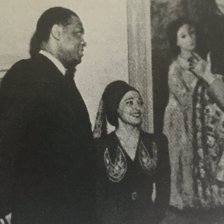
On an October evening in 1934, Clara Rockmore made her debut performance with the theremin, a then-new electronic instrument played without touch, in New York City’s historic Town Hall. Attended by critics from every major newspaper in the city, the performance not only marked the beginning of Rockmore’s illustrious career as a thereminist, it also featured the first known interracial collaboration in electronic music history. A sextet of Black male vocalists from the famous Hall Johnson choir performed a group of spirituals arranged by Johnson with Rockmore, whom the press—apparently unaware of her Jewish heritage—considered white. The collaboration was an anomaly: no other record exists of Black musicians performing with Rockmore (she toured with Paul Robeson in the 1940s, but no evidence has surfaced showing the two ever on stage together).
Though the Johnson Sextet’s performance with Rockmore is of intense interest to me as a historian, at the time the white press mostly ignored the collaboration. This is surprising given Johnson’s fame: his choir and work were critically acclaimed in productions including the 1930 Pulitzer-Prize-winning play The Green Pastures and the 1933 musical Run Little Chillun’. The Sextet’s spirituals were prominently featured in Rockmore’s debut, with four songs closing the program (“Stan’ Still Jordan,” “Swing Low, Sweet Chariot,” “Water Boy,” and “O Lord Have Mercy On Me”) and “Old Man River” likely serving as an encore. Yet only two writers—one Black, one white—discussed the spirituals in any detail. Though brief, these two reviews can help us understand why most critics ignored the spirituals at Rockmore’s debut, and illuminate the role that race played in the reception of Rockmore’s career, the theremin, and electronic musical sound.
One of these reviews was by an anonymous critic writing for the New York Amsterdam News, the city’s highly influential weekly African-American newspaper. Though unidentified, the author was likely Black, given the source. The critic described Rockmore and the Sextet’s rendition of the song “Water Boy” as “particularly effective,” ascribing the theremin’s expressive power to its sonority: “the deep ’cello tone of the instrument was more than faintly reminiscent of the throaty humming of a Negro singer.” The white critic who wrote about the collaboration—Paul Harrison, in his syndicated column, “In New York,” that ran in several newspapers across New York State—seemed to corroborate the Amsterdam reviewer’s hearing, writing that the theremin had been “improved so that it now can be made to sound like the choral humming of a hundred Negro voices.” Remarkably, Harrison made the comparison without so much as mentioning the presence of the Johnson Sextet or the spirituals, erasing the very real presence of Black musicians in the performance.
These reviewers agreed that the theremin sounded like a Black voice during the spirituals. Yet Harrison used the comparison to disparage. His use of the word “improved” was clearly ironic, and the overall tone of his review was mocking (he described twenty-three-year-old Rockmore as “a lovely and graceful girl, but too serious about her new art”). The Amsterdam critic, meanwhile, compared the theremin’s tone to that of a Black voice to communicate the instrument’s expressivity—its beauty, emotion, and humanity. They validated their own hearing of the powerful performance by noting that the capacity crowd “hailed Miss Rockmore’s mastery of the theremin and demanded several encores.” Despite the contrasts, these pieces share something absent from nearly every contemporary theremin review: an explicit discussion of race and the theremin’s timbre. These seemingly anomalous takes, when understood in the context of the theremin’s broader contemporary reception history among (mostly white, mostly male) critics, can amplify what Jennifer Stoever identified in The Sonic Color Line as the “inaudibility of whiteness” in the history of the theremin and electronic musical sound (12).

Clara Rockmore playing the theremin (c. 1930s) by Renato Toppo, courtesy of The Nadia Reisenberg / Clara Rockmore Foundation
When Rockmore performed as a soloist, critics tended to describe the theremin’s timbre in the context of western art music sonorities, making comparisons to the cello, violin, and classical voices. Reviewers frequently remarked on the instrument’s expressive powers, describing its tone as warm and rich, and writing of its “vivid expressiveness” and “clear, singing, almost mournful” tone. Many attributed the instrument’s expressivity to Rockmore’s skill as a trained classical performer, praising her repertory choices, musicianship, and technique.

Close-Up of “Figure 1109,” Image by Flickr User Theremin Player
Alongside celebrations of the theremin’s emotionally charged sonority was an opposing rhetoric of noisiness, one that critics employed to mark the theremin as sonically obnoxious. Early critics often complained about the “excessive” use of vibrato and portamento employed by thereminists, most of whom, like Rockmore, were (at least perceived as) white women. There is a practical explanation for this: if you’ve ever played a theremin, you know that without the use of these techniques, it is nearly impossible to locate pitches, or create even the impression of accurate intonation. Critics turned to identity politics to signal their displeasure with the instrument’s slippery chromaticism, taking a cue from the long history of linking copious chromaticism with bodies deemed sexually, racially, or otherwise aberrant. They compared the theremin’s timbre variously to that of a “feline whine,” a fictional Wagnerian soprano one critic dubbed “Mme. Wobble-eena” and “fifty mothers all singing lullabies to their children at the same time.” Such reviews used bodies and instruments assumed to be white and female as points of comparison: sopranos, violins, mothers (who were racially unmarked and thus by default white). To critics, the theremin was objectionable, was “other,” in a specifically white, specifically feminine way.
Critics were especially concerned with the theremin’s timbre, projecting onto it their hopes and anxieties about the potential impact of technology on their musical world. Since the theremin’s 1929 arrival in New York, critics had been assessing the instrument’s potential, treating it as a bellwether for technology’s impact on the future of music. Rockmore stoked this interest by claiming that her debut would “prove that the [theremin] may be a medium for musical expression.” Critics centered their hopes and anxieties about the promise and threat of electronic music in analyses of the theremin’s timbre, where the instrument could either be exposed as a fraud—a poor substitute for “authentic” “living” music—or celebrated as a breakthrough.
Paul Robeson and Clara Rockmore
Discussions among New York’s white critics about the theremin’s musical promise unfolded specifically and exclusively with regard to the white western classical tradition. Just as Toni Morrison noted in her book Playing in the Dark that “the readers of virtually all American fiction have been positioned as white,” whiteness was the default for writers and readers of music criticism on the theremin (xii). Though most white critics at Rockmore’s debut never mentioned race, their tacit dismissal of the spirituals she performed with the Johnson Sextet reveals that race was a central organizing force in their assessments of the instrument. The brief reception history of the spirituals Johnson arranged for voice and theremin, wherein writers—listening to the instrument perform with Black voices—clearly heard the theremin’s tone as Black, is the exception that proves the rule: white critics, by and large, heard the instrument as sounding white.
Just as Morrison asked: “how is ‘literary whiteness’ and ‘literary blackness’ made, and what is the consequence of that construction,” we must explore the ramifications of the assumptions we’ve made about whiteness and electronic musical sound (xii). For it is not only critics of the 1930s who heard the theremin’s sound as white: most current histories continue to focus on and reify a predominantly white academic and avant-garde electronic music history canon. The Amsterdam critic’s hearing opens new possibilities for understanding the history of electronic musical sound. While popular perceptions often frame electronic musical sound as “lifeless” or emotionally “flat,” the Amsterdam critic’s comparison of the theremin to the voice opens our ears to alternative hearings of electronic musical sound as expressive, affective, even human. When we hear this aspect of electronic music’s sound, we can begin to account for histories that go beyond the white western canon that dominates our understanding of electronic music history. We can populate such accountings with performers like Rockmore and composers like Johnson who worked and lived outside the boundaries we have traditionally drawn around electronic music history.
Dr. Madd Vibe (aka Angelo Moore) plays theremin in his band The Brand New Step, covering “Brothers Gonna Work it Out” Angelo Moore been playing theremin for over 20 years.
—
Featured Image: “Theremins are Dreamy” by Flickr User Gina Pina, (CC BY 2.0)
—
Kelly Hiser is co-founder and CEO of Rabble, a startup dedicated to empowering libraries to support and sustain their local creative communities. Kelly holds a Ph.D. in music history from the University of Wisconsin-Madison and embraces work at the intersections of arts, humanities, and the public good. She talks and writes regularly about music, technology, identity, and power.
—
Share this:


Current Top Posts





April 2021

January 2020

November 2019

October 2019

August 2019

April 2014

November 2017

March 2015

December 2017

October 2015
 Sounding Out!
Recent Comments