
Look Away and Listen: The Audiovisual Litany in Philosophy
This is an excerpt from a paper I delivered at the 2017 meeting of the Society for Phenomenology and Existential Philosophy.
—

“Compressed and rarefied air particles of sound waves” from Popular Science Monthly, Volume 13. In the public domain, via Wikimedia Commons.
According to sound studies scholar Jonathan Sterne in The Audible Past, many philosophers practice an “audiovisual litany,” which is a conceptual gesture that favorably opposes sound and sonic phenomena to a supposedly occularcentric status quo. He states, “the audiovisual litany…idealizes hearing (and, by extension, speech) as manifesting a kind of pure interiority. It alternately denigrates and elevates vision: as a fallen sense, vision takes us out of the world. But it also bathes us in the clear light of reason” (15). In other words, Western culture is occularcentric, but the gaze is bad, so luckily sound and listening fix all that’s bad about it. It can seem like the audiovisual litany is everywhere these days: from Adriana Cavarero’s politics of vocal resonance, to Karen Barad’s diffraction, to, well, a ton of Deleuze-inspired scholarship from thinkers as diverse as Elizabeth Grosz and Steve Goodman, philosophers use some variation on the idea of acoustic resonance (as in, oscillatory patterns of variable pressure that interact via phase relationships) to mark their departure from European philosophy’s traditional models of abstraction, which are visual and verbal, and to overcome the skeptical melancholy that results from them. The field of philosophy seems to argue that we need to replace traditional models of philosophical abstraction, which are usually based on words or images, with sound-based models, but this argument reproduces hegemonic ideas about sight and sound.
 For Sterne, the audiovisual litany is traditionally part of the “metaphysics of presence” that we get from Plato and Christianity: sound and speech offer the fullness and immediacy that vision and words deny. However, contemporary versions of the litany appeal to a different metaphysics. For example, Cavarero in For More Than One Voice argues that the privileging of vision over sound is the foundation of the metaphysics of presence. “The visual metaphor,” she argues, “is not simply an illustration; rather, it constitutes the entire metaphysical system” (38). The problem with this videocentric metaphysics is that it “legitimates the reduction of whatever is seen to an object” (Cavarero 176) and it cannot “anticipate” or “confirm the uniqueness” of each individual (4). In other words, it objectifies and abstracts, and that’s bad. If vision is the foundation of the metaphysics of presence, one way to fix its problems is to replace the foundation with something else. Cavarero thinks vocal resonance avoids the objectifying and abstracting tendencies that images and text supposedly lend to philosophy.
Similarly, in the same way that the traditional audiovisual litany “assume[s] that sound draws us into the world while vision separates us from it” (Sterne 18), Barad’s argument for agential realism in Meeting the Universe Halfway assumes that diffraction draws theorists into actual contact with matter while “reflection still holds the world at a distance” (87). Agential realism looks is the view that even the most basic units of reality, like the basic particles of matter, exercise agency as they interact to form more complex units; diffraction is Barad’s theory about how these particles interact. This litany of distance-versus-relationality and external objectivity versus immersive materiality structures Barad’s counterpoint between reflection and diffraction. For example, she contrasts traditional investment in reflective surfaces—“the belief that words, concepts, ideas, and the like accurately reflect or mirror the things to which they refer-makes a finely polished surface of this whole affair” (86)–with diffractive interiorities, which get down to “the real consequences, interventions, creative possibilities, and responsibilities of intra-acting within and as part of the world” (37). But how do we know Barad is appealing to an audiovisual litany? We know because her fundamental concept–diffraction–describes the behavior of waveforms as they encounter other things, and 21st century Western scientists and music scholars think sound is a waveform. When two or more waves interact, they produce “alternating pattern[s] of wave intensity” or “increasing and decreasing intensities” (Barad 77), like ripples in water or alternating light frequencies.

“diffracted hydrogen” by Flickr user candace, CC BY 2.0
Barad appeals to notions of consonance and dissonance to explain how these patterns interact. For example, when diffracting light waves around a razor blade, “bright spots appear in places where the waves enhance one another-that is, where there is ‘constructive interference’-and dark spots appear where the waves cancel one another-that is, where there is ‘destructive interference’” (Barad 77). This “constructive” and “destructive” interference is like audio amplification and masking: when frequencies are perfectly in sync (peaks align with peaks, valleys with valleys), they amplify; when frequencies are perfectly out of sync (peaks align with valleys), they cancel each other out (this is how noise-cancelling headphones work). Constructive interference is consonance: the synced patterns amplify one another; destructive interference is dissonance: the out-of-sync patterns mask each other. Both types of interference are varieties of resonance, a rational or irrational phase relationship among frequencies. Rational phase relationships are ones where the shorter phases or periods of higher frequencies are evenly divisible into the longer phases/periods; irrational phase relationships happen when the shorter phases can’t be evenly divided into the longer wavelengths. Abstracting from waveforms to philosophical analysis, Barad often uses resonance as a metaphor to translate wave behavior into materialist philosophical methods. However, even though most of Barad’s examples throughout Meeting the Universe Halfway are visual, she’s describing what scientists call acoustic relationships.
For example, Barad argues that “diffractively read[ing]” philosophical texts means processing “insights through one another for the patterns of resonance and dissonance they coproduce” (195; emphasis mine). Similarly, she advises her readers to tune into the “dissonant and harmonic resonances” (43) that emerge when they try “diffracting these insights [from an early chapter in her book] through the grating of the entire set of book chapters” (30). As patterns of higher and lower intensity that interact via ir/rational phase relationships, diffraction patterns are a type of acoustic resonance. Appealing to acoustics against representationalism, Barad practices a version of the audiovisual litany. And she’s not the only new materialist to do so—Jane Bennett’s concept of vibration and Elizabeth Grosz’s notion of “music” also ontologize a similar idea of resonance and claim it overcomes the distancing and skeptical melancholy produced by traditional methods of philosophical abstraction.

“Painter” by Flickr user Flood G., CC BY-NC-ND 2.0
There are also instances of the audiovisual litany in phenomenology. For example, Alia Al-Saji develops in the article “A Phenomenology of Critical-Ethical Vision” a notion of “critical-ethical vision” against “objectifying vision,” and, via a reading of Merleau-Ponty, grounds the former, better notion of sight (and thought) in his analogy between painting and listening. According to Al-Saji, “objectifying vision” is the model of sight that has dominated much of European philosophy since the Enlightenment. “Objectifying vision” takes seeing as “merely a matter of re-cognition, the objectivation and categorization of the visible into clear-cut solids, into objects with definite contours and uses” (375). Because it operates in a two-dimensional metaphysical plane it can only see in binary terms (same/other): “Objectifying vision is thus reductive of lateral difference as relationality” (390). According to Al-Saji, Merleau-Ponty’s theory of painting develops an account of vision that is “non-objectifying” (388) and relational. We cannot see paintings as already-constituted objects, but as visualizations, the emergence of vision from a particular set of conditions. Such seeing allows us “to glimpse the intercorporeal, social and historical institution of my own vision, to remember my affective dependence on an alterity whose invisibility my [objectifying] vision takes for granted” (Al-Saji 391). Al-Saji turns to sonic language to describe such relational seeing: “more than mere looking, this is seeing that listens (391; emphasis mine).
This Merleau-Pontian vision not only departs from traditional European Enlightenment accounts of vision, it gestures toward traditional European accounts of hearing. Similarly, Fred Evans, in The Multivoiced Body uses voice as a metaphor for the Deleuzo-Guattarian metaphysics that he calls “chaosmos” or “composed chaos” (86); he then contrasts chaosmos to “homophonic” (67) Enlightenment metaphysics. According to Evans, if “‘voices,’ not individuals, the State, or social structures, are the primary participants in society” (256), then “reciprocity” and “mutual intersection” (59) appear as fundamental social values (rather than, say, autonomy). This analysis exemplifies what is at the crux of the audiovisual litany: voices put us back in touch with what European modernity and postmodernity abstract away.

“Image from page 401 of “Surgical anatomy : a treatise on human anatomy in its application to the practice of medicine and surgery” (1901)” by Flickr user Internet Archive Book Images
The audiovisual litany is hot right now: as I’ve just shown, it’s commonly marshaled in the various attempts to move past or go beyond stale old Western modernist and postmodernist philosophy, with all their anthropocentrism and correlationism and classical liberalism. To play with Marie Thompson’s words a bit, just as there is an “ontological turn in sound studies,” there’s a “sound turn in ontological studies.” But why? What does sound DO for this specific philosophical project? And what kind of sound are we appealing to anyway?
The audiovisual litany naturalizes hegemonic concepts of sound and sight and uses these as metaphors for philosophical positions. This lets philosophical assumptions pass by unnoticed because they appear as “natural” features of various sensory modalities. Though he doesn’t use this term, Sterne’s analysis implies that the audiovisual litany is what Mary Beth Mader calls a sleight. “Sleights” are, according to Mader in Sleights of Reason,“conceptual collaborations that function as switches or ruses important to the continuing centrality and pertinence of the social category of a political system like “sex” (3). Sleights, in other words, are conceptual slippages that render underlying hegemonic structures like cisheteropatriarchy coherent. More specifically, sleights are “conceptual jacquemarts” (Mader 5). Jacquemarts are effectively the Milli Vanilli of clocks: sounds appear to come from one overtly visible, aesthetically appealing source action (figures ringing a bell) but they actually come from a hidden, less aesthetically appealing source action (hammers hitting gongs). The clock is constructed in a way to “misdirect or misindicate” (Mader 8) both who is making the sound and how they are making it. A sound exists, but its source is misattributed. This is exactly what happens in the uses of the audiovisual litany I discuss above: philosophers misdirect or misindicate the source of the distinction they use the audiovisual litany to mark. The litany doesn’t track the difference between sensory media or perceptual faculties, but between two different methods of abstraction.

Screenshot from Milli Vanilli’s video “Don’t Forget My Number”
This slippage between perceptual medium and philosophical method facilitates the continued centrality of Philosophy-capital-P: philosophy appears to reform its methods and fix its problems, while actually re-investing in its traditional boundaries, values, and commitments. For example, both new materialists and sound studies scholars have been widely critiqued for actively ignoring work on sound and resonance in black studies (e.g., by Zakiyyah Jackson, Diana Leong, Maire Thompson). As Zakiyyah Jackson argues in “Outer Worlds: The Persistence of Race in Movement “Beyond the Human,” new materialism’s “gestures toward the ‘post’ or the ‘beyond’ effectively ignore praxes of humanity and critiques produced by black people” (215), and in so doing ironically reinstitute the very thing new materialism claims to supercede. Stratifying theory into “new” and not-new, new materialist “appeals to move ‘beyond’…may actually reintroduce the Eurocentric transcendentalism this movement purports to disrupt” (Jackson 215) by exclusively focusing on European philosophers’ accounts of sound and sight. Similarly, these uses of the litany often appeal only to other philosophers’ accounts of sound or music, not actual works or practices or performances. They don’t even attend to the sonic dimensions of literary texts, a method that scholars such as Jennifer Lynn Stoever and Alexander Weheliye develop in their work. Philosophers use the audiovisual litany to disguise philosophy’s ugly politics—white supremacy and Eurocentrism—behind an outwardly pleasing conceptual gesture: the turn from sight or text to sound. With this variation of the audiovisual litany, Philosophy appears to cross beyond its conventional boundaries while actually doubling-down on them.
—
Featured image: “soundwaves” from Flickr user istolethetv
—
Robin James is Associate Professor of Philosophy at UNC Charlotte. She is author of two books: Resilience & Melancholy: pop music, feminism, and neoliberalism, published by Zer0 books last year, and The Conjectural Body: gender, race and the philosophy of music was published by Lexington Books in 2010. Her work on feminism, race, contemporary continental philosophy, pop music, and sound studies has appeared in The New Inquiry, Hypatia, differences, Contemporary Aesthetics, and the Journal of Popular Music Studies. She is also a digital sound artist and musician. She blogs at its-her-factory.com and is a regular contributor to Cyborgology.
—
 REWIND! . . .If you liked this post, you may also dig:
From “listening” to “filling in”: where “La Soeur Écoute” Teaches Us to Listen-Emmanuelle Sontag
The Listening Body in Death –Denise Gill
Re-orienting Sound Studies’ Aural Fixation: Christine Sun Kim’s “Subjective Loudness”-Sarah Mayberry Scott
Share this:

Voices at Work: Listening to and for Elsewhere at Public Gatherings in Toronto, Canada (at So-called 150)

“Decolonization,” Eve Tuck and K. Wayne Yang propose in “Decolonization is Not a Metaphor,” “is not an ‘and.’ It is an elsewhere.”
Elsewhere, not here, not now. Not here. Not now. Enough!
In the context of decolonization, elsewhere is a refusal to accept the conditions of life as is in the here and now.
Elsewhere is that place that already is, that place that used to be, that place that might just be.
Elsewhere, an endeavor to enact otherwise.
Elsewhere, a commitment to perform the work to create, memorialize, and sustain some place else because the here and now are not enough.
This essay listens to and for elsewhere in the voices performing decolonial efforts at some public gatherings—rallies, protests, marches, and memorials—in Toronto between March 2016 and June 2017. These gatherings took place in the lead-up to Canada (at so-called) 150, the federally funded, almost countrywide commemoration of Canadian Confederacy. At these public gatherings, the dissenting sounds of elsewhere reverberate to break the silence tantamount to Canada as a white settler colonial nation-state. It is by disrupting this silence that elsewhere takes form; “a break of something,” writes Sara Ahmed in her latest book, Living a Feminist Life, is also “the start of something” (200). This essay is about listening to the voice as a social prism of sound that disperses and reflects power. Thus by listening to and for elsewhere at public gatherings, we hear voices at work—in formation—producing an elsewhere by refusing to comply with the sonic demands of a Canadianness based on white settler colonialism, dependent on state-sanctioned multiculturalism, and rendered as silence.
Canadian Multiculturalism as Silent Visibility,
or the Visible Silence of White Settler Colonialism as Canada
Silence is often a condition of belonging that nation-states attach to citizenship. Indeed in Canada, visibility begets silence. Canadian Prime Minister Pierre Elliott Trudeau (1968–1979; 1980–1984) adopted Multiculturalism within a Bilingual Framework as official policy in 1971. This would subsequently catalyze the appearance of the figure of the visible minority, a demographic designation for anyone who is non-white and non-Indigenous but used as an umbrella term to denote “person of color.” The visible minority has been central to the discourse of diversity as multiculturalism; and diversity continues to be an enduring tenet of Canadian nationalism.
However, according to Eva Mackey’s The House of Difference: Cultural Politics and National Identity in Canada, the policy of multiculturalism is “primarily concerned with mobilising diversity for the project of nation-building, as well as limiting that diversity to symbolic rather than political forms” (80). To be understood as Canadian, one must ascribe to its multicultural terms, namely accepting white settler colonialism—and the sonic politics of whiteness—as norm; and typically, whiteness is thought to be unmarked and inaudible, silent.
It is in this way that in Canada silence is understood as harmony. Another way to put this: social harmony is believed to derive from silence. Any person or group or form of sound that breaks this social contract, what Audra Simpson refers to in “The State is a Man: Theresa Spence, Loretta Saunders and the Gender of Settler Sovereignty” as “Canadian silence,” is categorized as noise or noisy. Thus in the context of the US, and yet very much applicable to Canada, Jennifer Lynn Stoever writes in her book The Sonic Color Line, “As dominant listening practices discipline us to process white male ways of sounding as default, natural, normal, and desirable…they deem alternate ways of listening and sounding aberrant” (12).
Social censorship in Canada of what can and cannot be said in public is a distinguishing feature of everyday life. Silence is a sonic means by which white settler colonialism thrives. Stay quiet. Be quiet. Or, else; where the threat becomes a dare to live a life unrestrained by what Lesley Belleau describes as “the false safety of silence” in The Winter We Danced (181).
This else though. What are the possibilities of this else? Where might it lead?
Elsewhere.
Black Lives Matter Toronto Rally /// #BLMTOblackOUT
#BLMTOtentcity /// Toronto Police Service Headquarters
Saturday, March 26, 2016
It was a blustery, cold, spring day. Black Lives Matter Toronto (BLMTO) had organized a rally, #BLMTOblackOUT, to commemorate the then one-week anniversary of #BLMTOtentcity—their occupation of Toronto Police Service Headquarters’ outdoor plaza. On Sunday, March 20, 2016 outside Toronto City Hall in Nathan Phillips Square, BLMTO held a rally against anti-black racism—police brutality (in particular the killing of Andrew Loku and Jermaine Carby by the police), carding, and the defunding of black cultural programs, Afrofest namely. By evening’s end, the rally had moved to Toronto Police Service Headquarters where it became an occupation that lasted two weeks.
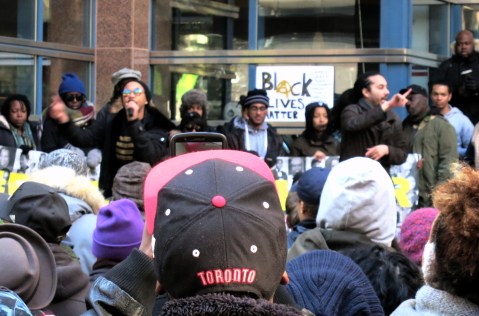
#BLMTOblackOUT, Toronto Police Service Headquarters, Toronto, Saturday, March 26, 2016, image by author
BLACK LIVES THEY MATTER HERE,” a BLMTO member shouted into a microphone; a call and declaration of a black elsewhere affirmed by the audience’s response: “BLACK LIVES THEY MATTER HERE.”
#BLMTOblackOUT, Toronto Police Service Headquarters, Toronto, Saturday, March 26, 2016, recording by author
She reiterated, “BLACK LIVES THEY MATTER HERE,” as Rhythms of Resistance Toronto, a band that performs at social justice events across the city, began to accompany her with a samba groove; this was elsewhere as a black diasporic space. “BLACK LIVES THEY MATTER HERE,” confirmed the audience in response who were now clapping along to the beat. A back-and-forth ensued where repetition and the obstinacy of the leader’s voice marked what Daphne Brooks has identified in “All That You Can’t Leave behind”: Black Female Soul Singing and the Politics of Surrogation in the Age of Catastrophe” as “urgency and excess.” This urgency and excess were further compounded by the start of another chant, which interlocked with the one she was leading. Another member of BLMTO then exclaimed into a microphone, “NO JUSTICE, NO PEACE. NO RACIST POLICE.” Some of the audience members began to heed her call. “BLACK LIVES THEY MATTER HERE / NO JUSTICE, NO PEACE. NO RACIST POLICE.” Together, the two chants, loud and overpowering, created a tension that paralleled the social pressures wrought by a Canadian silence that takes the form of anti-black racism.
After a few rounds of the layered chant were exhausted, the second leader stopped to catch her breath. By bringing the chant to a halt, she demonstrated not only the toll that shouting takes on a person but also the labor, power, and duress needed, according to Kelley Tatro, “to express personal and collective rage.” “I can’t breathe,” said Eric Garner eleven times while the police officers holding him down against the pavement disavowed him of his personhood. In the US and Canada, breathing and shouting are presumed antithetical to life within the realms of white settler colonialism.
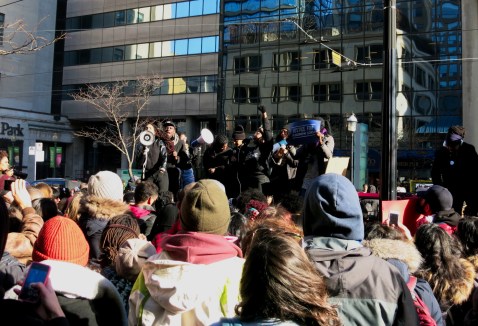
#BLMTOblackOUT, Toronto Police Service Headquarters, Toronto, Saturday, March 26, 2016, image by author
Shouting, performing anger and defiance via sound in public, is considered noise under the logics of whiteness. Thus, as Jack Halberstam writes in the introduction to Stefano Harney and Fred Moten’s The Undercommons, “In order to bring colonialism to an end then, one does not speak truth to power, one has to inhabit the crazy nonsensical, ranting language of the other, the other who has been rendered a nonentity by colonialism” (8). What both BLMTO members leading chants indicated at #BLMTOblackOUT is that shouting, in this case in the form of chanting, is another way of breathing elsewhere into existence.
#NoDAPL Solidarity March with Standing Rock
Queens Park to Nathan Phillips Square
Saturday, November 5, 2016
It began where many politically motivated public gatherings in Toronto do: outside Queen’s Park, which houses the Government of Ontario offices. Participants made speeches, chanted, cheered, jeered, and sang songs. The crowd then headed south on University Avenue sounding their discontent in front of the US Consulate building, which coincidentally is on the way to Nathan Phillips Square.
The march had been organized by and alongside Indigenous groups to show support for protesters at Standing Rock. In solidarity with the Water Protectors holding camp at Sacred Stone Camp, marchers in Toronto were expressing their disapproval of the US government’s efforts to construct an oil pipeline through Indigenous territory, a project that endangers clean water resources and violates treaties.
Once at Nathan Phillips Square, Indigenous people led participants in a pan-tribal round dance. Most strongly since Idle No More, or #IdleNoMore, in the winter of 2012/2013, round dances became emblems of Indigenous self-determination across what is typically referred to as Canada. Taking place in public venues, notably malls, as part of Idle No More actions, round dances served as communal claims not to Canada and Canadianness but rather to Turtle Island and Indigeneity.
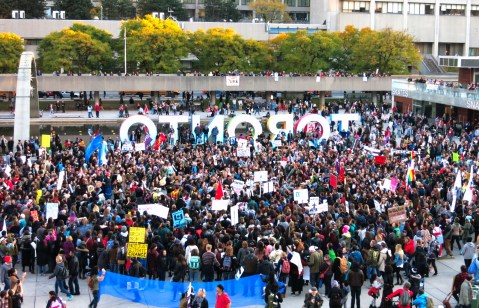
Round Dance, Nathan Phillips Square, Toronto, Saturday, November 5, 2016, image by author
Along with drumming, singing makes up the sonic elements of a round dance all the while those participants not playing a drum in the middle of the circle hold hands and move in a clockwise direction to the music. The high-pitched singing voice invites and welcomes those who have passed to join. In this way, the singing voice is an understanding that life and kinship do not cease at death. As such, the high-pitched singing voice is also a reach towards something else, a nameless elsewhere describable, graspable, through vocables. These vocables, these sonic registers of possibility, cannot be contained by the limitations of any official language. As part of round dances, then, vocables announce that while this elsewhere has yet to be legitimized through language, it exists in sound. And elsewhere’s existence is celebrated by what Anna Hoefnagels writes in “Northern Style Powwow Music: Musical Features and Meanings” are the improvised “whoops, shouts, yelps or ululations by singers” (14).
Through round dances, Indigenous people recognize that according to treaties signed by Indigenous groups and European settlers the land and its resources are to be shared. Round dances are a means to assert that Turtle Island is not another name for North America but rather a place that exists alongside North America.
Women’s March on Washington: Toronto
Queen’s Park to Nathan Phillips Square
Saturday, January 21, 2017
The labor, the creativity, of women of color is largely to thank for the organizing and mobilizing efforts that led to the Women’s March on Washington. Toronto’s “sister march” made evident the ways in which the work that women of color, particularly black women, perform in producing elsewhere has and continues to go unrecognized. The use of songs with black female vocals to lead Toronto’s Women’s March is an example of how audibility accompanies invisibility in Canada.
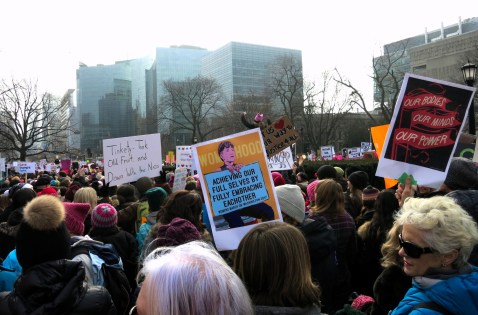
Women’s March on Washington: Toronto, Queen’s Park, Toronto, Saturday, January 21, 2017, image by author
he joyous tenor of the march was introduced partially through disco and disco-inflected songs like Sister Sledge’s “We Are Family” (1979) and the Eurythmics’ and Aretha Franklin’s duet “Sisters Are Doin’ It for Themselves” (1985). March organizers wanted participants to feel that this march was a celebration of sisterhood, of women, like Aretha Franklin and Annie Lennox, coming together harmoniously as kin. Intersectionality need not apply—maybe as a catchword but definitely not in practice.
Women’s March on Washington: Toronto, Queen’s Park, Toronto, Saturday, January 21, 2017, recording by author
.
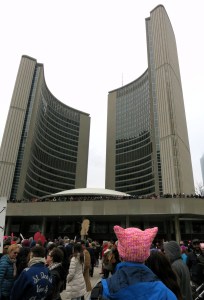
Women’s March on Washington: Toronto, Nathan Phillips Square, Toronto, Saturday, January 21, 2017, image by author
The emotional labor that Debbie, Joni, Kim, and Kathy Sledge of Sister Sledge and Aretha Franklin perform in these songs was not meant to be heard as women belaboring a black feminist, or womanist or queer, elsewhere; instead, marchers—like much of white feminism historically—enjoyed the benefits, without the risks, of an elsewhere made possible by the emotional labor that black female singers perform in dance music. In the voices of Sister Sledge and Aretha Franklin, some marchers did not recognize the invisible labor required to flourish in white settler heteropatriarchal nation-states; at the march, the power of black female voices was misappropriated to signal thriving because of white settler colonialism, paternalism, and blanket sisterhood.
Women’s March on Washington: Toronto, Queen’s Park, Toronto, Saturday, January 21, 2017, recording by author
.
Pulse Memorial
Barbara Hall Park
Monday, June 12, 2017
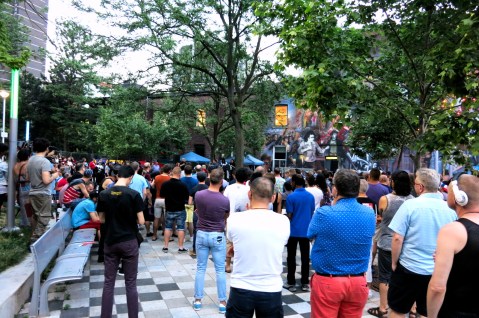
Pulse Memorial Event, Barbara Hall Park, Toronto, Monday, June 12, 2017, image by author
Adjacent to Toronto’s AIDS Memorial in Barbara Hall Park, attendees gathered to remember the forty-nine victims of the shooting at Pulse Nightclub in Orlando, Florida. The event commemorated the one-year anniversary of the shooting with a short film screening, a DJ set, musical performances, poems, short speeches, and food. Surrounded and sustained by the light of candles, the names of the forty-nine primarily Latinx victims were read by the event’s three MCs against the flickering screen of the lit wicks.
Pulse Memorial Event, Barbara Hall Park, Toronto, Monday, June 12, 2017, image by author
| Stanley Almodovar III, age 23
Amanda Alvear, 25 Oscar A. Aracena-Montero, 26 Rodolfo Ayala-Ayala, 33 Alejandro Barrios Martinez, 21 Martin Benitez Torres, 33 Antonio D. Brown, 30 Darryl R. Burt II, 29 Jonathan A. Camuy Vega, 24 Angel L. Candelario-Padro, 28 Simon A. Carrillo Fernandez, 31 Juan Chevez-Martinez, 25 Luis D. Conde, 39 Cory J. Connell, 21 Tevin E. Crosby, 25 Franky J. Dejesus Velazquez, 50 |
Deonka D. Drayton, 32
Mercedez M. Flores, 26 Peter O. Gonzalez-Cruz, 22 Juan R. Guerrero, 22 Paul T. Henry, 41 Frank Hernandez, 27 Miguel A. Honorato, 30 Javier Jorge-Reyes, 40 Jason B. Josaphat, 19 Eddie J. Justice, 30 Anthony L. Laureano Disla, 25 Christopher A. Leinonen, 32 Brenda L. Marquez McCool, 49 Jean C. Mendez Perez, 35 Akyra Monet Murray, 18 Kimberly Morris, 37 Jean C. Nieves Rodriguez, 27 |
Luis O. Ocasio-Capo, 20
Geraldo A. Ortiz-Jimenez, 25 Eric I. Ortiz-Rivera, 36 Joel Rayon Paniagua, 32 Enrique L. Rios Jr., 25 Juan P. Rivera Velazquez, 37 Yilmary Rodriguez Solivan, 24 Christopher J. Sanfeliz, 24 Xavier E. Serrano Rosado, 35 Gilberto R. Silva Menendez, 25 Edward Sotomayor Jr., 34 Shane E. Tomlinson, 33 Leroy Valentin Fernandez, 25 Luis S. Vielma, 22 Luis D. Wilson-Leon, 37 Jerald A. Wright, 31 |
The reading of their names was an incantation of forty-nine lives lost and an invocation of an elsewhere maintained through remembrance. The vocalization of their names was thus a commitment to an understanding of intimacy that refuses the state’s limited definitions of what and whom constitutes a (grievable) life; and concurrently, their names were sonic acknowledgments of the violence that is basic to life for many under white settler colonialism, what Christina Sharpe calls “being in the wake.” Their names, too, were evocations of the queer of color dancefloor. It us under and around the disco ball, after all, that many queers of color enact an elsewhere, love light in flight. Therefore, the reading of the forty-nine names was an assertion that life and intimacy are sonic demands and collective endeavors.
Night March
George Hislop Park to Old City Hall
Wednesday, June 21, 2017
Annually, some queer Canadians take it upon themselves to organize a Night March, an unofficial (by choice) Pride event that insists that Pride has been and will continue to remain political. Night March is a refusal to abide by the respectability politics attached to the visibility and corporatism that Pride garners across Toronto. “LET’S GET CRITICAL, OUR PRIDE IS POLITICAL,” one of the chants goes. Participants meet at a predetermined location, announced through posters and social media, somewhere near or in the Church and Wellesley Neighborhood—Toronto’s “gayborhood.” Before setting out to march, participants listen to a small set of speakers who share information on some of the issues that are not being discussed at Toronto’s official Pride events: the defunding of organizations working on HIV/AIDS and the housing discrimination faced by trans women and sex workers, for example.
The gathering at George Hislop Park this year also made evident a particular rift among LGBTQ+ people, groups, and institutions surrounding this year’s Pride festivities: whether to support BLMTO’s actions and demands at last year’s Pride Parade, namely the removal of uniform police from partaking in future parades. On Sunday, June 26, 2016 and in their role as honored guests of the parade, members of BLMTO halted Toronto’s Pride Parade at the intersection of Yonge and College Streets for thirty minutes—to the dismay of some and the approval of others. It was then that BLMTO served Pride Toronto, the organization that runs Pride in the city, with a list of demands. Pride Toronto’s Executive Director at time Mathieu Chantelois hastily signed BLMTO’s list of demands only to retract his approval shortly thereafter. Following months of heated debate and backlash against BLMTO, the Pride Toronto membership formally agreed to adopt all of BLMTO’s demands at its Annual General Meeting (AGM) on January 27, 2017—uniformed police would not march at this year’s Pride parade.
At George Hislop Park, Night March participants were unequivocal in their support of BLMTO. The mostly millennial and predominantly white gathering’s chants, which they shouted as they made their way down Church Street, included “BLACK LIVES MATTER” and “NO JUSTICE, NO PEACE. NO RACIST POLICE.”
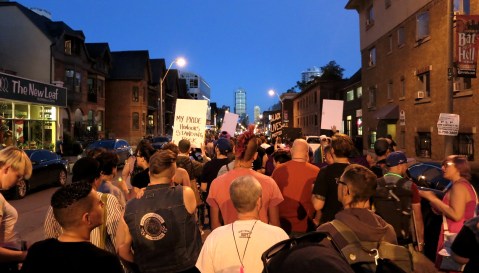
Night March, Church Street, Toronto, Wednesday, June 21, 2017, image by author
Night March participants even halted traffic on College Street as they briefly occupied the traffic lanes in front of Toronto Police Service Headquarters. Accompanied by Rhythms of Resistance Toronto, a few participants called out “BLACK LIVES THEY MATTER HERE.” The rest of the gathering responded, “BLACK LIVES THEY MATTER HERE.”
Night March, Toronto Police Service Headquarters, Toronto, June 21, 2017, image by author
.

Night March, Toronto Police Service Headquarters, Toronto, June 21, 2017, image by author
Police officers who were following the marchers on bicycles sounded out a short siren, a sound of disapproval and a warning to disperse. The marchers continued chanting. They then switched chants and began shouting in unison, “NO JUSTICE, NO PEACE. NO RACIST POLICE.” After a few rounds of this chant, one participant led the gathering into another chant:
WHEN BLACK LIVES ARE UNDER ATTACK, WE REVOLT, UNITE, FIGHT BACK. x9
WHEN TRANS LIVES ARE UNDER ATTACK, WE REVOLT, UNITE, FIGHT BACK. x3
WHEN INDIGENOUS LIVES ARE UNDER ATTACK, WE REVOLT, UNITE, FIGHT BACK. x3
WHEN WOMEN’S LIVES ARE UNDER ATTACK, WE REVOLT, UNITE, FIGHT BACK. x3
WHEN QUEER LIVES ARE UNDER ATTACK, WE REVOLT, UNITE, FIGHT BACK. x3
The chants at Night March were sonic testaments of an elsewhere impossible to imagine and enact without the collective labor of BLMTO’s membership since its formation in 2014, which has included but has not been limited to #BLMTOtentcity and their protests at Toronto’s 2016 Pride Parade. The chants were also a compilation and validation of noisy political activity—a loud elsewhere—in a city and in a nation-state that prefers, promotes, and is predicated on the silence, the violence, that is white settler colonialism.
Conclusion
“Only together,” argues Gloria Anzaldúa in Borderlands/La Frontera, “can we be a force” (209).
Together, these voices at public gatherings say NO to Toronto, Canada at so-called 150; NO is a refusal to be complicit, to stay silent, to death. These are voices that do not consent to white settler colonialism. A NO to police brutality, the disappearance and murders of Indigenous women and girls, the conditions that drive Indigenous youth to suicide, lack of clean drinking water, carding, anti-semitic and Islamophobic hate crimes, the different forms of violence LGBTQ+ people, particularly trans women, face, the municipal, provincial, and federal governments defunding and unfunding of public housing and healthcare programs. It is by amplifying and listening to these NOs that we actually hear the workings of a YES, to an affirmation of elsewhere in the here and now that is always already attuned to the past and future, to lives—black, trans, Indigenous, feminine, queer—that matter, to life otherwise.
—
Featured Image: Round Dance, Nathan Phillips Square, Toronto, Saturday, November 5, 2016, photo by author
—
Gabriela Jimenez defended her PhD dissertation in ethnomusicology at the University of Toronto this spring. Her dissertation is on the ways in which nonnormatively gendered and sexually oriented persons in Mexico City use musical performances to alter their surroundings. Her writing has been featured in Black Music Research Journal and The Fader.
—
REWIND!…If you liked this post, you may also dig:
“Quebec’s #casseroles: on participation, percussion and protest”-Jonathan Sterne
“Deejaying her Listening: Learning through Life Stories of Human Rights Violations”-Emmanuelle Sonntag and Bronwen Low
“Listening to the Border: ‘”2487″: Giving Voice in Diaspora’ and the Sound Art of Luz María Sánchez”-D. Ines Casillas
Share this:


Current Top Posts





April 2021

January 2020

November 2019

October 2019

August 2019

April 2014

November 2017

March 2015

December 2017

October 2015
 Sounding Out!
Recent Comments