
Voices at Work: Listening to and for Elsewhere at Public Gatherings in Toronto, Canada (at So-called 150)

“Decolonization,” Eve Tuck and K. Wayne Yang propose in “Decolonization is Not a Metaphor,” “is not an ‘and.’ It is an elsewhere.”
Elsewhere, not here, not now. Not here. Not now. Enough!
In the context of decolonization, elsewhere is a refusal to accept the conditions of life as is in the here and now.
Elsewhere is that place that already is, that place that used to be, that place that might just be.
Elsewhere, an endeavor to enact otherwise.
Elsewhere, a commitment to perform the work to create, memorialize, and sustain some place else because the here and now are not enough.
This essay listens to and for elsewhere in the voices performing decolonial efforts at some public gatherings—rallies, protests, marches, and memorials—in Toronto between March 2016 and June 2017. These gatherings took place in the lead-up to Canada (at so-called) 150, the federally funded, almost countrywide commemoration of Canadian Confederacy. At these public gatherings, the dissenting sounds of elsewhere reverberate to break the silence tantamount to Canada as a white settler colonial nation-state. It is by disrupting this silence that elsewhere takes form; “a break of something,” writes Sara Ahmed in her latest book, Living a Feminist Life, is also “the start of something” (200). This essay is about listening to the voice as a social prism of sound that disperses and reflects power. Thus by listening to and for elsewhere at public gatherings, we hear voices at work—in formation—producing an elsewhere by refusing to comply with the sonic demands of a Canadianness based on white settler colonialism, dependent on state-sanctioned multiculturalism, and rendered as silence.
Canadian Multiculturalism as Silent Visibility,
or the Visible Silence of White Settler Colonialism as Canada
Silence is often a condition of belonging that nation-states attach to citizenship. Indeed in Canada, visibility begets silence. Canadian Prime Minister Pierre Elliott Trudeau (1968–1979; 1980–1984) adopted Multiculturalism within a Bilingual Framework as official policy in 1971. This would subsequently catalyze the appearance of the figure of the visible minority, a demographic designation for anyone who is non-white and non-Indigenous but used as an umbrella term to denote “person of color.” The visible minority has been central to the discourse of diversity as multiculturalism; and diversity continues to be an enduring tenet of Canadian nationalism.
However, according to Eva Mackey’s The House of Difference: Cultural Politics and National Identity in Canada, the policy of multiculturalism is “primarily concerned with mobilising diversity for the project of nation-building, as well as limiting that diversity to symbolic rather than political forms” (80). To be understood as Canadian, one must ascribe to its multicultural terms, namely accepting white settler colonialism—and the sonic politics of whiteness—as norm; and typically, whiteness is thought to be unmarked and inaudible, silent.
It is in this way that in Canada silence is understood as harmony. Another way to put this: social harmony is believed to derive from silence. Any person or group or form of sound that breaks this social contract, what Audra Simpson refers to in “The State is a Man: Theresa Spence, Loretta Saunders and the Gender of Settler Sovereignty” as “Canadian silence,” is categorized as noise or noisy. Thus in the context of the US, and yet very much applicable to Canada, Jennifer Lynn Stoever writes in her book The Sonic Color Line, “As dominant listening practices discipline us to process white male ways of sounding as default, natural, normal, and desirable…they deem alternate ways of listening and sounding aberrant” (12).
Social censorship in Canada of what can and cannot be said in public is a distinguishing feature of everyday life. Silence is a sonic means by which white settler colonialism thrives. Stay quiet. Be quiet. Or, else; where the threat becomes a dare to live a life unrestrained by what Lesley Belleau describes as “the false safety of silence” in The Winter We Danced (181).
This else though. What are the possibilities of this else? Where might it lead?
Elsewhere.
Black Lives Matter Toronto Rally /// #BLMTOblackOUT
#BLMTOtentcity /// Toronto Police Service Headquarters
Saturday, March 26, 2016
It was a blustery, cold, spring day. Black Lives Matter Toronto (BLMTO) had organized a rally, #BLMTOblackOUT, to commemorate the then one-week anniversary of #BLMTOtentcity—their occupation of Toronto Police Service Headquarters’ outdoor plaza. On Sunday, March 20, 2016 outside Toronto City Hall in Nathan Phillips Square, BLMTO held a rally against anti-black racism—police brutality (in particular the killing of Andrew Loku and Jermaine Carby by the police), carding, and the defunding of black cultural programs, Afrofest namely. By evening’s end, the rally had moved to Toronto Police Service Headquarters where it became an occupation that lasted two weeks.
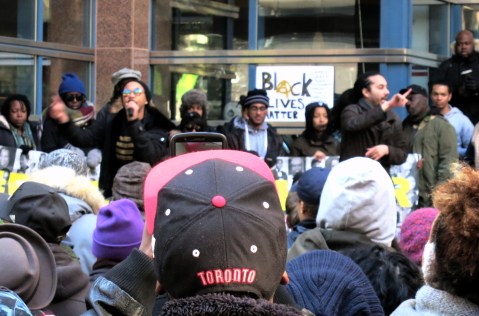
#BLMTOblackOUT, Toronto Police Service Headquarters, Toronto, Saturday, March 26, 2016, image by author
BLACK LIVES THEY MATTER HERE,” a BLMTO member shouted into a microphone; a call and declaration of a black elsewhere affirmed by the audience’s response: “BLACK LIVES THEY MATTER HERE.”
#BLMTOblackOUT, Toronto Police Service Headquarters, Toronto, Saturday, March 26, 2016, recording by author
She reiterated, “BLACK LIVES THEY MATTER HERE,” as Rhythms of Resistance Toronto, a band that performs at social justice events across the city, began to accompany her with a samba groove; this was elsewhere as a black diasporic space. “BLACK LIVES THEY MATTER HERE,” confirmed the audience in response who were now clapping along to the beat. A back-and-forth ensued where repetition and the obstinacy of the leader’s voice marked what Daphne Brooks has identified in “All That You Can’t Leave behind”: Black Female Soul Singing and the Politics of Surrogation in the Age of Catastrophe” as “urgency and excess.” This urgency and excess were further compounded by the start of another chant, which interlocked with the one she was leading. Another member of BLMTO then exclaimed into a microphone, “NO JUSTICE, NO PEACE. NO RACIST POLICE.” Some of the audience members began to heed her call. “BLACK LIVES THEY MATTER HERE / NO JUSTICE, NO PEACE. NO RACIST POLICE.” Together, the two chants, loud and overpowering, created a tension that paralleled the social pressures wrought by a Canadian silence that takes the form of anti-black racism.
After a few rounds of the layered chant were exhausted, the second leader stopped to catch her breath. By bringing the chant to a halt, she demonstrated not only the toll that shouting takes on a person but also the labor, power, and duress needed, according to Kelley Tatro, “to express personal and collective rage.” “I can’t breathe,” said Eric Garner eleven times while the police officers holding him down against the pavement disavowed him of his personhood. In the US and Canada, breathing and shouting are presumed antithetical to life within the realms of white settler colonialism.
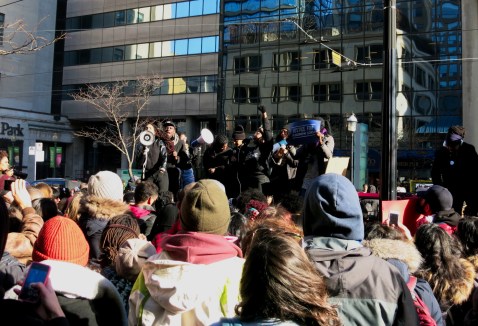
#BLMTOblackOUT, Toronto Police Service Headquarters, Toronto, Saturday, March 26, 2016, image by author
Shouting, performing anger and defiance via sound in public, is considered noise under the logics of whiteness. Thus, as Jack Halberstam writes in the introduction to Stefano Harney and Fred Moten’s The Undercommons, “In order to bring colonialism to an end then, one does not speak truth to power, one has to inhabit the crazy nonsensical, ranting language of the other, the other who has been rendered a nonentity by colonialism” (8). What both BLMTO members leading chants indicated at #BLMTOblackOUT is that shouting, in this case in the form of chanting, is another way of breathing elsewhere into existence.
#NoDAPL Solidarity March with Standing Rock
Queens Park to Nathan Phillips Square
Saturday, November 5, 2016
It began where many politically motivated public gatherings in Toronto do: outside Queen’s Park, which houses the Government of Ontario offices. Participants made speeches, chanted, cheered, jeered, and sang songs. The crowd then headed south on University Avenue sounding their discontent in front of the US Consulate building, which coincidentally is on the way to Nathan Phillips Square.
The march had been organized by and alongside Indigenous groups to show support for protesters at Standing Rock. In solidarity with the Water Protectors holding camp at Sacred Stone Camp, marchers in Toronto were expressing their disapproval of the US government’s efforts to construct an oil pipeline through Indigenous territory, a project that endangers clean water resources and violates treaties.
Once at Nathan Phillips Square, Indigenous people led participants in a pan-tribal round dance. Most strongly since Idle No More, or #IdleNoMore, in the winter of 2012/2013, round dances became emblems of Indigenous self-determination across what is typically referred to as Canada. Taking place in public venues, notably malls, as part of Idle No More actions, round dances served as communal claims not to Canada and Canadianness but rather to Turtle Island and Indigeneity.
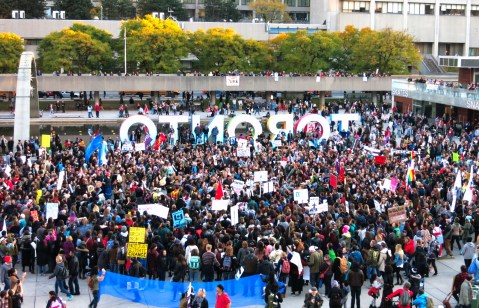
Round Dance, Nathan Phillips Square, Toronto, Saturday, November 5, 2016, image by author
Along with drumming, singing makes up the sonic elements of a round dance all the while those participants not playing a drum in the middle of the circle hold hands and move in a clockwise direction to the music. The high-pitched singing voice invites and welcomes those who have passed to join. In this way, the singing voice is an understanding that life and kinship do not cease at death. As such, the high-pitched singing voice is also a reach towards something else, a nameless elsewhere describable, graspable, through vocables. These vocables, these sonic registers of possibility, cannot be contained by the limitations of any official language. As part of round dances, then, vocables announce that while this elsewhere has yet to be legitimized through language, it exists in sound. And elsewhere’s existence is celebrated by what Anna Hoefnagels writes in “Northern Style Powwow Music: Musical Features and Meanings” are the improvised “whoops, shouts, yelps or ululations by singers” (14).
Through round dances, Indigenous people recognize that according to treaties signed by Indigenous groups and European settlers the land and its resources are to be shared. Round dances are a means to assert that Turtle Island is not another name for North America but rather a place that exists alongside North America.
Women’s March on Washington: Toronto
Queen’s Park to Nathan Phillips Square
Saturday, January 21, 2017
The labor, the creativity, of women of color is largely to thank for the organizing and mobilizing efforts that led to the Women’s March on Washington. Toronto’s “sister march” made evident the ways in which the work that women of color, particularly black women, perform in producing elsewhere has and continues to go unrecognized. The use of songs with black female vocals to lead Toronto’s Women’s March is an example of how audibility accompanies invisibility in Canada.
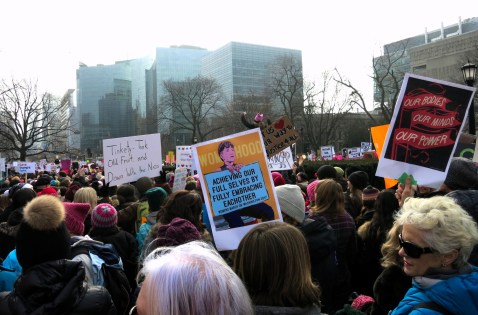
Women’s March on Washington: Toronto, Queen’s Park, Toronto, Saturday, January 21, 2017, image by author
he joyous tenor of the march was introduced partially through disco and disco-inflected songs like Sister Sledge’s “We Are Family” (1979) and the Eurythmics’ and Aretha Franklin’s duet “Sisters Are Doin’ It for Themselves” (1985). March organizers wanted participants to feel that this march was a celebration of sisterhood, of women, like Aretha Franklin and Annie Lennox, coming together harmoniously as kin. Intersectionality need not apply—maybe as a catchword but definitely not in practice.
Women’s March on Washington: Toronto, Queen’s Park, Toronto, Saturday, January 21, 2017, recording by author
.
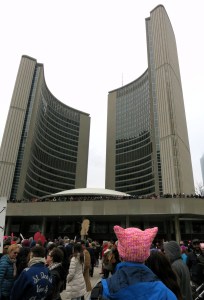
Women’s March on Washington: Toronto, Nathan Phillips Square, Toronto, Saturday, January 21, 2017, image by author
The emotional labor that Debbie, Joni, Kim, and Kathy Sledge of Sister Sledge and Aretha Franklin perform in these songs was not meant to be heard as women belaboring a black feminist, or womanist or queer, elsewhere; instead, marchers—like much of white feminism historically—enjoyed the benefits, without the risks, of an elsewhere made possible by the emotional labor that black female singers perform in dance music. In the voices of Sister Sledge and Aretha Franklin, some marchers did not recognize the invisible labor required to flourish in white settler heteropatriarchal nation-states; at the march, the power of black female voices was misappropriated to signal thriving because of white settler colonialism, paternalism, and blanket sisterhood.
Women’s March on Washington: Toronto, Queen’s Park, Toronto, Saturday, January 21, 2017, recording by author
.
Pulse Memorial
Barbara Hall Park
Monday, June 12, 2017
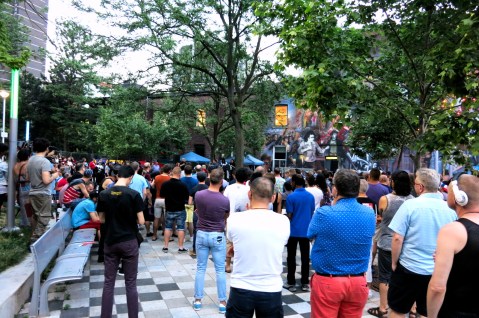
Pulse Memorial Event, Barbara Hall Park, Toronto, Monday, June 12, 2017, image by author
Adjacent to Toronto’s AIDS Memorial in Barbara Hall Park, attendees gathered to remember the forty-nine victims of the shooting at Pulse Nightclub in Orlando, Florida. The event commemorated the one-year anniversary of the shooting with a short film screening, a DJ set, musical performances, poems, short speeches, and food. Surrounded and sustained by the light of candles, the names of the forty-nine primarily Latinx victims were read by the event’s three MCs against the flickering screen of the lit wicks.
Pulse Memorial Event, Barbara Hall Park, Toronto, Monday, June 12, 2017, image by author
| Stanley Almodovar III, age 23
Amanda Alvear, 25 Oscar A. Aracena-Montero, 26 Rodolfo Ayala-Ayala, 33 Alejandro Barrios Martinez, 21 Martin Benitez Torres, 33 Antonio D. Brown, 30 Darryl R. Burt II, 29 Jonathan A. Camuy Vega, 24 Angel L. Candelario-Padro, 28 Simon A. Carrillo Fernandez, 31 Juan Chevez-Martinez, 25 Luis D. Conde, 39 Cory J. Connell, 21 Tevin E. Crosby, 25 Franky J. Dejesus Velazquez, 50 |
Deonka D. Drayton, 32
Mercedez M. Flores, 26 Peter O. Gonzalez-Cruz, 22 Juan R. Guerrero, 22 Paul T. Henry, 41 Frank Hernandez, 27 Miguel A. Honorato, 30 Javier Jorge-Reyes, 40 Jason B. Josaphat, 19 Eddie J. Justice, 30 Anthony L. Laureano Disla, 25 Christopher A. Leinonen, 32 Brenda L. Marquez McCool, 49 Jean C. Mendez Perez, 35 Akyra Monet Murray, 18 Kimberly Morris, 37 Jean C. Nieves Rodriguez, 27 |
Luis O. Ocasio-Capo, 20
Geraldo A. Ortiz-Jimenez, 25 Eric I. Ortiz-Rivera, 36 Joel Rayon Paniagua, 32 Enrique L. Rios Jr., 25 Juan P. Rivera Velazquez, 37 Yilmary Rodriguez Solivan, 24 Christopher J. Sanfeliz, 24 Xavier E. Serrano Rosado, 35 Gilberto R. Silva Menendez, 25 Edward Sotomayor Jr., 34 Shane E. Tomlinson, 33 Leroy Valentin Fernandez, 25 Luis S. Vielma, 22 Luis D. Wilson-Leon, 37 Jerald A. Wright, 31 |
The reading of their names was an incantation of forty-nine lives lost and an invocation of an elsewhere maintained through remembrance. The vocalization of their names was thus a commitment to an understanding of intimacy that refuses the state’s limited definitions of what and whom constitutes a (grievable) life; and concurrently, their names were sonic acknowledgments of the violence that is basic to life for many under white settler colonialism, what Christina Sharpe calls “being in the wake.” Their names, too, were evocations of the queer of color dancefloor. It us under and around the disco ball, after all, that many queers of color enact an elsewhere, love light in flight. Therefore, the reading of the forty-nine names was an assertion that life and intimacy are sonic demands and collective endeavors.
Night March
George Hislop Park to Old City Hall
Wednesday, June 21, 2017
Annually, some queer Canadians take it upon themselves to organize a Night March, an unofficial (by choice) Pride event that insists that Pride has been and will continue to remain political. Night March is a refusal to abide by the respectability politics attached to the visibility and corporatism that Pride garners across Toronto. “LET’S GET CRITICAL, OUR PRIDE IS POLITICAL,” one of the chants goes. Participants meet at a predetermined location, announced through posters and social media, somewhere near or in the Church and Wellesley Neighborhood—Toronto’s “gayborhood.” Before setting out to march, participants listen to a small set of speakers who share information on some of the issues that are not being discussed at Toronto’s official Pride events: the defunding of organizations working on HIV/AIDS and the housing discrimination faced by trans women and sex workers, for example.
The gathering at George Hislop Park this year also made evident a particular rift among LGBTQ+ people, groups, and institutions surrounding this year’s Pride festivities: whether to support BLMTO’s actions and demands at last year’s Pride Parade, namely the removal of uniform police from partaking in future parades. On Sunday, June 26, 2016 and in their role as honored guests of the parade, members of BLMTO halted Toronto’s Pride Parade at the intersection of Yonge and College Streets for thirty minutes—to the dismay of some and the approval of others. It was then that BLMTO served Pride Toronto, the organization that runs Pride in the city, with a list of demands. Pride Toronto’s Executive Director at time Mathieu Chantelois hastily signed BLMTO’s list of demands only to retract his approval shortly thereafter. Following months of heated debate and backlash against BLMTO, the Pride Toronto membership formally agreed to adopt all of BLMTO’s demands at its Annual General Meeting (AGM) on January 27, 2017—uniformed police would not march at this year’s Pride parade.
At George Hislop Park, Night March participants were unequivocal in their support of BLMTO. The mostly millennial and predominantly white gathering’s chants, which they shouted as they made their way down Church Street, included “BLACK LIVES MATTER” and “NO JUSTICE, NO PEACE. NO RACIST POLICE.”
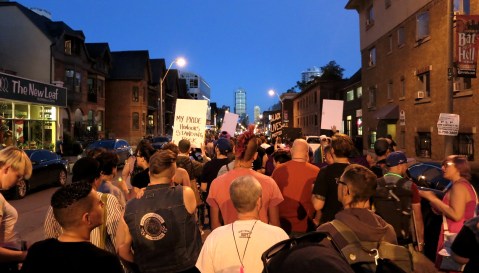
Night March, Church Street, Toronto, Wednesday, June 21, 2017, image by author
Night March participants even halted traffic on College Street as they briefly occupied the traffic lanes in front of Toronto Police Service Headquarters. Accompanied by Rhythms of Resistance Toronto, a few participants called out “BLACK LIVES THEY MATTER HERE.” The rest of the gathering responded, “BLACK LIVES THEY MATTER HERE.”
Night March, Toronto Police Service Headquarters, Toronto, June 21, 2017, image by author
.

Night March, Toronto Police Service Headquarters, Toronto, June 21, 2017, image by author
Police officers who were following the marchers on bicycles sounded out a short siren, a sound of disapproval and a warning to disperse. The marchers continued chanting. They then switched chants and began shouting in unison, “NO JUSTICE, NO PEACE. NO RACIST POLICE.” After a few rounds of this chant, one participant led the gathering into another chant:
WHEN BLACK LIVES ARE UNDER ATTACK, WE REVOLT, UNITE, FIGHT BACK. x9
WHEN TRANS LIVES ARE UNDER ATTACK, WE REVOLT, UNITE, FIGHT BACK. x3
WHEN INDIGENOUS LIVES ARE UNDER ATTACK, WE REVOLT, UNITE, FIGHT BACK. x3
WHEN WOMEN’S LIVES ARE UNDER ATTACK, WE REVOLT, UNITE, FIGHT BACK. x3
WHEN QUEER LIVES ARE UNDER ATTACK, WE REVOLT, UNITE, FIGHT BACK. x3
The chants at Night March were sonic testaments of an elsewhere impossible to imagine and enact without the collective labor of BLMTO’s membership since its formation in 2014, which has included but has not been limited to #BLMTOtentcity and their protests at Toronto’s 2016 Pride Parade. The chants were also a compilation and validation of noisy political activity—a loud elsewhere—in a city and in a nation-state that prefers, promotes, and is predicated on the silence, the violence, that is white settler colonialism.
Conclusion
“Only together,” argues Gloria Anzaldúa in Borderlands/La Frontera, “can we be a force” (209).
Together, these voices at public gatherings say NO to Toronto, Canada at so-called 150; NO is a refusal to be complicit, to stay silent, to death. These are voices that do not consent to white settler colonialism. A NO to police brutality, the disappearance and murders of Indigenous women and girls, the conditions that drive Indigenous youth to suicide, lack of clean drinking water, carding, anti-semitic and Islamophobic hate crimes, the different forms of violence LGBTQ+ people, particularly trans women, face, the municipal, provincial, and federal governments defunding and unfunding of public housing and healthcare programs. It is by amplifying and listening to these NOs that we actually hear the workings of a YES, to an affirmation of elsewhere in the here and now that is always already attuned to the past and future, to lives—black, trans, Indigenous, feminine, queer—that matter, to life otherwise.
—
Featured Image: Round Dance, Nathan Phillips Square, Toronto, Saturday, November 5, 2016, photo by author
—
Gabriela Jimenez defended her PhD dissertation in ethnomusicology at the University of Toronto this spring. Her dissertation is on the ways in which nonnormatively gendered and sexually oriented persons in Mexico City use musical performances to alter their surroundings. Her writing has been featured in Black Music Research Journal and The Fader.
—
 REWIND!…If you liked this post, you may also dig:
“Quebec’s #casseroles: on participation, percussion and protest”-Jonathan Sterne
“Deejaying her Listening: Learning through Life Stories of Human Rights Violations”-Emmanuelle Sonntag and Bronwen Low
“Listening to the Border: ‘”2487″: Giving Voice in Diaspora’ and the Sound Art of Luz María Sánchez”-D. Ines Casillas
Share this:

“To Unprotect and Subserve”: King Britt Samples the Sonic Archive of Police Violence
Author’s note: In line with the ethics of listening considered below, I’ve chosen not to embed the videos of police violence that I discuss. But I’ve linked to them when available for readers who’d like to see/hear their content.–Alex Werth
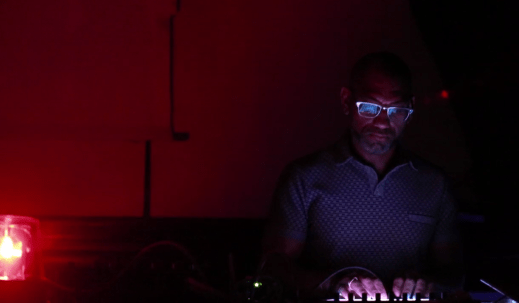
“I’m scared to death of these police.” Dave Chappelle’s voice—pitched down, but nonetheless recognizable—calls from the speakers, cutting through the darkness of Oakland, CA’s Starline Social Club. It’s closing night of the 2016 Matatu Festival of Stories, an annual celebration of Black diasporic narratives, technologies, and futures routed through the San Francisco Bay Area. King Britt—an eclectic electronic pioneer and producer, and former DJ for Digable Planets—has landed with the third version of “To Unprotect and Subserve: A Sonic Response.” (It was first performed after a march for Mike Brown in Ferguson in 2014.) I can barely see Britt, his solemn look bathed in the dim glow of electronic consoles and the red-and-blue pulse of police lights. “First money I got,” Chappelle continues, “I went out and bought me a police scanner. I just listen to these mothafuckas before I go out, just to make sure everything’s cool. ‘Cause you hear shit on there: ‘Calling all cars, calling all cars. Be on the lookout for a Black male between 4’7” and 6’8”.’” With this double invocation, Britt invites us to listen. Specifically, à la Chappelle, he invites us to listen back—to attune to the agents of a racialized security state that, from ShotSpotter to CIA surveillance, profile and police the world’s sonic landscapes.
This essay considers the ethical effects/affects in King Britt’s work of sampling what I call the sonic archive of police violence. From Oakland to Ferguson, the Movement for Black Lives has raised critical questions about the mass surveillance of Black and Brown communities, the undemocratic control of data in cases of police misconduct, and the use of smart phones and other recording devices as means to hold the state accountable. But the failure to indict or even discipline cops in police killings where audio/video evidence was not only available but overwhelming, from Eric Garner to Tamir Rice, casts doubt upon the emancipatory power of simply recording our race-based system of criminal (in)justice. And when re-presented ad nauseum on the news and social media, these recordings can retraumatize those most vulnerable to racist state violence. Indeed, at a discussion among Black artists at Matatu, each panelist admitted to limiting their exposure to what poet Amir Sulaiman called “e-lynching.”
What, then, can we learn from Britt about the praxis and politics of listening back when the circulation of what KRS One dubbed the “sound of da police” is now daily, digital, and ubiquitous? How can we make sense of audio recording when it’s come to signal repression, resistance, and painful reprisal all at the same time?
Back in the darkness of the club, Chappelle’s voice dissolves into a conversation between Darrin Wilson and a dispatcher from the Ferguson Police, who sends him to find the body of Mike Brown—a “Black male in a white t-shirt,” reportedly “running toward QuikTrip” with a stolen box of Swishers. The optimistic waves of sound that open the piece resolve into a throbbing pulse of 1/32nd notes that sounds like a helicopter. Britt begins to loop in other elements: a low bass tone, a syncopated stab. With kicks and reverb-heavy snares, he builds a slow, head-nodding beat (60 bpm) that coalesces around the vocal sample—swaddling, softening, and ultimately subsuming it with high-pitched legato tones. The synths are sorrowful. But the mesmerizing beat embraces listeners in their mourning.
This act of listening to the state differs from the one parodied at the start. Chappelle attends to the police scanner as a form of precaution, checking whether it’s safe for him to enter a realm where he can be marked as criminal (“Staying in the crib tonight! Fuck that!” he concludes). But Britt’s sonic bricolage is more therapeutic than protective. He uses repetition, reverb, and improvised melody to score a sonic altar—to open space, rather than control time—where we can meditate on the archive of police violence with the intention to heal. “Sometimes to push through the trauma we need to experience it in a different context,” he tells me over email. “There is room for healing within the chords and sounds that are carefully curated.” Britt thus reactivates the pathos buried inside this archive—reclaiming what Susan Sontag, in “On Photography,” recognizes as an “ethical content” of representational form that can fade from careless repetition (21).
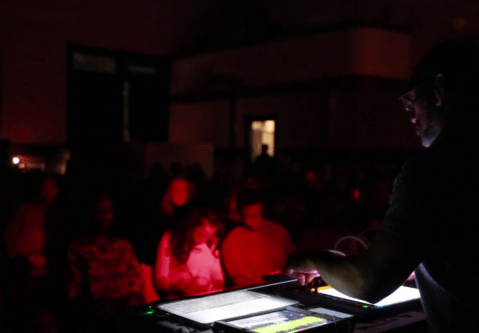
Picture of King Britt courtesy of Eli Jacobs-Fantauzzi for the Matatu Festival of Stories.
After removing the loops one-by-one, until the helicopter sound is all that remains, Britt releases a new sample into the mix. It’s audio from a cell-phone video taken in 2013 by two Black men as they’re harassed by White cops during a stop-and-frisk in Philadelphia (Britt’s hometown). He scores the somber scene with dissonant organs and an offbeat percussive note that reminds me of stress-induced arrhythmia—a heartbeat out-of-place, aggravated, precarious . Vibrating with anxiety, the soundscape temporarily snatches listeners from mourning, demanding that we listen in witness, instead.
The video reveals that the police tear the two men apart, pinning them to the cruiser. But the violence of the encounter is verbal as much as physical. The cops’ language and tone become increasingly abusive as the men contest their treatment in a sounding of agency that Regina Bradley, writing about Black women, calls “sonic disrespectability.” Philip Nace, the more audible of the officers, embodies a double bind built into what Jennifer Lynn Stoever calls the “sonic color line.” He threatens one of the men when he speaks out (“You’re gonna be in violation if you keep running your mouth when I split your wig open.”). But he turns around and ridicules him when, instead, the man refuses to speak (“You don’t know what we know…Right? Right?! What, you don’t hear now?”). As Stoever notes, the demand that African Americans speak when spoken to, but in a way that sounds their submission to Whites, is a feature of anti-Black oppression stemming from the “racial etiquette” of slavery (30-32).
Britt’s manipulation of vocals speaks to the centrality of sampling in hip-hop. According to Tricia Rose, hip-hop artists have long prioritized the sample as a way to recognize and renovate a communal repertoire of songs and sounds (79). And given the realities of anti-Black oppression in the U.S., this repertoire has often entailed the “sound(s) of da police.” From sirens to skits to verses, rappers and producers have remixed the sounds of the state to characterize, caricature, and critique the country’s criminal justice system. But Britt’s trespass on the state’s sonic sovereignty differs from classics like “Fuck tha Police,” in which N.W.A. conducts a mock trial of “the system.” Whereas N.W.A. reappropriates the rituals of legal testimony and judgment to condemn the police (“The jury has found you guilty of being a redneck, white-bread, chicken-shit mothafucka.”), Britt’s musical re-mediation of police violence favors grief over moralizing, dirge over indictment.
In this vein, the musical/ethical demand to witness waxes but then wanes. The soundscape becomes more and more dissonant until the vocals are consumed by a thunderous sound. Suddenly, the storm clears. Britt hits a pre-loaded drum track (136 bpm) with driving double-time congas and chimes over a steady sway of half-time kicks. He starts to improvise on the synth in an angelic register, revealing the impact of his early encounters with Sun Ra on his aesthetic. The catharsis of the scene is accentuated by the sporadic sound of exhalation. This sense of freedom dissolves when the beat runs out of gas…or is pulled over. In its stead, Britt introduces audio from the dashboard camera of Brian Encinia, the Texas State Trooper who arrested Sandra Bland. Encinia and Bland’s voices are pitched down and filtered through an echo delay, lending an intense sense of dread to his enraged orders (“Get out of the car! I will light you up!”).
Here, I sense the affective resonance of dub. Like the musicians on rotation in Michael Veal’s Dub, Britt manipulates the timbre and texture of voices in a way that demands a different sort of attention from listeners who, like me, may be desensitized to the sonic violence of the racialized security state as it’s vocalized and circulated in and between Ferguson, Philly, and Prairie View. Britt reworks the character and context of the vocals into a looping soundscape, and that soundscape sends me into a meditative space—one in which the vibes of humiliation and malice “speak” to me more than Encinia’s individual utterances as an agent of the state. According to Veal, the pioneers of dub developed a sound that, while reverberating with the severity of the Jamaican postcolony, “transport[ed] their listeners to dancefloor nirvana” and “the far reaches of the cultural and political imagination” (13). Now, conducting our Matatu, Britt is both an engineer and a medicine man. Rather than simply diagnose the state of anti-Black police violence in the American (post)colony, he summons a space where we can reconnect with the voices (and lives) lost to the archives of police violence amid what Veal refers to as dub’s Afro-sonic repertoire of “reverb, remembrance, and reverie” (198).
What Sontag once wrote about war photography no doubt holds for viral videos (and the less-recognized soundscapes that animate them). Namely, when used carelessly or even for gain, the documentary-style reproduction of the sonic archive of police violence can work to inure or even injure listeners. But in Britt’s care-full bricolage, sampling serves to literally re-mediate the violence of racialized policing and its reverberations throughout our everyday landscapes of listening. It’s not the fact of repetition, then, but the modality, that matters. And Britt draws upon deep traditions of scoring, hip-hop, and dub to sonically construct what he calls a “space to breathe.”
—
Featured image of King Britt’s performance courtesy of Eli Jacobs-Fantauzzi for the Matatu Festival of Stories.
—
Alex Werth is a doctoral candidate in the Department of Geography at UC Berkeley. His research looks at the routine regulation of expressive culture, especially music and dance, within the apparatuses of public nuisance and safety as a driver of cultural foreclosure in Oakland, CA. It also considers how some of those same cultural practices enable forms of coordination and collectivity that run counter to the notions of “the public” written into law, plan, and property. In 2016, he was a member of the curatorial cohort for the Matatu Festival of Stories and is currently a Public Imagination Fellow at Yerba Buena Center for the Arts in San Francisco. He lives in Oakland, where he dances samba and DJs as Wild Man.
—
REWIND!…If you liked this post, you may also dig:
Music to Grieve and Music to Celebrate: A Dirge for Muñoz— Johannes Brandis
Singing The Resistance: January 2017’s Anti-Trump Music Videos–Holger Schulze
Black Mourning, Black Movement(s): Savion Glover’s Dance for Amiri Baraka –Kristin Moriah
Share this:


Current Top Posts





April 2021

January 2020

November 2019

October 2019

August 2019

April 2014

November 2017

March 2015

December 2017

October 2015
 Sounding Out!
Recent Comments