
From Spanish to English to Spanish: How Shakira’s VMA Performance Showcases the New Moment in Latin Music “Crossover”

***This post is co-written by Petra Rivera-Rideau and Vanessa Díaz
On the night of September 12, Colombian pop star Shakira made history as the first predominantly Spanish-language artist to be honored as MTV’s Video Vanguard at the Video Music Awards (VMAs). The award recognizes artists who have had a major and innovative impact on music videos and popular music. Shakira played a 10-minute medley of Spanish and English hits from her three-decades long career. Her performance demonstrated her breadth as an artist as she shifted from pop to rock to reggaetón.
Not only did she demonstrate her impressive musical range, but of her 69 singles, Shakira selected those that represent two significant crossover moments for Latin music. She sang hits like “Wherever, Whenever,” “Hips Don’t Lie,” and “She Wolf” from her English-language crossover in the early 2000s as part of the so-called “Latin Boom.” She sang 2001’s “Objection (Tango)” with the same samba/rock music arrangement she used at her very first VMA performance in 2002.
During this “Latin Boom” of the late 1990s and early 2000s, Shakira and other established Latin stars who had previously performed in Spanish, such as Ricky Martin, Marc Anthony, and the late Selena Quintanilla, dominated the charts with English-language albums. Despite their successful global careers in the Latin market—and the long history and influence of Latinx musicians in U.S. pop music–U.S. media consistently portrayed these artists as exotic newcomers to the scene, praised more for being “Latin lovers” than established musicians. The Latin boom stars were valued as spicy foreigners there to expose Americans to new, exotic Latin sounds – conga beats, flamenco-style guitar riffs, and festive horns – even as many of these songs draw from familiar rock/pop references. Draco Rosa, one Ricky Martin’s co-writers, remembers “channeling [Jim] Morrison” and “elements of big band … a little bit of surf guitar” in the 1999 smash “Livin’ La Vida Loca.”

Despite the Latin Boom’s English-language crossovers, the images and sounds associated with the moment underscored the artists’ foreignness, something that continues today. This year’s Grammys’ botched treatment of superstar Bad Bunny’s performance and acceptance speech, in which, in lieu of translations, the subtitles merely declared that his words were “non-English.” Spanish has long been used to signify Latinxs’ alleged foreignness and inability to assimilate into US life and culture despite the fact that Latinx communities have been part of the fabric of the US for centuries. In the context of increased anti-immigrant sentiment, the popularity of Spanish-speaking artists like Bad Bunny and Shakira takes on even greater significance.
Following the Grammy’s disastrous handling of Bad Bunny’s performance and speech, backlash ensued. A plethora of popular memes and even t-shirts proudly claiming non-English popped up almost overnight. New York Times’ critic and Princeton professor Yarimar Bonilla proclaimed that “Bad Bunny is [Winning in Non-English].” Celebrities from comedian Cristela Alonzo to rapper 50 Cent admonished CBS. Even California Congressman Robert Garcia sent a letter directly to the CBS president and CEO George Cheeks, writing that the incident “display[ed] a lack of sensitivity and foresight. For too many Spanish-speaking Americans, it felt disrespectful of our place in our shared society, and of our contributions to our shared culture.” CBS eventually released a tepid statement saying that their vendor was not adequately equipped to manage Benito’s Spanish-language speech and performance, and Cheeks took “full responsibility” for the incident. Overall, the Grammys snafu reflects the ways in which the American mainstream still is incapable of embracing the status of Latin artists as equal players in the US and global music markets, in any language.
Compared to this year’s Grammys, however, MTV’s VMAs offered a much more inclusive approach, with a historic perspective that demonstrated exactly how we were able to arrive at this new moment in Latin music. When Puerto Rican and Cuban American rapper Fat Joe and Mexican pop star Thalia presented the award for Best Latin video, Thalia reminded the audience that “in the 2000s’ first Latin explosion, we had a song together, and now we’re here celebrating again this new Latin explosion.” This new Latin explosion refers to the numerous Spanish-language artists like Shakira, Bad Bunny, Karol G, and Peso Pluma who have recently broken out in the US mainstream.
But, unlike the previous Latin Boom, these artists have maintained their Spanish and their musical style. Bad Bunny’s Grammy performance included plena, reggaeton, and merengue rather than the kitschy styles of his Latin Boom predecessors. In addition to selling out stadiums around the country, Karol G drew 15,000 fans, the largest crowd in the Today Show’s history, for her reggaetón performance as part of the program’s Summer Concert Series in Rockefeller Center. Just this past September, Eslabon Armado became the first Mexican regional music group to ever perform on Good Morning America with their chart-topping hit “Ella Baila Sola” (the first Mexican regional song to ever hit number one on Billboard’s Global 200 chart). Whether it is the percussive dembow beat of reggaetón or the syncopated horns of corridos tumbados, all of these musicians have maintained the sounds of their respective genres, foregoing the stereotypical “Latin” sonic signifiers historically associated with Latin music.
Shakira herself reflected this moment in her Video Vanguard performance. She performed her new Spanish-language songs as 2022’s “Te Felicito,” and 2023’s “TQG” and “Bzrp Music Sessions: Volume 53” (the latter having broken four Guinness world records, including the most streamed Latin track in 24 hours). All of these songs have been part of this new Latin music movement. In fact, her “TQG” collaborator Karol G also performed her Spanish hits at the show. Mexican regional phenom Peso Pluma sang “Lady Gaga” on a small stage, surrounded only by his band, and called out “¡arriba México!” at the end. Brazilian artist Anitta performed a multilingual medley from her Funk Generation: A Favela Love Story. In addition, Shakira and Karol G won the award for best collaboration for “TQG.” Not only did the women give their acceptance speech in Spanish, shouting out their home country of Colombia, but they also won in a category otherwise populated by mainstream English-language artists like Doja Cat with Post Malone, and Metro Boomin with The Weeknd, 21 Savage, and Diddy. The interchangeable, tropical Latinidad of the earlier Latin boom was replaced with shout outs to specific countries and regions, and the crowd proudly waved Mexican, Puerto Rican, and Colombian flags. At the VMAs, Latin musicians were not isolated in Latin awards categories or depicted as exotic novelties. They were central to the show – nominated for major awards, and celebrated for some of the night’s most memorable performances.
Much like this year’s Coachella, which featured Bad Bunny and K-Pop sensation Black Pink as headliners, this year’s VMAs reflects a more global approach to pop music. Tuesday night’s award show also featured two performances by K-Pop groups, and MTV offered its first ever award in Best Afrobeats. In this context, it makes sense that Latin music would have a significant presence in the program. But the dominance of Latin music right now makes it so that no part of the music industry can leave Latin music out anymore. Not the VMAs, not the Grammys, not Coachella. As Thalia proudly declared on stage, “this last year for the first time in the US Latin music made a billion dollars in streaming.” Bad Bunny has been the most streamed artist on Spotify for three years in a row, has the longest-running Spanish-language album at the top of the Billboard chart, and in 2022 became the only artist in history to stage two separate $100 million-grossing tours in less than 12 months. Karol G became the first woman to have a Spanish-language debut at number one, and came to the VMAs after a string of historic performances at her Mañana Será Bonito stadium tour. Latin music’s global appeal is undeniable and the industry has to respond accordingly.
This is among the most important times in history for Latin music, and honoring artists like Shakira center stage at the VMAs helps underscore the musical evolution we are lucky enough to witness. Twenty years ago, Shakira had to crossover into the US market in English; now she performs in her native Spanish and is more relevant than ever. The global success of stars like Peso Pluma, Karol G, and Bad Bunny means we need to completely reevaluate the concept of the crossover. Latin artists today did not crossover, the market crossed over into them. They are not compromising their language, their identity, or their culture. They do not have to kowtow to industry expectations that they perform the exotic, sexy Latin other. So while the VMA Vanguard Award winner Shakira may have had to crossover into English to make it during the ‘90s Latin boom, she can proudly return to her roots and, this time, the market will follow her.
—
Featured Image: Screen shot by SO! from Shakira’s MTV 2023 Video Vanguard acceptance speech
—
Petra Rivera-Rideau is Associate Professor of American Studies at Wellesley College, and the author of Remixing Reggaetón: The Cultural Politics of Race in Puerto Rico and the forthcoming book Fun, Fitness, Fiesta: Selling Latinx Culture in Zumba Fitness. Vanessa Díaz is Associate Professor of Chicana/o and Latina/o Studies at Loyola Marymount University, and the author of Manufacturing Celebrity: Latino Paparazzi and Women Reporters in Hollywood. Díaz and Rivera-Rideau are the co-creators of the Bad Bunny Syllabus.
—

REWIND!…If you liked this post, you may also dig:
Ronca Realness: Voices that Sound the Sucia Body—Cloe Gentile Reyes
Contra La Pared: Reggaetón and Dissonance in Naarm, Melbourne—Lucreccia Quintanilla
Unapologetic Paisa Chingona-ness: Listening to Fans’ Sonic Identities–Yessica Garcia Hernandez
SO! Podcast #74: Bonus Track for Spanish Rap & Sound Studies Forum
Listening (Loudly) to Spanish-Language Radio– D. Inés Casillas
Share this:

Beyoncé’s New Weave Swing, or How to Snatch Wigs With Hair Choreography
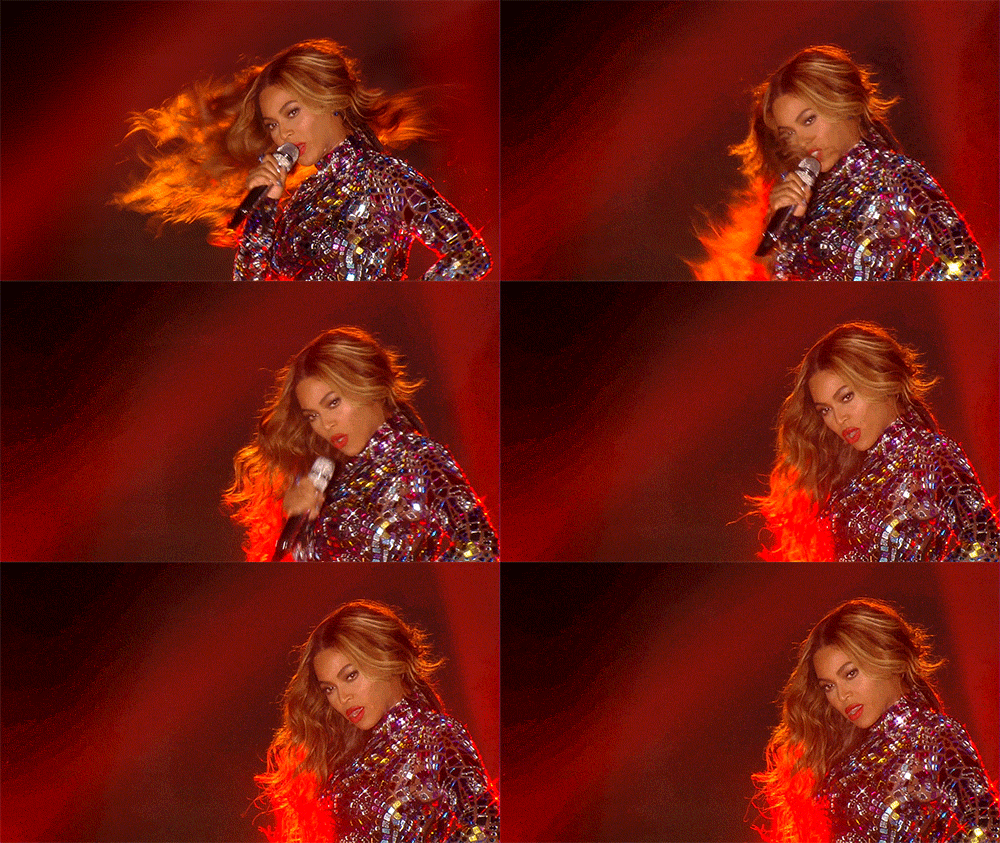
 This September, Sounding Out! challenged a #flawless group of scholars and critics to give Beyoncé Knowles-Carter a close listen, re-examining the complex relationship between her audio and visuals and amplifying what goes unheard, even as her every move–whether on MTV or in that damn elevator–faces intense scrutiny. Last week, Regina Bradley (writer, scholar, and freelance researcher of African American Life and Culture) introduced us to the sonic ratchetness of Baddie Bey; the week before you heard our Beyoncé roundtable podcast featuring our first two writers, Priscilla Peña Ovalle (English, University of Oregon) and Kevin Allred (Women and Gender Studies, Rutgers)–as well as Courtney Marshall (English, University of New Hampshire) and Liana Silva (Editor, Women in Higher Education, Managing Editor, Sounding Out!), who will close out our series next week. Today, madison moore gives us not only great face but killer hair choreo. Mic drop. Hair flip.–Editor-in-Chief Jennifer Stoever
—
“Which Beyoncé are you trying to do?,” a sale associate at Beauty Full, the largest beauty supply house in Richmond, Virginia, asked me. It was a good question, because the shop had whole rows of wigs and ponytails that conjured Beyoncé enough for what I needed to do. Choosing just one would be tough.
“This one is very Beyoncé,” he said, pointing to a style reminiscent of the huge, teased out curly Afro Beyoncé worked in the early 2000s. I wasn’t really feeling this particular style but I could tell my sales guy was living it. “It’s not fierce enough!” I told him. “I need something that really moves!” I’d been invited to give an hour-long lecture on Beyoncé at a university, one of my first gigs, and I was out at the last minute shopping for a wig to wear during my talk so that I could give the children a little sip of Beyoncé. That’s when I saw it: a long, black and dark brown two-toned wig with curls for eternity that I knew would look great on stage. Come on, wig!
 I wanted to wear a wig “that really moves!” during this talk to demonstrate what I feel is the creative genius of Beyoncé’s performance persona: what I call “hair choreography.” Not unlike dance moves intended for the body, “hair choreography” is a mode of performance that uses hair to add visual drama to the overall texture of sound and it’s the special genius of Beyoncé’s stagecraft. On one occasion some friends and I were drinking wine and downing live Beyoncé videos on YouTube when one of us was like “I am living for her hair choreography!” I’m not sure we invented the concept but the phrase “hair choreography” has certainly stuck with me. Hair choreography is one of the secret weapons of the pop diva, those places in a live performance where she flips and whips her hair in exactly the right point, using “haircrobatics” to punctuate a moment, a feeling, raising the stakes, the sex appeal, and even the energy in the audience.
Hair choreography is exciting because it tells a story, but even more than telling a good story in performance “hair choreography” punctuates everything else happening on stage: the lights, the dance moves, the glitter, the sequins, the music. In this way, “hair choreography” becomes part of the spectacular offering of stage presence; a type of magnetism that, despite everything else happening on stage, draws us into a single performer – the star – whose single energy needs fill up the whole space. “Hair choreography” occurs in those moments of a live performance where the hair is flipped, whipped, dipped, spun and amplified during the most exciting, emotion-filled sounds and dance moves.
Even though many scholars still often approach them as separate practices, sound and motion are so fluidly entangled, as Jennifer Stoever has revealed. In this way, “hair choreography” builds on performance studies scholar Imani Kai Johnson’s call for the “aural-kinesthetic.” The “aural-kinesthetic” is not a method or a theory but simply a way for scholars to think about how music and movement happen at the same time. “Hair choreography” is about the relationship between sound, body and movement, and how each of those comes together to leave a visceral impact on an audience.
One video that shows the importance of hair choreography to Beyoncé’s package is her medley “If I Were A Boy/You Oughta Know,” a mélange of the soft hard rock her own track coupled up with the aggressive rock of Alanis Morissette’s iconic break-up jam of the same title. In the clip, as Beyoncé segues from “If I Were A Boy” into “You Oughta Know” the wind machines appear to blow her hair faster, and with every emotional note or beat she knocks her head to the side with attitude, forcing her straight hair with it. By the time Beyoncé sings “And I’m here, to remind you…,” the most emotional (and recognizable) transition of the song, the hair is already going full blast. Guitars and drums go off while strobe lights engulf the stage in a frenzy of chaos.
At “You, you, you oughta know” she falls to her knees and performs a choreographed head bang while sliding across the floor using only her knees. It’s important to note here that the singing has stopped because this is a moment of “hair choreography,” a transition indicating an impending change in mood.
Everyone loves Beyoncé’s hair. In her will the late comedian Joan Rivers requested “a wind machine so that even in the casket my hair is blowing just like Beyoncé’s.” There are countless YouTube tutorials showing young girls how they too can achieve that Beyoncé look with weaves, wigs and lace fronts. Even the comedian Sommore, who stared in the 2001 film Queens of Comedy , had something to say about Beyoncé’s hair:
Beyoncé is a bad motherfucker. Oh this bitch bad. Let me tell ya’ll how bad this bitch is. I went to see her concert in Atlantic City after she had her baby. I sat in the second row – this bitch was flawless. I mean I’m talking about the bitch was flawless. Only problem I had with Beyoncé…she had on too much hair! This bitch came out she had at least 18 packs of hair on. She came out I thought the bitch was the cowardly lion from The Wiz. I’m sitting there in awe of this bitch neck, I’m like, “This bitch neck is strong as a motherfucker!”
All jokes aside, the mystery of Beyoncé’s hair-–and all of the technologies involved in keeping it moving–is part of the genius of her brand image, particularly because it works to make her ethnically ambiguous.. Having various types of hairstyles allows her creole body to infinitely play with race, and this makes her marketable to nearly everyone. Is she black? Is she Spanish? Is she biracial? Could she be Brazilian or from Latin America? Yes. In this way, her hair choreography not only punctuates her sound, but it shapes the very way it is heard, enabling her to morph into more personalities and fit into more demographics than even Lady Gaga or Madonna. It’s why she’s able to sound sexy or inspirational, “hood” or “classy,” vampy or masculine, vocal or dance-y. Look at a video like “XO,” to me the most mass-marketable song on BEYONCE. First of all she looks fabulous, but I think it’s hard to watch that video and not feel like it’s specifically pitched to 15-year-old white girls in Connecticut. Everything about the video, especially her sweeping hair flourishes, positions Beyoncé as relatable to teenage girls all over the US.
As dance studies scholar Melissa Blanco Borelli sees it the mulatta body engages with a practice she calls “Hip(g)nosis,” or a type of hypnosis enacted by the yellow-bodied performer on fascinated audiences. This type of hypnotics, via the hips, “exposes the male gaze” by thinking through the “pleasure and consumption of the mulatta…” (She Is Cuba, forthcoming, Oxford University Press). Through hip(g)nosis Beyoncé has learned to use her ambiguous skin color and hair optics to her (monetary) advantage as a way to slide in and out of ethnic categories. Indeed, what does the fact that she is the lightest member of Destiny’s Child and also the groups’ most successful member have to do with her celebrity? The irony in all of this race play is that she was recently awarded the Michael Jackson Video Vanguard Award after her jaw-dropping 15-minute performance at the MTV Video Music Awards, and she is one of the few contemporary black pop singers who can play with race in the same way Michael Jackson did.
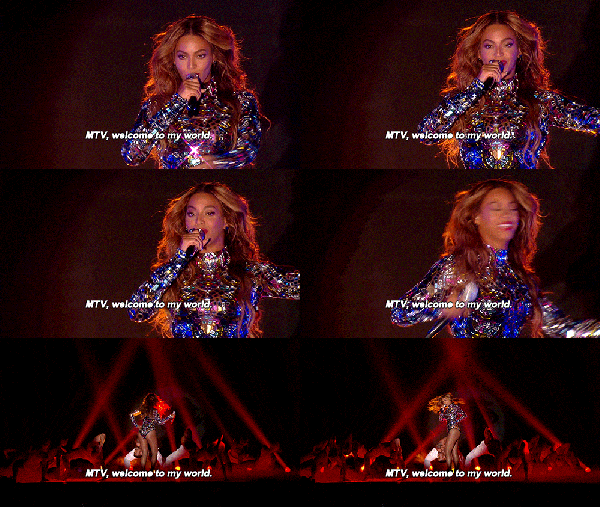 When I watched her recent MTV VMA performance I screamed a lot during her show, but the one moment I remember specifically, and still keep rewinding back to, happened right at the end of “Mine,” to me the best track on BEYONCE. She vamps “MTV, Welcome to My World,” and quickly spins and flips that hair back around baby, giving face to the camera, making millions of queens all over America scream YAASSS!!! at the top of their lungs. Beyoncé herself nodded back to queer performance and performers during a performance of “XO” this year on February 28th 2014 at the O2 Arena in London, after one overzealous fan threw a wig at Beyoncé as she sauntered off the stage and into the crowd (3:17).
When she turned around to pick the wig up she ad libbed “You got me snatching wigs, snatching wigs” into her microphone, knowing perfectly well that “Beyoncé snatching wigs” is one of the most popular fan-created Internet memes. In black gay male performance culture people often talk about “snatching wigs” or “coming for your wig,” and to this end scholars like E. Patrick Johnson and Marlon Bailey have done important work in theorizing the interplay between black gay colloquialisms and performance. If you’re “snatching wigs” then you’re performing better than everybody else while completely eradicating the competition. You’re seemingly indefatigable. Snatching a wig means a particular performance was highly effective or unique, and a snatched wig implies how an audience might surrender itself to a strong performer, as was the case with the aforementioned wig thrower. Beyoncé definitely understands the power of stage presence; a type of magnetism that, despite everything else happening on stage, draws us into a single performer – the star – whose single energy needs fill up the whole space. Filling up an empty stage with a single body is a lot of space to fill if you think about it. And making an audience focus on you when there are 10,000 other things are happening around you is an even more challenging task.
 But “snatching wigs” can also mean you’re revealing someone’s deepest secrets, something you know they’re hiding. What’s underneath a wig but a secret – your real hair texture, a bald spot you don’t want anyone else to know about. A snatched wig can mean a break of the illusion. When I wore that wig during my Beyoncé talk to demonstrate hair choreography everyone knew it was fake – I put it on in front of them – but if the wig came off the illusion would have been broken nonetheless.
Part of Beyoncé’s monumental fame has to do with the fact that while she synchronizes, punctuates, captivates, and performs, she never lets us see underneath her wig. She just lets it whip.
—
madison moore (Ph.D., American Studies, Yale University, 2012) is a research associate in the Department of English at King’s College London. Trained in performance studies and popular culture, madison is a DJ, writer and pop culture scholar with expertise in nightlife culture, fashion, queer studies, contemporary art and performance, alternative subcultures and urban aesthetics. He is a staff writer at Thought Catalog, Splice Today, and his other writing has appeared in Vice, Interview magazine, Art in America, Dancecult: Journal of Electronic Dance Music Culture, the Journal of Popular Music Studies and Theater magazine. He is the author of the Thought Catalog original e-book How to Be Beyoncé. His first book, The Theory of the Fabulous Class, will be published by Yale University Press.
—
–
 REWIND!…If you liked this post, check out:
Karaoke and Ventriloquism: Echoes and Divergences–Karen Tongson and Sarah Kessler
– Yvon Bonefant
“New Wave Saved My Life*”-Wanda Alarcon
Share this:


Current Top Posts





April 2021

January 2020

November 2019

October 2019

August 2019

April 2014

November 2017

March 2015

December 2017

October 2015
 Sounding Out!
Recent Comments