
Fade to Black, Old Sport: How Hip Hop Amplifies Baz Luhrmann’s The Great Gatsby
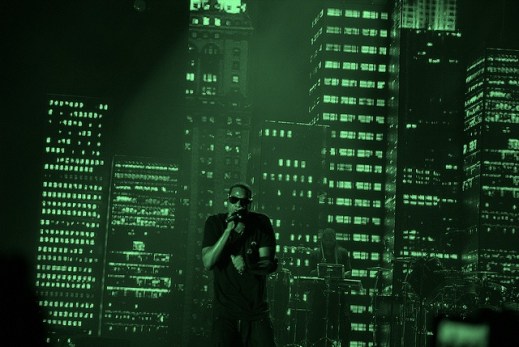
When I heard of people flocking to recreate “Gatsby Dress” costumes for Halloween 2013, I couldn’t help but ponder the seemingly-perpetual cultural allure of F. Scott Fitzgerald’s The Great Gatsby, particularly its latest cinematic incarnation in spectacular Baz Luhrmann-style. More than a little of the momentum of the recent revival, however, had everything to do with the film’s soundtrack–executive produced by Jay-Z (who also executive produced the film)–that drew heavily on hip-hop. This sonic move was not without controversy, however, sparking intense debate when the film was released in May 2013. Take this line from Vice Magazine’s UK music blog Noisey (from a post snarkily entitled “Who Let The Great Gatsby Soundtrack Happen?”) that describes Kanye West and Jay-Z’s Watch the Throne album, from which many of the film’s songs are taken, as “a record that couldn’t be further removed from West Egg than a pauper trying to gain access to a Gatsby soiree.” This statement reveals more about this particular listener than it does about either the record or the film, which are intimately connected through the labor of Jay-Z and what I theorize here as a “sonic hip hop cosmopolitanism.”
I’ll admit that when I was first hip to The Great Gatsby my junior year of high school, I thought it was boring and couldn’t stand Tom or Daisy Buchanan or their rich white folk problems. I rooted for Jay Gatsby but couldn’t for the life of me understand why he was so sprung over Daisy, who wanted her daughter to be a “beautiful little fool” (17). But as I got older, I found myself returning to the novel time and time again, coming back to Gatsby like a forlorn lover and reconsidering what Jay Gatsby’s character represents: unrequited love, American idealism, (capitalistic) hustle, and (white) masculine performance. However, I’ve always been part of the camp that secretly hoped Gatsby was a black man passing for white, yearning for a life – and a woman – out of his grasp no matter how much “new money” he acquired.
It was not until Baz Luhrmann’s film adaptation of Gatsby that I realized how hip (hop) Gatsby really could be.

Image from Vulture’s “Quiz: Jay-Z Lyric or Line From The Great Gatsby?”
Luhrmann’s modernization of classic literary texts is not new; Romeo + Juliet (1996) got me through high school readings of Shakespeare’s play in ways Sparknotes could not. While Shakespeare’s words remained intact, the scenery and aura of the play burst to life on the big screen. Luhrmann uses in that film sonic cues of contemporary (youth) popular culture to make Shakespeare’s characters relatable. Verona is a hip, urban hub of violence that vibrates to grunge and pop artists such as Garbage, Everclear, and Quindon Tarver instead of mandolins and harps. The grittiness of grunge rock signifies the grittiness of Verona street life while Quindon Tarver’s angelic voice signifies the innocence and vulnerability of (first) love.
But Luhrmann’s Gatsby takes it up a notch, looking to hip hop culture as a bridge between the roar of the 1920s and the noise of the present. Aside from the literal presence of hip hop sound – mostly snippets from Jay-Z and West’s Watch the Throne – the materiality of hip hop sound also serves to update the Gatsby narrative. Consider how Gatsby’s parties are loud and bass-filled with a live jazz band. The loudness of the party and “surround sound” stereo sound of the film amplifies the vibrancy of the Jazz era while drawing in the audience with a contemporary interpretation of live parties seen and heard in contemporary hip hop culture. “The question for me in approaching Gatsby was how to elicit from our audience the same level of excitement and pop cultural immediacy toward the world that Fitzgerald did for his audience?” Luhrmann told Rolling Stone. “And in our age, the energy of jazz is caught in the energy of hip-hop.”
.
The film itself is stunning: vividly colored with panoramas and ground shots of New York City, Luhrmann’s film draws in an audience possibly unfamiliar with Fitzgerald’s novel. The film utilizes the more traditional jazz aesthetic that captures the novel’s initial element, but invokes hip hop to span a generational divide and update the (black) cool factor of the film. Indeed, both jazz and hip hop best signify black cool and its commodification into mainstream white America. For example, Norman Mailer’s discussion of the white hipster and Jazz aficionado as a “white Negro” is also tantalizingly useful in thinking of Gatsby as a black man passing for white. His affinity for Jazz and throwing jazzy parties incites the probability of Gatsby’s racial and social background. The film uses sound to create a hybrid of timeless black cool, while highlighting the presence of African Americans’ contributions to American culture. Hip hop’s birthplace and the portal for many immigrants into America, New York is arguably America’s most mythological city, grounded in both white and African American culture memory as such. Jay-Z’s own mythic rise to fame, wealth, and power in New York City–exemplified in some lines from 2009’s “Empire State of Mind,” “Yeah I’m out that Brooklyn, now I’m down in TriBeCa/ Right next to De Niro, but I’ll be hood forever/ I’m the new Sinatra, and since I made it here/I can make it anywhere, yeah, they love me everywhere”– grounds the film’s rags-to-riches mystique.
In addition to such extradiegetic associations, the film’s soundscape itself enthralls, with brassy, lively instrumented notes of jazz – which carried the sonic narrative of the 1920s – sounds of the hustle and bustle of urban spaces, particularly New York City, and hip hop. The film’s soundscape presents a hybrid of sonic black identities – jazz and hip hop – and uses their blended aesthetics to speak to the continued framework of black popular culture as a gauge of Americanism. In other words, the marginalized perspective is used to decide whether or not something is authentically American or not.
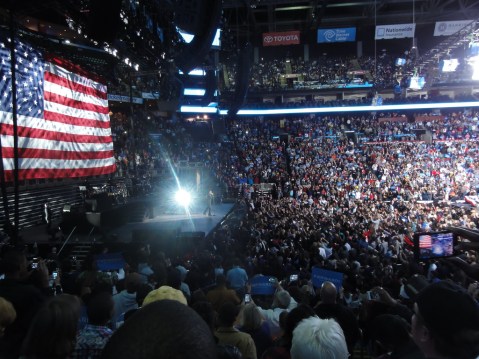
Jay-Z performs at Obama Pre-Election Rally 2012 in
Columbus, Ohio, w/ Bruce Springsteen, Image by Flickr User Becker1999
Hip hop aesthetics bridge old New York with the current New York as a foundation of Americanness. Gatsby bridges the old adage of New York as a space of opportunity with the familiar New York adage that Harlem-born and Mt.-Vernon-raised P. Diddy drops in Jermaine Dupri’s “Welcome to Atlanta,” “if you can make it here, you can make it anywhere,”a call back to Sinatra’s “New York, New York” that is also echoed by Jay-Z that forms a foundational trope of the film and the novel. A particular striking example of the merging of these adages is a scene in the novel where Nick and Gatsby are on their way to the city. They pass a car with black passengers and a white chauffeur:
As we crossed Blackwell’s Island a limousine passed us, driven by a white chauffeur in which sat three modish negroes, two bucks and a girl. I laughed aloud as the yolks of their eyeballs rolled toward us in haughty rivalry.
“Anything can happen now that we’ve slid over this bridge,” I thought; “Anything at all” (69).
While the novel does not describe a sonic accompaniment to Carraway’s observation of the black folks in the limousine, there is an inherent understanding of the “modish” fashion of the black folks as jazzy, as cool. In the film, there is an audible sound associated with the black folks. They are sipping champagne and listening to Watch the Throne. Although visibly symbolic of the 1920s – dressed in zoot suits and flapper dresses – the aural blackness associated with the scene suggests a merger of jazz and hip hop cool and cosmopolitanism.

Still from The Great Gatsby (2013)
In order to understand how hip hop updates the struggle for realness, entitlement, and respectability in the Gatsby film, it is important to return to the major sonic influence of the literal hip hop sound in the film: Jay-Z and Watch the Throne. Jay-Z’s work on the album raises questions of how hip hop culture impacts not only the American dream but the aspirations of mogul-dom seen and heard in the film and novel. Christopher Holmes Smith’s discussion of hip hop moguls in Social Text (Winter 2003) is particularly useful in teasing out the implications behind the hip hop mogul and such figures’ social-cultural responsibility to their respective communities. Holmes Smith argues:
The hip-hop mogul bears the stamp of American tradition, since the figure is typically male, entrepreneurial, and prestigious both in cultural influence and wealth. The hip-hop mogul is an icon, therefore, of mainstream power and consequently occupies a position of inclusion within many of the nation’s elite social networks and cosmopolitan cultural formations (69).
Jay-Z’s status as a hip hop mogul – serving both as a creative talent and corporate backer – lends credence to thinking about hip hop as a space of entitlement and a site of struggle to attain that entitlement. It is from this perspective that I think of Gatsby as a hip hop figure/mogul: his working class background, hyper-performance of white privilege, materialistic pursuit of wealth for visibility, and desperate need for approval as “authentic.” To borrow from rapper Drake, Gatsby “just wanna be successful.”
Mark Anthony Neal’s discussion of Jay-Z as a hip hop cosmopolitan figure in Looking for Leroy (2013) further enables an understanding of how Jay-Z lends his (sonic) hip hop cosmopolitanism to sonically navigate between hip hop’s working class aesthetics and his own sense of entitlement because of the way he mobilized those working class experiences to become wealthy. While the film does have performances by artists who are not considered hip hop – i.e. Lana Del Rey, Jack White, and Florence+the Machine – Jay-Z’s use of his own raps, including tracks from the Kanye West collaboration Watch the Throne suggests a “sonic hip hop cosmopolitanism” complements any sense of the film as a case study of white entitlement. Tracks like “100$ bill,” “No Church in the Wild,” and “Who Can Stop Me” both prop up and tear down Luhrmann’s visual rendition of Fitzgerald’s critique of the uppercrust of America as corruptibly entitled.
.
Baz Luhrmann’s adaptation of The Great Gatsby is an intriguing and useful tool through which to analyze the (in)consistencies of race and cultural authenticity in the United States. Both jazz and hip hop exist in the interstitial spaces that lie between black cultural expression and white entitlement to those expressions. Luhrmann uses hip hop’s sonic and cultural aesthetics to pump up the capitalistic and all-American narrative of “pull yourself up by the bootstraps” narrative in Gatsby by also declaring, “get yours by any means necessary.”
—
Featured Image adapted from Flickr User kata rokkar
—
Regina Bradley recently completed her PhD at Florida State University in African American Literature. Her dissertation is titled “Race to Post: White Hegemonic Capitalism and Black Empowerment in 21st Century Black Popular Culture and Literature.” She is a regular writer for Sounding Out!
—
 REWIND! . . .If you liked this post, you may also dig:
“‘I’m on my New York s**t’: Jean Grae’s Sonic Claims on the City”— Liana Silva
“I Like the Way You Rhyme, Boy: Hip Hop Sensibility and Racial Trauma in Django Unchained“– Regina Bradley
“The Victoria’s Secret Fashion Show and the Soundtrack of Desire“— Marcia Dawkins
Share this:

The Noisiest City on Earth? or, What Can the 2012 Manhattan Noise Complaint Maps Really Tell Us?

“It’s a city, not a cemetery. You can’t tell everybody to go around wearing earplugs.”
Ex-New York City Parks Commissioner Henry J. Stern, quoted in “Many Pleas for Quiet, but City Still Thunders”
In 1905, a New York Times article declared New York City “the noisiest city on Earth.” More than a century later—this summer, to be exact—The New York Times ran a series on noise in New York City titled “What? The Long War on Loud” that proved that this city is still trying to figure out its relationship to sound. (One of the gems of that series? “New York’s War on Noise” timeline.) As a displaced New Yorker, some of my most vivid memories of the city are aural. Although New York City isn’t the only loud city out there, there are many reasons it’s called “The City That Never Sleeps”—and sound has a lot to do with it, depending on which neighborhood you call home.
Now you can see what neighborhoods are allegedly noisiest, and where all that noise comes from. Brooklyn designer Karl Sluis created the 2012 Manhattan Noise Complaints maps (click for full image), in which Sluis correlated the data on 311 noise complaints made during the year 2012 (40, 412 complaints, to be exact) that he obtained from the NYC Open Source site with Manhattan’s geographical coordinates. He used circles of various sizes to a) create an aural tracing of the island of Manhattan, sitting in a sea of turquoise blue b) showcase the number of complaints in an area. The bigger the circle, the larger the number of complaints.

Screen Capture of Karl Sluis’s 2012 Manhattan Noise Complaints maps (click for interactive image)
The maps Sluis has created are helpful for visualizing the complaints on a broad scale, but they paint an incomplete picture of what noise means in New York City. The demographics of each neighborhood are absent from each map, a slight that can perhaps be traced to the 311 data available, but in order to better understand how New Yorkers define “noise” those stats must be included. Both Sluis and John Metcalfe from The Atlantic Cities discuss notable findings, but neither takes into account the fact that some of the areas with a higher concentration of noise complaints are not just densely populated but densely populated with racial and ethnic minorities. Indeed, comparing the maps’ noisy hotspots to a map of Manhattan racial demographics reveal how urban racial dynamics intersect with ideas about sound and power: who can make sound, who must be chastised for making noise, who can complain and whose complaints are actually being heard.

“Unnecessary noise prohibited” by Flickr user Ricky Leong, CC BY-NC-SA 2.0
Mapping noise complaints gives a spatial dimension to noise, and it renders noise palpable, in a way. Sluis points out, “Noise complaints reveal the concentration of activity in the city as well as many smaller stories, such as the construction of the Second Avenue subway line, idling buses on the Upper East Side, and the homes of the loudest dogs (or the least patient neighbors).” He reminds us that the data comes from complaints and not necessarily decibels; in other words, it represents local ideas of what counts as sound and what counts as noise.
While Metcalfe correctly describes the thousands of 311 complaints about noise from 2012 as “the entire year’s expression of mass annoyance,” Sluis’s map does not go far enough toward figuring out whose annoyance, exactly. We must remember that annoyance oftentimes stems not just from physical reactions to noise but rather one’s perceptions about noise, what Jennifer Stoever-Ackerman deems “the listening ear.” How we hear others, Stoever-Ackerman argues, is not as natural as it seems. For example, whom we deem as noisy may stem from our community, our parents, and/or social conditioning. Accounting for race/ethnicity in noise maps will show how the listening ear conditions neighbors to categorize and react to certain sounds.
For the purpose of this analytic exercise, I compared Sluis’s maps and the Center for Urban Research, CUNY Graduate Center’s 2010 map of block-by-block demographic changes in New York City, in order to illustrate how population density and racial/ethnic demographics play a role in concentrated pockets of noise complaints. Drawn from 2010 census data, the CUNY map clearly delineates neighborhoods and color-codes the groups in each neighborhood per block: blue for whites, green for Latino, orange for black, purple for Asian, and grey for “Other.” Although the Center for Urban Research, CUNY Graduate Center’s maps cannot be superimposed on Sluis’s maps, they help give a general idea as to where neighborhoods are located in addition to racial demographics.
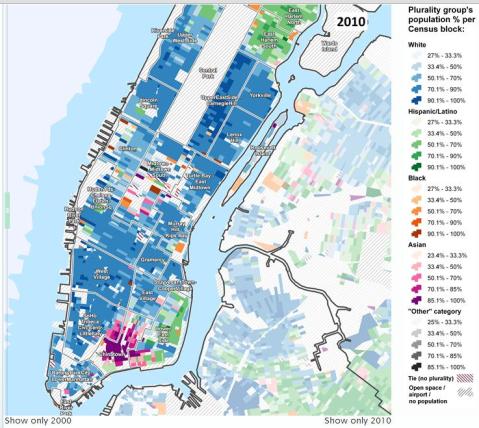
Manhattan below 110th Street in 2010, courtesy of the Center for Urban Research, CUNY Graduate Center

Manhattan above 110th Street 2010. Courtesy of the Center for Urban Research, CUNY Graduate Center
From the maps illustrating changing race/ethnicity patterns, I gathered what neighborhoods were predominantly white (West Village, Lincoln Square, Yorkville, Upper West Side), predominantly Latino (Washington Heights, East Harlem) predominantly black (Central Harlem, parts of Hamilton Heights), and predominantly Asian (Chinatown, blocks of the Lower East Side). When one compares Sluis’s overall noise map of Manhattan to the racial demographic maps of Manhattan, what stands out is that the major circles of noise complaints are also places where there are different racial and ethnic groups mingling (for example, Times Square) or places that are populated by mostly minorities (Hamilton Heights). Whereas Sluis flattens out the noise complaints, demographic stats point to the racial/ethnic contours of each neighborhood. Sluis’s maps focus on number of complaints; unfortunately this assumes everyone complaining is the same and that everyone making the noise is the same—a level aural playing field if you will. Bringing demographics into the equation underscores how not all complainers are equal and how not all complaints carry the same heft.
The city may be noisy, but “noisy” is relative. Sluis’s map shows some predictably noisy areas for those of us familiar with Manhattan’s soundscape (Union Square, Times Square) but it also draws attention to other areas not as predictable in the mainstream imagination (East Harlem South, Hamilton Heights). However, the maps by the Center for Urban Research, CUNY Graduate Center help us better understand the context for the high or low number of complaints in certain areas. For example, one of the biggest circles on Sluis’s general map of Manhattan is located in the Hamilton Heights/Washington Heights area; the Center for Urban Research, CUNY Graduate Center’s map of Manhattan above 110th Street show that these areas are densely populated by blacks and Latinos/as. This is key information because it reminds viewers that this neighborhood is a lot more ethnically diverse than other neighborhoods with a smaller number of complaints. It brings to mind: what role does race play in these complaints, in terms of those who complain and those who are the focus of the complaints? Although more people might mean more complaints, the prevalence of complaints like “loud talk” in East Harlem (Spanish Harlem) are nevertheless connected racialized ideas about people of color being “loud.” This doesn’t assume that the people complaining are white, but that they are complaining about groups that are characterized as loud, noisy, rowdy.

“Classic New York: noise, smoke” by Flickr user Will, CC BY-NC-ND 2.0
These noise maps, when put into conversation with demographic data, also indicate what areas are priorities in urban planning—the sounds of gentrification. The visualizations of the complaints by section (under the main map), combined with CUNY’s maps, are even more telling because they break down the number of complaints by category. The aforementioned northern tip of Manhattan, for example, is also where many of the complaints are concentrated. At a glance, loud parties, loud people, and loud car stereos seem to be the major complaints in those areas, according to Sluis’s visualizations. Meanwhile, noises of “urban growth,” such as construction and jackhammers, are less prevalent in these areas, whereas they are more prevalent below Central Park North, in now mostly-white neighborhoods.
Sluis’s maps of the 311 noise complaints data allow readers to see differences in terms of neighborhoods: who complains the most? what do they complain about? However, one thing to keep in mind is that first question: who makes the complaints. This is where the data falls short. Can it be assumed that those who are calling about the noise are mostly people who live in the neighborhood? Are Upper Manhattan neighbors less or more tolerant of noise? The answers to these questions, although they’re not found in Sluis’s map, point to how ideas of who is noisy or who can make noise are at play here.
I do not mean to downplay the usefulness of Sluis’s map. I instead call for the necessary addition of key missing factors to future noise maps in order to give us a more complex picture of noise complaints in Manhattan and elsewhere. Although it may not be possible to gather who the 311 callers are, including factors such as race and class may lead to very different noise maps. For example, what would a noise map of Manhattan look like if researchers brought income into the equation? Income inequality, especially in Manhattan where that imbalance is starkly on display, matters for the purpose of sound mapping. The more affluent neighborhoods are also the ones with less complaints and are the ones that are mostly inhabited by whites. Wealthier communities are more spread out and have more ability to couch themselves from noise, not to mention that it probably takes fewer complaints to get a response.

“Marcus Garvey Park Drum Circle, Harlem, NYC” by Flickr user j-No, CC BY-NC-ND 2.0
Gentrification is another factor: what kind of analysis could we do if we considered what neighborhoods have been gentrified in the past ten years? It is possible that as whites move into neighborhoods where people of color have historically lived, suddenly they find them noisy—hence, complaints. It is fitting to consider, for example, the tension between an established group of drummers in Marcus Garvey Park in Harlem and the inhabitants of a new highrise (characterized as “young white professionals”) who wanted the 30-years and running drum circle shut down, as reported in The New York Times in 2008. Moreover, if we accounted for the history of zoning in the neighborhoods that have the most or the least complaints it would add another layer of analysis to the data. Are some of these neighborhoods used as entertainment zones, for example? Is it easier to open up bars there than elsewhere in the city?
With these questions in mind, the maps go from beautiful renditions of data, to opening up a bigger conversation about the arbitrariness of noise. The demographical and sociological context of these noise complaints must accompany the raw data, especially when it comes to sound. The analysis also points to the source of the data: 311 calls. I wonder if this is the only way that people in Manhattan (and New York City at large) are dealing with noise. I’m sure that after a century of being “the noisiest city on Earth,” folks have gotten creative about it.
—
Featured image: ” Stranger 10/100 Johano” by Flickr user MichaelTapp, CC BY-ND 2.0
—
Liana M. Silva-Ford is co-founder and Managing Editor of Sounding Out! She is also known professionally as the Writer Whisperer.
—
REWIND! . . .If you liked this post, you may also dig:
“I’m on my New York s**t”: Jean Grae’s Sonic Claims on the City -Liana Silva
The Noise You Make Should Be Your Own–Scott Poulson-Bryant
Sounding Out! Podcast Mini-Series (#16): Listening to The Tuned City of Brussels, Day 1: “Noise”
Share this:


Current Top Posts





April 2021

January 2020

November 2019

October 2019

August 2019

April 2014

November 2017

March 2015

December 2017

October 2015
 Sounding Out!
Recent Comments