
A Listening Mind: Sound Learning in a Literature Classroom

“Listening is little short of a synonym for learning.”
–Julian Henriques, Sonic Bodies
 This is the third post in Sounding Out!’s July forum on listening in observation of World Listening Day on July 18th, 2013. World Listening Day is a time to think about the impacts we have on our auditory environments and, in turn, its affects on us. To read last week’s post by Maile Colbert click here and Regina Bradley’s discussion of listening, race, and Rachel Jeantel (and to read more about World Listening Day) click here.
—
How can listening, which I’ve come to understand as an essential way of knowing, enhance the learning experience? My pedagogical challenge over the past few years has been to develop a heightened awareness of the ways our ears are not necessarily, as Robert Frost asserts, “the only true reader and the only true writer,” but certainly an essential mode of reading and writing that is too often underdeveloped. As my high school students read works by Zora Neale Hurston, Ralph Ellison, Michael Ondaatje, Jonathan Safran Foer, James Baldwin, and Lucille Clifton, I want their ears to become increasingly attuned to the sounds, silences, vibrations, and other sonic significance embedded within printed words. I want them to experience how listening enhances their understanding of literature, that listening is learning.

“Writing” by Flickr user filipe ferreira, CC BY-NC-SA 2.0
I’ve taught A Listening Mind, a trimester course for high school juniors at Princeton Day School in New Jersey, for two years. Inspired by Toni Morrison’s 1996 National Book Award acceptance speech, “The Dancing Mind,” the course title signals my interest in challenging students to practice writing and reading in ways that are collaborative and cognitively (and otherwise) dissonant with their usual English classroom habits of mind. For my students, at least initially, writing is ruled solely by the mantra “Show. Don’t Tell.” This course, then, creates preconditions for a new kind of learning. It aims to heighten students’ aural attentiveness in general, and particularly in relation to the sonic life that inhabits the lower frequencies of the printed word. In many ways, the class resonates with Liana Silva’s discussion of sound as significant to writing and learning. In this course, we grapple with essential questions such as: How might we read and write with our ears? What happens when we take the risk to do so? As I design assessments and moderate the course, I keep in mind my own essential question as an educator: How can my scholarly interest in listening as a significant mode of cultural and social engagement translate into sound study learning opportunities for my students? The assignments students complete in A Listening Mind, a few of which I share next, are my response to these questions–a response that is in constant development.
CULTIVATING A LISTENING MIND
On the first day of class, I play Jason Moran’s “Cradle Song” from his most recent album, Artist in Residence. Moran plays the Carl Maria von Weber-composed lullaby on unaccompanied piano; the urgent scratching of a closely miked pencil on paper writes slightly ahead of the calming melody.
The song, a tribute to Moran’s mother who would stand over his shoulder taking notes as Moran practiced piano as a child, amplifies a sonic life that more often lingers within the printed word. Thus, it allows us to begin exploring the possibilities of listening as an approach to reading and writing.
In the first month of the course, students practice low stakes listening and writing: they go on short listening walks and record by hand what they hear in their sound journals. Rutger Zuydervelt’s Take a Closer Listen, an excerpt from the opening pages of Jonathan Safran Foer’s Extremely Loud and Incredibly Close, and the New York Times Magazine prose and audio essay, “Whisper in the Wind” are our inspirations for this assignment. They visit a space in which they feel most like themselves and tune into the space’s acoustics. They do the same in a space where they are less comfortable. Students also tune their attention to eco-listening – listening with intention to the natural or man-made environments in which we find ourselves. The idea is to notice the sounds our ears have become deaf to as we’ve become accustomed to a space. Their eco-listening results in their creating individual listening booklets that record the sounds we hear and our occasional reflections on them. By listening to various sounds and in various ways during the early weeks of the course, students exercise their ears and, along the way, some even realize that you need more than just ears to listen.

“Listening Devices” by Flickr user abrinsky, CC BY-NC-SA 2.0
SONIC MATERIAL CULTURE
One of the assignments of the course involves work in what I call “sonic material culture.” According to the University of Delaware’s Center for Material Culture Studies, the study of material cultural objects “promotes the learning from and the teaching about all things people make and the ways people have acted upon the physical and visible world.” But, what about the ways in which material culture impacts the audible world? Sonic material culture looks at how material cultural objects help create cultural meaning through the sounds they make and the ways in which people use those sounds. Students explored an array of “sonic objects” that included, among others, a Tibetan singing bowl, steel drum, Shofar, typewriter, stethoscope, and a boom box. They then chose one of the items – an item that either makes sound (like a steel drum) or allows for access to sound (like a stethoscope), and began their research with a specific focus on how this item holds sonic cultural significance.
To research the stethoscope, for example, one student interviewed a cardiologist and a medical historian. She learned that sounds doctors hear through the stethoscope “comprise a language, spelling out diagnoses and prognoses” and provide “gateways to our understanding of the heart.” Another student chose the Steel Drum, an instrument developed in the 20th century in Trinidad and Tobago, and ended up discussing the innovation involved in reusing oil containers to produce a new cultural sound. Another student’s research on the Tibetan Singing Bowl led him back to a moment in Jonathan Stroud’s The Bartimaeus Trilogy: Book Three, Ptolemy’s Gate when the character Kitty Jones describes the ringing of a Singing Bowl that signals her transport into the world of magical spirits. Listening to the Singing Bowl made this student more attentive to this moment that he initially skimmed. And, one student’s love of all things vintage led her to her father’s manual typewriter and an essay combining family history and larger insights about education, workplaces, and mechanical writing. In each of these cases, the students realized that the sounds cannot be extricated from the material, social, and historical conditions that produce them.
SOUNDING HISTORY
The last time I taught the course, I designed a sound history mini-project. Students read excerpts from the work of Mark A. Smith and my work on historical listening in David Bradley’s The Chaneysville Incident, and considered these question: How might sound function as a way to narrate a specific historical moment? Students needed to choose a historical moment, locate a sound, and then create a museum card that, among others, answered the following key questions: What does this sound bring to our attention that we might not otherwise consider? What questions does this sound raise? What does it leave mute? Since students had watched Django Unchained recently, we discussed sounds of slavery in that film. If you write slavery through the crack of the whip, then your focus might be on violence and torture used during that peculiar past. If you tell slavery, though, from the code-laden singing enslaved persons used to send messages to flee, then you have a different frame, a different sonic way into the historical moment.
One student used the opening sounds from The Wizard of Oz to narrate the Dust Bowl. Another examined news reports and hip hop music to listen back to the Los Angeles Uprisings. One young woman interviewed her mother about her immigration experience from Guatemala; in her project, the sound of a train whistle signaled arrival to the United States and a new life. One of the most striking projects consisted in an inventive student engineering her own sound using a teakettle in order to recreate what she imagined as the sound inside a gas chamber in a concentration camp during World War II. As she explained during her presentation, the screeching teakettle captures for her both the sound of gas and the screaming of those persons trapped within a chamber. What an empathetic choice to make as a listening scholar: to imagine the voice of one in the midst of death.
Students worked on this assignment as part of their culminating assessment for the course. I assigned this work at the end of the course because it gave students an opportunity to delve into the work of a Sound Studies scholar: students drew on their skills as listeners developed over the term; returned to questions we asked regarding listening and interpretation of written and recorded texts; framed their own questions for inquiry; and used sound technologies such as Audacity and GarageBand to amplify their historical sound.

“Turn Up the Mix” by Flickr user Travis Hightower, CC BY-NC-ND 2.0
LISTENING BACK
As I tune my ears excitedly towards another World Listening Day (this year on July 18, 2013), I find myself remembering my students’ portfolio reflections of their learning in this course. Students mentioned that their time in the course helped them pay more attention to sounds around them: “my ears have been retrofitted by my experience in this class.” Some students became more in tune with their own sound: “The world is too noisy. I need to focus in, to tune in to myself.” Yet others found themselves “slowly opening [them]selves up to others” and becoming “more engaged with others’ opinions even if they were different from” their own. Even though some students entered the class resistant to, uncertain about, or “unnerved” by the thought of a listening English course, they felt by the end that, in the words of one student, “Now I leave this class with a purpose and clearer understanding of the importance of listening to my own echo.” In short, the two groups of students who have taken this class grow more “in tune” to multiple frequencies of reading, writing, and learning.

“Verbose, sentimental foolery” by Flickr user Sarah Ross, CC BY-NC 2.0
Lastly, while I hoped students would grow as listeners, I did not anticipate that their perceptions of themselves as readers and writers would also shift. Students who previously described themselves as “just not an English student” or who began writing and reading assignments with self-defeating “I’m just not good at this” comments, delved more deeply into the writing process and produced strikingly confident, nuanced pieces by term end. They have grown in their sonic literacy. In this, my students remind me of the most essential of questions: How, to borrow Carol Dweck’s language, do we help students develop a growth, rather than a fixed, mindset where learning is concerned? In my view, listening—practiced as a dynamic, tinkering, beta-type approach to the study of literature and writing—provides interesting answers.
—
Featured image photo credit: “Listen, Understand, Act” by Flickr user Steven Shorrock, CC-BY-NC-SA-2.0
—
Nicole Brittingham Furlonge earned her PhD in English from the University of Pennsylvania. Her dissertation, “On the Lower Frequencies: Listening and African American Expressive Culture,” marks the beginnings of her investment in sound studies as the field resonates with issues of race, class, gender and education. Her work has been published in the academic journals Callaloo and Interference, and in the publication St. Andrew’s Today. She also has published a cookbook for young children, Kitchen Passports: Trinidad and Tobago. She has taught in independent high schools and colleges for 16 years, including University of Michigan, UPenn, The Lawrenceville School, Holderness School and St. Andrew’s School in Delaware. She has extensive experience in the classroom and in administrative roles dealing with curriculum development, diversity issues, faculty development and issues regarding education, equity and access.Currently, Nicole chairs the English Department at the Princeton Day School in New Jersey and blogs at the Huffington Post. She lives in the green part of New Jersey with her spouse and their three young children.
—

REWIND! . . .If you liked this post, you may also dig:
“The Sounds of Anti-Anti-Essentialism: Listening to Black Consciousness in the Classroom“–Carter Mathes
“Deejaying her Listening: Learning through Life Stories of Human Rights Violations“–Bronwen Low and Emmanuelle Sonntag
“Audio Culture Studies: Scaffolding a Sequence of Assignments“–-Jentery Sayers
—
Share this:

Listening to #Occupy in the Classroom

 Yes, it’s that time again, readers. You are going to have to stop pretending the “Back to School” aisles haven’t been appearing in stores for the past few weeks. We at SO! are here to ease your transition from summer work schedules to the business of teaching and student-ing with our fall forum on “Sound and Pedagogy.” Developed to explore the relationship between sound and learning, this forum blends the thinking of our editors (Liana Silva), recruited guests (D. Travers Scott), and one of the winners of our recent Call For Posts (Jentery Sayers) to explore how listening impacts the writing process, the teachable moment, and the syllabus (and vice versa). We hope to inspire your fall planning–whether or not you teach a course on “sound studies”–and encourage teachers and students of any subjects to reconsider the classroom as a sensory space. We also encourage you to share your feedback, tips, and experiences in comments to these posts and on our Twitter, Facebook, and Reddit sites. As I said in the Call for Posts for this Forum: “because teaching is so crucial—yet so frequently ignored at conferences and on campus—Sounding Out! wants to wants to provide a virtual space for this vital discussion.” This conversation will be ongoing: we will also bring you a “Spring Break Brush-Up” edition in 2013 featuring several more excellent posts by writers selected from our open call. Right now, the bell’s about to ring–so take a seat, open those ears, and enjoy this shiny auditory apple of an offering from D. Travers Scott in which he discusses how the sounds of #Occupy invigorated his classroom. And, yes, it will be on the test. —JSA, Editor-in-Chief
—

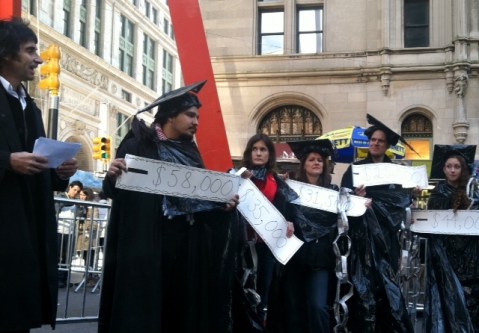
In the late fall of 2011, I was teaching a class on cultural studies of advertising. I presented the Occupy Student Debt campaign, a subcategory or spinoff of the larger Occupy movement, while we were examining ways people challenged consumer culture. We discussed education as a commodity and students as consumers. Unsurprisingly, my seniors were dissatisfied consumers. They expressed that what had been advertised to them was a product that guaranteed or at least would strongly increase their chances for quality employment (of course, it was also a product they had worked for years in creating, and one they couldn’t return.) If higher education really did land you the lucrative job it had been advertised as guaranteeing, in theory, then, you would be able to more easily pay off student loan debt. To address this dissatisfaction, I showed them two artifacts: a video from the launch in New York City on November 12, 2011, and the OSD debtors’ pledge*.
In the video, OSD founder Pamela Brown reads the pledge one line at a time, with each line chanted back by others. I played the video in a dark classroom. I also projected it on the room’s main screen, but I didn’t use the room’s amplification system because it sounds too much like an authoritarian public address and disperses the audio in a dominating way. External speakers connected to my laptop made the sound feel, to me, more localized and objectified, something we could focus on rather than an institutional part of the room. The students’ first reaction was, not to the words, but the sound: the verbal relay used at the public demonstration. Brows furrowed and heads cocked quizzically, they asked, “Why are they all repeating the speaker like that?” I explained how this provides additional amplification, but the students’ listening experience was instructive to me. Their unfamiliarity with a sonic practice of vocalization indicated their unfamiliarity with larger practices of collective, public social action.
Listening to OSD, and paying attention to how my students listened to it, informed me of larger contexts they needed to understand and discuss it, in ways that the object of the text did not suggest to me. It made me think about the experience and process of my students’ encountering OSD. I immediately noticed its ambient sounds of city life, which I no longer hear. These sounds of traffic, the acoustics of being surrounded by buildings, etc. gave several urban dimensions to the movement the pledge text did not. From the perspective of Upstate South Carolina, “urban” is not a simple thing, an identity or geography category, but intersectional: our largest city, Greenville, has a population under 60,000. City noises feel not merely urban, but un-Southern, and thereby alien. (I say un-Southern rather than Northern or Yankee because another thing I’ve learned here is the inadequacy of that binary: Los Angeles, for example, is not a Northern city but most certainly is as un-Southern as New York. Cities also carry a class dimension.) Even though my school is one of the elite institutions in this area, this region is still worse off economically than the rest of the country and has a generally lower cost of living. Cities require money to live in. In spatial, class, and urban dimensions, OSD felt alien.
Opening of the Occupy Student Debt Campaign, Image by Flickr User JohannaClear
The experience of listening to the ODS rally illustrates how a sound studies perspective foregrounds experiential processes over exclusive categories of things and ideas. For example, when I read the OSD Debtors’ Pledge aloud to my students—vocalizing the text and sounds and listening to them— it brought the text into my body, making it an action. It also made students uncomfortable. Even just a round-robin reading of theory seems to make then anxious and fidgety. While I try to understand and accommodate anxieties around public speaking, I think the way sound makes a text enter the body can be a powerful affective experience. And no one ever said the classroom always had to be comfortable. For me, reading the text aloud personalized the OSD pledge. It evoked sensory memories: “Pledge of” evoked saying the pledge of allegiance in public school; saying “We believe” took me to attending Lutheran church services with my husband at the time where they collectively recite the Apostles’ Creed. These associations evoked emotional disidentifications from organized religion and mandatory collective professions of patriotism. It also temporalized and spatialized OSD for me, positioning it in relations to Dallas, Texas in the 1970s and Greenville, SC today.
Overall, the reading aloud of the pledge staged a tension or dialectic of identification and disidentifications. Although I agreed and identified with the sentiments of the movement, several alienating and unsettling aspects of the pledge came through as I read aloud: the blithe collapsings of “we” and “as members of the most indebted generations” made me wary (collectives always do, but so do easy historical assertions. Really? Are we more indebted than indentured servants who came to America, or people born into slavery?), and the sudden shift to first person singular at the very end seemed jarring: (After saying “we” six times, suddenly it’s ‘I’ now – what happened?). Lastly, the numerous alliterations also had an alienating effect, making the text seem sophistic and manipulative, artificial, composed.
The auditory experience of OSD can also provide insight into how we create texts. A video of Andrew Ross shows him presenting the first, “very rough draft” weeks earlier at an OWS event. Listening to him read this different, earlier version underscores the text as process. The pledge is something that developed. While his flat tone and straight male voice do not appeal to me, they do complexify and dimensionalize Brown’s reading, giving it depth. They also show that some things that bothered me in the final version – the collectivity and alliterations – were not there. This intertextual, diachronic listening does not erase troublesome aspects of the ‘final’ text, but it mediates them. I am moved closer to it by listening to its different origin.
Arguably, any of these points could have been arrived at by good ole’ textual analysis. My point is not that listening always should supplant visual modes; sound studies tries to break that false dichotomy by not denigrating or replacing the visual but by elevating the sonic to complementary – not superseding – status. I argue that reading aloud should be a fundamental, basic component of sound studies methodology, as it allows anyone to hear, voice, embody, and experience a text. I not only noticed these aspects sooner through listening – my first time speaking it aloud, despite having read it at least a dozen times before. Moreover, I didn’t just notice them: I felt them on a personal, emotional, level, which spurs thinking and analysis that is, if not completely new and unique, definitely qualitatively different in its potency and urgency.
Listening to OWS, and the OSD in particular, brings insights affective and personal. Yes, I can read a statistic from a survey stating that a certain percentage of participants in OWS feel angry or betrayed. That doesn’t mean anything to me in a specific, personal, and empathetic way – and empathy is crucial for a social movement to garner support. Listening to both Ross and Brown, I am reflective and conflicted over my professional role – no longer a grad student, but certainly not an established scholar like Ross. I feel connected to OSD in ways beyond the literal facts of my debt. Listening draws me into a contemplative, reflexive space beyond a sticky note on my office desk saying “OWS: teachable moment.” I can see a map with big, red OWS circles over Washington D.C. and New York, but I don’t feel the distance from myself and my students in the same way—and this is crucial for my teaching and engaging them in dialogue about what could be the most significant social movements of their lifetimes.
Share this:


Current Top Posts





April 2021

January 2020

November 2019

October 2019

August 2019

April 2014

November 2017

March 2015

December 2017

October 2015
 Sounding Out!
Recent Comments