
SO! Reads: Todd Craig’s “K for the Way”: DJ Rhetoric and Literacy for 21st Century Writing Studies

or, Last Summer a DJ Saved My Life
“Hip Hop does work that a lot of other things don’t do” Young Guru (viii).
The way that we imagine English Studies, specifically Composition and Rhetoric (Comp/Rhet), today needs a radical shift. Specifically, we need new techniques for Writing Studies pedagogy to reach students in a more meaningful and contemporary fashion. Todd Craig’s “K for the Way:” DJ Rhetoric and Literacy for 21st Century Writing Studies (Utah State University Press, 2023) both documents the need for this shift and enacts it. Craig’s work enables us to recognize the pedagogical impact on writing that Hip Hop has had over the last 50 years—specifically how the DJ/deejay as twenty-first century new media reader and writer teaches students not just to think about sound, but to compose with it, too.
An Associate Professor of English at CUNY Graduate Center, Craig has little desire to shake the foundations of English Studies, but instead do what Hip Hop has always done—make a way where there is none. The point is to (re)imagine new ways of doing old things; in this case, of teaching and reaching students who arrive in First-Year Writing courses. “K for the Way” does more than demonstrate the ways in which the DJ is a twenty-first century pedagogical savant; it also teaches readers, using DJ Rhetoric and DJ Literacy, about the culture that makes them possible.
This summer, a DJ really did save my life: as someone who feels consistently overwhelmed by the vast nature of scholarly discourse, “K for the Way” gave me a chance to breathe, to identify with something that has been a part of me for the better part of my life, and to see myself in a conversation about a topic I am more than passionate about. For Craig, community, history, and culture are the core of his mission as a scholar, educator, and DJ.
Craig defines several new terms that bridge the worlds of Hip Hop and Composition and Rhetoric. First, we have DJ Rhetoric, which can be understood as the modes, methodologies, and discursive elements of the DJ. For Craig, it “encompasses the quality of oral, written, and sonic language that displays and expresses sociocultural, historical, and musical meanings, attitudes, and sentiments” (23). Next, there is DJ Literacy, which is the “sonic and auditory practices of reading, writing, critically thinking, speaking, and communicating through and with the rhetoric of Hip Hop DJ culture” (23). These two definitions, operating in conjunction, situate the DJ as a kind of griot, a figure that Adam Banks invokes as a carrier of tradition, stories, and histories in Digital Griots: African American Rhetoric in a Multimedia Age (Studies in Writing and Rhetoric) (2011). The mission of the griot is to carry stories and translate them to various audiences while adhering to the rhetorical conventions and modes of whichever audience they find themselves before; similarly, the DJ is responsible for “communicating the pulse and the evolution of a culture that once sat as ‘underground’ but now has dramatically evolved to ‘mainstream’” (25). These definitions serve as guides for the reader as they are tethered to all of the concepts and (re)imagining happening throughout the book.
Craig is intimately close to the work he is doing. He lives and breathes Hip Hop; and what should a book about the Hip Hop DJ be if not written by someone who embodies the role, culture, and practice of DJing? Craig uses a a research methodology known as hiphopography in which Hip Hop ways of being are central to studying it. Coined by James G. Spady, this term is defined as “a shared discourse with equanimity, not the usual hierarchical distancing techniques usually found in published and non-published (visual-TV) interviewers with rappers” (27). Craig states that hiphopography “allowed me to engage a variety of Hip Hop DJs while also maintaining my own shared values and sentiments around my love of Hip Hop culture and DJ practices” (28). Hiphopography constructs a conversational, intimate space—touched by history, culture, and music—wherein the interviewer and interviewee can engage and produce meaningful data. This methodology—and Craig’s many interviews with DJs about their craft—becomes part of the text’s core as we begin to see how Craig’s two-pronged argument connects DJ Rhetoric and DJ Literacy to bring both life throughout the book.
If one understands the DJ as a twenty-first century rhetorician and compositionist and considers the ways in which the DJ is a cultural meaning-maker, sponsor, and master sampler, then one can clearly see the connections between the DJ, DJ culture, and Writing Studies in the contemporary moment. In the first part of his argument supporting the significance of DJ Rhetoric and Literacy in writing pedagogy Craig asserts that, “it is essential that the academy at large works to strengthen students’ undergraduate experiences by reinforcing their racial, ethnic, and cultural ties” (14). This perspective provides the foundation for the second part of his argument that “the DJ (and thus, Hip Hop DJ culture) is the epicenter of Hip Hop culture’s creation” (23). Taken together, these dynamic arguments make the claim that the DJ offers a powerful model of a new media reader, writer, and critic. Today, our students come to writing classrooms with a “vast array of cultural capital. . .in their philosophical and cultural backpacks” (107). If we, as writing teachers, want to honor that cultural capital and build with it, we should follow Craig’s lead and look toward the DJ for some pointers on how to expand students’ access to a language that represents them.
Readers will also see a developing research agenda in “K for the Way” that thinks toward changing the culture beyond the present, while acknowledging the groundwork laid for the current moment and building genealogically upon that foundation, just as DJs do with sampling. Craig best exemplifies this when he writes, “in order to fully engage in a conversation—whether intellectual, pedestrian or otherwise—that discusses what DJ Rhetoric might look like, one has to think about the cultural and textual lineage of sponsors and mentors” (51). This notion of textual lineage is borrowed from Alfred W. Tatum who explains the term as “Similar to lineages in genealogical studies” and continues to note that textual lineage is “made up of texts (both literary and nonliterary) that are instrumental in one’s human development because of the meaning and significance one has garnered from them” (Tatum, qtd. in Craig, 51). Craig builds upon Tatum’s idea by introducing sonic lineage, which follows the same logic as Tatum’s term, but through sound (51). What becomes apparent, is that the DJ, as a cultural sponsor, can deploy sonic lineage as a way of communicating history and culture to members within and outside of the Hip Hop community and, more specifically, DJ culture.
Chapter three, especially, works at the interdisciplinary junction of Sound Studies, Writing Studies, and Hip Hop studies to convey a clear critique of the dominant discourse surrounding plagiarism. Craig is unsatisfied with the black-and-white conception of plagiarism as it presents itself in the academy. As a result, he moves to inquire “how we as practitioners [of teaching composition] approach citation methods and strategies within a twenty-first century landscape” (75). Craig promptly turns us toward the DJ’s conceptualization of sampling as a citation practice. Sampling in Hip Hop, as defined by Andrew Bartlett, “is not collaboration in any familiar sense of the term. It is a high-tech and highly selective archiving, bringing into dialogue by virtue of even the most slight representation” (77). The highly selective archiving, a.k.a crate diggin’, builds upon the idea of sonic lineage.
For the DJ, the process of diggin’ through crates to find that right sound, that one joint that going to get the party jumpin’, is a key element in the practice of “text constructing” (79). The Hip Hop sample functions alongside an understanding, offered by Alasdair Pennycook, of “transgressive-versus-nontransgressive intertextuality,” which, for an academic audience, complicates the idea of plagiarism.. The DJ becomes a figure through which we can understand intertextuality, sampling becomes the practice through which we can see parallels to citation through text construction, and the mix is where we begin, with the help of Pennycook, to complicate notions of plagiarism. In this chapter, readers are able to understand through sound.
Subsequently, Craig explores the concept of revision as it relates to the DJ’s ability to engage with an emcee on the point of “remix as revision” (107). Building from on Nancy Sommers’ article, “Revision Strategies of Student Writers and Experienced Adult Writers,” Craig lifts and examines four strategies of revision through the lens of the Hip Hop DJ: deletion, substitution, addition, and reordering (Sommers, qtd. in Craig, 107). These practices not only identify the Hip Hop DJ as a master of revision but also center the DJ, in the context of the writing classroom, as a key figure for understanding editorial practice. As teachers of writing—and especially for those of us who are deeply connected to Hip Hop culture—we have traditional scholars, such as Sommers, but we also have the DJ as cultural scholar, which offer new models with communicating and practicing the craft of writing in the twenty-first century.

Chapter Five, which is co-written by Craig and Carmen Kynard, centers on six women DJs: DJs Spinderella, Pam the Funkstress, Kuttin Kandi, Shorty Wop, Reborn, and Natasha Diggs to work toward developing a “Hip Hop Feminist Deejay Methodology” that positions women in Hip Hop culture as a key source of key knowledge production–as meaning-makers, theoreticians, storytellers–and as tastemakers in twenty-first century discourse about education, technologies, race, and gender. This chapter is also apt representation of hiphopography at work, as both Craig and Kynard ground their position in the interviews of these six women deejays, “deliberately situating their stories first… as opposed to the usual academic expectation that a tedious delineation of methods and an extant literature review come before a discussion of the actual subjects” (123).
In part, this chapter focuses on the affordances and limitations—political, social, and economic—present in DJ culture, and the effects it has on these women DJs to make it do what it does. For example, the introduction of the digital software Serato has simultaneously made access to music easier, and complicated access to the cultural archive that made the music possible in the first place. Natasha Diggs, states, “While she values the ability to access mp3 files so readily, she argues a deejay’s research and craft suffer, because many times the mp3 files do not include information about an artist’s name, history, or band” (129). Pam the Funkstress ties this sentiment up nicely when she argues, “There’s nothing like vinyl” (129).
The final chapter is fashioned like a Hip-Hop outro, with Craig leaving with a few parting ideas. Most important among them is his vision of “Comp 3.0,” a version of Comp/Rhet wherein “we have to push the scope of writing and rhetoric—with or without the field’s permission or acknowledgement” (171). For scholars of composition and rhetoric and writing teachers who ground part of their understanding of the field in Black Studies, Hip Hop, and the DJ, we gotta make it do what it do, regardless of who says what! Comp 3.0 does not seek approval or recognition from the powers that be; instead, it focuses on the new ways of thinking and writing, and of teaching, that we are able to conjure—with history, culture, and practice propelling us—when we invoke that which got us to the academy in the first place.
What is at stake, for those of us who engage Black Studies, Sonic Studies, Comp/Rhet, and Hip Hop Studies as critical points of departure for the teaching of writing, is that our presence—our being, methods, and our teaching—is crucial for developing a genealogy of scholars and world citizens who are aware of the myriad possibilities present in the twenty-first century.
—
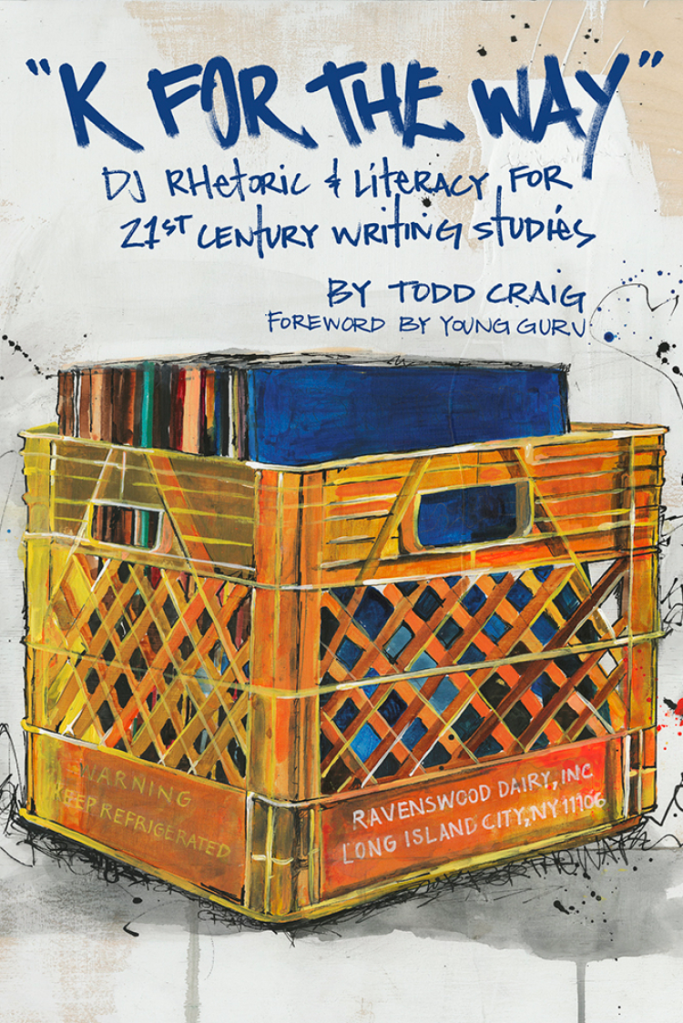
Featured Image: Cover Art for “K for the Way”: DJ Rhetoric and Literacy for 21st Century Writing Studies by Cathey White
—
DeVaughn (Dev) Harris is a PhD student studying composition and rhetoric in NYC. His academic interests are mainly in writing studies and pedagogy, but those are often supported by other sub-interests in music, creative writing, African American studies, and philosophy. When not reading or writing, Dev enjoys making music wherever and however possible. He has published music before under the collective AbstraktFlowz.
—

REWIND! . . .If you liked this post, you may also dig:
“Heavy Airplay, All Day with No Chorus”: Classroom Sonic Consciousness in the Playlist Project—Todd Craig
Deep Listening as Philogynoir: Playlists, Black Girl Idiom, and Love–Shakira Holt
SO! Reads: Steph Ceraso’s Sounding Composition: Multimodal Pedagogies for Embodied Listening--Airek Beauchamp
The Sounds of Anti-Anti-Essentialism: Listening to Black Consciousness in the Classroom- Carter Mathes
Contra La Pared: Reggaetón and Dissonance in Naarm, Melbourne–Lucreccia Quintanilla
Ill Communication: Hip Hop and Sound Studies–Jennifer Stoever
SO! Amplifies: Regina Bradley’s Outkasted Conversations
A Listening Mind: Sound Learning in a Literature Classroom–Nicole Brittingham Furlonge
Share this:

Ghosts in the Machine: Sampling Dr. King

Education is never politically neutral. Many of us advocate for social justice when we’re outside of the classroom but struggle to continue that work inside as well, especially with issues that appear on the surface largely unrelated to our disciplines. This inaction maintains the centering of the white experience, continuing to normalize and prioritize it at the expense of all others. Marginalized voices remain marginalized. We don’t need our own students to be directly impacted by policies to advocate on behalf of those who are. This is work we all must do.

“New Orleans Street Musicians …” by Flickr user sswj, CC BY-NC-ND 2.0
While social issues have made important inroads within musicology and ethnomusicology, they rarely make an appearance in music theory or composition, especially in a classroom setting. To begin these conversations, we must expand the scope beyond the purely technical and examine the ways in which music is a social and cultural phenomenon. Understanding how a triad functions, for example, is only part of the story. We must also recognize that any musical activity involves a network of people who might be engaged in any combination of producing, performing, buying, selling, listening, analyzing, teaching, institutionalizing, and so on. Discussing these networks means discussing their persistent systemic inequalities and power differentials, and understanding that these are social and not just musical issues. Cultivating this awareness is crucial in the development of our students as critical thinkers who can question the society in which they live, who can locate injustice and fight to advance social good. Abstract music theory is important, but music theory combined with a social awareness is vital.
Georgetown University hosts an annual Let Freedom Ring! initiative, a recurring project to honor the legacy of Dr. Martin Luther King. “Teach The Speech,” in particular, is a cross-campus curriculum project where interested faculty and staff incorporate that year’s selected work by Dr. King in our courses and workshops, sparking campus-wide conversations rooted in themes of social justice. The first time I joined the “Teach the Speech” efforts, I redesigned my basic theory class to include guiding principles from King’s entire body of work. In addition to covering the expected chords, scales, and other technical material, we discussed the disparity in representation faced by women and POC within music, viable modes of protest in music, and the possible roles of government sponsorship and censorship of artists. We rooted these issues in the real-life examples of the Grammy’s, the Women’s March, and the threats by the Trump administration to cut funding to the NEA and the NEH. Final projects based on these bigger-picture topics provided students further opportunity to reflect on the ways in which these and similar topics manifest in their own lives, transcending a preoccupation with “notes on a page.”

“Free at Last” by Flickr user Thomas Hawk, CC BY-NC 2.0
My second time participating in the “Teach the Speech” initiative, I used a recording of Dr. King delivering “I Have Been to The Mountaintop” as part of a module on sampling for my DJing and production class. Students had to create short tracks using this recording as the only permissible sound source. Anything resembling a kick, snare, hi-hat, melody, or harmony had to be constructed from a sample. Using something we don’t typically consider to be music as the sound source for creating music demonstrates the power of the studio and illustrates just how far creative slicing, dicing, and processing can take us. Beyond these important practical applications, though, the use of speech provides us with a framework for discussing why context matters. Do context and history always travel alongside the immediate acoustic phenomenon of sound? Can we identify something as “the music itself”? Through wrestling with these and related questions, students begin to understand sample-based composition as both a musical and a moral undertaking.
The process of sampling is largely a process of curation, involving a responsibility not just for the product but also for the source. If a student chooses to sample a large-enough portion of Dr. King’s speech, so that one can recognize words, phrases, even full sentences, then her choice includes the layers of extra-musical meaning attached to those words in addition to their musical qualities. “Violence,” for example, has a particular sonic profile and meaning that most listeners understand. How we actually interpret this word depends on many factors, including the context in which it is used in the original source, the identity of the speaker, and any audio processing that students might apply. The addition of distortion, for example, will influence the impact of that word on and its reception by the listener. The sampled word might be a fragment of a larger word, “violence” snipped from “nonviolence,” and never appear in its own right in the source. These and other complex issues involved in the process of sampling exist whether or not the student chooses to engage with them.
If the student samples an extremely small fragment of the Dr. King speech, obscuring the source and working with sound on an almost molecular level, then perhaps these questions go away. Can we still discuss the attendant connotations and denotations of indecipherable fractions of words or slices of the ambient hiss between the words? In this situation, is the origin of the sample still relevant for the work being done? When the ties connecting a heavily processed source to the finished product are untraceable, does it matter where we sampled from? Is white noise simply white noise?

“White noise on the Columbia” by Flickr user jaisril, CC BY-NC-ND 2.0
Arriving at these kinds of questions is largely the point of the exercise. With a little deliberation, students realize that there is a very clear distinction between sampling the word “violence” from a speech by Trump and from a speech by MLK. There is a context, a lineage, and a history to samples that lives outside the phenomenon of pure sound, and this holds true even at the molecular level. This is crucial for students to understand, and its implications extend far beyond a music class.

“Pride (In the Name of Love)” by Flickr user T, CC BY-NC-ND 2.0
We can, for example, ask students to consider the related question about whether or not it’s possible to separate art from the artist. Can we ever listen to pre-MAGA Kanye with the same ears? How do we interpret a post-MAGA Kanye song about uplift and resilience? What does it mean to watch a film where Harvey Weinstein had a major role in producing? A minor role? Moral dilemmas form a part of every media interaction we have, and similar questions comprise other aspects of our lives. Can we continue to allow the misappropriation of Dr. King’s “I have a dream that my four little children will one day live in a nation where they will not be judged by the color of their skin, but by the content of their character” without acknowledging the “radical” Dr. King? Can we reconcile a country built on expropriation, slavery, and genocide with one whose propaganda extolls the principles of equality and freedom? These are indeed crucial lines of moral inquiry, and our pretending otherwise enables current systems to remain in place. Sampling King’s speech enables my students to engage with those lines of inquiry from an angle they have not considered before: at the level of sound.
This is work we all must do. Within academia, we need to combat injustice inside the classroom as well as outside to bend the arc of the moral universe toward justice. One way we can engage is through careful attention both to the examples we choose and the way we contextualize them. Students and educators alike need to understand the political nature of education that is too often a means of upholding the power structures within society that position whites at the top, and white males at the very top. These largely invisible systems have very real impacts on our lives, and the only way we can evolve to a more just society is by questioning their seeming inevitability. We must foster dialogue that transcends the classroom. We must engage with social problems. We must look beyond the accumulation of knowledge as an end in itself. We must, in short, to do good. This is work we all must do.
—
Featured image: “Martin Luther King, Jr. Memorial” by Flickr user Cocoabiscuit, CC BY-NC-ND 2.0
—
Dave Molk teaches composition and theory at Georgetown University. He’s close friends with producer Olde Dirty Beathoven, a founding member of District New Music Coalition, and a board member of New Works for Percussion Project. Outside of music, Dave is a leader of CCON, an organization devoted to supporting undocumented communities in higher ed in the DMV. Find him online at https://www.molkmusic.com/ and @DaveMolkMusic.
—
 REWIND!…If you liked this post, you may also dig:
A Listening Mind: Sound Learning in a Literature Classroom–Nicole Furlonge
Freedom Back: Sounding Black Feminist History, Courtesy the Artists– Tavia Nyong’o
My Music and My Message is Powerful: It Shouldn’t be Florence Price or “Nothing”–Samantha Ege
Share this:


Current Top Posts





April 2021

January 2020

November 2019

October 2019

August 2019

April 2014

November 2017

March 2015

December 2017

October 2015
 Sounding Out!
Recent Comments