
Vocal Gender and the Gendered Soundscape: At the Intersection of Gender Studies and Sound Studies
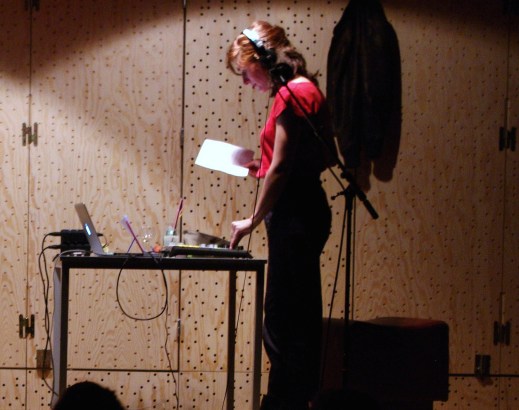
 Editor’s Note: Welcome to Sounding Out!‘s annual February forum! This month, we’re wondering: what ideas regarding gender and sound do voices call forth? To think through this question, we’ve recruited several great writers who will be covering different aspects of gender and sound. Regular writer Regina Bradley will look at how music is gendered in Shonda Rhimes’ hit show Scandal. A.O. Roberts will discuss synthesized voices and gender. Art Blake will share with us his reflections on how his experience shifting his voice from feminine to masculine as a transgender man intersects with his work on John Cage. Robin James will return to SO! with an analysis of how ideas of what women should sound like have roots in Greek philosophy. Me? I’ll share a personal essay/analysis of what it means to be called a “loud woman.”
Today we start our February forum on gender and sound with Christine Ehrick‘s selections from her forthcoming book Radio and the Gendered Soundscape in Latin America. Below, she introduces us to the idea of the gendered soundscape, which she uses in her analysis on women’s radio speech from the 1930s to the 1950s. She will make you think twice about the voices you hear on the radio, in podcasts, over the phone…
In the meantime, lean in, close your eyes, and let the voices whisk you away.–Liana M. Silva, Managing Editor
—
Several years ago, while aboard a commercial airline awaiting take off, I heard the expected sound of a voice emerging from the cockpit, transmitted via the plane’s P.A. system. The voice gave passengers the usual greeting and general information about weather conditions, flight time, etc. What was unusual, and caught the otherwise distracted passengers’ attention, was the fact that the voice speaking was female. People looked up from their magazines and devices not because of the “message” but because of the “medium”: a voice that deviated from the standard soundscape of commercial aviation, a field comprised mostly of men.
For this historian, interested in vocal gender and the female voice in particular, the incident was a fascinating demonstration of both the voice as performance of the gendered body, and the fact that the human voice can and often does communicate beyond (and sometimes despite) the words being spoken. In this essay I want to briefly discuss some of the ideas I explore more fully in my forthcoming book, a study of women/gender and golden age radio titled Radio and the Gendered Soundscape in Latin America: Women and Broadcasting in Argentina and Uruguay, 1930-1950 (forthcoming, Cambridge 2015). In this book, I use the stories of five women and one radio station to explore the possibilities and limits for women’s radio speech, and to pose some larger questions about vocal gender and the gendered soundscape. For this post, I present the conceptual framework that I use to understand how gender is constructed through the voice.

“DSC00814” by Flickr user jordan weaver, CC BY-NC-ND 2.0
Gender and sound have both been explored as categories of historical analysis, but largely in isolation from one another. The historiographical impact of gender analysis is almost too obvious to mention; suffice to say that attention to gender has altered the very questions historians ask of the past and the way we understand structures of power and historical change. More recently, historians have begun to incorporate R. Murray Schafer’s concept of the soundscape and what Jonathan Sterne has called “sonic thinking” into their analysis of the past (The Sound Studies Reader, 3). But not enough consideration has been given within the field of history to the ways sound may be gendered and gender sounded.
I bring these three threads together – gender, sound, and history – via the concept of the gendered soundscape. Helmi Järviluoma, Pirkko Moisala and Anni Vilkko introduce the term in their book Gender and Qualitative Methods (2004), which asks readers to contemplate the way gender – and gendered hierarchies – may be projected and/or heard in sound environments. We not only “learn gender through the total sensorium,” as they put it; gender is also represented, contested and reinforced through the aural (85). Thinking historically about gendered soundscapes can help us conceptualize sound as a space where categories of “male” and “female” are constituted within the context of particular events over time, and by extension the ways that power, inequality and agency might be expressed in the sonic realm—in other words, tuning in to sound as a signifier of power. Although many of us have been well-trained to look for gender, I consider what it means to listen for it.
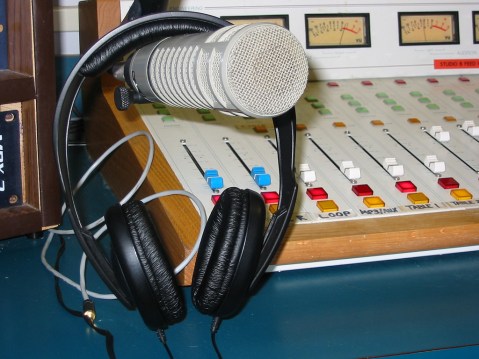
“Untitled” by Flickr user Observe The Banana, CC BY-NC 2.0
The soundscape, of course, is not only gendered; other aspects of social hierarchy, such as race, class and sexuality, are also performed and perceived in the aural realm. Greg Goodale’s analysis in Sonic Persuasion: Reading Sound in the Recorded Age (2011) of “the race of sound,” which argues that sound constructs rather than simply reiterating race, provides a useful framework for understanding both what we might call the gender of sound and the ways gender and race might intersect in the soundscape (76-105). As we learn to become more “ear-oriented” scholars, in other words, we come to perceive power, oppression, and agency in entirely new ways.
One of the most immediately gendered sound categories is the human voice, a richly historical convergence of human biology, technology and culture. We can and do hear gender in most human vocalizations; linguists seem to agree that, when listening to adult (non-elderly) voices speaking above a whisper “gender determination is usually a simple task” (See, for example, David Puts, Steven Gaulin and Katherine Verdolini in “Dominance and the Evolution of Sexual Dimorphism in Human Voice Pitch” and Michael Jessen in “Speaker Classification in Forensic Phonetics and Acoustics”). When we hear a voice without visual referent, as in the airplane example above or when listening to the radio, we immediately tend to classify the voices as “male” or “female.”

“my vocal cords.” by Flickr user Dan Simpson, CC BY-NC 2.0
Voice differences have roots in biological sex difference. With the onset of puberty, the larynx is enlarged and vocal folds increase in length and in thickness, resulting in a decrease in frequency (Hz) of vocal fold vibration and thus a lowering of voice pitch. But while bodies classified as biologically female experience about a one-half octave average drop in voice pitch with puberty, biological males tend to experience a full octave average drop in pitch, with the result being that adult male voices tend to operate within a lower frequency range than female voices. However, gendered constructions of the human voice vary widely over time and place.
Biology (body size, hormonal secretions, age, and other physiological factors) is no way destiny when it comes to the human voice. Linguists distinguish between “anatomical voice quality features,” which in essence set the parameters of comfortable pitch range given a person’s vocal anatomy (the range outside of which is difficult to easily maintain one’s speaking voice) and “voice quality settings,” which refers to where someone places their voice within that range (See Monique Adriana Johanna Biemans’ thesis, Gender variation in voice quality.) Bound to some degree by these physiological parameters, humans can and do place their voices in ways that are consistent with the performative aspects of gender, and voice pitch is both highly variable and subject to cultural/historical framing and self-fashioning (For more on this subject, see Anne Karpf, The Human Voice: How this Extraordinary Instrument Reveals Essential Clues About Who We Are, 2006). Thus like other aspects of gender, voice is culturally and historically constructed and performative.
Conceptualizing the voice as a sonic expression of the gendered body requires revisiting both the tendency of feminist scholars to equate “women’s voice” with writing or discourse, and the tendency of some media scholars to refer to voices without immediate visual referent (in film, radio) as “disembodied.” In their Introduction to Embodied Voices: Representing Female Vocality in Western Culture (1997), Leslie C. Dunn and Nancy A. Jones concisely articulate the challenge for scholars interested in the sonic/acoustic dimensions of women’s voices:
Feminists have used the word “voice” to refer to a wide range of aspirations: cultural agency, political enfranchisement, sexual autonomy, and expressive freedom, all of which have been historically denied to women. In this context, “voice” has become a metaphor for textual authority…This metaphor has become so pervasive, so intrinsic to feminist discourse that it makes us too easily forget (or repress) the concrete physical dimensions of the female voice upon which this metaphor was based. (1)
Thinking about voice in terms of vocal gender brings us to the complex relationship between voice and body. The concept of disembodiment conveys the sometimes uncanny effect of hearing (especially female) voices without an immediately discernible source. It also underscores the destabilizing effect of these unseen female voices liberated thus from patriarchy’s specular regime. Yet to refer to voices from an unseen source as “disembodied” is to suggest that the voice is somehow separate from the body, a problematic formulation.
“Untitled” by Flickr user Luci Correia, CC BY 2.0
Simply: if the voice is not the body, what is it? Even when it travels over long distances (via telephone or radio, for example) and/or if its source remains out of sight, the body is there, present via the sound vibrations it produces. Stepping away from concepts like disembodiment frees us to explore the nuances of the relationship between the voice and the body, and the presence of gendered bodies in the soundscape, particularly with regard to the vertiginous relationships between bodies and voices that are gendered female.
Gender and history impact how we read the tone, velocity and pitch of the voice, but they also shape parameters of where and when particular voices are invited to speak or expected to remain silent. And here of course we encounter the ways gender hierarchy is expressed and constructed in the acoustic/vocal arena, as well as racial categorization. Kathleen Hall Jamieson puts it succinctly in Eloquence in an Electronic Age: The Transformation of Political Speechmaking (1990): “History has many themes. One of them is that women should be quiet” (67). While by no means absent, women’s voices have remained largely outside of the realm of what Schafer calls “signal”: sounds listened to consciously and that often convey messages and/of authority. Just as other aspects of gender inequality become naturalized, patriarchy tunes our ears to listen to certain voices differently. In these formulations, women’s voices are thus subject to categorization as “noise” or “unwanted sound” (see Mike Goldsmith, Discord: The Story of Noise) and therefore dissonant, disruptive, and potentially dangerous.
The discomfort (or dissonance) with women’s voices, especially women’s voices speaking publicly and/or with authority, carried over into and shaped the history of radio, making early and golden age broadcasting an ideal venue for an historical exploration of gender and voice. What did it mean to hear women’s voices on the radio? How did radio rework the gendered dimensions of public and private space, and by extension the place of the female voice in the public sphere?
The emergence of radio in the early twentieth century was part of a larger revolution in human communication which Walter Ong termed in Orality and Literacy: The Technologizing the Word (1983) a “secondary orality,” an historical moment which reawakened older oral traditions and communal listening in a very different historical and technological context (3). It also reawakened a focus on the human voice, with all of its implications for the gendered soundscape.
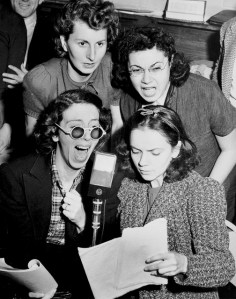
“Jane Hoffman, Tobey Weinberg, Ruth Goodman, and Amelia Romano read for a radio broadcast about the Triangle Fire” by Flickr user Kheel Center, CC BY 2.0
In many parts of the world, the rise of radio also coincided with an upsurge in feminist politics and discourses calling for women’s full citizenship and other related matters. As Kate Lacey notes in Feminine Frequencies: Gender, German Radio and the Public Sphere 1923-1945 (1997), “the arrival of radio heralded the modern era of mass communication, while women’s enfranchisement confirmed the onset of mass politics in the twentieth century.” Researching the history of women and radio – and particularly the sometimes hostile reactions to women’s radio voices – led me to appreciate the ways gender is performed and perceived via the voice, and from there into larger questions about the way social hierarchies – of gender, but also of race/ethnicity, class and sexuality – are reproduced and challenged within the sonic realm.
In this way we can better begin to contemplate the historical significance of women’s radio speech in understanding the sonic construction of gender. Depending on content and context, these voices carried the potential to not only challenge taboos on women’s oratory, but to assert the female body into spaces from which it had previously been excluded—like the cockpits (can’t help but note the name here) of commercial airliners.
–
Featured image: “ateliers claus – 140522 – monophonic – Radio Femmes Fatales” by Flickr user fabonthemoon, CC BY-NC-SA 2.0
–
Christine Ehrick is an Associate Professor in the Department of History at the University of Louisville. Her second book, Radio and the Gendered Soundscape in Latin America: Women and Broadcasting in Argentina and Uruguay, 1930-1950 will be published by Cambridge University Press in Fall 2015. This book explores women’s presence and especially their voices – on the airwaves in the two leading South American radio markets of Buenos Aires and Montevideo. Her current work looks at comedy, gender and voice, with a focus on mid-twentieth century Argentine comedians Niní Marshall and Tomás Simari.
Thanks to Cambridge UP for allowing me to use some excerpts from the forthcoming book in this essay.
–
 REWIND! . . .If you liked this post, you may also dig:
Look Who’s Talking, Y’all: Dr. Phil, Vocal Accent and the Politics of Sounding White– Christie Zwahlen
On Sound and Pleasure: Meditations on the Human Voice– Yvon Bonefant
Heard Any Good Games Recently?: Listening to the Sportscape–Kaj Ahlsved
Share this:

The (Magic) Upper Room: Sonic Pleasure Politics in Southern Hip Hop

 After a rockin’ (and seriously informative) series of podcasts from Leonard J. Paul–a three part “Inside the Game Sound Designer’s Studio”– our summer Sound and Pleasure series keeps giving you the good stuff, this week with SO! Regular Regina Bradley, making it rain. . . with some serious knowledge. What is the connection between sound and enjoyment, and how might black women’s sexual freedom be manifested via sound? –-JS, Editor-in-Chief
—
At fifteen, while in church service, I learned how to clutch pearls after hearing a woman moan during the altar call.
It was not a “Jesus done found and saved me” moan, either. A friend forgot to turn his cell phone off for church. As the church prayed, his phone started to ring. It was not the usual digital beeping or quick calypso ring tone. His phone calls were annotated by a woman’s moan during sex. She moaned from his cell phone to pick up the call. Each ring the woman moaned louder and adamant until she hollered like she was just saved. The kids in the back snickered as the ushers – including my grandmother – silently and angrily screened each pew to see who would pick up the phone. Quaking church ladies and my grandmother’s wide-eyed glare and heaving chest suggested they were about to pass out from embarrassment. Wringing their white gloved hands and grabbing at their pearl necklaces in angst, they looked everywhere but at each other: the back of a man’s head, the cross at the front of the church, the stain glass windows. A flush of warmth entered my cheeks and neck as I tried to contain my laughter and creeping embarrassment. I was embarrassed for my grandmother and the ladies of the church because I was aware of the unspoken rule that women – especially middle-class black women – don’t do sex. Being embarrassed of sex is proper and “ladylike.”

“Dancing underwater II” by Flickr user Miss Cartier, CC BY-NC-SA 2.0
Ashon Crawley’s contextualization of the praise and worship in Black Pentecostal church as a sonic public zone is useful for using sound to complicate the church as an erotic space. Crawley’s suggestion of sound as a “vessel. . .for the exchange of ecstasy and ecstatics” collapses the more tangible notions of gender and respectability via physical displays –i.e. the quaking church ladies and clutching pearls – to recognize the overlap of moaning as a marker of sexual joy, moaning as a form of praise and worship, and moaning as an indicator of shame. Crawley’s observations bring to mind Helga Crane’s run in with the storefront church in Nella Larsen’s Quicksand. It is not the physical aspect of the church and its embodiment of respectability that draws Helga into the space. Rather, it is the singing, weeping, and moaning – the sonic elements of praise and worship–that parallel her own suppressed sexual frustrations. Her weeping is not necessarily a “come to Jesus moment” but rather a sonic release acknowledging her sexual agency.
Looking back at when this dude’s phone went off in church, I realize the bulk of discomfort in acknowledging sexual pleasure exists in how it sounds. The woman’s moan highlighted an alarming reality for the women at my church: pleasure was being presented outside of its respectable physical and sonic boundaries. I wish to identify what I call sonic pleasure politics to address new developments in 21st century southern gender identity politics. Sonic manifestations of pleasure point to a younger generation’s rearticulation of sexuality as a site of agency and self-definition in an otherwise suppressed southern experience.
![Purity-Rings.jpg by Wikimedia user Bibleknowledge, CC-BY-SA-3.0 (http://creativecommons.org/licenses/by-sa/3.0)], via Wikimedia Commons](http://commons.wikimedia.org/wiki/File:Purity-Rings.jpg)
Purity-Rings.jpg by Wikimedia user Bibleknowledge, CC-BY-SA-3.0, via Wikimedia Commons
As a southern black woman, I’ve always been struck by the anxiety sex and pleasure invoked in the women in my life. Sex and pleasure were never articulated in the same breath, as sex was a wifely duty and responsibility for procreation. Pleasure was never synonymous with sexual joy, even when I snatched whispers of conversation about sex from my elders. Moreover, I was taught that sex (or even an interest in it) would plummet my stock as a good girl and put me in the ranks of “fast-tailed” girls who used sex as a desperate plea for attention. Nope, sex – pleasurable sex – was always for men’s gratification. Aside from the abstinence manifesto – “just don’t do it, chile” – for women, enjoying sex was the devil’s work. Respectable sex was quiet, for marriage, and never discussed outside of the house.
Sound as a signifier of sexual pleasure is considered by many to be counterintuitive because of the history of sexual trauma associated with black women’s bodies in the south. Reading sex as a genesis point of southern black women’s pleasure and empowerment is a difficult undertaking. The forced silence of slave women’s rapes and other physical violence that took place on southern soil parallels the silence that is deemed to be necessary for survival in a racist society. Further, the far-reaching residual effects of black women’s inferred lacking virtue lurk in how black folks navigate their southern experience and identities. Conservative attitudes towards sex in the southern black community are no doubt associated with the constructed attempts to humanize and validate blacks outside of hypersexual scripted blackness.
However, the sonic dimension of sex and pleasure in the south goes largely without analysis even though sound is a primary space in which recognition of sexual and nonsexual pleasure takes place. Consider blues women and, more recently, women in [southern] hip hop culture. The sounds of women’s giggles and moans as representative of sexual pleasure in bass music and the heavy use of moaning in the work of Trina, Jacki-O, Khia, Erykah Badu, Beyoncé, and Missy Elliott points to a need to recognize sound as a reservoir of pleasure, raunchiness, and sexual work—what I call “sonic pleasure politics.”
Studies of sonic pleasure including those of Robin James contextualize pleasure via the technical production of sound to induce a particular set of cultural and visceral responses. However, I ground my theorization of sonic pleasure politics in the growing body of scholarship offered by the “Pleasure Ninjas” collective consisting of Joan Morgan, Brittney Cooper, Treva Lindsey, Kaila Story, Yaba Blay, and Esther Armah. They utilize pleasure as a site of healing and reclamation of black women’s identities. Morgan’s interrogation of pleasure as a form of survival, for example, is especially useful in thinking about how southern women’s sexuality stems from the trauma of the transatlantic slave trade. She suggests pleasure’s palpability as an alternative space to reclaim slaves’ humanity. The Pleasure Ninjas’ construction of pleasure lends credence to my theorization sonic pleasure politics as a space for mediating the historical implications of abusive sexual power and the use of sexual pleasure as a form of resistance in the south.

“Atlanta – Poncey-Highland: Clermont Lounge” by Flickr user Wally Gobetz, CC BY-NC-ND 2.0
Situating women’s pleasure in southern hip hop is messy as it reflects both men’s investment in women as objects of pleasure – i.e. bass music – and women’s subversion of this expectation of their sexuality a way to express themselves. For example, Lil Wayne’s lyrical affirmation of his sexual prowess via cunnilingus in songs like “Pussy Monster,” “She Will,” and “Lollipop” parallels singer Joi’s demonstration of pleasure as a form of sexual consent via the use of (presumably her) moans and sounds of cunnilingus on her popular song “Lick.” Sonic pleasure politics become a workspace for bridging the south’s historical construction of [black] women’s sexuality-as-respectability and the recent, more fluid form of younger women’s embrace of sex-as-empowerment heard in southern popular culture.
Sonic Pleasure Politics and Strip Club Culture
A primary space for teasing out the multi-layered significance of sounds and sexuality in southern hip hop is the strip club. The production of sonic and visual representations of strip clubs are inextricably linked: bass heavy musical tracks keep time with the “clapping cheeks” of exotic dancers. Further, the loudness of the strip club denotes patrons’ attempts to drown out the world while pivoting off of the fantasy of sexy women dancing, moaning, and sexually gesturing for their entertainment. The dominance of strip clubs in southern hip hop contribute to the erotic map(s) of a younger generation of southern black women. My contextualization of strip clubs as a cartographic point of interest pivots off of Kaila Story’s description of erotic maps as an entry point for recognizing black women’s sexual agency. Erotic maps are the touchstones through which people address sexual pleasure. Story uses black women’s social-historical narratives to map out black women’s use of sexuality as a measure of self-definition. These maps are complex as they are intertwined with historical-cultural biases and cultural preferences frequently outside of black women’s experiences.

“IMG_0478” by Flickr user Ferrum College, CC BY-NC-SA 2.0
Strip club anthems, like Memphis rapper Juicy J’s “Bandz a Make Her Dance,” riff on the sonic and physical components of strip club culture. The bass kicks complement what sounds like clapping hands, a signifier of strippers’ clapping butts. Juicy J talks at length about his love of the strip club, distinguishing between “real” and fake strip clubs by the amount of nakedness and strippers wrangling for high-paying patrons’ bands of money. The snapping sound of rubber bands holding wads of cash together authenticates the duality of the women’s sexual posturing as physically pleasurable for men and profitable – economically pleasurable – for women. “Bandz a Make Her Dance” is grounded in the appeal of strip clubs as spaces of empowerment for black men. From this perspective, the clapping heard across the track could also signify the snapping of rubber bands against money to sonically signify men’s power as a strip club patron. Yet the physical and sonic presence of black women’s bodies – i.e. grunting as they maneuver and climb the dancing pole – also makes strip club culture a useful space to pivot southernness and sonic pleasure.
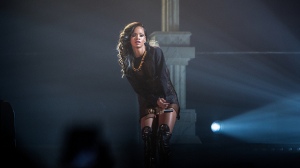
An example of establishing black women’s sonic pleasure narratives in strip clubs is singer Rihanna’s panning of “Bandz a Make Her Dance” titled “Pour It Up.” Although Rihanna is a pop singer from the “Global” South, she sonically signifies if not subverts southern hip hop gender politics via sampling the instrumental from Juicy J’s record. The majority of “Pour It Up’s” instrumental accompaniment is a subdued if not washed out sample of “Bandz a Maker Dance” that helps highlight Rihanna’s voice. The clarity of Rihanna’s voice “garbles” the accompaniment in the sense it is background noise to her narrative of enjoying herself and taking pleasure in the bodies of other women present in the club. The accompaniment serves as a brief nod to Juicy J’s initial intentions of crafting the strip club as a sexual space but ultimately uses the track as a testament to her own pleasure narrative.
In particular, Rihanna’s sing-song holler before the chorus “All I see is signs…all I see is dollar signs,” points to a subversion of the hypermasculinity in strip club culture to establish her own pleasure in a similar space. Parallel to Juicy J’s indulging of exotic dancers via throwing bands of money, Rihanna enjoys herself at the strip club using other people’s money:
Strip clubs and dolla’ bills (Still got mo’ money)
Patron shots can I get a refill (Still got mo’ money)
Strippers going up and down that pole (Still got mo’ money)
4 o’clock and we ain’t going home (Still got mo’ money)
Bands make your girl go down (Still got mo’ money)
Lot more where that came from (Still got mo’ money)
“Rihanna – Oslo 2013” by Flickr user NRK P3, CC BY-NC-SA 2.0
In particular, Rihanna’s verse not only demonstrates an alternative viewpoint of black women’s bodies in the strip club but destabilizes the idea of the strip club – and intercedes on the understanding of southern hip hop – as a heternormative hypermasculine space. The line “bands make your girl go down” alludes to not only a possible sexual encounter by Rihanna or for the girl in question but doubly signifies upon the potential for pleasure via the strip club culture for women and the hypersexuality of Juicy J’s track. “Pour it Up” reflects the messiness of [southern] hip hop gender politics because it builds upon the reputation of the strip club as a site for men’s pleasure to excavate women’s dancing as pleasurable for their own purposes. In addition to Rihanna’s sonic signifying of strip club culture, the “Pour It Up” reveres pole dancing as an art form rather than an exploitative practice. Rihanna’s pleasure in watching the dancers perform parallels the exertion of joy – and consent – that the dancers exhibit in their movement.
Trekking back to the sexy moaning phone in church, the sonic cue of sexual pleasure and joy conflicted with the gender norms associated with southern black women’s identities. Consideration of sonic pleasure narratives stirs discussion of the unarticulated experiences of southern black womanhood that may be overlooked in favor or a larger, more conservative, and familiar narrative of sex as tool of victimization. Sonic pleasure politics makes room to remap the contemporary southern social-cultural landscape as a complex yet living space of cultural production and sexual freedom.
–
Featured Image: “RIHANNA EM BELO HORIZONTE” by Flickr user http://www.rihannafentyforum.com, CC BY-NC-SA 2.0
–
Regina Bradley recently completed her PhD at Florida State University in African American Literature. Her dissertation is titled “Race to Post: White Hegemonic Capitalism and Black Empowerment in 21st Century Black Popular Culture and Literature.” She is a regular writer for Sounding Out!
–
 REWIND!…If you liked this post, you may also dig:
Thrills, Chills, and Safe Sexuality: The Sounds of Michael Jackson’s “Thriller” – Osvaldo Oyola
“I Love to Praise His Name”: Shouting as Feminine Disruption, Public Ecstasy, and Audio-Visual Pleasure – Shakira Holt
I Like the Way You Rhyme, Boy: Hip Hop Sensibility and Racial Trauma in Django Unchained – Regina Bradley
Share this:


Current Top Posts





April 2021

January 2020

November 2019

October 2019

August 2019

April 2014

November 2017

March 2015

December 2017

October 2015
 Sounding Out!
Recent Comments